
Adrian Siemieniec is an exciting 32-year-old Polish manager in his first full season as a head coach in senior professional football.
Last season, Jagiellonia Białystok finished 14th out of the 18 teams in the Ekstraklasa.
Siemieniec was appointed on April 4, 2023, before steering them to safety in the last nine games of the season.
However, the tides have changed this season, and Jagiellonia currently sit in second place, just three points off the top at the winter break.
The club is competing for its first top-flight title in club history and its first return to European competitions since 2018/19.
In this tactical analysis, we will analyse the key tactics that have made Siemieniec’s side so impressive this term, covering all phases of the game.
Jagiellonia Białystok Tactics In possession
One of the most important aspects of Jagiellonia’s success has been its quality on the ball.
The side led the league with 45 goals in its opening 19 games, accumulating an xG of 33.4.
So, they are exceeding their xG by a significant margin; in fact, they are exceeding it by five more goals than any other team in the division.
At face value, this might suggest that there may be some attacking regression towards the mean.
First of all, let’s detail how Jagiellonia have been able to achieve this success so far this season:
One significant contributor to this success has been their ability to play out from the back and then play for long periods, creating significant openings through positional play, as many elite European teams do.
So far, they have had the fourth-highest average possession this season, averaging 55.5% possession per game.
With that possession, they also complete the most passes per minute when in possession, with 15 passes.
This shows the tempo at which Jagiellonia plays when they have the ball.

Now that we’ve examined how well they have kept the ball this season, let’s provide some context for that possession.
The above graph compares the number of passes to the number of key passes completed this season.
Some teams can complete many passes without danger from the opposition’s shape.
So, as you can see, in terms of the league’s high passers, Jagiellonia are one of the most effective at creating and playing key passes, completing 9265 passes and 73 key passes, only being exceeded by Pogoń Szczecin.
Now, having looked at some of the underlying numbers behind Jagiellonia’s success in possession so far this season, let’s take a look at what they actually do.
Jagiellonia tends to operate with double pivots in deep build-up play, with Nene playing alongside captain Taras Romanczuk in the midfield.
Within this, Jagiellonia will look to draw opponents in and create space for their front four players to drive into and attack.
The second option is to use the technical skills of centre forward Afimico Pululu to hold the ball up.

In the above example, you can see the double-pivot nature of the Jagiellonia shape with Nene sitting beside Romanczuk.
The full-backs are in more advanced positions, creating this hexagon shape.
Then you have the two wide players playing high and wide as outlets for longer balls.
At the same time, centre forward Pululu and attacking midfielder Jarosław Kubicki play centrally again, ready to be outlets for longer balls.

Here, you can still see the hexagon shape; however, it is significantly more squashed deeper this time.
As the shape has been drawn deeper, Kubicki and left winger José Naranjo have dropped deeper, bringing their opponents with them and creating more space for Pululu to receive this long ball from centre-back Adrián Diéguez.
The second important aspect to consider is the middle-third possession.
Now, Jagiellonia spends the majority of its time in this area of the field throughout the game, particularly against the leading teams in Ekstraklasa, who cede the first half of the field and focus on stopping in this middle possession phase.
Here, they create this pentagon shape with the two full-backs playing narrowly more like inverted full-backs.
In addition, Romanczuk is the sole pivot.
These five players will interchange passes, looking for diagonal passes to the two wingers who hold the width and hug that touchline.
Alternatively, the five will play penetrating passes to the two central midfield players operating between the lines and in the half-spaces.

Here, you can see the narrow pentagon five we discussed before, with the left winger clearly holding his width and then the two other central midfielders, Nene and Kubicki, operating in the half-spaces.
Here, Mateusz Skrzypczak plays that penetrating pass through the opposition lines for Nene to receive and launch a dangerous attack in enemy territory.
This attack led to a penalty, which VAR ruled out.
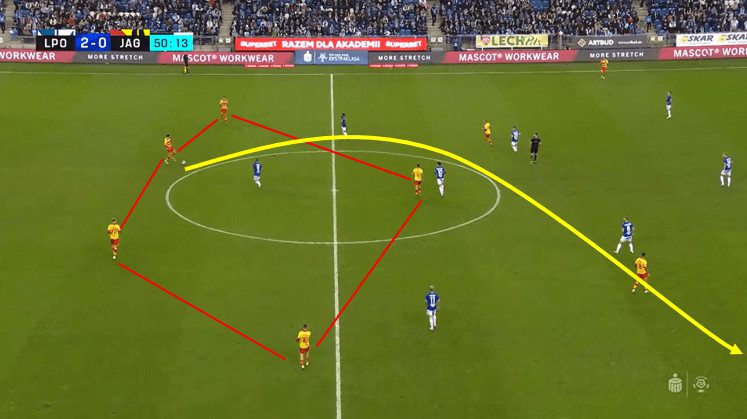
In this example, you can see the pentagon shape more clearly, but this time it’s Jagiellonia playing a diagonal pass.
It is often played between left centre-back and right winger or right centre-back and left winger.
However, there are many examples of Romanczuk as the pivot playing these passes to the wingers in space.
An issue with this did, however, arise against Śląsk Wrocław, who sought to block the passing lanes to the central midfielders, thereby reducing the side’s effectiveness in possession.
Siemieniec’s solution was to drop Nene deeper and create a shape more similar to the deep build-up shape.
Here, you can see an example of how Śląsk looked to cut off the passing lanes to the two more advanced central midfielders by playing a narrow four in midfield.

Here is an example of how Siemieniec made adjustments in the second half of the game to solve the problem of Nene dropping alongside Romanczuk.
This, in turn, forced the Śląsk midfielders to engage with him and step out of their defensive shape, creating space and gaps in the midfield.
This enabled Siemieniec’s side to play through the shape and get the ball to Kubicki.
Jagiellonia Białystok Out of possession
As a defensive side, Jagiellonia are also one of the leading sides in Ekstraklasa.
They have the fifth-lowest xG conceded so far this season at 24.17.
Some significant contributors to this are their high-possession style of football, a high-energy defensive shape, and several triggers that effectively enable the side to win the ball back.
They have the sixth-best PPDA (passes per defensive action) in the division at 8.95.
Now that we have a broad idea of Jagiellonia’s defence style, let’s see how they apply it.
They have tended to operate in a 4-1-4-1 shape; this will change to a 4-4-2 shape under certain triggers, which vary from game to game.
One of these triggers, particularly against Śląsk, was that as the ball was played across the backline, one of the central midfielders would step up and press the ball.
An alternative to this was seen against Lech Poznań, where, instead of being one of the central midfielders, the wingers put pressure on the ball from the outside.

In this example against Śląsk, the ball is passed from left to right, causing Nene to engage and pressure the ball.
This, in turn, rushes the opposition, and they force the ball down the Jagiellonia left flank, where they can regain possession comfortably.

In this example, against Poznań, the trigger is slightly different, with the starting shape looking more like a 4-4-2.
The wingers were tasked with pushing to put pressure on balls across the field, creating a superficial front three, and allowing the team to work across the field.
In this case, Kristoffer Hansen steps up and puts pressure on the ball out wide.
Taras Romanczuk Defensive Territory Chart

Another key aspect of this is Romanczuk’s role.
He is given the role of the mop in front of the backline and, as such, plays with more depth than the other midfielders.
His role is to fill in these gaps, which will and do open up as the midfielders are aggressive.
He does so to a high level, ranking 10th in interceptions per 90 at 6.62, which is particularly impressive given that his side is one of the more dominant possession sides in the division.

In this situation, you can see how the Jagiellonia midfield line has all stepped up to pressure the opposition; however, this has left gaps in the midfield itself.
This leaves Romanczuk isolated in the midfield, and although his anticipation and reading of the game are sufficient enough to prevent many attacks from developing, this is an area that can leave.
Siemieniec’s side is exposed and thin for numbers due to their naturally more aggressive shape.
However, interestingly, Siemieniec’s side has adapted by switching between the 4-1-4-1 and 4-4-2 defensive shapes in the game, with the 4-4-2 a less aggressive, more disciplined approach and the 4-1-4-1 a more dynamic, aggressive approach used at opportunistic moments.
Adrian Siemieniec Transitions
An aspect Jagiellonia often struggles with is the attack-defence transition.
This is particularly clear against Lech Poznań.
In this game, Jagiellonia had 59.14% possession, and Poznań was quite happy to sit back and let Jagiellonia have the ball.
The problem is that Jagiellonia wants to play with some risk and with the ball in dangerous areas; they are prone to mistakes, leaving them exposed to counterattacks.
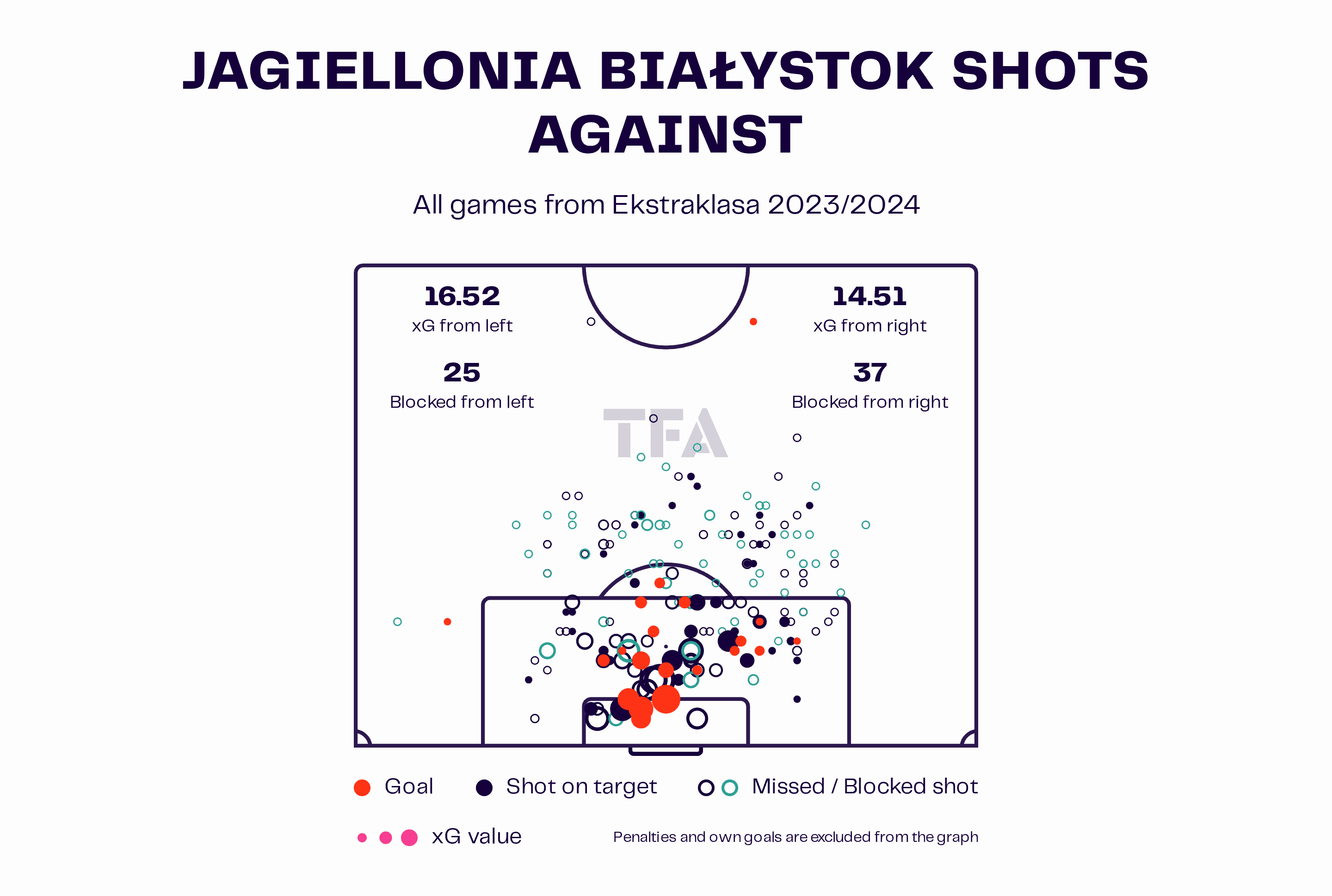
This shot map shows the quality of the shots that Jagiellonia conceded throughout the games.
A significant proportion are high-quality chances inside the box, and these are the ones that are converted into goals.

In this example, Jagiellonia was involved in some sustained possession in the opposition half of the field.
Then, a poor misplaced pass by Nene falls at the Poznań player’s feet.
Who can then launch a dangerous counterattack, which results in a goal, giving them a 3-0 lead in the game.
Again, in this regard, Romanczuk plays a vital role in mopping up dangers before they cause real damage, and his ability to selflessly cover for teammates is particularly impressive.


In this example, you see the importance of Romanczuk’s role in transition with Poznań launching a counterattack, which without Romanczuk would become a four against three.
However, fortunately, he is present, and his presence enables the Jagiellonia defenders to drop back, delay, and avoid engaging the opposition, slowing the attack to some degree before Romanczuk can make an effective one-on-one tackle to prevent it from developing further.
Although Jagiellonia aren’t readily able to create defence-attack transitions, with many of the bigger teams playing a deeper engagement line and enabling Jagiellonia to play with the ball more, when they get the opportunity to attack in this manner, they can be very dangerous, with players comfortable rotating and moving between each other.
Additionally, you have players such as Pululu, Jesús Imaz, and Kubicki, who are all able to receive the ball with their backs to goal and link effectively with teammates, particularly wide players Dominik Marczuk on the right and Kristoffer Hansen on the left.
These two wide players really thrive in these open spaces, and their dribble success rates are 56.58% and 58.84%, respectively.


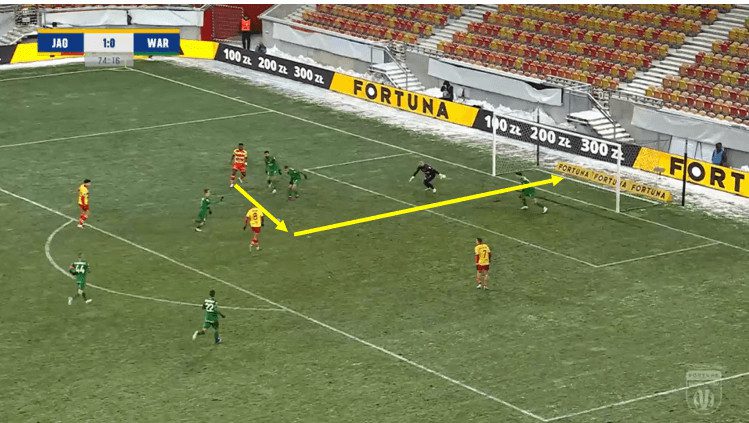
For this goal, you can see the effective fluid off-the-ball movement that Jagiellonia can use to score in the defence-attack transition if they are given the opportunity.
With the ball being recovered by right-back Dušan Stojinovič, he plays an effective pass to Nene in the middle of the field with enough space and time to turn and pick his pass to left winger Naranjo, who drives at the defence before playing a through ball to Pululu, who makes a well-timed run behind the defender engaged by Naranjo.
Then Pululu draws two defenders before playing the ball back across goal to Nene, who duly finishes it off to cap off a fantastic free-flowing Jagiellonia attack.
Jagiellonia Białystok Set pieces
Jagiellonia have been particularly effective throughout the season from set pieces.
Scoring from a total of three corners this season.
The most impressive area of set pieces is Bartłomiej Wdowik’s ability as a direct free-kick specialist, having scored an impressive five free-kicks so far this season.
This would majorly contribute to Jagiellonia exceeding their xG by 11.6 goals.
Here is an example of the quality that Wdowik has from dead balls in and around the box.
However, the set-piece quality is not exclusive to direct free-kicks.
Wdowik is also effective at putting the ball into dangerous areas, creating uncertainty in the opposition and goal-scoring opportunities for Jagiellonia.

In this example, Wdowik plays an excellent left-footed inswinging ball towards the front post, where Imaz has made an excellent run.
He duly flicks the ball on towards goal, catching the goalkeeper off guard on his near post.
Additionally, they have demonstrated the ability to be more creative with their set-piece routines, using Nene’s quality to create different angles and threats for opponents.

With so much attention drawn to the threat of Wdowik, opponents have to respect it and devise a game plan against it.
However, in this example, they play a short corner towards Nene at the edge of the box, who plays a left-footed inswinging ball over the top of the opposition’s defensive line for Imaz to tap in on the back post.
Conclusion
Many factors have helped Siemieniec transform Jagiellonia from the bottom of the table into a title contender this season.
In this tactical analysis, we have outlined a few key aspects of this season’s title charge.
However, the most interesting thing about Siemieniec’s side is the exciting brand of football he has used to achieve his success so far this season, with the season still on its winter break until the 11th of February 2024.
There will be some pivotal games in the coming weeks for a very young manager in his first full season of first-team management.
