


Royale Union Saint-Gilloise currently lead the Belgian Pro League, with 29 points after 12 matches, three points above Club Brugge, who have 26 points.
David Hubert‘s side has the best attacking line in the Belgian Pro League, with 22 goals scored and the best defensive record in the league, having conceded just six.
They have one UEFA Champions League win to their name so far this term, gaining three points from PSV.
Set-pieces play a role in their brilliance.
In the Belgian Pro League, they have scored three goals from corners so far (the most), and we will focus more on David Hubert tactics in attacking corners.
In this Royale Union Saint-Gilloise set-piece analysis, we will dive into the details of their attacking corners and how RUSG are effective and innovative in this important aspect of the game.
Crossing Routes & Framing The Goal
Royale Union Saint-Gilloise have some common tricks and principles on which they rely against teams that defend with four or more zonal defenders.
In this first routine below, they targeted the far post by blocking the goalkeeper, preventing him from claiming the ball, and blocking the last zonal defender.
They usually depend on at least one player to attack the targeted area vertically from the penalty spot and two players starting from the area beyond the six-yard after the far post.
One of them is to attack the targeted area horizontally, while the other waits in case the cross is overhit, ready to nod the ball back to the six-yard line.
Let’s get to the point with a perfect example.
As shown below, the opponent defends with five zonal defenders (green), four man markers (red), and a player ready to defend the rebound and short corners too.

The idea is simply about blocking the last zonal defender and the goalkeeper.
Below, Royale Union Saint-Gilloise use two players (green) coming from their blind sides, two targeted players (yellow), and an additional player (white) to get the ball back to the six-yard line in case the cross is overhit.
However, we still need to know how these two targeted players get to the ball and avoid the disturbance of their two man-markers.
The first targeted player stands on the penalty spot in a stack behind his mate, who goes to the near post, while the targeted player goes to the far post.
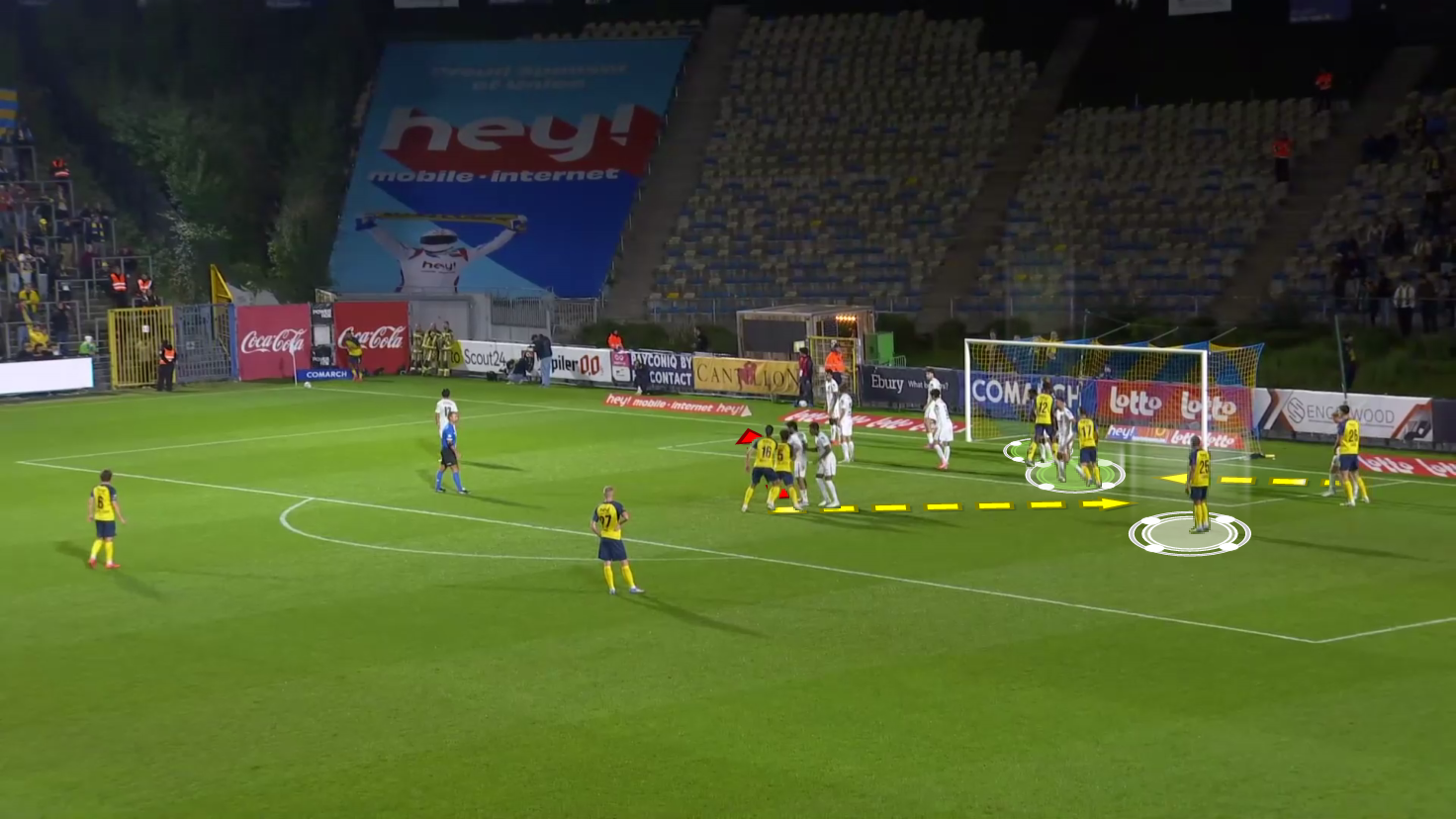
This leads to simple confusion, separating the targeted player from his man marker, who must turn to track the first targeted player.
At the same time, the second targeted player has a difficult starting position for his man marker.
The marker has two choices: giving his back to the ball to control the attacker and mark him well, or take an open body position, which makes it easier for the attacker to reach the targeted area, as in this case.
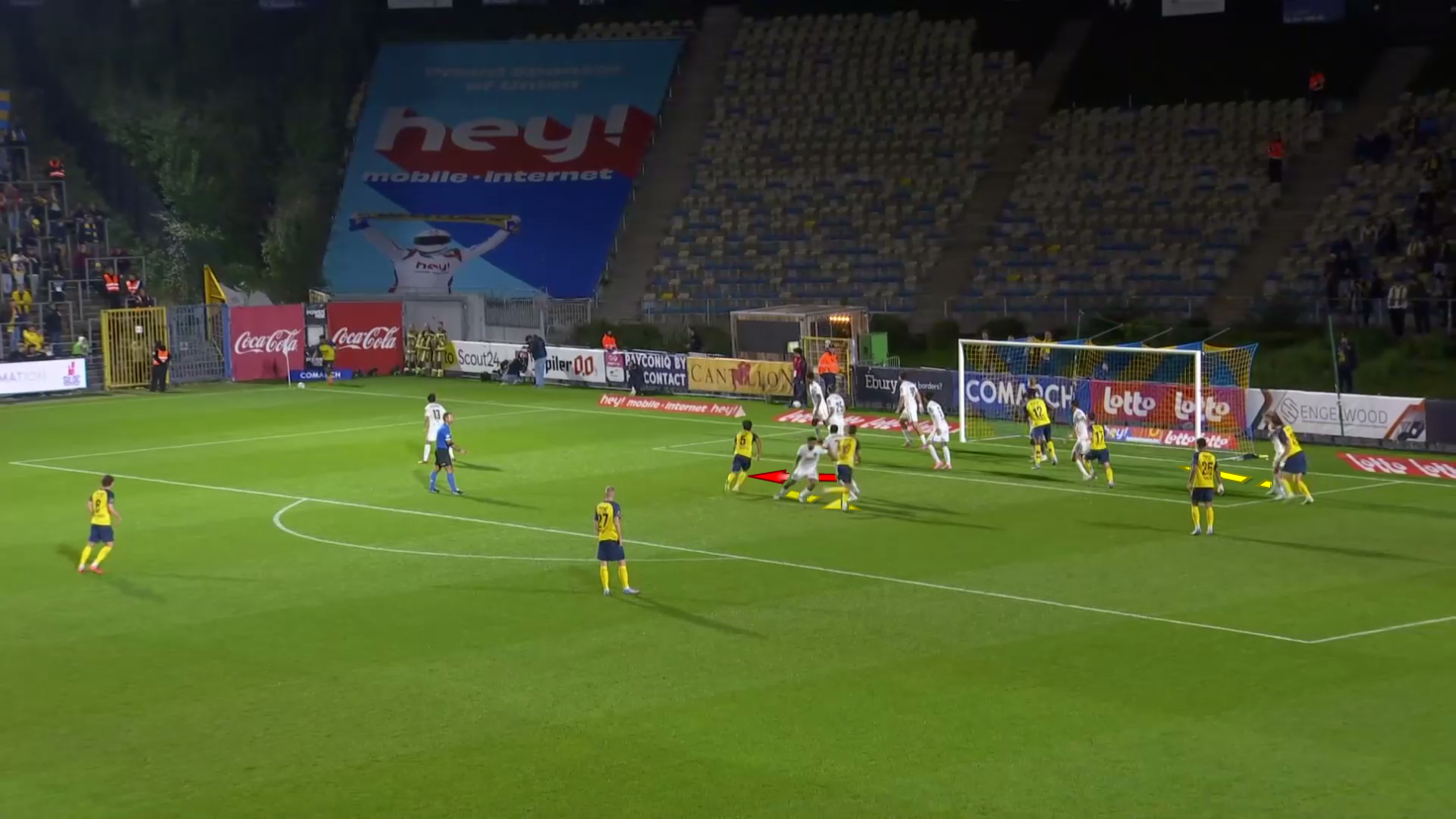
As we see below, the plan is effective.
It allows them to have two targeted players with positional superiority over their man-markers.
An additional attacker waits in case the ball passes everyone, while the last zonal defender and the goalkeeper are marked.
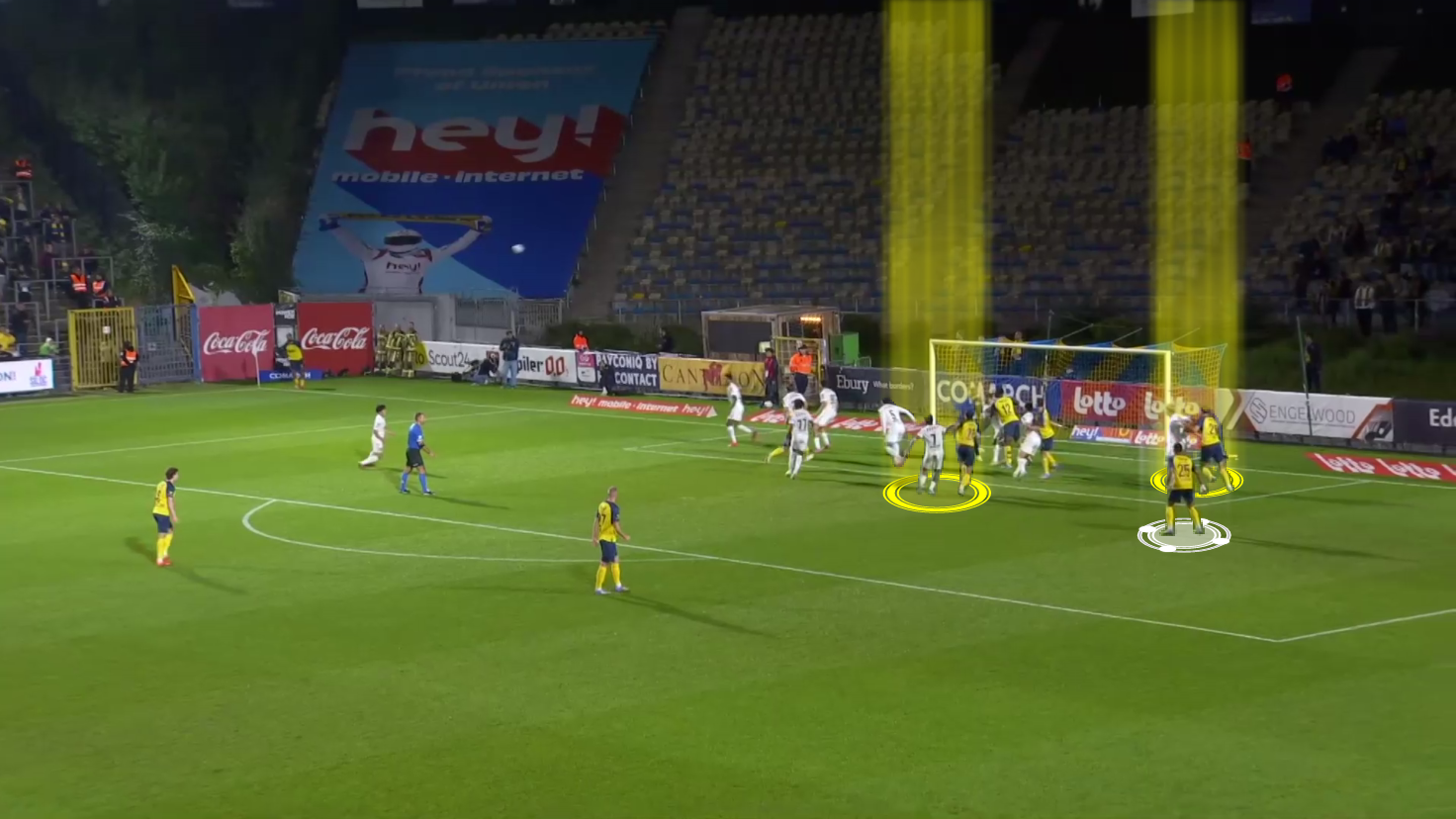
Below, the player who attacks the targeted area vertically gets the cross, but that doesn’t always happen.
Sometimes a teammate reaches the cross, and we can say they overload the targeted area by taking different paths.
The vertical player attacks the ball from a point, so he should have vertical timing to do so.
That’s why Royale Union Saint-Gilloise need to have another targeted player who attacks the ball horizontally, sees the whole ball path in front of his eyes and can measure the landing point of the ball.
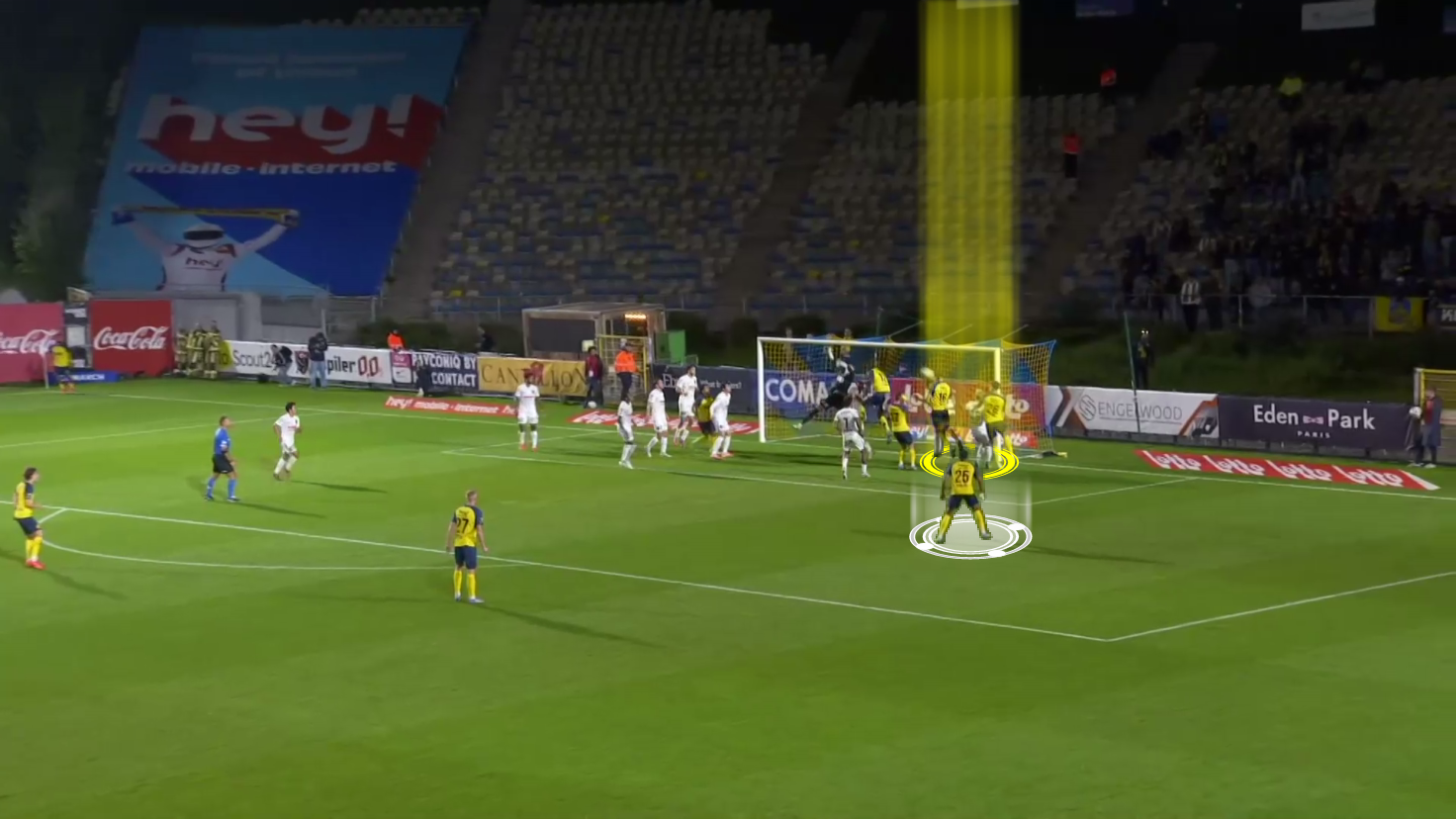
As shown below, the vertical-targeted player realizes he can’t reach the cross, so he blocks his marker, allowing the other targeted player to reach the ball.
You can also see that the additional player (white) waits in case the cross is overhit, so Royale Union Saint-Gilloise have multiple options to ensure that they get the cross against any scenario.
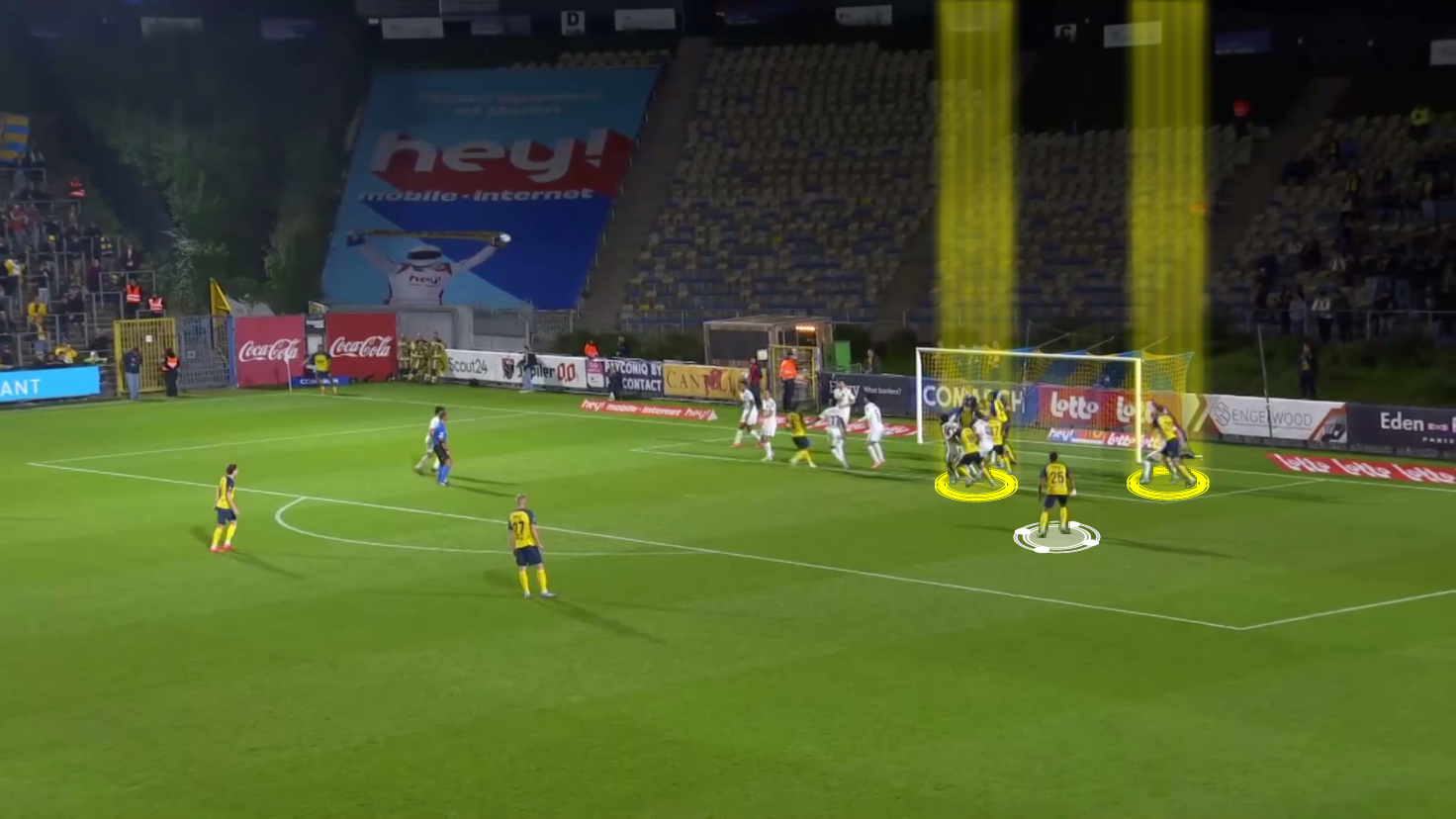
In the end, the horizontally targeted player gets the ball and scores a goal.
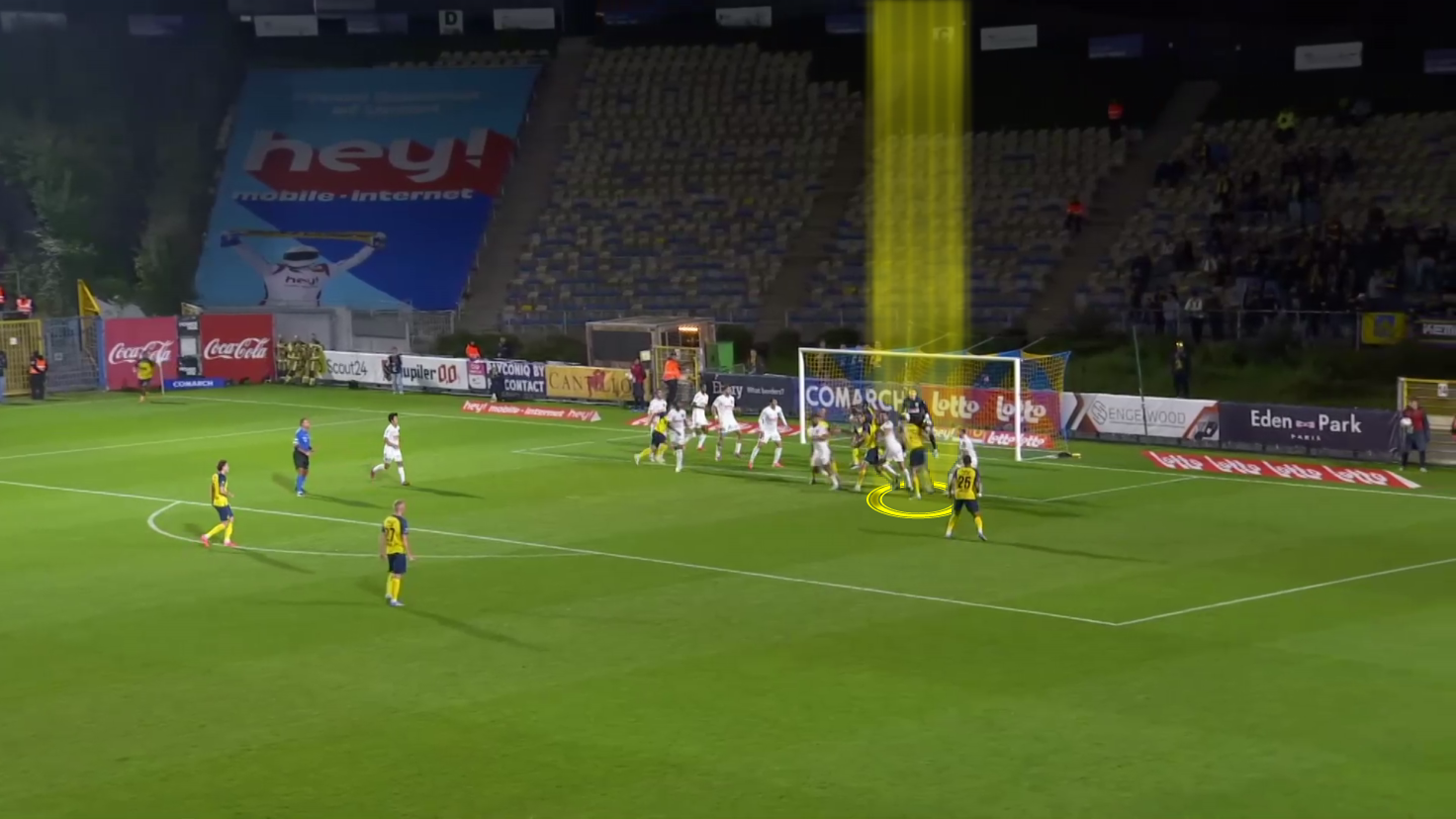
Now we know the importance of having two targeted players coming from two different angles.
Let’s know the importance of the awaiting far player.
As shown below, Royale Union Saint-Gilloise have a similar idea, but they add another small trick: They ask a free player (red) to act as a screen (a block on a teammate’s man-marker) to free the vertically targeted player.
As shown below, the screen frees the targeted player from the man-marker for a moment, allowing him to reach the targeted area before him.
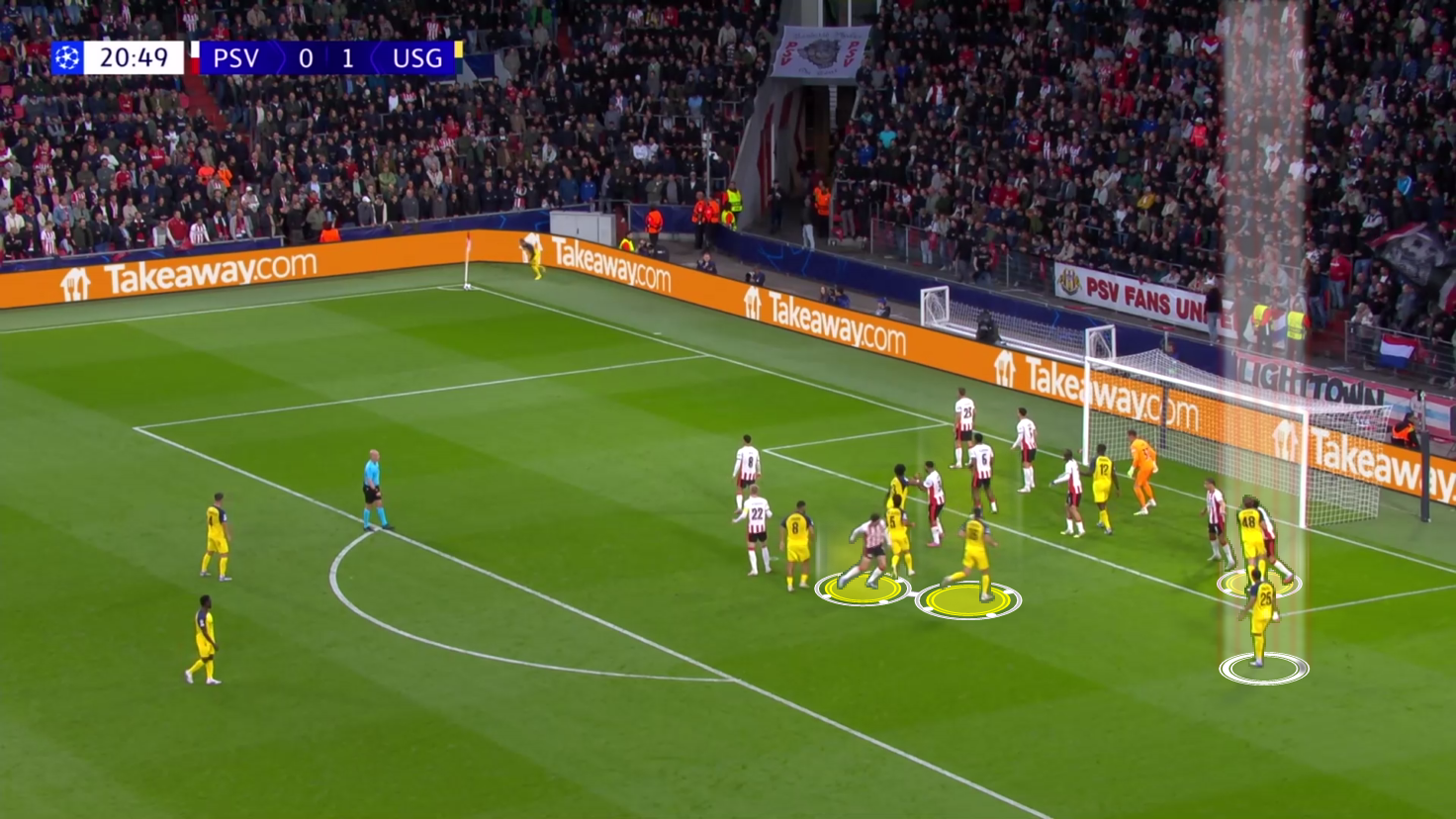
However, the cross is overhit, and here we can see the importance of this additional player (white) while the two targeted players block their two-man markers when they realise the ball won’t land in the targeted area, knowing they have an additional player to collect it.
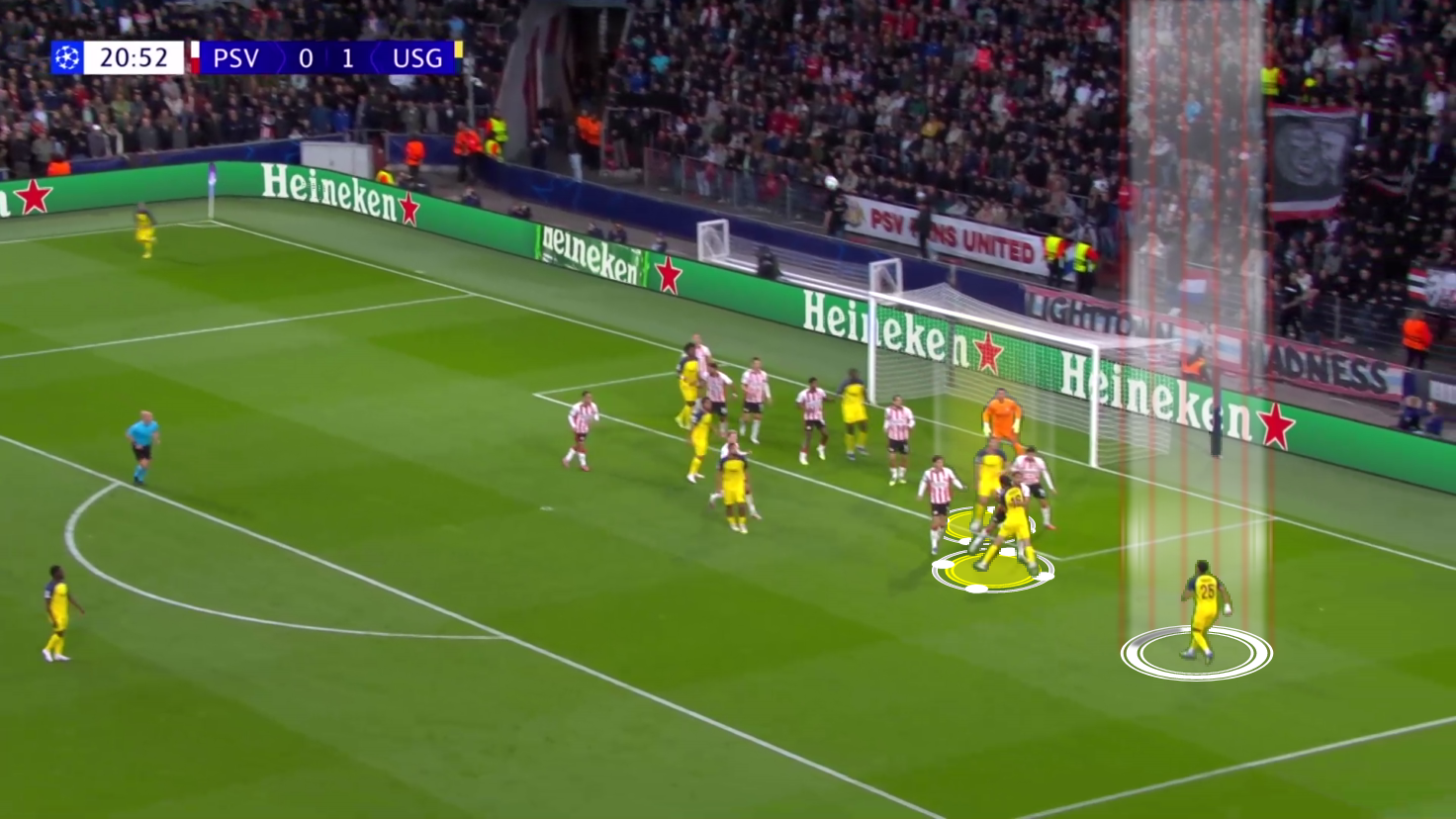
In this moment, the other players have a new role: to frame the goalmouth to give themselves a better chance of getting the cross or the headed pass, while also being ready to get the rebound.
That’s why you can see four players (yellow) framing the goal, with a player behind them (red).
That shows that the top set-piece can have more than one role for the same player.
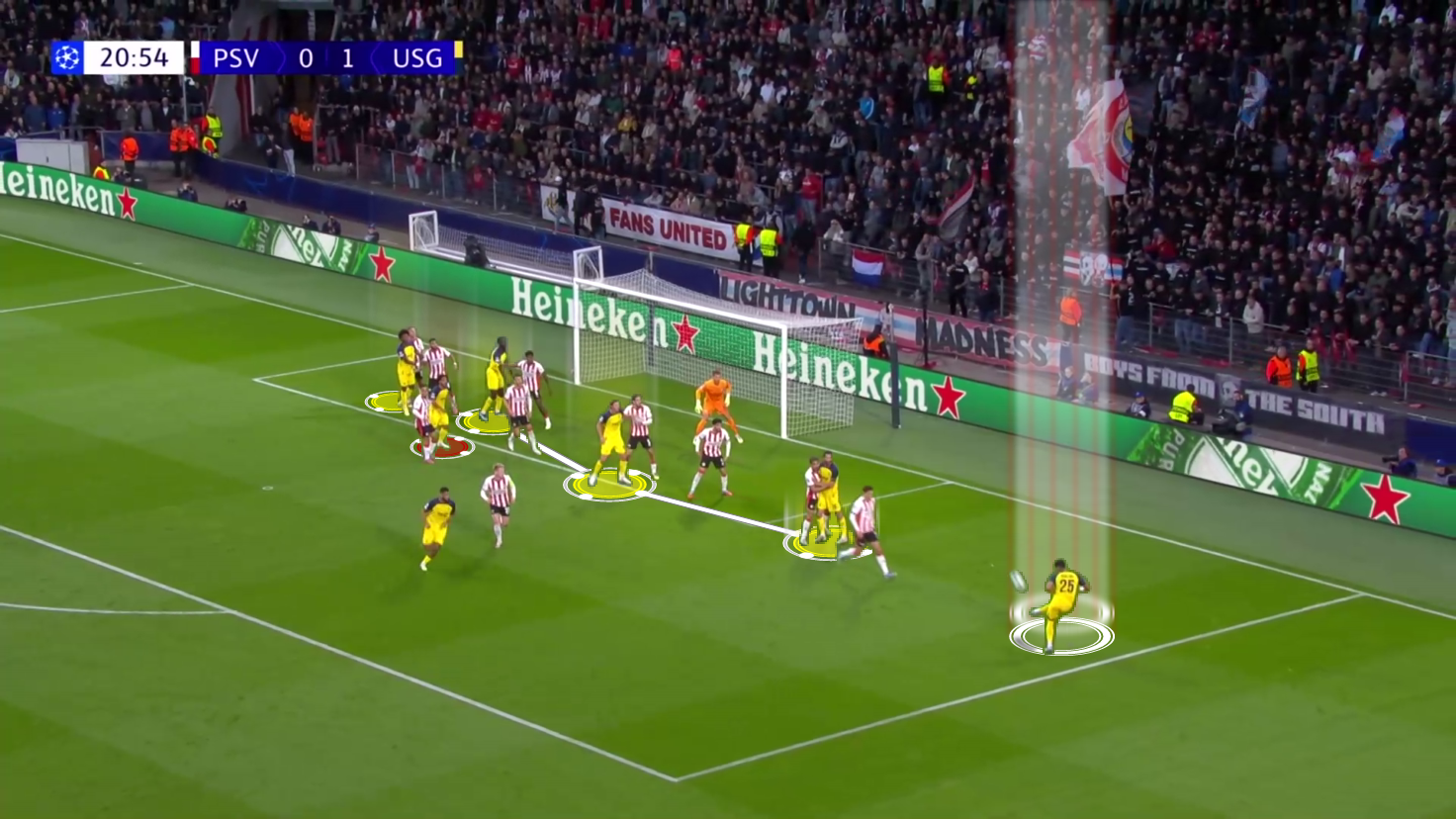
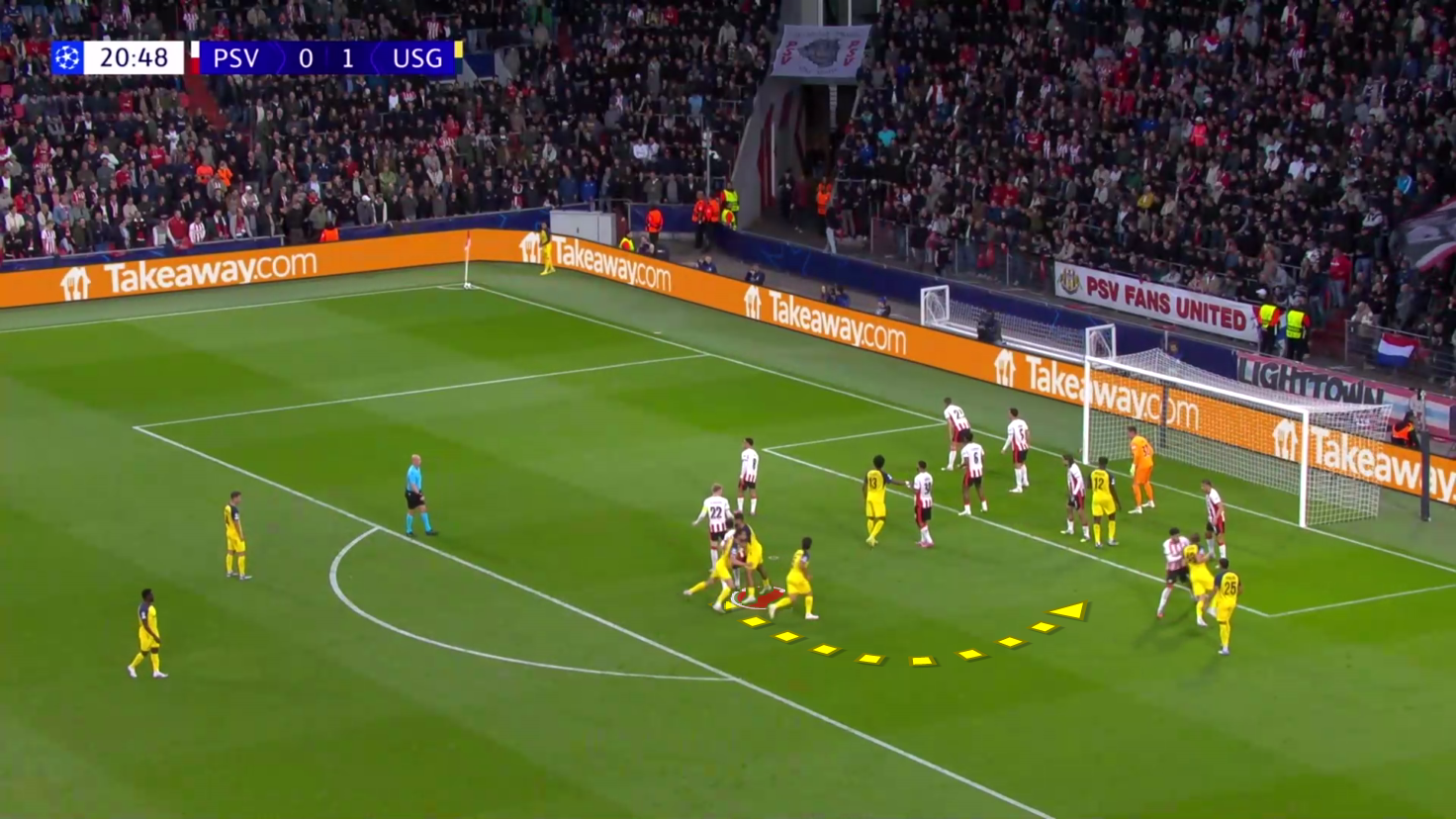
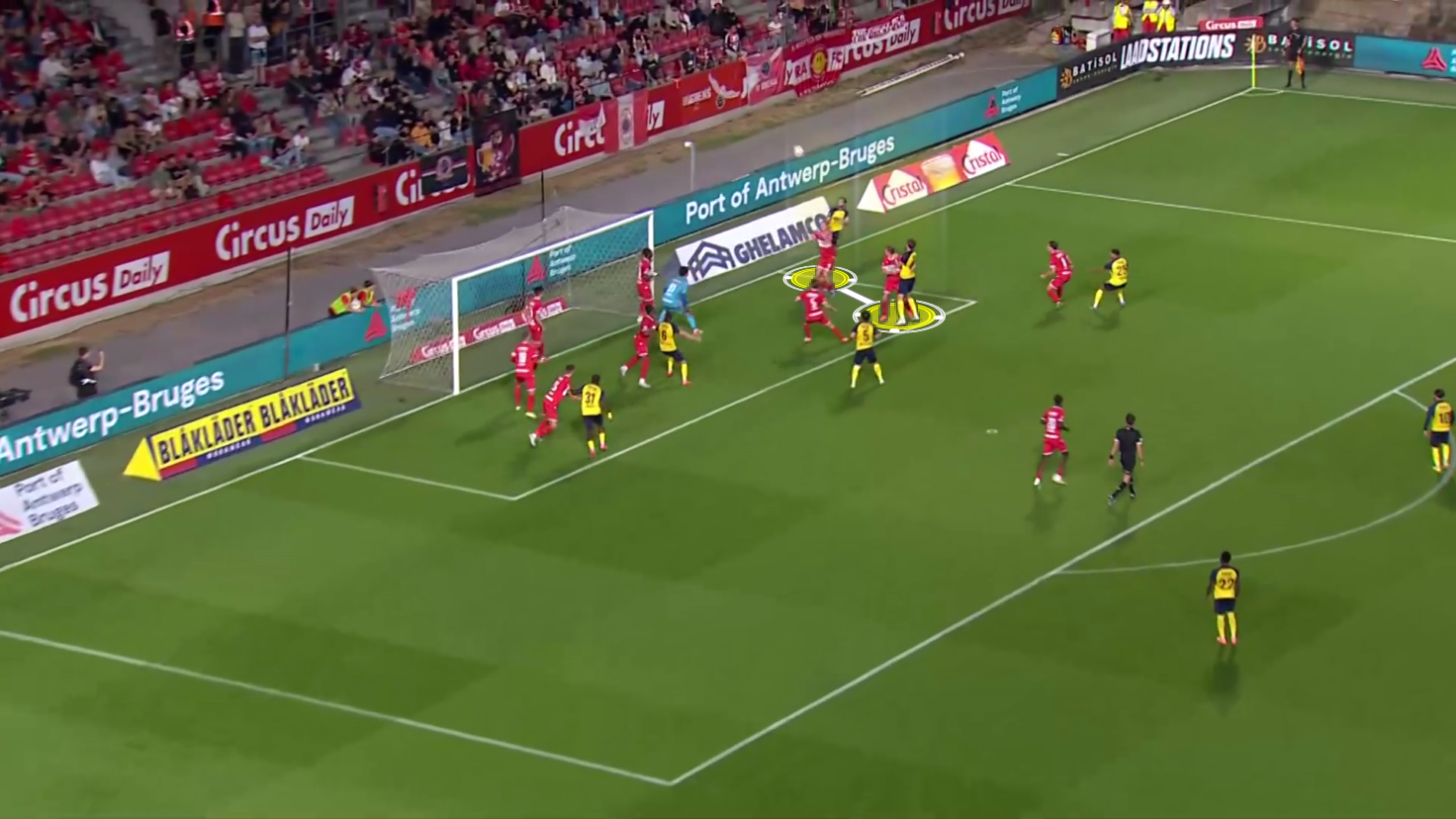
In a variation, Royale Union Saint-Gilloise can ask the two players to run to the target area from this difficult starting position (beyond the far post), creating a significant orientation problem for the two man-markers, as shown below.
At the same time, the player on the penalty spot runs in a curved way to the far post (green).
In the photo below, one of these two attackers can easily get the ball because of the defender’s orientation problem.
You can see the attacker jump from the defender’s blind side, with a clear view of the whole field.
Blocks, Screens & Fake Runs
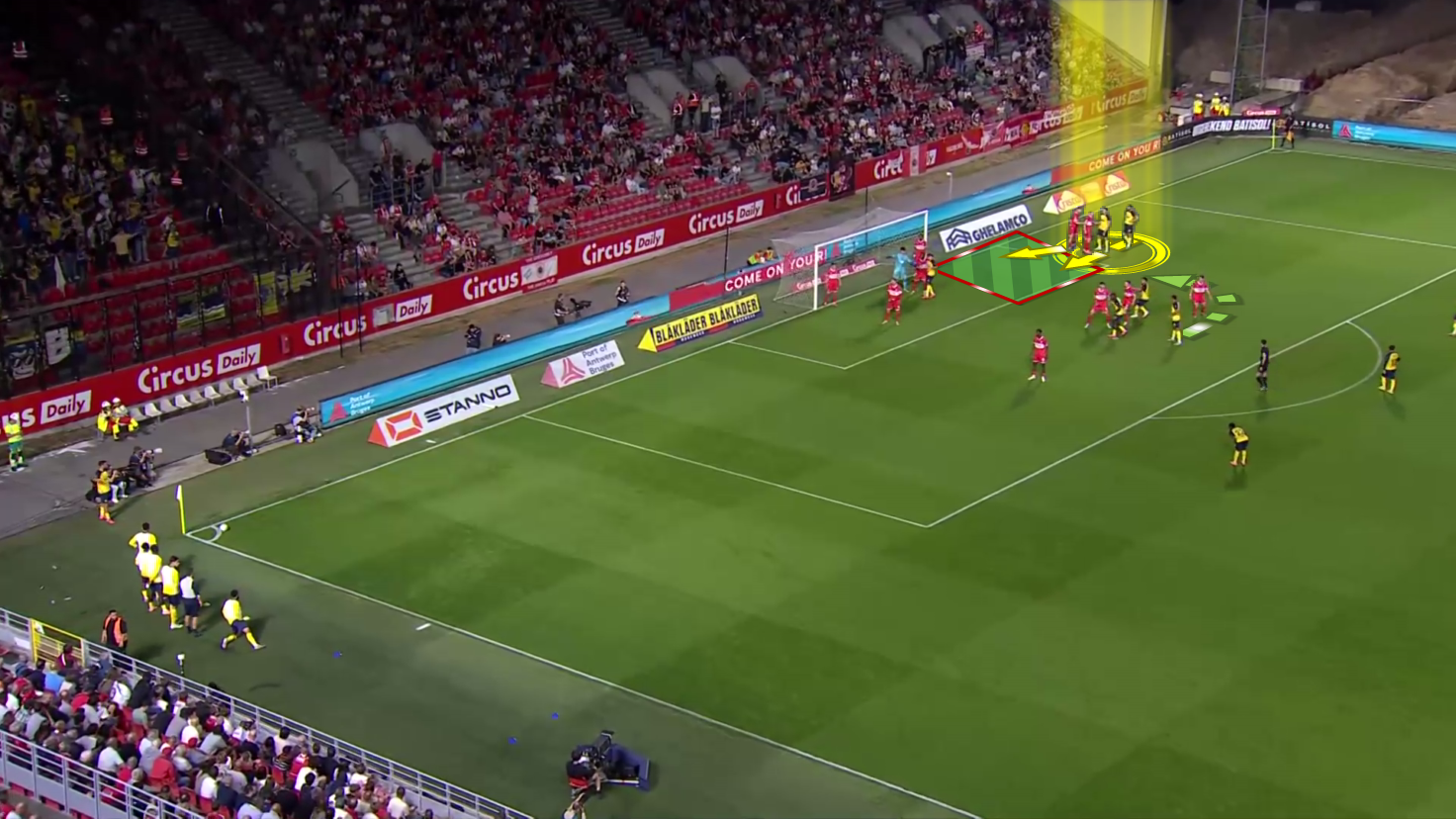
In a different routine, Royale Union Saint-Gilloise can target the area in front of the six-yard box on the near post with an out-swinging cross.
Below, the opponent has five zonal defenders (red) while Royale Union Saint-Gilloise see that they can target the area in front of this zonal line on the near post (blue).
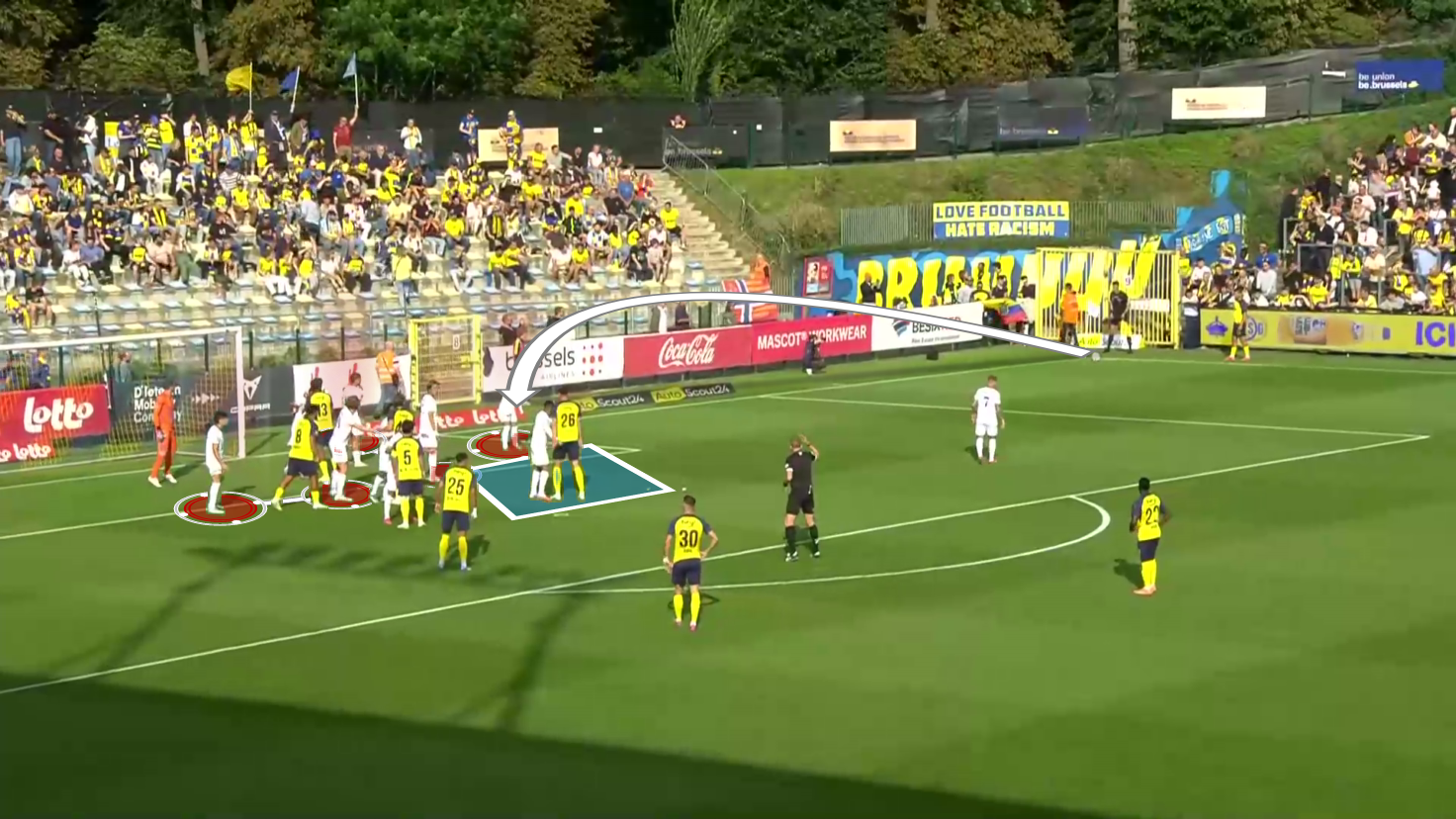
As shown below, two players have the same role of a blocking job.
The two players (red) go to block the two zonal defenders who can chase the ball in this area, but how can they free the targeted player (yellow arrow)?
The targeted player (yellow) runs in a curved path around his teammate (blue), who acts like he is just still standing at his starting position.
He is actually waiting for the targeted player’s man marker to slow him down, so he can’t track the targeted player.
This is called a screen, just like in basketball.
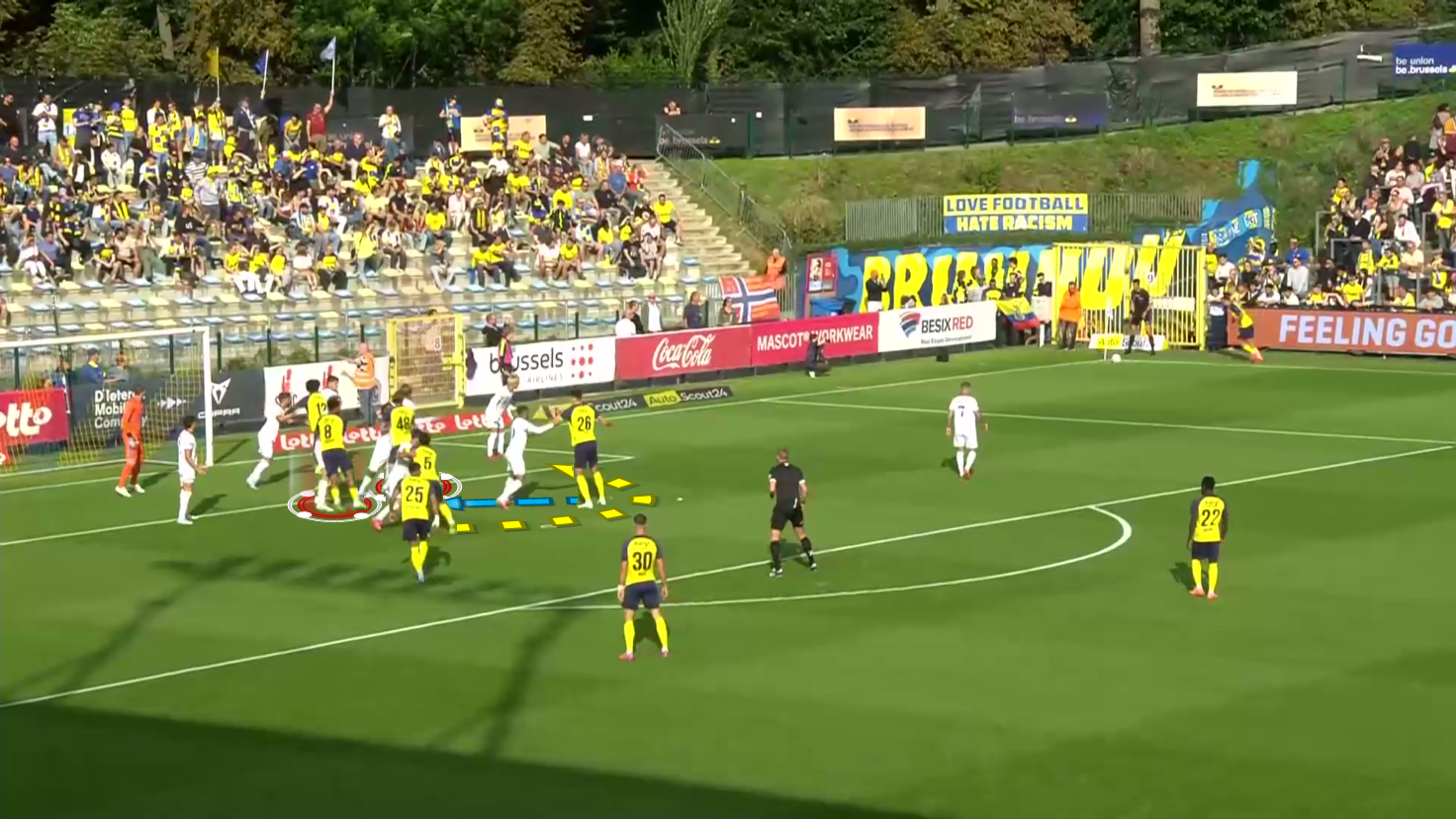
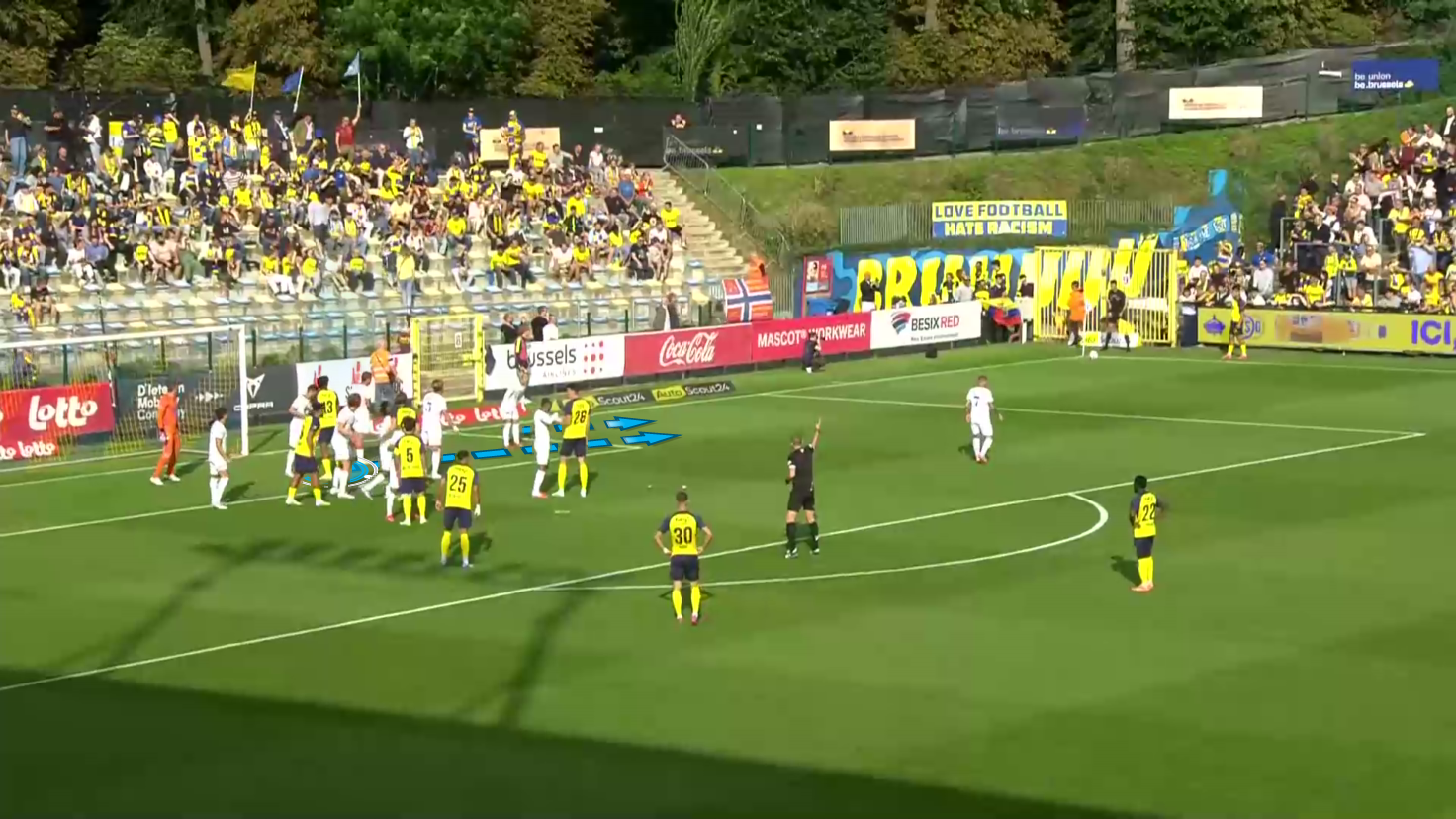
In the photo below, the two blocks (red) and the screen (yellow) are clear, and here we should focus on how the referee can’t consider it a foul because the one who performed the screen actually stands at the same point from the beginning to the end of the corner.
At the same time, the defender seems to be the one moving toward the attacker, so it is not clear to the referee whether to whistle for a foul.
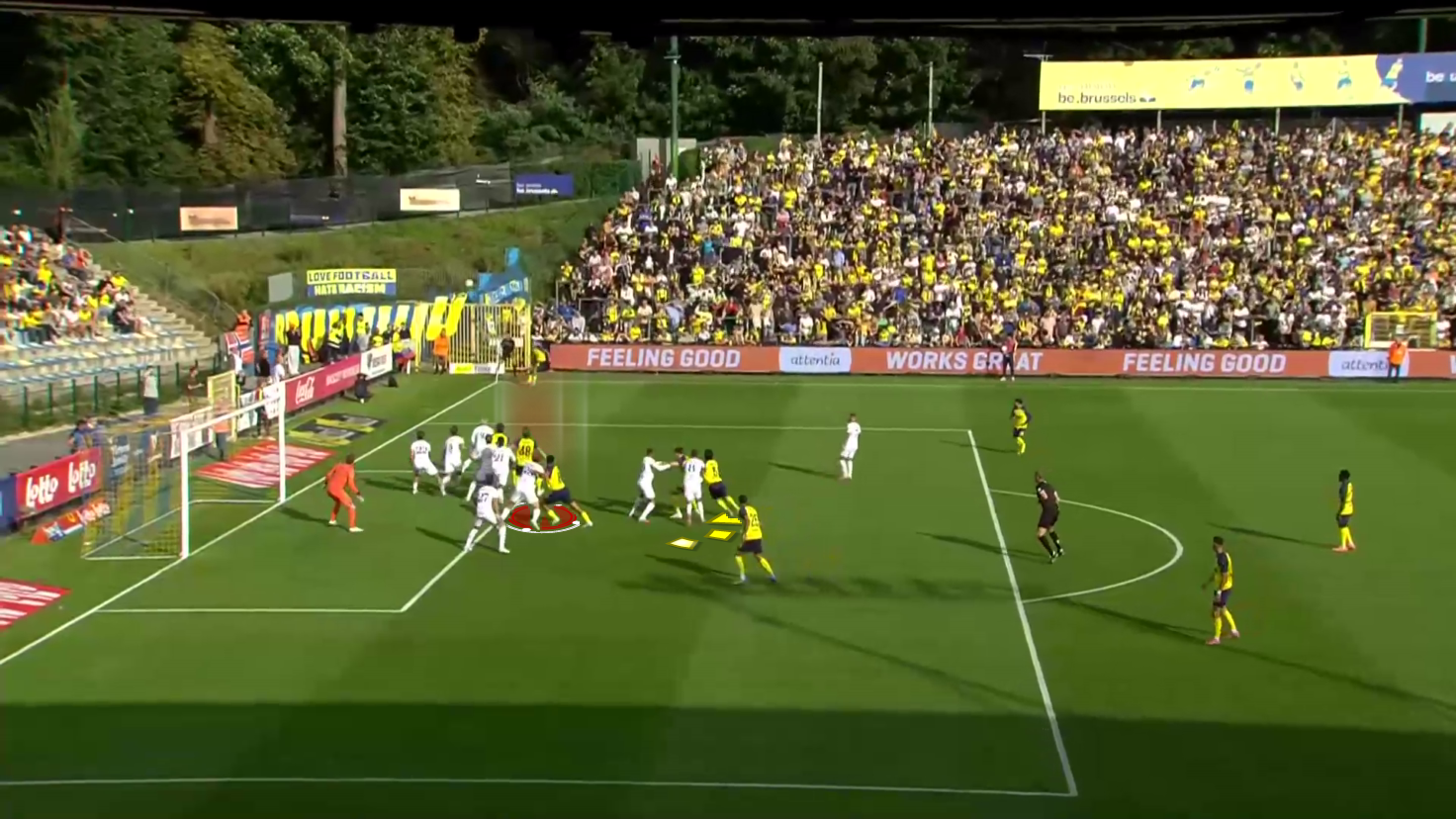
We should also not neglect another important trick: how they can drag the first zonal player far away from the targeted player.
As shown below, an attacker (blue arrow) performs a feint toward the near post, pretending to flick the ball to drag the first zonal defender with him, ensuring he won’t chase the ball into the targeted area.
Conclusion
In this analysis, we have demonstrated how Union Saint-Gilloise excel at set-pieces, particularly in attacking corners, utilising some simple yet effective routines.
We have explained how it helps them to lead the Belgian Pro League and how they have also been relatively threatening in terms of xG and shots from set plays in the UEFA Champions League so far.
In this set-piece analysis, we have also shown that they don’t overlook the importance of the variation principle.
Royale Union Saint-Gilloise have diverse tactics despite having common tricks in all of them, which makes it easy for their players but unexpected for the opponents.

