


After a stoppage-time equaliser in last week’s first leg in Banja Luka, Thursday’s return fixture at the Allianz Stadion in Vienna, Austria, saw Rapid Wien stage a 2-1 comeback victory at home to advance to the last 16 of the UEFA Conference League.
Sandi Ogrinec gave Mladen Žižović‘s FK Borac Banja Luka shock lead midway through the second half, which lasted only four minutes before Dion Drena Beljo’s leveler from the edge of the penalty area.
In the end, Louis Schaub netted the winning goal early in extra time to send Rapid through to what will be their first appearance in a European quarterfinal since their run to the UEFA Cup Winner’s Cup final in 1995/96, where they eventually lost to Paris Saint-Germain.
This tactical analysis will examine some of the keys behind Rapid’s victory in the second leg, which ultimately ended the fairytale run of their opponents from Bosnia & Herzegovina.
Rapid Wien Vs Borac Banja Luka Lineups & Formations
Rapid Wien set out in their usual 4-4-2 shape under Robert Klauß, with two changes to the team from the first leg.
Niklas Hedl was in goal, and Bendegúz Bolla, Nenad Cvetković, Serge-Philippe Raux-Yao, and Moritz Oswald, who came in for Jonas Auer at left back, formed the back four in front of him.
Lukas Grgić partnered Mamadou Sangaré in central midfield, with Louis Schaub and Isak Jansson, the other change for Andrija Radulović at left wing, either side of the pair to make up the team’s second line of four.
At the same time, Dion Drena Beljo and Nikolaus Wurmbrand led the attack up front.
Similarly, Borac made two changes to the starting eleven of the reigning champions of Bosnia & Herzegovina from the first leg.
The side featured eight foreigners and just three domestic players.
Filip Manojlović was in between the sticks, with Viktor Rogan switching to his natural right-back role to make way for Sebastián Herrera at left-back, which meant Zoran Kvržić was dropped to the bench.
In contrast, Bart Meijers and Jurich Carolina made up their center-back pairing.
Captain Srdjan Grahovac, who played nearly 200 games for Rapid in two different stints with the club between 2014 and 2022, returned to the lineup after shaking off an injury to marshal the central midfield alongside Sandi Ogrinec in place of Boban Nikolov.
Stefan Savić occupied a central attacking midfield role with a pair of 21-year-old wingers on either side of him in Enver Kulašin and David Vuković.
At the same time, veteran striker Djordje Despotović remained up front on his own.
Rapid Wien’s Missed Chances
Rapid missed at least two or three guilt-edged opportunities in the first leg, which eventually cost them.
Instead of walking away with a multiple-goal lead, they only had a draw to show for their efforts in Bosnia.
The chances of a repeat of that seemed unlikely going in, but unfortunately for Rapid, it proved to be another frustrating night in front of goal.
 They could have gotten off to the perfect start in the very first minute when Wurmbrand broke down the right and delivered a cross to Beljo, whose shot from point-blank range was somehow saved by Manojlović before Schaub managed to hit the crossbar on the rebound.
 All of which happened in just the first 30 seconds, and set the tone for the rest of the night for the home side.
 A few minutes past the half-hour mark, they rattled the woodwork again, this time with Isak Jansson finding space away from the Borac markers and hitting a thunderous strike, which came crashing back off the crossbar.
After hitting the goal frame for a third time through a deflected Wurmbrand strike early in the second half, Rapid had a 3v2 opportunity, which eventually became a 3v1 after the same player managed to outwit Carolina, who fell to the floor trying to intercept the ball.
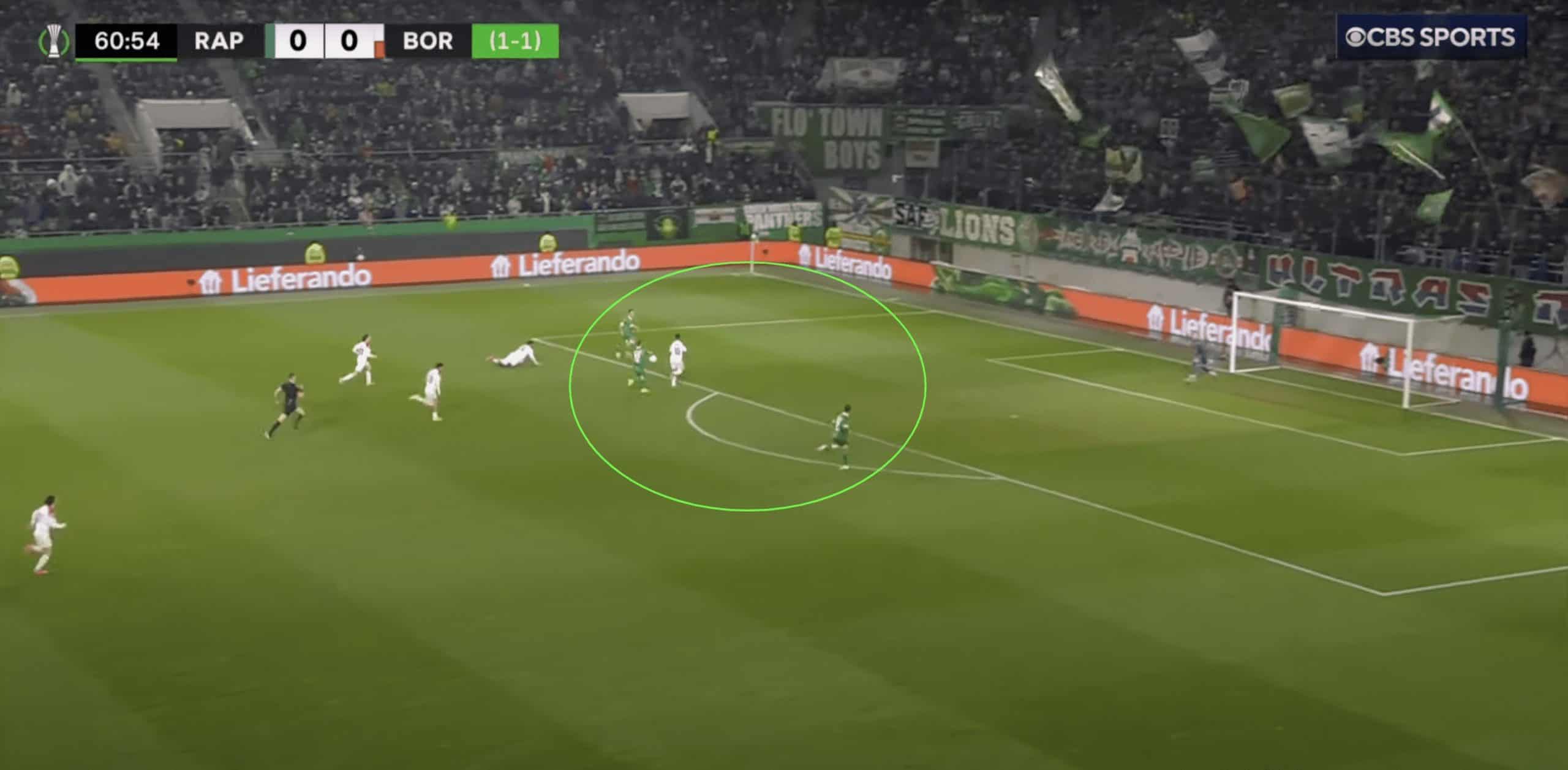 Instead of passing the ball to one of his teammates, Wurmbrand went for the near post, which was saved by Manojlović, who was in inspiring form for the guests.
Ultimately, it was a catalogue of missed opportunities from Rapid’s point of view.
They even fell behind shortly after that last miss, with commentary on the English feed describing Borac’s taking the lead as ‘barely believable.’
Although Beljo restored parity shortly afterwards, Rapid couldn’t settle the tie in regulation and thus had to go to extra time to try and see off the challenge of the resilient Bosnian champions.
But before we discuss how they ultimately won the game, let’s examine another key aspect of their game that allowed them to create so many opportunities.
Rapid’s Quick Releases Against the Low Block
While Rapid’s inability to convert the chances they generated into goals was undoubtedly the central theme of the game, their ability to repeatedly find good openings against Borac’s low block was impressive throughout the contest.
They achieved this so much due to their quick decision-making on the ball, which allowed them to play it early before the visitors could settle into their preferred defensive shape.
Besides the chances mentioned above, here are other examples in the game where Rapid Vienna used this strategy.
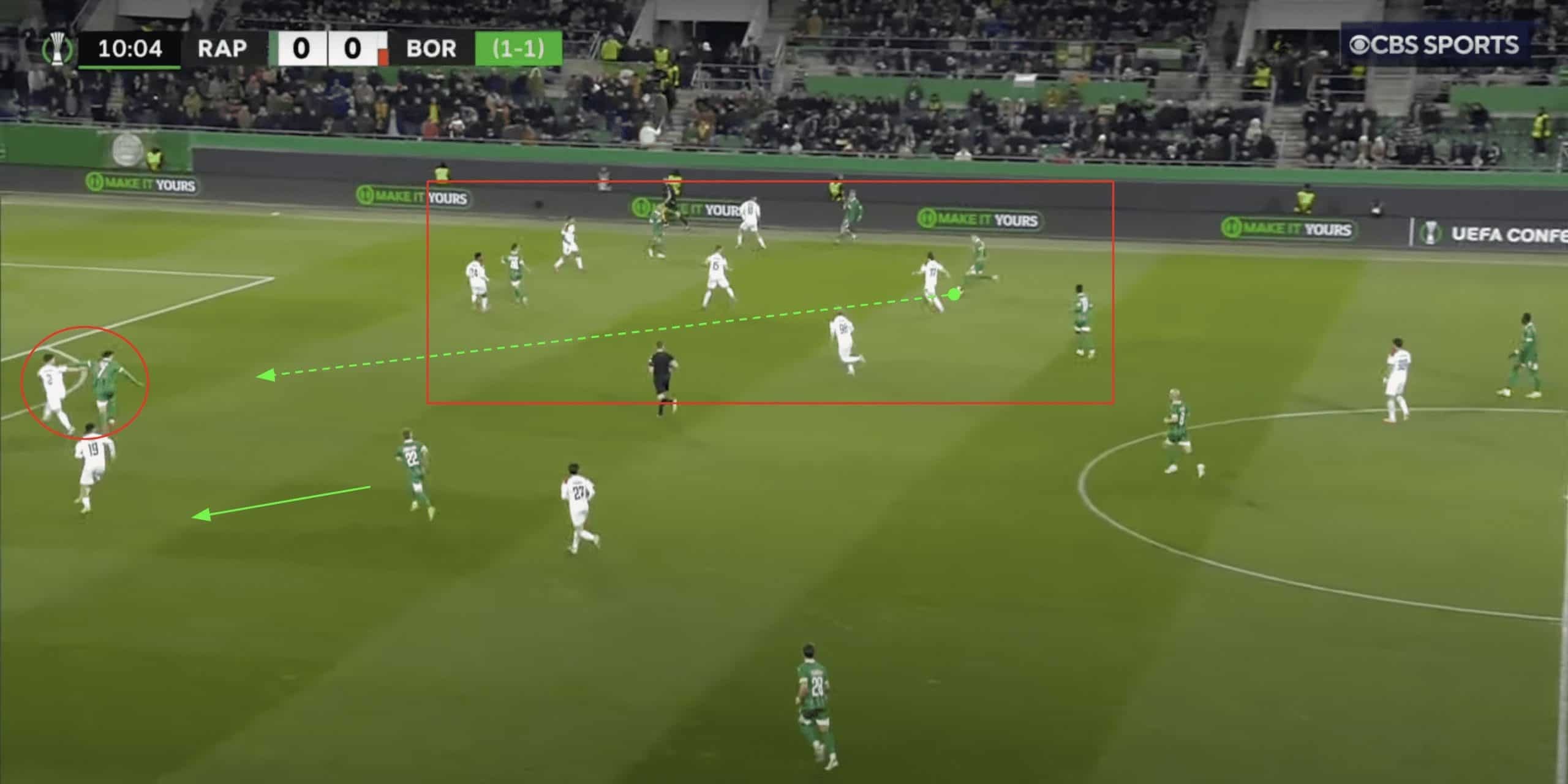 Here, we see Cvetković bringing the ball out from the back under no pressure, with three Rapid players to his right and five Borac players shifting across to help defend against them.
This leaves a large gap down the middle in front of the back four, which Beljo spots before quickly changing direction away from Meijers to move into that empty space.
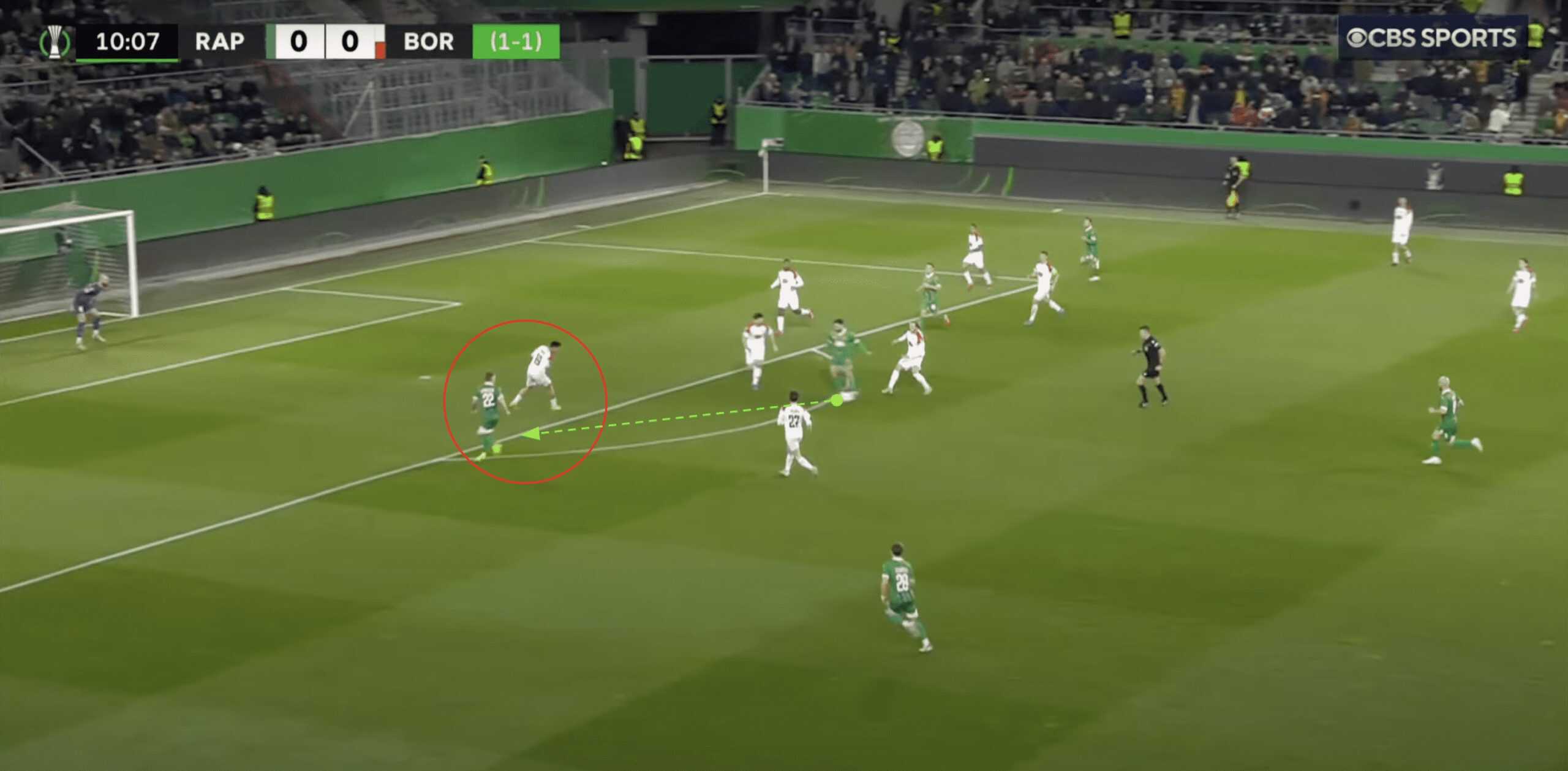 Cvetković spots this and plays the ball to Beljo, who is then joined by Jansson.
Jansson makes the run on the outside of Rogan into the box and receives the ball for a chance to strike at goal, which he does, albeit unsuccessfully.
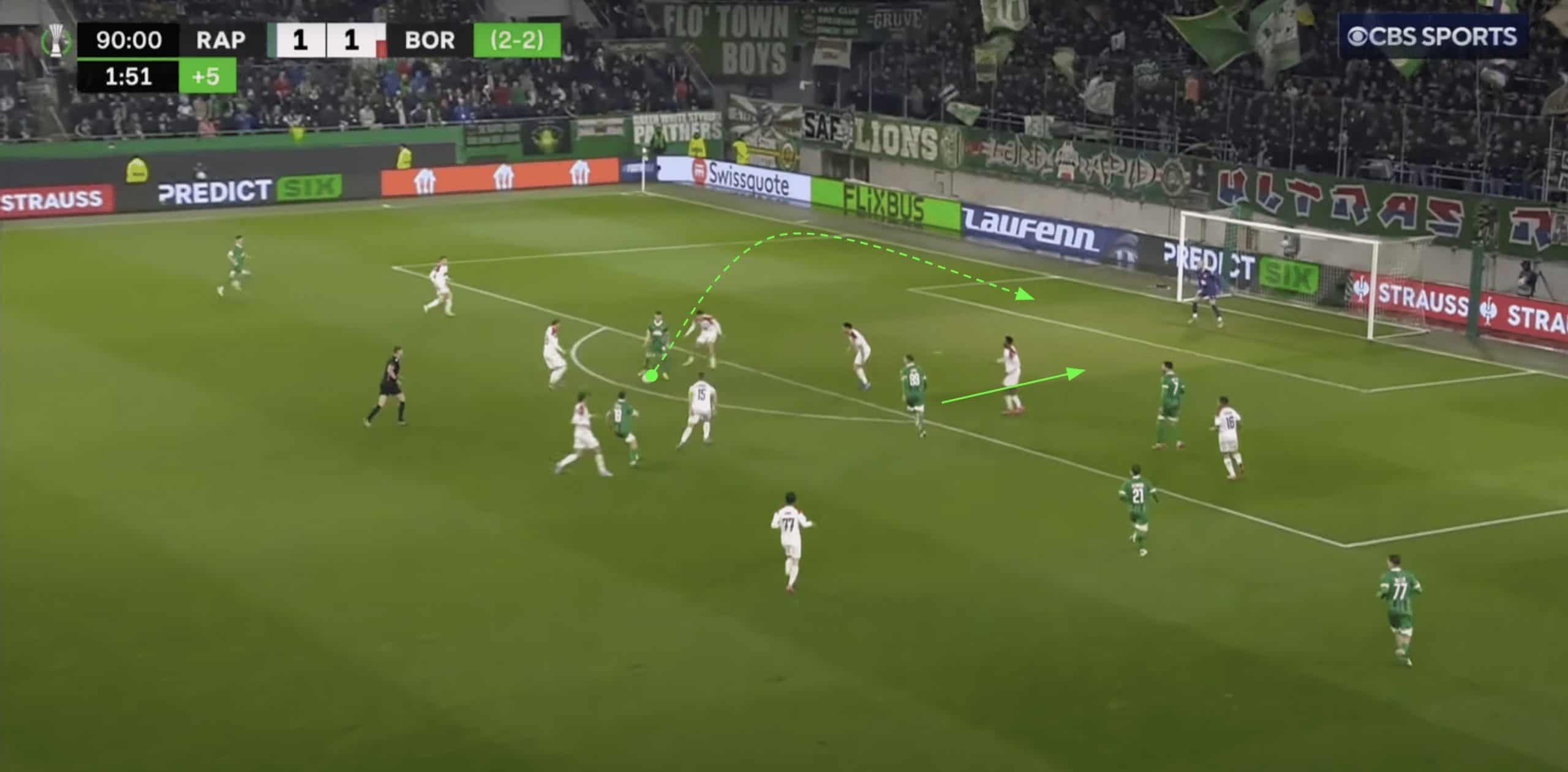 Another one is in this sequence towards the end of regulation, where Jansson receives the ball on the edge of the box with his back to goal and Rogan quickly breathing down his neck.
Jansson has almost no time to think about what to do with the ball before it comes to him but is able to make the quick decision to try to lob it into the box, which eventually ends up falling to substitute Ercan Kara, who scuffs his shot wide of the post.
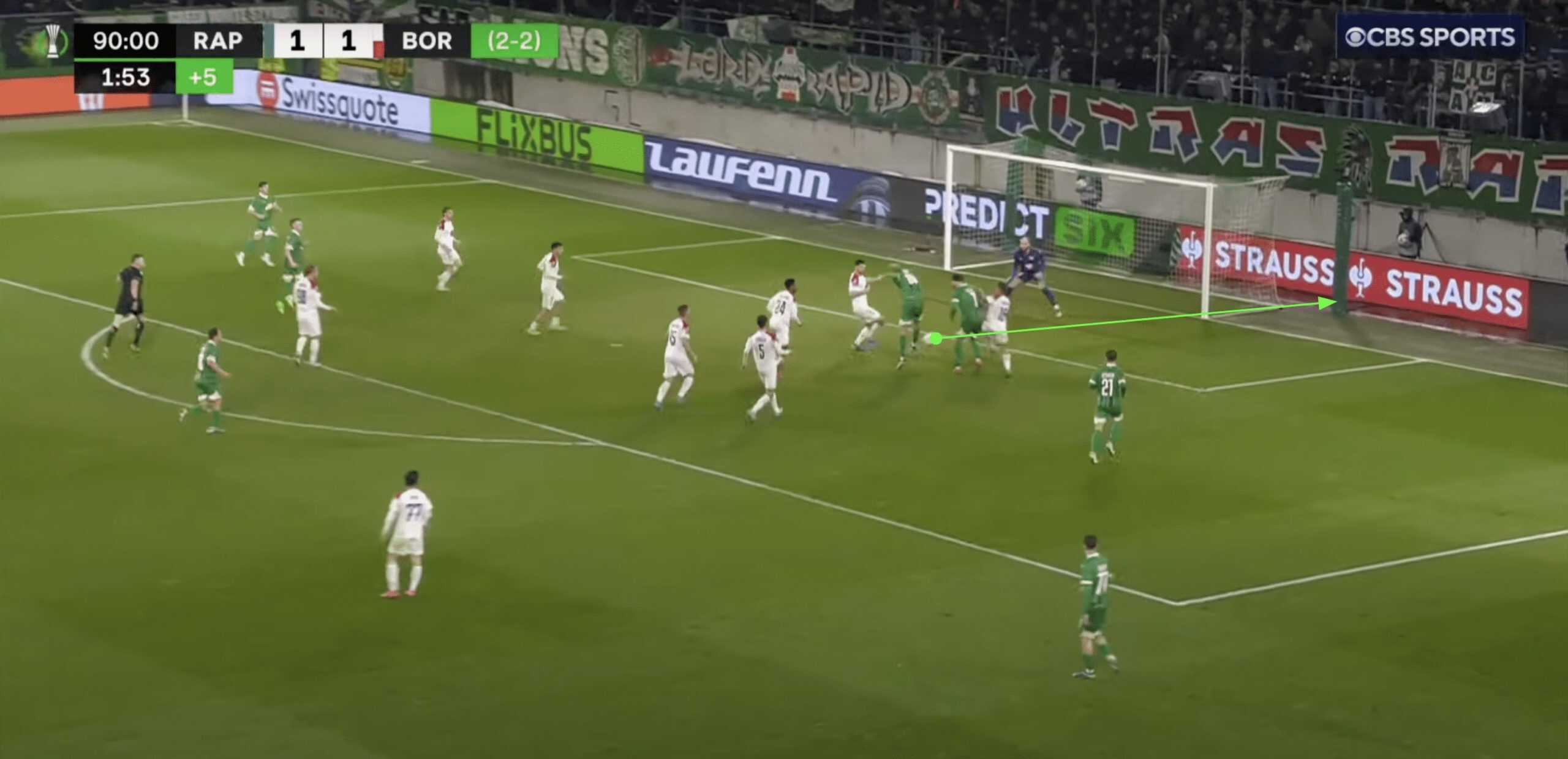 While there was very little else for Jansson to do in this situation than what he did, it’s another example of an effective early release pass that ultimately unsettled and broke down Borac’s low block deep in their defensive third, even if it didn’t end in a goal.
Borac’s success in Europe this season was built on its defensive organisation, which helped it keep three clean sheets in its previous five away outings and just three goals allowed in as many home games in this competition.
Rapid were well aware of that coming into this fixture and found ways to deal with it.
They managed to stretch Borac more than any other side this season, including Panathinaikos, APOEL, LASK, Ferencváros, and Olimpija Ljubljana.
So, while Borac may not have had the individual quality or budget to compete with such teams, they found another way to compete by giving themselves a chance with their defending, which got them this far.
Rapid managed to generate 35 shots, 11 of which were on target, and a 3.96 xG, all numbers Borac had not come up against in their run to this stage.
While they didn’t manage to put as many of those away as they should have, it was a lesson from the Austrian side on how to play against a low-block opponent.
Let’s move on to the moment Rapid Vienna won the game.
Rapid Wien’s Winning Goal
Eventually, their pressure finally told, and they did manage to find a winner early on in extra time.
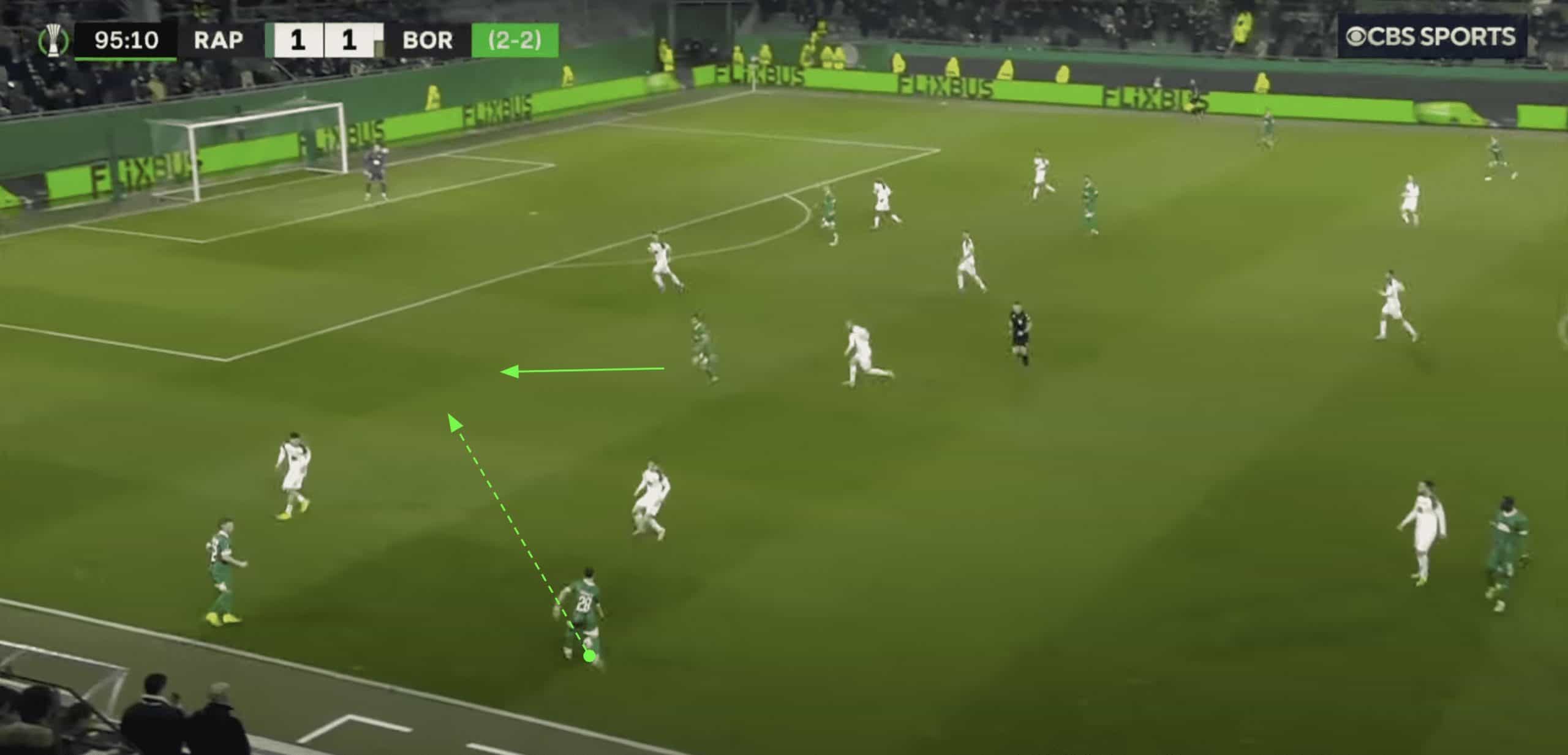 Rapid broke down the left-hand side with Oswald playing an early pass down the line to substitute Matthias Seidl, who laid it off to Jansson before it made its way to the feet of Beljo on the edge of the penalty area.
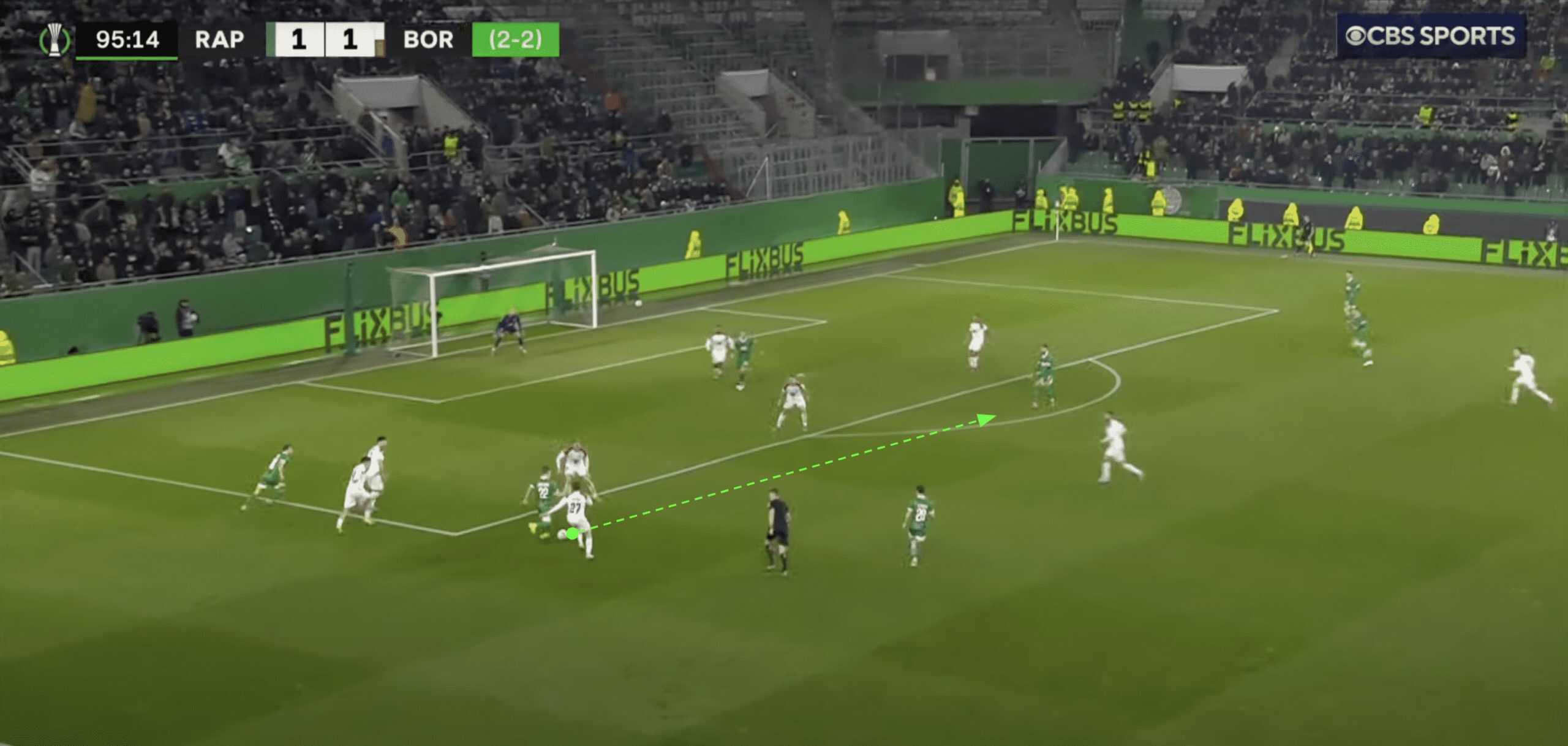 With Beljo having scored from a similar position already during the second half, Borac’s defenders were well aware of the damage the Croatian forward posed and stepped up early to close down the space as the ball came to him.
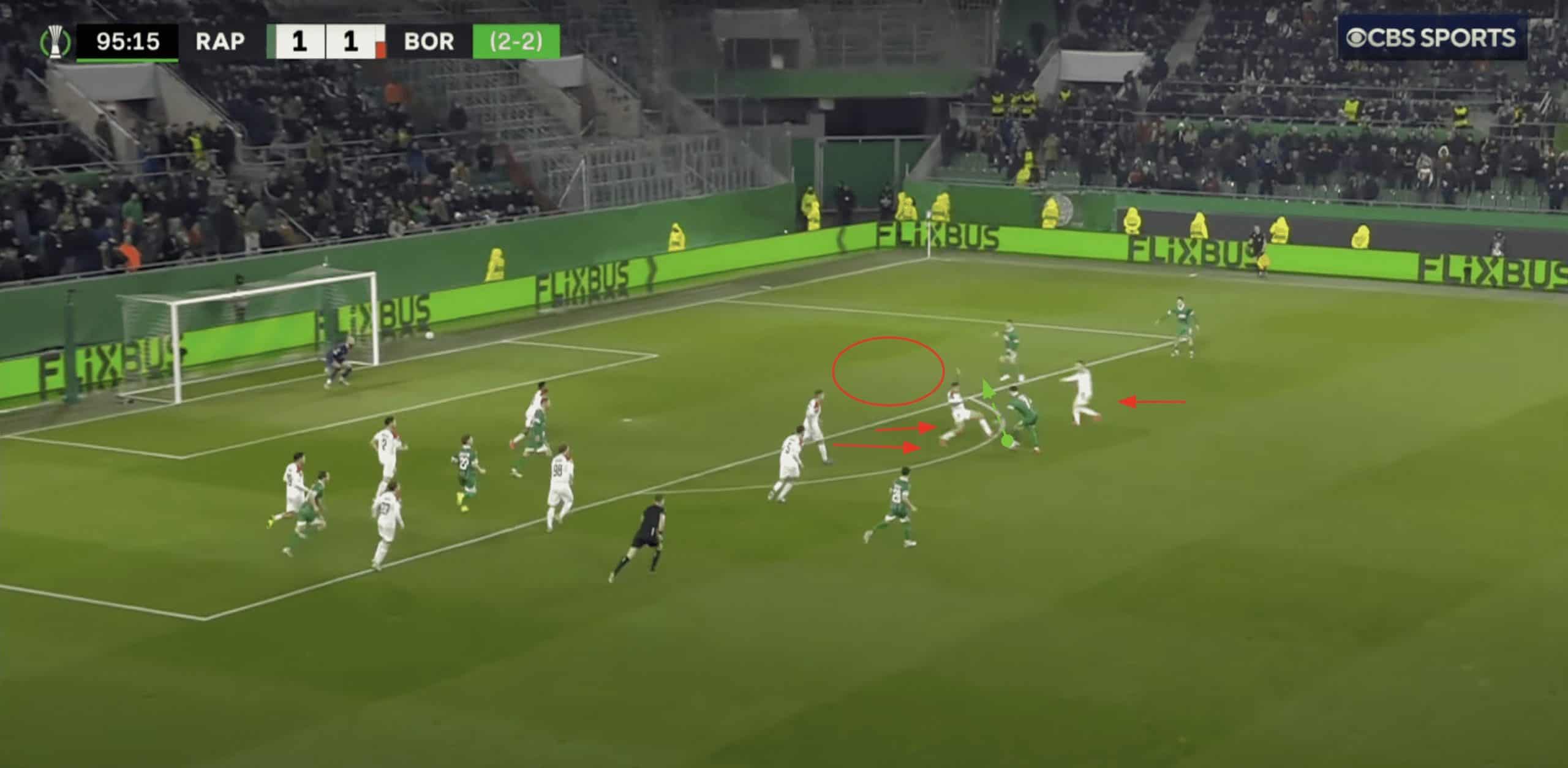 But instead of trying to take the shot in with three defenders making the effort to limit the room for him to strike, Beljo quickly notices the empty space left behind to his right and the run of Schaub into the box.
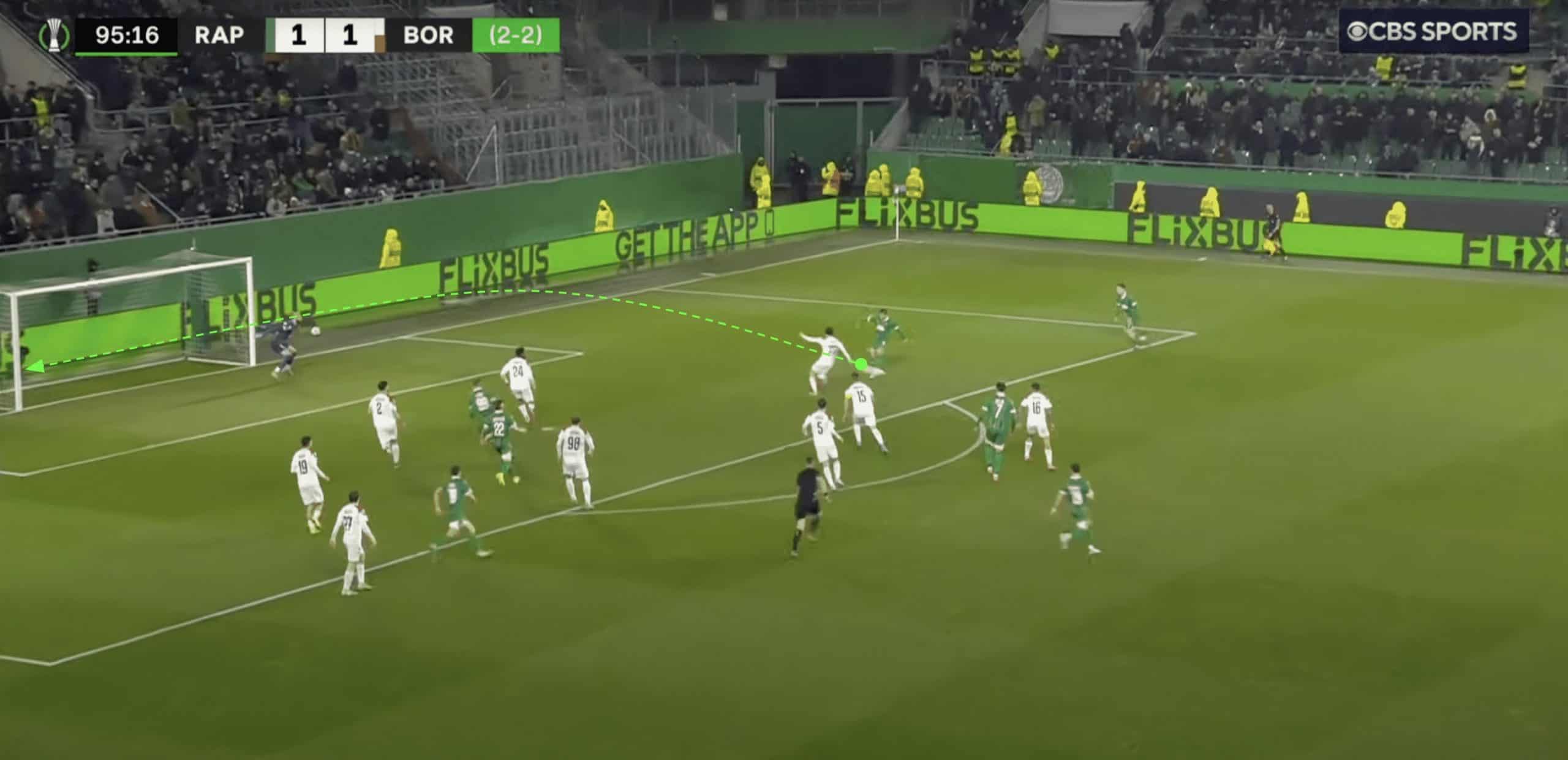 He then managed to play the pass early enough to catch Borac out of position, while Schaub made a similar decision in curling the shot early with his left foot, managing to beat Manojlović as the ball nestled into the back of the net.
Quick, sharp, and effective decision-making from Rapid’s forwards here was needed to break down a stubborn low-block defense, and it proved to be enough to send them into the last 8 of the competition.
Conclusion
Ultimately, Rapid’s relentless pressure proved too much for the visitors to withhold, ending a historic run for them and their nation in European club competitions.
As for Rapid, it’s been nearly thirty years since a continental run like this was experienced on the green-and-white side of Vienna, with a meeting against Swedish outfit Djurgårdens now set up for the quarterfinals.
Rapid have struggled domestically, with just one win in their last eight Austrian Bundesliga encounters.
Still, they now have an opportunity to potentially reach a European semifinal, which could pit them against Chelsea.
While it wouldn’t save what’s been a disappointing season thus far alone, it would be a big occasion for the club and one that does not come around very often, particularly in today’s football for clubs from smaller countries.

