
In a dominant season in the Hungarian league, Ferencváros wrapped up yet another league title, making it five in a row for the club based in Budapest, Hungary.
The Hungarian side were again led by former Russian national team manager Stanislav Cherchesov, with the 59-year-old being appointed by the club in December of 2021. In that half-season in charge, he led the Hungarian side to a league and domestic cup double and has now guided them to another league triumph, with Ferencváros having both the best attack and defence in the Hungarian top flight.
This tactical analysis and scout report will take a look at Cherchesov’s tactics, looking at what has made Ferencváros so dominant this season, with the club also making it to the round of 16 stage in the Europa League, before eventually being beaten by former Liverpool, Bayern Munich, and Real Madrid midfielder Xabi Alonso’s Bayer Leverkusen side.
Stanislav Cherchesov Preferred Formation And Style Of Play

As the image above shows, under Stanislav Cherchesov this season, Ferencváros have primarily utilised a 4-2-3-1 formation, which has given the Russian manager the most balance. This has shown as the Hungarian champions have the best attack and best defence in the league.
Under Cherchesov this season, Ferencváros have looked to dominate the ball, averaging 55.2% possession. They are not a team that often looks to counterattack, with the majority of their attacks ending in positional shots. From a defensive standpoint, Ferencvaros actually average fewer defensive duels per 90 minutes than their opposition, with 67.48 compared to 82.85.
With them being the strongest team in Hungary, Cherchesov’s side look to high press often, with their 7.7 PPDA being the best in the Hungarian top flight. In general, Ferencváros are at the top of essentially every single key attacking metric, as well as being very good in the defensive phase of play. They also are good at set pieces, boasting the highest number of corners in the top flight of Hungary this season as well.
To summarise, under Stanislav Cherchesov, Ferencváros have been dominant, always looking to be on the front foot and adopting an attack-first mindset.
Looking To Create Overloads In The Wide Areas
One thing that Stanislav Cherchesov’s side frequently does is rotate and interchange positions off the ball in the attacking third, with this tactic aimed at creating confusion within the opposition’s defensive ranks and overloads when the ball is played into the wide areas.
When watching Ferencváros in possession in the opponent’s half, it is common to see midfielders making runs from deep, with the forward dropping into a deeper position to facilitate this. There is also frequent movement between the wide midfielders and fullbacks, with them rotating at times to create space off the ball in the central areas.

The image above shows a phase of play where Ferencváros look to use an overload in the wide area to create space for runners to make darting movements behind the opposition’s defence. In this specific attacking sequence, that does not happen, but the idea is present in the image. The wide midfielder and one of the defensive midfielders move into wider positions, creating an overload with the fullback already positioned high, keeping the width on that far touchline. With them currently having an overload against the opposition defender, they look to drag the two closest players over to even the numbers.
What this would have been able to do was open up space for the midfielder positioned centrally, the ability to make an unmarked run behind the defence and into the space. This does not happen, with the attacking move breaking down for Ferencváros. However, it still illustrates what Cherchesov wants his side to do in the attacking phases of play.
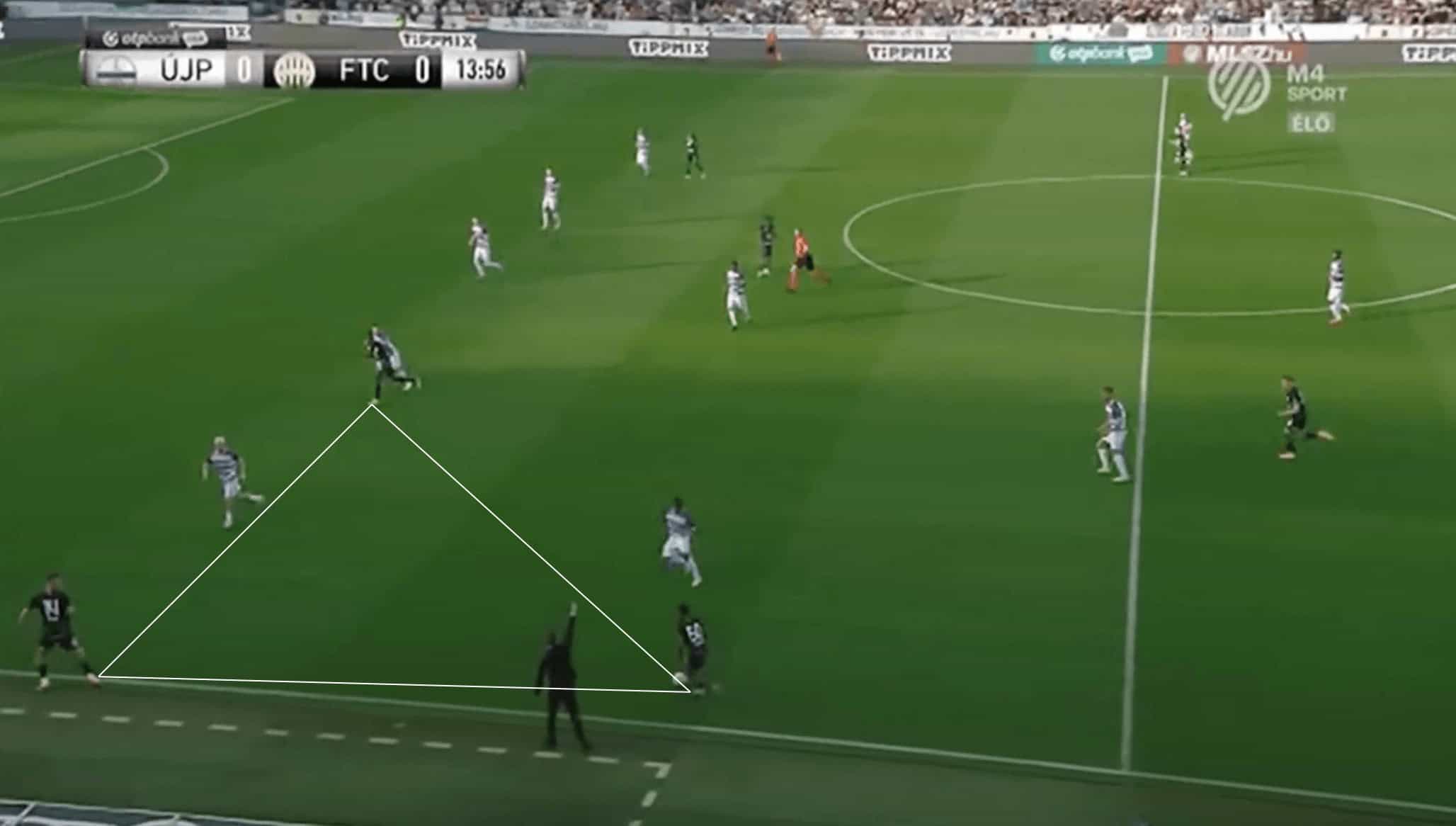
The image above shows another example of the Ferencváros attackers shifting over to the wide channel during an attacking phase of play. In this example, the fullback is in possession and has advanced into the attacking half of the pitch. The wide midfielder has come really wide, occupying the space on the near touchline. The forward has also drifted into a wide position, creating the attacking triangle. While this does not create an overload, it does create a gap in the Ujpest defence.
With the movement of the forward into a wider position, the one opposition centre-back opts to follow him out wide, which negates the potential overload. Due to the central defender leaving his position, this opens up space for a deeper-lying Ferencváros player to potentially make an advancing run into. However, this does not happen, so the attacking move breaks down, and the ball cannot be advanced into the penalty area.

The data viz graphic above highlights more of the chance-creation potential that Ferencváros have when they are able to create overloads in the wide areas and utilise positional rotations to progress the ball forward. This graphic above shows the progressive passes the Hungarian champions have played this season, with the ones in pink marking the passes that have reached the penalty area. As we can see, many of these have originated from the wide areas, indicating that much of the Hungarian side’s chance creation comes from the flanks.
These overloads play a large part in this attacking success, with the positional rotations and off-the-ball movements of the attackers also creating space for passes into the penalty area. All in all, under Stanislav Cherchesov this season, Ferencváros have been the best attacking side in Hungarian football, and these tactics have played a vital part in this attacking success.
Looking To Win Back Possession In Advanced Areas
On the defensive side of the game for Ferencváros, the Hungarian champions look to win possession back in advanced areas of the pitch, using a counter-pressing style when they turn possession over. As mentioned previously, Stanislav Cherchesov’s side possesses the best defence in the league, along with the best attack. A lot of this defensive strength comes from their ability to win possession back in the attacking half of the pitch, preventing the opposition from building up play and progressing the ball into an area where they can take shots.

The data viz graphic above shows the high regains of the Hungarian side this season across all competitions, with them being the highest-pressing/most aggressive front-foot defending side in Hungary. As we can see, Cherchesov’s side have 455 high regains this season, along with 643 counter-pressing recoveries and 164 dangerous recoveries. The graphic also shows the area where these actions have occurred in the opponent’s half, with not many occurring inside the penalty area. Ferencváros instead wait until the ball has progressed outside of the penalty area before all converging on the opposition when they are in possession.
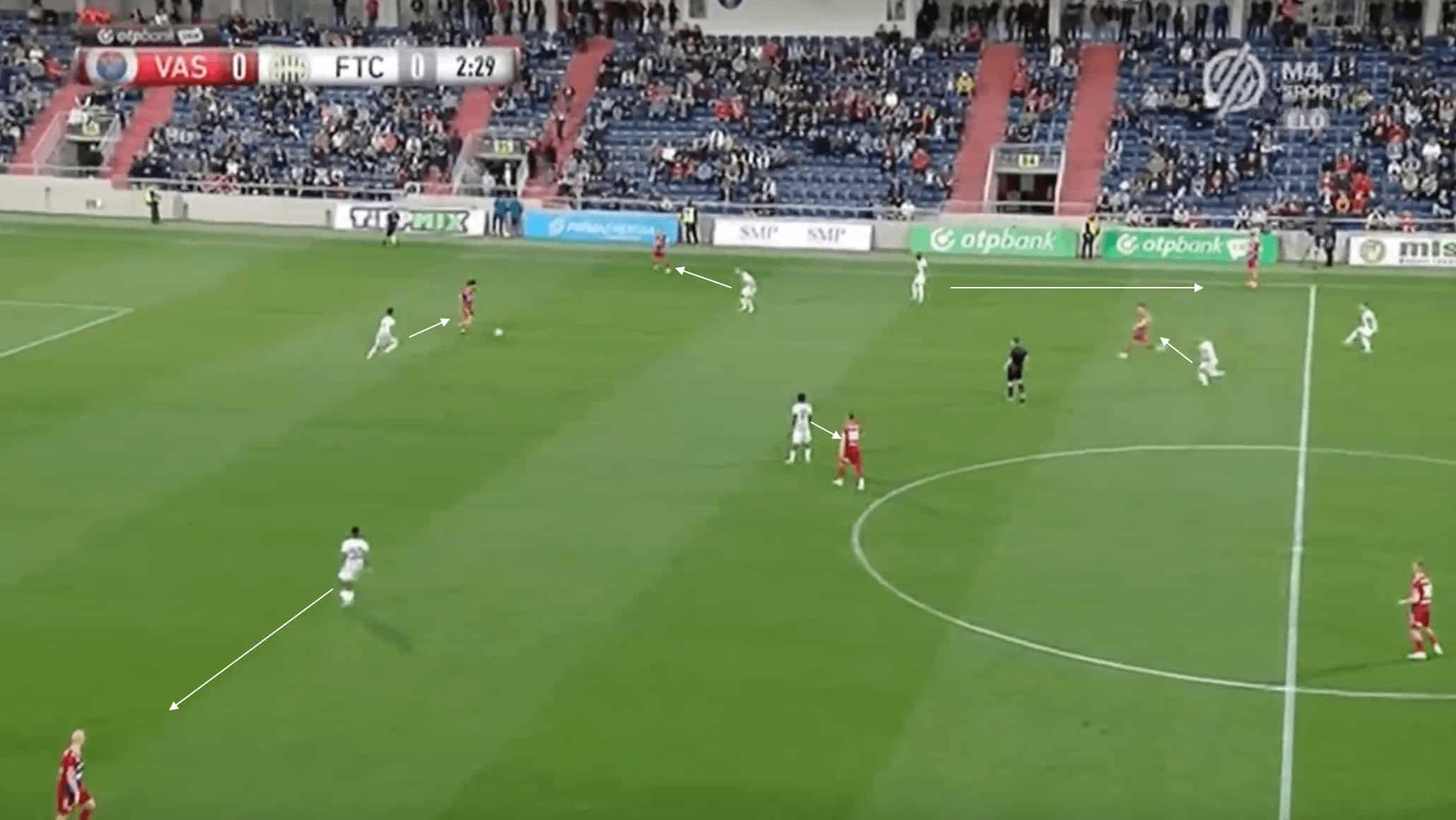
The image above shows a pressing sequence from Ferencváros this season, illustrating that they utilise a man-to-man pressing system. As the image shows, all the Vasa players around the ball are marked by a Ferencváros player, making it challenging for the opposition to play through the press. As the Vasa player drives forward into midfield, one of the Vasa forward players looks to drop into midfield to receive possession.
However, he is followed into midfield, forcing the player in possession to turn and play the ball back to the fullback, with the forward pass a risky option given the number of bodies the Hungarian champions had forward. The opposition then look to switch the play through the goalkeeper, but his pass is overhit, with Ferencváros able to regain possession in the attacking half.
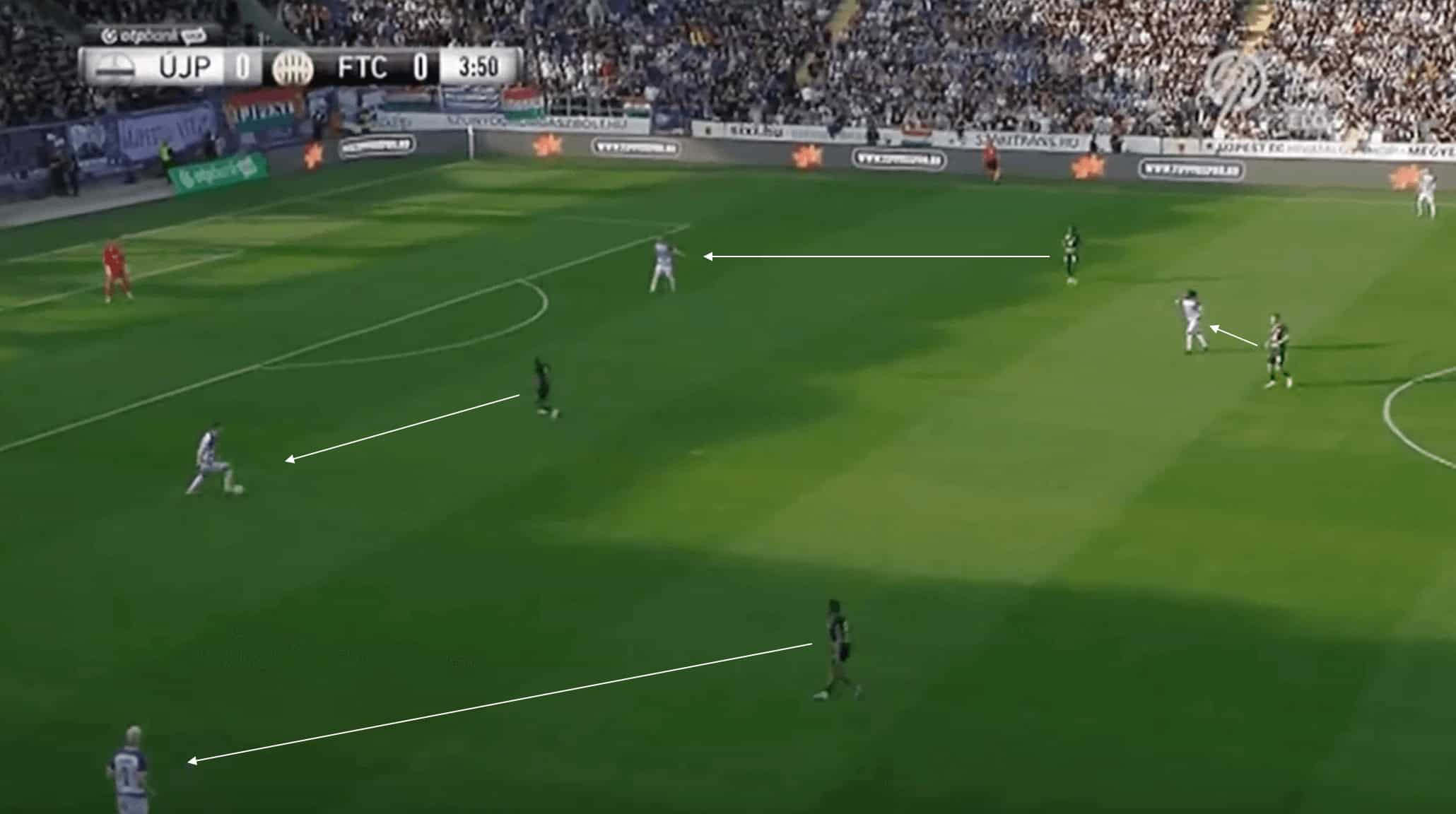
The image above shows the man-to-man pressing shape that Ferencváros has used to great effect this season once more. Again, as the Ujpest centre-back is in possession, all the closest passing options are being man-marked, making it risky to play through the Ferencváros press. As a result, the central defender dribbles forward into midfield, then plays a long switch of play ball to the opposite touchline. This allows Ujpest to retain possession, but they are not able to create a chance or get a shot on the Ferencváros goal, with the champions able to regain possession and begin an attacking phase of their own.
As this section has shown, Ferencváros uses their front foot defensive ability to limit opposition sides when it comes to getting shots on their goal. Stanislav Cherchesov’s man-marking pressing system makes it risky for opposition sides to attempt to play through it, meaning the majority of the time the opposition have to play it long to not risk the Hungarian champions regaining possession in a dangerous attacking area of the pitch for them to counter-attack.
Conclusion
As this tactical analysis has shown, Ferencváros have been by far the best team in Hungary this season, having already been confirmed as champions of the Hungarian league for this season, with the Budapest-based side possessing the best attack and defence in the Hungarian league.
They have thrived under the leadership of Cherchesov, who, since he replaced Austrian Peter Stöger in 2021, has led the club to a Hungarian Cup and now two Hungarian league titles, with the future of the club looking bright under his leadership.
