
Austrian football was different 20 years ago.
Rapid Wien and FK Austria Wien, the two most prominent clubs in the country’s capital, have been consistently battling it out to win the Austrian Bundesliga title for years.
SK Rapid Wien has won the most titles in the league to date, with 32 championships in Austria and one in Germany, achieved in 1941.
Cue 2005, and the landscape of Austrian football changed drastically.
Red Bull, the energy drink manufacturer, decided to purchase a football club in Salzburg and invest heavily in both the infrastructure and the team itself.
German Ralf Rangnick was hired to develop a Red Bull style of play, which ultimately centred around counter-pressing and rapid, high-intensity attacks.
With the rise of a new dominant force in the Bundesliga, as well as in the youth categories, the former giants had to reinvent themselves.
Currently, more than half of the clubs, especially in the top half of the table, are trying to imitate or are heavily influenced by the Red Bull way of working.
Rapid began to settle into a position of second place in Austria, consistently falling short of Red Bull Salzburg.
Many players left the club to strive for the German Bundesliga or even Red Bull Salzburg itself, as Marcel Sabitzer did, resulting in a decline in Rapid Wien’s quality.
The start of the 2020s was especially rough for Rapid because, after another second-place finish in the 2020/21 season, Rapid have never managed to finish better than in fourth place.
Last season, Rapid were even on the verge of missing out on the championship playoff and facing relegation in the relegation play-off for the lower half of the table, forcing the club into a coaching change.
After Zoran Barisic was released, the club hired German coach Robert Klauß as their new head coach.
Klauß found immediate success, qualifying for the championship playoffs at the last minute and climbing back into fourth place.
What’s interesting about Robert Klauss style of play is that he is a Red Bull coach through and through.
The now 39-year-old began his coaching career at RB Leipzig, progressing through the ranks of their academy to their Bundesliga team, where he served as assistant coach to both Ralf Rangnick and Julian Nagelsmann during their respective tenures.
After a stint in Nuremberg, Klauß is now bringing the Red Bull tactics to Rapid Wien.
The club is currently in second place again, this time behind SK Sturm Graz, and is in contention to win a title for the first time in 16 years.
In this tactical analysis, which focuses on a team analysis, we will examine how Robert Klauß tactics transformed a struggling team into a Red Bull-powered juggernaut in just a few months.
Verticality Over Ball Security
Examining Rapid Wien’s ball possession this season under Robert Klauss coaching style reveals obvious similarities to how the Red Bull teams worldwide play.
Robert Klauss preferred formation is a 4-4-2 setup, which often evolves into a 4-2-2-2 formation because he prefers his wingers to be positioned centrally.
Looking at their structure in the build-up, Klauß prioritises verticality over ball security.
While Rapid has more possession on average compared to their opponents so far this season, this fact is mainly due to the team’s status as a top team in the league.
Due to a significant drop-off after the top four or five teams in the Austrian Bundesliga, many smaller clubs are not interested in playing with possession against Rapid.
Let’s take a look at Robert Klauss build-up play.
Here, we can see a very typical situation for Rapid while building up.

Their centre-backs are occupying the half-spaces and are starting to dribble the ball towards the opposing team’s press.
In their shape, the full-backs are extremely wide near the sideline, with the near-sided full-back staying close to the backline and the far-sided full-back playing at the height of the attacking midfield.
One of the strikers is dropping back into the attacking midfield position, and the two wingers are in a highly narrow formation, playing in the half-spaces as well.
This allows Rapid to play a lot of vertical passes by creating an overload in the centre of the pitch.
With the full-back out wide, the opposing pressing players can not shut off the passing window completely.
Otherwise, Klauß would have his men use the third-man principle, and the threat of the pass outside would open up the passing lane towards the attacking midfielder.
Their opponent in this game was RB Salzburg, a team with very forward-oriented midfielders and only one holding midfielder.
This tactical measure allowed Rapid to frequently get behind the first line of press and into the backs of Salzburg’s midfielders this game.
From there on, Rapid has a player in acres of space right in front of the defensive line every single time.
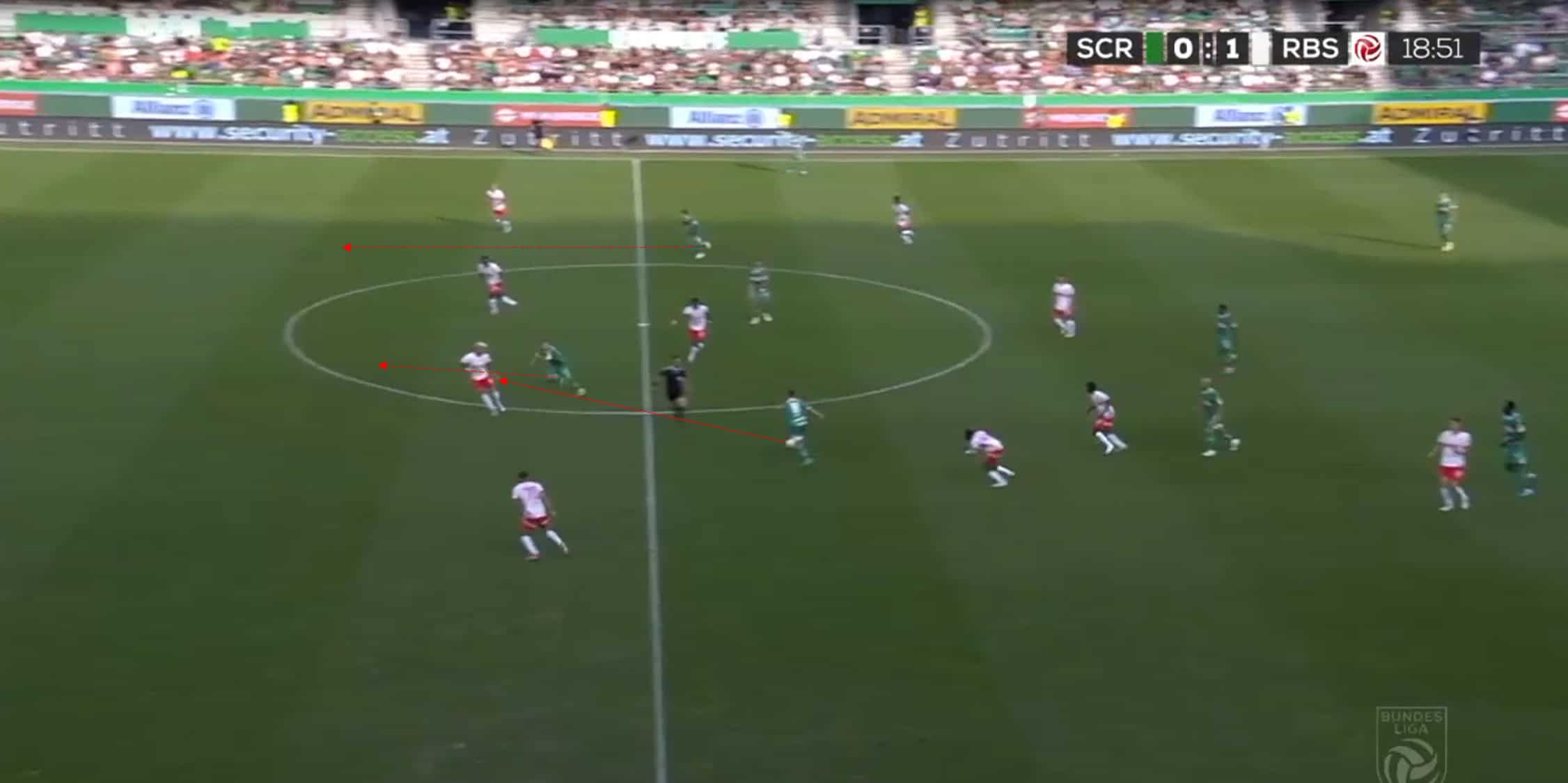
In this case, Seidl was able to turn and scan down the field.
It’s an evident pattern in Robert Klauß style of football for his men to always look for a deep ball down the centre of the pitch towards their striker.
Every player in every position looks for these passes immediately after winning the ball.
To make this possible, Rapid need a lot of vertical runs.
Here, the striker and the far-sided attacking midfielder provide these runs and instantly move in behind Salzburg’s backline after Seidl receives the pass.
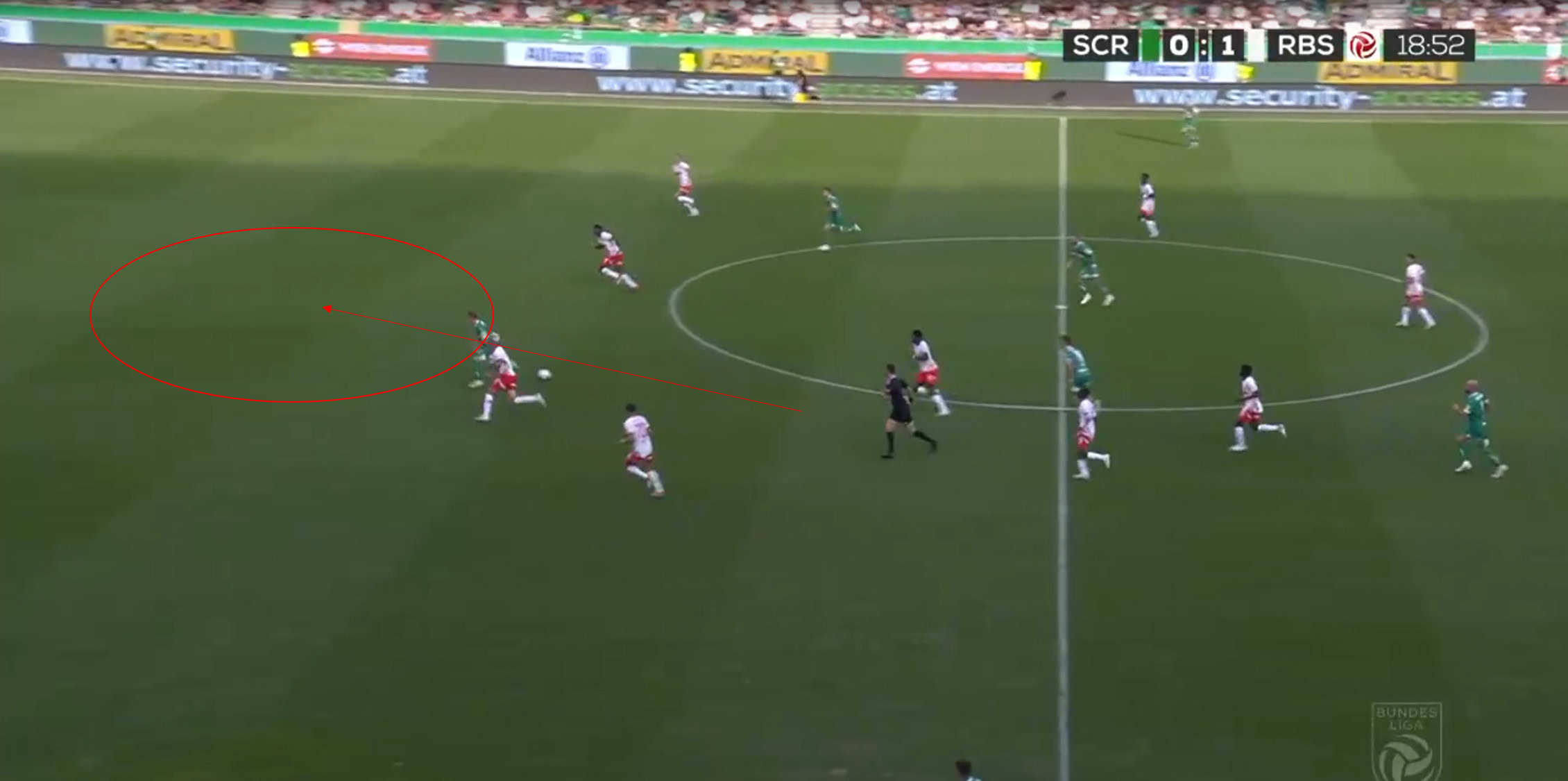
Seidl plays a straightforward pass behind the Salzburg backline into the path of striker Jansson, who then finishes in front of goal and gets Rapid back to level in this game.
In the end, it takes three passes from goalkeeper to goal to cover the distance of the pitch in about ten seconds with vertical passes and runs.
There are not many teams capable of countering this type of attack velocity while defending.
Diving Into The Depth
As mentioned in the previous paragraph, Robert Klauß’s managerial style requires his team to look for verticality and depth every time they regain possession of the ball.
There is no focus on quick combinations to establish ball security after recoveries; for Rapid, it’s just pace pace pace.
Every time they win the ball, the first look goes towards the striker and the centre of the field.
Rapid is always keen on forcing defenders into challenging duels and getting their striker in behind the opposing backline.
Here, we see Rapid against Salzburg again; this time, they are defending in a deep block.
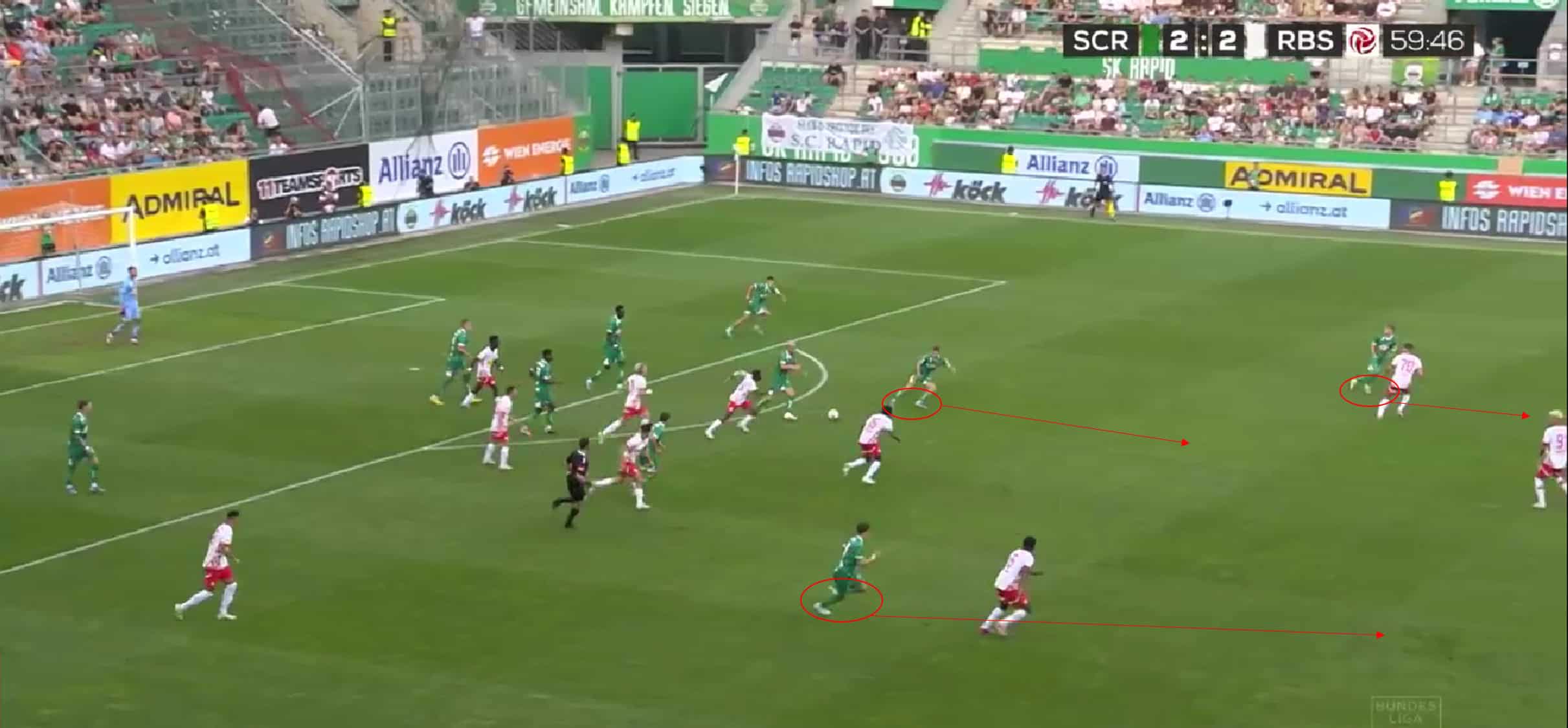
Even though Salzburg has had some troubles this season, they are still the best team in Austria, considering factors like individual class and talent.
Rapid did very well defending in this situation but were not really able to win the ball back the first two times they got their feet on it.
Red Bull Salzburg, under Pep Lijnders, is also one of the most formidable teams in terms of counter-pressing opponents, which meant that Rapid had to find solutions to avoid losing the ball near their own box repeatedly under the relentless pressure Salzburg was exerting on them.
Their transitional phase had to be swift and low-risk.
The solution Klauß came up with was relatively simple: Kick and Rush.
While the term is often associated with negative values these days, long balls are still the easiest way to prevent a loss and cover a lot of distance.
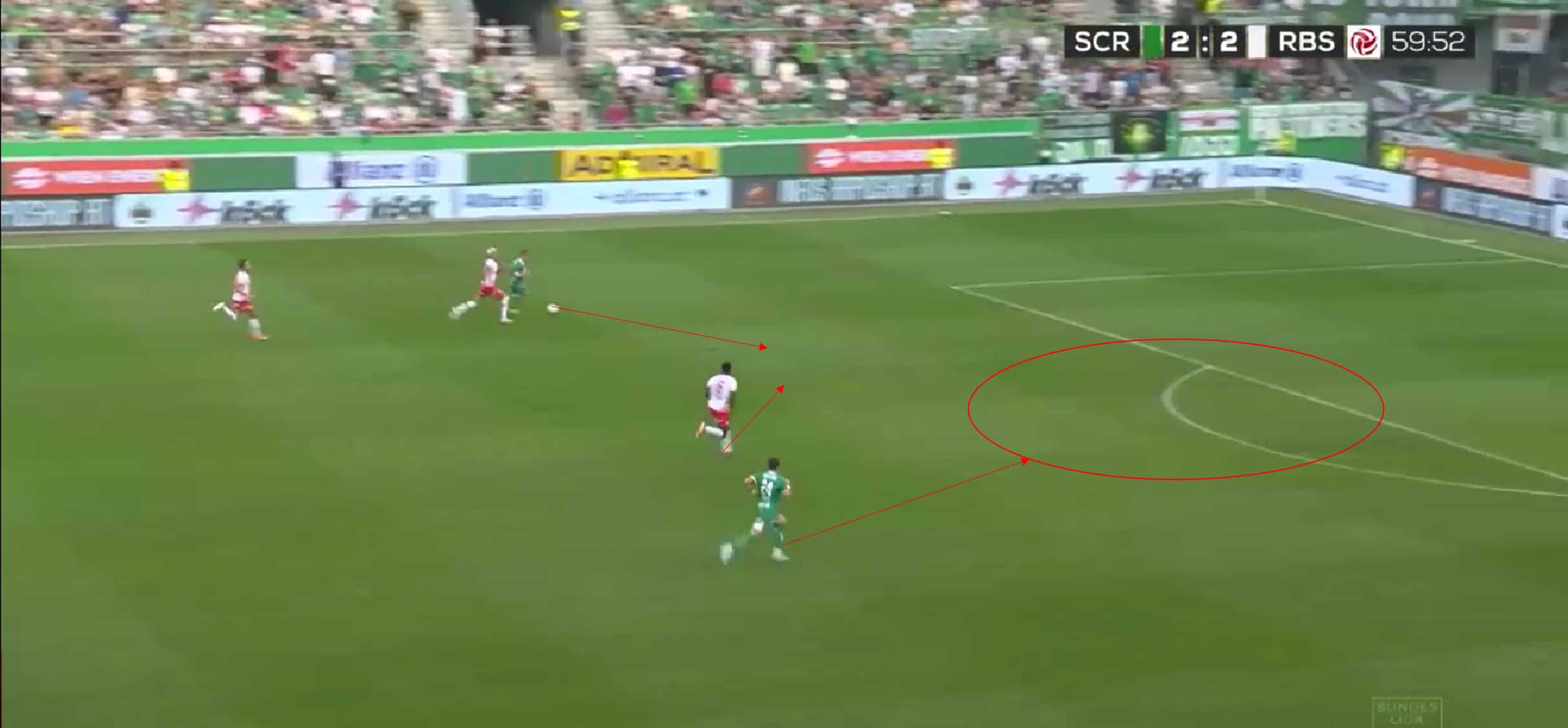
In the picture above, when Rapid finally got a second to breathe, all the players in front of the ball did not hesitate or try to find space for short passes; all three of them started accelerating and sprinting down the field the instance Rapid won the ball.
However, this time, the two strikers were not running down the middle of the field.
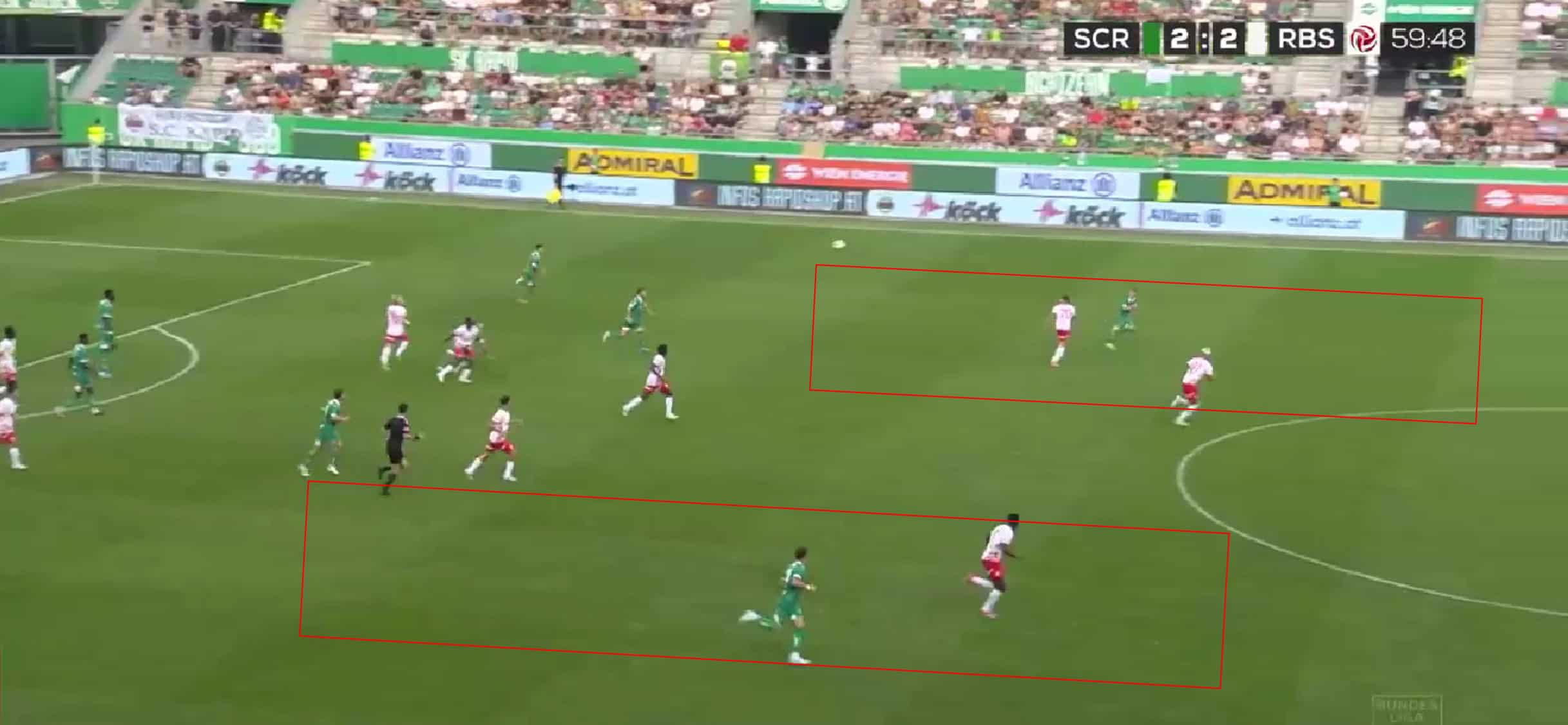
Rapid and Klauß knew one thing: Defences will always prioritise defending the centre of the pitch.
This means they will usually keep their centre-backs in the middle of the field, especially when they move forward with many players, as they did in this situation.
Therefore, Klauß had his striker attack the half spaces down the field with all their might.
Both Dion Beljo and Isak Jansson moved slightly to the outside, ensuring that both half-spaces were covered, and then moved into the gap between the forward-oriented full-back and the centre-back.
This is nearly impossible to defend for a team like Salzburg because their centre-backs can not match the pace of the two Rapid (and rapid) strikers.
All Rapid now have to do is launch a long ball down the field behind the opposing backline and let their players make a run for it.
Jansson uses his pace well in this situation and manages to win the attacking duel relatively easily, showcasing another strength of attacking the half-spaces like that in transition.
After Jansson got in behind his man, the other centre-back had to cover off the middle of the field to reestablish some defensive stability and attempt a defensive duel or tackle.
This means that he has to turn his back towards the other striker, allowing Beljo to roam free and be uncovered on the far post.
Jansson could simply square the ball into open space if he wanted to, allowing Beljo to get an easy finish here.
However, Jansson just decided to take on the other centre-back as well and then cold-bloodedly finished the opportunity, putting Rapid into the lead against Salzburg, the team their game is modelled after.
Target Men In All Shapes & Forms
What’s really interesting about Rapid as well is how Robert Klauß uses his target men upfront.
Their most traditional target man is Guido Burgstaller.
He is tall, with broad shoulders, and excels when his back is turned towards the goal.
Most teams are using their target men to establish some depth in their game.
They are putting their big strikers into the opposing defensive line, forcing them into a lot of aerial duels or even just trying to find him for a quick lay-off after winning the ball.
Rapid look for depth pretty much every time they win the ball, so you would think that they are doing the exact same thing, but you’d be wrong.
Here, we can see what Klauß actually does with his strikers.
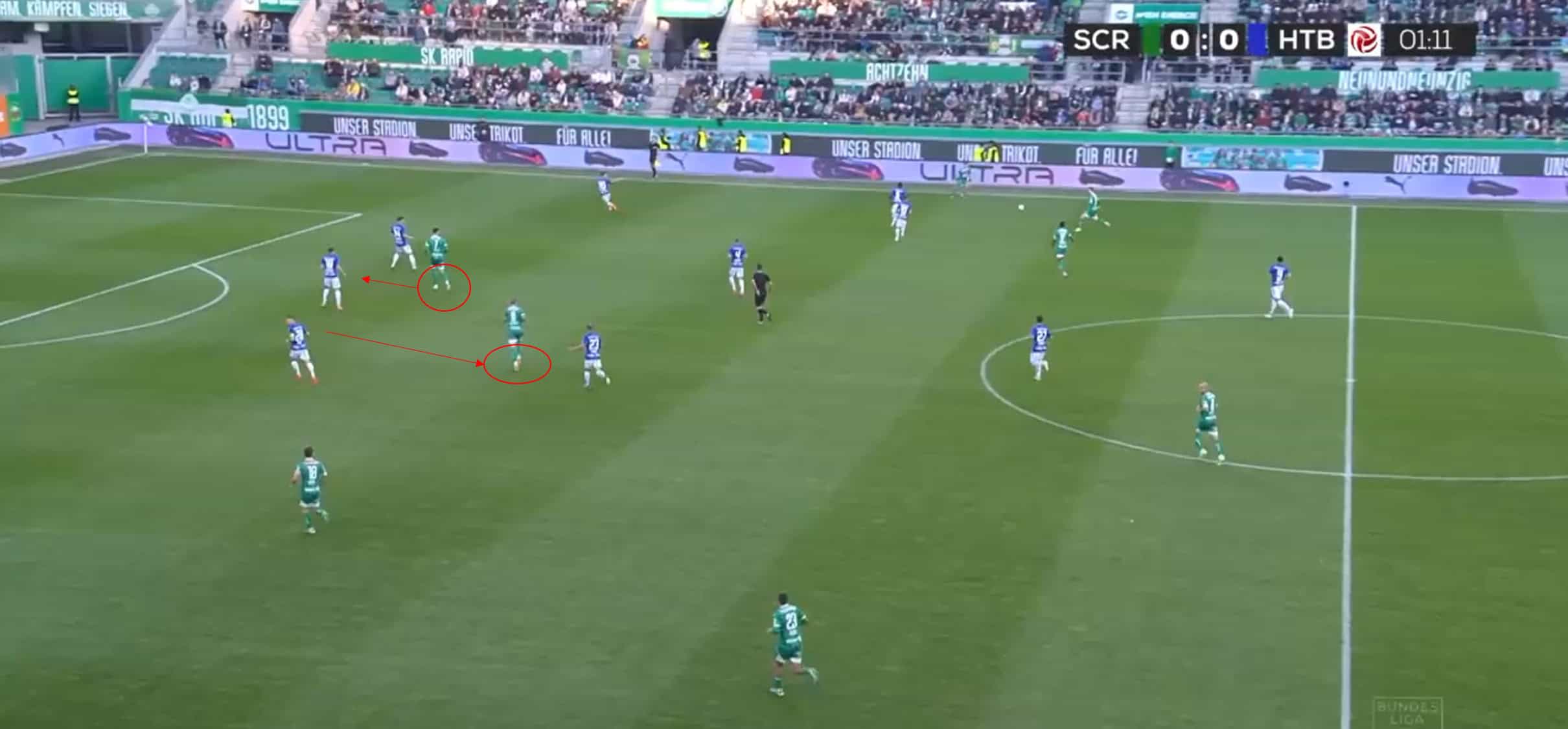
Obviously, the two-striker formation allows him to always have a presence in the middle of the field up front.
Additionally, Rapid employs alternating movements in tandem during attacks, forcing defenders into difficult decisions.
This is also evident in the picture above.
While Beljo is moving forward, making a run behind the backline, Burgstaller, who is the apparent target man in this situation with these players on the field, drops back into midfield, playing as a number 10 for the most part.
This is rather interesting and shows that, even though Rapid play a lot of long and vertical passes, they are not trying to get their players into attack with their backs turned towards the goal, but instead trying to find them in midfield and then threaten the opposing backline with vertical runs.
There is also another benefit.
Let’s look at the first situation against Salzburg again.
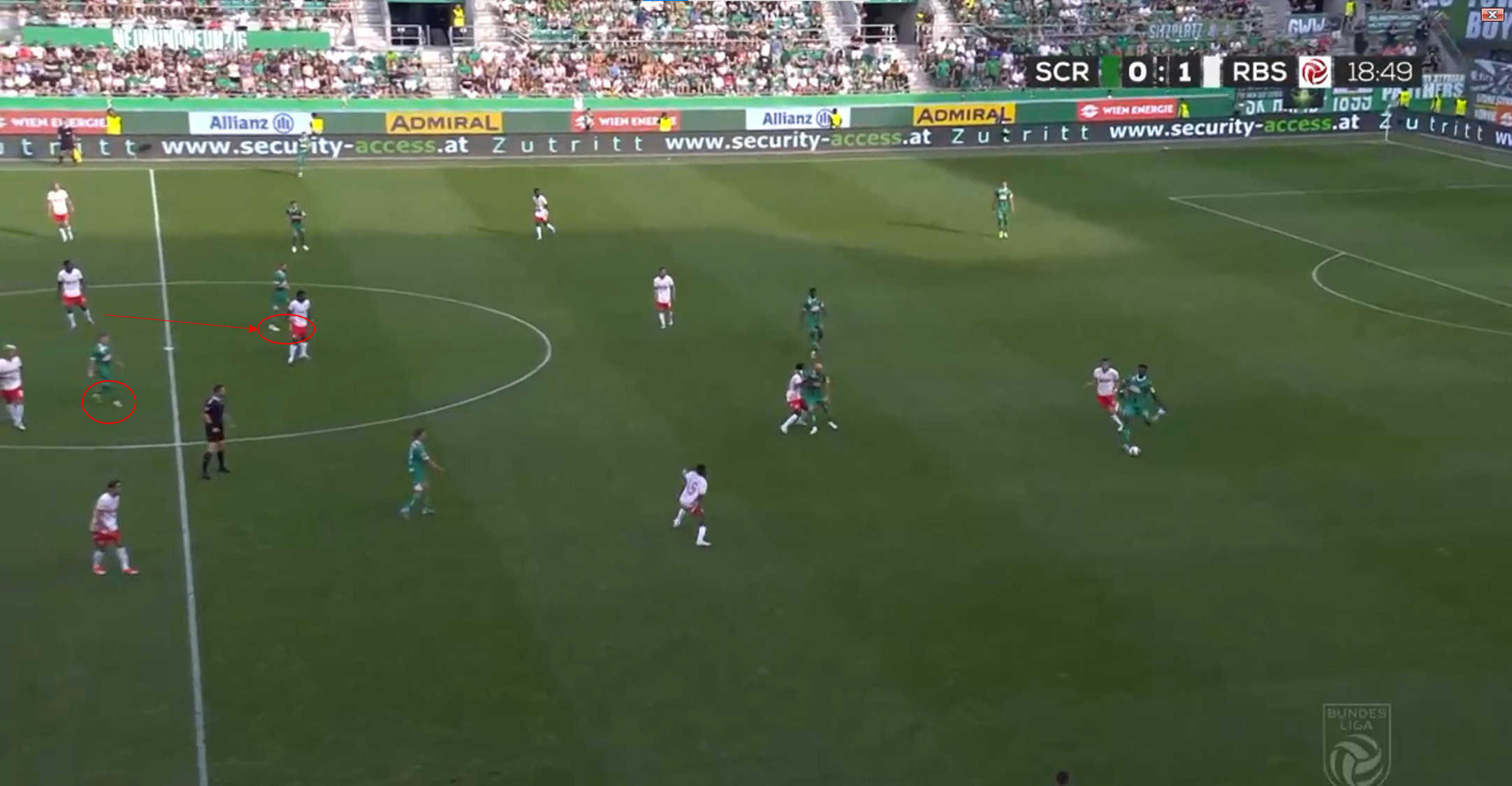
In this situation, the small and pacey Jansson stays up front, and the tall and bulky Burgstaller drops back into midfield as well.
Burgstaller is not in a position to receive the ball here whatsoever, but he still has an immense impact on the situation.
As previously stated, Salzburg play with only one holding midfielder.
With their central midfielders pressing forward frequently, they usually try to cut off the opposing team’s play, as they did in this situation against Rapid.
There was no way the centre-back could have played a pass to the right side of the field.
If Burgstaller just stays at the height of the opposing backline, the holding midfielder can move towards Seidl and cut off the half-space with man-marking as well.
However, with Burgstaller dropping back, the holding midfielder now has to cover him as a priority and can’t move out; therefore, the half-space remains open, and the goal is scored.
While it might be frustrating for a striker like Burgstaller to be used as a dummy, Klauß opens up their vertical play by doing stuff like this.
What’s also interesting here is the terminology.
While in English, a target man refers to a tall and bulky striker, the definition is slightly different in German.
While we also have “Zielspieler”, the literal translation of target man (or target player, to be exact here), we would call a tall and bulky striker a “Wandspieler” (wall-man) because he should be built like a brick wall and used to play quick one-touch passes, shielding off defenders in his back.
The German definition of target men includes all the players that a team is trying to find in each phase of the game.
When Rapid plays long balls, they rarely play them to Burgstaller.
They don’t even chip the balls; they just hit them behind the opposing team’s backline, as seen before.
The target-man in these situations is their pacey strikers, such as Jansson and Beljo, which means they are not playing in a very traditional way here.
While that may seem like a boring technicality, there still is a nice callback to Klauß’s RB Leipzig tenure here.
When he was an assistant coach at Leipzig, they did the exact same thing, so this is definitely a Red Bull principle.
Klauß and his head coach, Nagelsmann, were dropping their big striker, Poulsen, back into midfield; they were using a very pacey striker as their target man for long balls over the top of the defence in Timo Werner.
Werner scored a career-high 28 goals in that Bundesliga season, so Jansson should be in for a nice breakout soon under his new head coach.
Conclusion
Red Bull is dominating the Austrian football world, and the impact of the takeover, and consequently, the establishment of the Red Bull way of playing football, reaches every single aspect of Austrian football to this day.
That said, Rapid was very clever to hire a coach who fits perfectly into this mould and can utilise a league and youth system oriented around the football he learned to coach from the start of his coaching career, from the founding father of Red Bull football, Ralf Rangnick.
Robert Klauss tactics have done an excellent job of getting Rapid back on track since he took over in the middle of last season, but after his failed stint in Nuremberg, questions arose about whether he was capable of taking the next step with his team.
This season, he established a Red Bull style of play at Rapid, characterised by a very vertical and intense play style that is incredibly fast-paced and fun to watch.
With many young players making strides in their development under Klauß and RB Salzburg struggling to start the season, Rapid Wien is the biggest challenger to Sturm Graz for the Austrian championship this season and has excellent odds to make the most of it.
However, their playstyle is very intense, and it will be hard to maintain that level over a long season.
It will be interesting to see what Klauß does in the Winter and the coming spring to give his team even more solutions and power.
