


Following a memorable 1-0 victory against Manchester United at Old Trafford at the end of September, Aston Villa were sitting just four points off the top of the Premier League.
The historic English club had recently lost Jack Grealish to Manchester City in the summer, but Dean Smith’s side looked unphased, punching above their weight yet again. Five weeks later, Smith was relieved of his duties following a run of five consecutive defeats in the league.
There were defensive issues and serious problems regarding the functionality of the midfield as well. Villa already had their man lined up and within four days, Steven Gerrard was announced as the new manager at Villa Park.
Gerrard had an astronomical reputation in England for his illustrious career with Liverpool but also began to make a name for himself as a coach, winning the Scottish Premiership title with Rangers last season and advancing very deep in the UEFA Europa League over the past few campaigns.
His impact at Aston Villa has been prodigious, winning four of his first six games in the league. Only Liverpool and City have picked up more points since he took over, but how, exactly, has he fixed the Villans?
This article will be a tactical analysis of Villa under Gerrard. It will be an analysis of the tactics that the English manager has implemented, particularly focusing on the midfield and wingers.
Christmas tree formation
Throughout Smith’s tenure, Villa predominantly played with a 4-2-3-1, although the 4-1-4-1 and 3-5-2 were deployed on a plethora of occasions too. The 3-5-2 was particularly used by the coach towards the end of his tenure in order to provide more defensive stability to the team.
Unfortunately for Smith, his tactical tweaks were not enough to stabilise the sinking ship.
Gerrard’s preferred formation at Rangers was the 4-3-3 which he used in 70 percent of their matches en route to lifting the SPL title last season.
On arrival at Villa Park, Gerrard automatically switched to a 4-3-2-1, or the ‘Christmas Tree’ formation as it is more commonly referred to in the football stratosphere, which is an unconventional variation of the conventional 4-3-3.
The formation got its name from its resemblance to a Christmas tree, getting narrower and narrower the further up the formation you go. While not inventing the tactical structure, it was Carlo Ancelotti who has been most notorious for using the 4-3-2-1 from his time with Milan.

In a regular 4-3-3 formation, when a team is defending in a medium or low-level block, the wingers tend to drop back and become part of the midfield line, often causing the structure to take the shape of a 4-1-4-1 or a 4-5-1.
With the 4-3-2-1, the wingers tuck inside just behind the centre-forward to defend the inside spaces, leaving the midfielders and fullbacks to defend the wide areas for the most part.
Gerrard’s 4-3-2-1 is a lot more rigid than Ancelotti’s mainly because of the difference in class of the players at each coach’s disposal. While the legendary Italian manager had Ronaldinho, Clarence Seedorf and other offensive geniuses, Gerrard has opted for a more tactical approach by utilising players such as Jacob Ramsey and Ashley Young as the ‘inside forwards’.
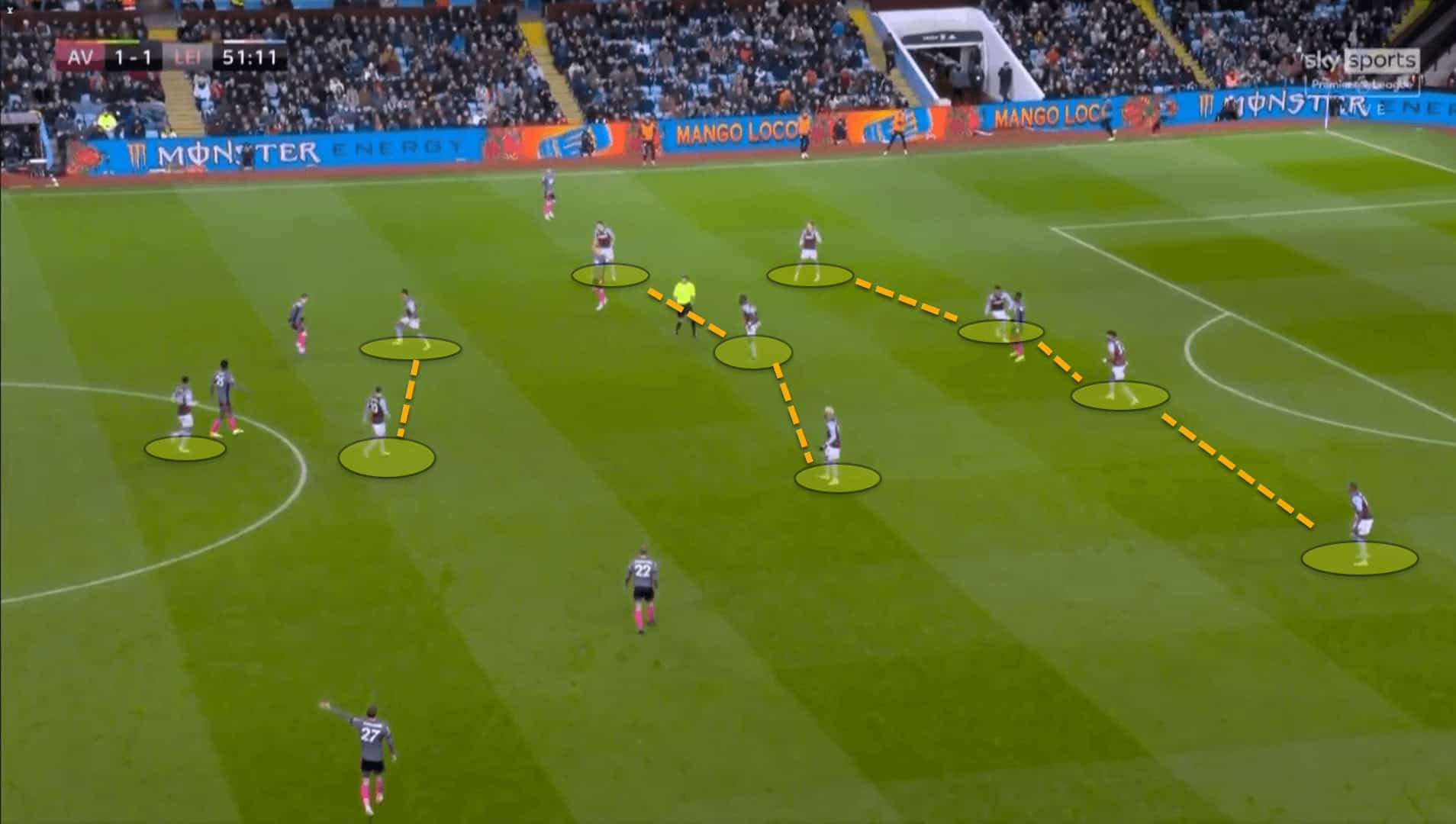
The newfound formation has helped the team prosper in recent weeks which is a massive credit to Gerrard and the work himself and his coaches have done so far. But how exactly has the formation functioned to allow the team to flourish since his arrival?
Midfield three push wide in the build-up phase
A major difference that Gerrard has made in his first few games in charge is how high the fullbacks push up the pitch while the team are in the attacking phases.
The fullbacks are given license to get forward when two of the central midfielders push wider while Villa are in the attacking phases. This is a regular pattern from Villa’s positional attacking structure.
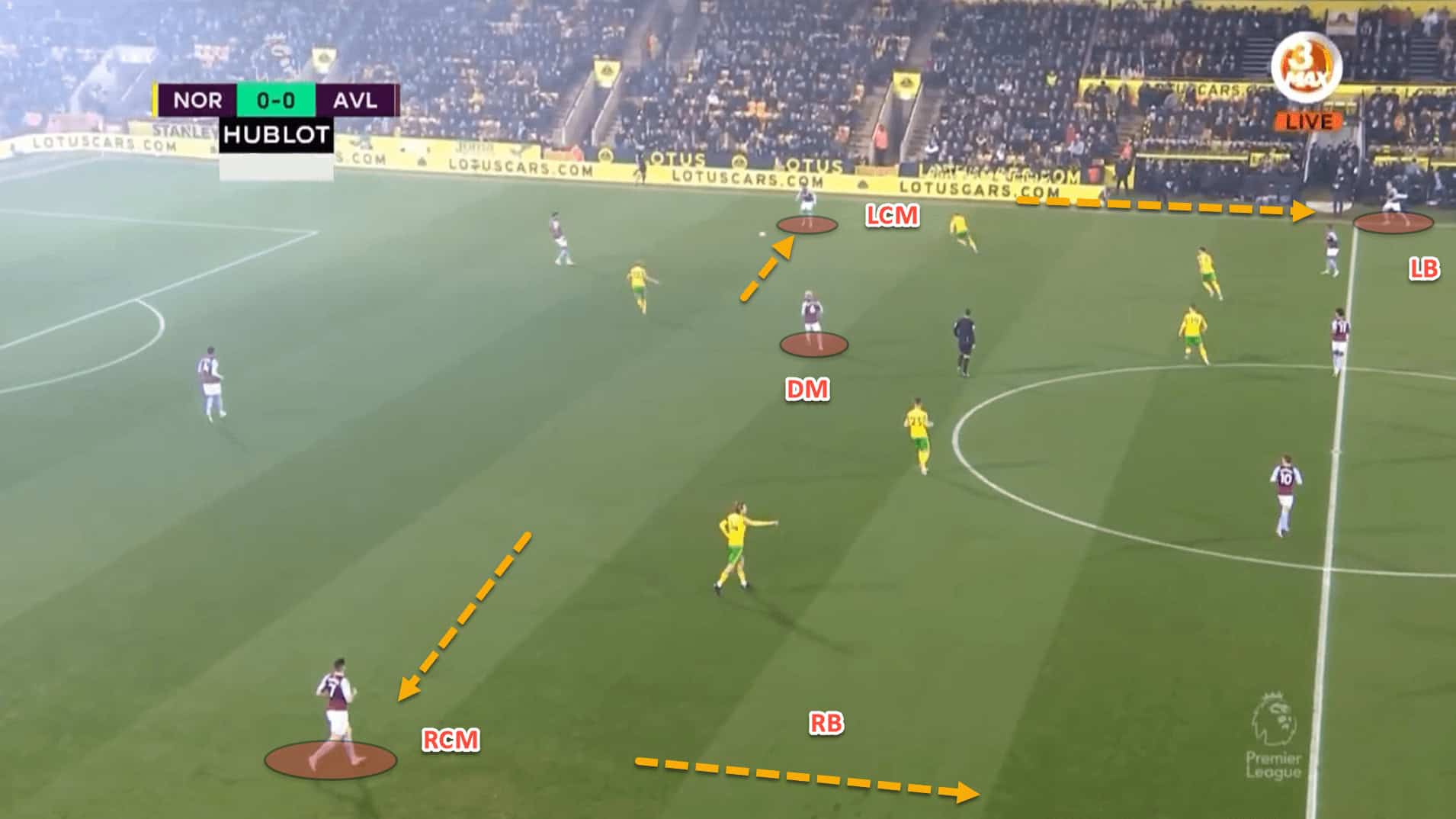
As can be seen from this image, both Ramsey and John McGinn have dropped out to the wide areas in the fullbacks’ conventional positions which allows the wide-backs to get up the flanks.
Doing so ensures that there is cover in these spaces in the case of a turnover of possession. It makes the team less susceptible to counterattacks.
However, on a more attacking note, it allows Villa to progress the ball through the wide areas easier. This is because central midfielders are generally more comfortable in possession and are better at progressing from deeper areas. Villa tend to attack down the sides and so having midfielders out wide to initiate the attacks is a smart move by Gerrard as opposed to leaving it to the fullbacks.

This data viz displays all 29 of Aston Villa’s positional attacks from their recent 2-0 win at Carrow Road against Norwich City. 24 were down the flanks with just five coming through the central corridors.
This was the area that had McGinn, Matty Cash, and Emiliano Buendia and so one can see why it was their most favourable space to take down.
The wingers stay tucked inside to accommodate the fullbacks bombing on and so the shape in possession tends to resemble a very wide 2-3-5, an upside-down Christmas tree even.

Here is Villa’s pass map from their recent game against the Canaries. The three noticeable aspects from this data viz are that the distances between each midfielder are very wide, the front three are extremely compact, and the fullbacks are very high, particularly Cash on the right side.
Villa’s fullbacks are very efficient going forward and so it makes sense to rely on them going forward. In the final third, these two players, generally Matt Targett and Cash, are instructed by Gerrard to provide the width and put low crosses into the box for one of the front three to attack.
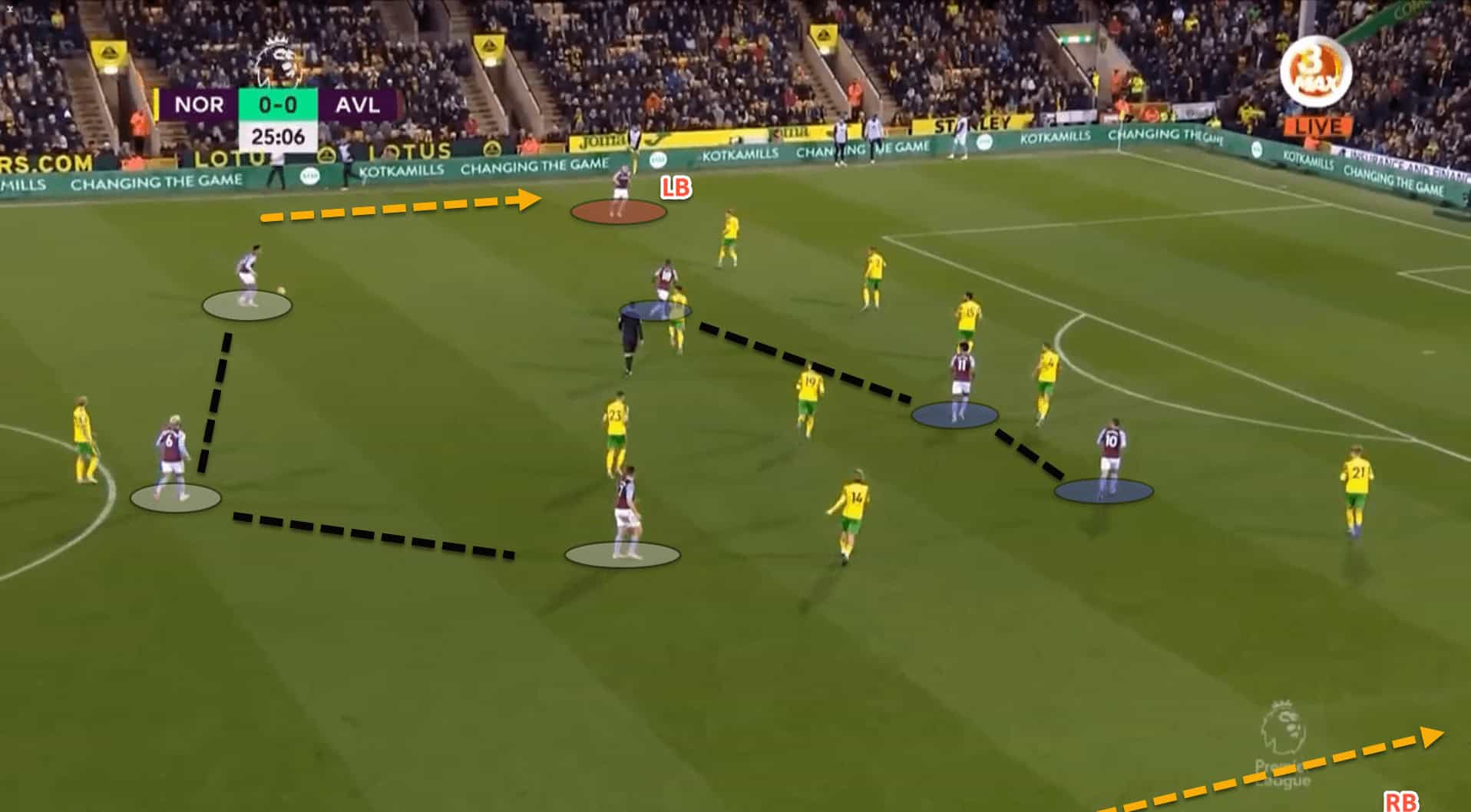
Cash and Targett have provided 1.6 key passes per 90 between them which seems low, but this has been lowered because of their ineffectiveness under Smith.
Against Norwich, this rose to three. At home to Leicester, the pair contributed 2 key passes and then 3 against Brighton in Gerrard’s first match. The only games where the pair did not perform above their average key passes were against Liverpool, Manchester City, and Crystal Palace. It is likely that their goal creation statistics will see a massive upturn under the new manager going off of the evidence available.
Deep line of engagement and central blocking
Under Smith, Villa did try to press high. Nevertheless, the pressing was sporadic, discombobulated and quite inefficient for the most part.
The most notable difference under Gerrard is that Villa are now pressing less and prefer to engage in deeper areas of the pitch with their first line of pressure. While their styles of football may be different, Gerrard has undoubtedly graduated from Rafael Benitez’s school of defending where being ‘compact’ is one of the most important elements to defending in a block.
In actuality, Gerrard has preferred to call this ‘distance’ in his first press conference as the new Villa boss, recognising that the distances between each player in a defensive block must be limited to ensure solidity.
Compactness, or short distances, are evident from Villa’s defensive shape under Gerrard as the team sit in a deep defensive block and engage with their first line of pressure around the halfway line.
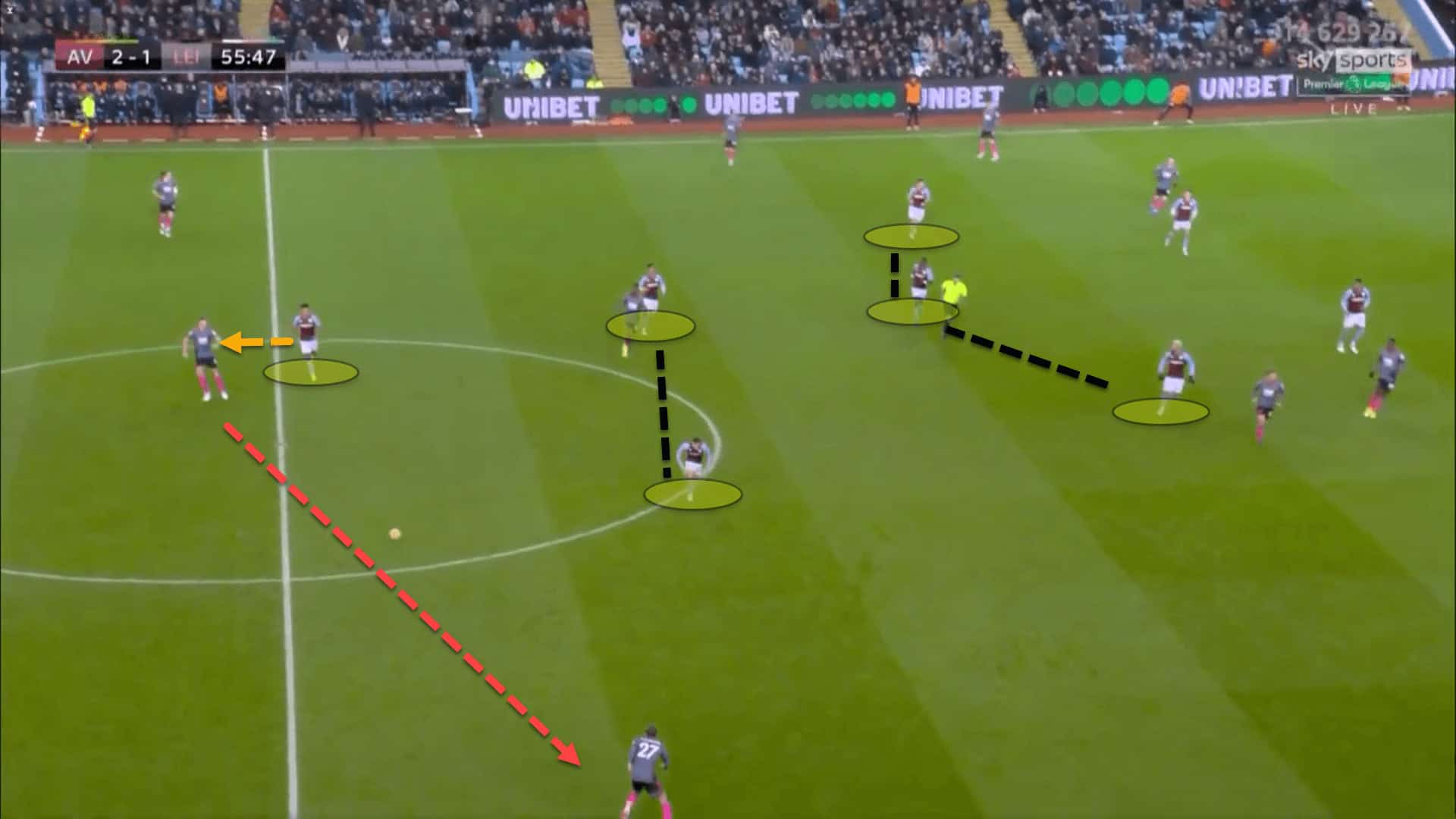
Here, Villa are sitting in their mid-to-low 4-3-2-1 defensive block, allowing Leicester to progress the ball from the goalkeeper up to the halfway line. It is only when the central defender receives the ball on the halfway line does Ollie Watkins begin pressing, shaping his run to force the team in possession out wide.
Villa have averaged 16.36 Passes allowed Per Defensive Action so far under Gerrard, proving how much emphasis there is on staying compact as opposed to trying to win the ball high up the pitch.
Under Smith, earlier in the season, the Villans’ PPDA stood at 10.3. However, Villa’s xGA (expected goals against) under Gerrard has averaged at just 1.06 per 90 across his six games in charge compared to 1.66 this season under Smith. There is clearly a correlation between Gerrard’s defensive tactics being far more competent for this Villa team despite the massive drop-off in pressing.
While sitting in the defensive block, the ‘wingers’ are instructed to deny passes into the opposition’s pivot players, whether they use a double or single pivot.
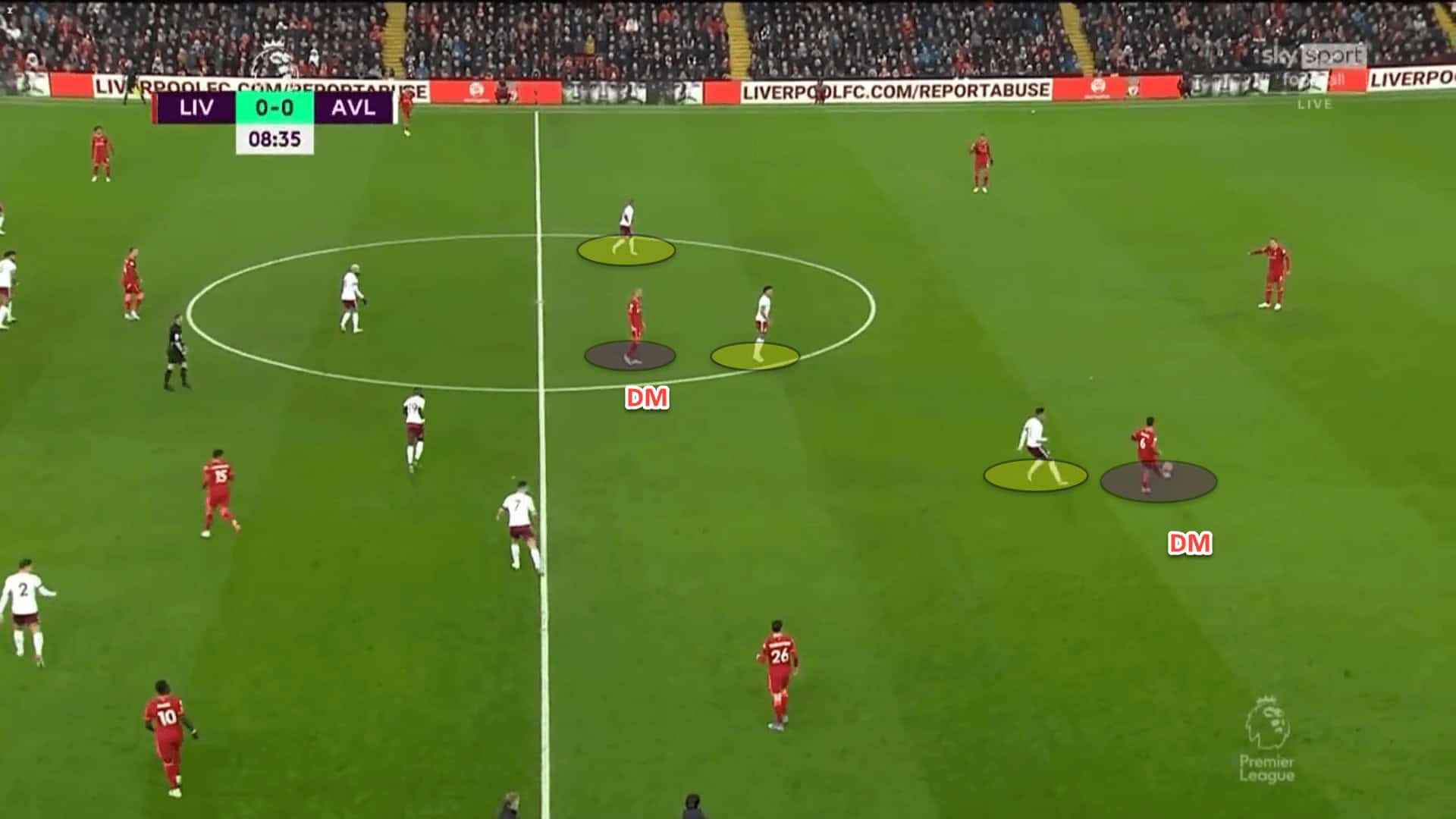
Liverpool use a 3-2 structure against the opposition’s frontline. Villa’s wingers, or inside-forwards, were tasked with marking them and applying pressure when they received the ball in or around the defensive block.
This would force Jurgen Klopp’s side to play out wide which is the area of the pitch that Villa want their opponents to play. Keep the central areas compact and navigate the ball out wide, is the message from Gerrard.
Villa have done this extremely well since he took over and have made it much more difficult for their opponents to break them down. It is also one of the reasons why their xGA per 90 has admirably improved.
Under Smith, the team were being carved open centrally. The central areas of the pitch are where the highest-quality chances come from. By negating this and forcing the opponent wide, it reduces the quality as crosses from the flanks have a notoriously low success rate.
Wide pressing traps and a hardworking midfield
One characteristic of a Steven Gerrard team in a 4-3-2-1 formation is that the midfield must be hard-working. Of course, who better to instil hard work into a midfielder than one of the most infamous in Premier League history?
As already stated earlier in this piece, the wingers do not work the same in a 4-3-2-1 as in a 4-3-3. They remain tucked inside to block off passes to the opposition’s central midfielders.
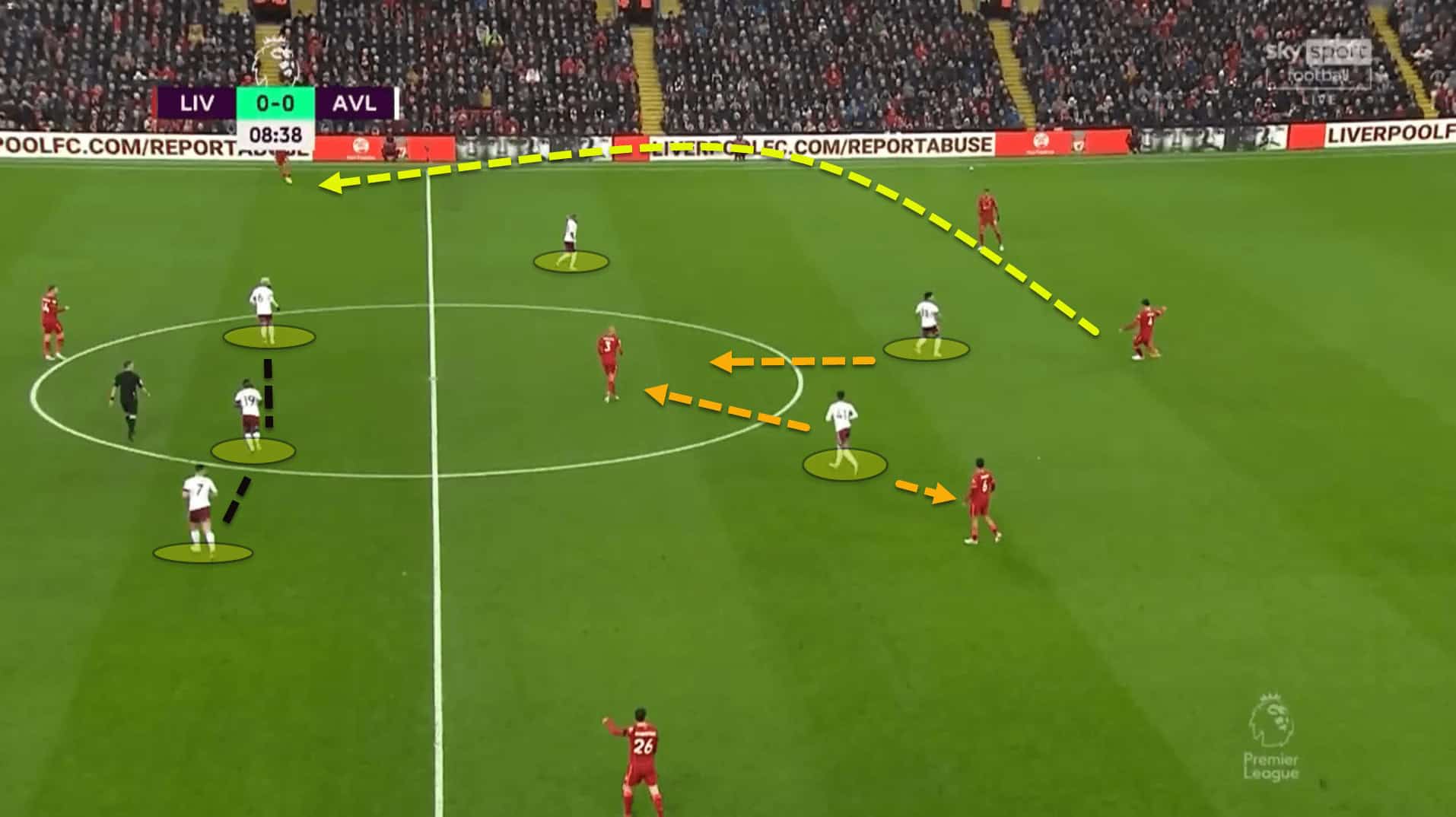
When the ball is played out wide, the nearest central midfielder is instructed to shuttle across and close down the ball carrier. The other two midfielders must then shift across in unison in order to prevent any gaps from opening up in the defensive block through the central areas.

Here, Liverpool have been forced wide to Andy Robertson, their left-back who has pushed high on the flank. Instead of the winger dropping back to mark him, which would typically occur in a 4-3-3 defensive block, the two ‘wingers’ for Villa remain close to Liverpool’s pivot players.
McGinn shuffles across and presses his compatriot instead while Marvelous Nakamba, and Douglas Luiz plug the gap left by the Scottish international. If the ball was switched to the far side, midfield would have to quickly shuffle across to the opposite flank and complete the same task.
Again, here is the emphasis on have short distances between each player, especially in the midfield. Keeping close connections is absolutely vital for the Christmas tree formation to work from a defensive standpoint.

Here are all 76 of Villa’s ball recoveries from Gerrard’s return to Anfield two weeks ago in the 1-0 loss to Liverpool. One noticeable take-away from this data viz is just how many recoveries were in deeper areas out wide as well as how few were high and in the central areas.
Another thing to note is just how many of their central midfielders’ ball recoveries were out in the wide areas from McGinn (7), Nakamba (19) and Luiz (6).
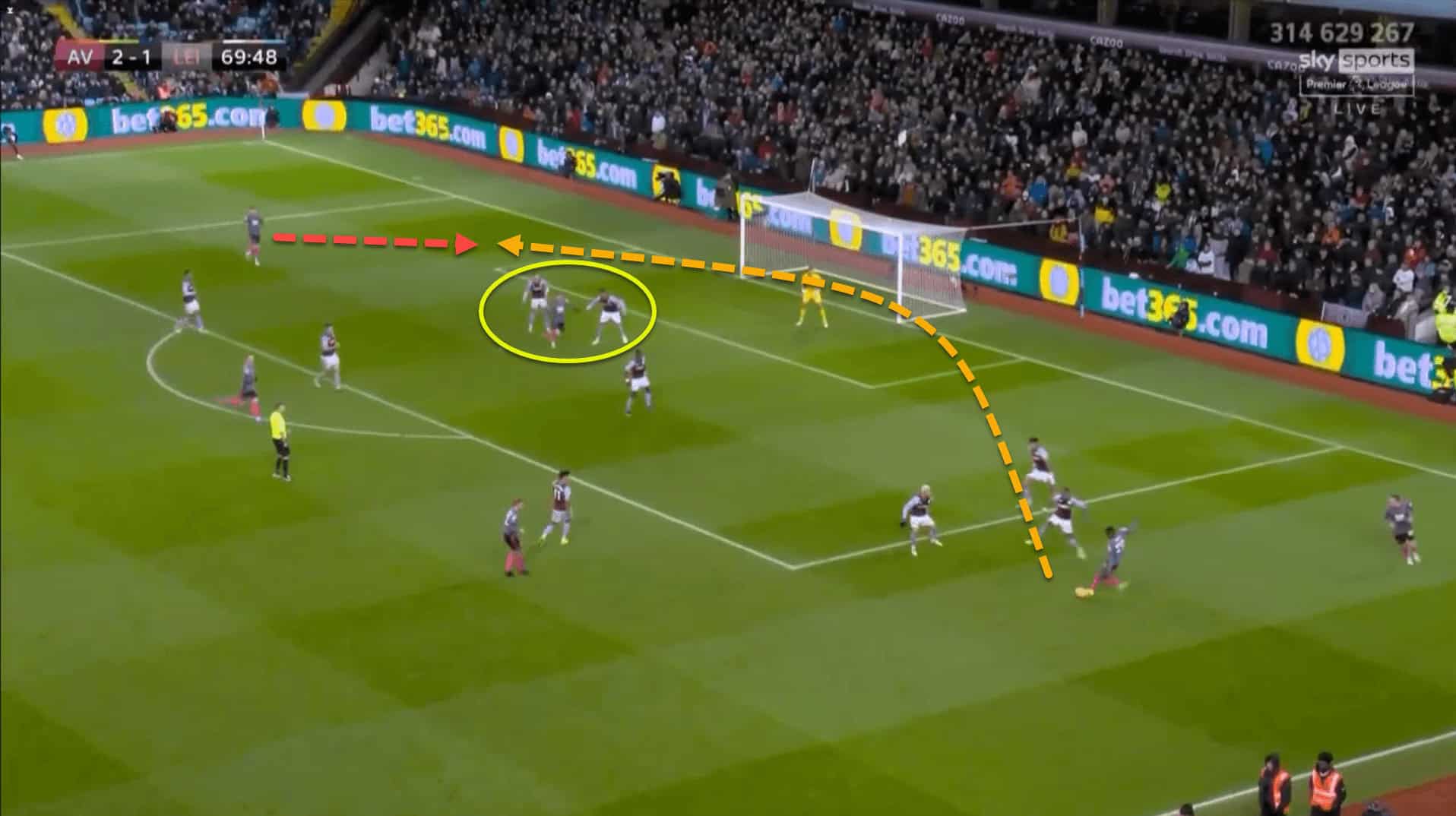
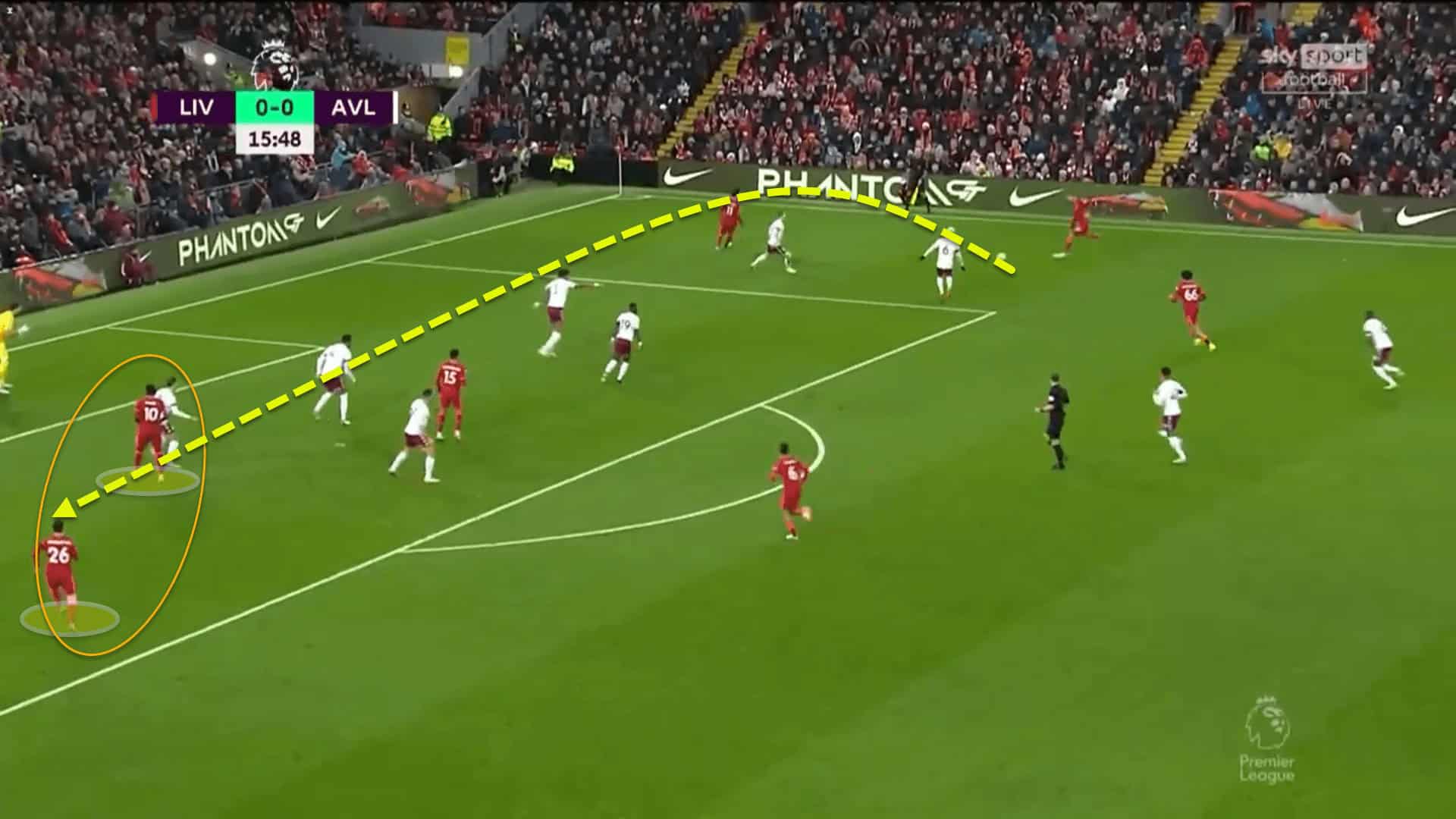
One issue that often comes from Gerrard’s persistent use of the 4-3-2-1 is that it can sometimes leave the ball-far fullback exposed to overloads as the wingers do not drop back to help.
Generally, in most defensive blocks, the wingers will drop alongside the ball-far fullbacks to create a temporary back five in order to prevent an overload on this player. For instance:

Villa’s wingers are not in a position to do this and so the fullback can get outnumbered at the back post which does lead to issues from high crosses at times, particularly if the player arriving to head the ball is potent in the air.
Conclusion
Under Gerrard, Aston Villa have not been the most exciting side in the league, but this matters very little. The former Liverpool and England captain needed to drastically improve Villa’s defensive structure and make them tough to beat.
He’s certainly done that. The Villans are improving in each game under Gerrard and the Englishman has proven himself to be just as tactically astute as he was in Scotland, which is one of the reasons that Rangers could go so deep in Europe on several occasions.
There are exciting times ahead for Villa fans who are now being led by one of the best young coaches in the country.

