Total Football Analysis
  • Football Analysis
    • Data Analysis
    • Formations
      • 2-2-4 Formation
      • 2-3-5 Formation
      • 3-1-4-2 Formation
      • 3-2-2-3 Formation
      • 3-2-4-1 Formation
      • 3-1-6 Formation
      • 3-3-4 Formation
      • 3-4-1-2 Formation
      • 3-4-2-1 Formation
      • 3-4-3 Formation
      • 3-5-1-1 Formation
      • 3-5-2 Formation
      • 4-1-4-1 Formation
      • 4-2-2-2 Formation
      • 4-2-3-1 Formation
      • 4-2-4 Formation
      • 4-3-1-2 Formation
      • 4-3-3 Formation
      • 4-4-2 Formation
      • 4-5-1 Formation
      • 5-3-2 Formation
      • 5-4-1 Formation
      • 6-3-1 Formation
    • Head Coach Analysis
    • Match Analysis
    • Player Analysis
    • Recruitment Analysis
    • Set Piece Analysis
    • Tactical Theory
    • Tactical Preview
    • Team Analysis
    • Training Analysis
    • Tactical Analysis
    • Scouting Report
  • FIFA World Cup 2026
    • World Cup Betting Sites
    • World Cup Betting Promotions
    • World Cup Free Bets
    • World Cup Golden Glove Odds
    • World Cup Top Scorer Odds
    • World Cup Player of the Tournament Odds
  • Competitions
    • English Premier League
    • Champions League
    • La Liga
    • Bundesliga
    • Serie A
    • Ligue 1
    • Eredivisie
    • EFL Championship
    • Women’s Super League
    • NWSL
    • Belgian First Division A
    • A-League
    • Liga Profesional de Argentina
    • Austrian Bundesliga
    • Campeonato Brasileiro Série A
    • DFB Pokal
    • 1. HNL
    • Danish Superliga
    • EFL League One
    • EFL League Two
    • FA Cup
    • EFL Cup
    • Indian Super League
    • K-League
    • J1 League
    • Liga MX
    • Copa del Rey
    • MLS
    • Eliteserien
    • Allsvenskan
    • Primeira Liga
    • Scottish Premiership
    • Europa League
    • UEFA Nations League
    • Liga AUF Uruguaya
  • Coaches
    • All Coaches
    • Alfred Schreuder
    • Ange Postecoglou
    • Antonio Conte
    • Arne Slot
    • Bo Svensson
    • Brendan Rodgers
    • Bruno Lage
    • Carlo Ancelotti
    • Christophe Galtier
    • Claude Puel
    • Claudio Ranieri
    • David Moyes
    • Dean Smith
    • Diego Simeone
    • Domenico Tedesco
    • Frank Lampard
    • Eddie Howe
    • Edin Terzić
    • Emma Hayes
    • Erik ten Hag
    • Ernesto Valverde
    • Gennaro Gattuso
    • Gerardo Seoane
    • Gian Piero Gasperini
    • Giovanni van Bronckhorst
    • Graham Potter
    • Igor Tudor
    • Imanol Alguacil
    • Jesse Marsch
    • Jonas Eidevall
    • Jorge Sampaoli
    • José Bordalás
    • José Mourinho
    • Julien Stéphan
    • Julen Lopetegui
    • Julian Nagelsmann
    • Jürgen Klopp
    • Luciano Spalletti
    • Lucien Favre
    • Manuel Pellegrini
    • Marcelo Bielsa
    • Marco Rose
    • Marco Silva
    • Massimiliano Allegri
    • Mauricio Pochettino
    • Maurizio Sarri
    • Mikel Arteta
    • Niko Kovač
    • Nuno Espírito Santo
    • Oliver Glasner
    • Patrick Vieira
    • Paulo Fonseca
    • Pep Guardiola
    • Peter Bosz
    • Rafa Benítez
    • Ralf Rangnick
    • Ralph Hasenhüttl
    • Roger Schmidt
    • Roy Hodgson
    • Sean Dyche
    • Sérgio Conceição
    • Simone Inzaghi
    • Sonia Bompastor
    • Stefano Pioli
    • Steffen Baumgart
    • Steven Gerrard
    • Thiago Motta
    • Thomas Frank
    • Thomas Tuchel
    • Unai Emery
    • Vincenzo Italiano
    • Xavi
  • Teams
    • ALL Teams
    • AC Milan
    • Ajax Amsterdam
    • Arsenal
    • AS Monaco FC
    • Atalanta
    • Atlético Madrid
    • FC Barcelona
    • FC Bayern Munich
    • Borussia Dortmund
    • Celtic FC
    • Chelsea FC
    • Everton F.C.
    • Inter Milan
    • Juventus F.C.
    • Leeds United F.C.
    • Liverpool FC
    • Manchester City
    • Manchester United FC
    • Paris Saint-Germain
    • Rangers FC
    • RB Leipzig
    • Real Madrid CF
    • Tottenham Hotspur
    • West Ham United
  • Players
    • ALL Players
    • Alisson Becker
    • Bukayo Saka
    • Erling Haaland
    • Harry Kane
    • Jack Grealish
    • John Stones
    • Kevin De Bruyne
    • Julián Alvarez
    • Kalvin Phillips
    • Kyle Walker
    • Kylian Mbappé
    • Luis Díaz
    • Lamine Yamal
    • Mohamed Salah
    • Lionel Messi
    • Virgil Van Dijk
    • Phil Foden
  • Guides
    • Betting Sites
      • Betting Apps
      • Betting Bonuses
      • Betting Exchanges
      • Betting Sites Not on GamStop
      • Cash Out Betting Sites
      • Crypto Betting Sites
      • European Bookmakers
      • Footbal Betting Sites
      • Free Bets
      • New Betting Sites
      • No KYC Betting Sites
      • Live Betting Sites
    • Online Casinos
      • Casino Apps
      • Credit Card Casinos
      • Crypto Casinos
      • Fast Payout Casinos
      • Non GamStop Casinos
      • Offshore Casinos
      • Slots Casinos
      • Irish Online Casinos
    • International
      • Betting Sites Ireland
  • Contact
No Result
View All Result
No Result
View All Result
Total Football Analysis
No Result
View All Result
Home Analysis

Ryan Lowe Tactics At Plymouth Argyle 2021/2022 – Blending Direct And Possession-Based – Tactical Analysis

Adam Scully by Adam Scully
October 16, 2021
in Analysis, Bury FC, EFL League One, Jordan Houghton, Plymouth Argyle FC, Ryan Broom, Ryan Lowe, Tactical Analysis, Team Analysis
0
How Ryan Lowe has managed to blend direct and possession-based football to make Plymouth Argyle title contenders - tactical analysis

At Bury Football Club during the 2018/19 season, word began to spread about Ryan Lowe, the manager at the time of the now-dissolved club.

Lowe had managed to get Bury promoted.

Bury boasts a very attack-minded style of football that has been said to be influenced by some of the world’s greatest coaches, including Jurgen Klopp, Rafael Benitez, and Pep Guardiola.

Bury were League Two’s highest-scoring team, finishing second and earning promotion before Plymouth Argyle poached Lowe.

Lowe guided the team to third place in his debut campaign with the Pilgrims, earning automatic promotion to League One.

In the 2020/21 season, Plymouth was finding its feet in a higher-quality league and ended the year in a respectable 18th place in the third-tier table.

Nonetheless, Lowe’s men have hit the ground running in the current campaign and are now sitting pretty at the top after twelve matches.

What’s more impressive is that Plymouth Argyle are on the second-longest unbeaten run in English league football at the moment, spanning 11 matches as of writing, with only Liverpool besting this record.

It is still early days, but the fans will certainly be happy with the team’s current form.

However, what is even more impressive is Plymouth’s style of play under Lowe.

This article will be a tactical analysis of the Pilgrims under their Merseyside-born head coach, presented as a team scout report.

It will analyze the team, with a heavy focus on Plymouth’s tactics and principles of play in possession.

Formation and Lineup

Plymouth Argyle have mainly utilised a 3-5-2 formation in all competitions this season.

Of course, in the defensive phases, this collapses into a 5-3-2 with the wingbacks dropping alongside the three centre-backs.

The 3-5-2/5-3-2 has been used in 92 percent of the Pilgrims’ matches this season, although Lowe has also deployed a 3-1-4-2 in certain games, such as the 2-2 draw with Lincoln City at the Sincil Bank Stadium.

How Ryan Lowe has managed to blend direct and possession-based football to make Plymouth Argyle title contenders - tactical analysis

Plymouth underwent severe surgery to their squad during the summer transfer window as lower-league clubs tend to do.

Quite a lot of their first-team players this summer were brought in on free transfers.

Plymouth’s entire backline was newly recruited in the recently shut summer market.

Brandon Galloway, Macaulay Gillesphey, James Wilson, and Dan Scarr were all brought to Home Park on free transfers, whilst Jordan Houghton, Plymouth’s new number ‘6’ in midfield, was also bought for free, according to Transfermarkt.

Midfielder Ryan Broom moved to Plymouth on a loan deal from Peterborough United, as well as Jordon Garrick from Swansea City, whilst Kieran Agard was brought in as a free agent following his release from MK Dons after five years with the Buckinghamshire club.

Lowe has predominantly used the same starting lineup this season.

How Ryan Lowe has managed to blend direct and possession-based football to make Plymouth Argyle title contenders - tactical analysis

Building through the thirds with a back three

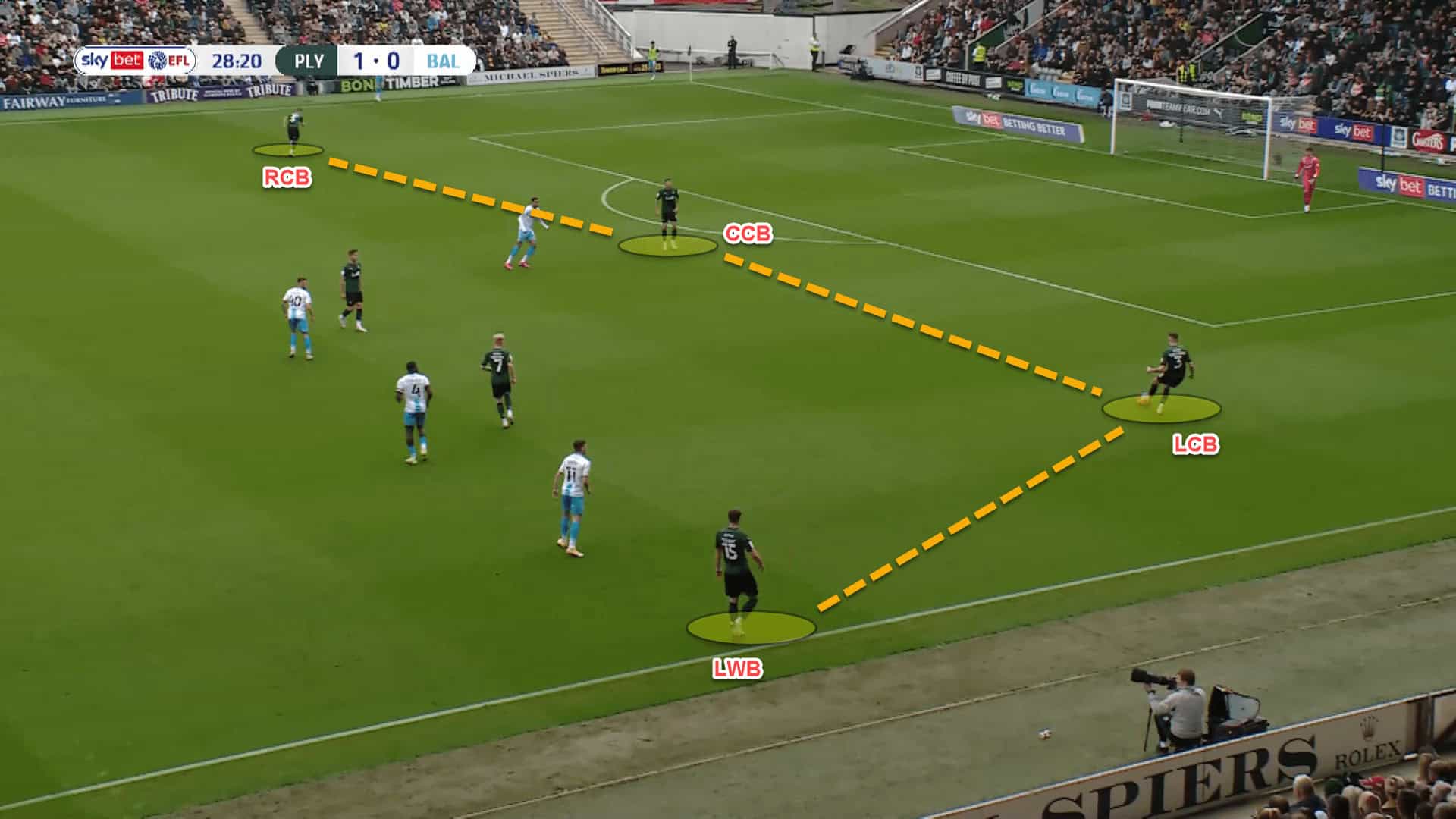
When Plymouth has the ball in deeper areas of the pitch, the centre-backs split very wide to cover the field’s width.

This allows the Pilgrims to stretch the opposition’s press as they will have more ground to cover when pressing.

It also allows the wide central defenders to link up with the wingbacks and create clean and easy progression.
How Ryan Lowe has managed to blend direct and possession-based football to make Plymouth Argyle title contenders - tactical analysis

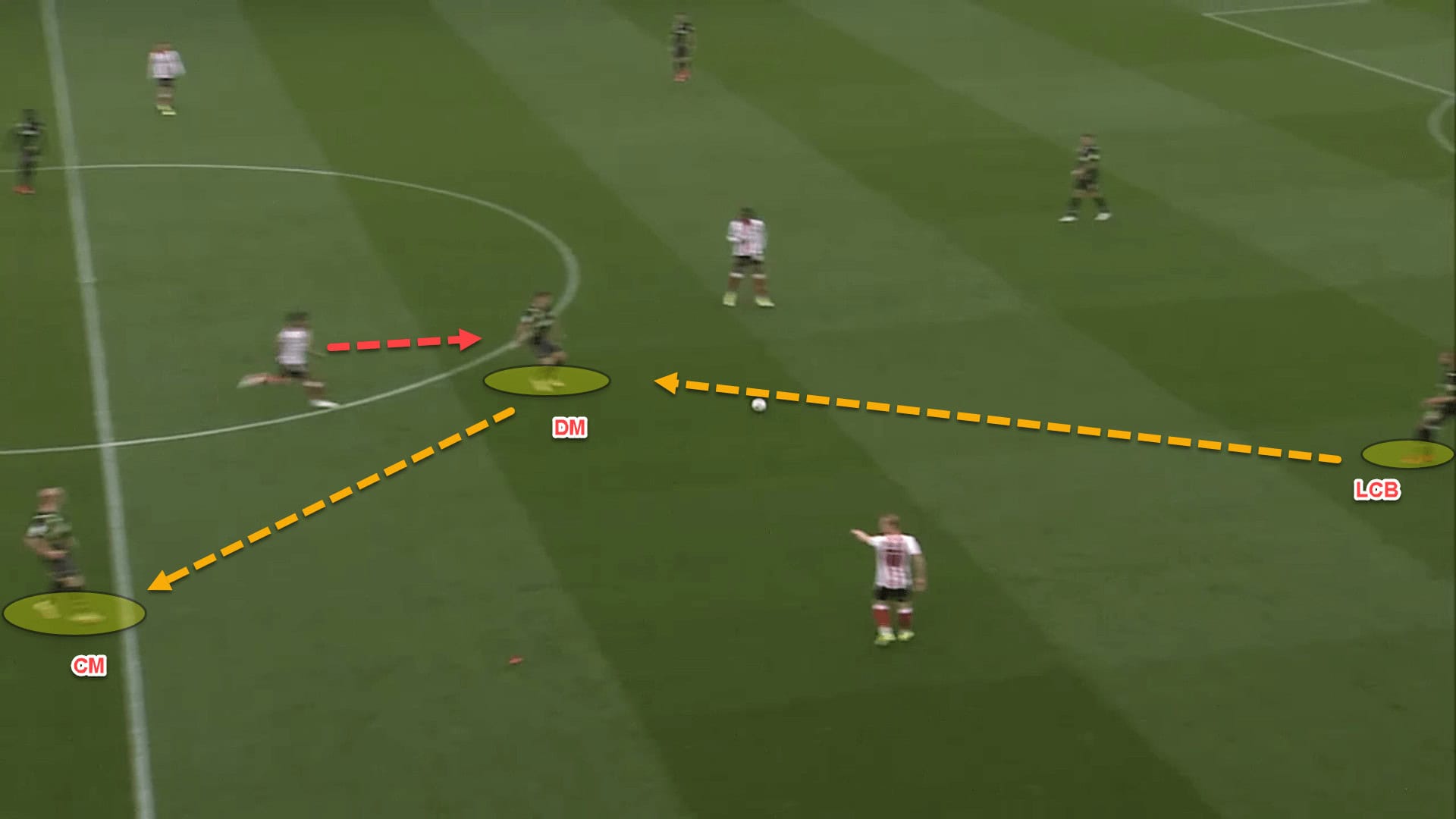
Generally, in this phase, Plymouth uses just one single pivot in front of the backline, which sits behind the opposition’s first line of pressure.

This allows Lowe’s men to essentially have a player they can use as a ‘wall pass’ to play inside to.

The ‘6’ can then circulate the ball around to the other side or else pass it back to the player who originally played it to him.

This constantly moves the opposition while the Pilgrims look to break through the press eventually.

As stated in the previous section, this player has been Houghton, who has been trusted in the single-pivot role so far this season.

How Ryan Lowe has managed to blend direct and possession-based football to make Plymouth Argyle title contenders - tactical analysis

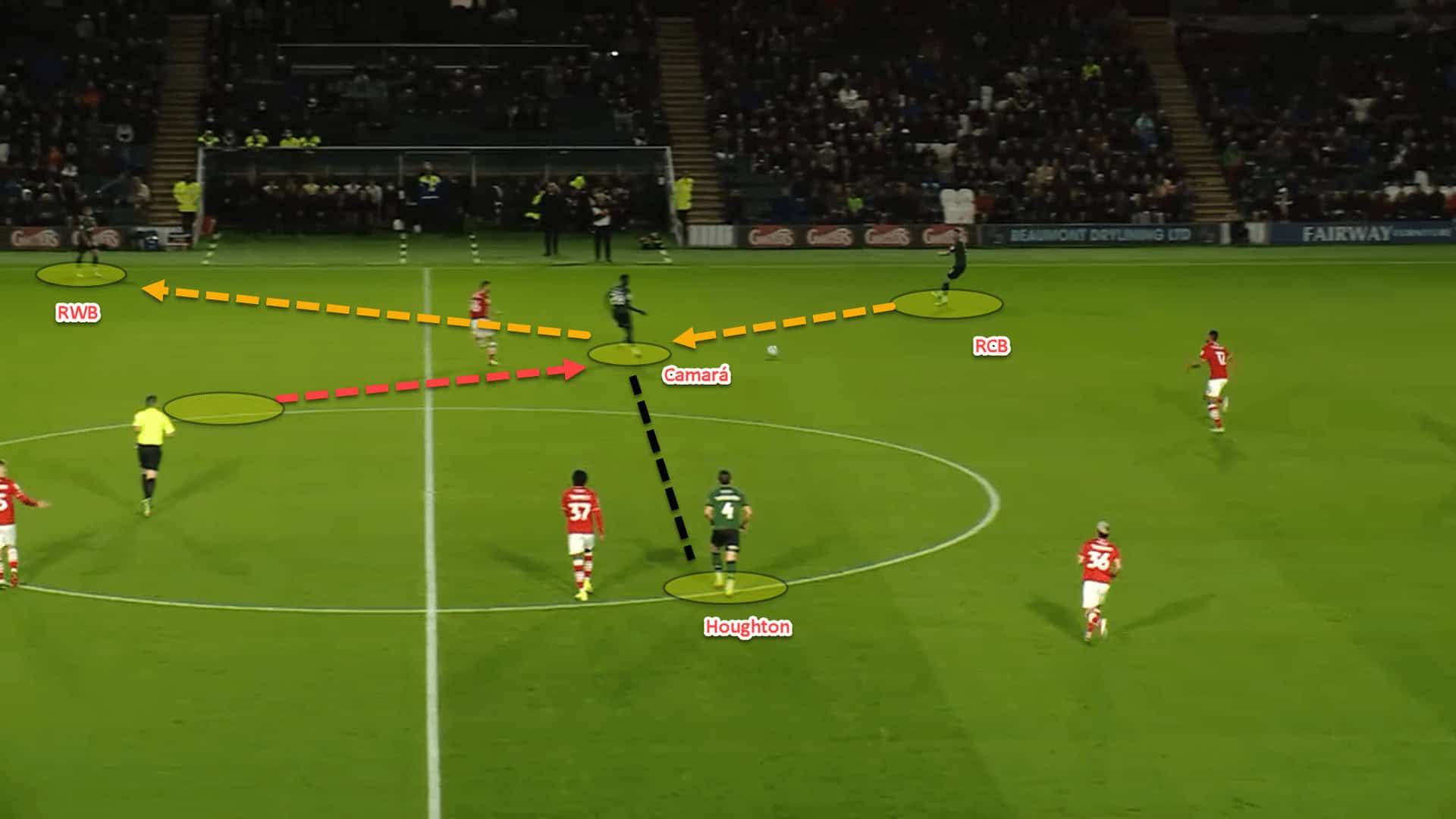
Here, the right centre-back has played into Houghton’s feet, which has triggered Burton Albion’s number 10 to put pressure on him.

Instead of taking a touch or trying to turn on the ball, Houghton simply plays it out wide first-time to the right wingback which allows Plymouth to advance higher up the pitch.

However, Houghton does not always simply look to move the opposition by playing intelligent first-time passes to the centre-backs and wingbacks.

At times, he has shown himself to be very capable of progressing the ball centrally by holding off a player who is putting pressure on him from behind and then eventually either turning him on the ball or else slipping a more advanced player in behind.
How Ryan Lowe has managed to blend direct and possession-based football to make Plymouth Argyle title contenders - tactical analysis

Sometimes, ball progression up the pitch from deeper areas will be more difficult if the opponent’s high block is very dogged.

If this happens, either Broom or Panutche Camará will drop alongside Houghton to give the centre-backs an extra option.

While there would be one less player higher up the pitch, the increased personnel in deeper areas can facilitate easy ball progression.
How Ryan Lowe has managed to blend direct and possession-based football to make Plymouth Argyle title contenders - tactical analysis

Plymouth’s average positions map proves how their midfield tends to operate.

One defensive midfielder sits very deep as the double-pivot, one is pushed really high, operating in the halfspaces, and one tends to sit slightly deeper, dropping deep but can also push high, depending on the situation.

Here are the average positions of Plymouth’s players from a recent 2-2 draw with Lincoln City.

How Ryan Lowe has managed to blend direct and possession-based football to make Plymouth Argyle title contenders - tactical analysis As can be seen from the data visualisation, the midfield operates as a stereotypical ‘6’,’8’,’10’ midfield with the three players all operating in different horizontal and vertical lines most of the time.

This aids with some nice and clean ball progression from deeper pitch areas.

Plymouth are very astute at this, and Ryan Lowe’s side have averaged 70.25 progressive passes per 90 minutes, which is one of the highest in League One.

How Ryan Lowe has managed to blend direct and possession-based football to make Plymouth Argyle title contenders - tactical analysis

Use of wingbacks and long balls to reach the final third

While the team plays some really exciting and expansive football, what makes Plymouth Argyle’s system in possession very interesting is just how directly they can play.

Plymouth are currently averaging just 3.47 passes per possession.

Putting this into perspective, League One’s average is 3.89, so Lowe’s are quite a bit below the mean, which implies that Plymouth tends to try and play up the pitch as quickly as possible when in possession of the ball.

The two main ways that the Pilgrims look to reach the final third are by using the wingbacks to create combination play on the flanks, by playing direct through balls into the channels, or by playing along to the centre-forwards and trying to win the second balls.

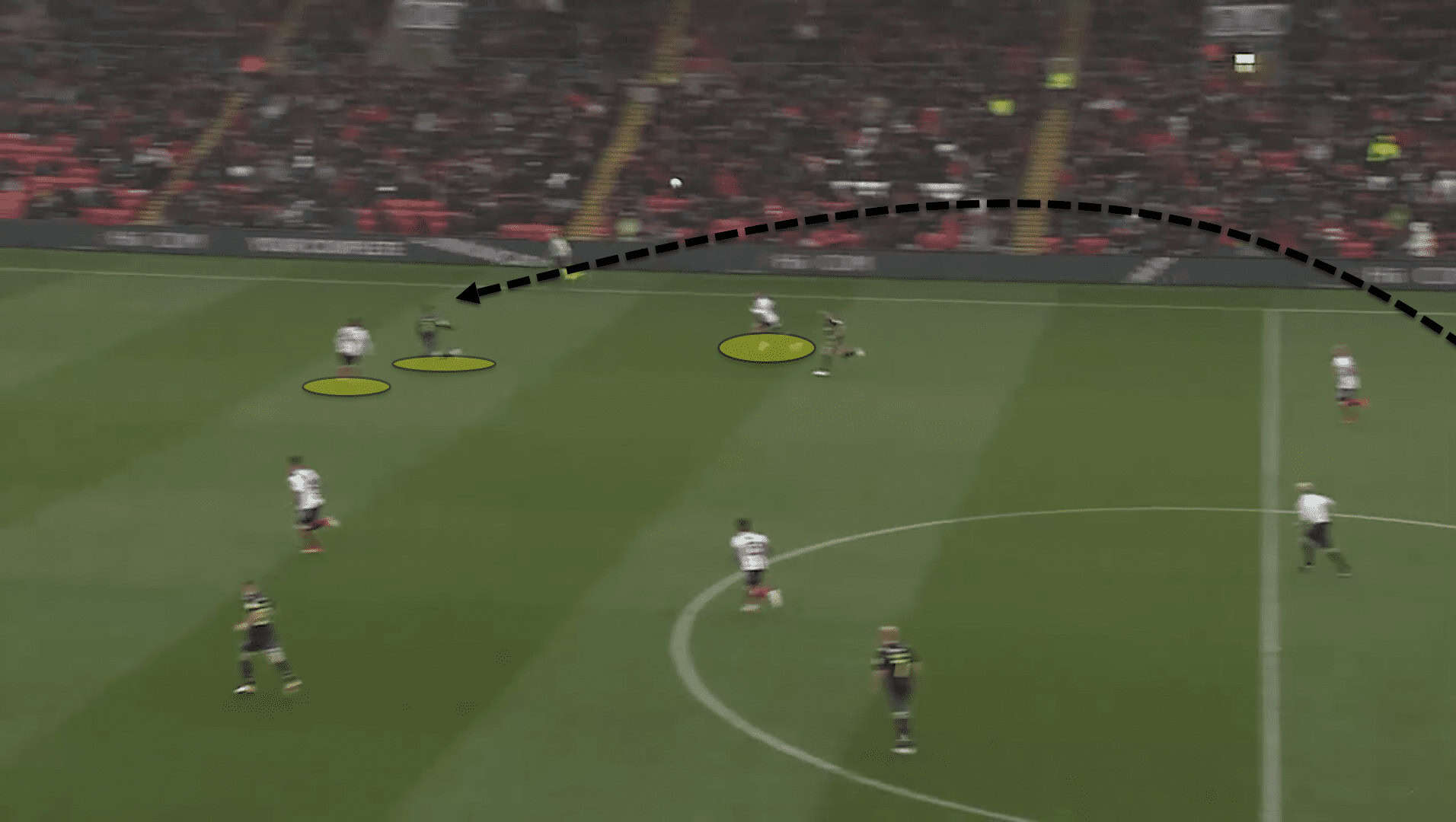
If the defending team’s press is difficult to bypass, Plymouth will try to play directly into the channels.

In this respect, the two centre-forwards sometimes operate as split-strikers, similar to how Manchester United played during Ole Gunnar Solskjaer’s spell as caretaker manager, which proved very successful.

The definition of running into the channels in this respect refers to when a striker attacks the depth of the pitch between the opponent’s fullback/wingback and nearest central defender.
How Ryan Lowe has managed to blend direct and possession-based football to make Plymouth Argyle title contenders - tactical analysis

This is a really efficient way of reaching the final third when it is done with precision instead of merely hopeful punts up the field as quite a lot of teams at this level tend to do.

It must be done when the opponent is pressing high, though, in order to reach maximum efficiency.

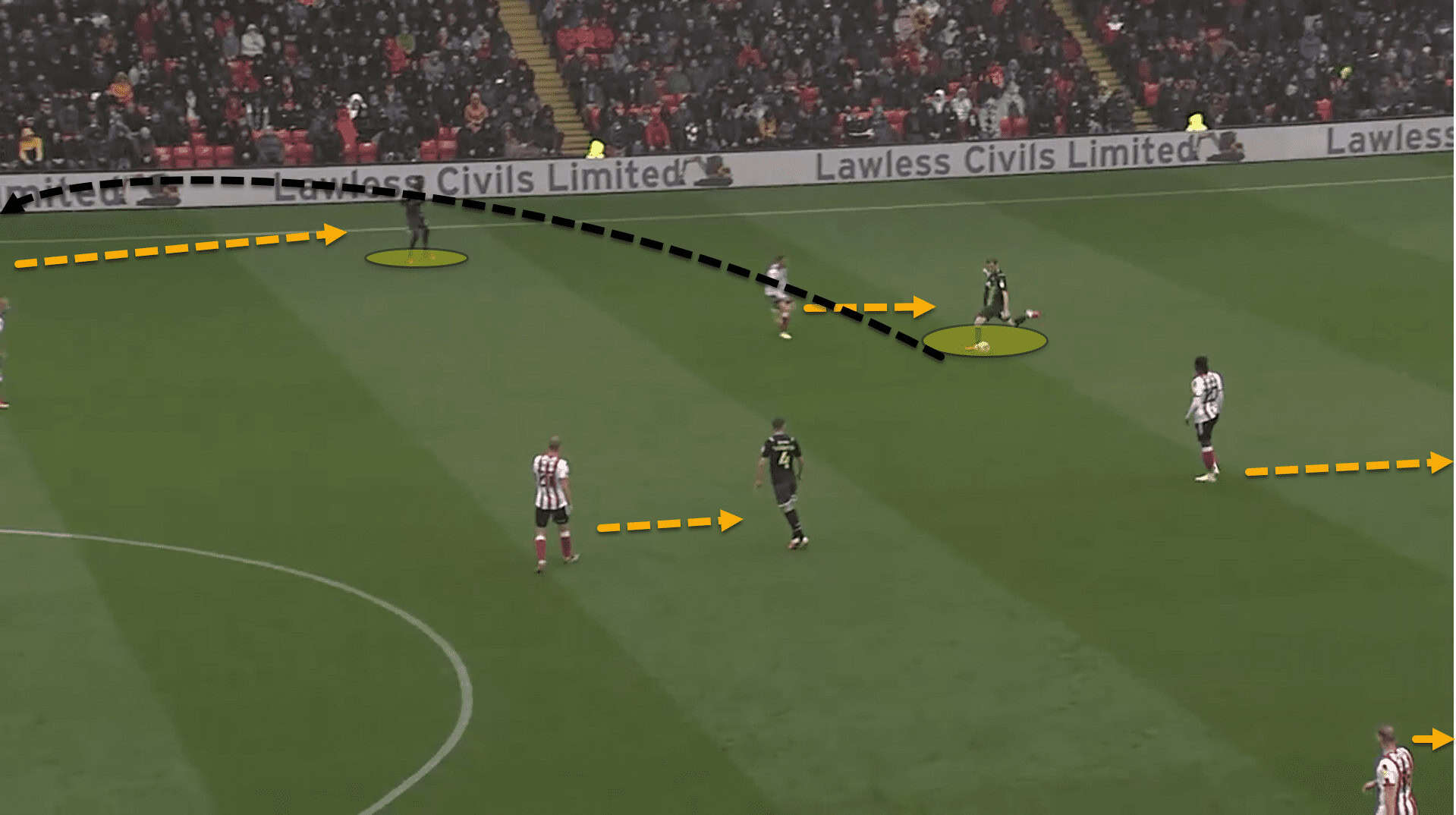
When the defending team is pressing in a high block, their fullbacks push with the two central defenders near the halfway line.

In the image above, Lincoln are pressing high with their midfield, forward line, and fullbacks.
How Ryan Lowe has managed to blend direct and possession-based football to make Plymouth Argyle title contenders - tactical analysis

The Imps’ backline has pushed right up in coordination with the midfield and forward line, leaving space for Plymouth’s centre-forwards to attack into.

Lowe’s centre-backs all have very solid passing ranges, so going long is a really good option for them in times of trouble.

They can reach the final third quickly and look to create goalscoring opportunities.

These long balls are not always in behind the opposition’s backline into space for the forwards to run onto.

At times, they can also be direct to the centre-forwards’ heads to challenge in the air.

From there, players will push and create a nice support system under the ball to try and win the second ball.

Unfortunately, Plymouth is not overly proficient in its aerial duels.

It contests a total of 43.93 aerial duels per 90, winning just 43.3 percent.

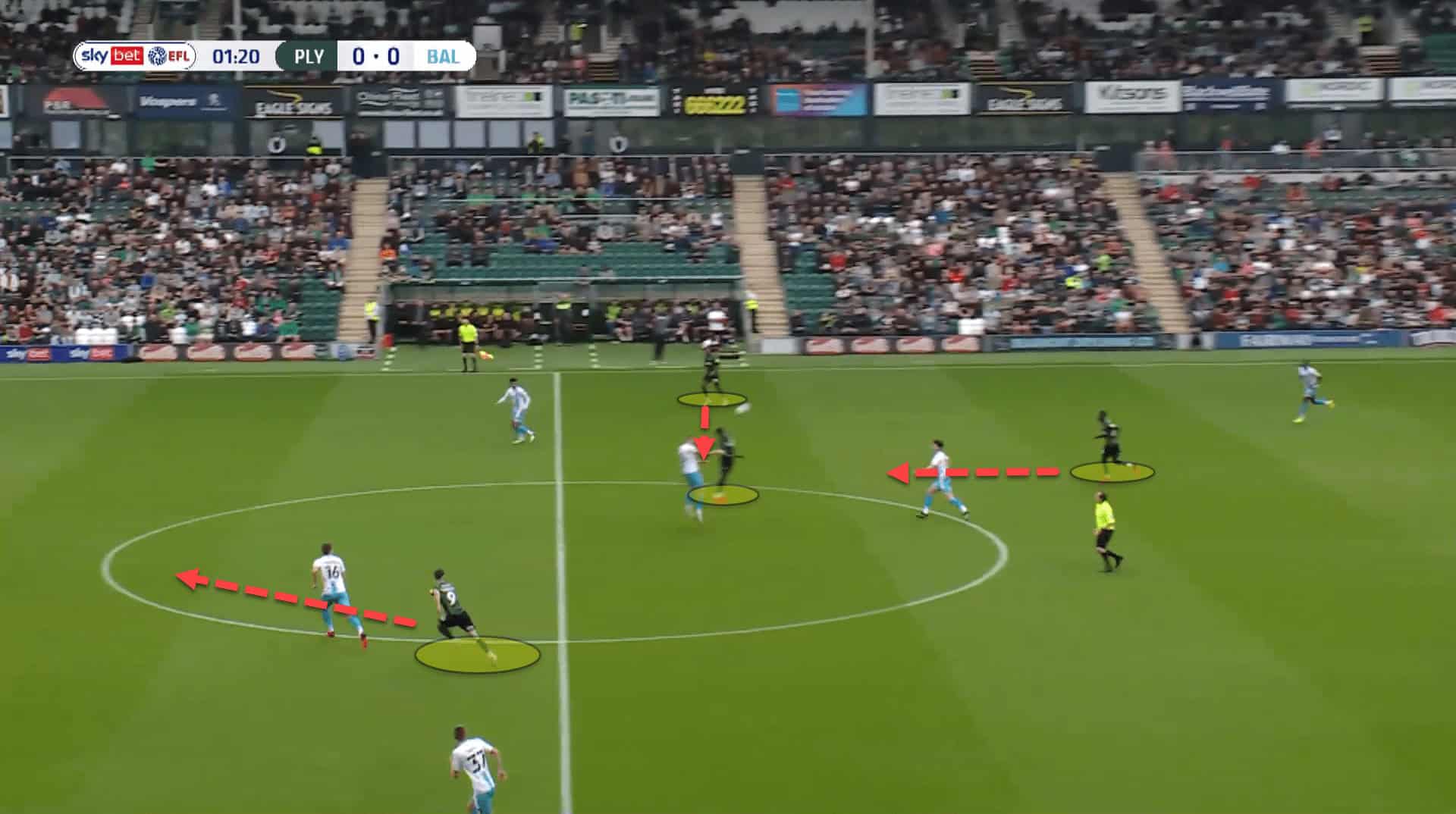
Regardless, when going long, winning the first contact duel is not so important as the second.

Lowe’s men are very good at winning the second balls and always have at least two players under the ball to win the knockdown and one running behind to attack the flick-on.
How Ryan Lowe has managed to blend direct and possession-based football to make Plymouth Argyle title contenders - tactical analysis

From here, providing that the second ball is won, Plymouth can begin attacking an exposed opposition backline with numbers and transition quickly up the field.

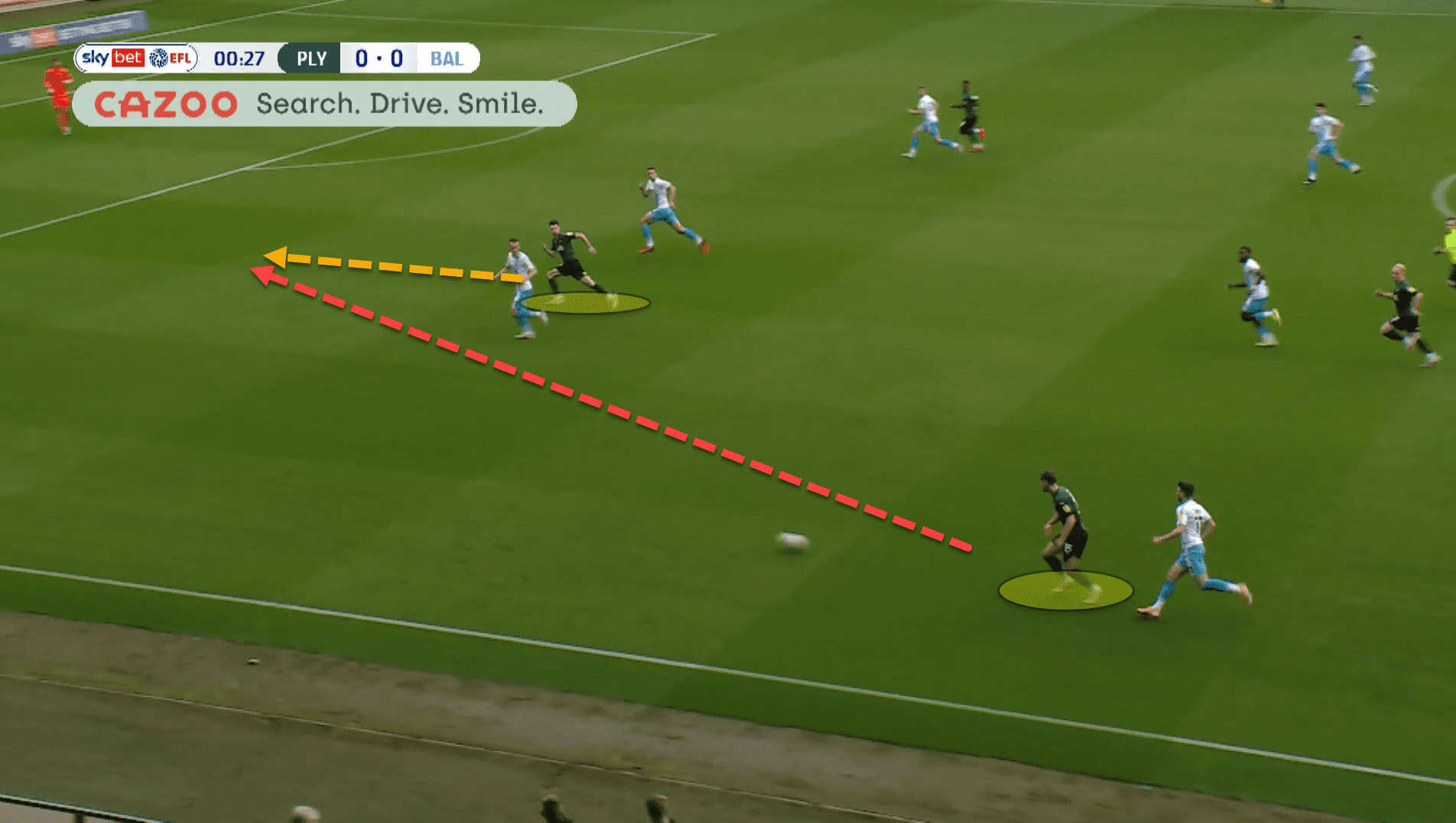
A lot of progression to the final third also comes through the wingbacks.

This is generally done from them playing the ball into channels once more to centre-forwards attacking the depth when the defending team have committed men up the pitch in the press.
How Ryan Lowe has managed to blend direct and possession-based football to make Plymouth Argyle title contenders - tactical analysis

The following image is an example of Plymouth Argyle’s most used final third entries from a recent game against Burton in League One, which backs up the points discussed in this section.

How Ryan Lowe has managed to blend direct and possession-based football to make Plymouth Argyle title contenders - tactical analysis

Final third play

Like their final third entries, Plymouth often try to play through balls behind the opposition’s defensive line to create solid goalscoring opportunities.

Lowe’s side currently play the seventh-highest number of through balls in League One out of the 24 teams in the division.

Plymouth are averaging 6.41 through passes per 90 with an accuracy of 35.3 percent.

How Ryan Lowe has managed to blend direct and possession-based football to make Plymouth Argyle title contenders - tactical analysis

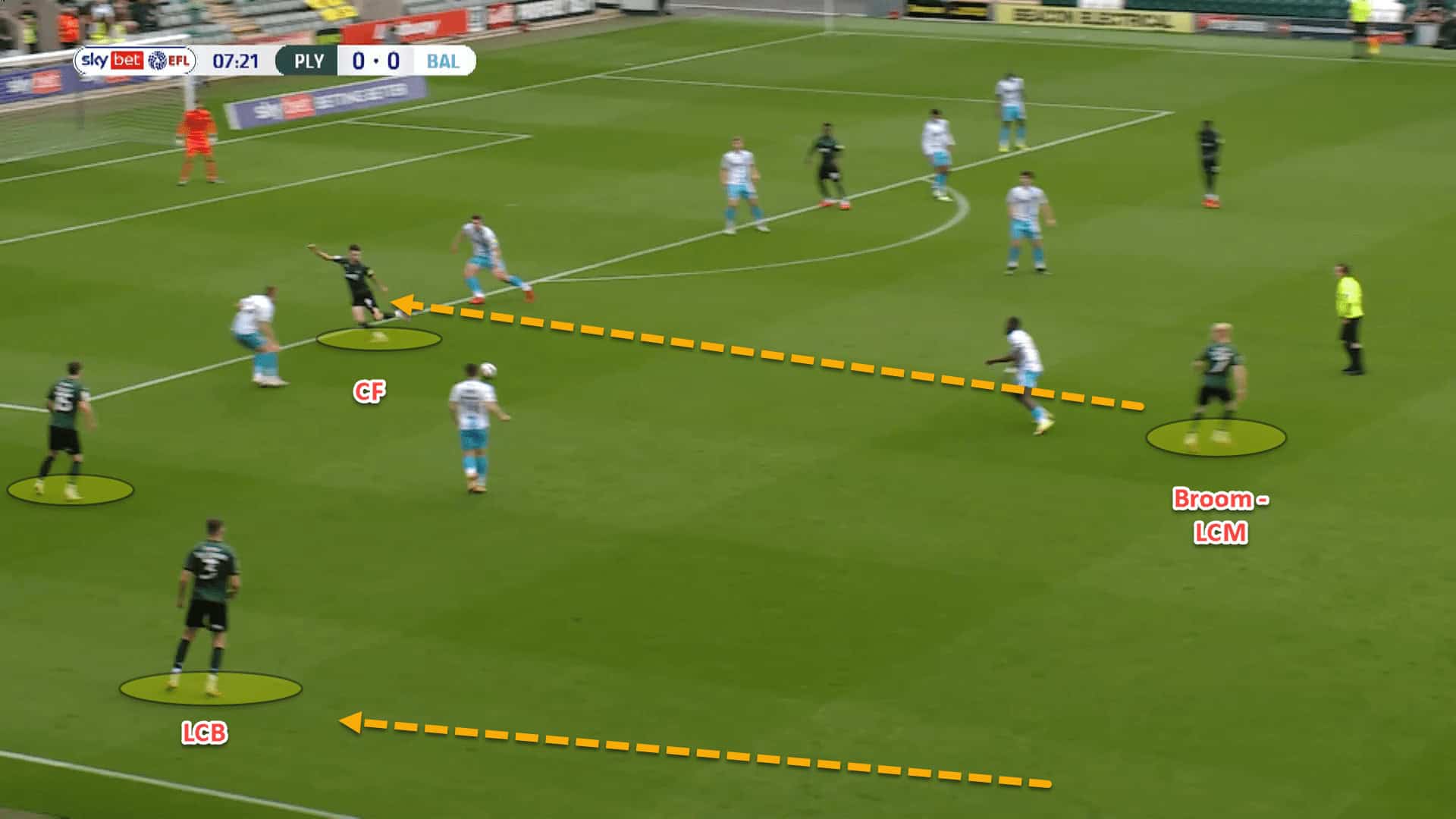
Ryan Broom is very important to do this.

The midfielder, who plays in the left halfspace, has an impressive ability to break opposition lines with eye-of-the-needle through balls.
How Ryan Lowe has managed to blend direct and possession-based football to make Plymouth Argyle title contenders - tactical analysis


Here, Broom is positioned in the left halfspace and has found the run of the centre-forward in the space between Burton’s fullback and centre-back.

This sets the striker through on goal and into a great position to score.

What makes this possible, though, is the stretching of Burton’s midfield line due to the advancement of the left centre-back, Gillesphey.

Because of this, the defending team’s midfield line is stretched wider, which allows Broom to gently thread a lovely pass through into a very dangerous area, although nothing comes from the attack in the end.

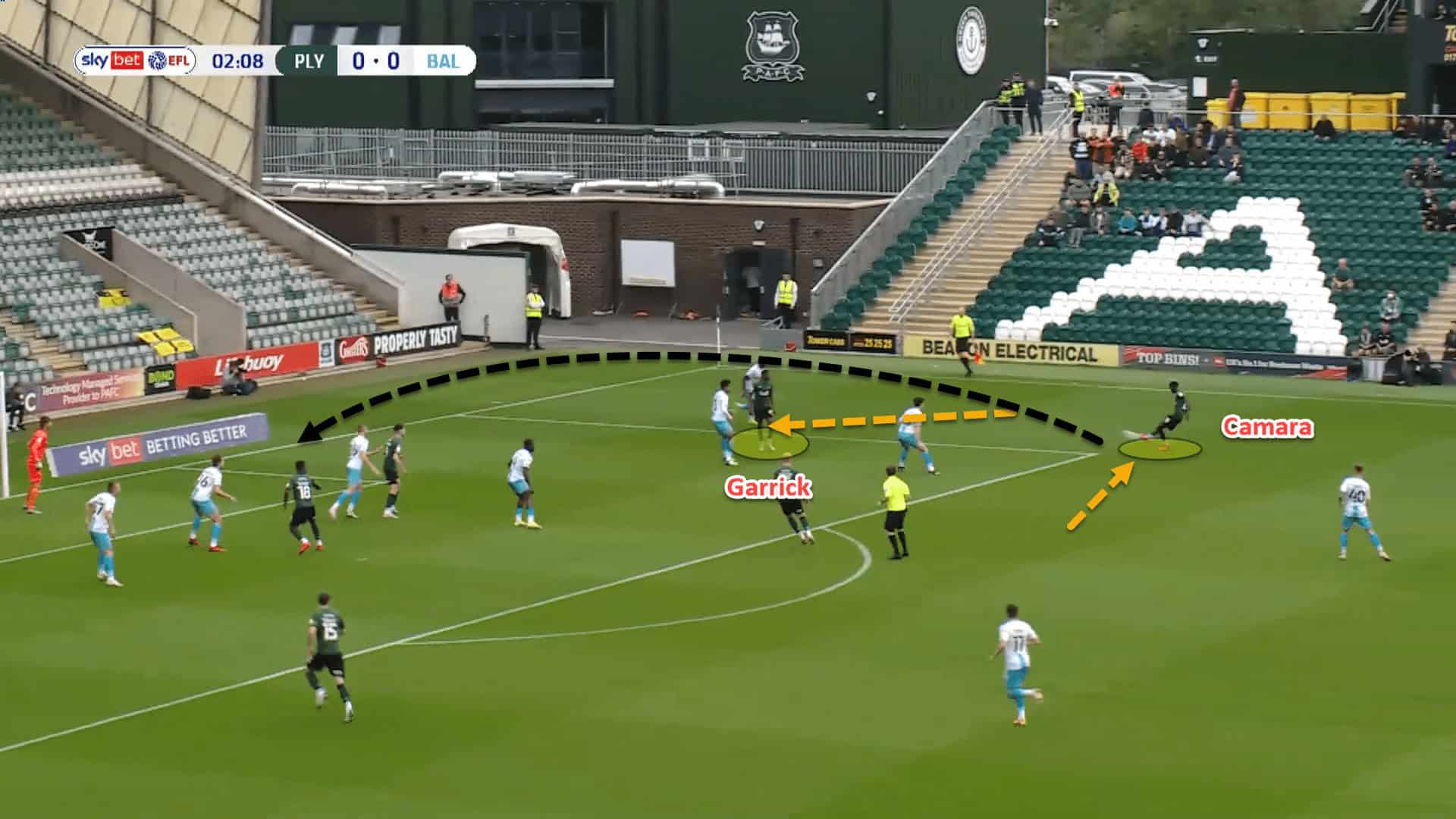
Another way Plymouth can look to score chances in their positional attacks is by putting crosses in the box.

Generally, to do this, the ball-near central midfielder and wingback rotate and link up to supply the box into the box.
How Ryan Lowe has managed to blend direct and possession-based football to make Plymouth Argyle title contenders - tactical analysis

Here, Garrick has made a run forward into the box, which has dragged Burton’s defending players deeper and pinned them.

Seeing the space, Camara has drifted over to the right flank, completing the wide rotation, and put a decent ball into the area.

Plymouth are currently averaging the fifth-highest number of crosses per 90 with 16.66 and an accuracy of 36.2 percent.

How Ryan Lowe has managed to blend direct and possession-based football to make Plymouth Argyle title contenders - tactical analysis

Conclusion

Plymouth is far from perfect, but they are undoubtedly one of the most exciting and interesting teams in England from the perspective of a football fan and even an analyst.

The lower leagues in English football are rapidly modernising.

They are moving away from the old-school long ball and physical styles of play to more expansive and attacking football, with teams even using positional play systems.

Plymouth is an example of this.

While the Pilgrims’ impressive unbeaten run in the league may not continue, Ryan Lowe’s tactics deserve massive credit for turning them into title contenders in the first place.

If you can watch them live on TV or in person, it will be 90 minutes well spent.

Previous Post

Lazio vs Inter preview: How can Inzaghi control his ex-players’ movement to defend against the Sarriball – tactical analysis

Next Post

The next Maya Yoshida: Finding the best centre-backs in Asia – data analysis

Next Post
Finding the best centre-backs in Asia - data analysis statistics

The next Maya Yoshida: Finding the best centre-backs in Asia - data analysis

Match ball on centre spot of floodlit pitch at dusk, geometric shadows, stadium lighting, cool-blue and warm-gold atmospheric haze.

Germany vs Curaçao Prediction: World Cup 2026 Preview & Best Bets

June 11, 2026
Floodlit football pitch at dusk with match ball on penalty spot, dramatic stadium shadows, cool-warm colour grade.

Netherlands vs Japan Prediction: World Cup 2026 Preview & Best Bets

June 11, 2026
Overhead stadium view during evening kickoff: floodlit pitch, mixed-nation crowd colours, match ball on halfway line, dramatic shadows.

World Cup 2026 Group H Winner: Odds, Predictions & Best Bets

June 11, 2026
  • About Total Football Analysis
  • Contact Total Football Analysis
  • Advertise
  • Privacy Policy
  • Cancellation / Refund Policy
  • Resources
  • Terms Of Service

© 2026 Total Football Analysis

No Result
View All Result
  • Football Analysis
    • Data Analysis
    • Formations
      • 2-2-4 Formation
      • 2-3-5 Formation
      • 3-1-4-2 Formation
      • 3-2-2-3 Formation
      • 3-2-4-1 Formation
      • 3-1-6 Formation
      • 3-3-4 Formation
      • 3-4-1-2 Formation
      • 3-4-2-1 Formation
      • 3-4-3 Formation
      • 3-5-1-1 Formation
      • 3-5-2 Formation
      • 4-1-4-1 Formation
      • 4-2-2-2 Formation
      • 4-2-3-1 Formation
      • 4-2-4 Formation
      • 4-3-1-2 Formation
      • 4-3-3 Formation
      • 4-4-2 Formation
      • 4-5-1 Formation
      • 5-3-2 Formation
      • 5-4-1 Formation
      • 6-3-1 Formation
    • Head Coach Analysis
    • Match Analysis
    • Player Analysis
    • Recruitment Analysis
    • Set Piece Analysis
    • Tactical Theory
    • Tactical Preview
    • Team Analysis
    • Training Analysis
    • Tactical Analysis
    • Scouting Report
  • FIFA World Cup 2026
    • World Cup Betting Sites
    • World Cup Betting Promotions
    • World Cup Free Bets
    • World Cup Golden Glove Odds
    • World Cup Top Scorer Odds
    • World Cup Player of the Tournament Odds
  • Competitions
    • English Premier League
    • Champions League
    • La Liga
    • Bundesliga
    • Serie A
    • Ligue 1
    • Eredivisie
    • EFL Championship
    • Women’s Super League
    • NWSL
    • Belgian First Division A
    • A-League
    • Liga Profesional de Argentina
    • Austrian Bundesliga
    • Campeonato Brasileiro Série A
    • DFB Pokal
    • 1. HNL
    • Danish Superliga
    • EFL League One
    • EFL League Two
    • FA Cup
    • EFL Cup
    • Indian Super League
    • K-League
    • J1 League
    • Liga MX
    • Copa del Rey
    • MLS
    • Eliteserien
    • Allsvenskan
    • Primeira Liga
    • Scottish Premiership
    • Europa League
    • UEFA Nations League
    • Liga AUF Uruguaya
  • Coaches
    • All Coaches
    • Alfred Schreuder
    • Ange Postecoglou
    • Antonio Conte
    • Arne Slot
    • Bo Svensson
    • Brendan Rodgers
    • Bruno Lage
    • Carlo Ancelotti
    • Christophe Galtier
    • Claude Puel
    • Claudio Ranieri
    • David Moyes
    • Dean Smith
    • Diego Simeone
    • Domenico Tedesco
    • Frank Lampard
    • Eddie Howe
    • Edin Terzić
    • Emma Hayes
    • Erik ten Hag
    • Ernesto Valverde
    • Gennaro Gattuso
    • Gerardo Seoane
    • Gian Piero Gasperini
    • Giovanni van Bronckhorst
    • Graham Potter
    • Igor Tudor
    • Imanol Alguacil
    • Jesse Marsch
    • Jonas Eidevall
    • Jorge Sampaoli
    • José Bordalás
    • José Mourinho
    • Julien Stéphan
    • Julen Lopetegui
    • Julian Nagelsmann
    • Jürgen Klopp
    • Luciano Spalletti
    • Lucien Favre
    • Manuel Pellegrini
    • Marcelo Bielsa
    • Marco Rose
    • Marco Silva
    • Massimiliano Allegri
    • Mauricio Pochettino
    • Maurizio Sarri
    • Mikel Arteta
    • Niko Kovač
    • Nuno Espírito Santo
    • Oliver Glasner
    • Patrick Vieira
    • Paulo Fonseca
    • Pep Guardiola
    • Peter Bosz
    • Rafa Benítez
    • Ralf Rangnick
    • Ralph Hasenhüttl
    • Roger Schmidt
    • Roy Hodgson
    • Sean Dyche
    • Sérgio Conceição
    • Simone Inzaghi
    • Sonia Bompastor
    • Stefano Pioli
    • Steffen Baumgart
    • Steven Gerrard
    • Thiago Motta
    • Thomas Frank
    • Thomas Tuchel
    • Unai Emery
    • Vincenzo Italiano
    • Xavi
  • Teams
    • ALL Teams
    • AC Milan
    • Ajax Amsterdam
    • Arsenal
    • AS Monaco FC
    • Atalanta
    • Atlético Madrid
    • FC Barcelona
    • FC Bayern Munich
    • Borussia Dortmund
    • Celtic FC
    • Chelsea FC
    • Everton F.C.
    • Inter Milan
    • Juventus F.C.
    • Leeds United F.C.
    • Liverpool FC
    • Manchester City
    • Manchester United FC
    • Paris Saint-Germain
    • Rangers FC
    • RB Leipzig
    • Real Madrid CF
    • Tottenham Hotspur
    • West Ham United
  • Players
    • ALL Players
    • Alisson Becker
    • Bukayo Saka
    • Erling Haaland
    • Harry Kane
    • Jack Grealish
    • John Stones
    • Kevin De Bruyne
    • Julián Alvarez
    • Kalvin Phillips
    • Kyle Walker
    • Kylian Mbappé
    • Luis Díaz
    • Lamine Yamal
    • Mohamed Salah
    • Lionel Messi
    • Virgil Van Dijk
    • Phil Foden
  • Guides
    • Betting Sites
      • Betting Apps
      • Betting Bonuses
      • Betting Exchanges
      • Betting Sites Not on GamStop
      • Cash Out Betting Sites
      • Crypto Betting Sites
      • European Bookmakers
      • Footbal Betting Sites
      • Free Bets
      • New Betting Sites
      • No KYC Betting Sites
      • Live Betting Sites
    • Online Casinos
      • Casino Apps
      • Credit Card Casinos
      • Crypto Casinos
      • Fast Payout Casinos
      • Non GamStop Casinos
      • Offshore Casinos
      • Slots Casinos
      • Irish Online Casinos
    • International
      • Betting Sites Ireland
  • Contact
  • Login

© 2026 Total Football Analysis