
Barcelona’s 2025/2026 campaign has been significantly disrupted by a serious setback in defence following Andreas Christensen’s knee injury.
In late December 2025, the club confirmed that the Danish centre-back suffered a partial tear of the anterior cruciate ligament (ACL) in his left knee during a training session, resulting in an absence that could extend to three or four months under a conservative treatment plan, a timeline that effectively rules him out for much of the season.
Christensen’s injury compounds long-standing fitness issues that have limited his availability over recent campaigns, and comes at a pivotal moment with Barcelona competing across La Liga, the Champions League, and the Copa del Rey.
The setback is particularly damaging as it arrives while his contract is due to expire in June 2026, adding uncertainty to his future at Camp Nou.
Moreover, Barcelona’s defensive depth has been stretched further due to Ronald Araújo’s ongoing absence, which has left manager Hansi Flick with limited options at centre-back, a situation that demands tactical flexibility and squad reassessment.
In this Barcelona data analysis, we will evaluate how Barcelona’s defensive profiles adapt to these challenges, focusing on Gerard Martín’s role as a left-centre back and Eric García’s potential deployment in central defence.
We will also discuss whether Barcelona may need reinforcements in the January 2026 transfer window to bolster their defensive resilience.
Will Barcelona Pursue A Left-Footed Centre-Back In January?
Amid Barcelona’s defensive crisis in the 2025/2026 season, the prospect of signing a left-footed centre-back in the January 2026 transfer window has become a topic of intense debate.
Barcelona’s sporting director, Deco, publicly stated that the club does not intend to prioritise defensive reinforcements in January.
In a recent interview, he emphasised confidence in the players already within Hansi Flick’s squad, suggesting that the current options, including Gerard Martín, Eric García, and Pau Cubarsí, are capable of stepping up without immediate January recruitment.
Examining the data highlights why Barcelona might feel justified in this stance.
Among Barcelona’s defensive options, Eric García and Gerard Martín stand out with high ‘successful defensive actions per 90’ rates.
La Liga Centre-Backs 2025/2026 Defensive Volume

García, often deployed in deeper roles this season, has maintained a strong 8.32 successful defensive actions per 90 minutes, while Martín, a natural full-back but utilised as a left-centre back, has delivered even higher figures at 8.84 per 90, outperforming many La Liga counterparts in aggregate defensive metrics.
Their consistency over a significant number of minutes underlines their reliability despite positional reshuffling.
Moreover, Pau Cubarsí has shown a dip in performance this season, a trend reflected in his defensive numbers compared to his teammates and other centre-backs across La Liga.
While he remains relied upon due to the lack of alternatives, his statistical output suggests inconsistency rather than stability, underscoring the pressure on Barcelona’s internal defensive depth.
This decline suggests that, although the squad remains competitive on paper, the current options are operating close to their limits within the league’s defensive landscape.
Considering this mixed statistical picture, Barcelona faces a far more delicate decision than merely riding out a short-term crisis.
While the reliability and consistency of Eric García and Gerard Martín provide Flick with workable solutions in the immediate term, the evident decline in Pau Cubarsí’s performance highlights the fragility of the club’s defensive depth.
Barcelona may be forced to balance short-term tactical adjustments with longer-term squad planning, reassessing whether reliance on existing personnel alone is sustainable or whether external reinforcement becomes necessary to prevent the defensive unit from being stretched beyond its limits.
Gerard Martín As A Left Centre-Back Under Hansi Flick: Necessity & Tactical Trade-Offs
Gerard Martín’s deployment as a left centre-back during the 2025/2026 season has been driven more by necessity than design.
The defensive data from his appearances in this role paints a largely encouraging picture.
Gerard Martín Defensive Profile In The LCB Role
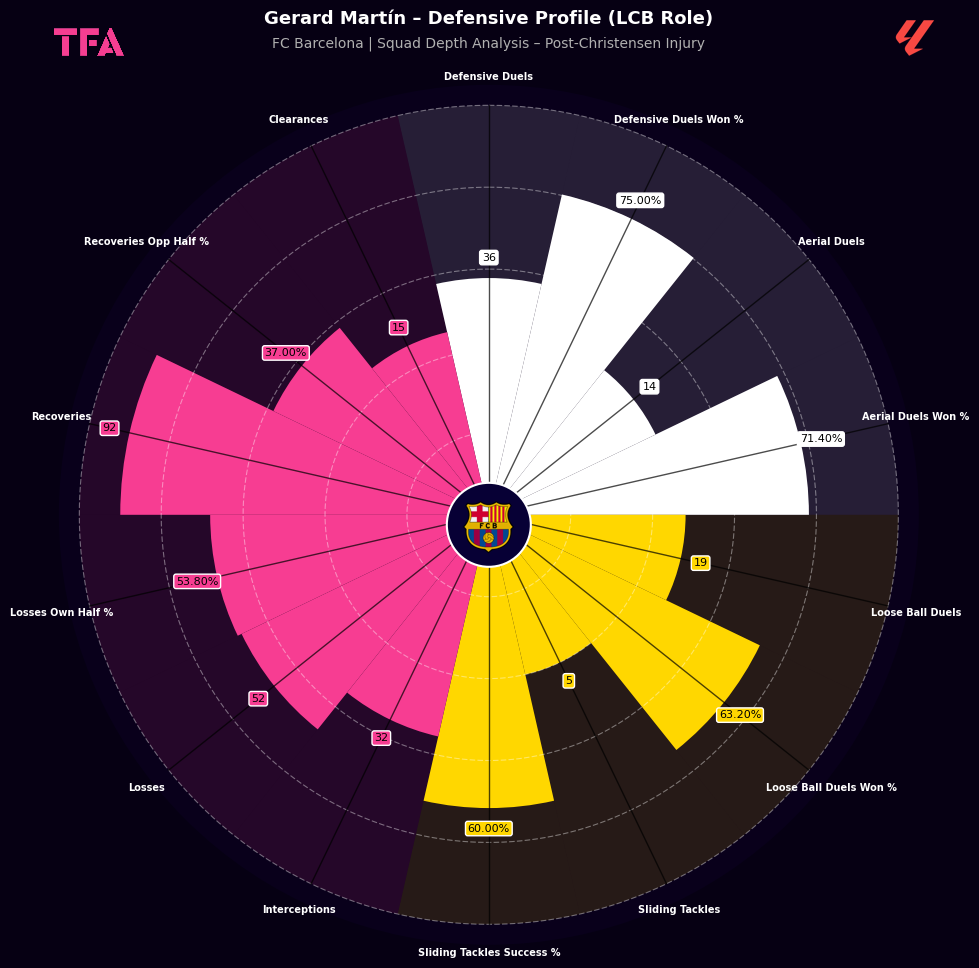
Across key fixtures in La Liga, the Champions League, and the Copa del Rey, Martín has shown a strong capacity to adapt to the demands of central defence.
Matches such as those against Alavés, Atlético Madrid, and Osasuna underline his defensive volume, frequent defensive duels, a solid success rate in loose-ball contests, and consistent interception numbers.
Notably, his performances often feature a high number of recoveries and clearances, indicating an ability to read danger early rather than simply reacting inside the box.
Tactically, these numbers suggest a defender comfortable stepping out of the line to engage, which suits Flick’s preference for proactive defending and a relatively high defensive block.
However, the data also reflects a learning curve in aerial duels and positional discipline, areas where a natural centre-back would typically be more efficient.
The defensive distribution map further reinforces Martín’s influence when used as a left centre-back.
Gerard Martín Defensive Actions Map (LCB) – Barcelona 2025/2026
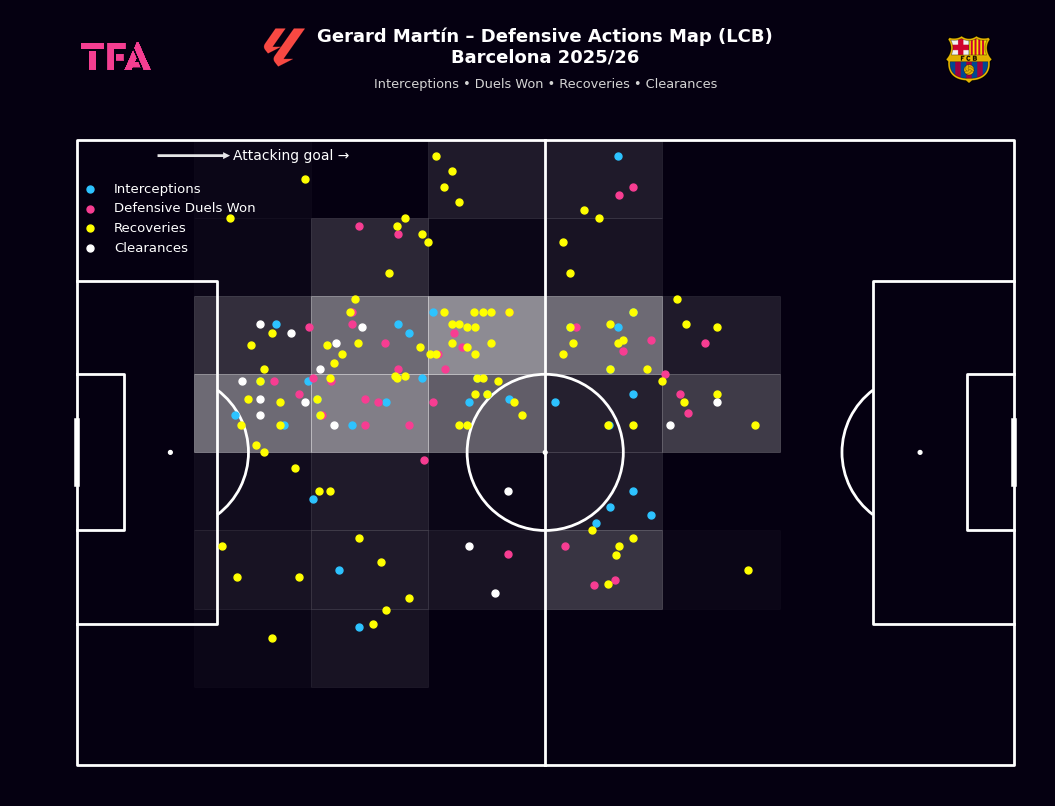
With 32 interceptions, 15 clearances, 92 recoveries, 36 defensive duels, and 14 aerial duels, his overall defensive contribution ranks favourably when compared to several established centre-backs in La Liga.
The high number of recoveries, in particular, highlights his effectiveness in regaining possession during transitional phases, a crucial element in Flick’s structure.
Rather than acting as a purely reactive defender, Martín frequently intervenes before attacks fully develop, helping Barcelona sustain pressure and maintain territorial control.
However, Martín’s heat map reveals the core limitation of this adaptation.
His activity is clearly skewed towards zones traditionally occupied by a left-back, reflecting his natural instincts and positional habits.
Gerard Martin Heat Map As LCB 2025/2026
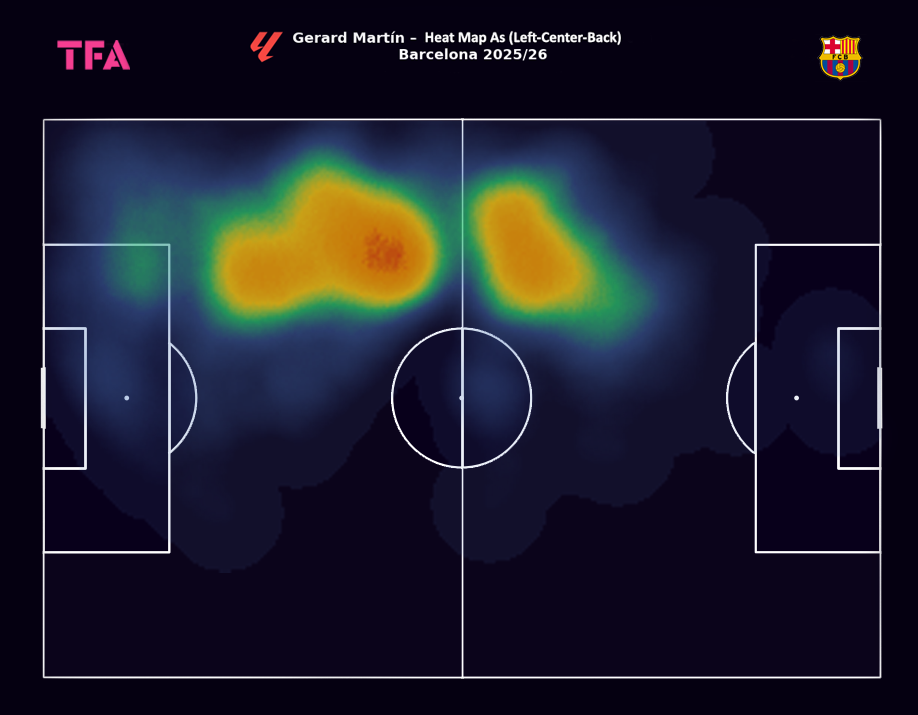
While this provides Barcelona with defensive support in wide areas, it also exposes a potential weakness in central coverage, especially when defending quick transitions or diagonal runs behind the line.
This positional bias means Barcelona often requires additional compensatory movement from the opposite centre-back or holding midfielder.
Addressing this issue will demand targeted tactical work, ensuring Martín can cover larger central spaces more consistently without compromising the team’s overall defensive balance.
Tactical Implications Of Eric García As A Left-Centre Back Under Hansi Flick 2025/2026
Eric García’s utilisation as a left-centre back during Barcelona’s 2025/2026 campaign, despite being a natural centre-back, has produced a statistically notable defensive impact.
Across his appearances in La Liga and the Champions League, García has demonstrated adaptability to the left-sided central role, maintaining high defensive standards.
Eric García Defensive Profile 2025/2026 – LCB Role
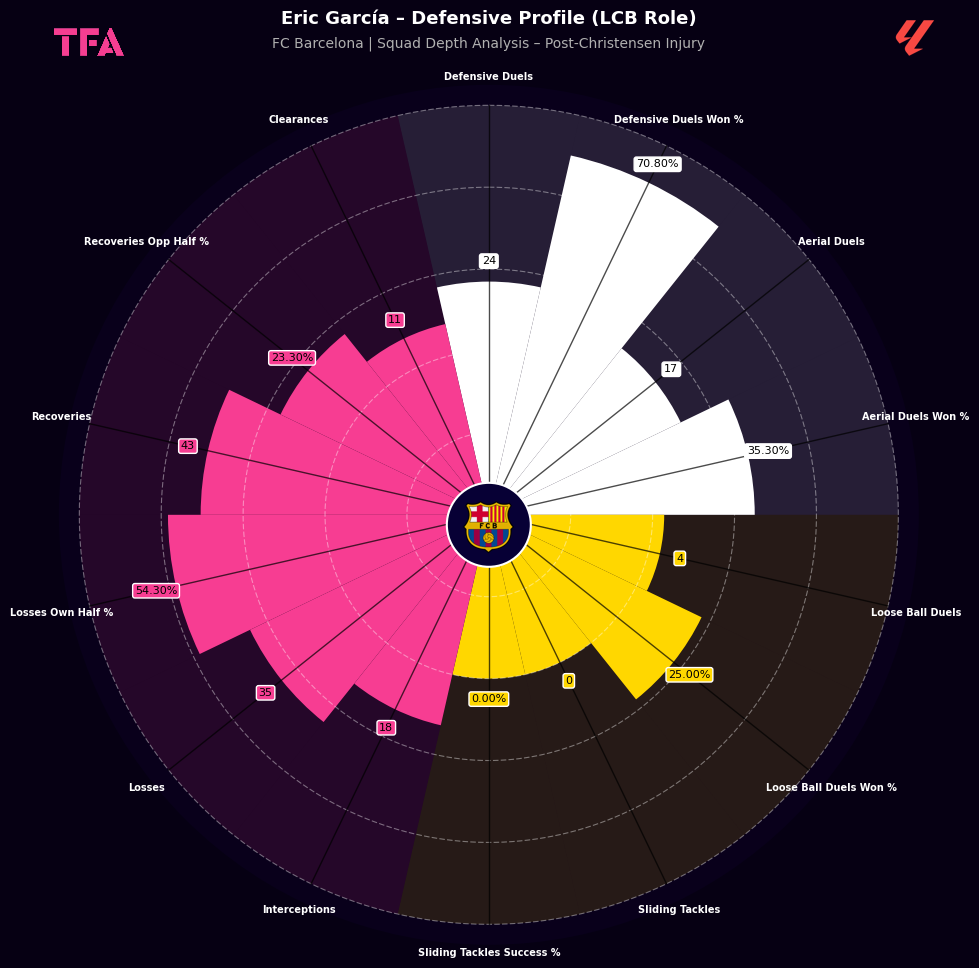
In matches such as Club Brugge, Elche, Real Madrid, Olympiacos, Girona, and Mallorca, he consistently contributed to defensive duels, aerial contests, and loose-ball recoveries.
For instance, his defensive duels per match ranged from one to eight with strong success rates, while aerial duels won frequently surpassed 50%, reflecting reliability in both ground and aerial challenges.
García’s recoveries and clearances indicate proactive positioning, often intercepting attacks before they fully develop.
These numbers illustrate a defender comfortable stepping into wider channels when required, supporting Hansi Flick’s emphasis on proactive defensive engagement, high pressing from central positions, and maintaining a compact block, despite the positional adjustment from his usual centre-back role.
García’s defensive distribution map further highlights his influence as a left-centre back.
Eric García Defensive Actions Map As LCB – Barcelona 2025/2026
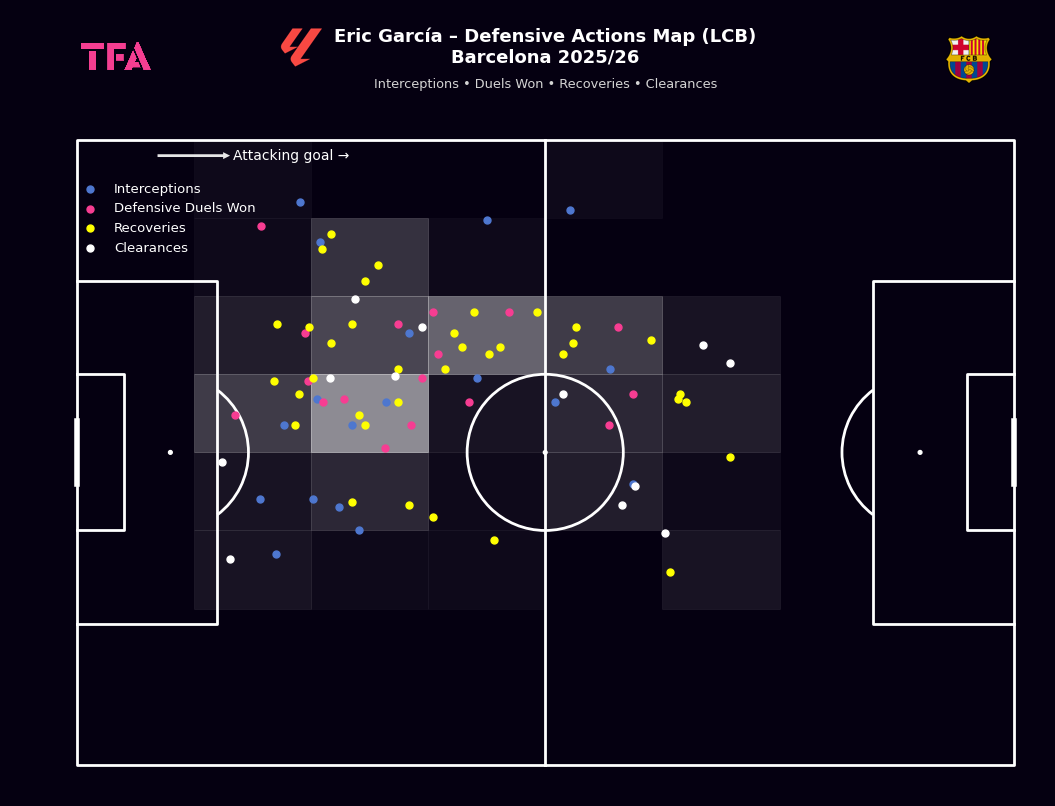
With 18 interceptions, 11 clearances, 43 recoveries, 24 defensive duels, and 17 aerial duels, he ranks favourably against other La Liga centre-backs in similar minutes played.
The high number of recoveries demonstrates his effectiveness in transitional phases, regaining possession in both offensive and defensive sequences.
The map reveals García’s capacity to read the game proactively, stepping into threats and mitigating danger before attacks develop fully.
His contribution sustains Barcelona’s defensive pressure and territorial control, indicating that the tactical deployment of a natural centre-back in this hybrid role can function effectively under Flick’s system.
García’s heat map shows disciplined positioning consistent with a natural centre-back, despite being deployed as a left-centre back.
Eric García Heat Map As LCB 2025/2026
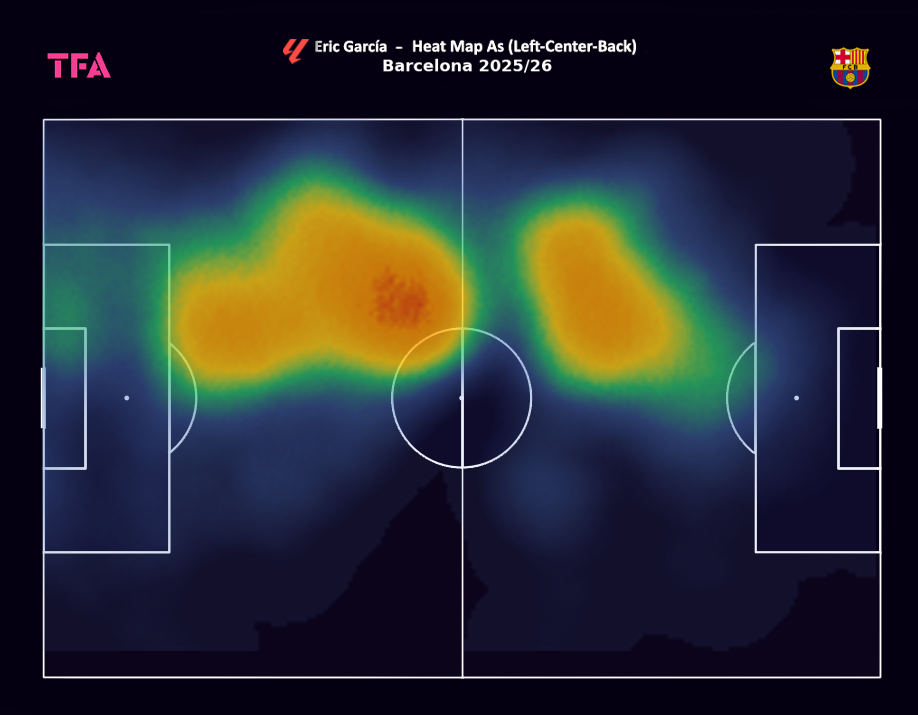
Activity remains concentrated centrally, reflecting instinctive defensive positioning, while occasional lateral forays support the left channel, balancing individual discipline with the demands of team coverage.
Conclusion
Barcelona’s defensive crisis in 2025/2026, exacerbated by Christensen’s ACL injury and Araújo’s absence, has tested Hansi Flick’s tactical flexibility and squad depth.
Data analysis reveals that both Gerard Martín and Eric García have adapted effectively to unconventional roles, with Martín operating as a left-centre back and García providing reliability despite positional adjustments.
Their proactive defensive contributions, interceptions, recoveries, clearances, and duels have sustained pressure and preserved territorial control.
However, limitations in positional coverage and Cubarsí’s inconsistent output highlight underlying fragility.
Barcelona must balance short-term tactical solutions with strategic squad planning to ensure defensive resilience for the remainder of the season.
