
On Tuesday, in Dunedin, a crowd of 8,215 witnessed an extraordinary performance by The Netherlands in the Women’s World Cup. They secured a spot in the last 16 as group winners, outshining the reigning champions, the United States, with a dominant 7-0 victory over Vietnam.
“In the end, it turned out the way we wanted it to,” the coach Andries Jonker told NOS. “This is what you’re hoping for – one opportunity after another. They were fantastic goals and not lucky goals. A dream scenario came true.”
After defeating Portugal and drawing with the worthy USA, followed by a dominant victory in Group E, the 2019 runner-up, the Netherlands, have firmly established themselves as formidable contenders for the championship.
The Oranje team’s performance in the group stage was awe-inspiring, thanks to their well-structured methods, playing style, and effective tactics. As a scout report, this tactical analysis examines their strengths in depth and highlights specific weaknesses they displayed.
Building from deep
Andries Jonker’s team presented a solid performance in the three successive matches played, netting an impressive total of nine goals while conceding only one.
Jonker’s 3-5-2 structure is modern and flexible, aiming to gain various superiorities in different phases of play. This adaptability allows the team to tailor their strategy from one match to another, ensuring they can effectively capitalise on their strengths and exploit their opponent’s weaknesses.
The Netherlands have the tactical culture to build up from the back; the team initiate their plays from the goalkeeper to a 4-1-2 base, where the central centre-back advances forward. At the same time, the pressing team is manipulated on one side to create space on the opposite side to switch the play where they potentially have the advantage there (combining the wing-back, the nearest midfielder and the drifting striker).
As depicted in the illustration below, this setup ensures a guarantee of numerical superiority in the destination; meanwhile, the other side players initiate runs to join the attack quickly — the farthest No. 8 joins the last line with the opposite wing-back while the main striker provides the support.
Indeed, another common approach utilised by them is the use of the goalkeeper’s long ball. When employing this, the targeted midfielder advances, providing a viable option for the long ball distribution. Simultaneously, nearby players surround the targeted area to secure the second ball, gaining possession if the initial pass is contested. Meanwhile, the striker and the wing-back execute third-player runs to create penetrative follow-up actions to exploit spaces left behind by the opponents.

Higher a little away from the goalkeeper. The Netherlands take their primary in-possession structure, transitioning between 3-1 and 3-2 setups based on the opposition’s pressing scheme. From their 3-5-2, they transform into either 3-2-5 or 3-1-6.
Their game plan revolves around controlling the ball efficiently, prioritising vertical penetration in the appropriate moment over mere possession. Every player in the first line possesses the ability to execute vertical or diagonal passes that can break through the opposition’s lines.
Usually, both wide centre-backs advance to play higher and provide valuable support to keep possession. Indeed, Andries Jonker ingeniously employs Ajax’s midfielder Sherida Spitse as a right centre-back (She has 26 progression passes, the highest player in the team, as per FBref, and 35 passes into the final third, the second in the tournament). While Dominique Janssen, also the left centre-back, has five goal-creating actions above all players in the cup.
Thanks to this ability of first line players and the mobility of the second-line players to manoeuvre through pressing schemes, the team always works to play through the pressing schemes to pull the opponents to a side before quickly switching and then playing vertically where the players are well positioned in a dynamic box-midfield.
This box is formed dynamically, with striker Lieke Martens dropping off and the reverse No. 8 advancing into the right half-space. Meanwhile, striker Katja Snoeijs acts as the focal point, pinning the opponent’s backline.
In the illustration below, playing directly from the first line or manipulating and penetrating through pressure. The wide centre-backs have the option to play diagonally to the wing-back or vertically for a direct pass to the highest player in the box — Lieke Martens has until now 30 progressive passes rec, as per FBref.

Under the same principles of seeking superiorities, when facing a five-player defensive line (as in the Vietnam game), the Netherlands cleverly switched to a 3-1-6 to overload the last line with remarkable brilliance and mobility.
In these plans (3-5-2, 3-4-3, etc.), mobility and style are always affected by the type of wing-backs. Coaches often face a trade-off when selecting wing-backs; they must decide between full-backs who excel in attacking or wingers who possess defensive capabilities, depending on the team’s identity and nature of play.
Andries Jonker made a bold choice from the start by selecting WSL player and Arsenal’s right winger, Victoria Pelova, as the right wing-back and PSV’s left winger, Esmee Brugts, as the left wing-back, who are very excellent at attacking.
Esmee Brugts plays on the left side with her right foot in this slightly low position, making her, as she provides the width, and becomes a valuable reference point for her teammates due to her inward orientation (using the opposite foot). Her positioning aids the team’s possession play significantly. Because of this, she scored two superb goals in the previous game of curvy shots.
On the other hand, Victoria Pelova stands out on the right side for her speed and ability to exploit blind spots behind the defences. Her well-timed runs make her a constant threat to the opponents, often receiving the ball diagonally from the blindside, adding a dimension of danger.

Using fluid (AMs & STs) in the final third
The Netherlands uses countermovement runs in the final third to break through defensive lines, particularly when facing deep block defences. They use these runs deliberately vacate spaces by drawing defenders out of position and enticing them to step out of the defensive block, aiming to open up gaps that can be exploited by the diagonal and vertical runs made by the wing-backs and attacking midfielders.
The fluidity and various movements executed by the Netherlands often force the team to resort to direct approaches, including long balls from the centre-backs to exploit space behind the opposition’s defence or execute precise passes to the attacking players who have found gaps in the defensive block.

Indeed, the first goal against Vietnam perfectly exemplified the principles of fluidity, countermovement runs, and exploiting spaces, the Netherlands employs in their attacking approach. In that goal, the striker’s intelligent movement to withdraw the defender created a gap, while Lieke Martens made a well-timed run from behind to exploit the vacant space.
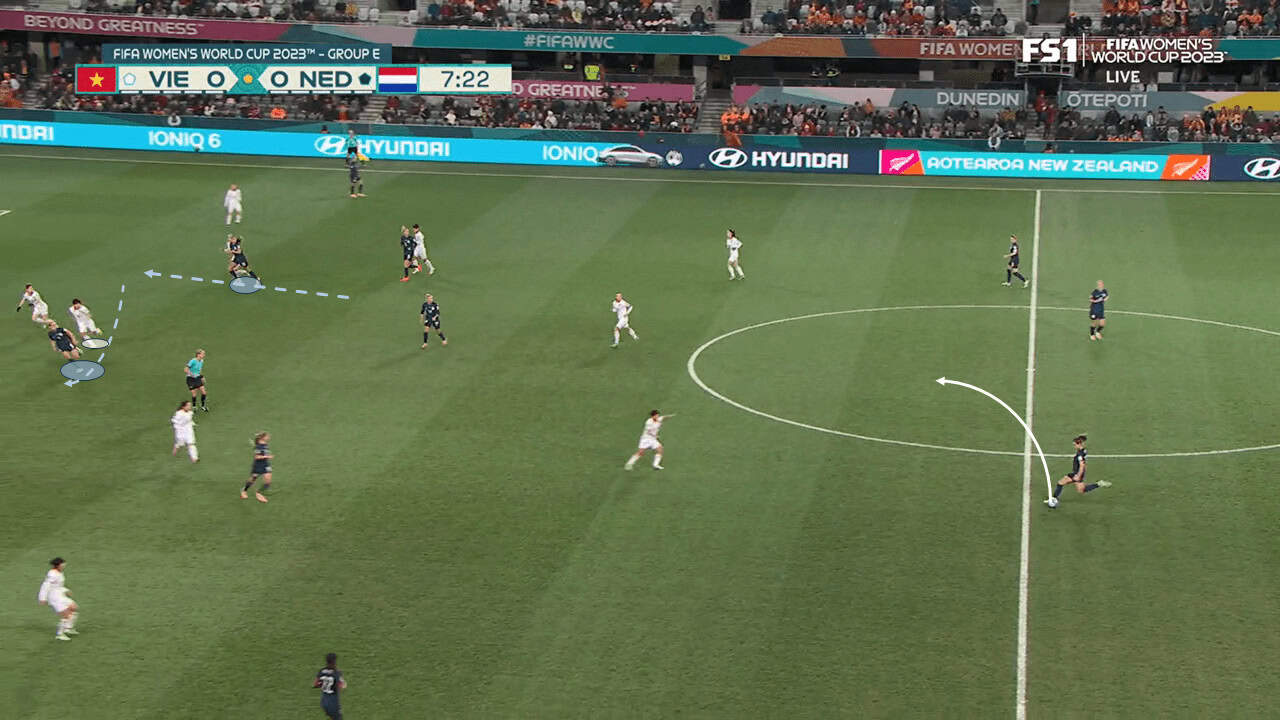 Image credit: FS1
The team also utilises a combination of play in the final third and offloading the ball to the sides. They actively seek to switch the play, isolating the opposite wing to exploit available space.
Moreover, involving the wide centre-backs in the attacking phase add an extra dimension and provides an additional passing option and, if necessary, can become an added support as a relay player. Their advanced positioning adds numerical superiority in the attack, which can overwhelm opposing defences.
How to stop them?
In every structure, there are inherent weaknesses, and in this case, the two wing-backs possess defensive shortcomings and require considerable stamina and speed to cover the flanks effectively.
To address these vulnerabilities, the coach aims to avoid exposing the wing-backs in defensive situations. The team emphasises possession to limit ball loss and reduce defensive responsibilities for the wing-backs, focusing on maintaining control of the play.
However, when isolated in 1 vs 1 defensive situations, opponents can exploit the wing-backs. To mitigate this risk, the Dutch coach implements possession-based tactics, counter-pressing, and high pressing to minimise exposure to such scenarios.
The Dutch team employs a 3-5-2 high pressing scheme to strategically direct the opposition’s buildup play towards the wide areas (pressing trap). Once the opponent is drawn to the sidelines, the Netherlands applies aggressive pressing, utilising the touchline as an additional tool to regain possession of the ball quickly.

To exploit these weaknesses, opponents look to launch swift counterattacks, capitalising on moments when the wing-backs are caught higher up the field. By attacking quickly, they aim to create gaps and expose the Dutch team’s triple backline, as demonstrated by the USA in their prominent attacks.
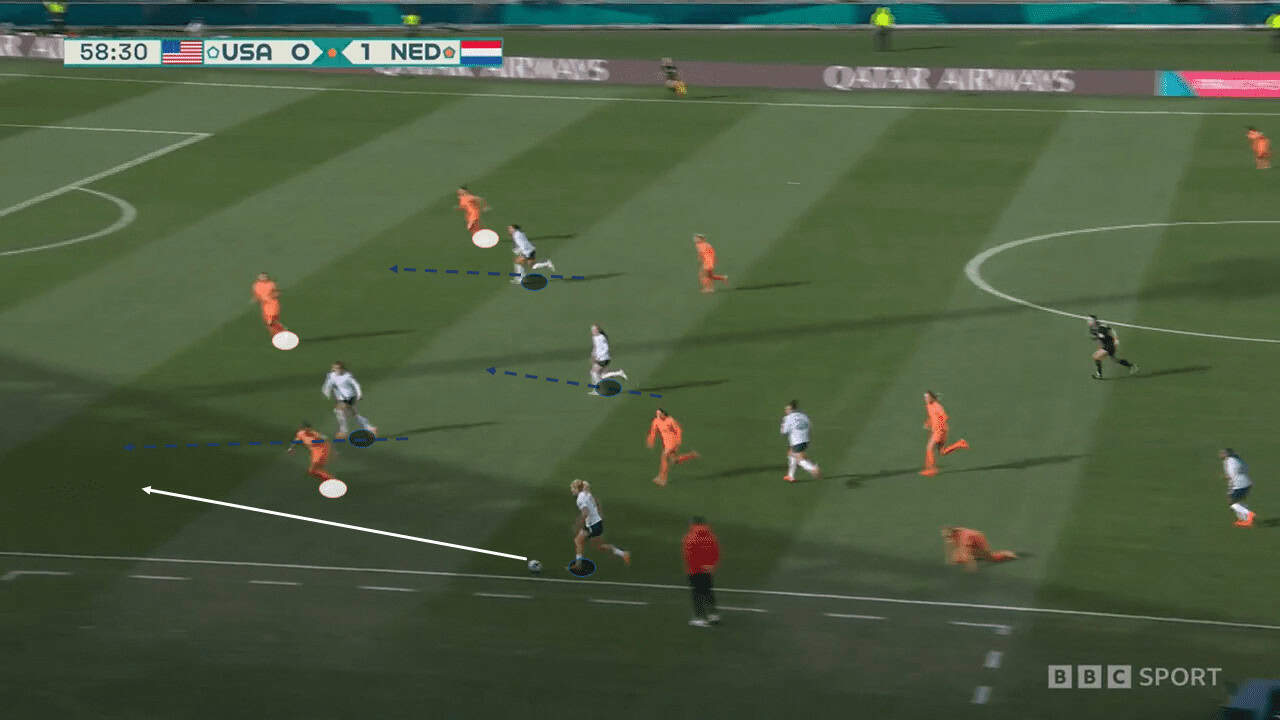 Image credit: BBC SPORT
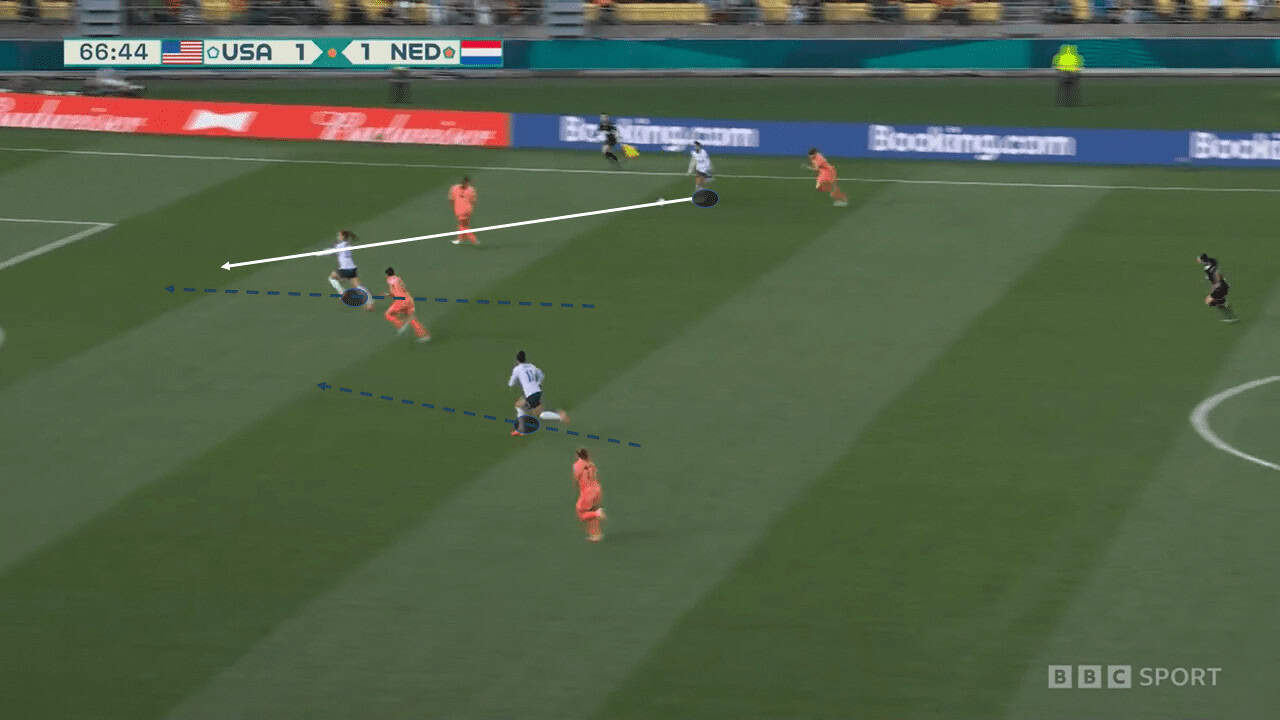 Image credit: BBC SPORT
South Africa, the next stop
On Wednesday, South Africa achieved a historic milestone by qualifying for the last-16 for the first time. They secured this achievement with a remarkable 3-2 victory against Italy in a thrilling Group G encounter held in Wellington.
South Africa adopts a 4-2-3-1 shape; the wingers are positioning themselves deep on the field. In contrast, versus the Netherlands, you should aim to exploit spaces behind the sides to pose a threat as the depth is crowded.
Having made history with their qualification, South Africa will play with nothing to lose, seeking to continue their remarkable journey.
The Netherlands, aware of the challenge, anticipates a balanced match – not as straightforward as their encounter with Vietnam, nor as challenging as facing the USA.
They recognise the need to maintain control while staying vigilant against potential South African counterattacks. As both teams have displayed exceptional physical strength throughout the tournament, the match is expected to be a test of ability versus ambition. Physicality will be evident, leading to numerous duels and contacts on the field.
Summary
The analysis highlights Dutch coach Andries Jonker’s strength and modern approach, potentially propelling the Dutch women to secure the title.
Coach Jonker confidently stated, “From the very beginning of our preparations, we were quite confident that we could beat every opponent in this tournament,” emphasising a consistent strategy of believing they could overcome any team, including Italy, South Africa, or any other challengers.
The question arises whether the Netherlands will emerge as champions and put an end to the USA’s reigning dominance in this championship. At the same time, the task is undoubtedly challenging. The journey ahead promises excitement and a keen interest in seeing if the Netherlands can achieve this historic feat.
