
In this UEFA Champions League campaign, Group A is the group of death as it contains Manchester City, Paris Saint-Germain, and RB Leipzig. But people forget about the Jupiler Pro League 2020/21 winner, Club Brugge.
Philippe Clement’s side started the season by winning the Belgian Super Cup.
In Europe, they shocked everyone by earning four valuable points against PSG and Leipzig despite having fewer star players.
Furthermore, their xGA against PSG (0.76) and Leipzig (0.99) were very impressive, so what’s the secret behind their good results?
This tactical analysis is a scout report that focuses on Clement’s defensive tactics, and how his principles of play helped the Belgian side to limit the best attackers in the world.
Midblock and pressing
One thing that separated Brugge and normal underdogs were the height of the defensive lines. Even though they are the weaker side on paper, the players would not be happy to “park the bus” by playing everyone behind the ball. Instead, they pushed the block and last line into the central third and defended in higher areas.

Although Brugge might not be pressing with an extremely high line in the offensive third, they would try their best to keep the opposition in one vertical half. Once the ball gets there, they would have numbers to close those flank spaces. Therefore, the job of the lone striker was to use his body angle to block the passing lane between centre-backs, as shown by Charles De Ketelaere above.
Brugge defended with a 4-2-3-1 shape initially, with the attacking midfielder (Hans Vanaken) to close the opposition holding midfielder. If the number eight dropped to overload Vanaken, Brugge would react by using the defensive midfielder to press close to the body as Éder Balanta did here. Meanwhile, the other midfielder should go inner to cover his teammates.
Also, the centre-backs must step up to close spaces in midfield when the Balanta was up. We will see more related concepts later.
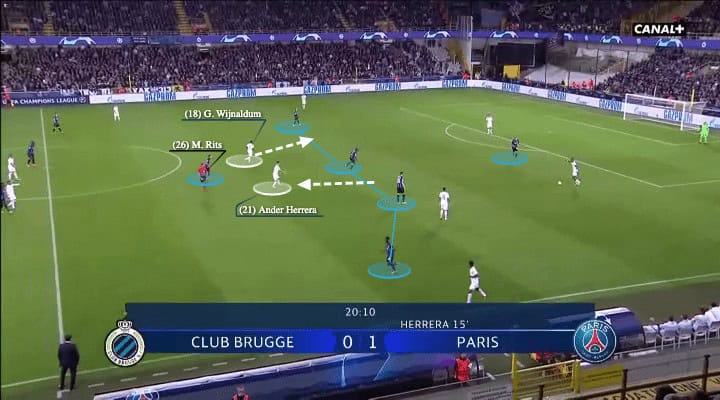
Leipzig players thought they could not break Brugge’s man-marking, but that was partially true. In some circumstances, Clement allowed his players to switch the defending targets as the man-oriented approach was not rigid. Since Balanta went out to close Ander Herrera before the above scenario, Brugge was in a 4-1-4-1 on that instance.
But football is a dynamic game. When Herrera simply positioned himself behind the second line again, the defense broke down, as Balanta could not catch his target. From there, Brugge adapted by Mats Rits’ communication, who asked Balanta to cover Georginio Wijnaldum so he could press Herrera. It was the same pressing, closed-body concept.
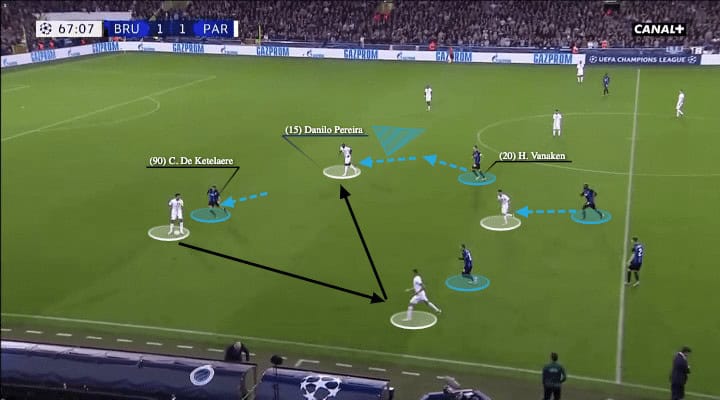
Brugge should be given praise for not backing off after levelling against PSG. Even in the second half, they chose to defend higher spaces instead of staying deep and waiting for the opposition to come. After the break, PSG adjusted by dropping Danilo Pereira to form a three-back in the build-up, but the effect was limited by Brugge’s press again.
Here, De Ketelaere initiated the press and forced PSG on one side, but the opposition was clever, using the right-back to evade pressure and reach Pereira.
However, Brugge was calm, and Vanaken did well by waving another press with a change-direction run. That run was important as the skipper blocked the switch angle again, forcing PSG to go back on the side where many blue shirts were waiting for the press.
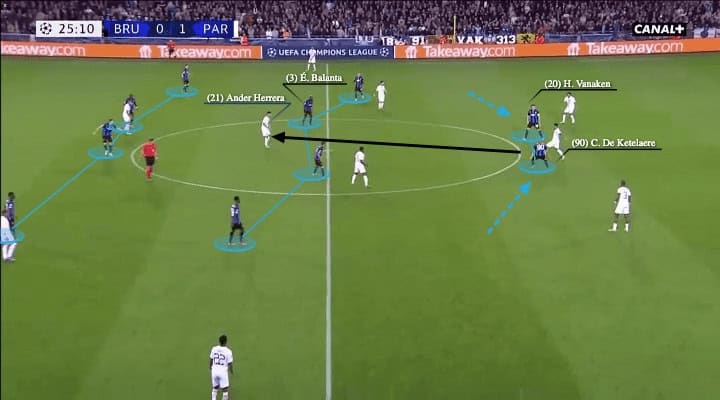
An important aspect of Brugge’s pressing was the subject of closing spaces. Since their players are always stepping out from the initial position, spaces occur behind or around the defence. Therefore, they must also close the corresponding spaces at the right moment.
Brugge’s midfielders were not tight in positioning as they were always pressing around; the opponents would also find their chance to break lines in the centre, such as finding Herrera in this situation. In this case, Balanta must react instantly to close the Spaniard, forcing him out of that zone.
You can interpret the pressing/midblock of Brugge in a vertical chain, with each line covering the other by closing spaces.
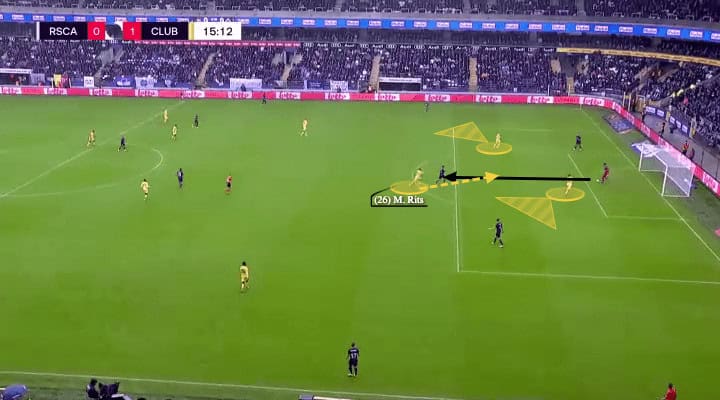
Wide triangular defending and low block
Of course, Brugge also had to defend in lower and wider areas, as they were not dominant in possession. They had an interesting structure to defend the flanks, and this limited the threat from Lionel Messi and Neymar.

When the ball reached the wide zones where the wingers had already been bypassed, Brugge often had their full-backs press. Of course, spaces would then appear behind the full-back, so they also needed the centre-backs or defensive midfielders to cover those spaces.
You can see how their defensive system operated in the screenshot above. Eduard Sobol stepped up to press the opposition, and so Stanley Nsoki and Balanta must go back to cover, especially since this was the job of the defensive midfielders.
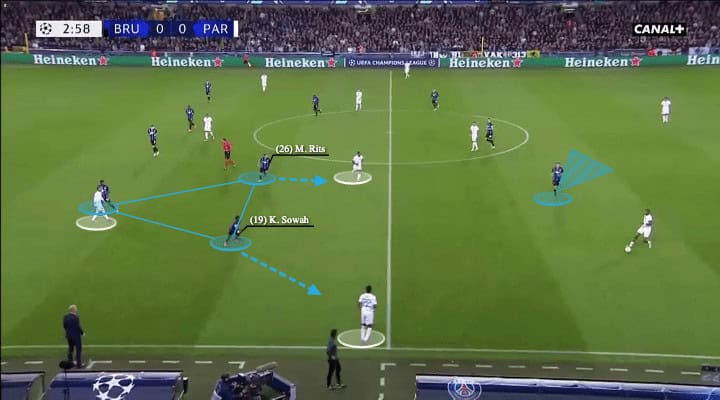
However, it was not the only way of Brugge’s wide defending. If their full-backs were occupied by the opposition winger, they must drag their own winger down to defend the opposition full-backs. It was a 2v2 situation, plus 1 defensive midfielder to cover them. These three positions should always form a triangle with the defensive midfielders covering them.
In the above image, it was a 3v3 on PSG’s left. You could see Brugge’s Rits and Kamal Sowah pressing their respective targets in a synchronized timing. Also, Clinton Mata tightly marked Neymar in the defence. When this three-man group stepped up together in the press, they could shut the passing option around the ball on time and make contact.
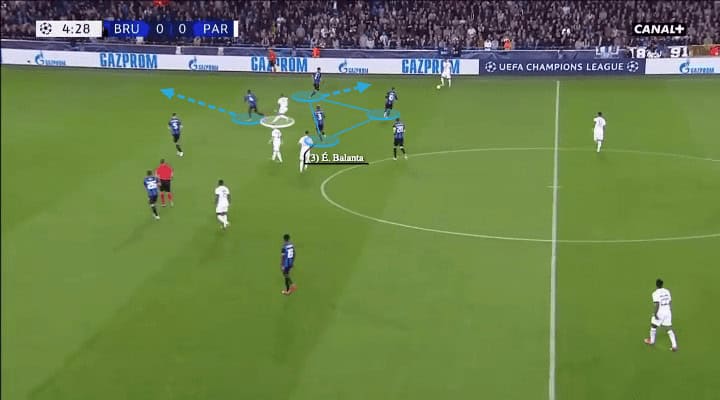
Since Brugge players also moved away from their positions to press in a lower block, teammates around also needed to close spaces accordingly. That’s why the triangular relationship of the three wide players was important, it allowed the defensive midfielders to block the opposition in the half-spaces.
Here, Sobol stepped up to press the wide player again. You could see Balanta move back toward the half-space to shut the diagonal passing lane of the ball. Meanwhile, the centre-back (Nsoki) also moved back to defend the spaces behind, so they caged the highlighted PSG player and prevented him from being free.
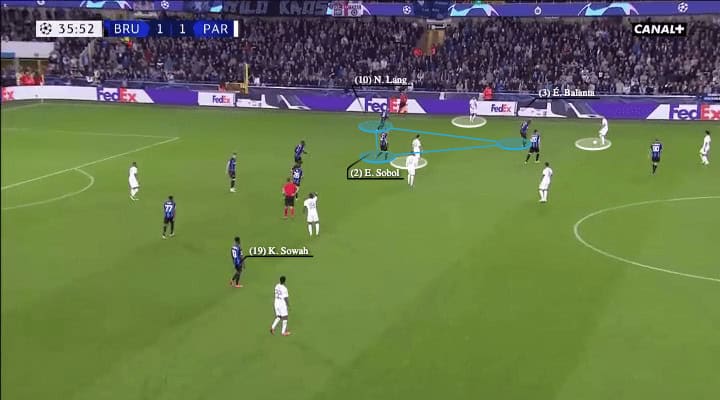
The three-man triangular defensive group could rotate, but the same concepts must be held in the wide defending. In the above situation, Balanta was the highest player, while Noa Lang was slightly lower to limit the wide spaces. That means Sobol should not stay in his left-back position but should be aggressive, stepping up to block the diagonal lanes and half-spaces.
Also, the far-side should also commit and defend deeper, almost like a winger. You could see Sowah was very low on the other side to allow the defensive line to swing towards the ball flank.

You could tell from the above example that Brugge was not defending in a rigid man-marking system. This time, PSG broke the lines and reached Neymar on the touchline. Mata had already stepped up to limit his room to dribble; Sowah was covering the left-back as well; then Rits, the defensive midfielder, must move back to protect the white spaces instead of attaching himself to Herrera.
Rits’ decision to defend half-spaces was important as he would block Neymar’s diagonal spaces into the centre, or you can interpret this as covering Mata. Brugge knew PSG possessed the most lethal and creative wrong-footed wingers in the world, so they must not let them play into the final third. Comparatively, letting Herrera to receive outside of the midfield line carried less threat, and they allowed Neymar to find the former Manchester United midfielder. From there, Brugge bought the time to reorganize while forcing the ball away from a more dangerous opposition.
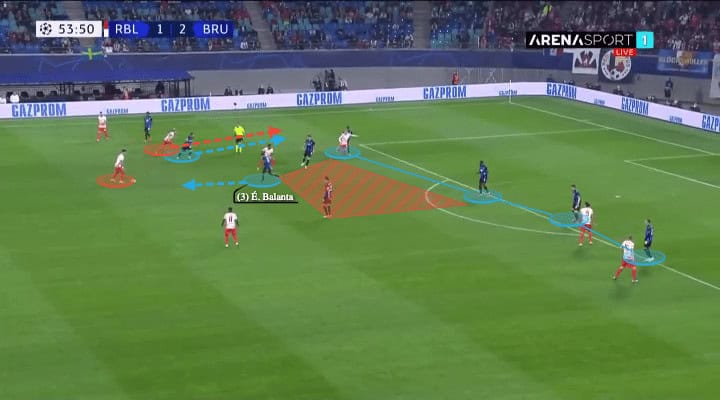
Even in a low block, Brugge would not put every player in the box to defend the crosses. Instead, they continue to apply continuous pressure on the ball, making it difficult for the opposition to play. For example, Balanta instantly jumped out to press the ball vertically once Dominik Szoboszlai received it, which narrowed his angle of pass into the red zone. They must make sure the lines were compact vertically so the opposition would not play into or through them in the defensive third.
Meanwhile, you could see the important coverage of Brugge’s defensive midfielders. On this occasion, the early run of Emil Forsberg brought away Mata, but Kevin Kampl dashed into spaces behind from the wide zone. It was the defensive midfielder’s (Rits) task to cover the wide space. Brugge players should be appreciated for not hiding in those situations, instead, watching each other’s backs.
Weakness 1: the channels
Brugge wasn’t without its weaknesses; indeed, it had some because of its defensive principles. One of their problems was the channels between defenders. Their backline was always incomplete as defenders stepped away from position frequently, so centre-backs were often isolated from each other.
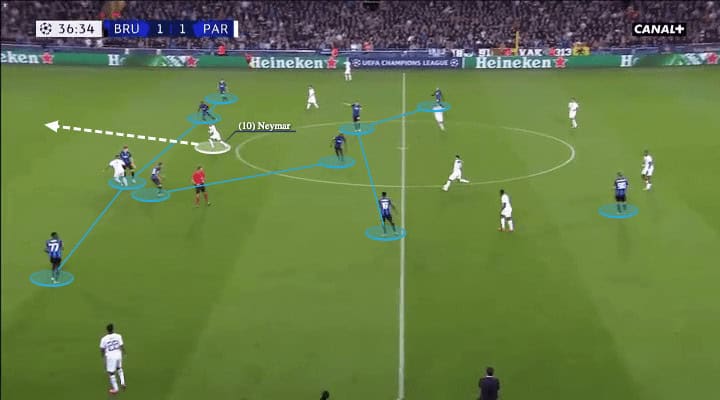
Therefore, even Brugge were not afraid of chipped balls and short passes into the centre in their defensive third, they were quite vulnerable against through passes from the midfield. This would be a major issue when the defensive midfielders failed to put pressure on the ball.
In the above situation, the gap between the centre-backs was criminally large, as Messi initially dragged away Nsoki. While Kylian Mbappé occupied his partner, Herrera could not be stopped, passing to Neymar through the channel. Simon Mignolet must come out to sweep and clear the danger.
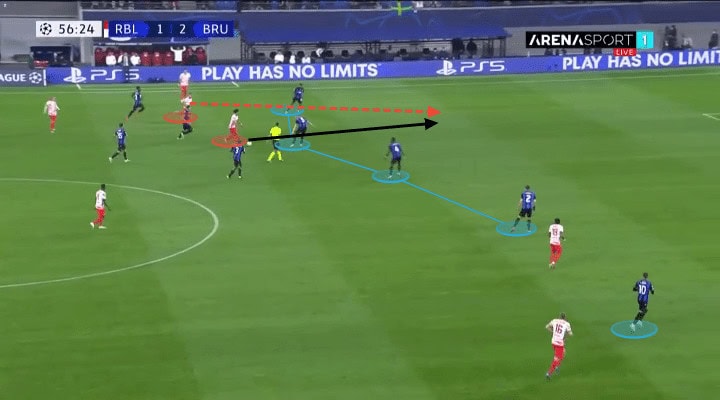
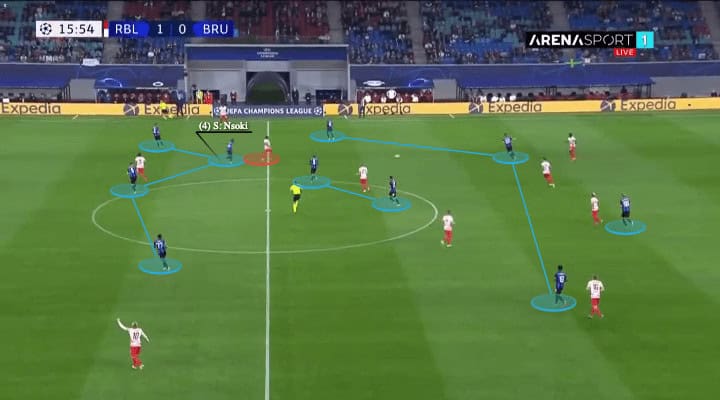
Again, it was the same issue that allowed Leipzig to reach spaces behind in this scenario above. Since the centre-backs always orienting themselves on a specific player, they were likely to be pulled out of position, hence, unable to chase the deep runners on his side.
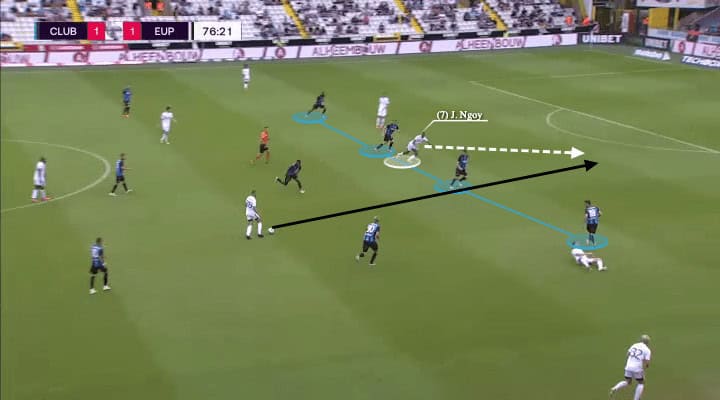
Weakness 2: in the box
Another problem attributed to their incomplete backline was the defending in the box. On occasions, the defenders were isolated in the box, and they would concede opportunities if the deliveries were accurate.
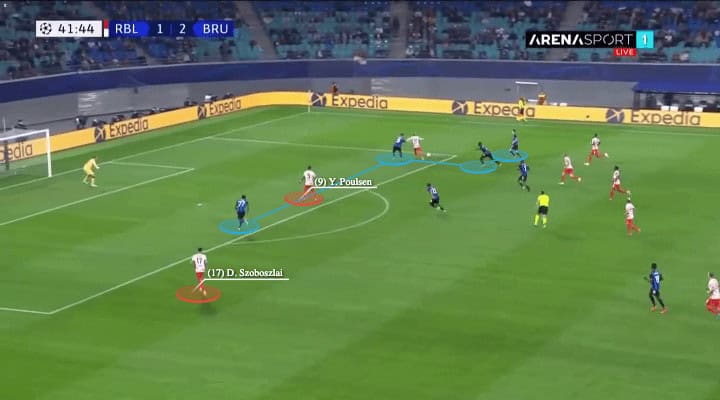
Here, they allowed Forsberg to receive in the penalty box but were unable to block the cross. The box was left vacant because centre-backs stepped up too early; now Nsoki was eliminated from the defence, and no one could help Mata in the centre. If the ball went to Poulsen or Szoboszlai, it would be a very dangerous opportunity.
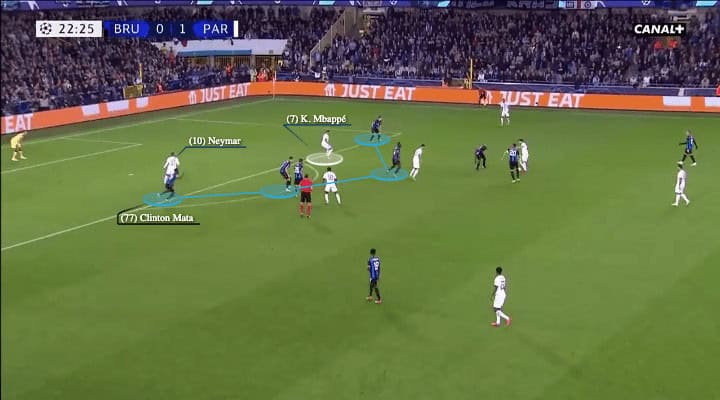
Another similar scenario is in the above image. As Nsoki was a bit higher to close the target, he totally left Mbappé unmarked behind. When the opposition had a good dynamic, such as PSG, they could use different run timings to break offside traps. For example, Neymar’s early run dragged Mata down in the above image, so Mbappé stayed onside when he was released.
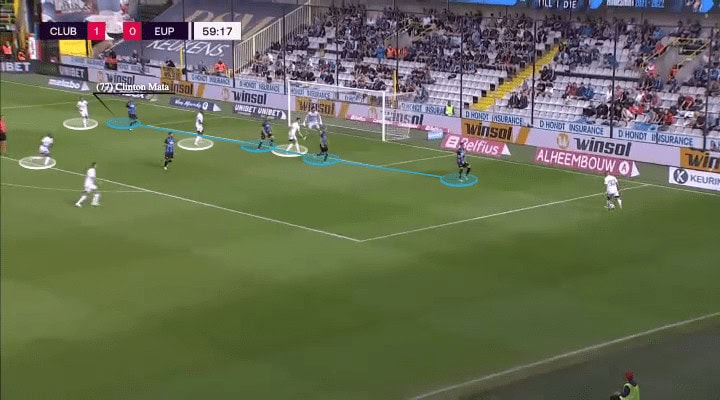
Conclusion
As we have shown in this analysis, Brugge’s defence was imperfect; they had clear principles of play but also had some weaknesses. Nevertheless, players’ commitment on big stages was the key. In Juplier Pro League, sometimes Brugge were too casual without possession, but their standard in the UEFA Champions League escalated. Even conceding early goals in both games, they never lost faith and just played in their own way, sticking together as a unit.
Clement’s side would play City in back-to-back continental matches; it would be intriguing to analyze how Pep Guardiola would handle the Brugge block!
