


RB Leipzig have had a pleasing start to the season so far, qualifying for the knockout phases of the UEFA Champions League while staying close to Bayern Munich in the Bundesliga, with the Bulls just two points behind Bayern at the time of writing. One of the key areas of Leipzig’s success has been their defensive systems, with Leipzig recording the lowest xGA of any team in Europe’s top five leagues this season, with 12.61 xGA and 12 goals conceded, with this xGA even lower than Atlético Madrid’s 14.81. Atlético, however, boast a better goals conceded record, with only six goals conceded. It does seem an odd statistic considering Leipzig’s leaky record against the likes of Bayern Munich, Man United, and Borussia Dortmund, however looking deeper into such games we see the opposition overperforming xGA greatly, and that Leipzig’s pressing systems have also largely been successful in these games.
As a result of their record, I decided to take a look at RB Leipzig’s defensive tactics so far this season, and in this tactical analysis have broken down the tactical reasons for their success into four sections, analysing the tactical nuances and flexibility behind Julian Nagelsmann‘s defensive strategies this season.
Conventional 4-2-3-1
As I’ll touch on within this analysis, Leipzig are somewhat notorious for their unpredictable shapes out of possession, but their most commonly used shape is the 4-2-3-1. There have been variations seen between games within the 4-2-3-1 Nagelsmann deploys, however there is a fairly consistent shape which has been successful, mainly against teams who they want to press aggressively. The sheer number of formations on the list shows the flexibility, and I would suggest that the 43% for the 4-2-3-1 could be inaccurate, with Wyscout sometimes incorrectly picking up Nagelsmann’s adapting shapes.

An example of the 4-2-3-1 system being implemented can be seen below against Werder Bremen, which was a game in which Leipzig clearly wanted to be aggressive and press high against Werder Bremen’s short build-up play. We can see the basic structure of the two first lines of pressure here, with striker Yussuf Poulsen applying pressure to usually the central centre back or wherever possible, in order to force the ball into a wide centre back. Wide centre backs would be pressed by the Leipzig wingers from in front, who would show the Bremen defenders outside. Dani Olmo often acts as the pressing ten within the 4-2-3-1, and it is his role to occupy the ball near pivot.
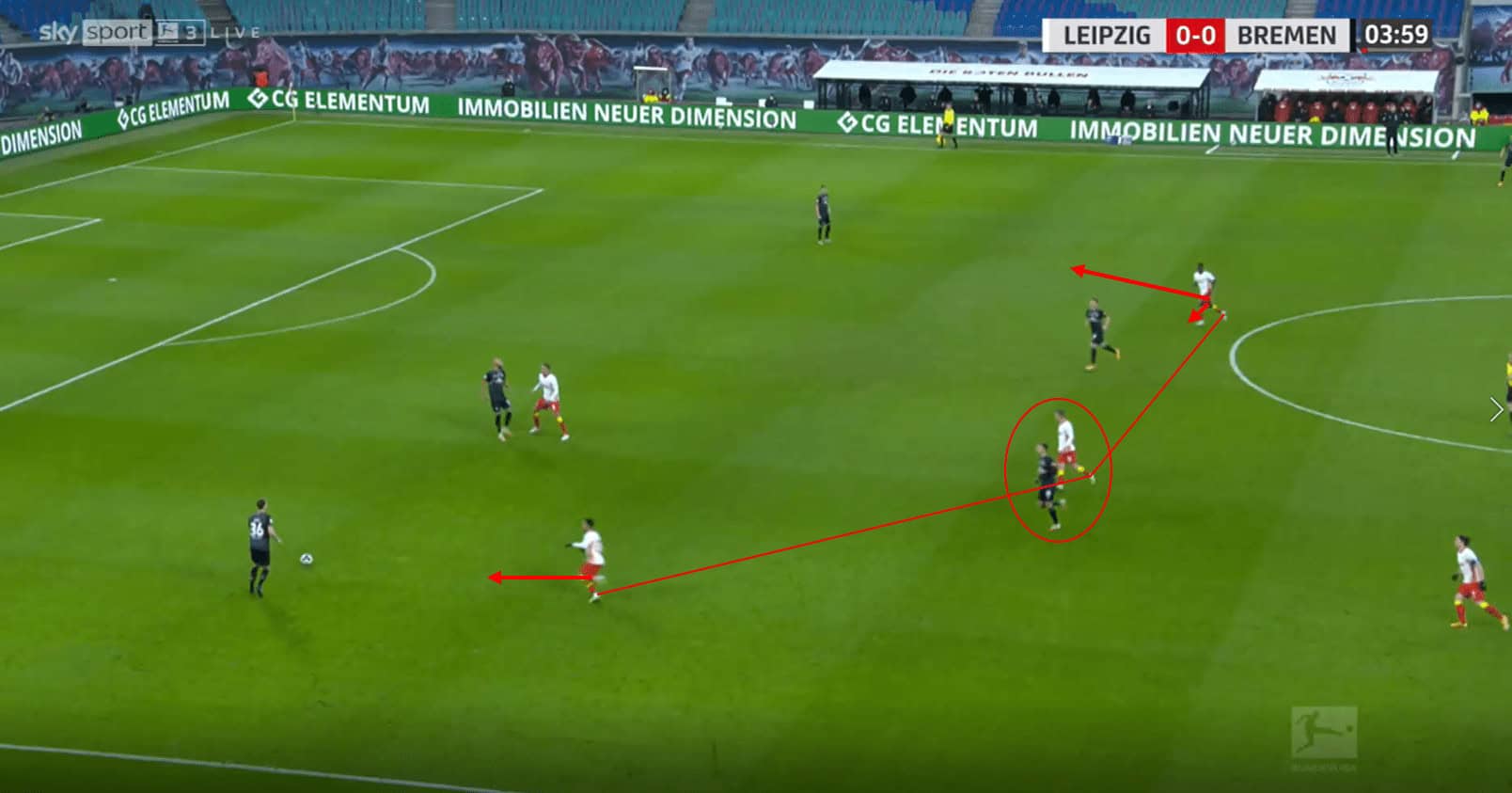
We can see in a very high area here the Leipzig right winger applies pressure to the right centre back, and shows the ball to the wide area, which is also a common theme throughout Leipzig’s multiple systems used this season. The ball near pivot is covered and the angle to the far pivot isn’t accessible, and so the ball is forced wide.
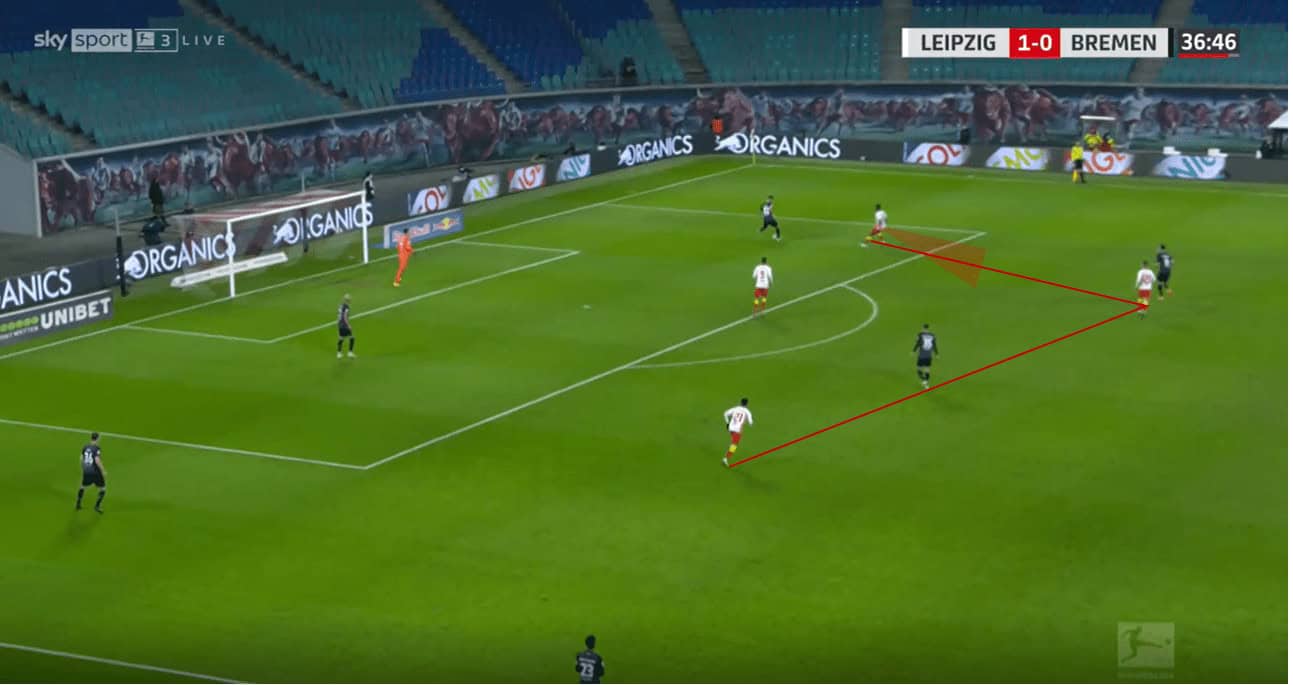
Once the ball is forced wide, Leipzig’s aggressive and man-oriented pressing kicks in, with the full-back pushing very high to press the wing-back, while the two deeper midfielders for Leipzig cover the centre and the forward dropping deeper in the half-space. As I’ll touch on later, the full-backs are very aggressive within this system Players remain tight in this area, and so the opposition find it incredibly difficult to work possession from out to in, meaning possession is often lost as it is here. Again, this very aggressive approach is mainly used against weaker teams in the Bundesliga.
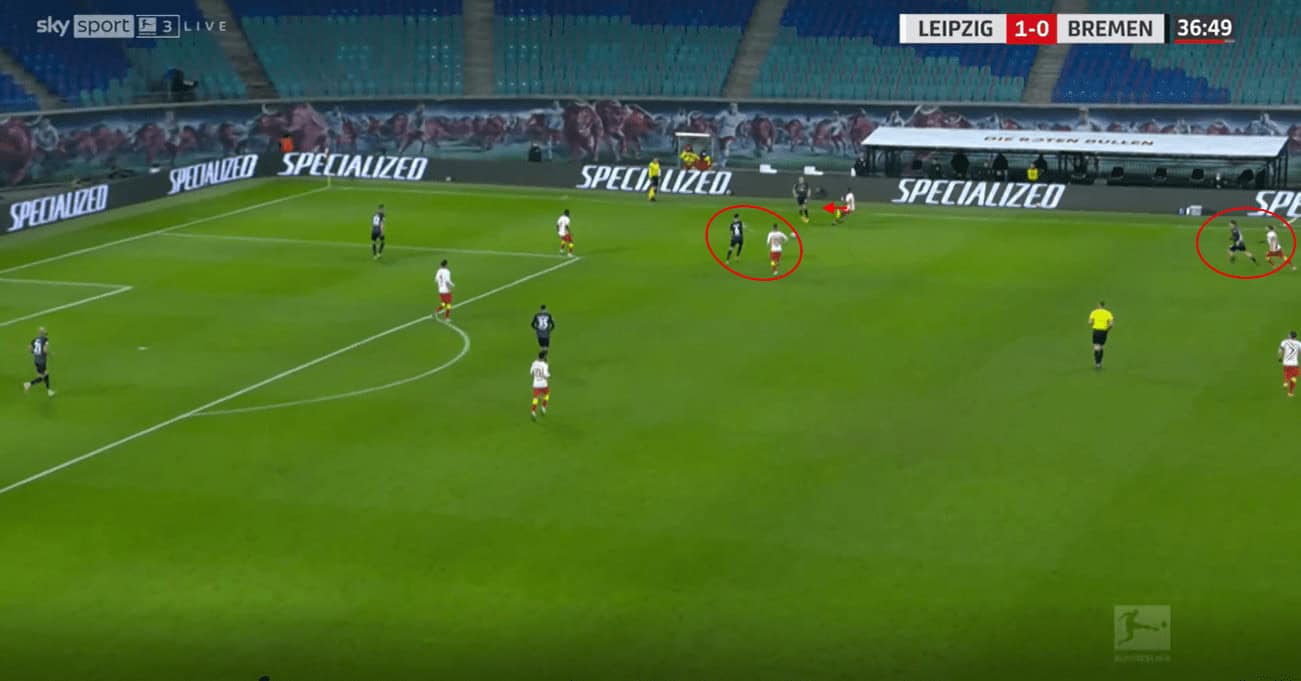
The main disadvantage to this 4-2-3-1 press in particular is the presence of only a single pressing ten, and so often Leipzig are forced to manage the overload placed on this pressing ten, with the two deeper midfielders rarely able to press that high up the pitch. We can see an example here of Werder Bremen overloading Marcel Sabitzer and the pivot zone. Dani Olmo (circled) acts as the pressing ten, and from the goalkeeper, marks the nearest pivot. The ball gets played across, and Omer Toprak moves from centre back higher to from a double pivot. We see potential options for covering Toprak through Poulsen and the nearest winger, however these tactics are sometimes difficult to use situationally and can have damaging effects, such as the less pressure being applied to the ball or the wider pass being freer. Leipzig manage the overload well here though, restricting space around the receiver and forcing the pass backwards and then wide, where the full-back is then able to push higher and press.
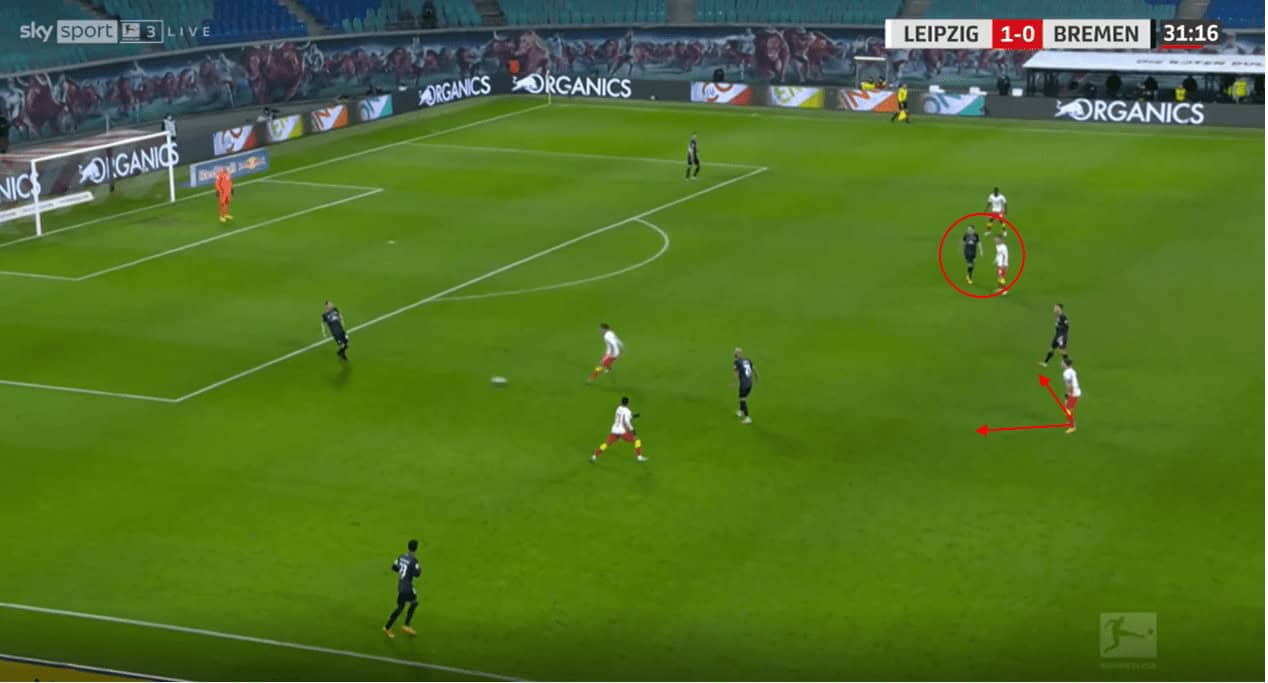
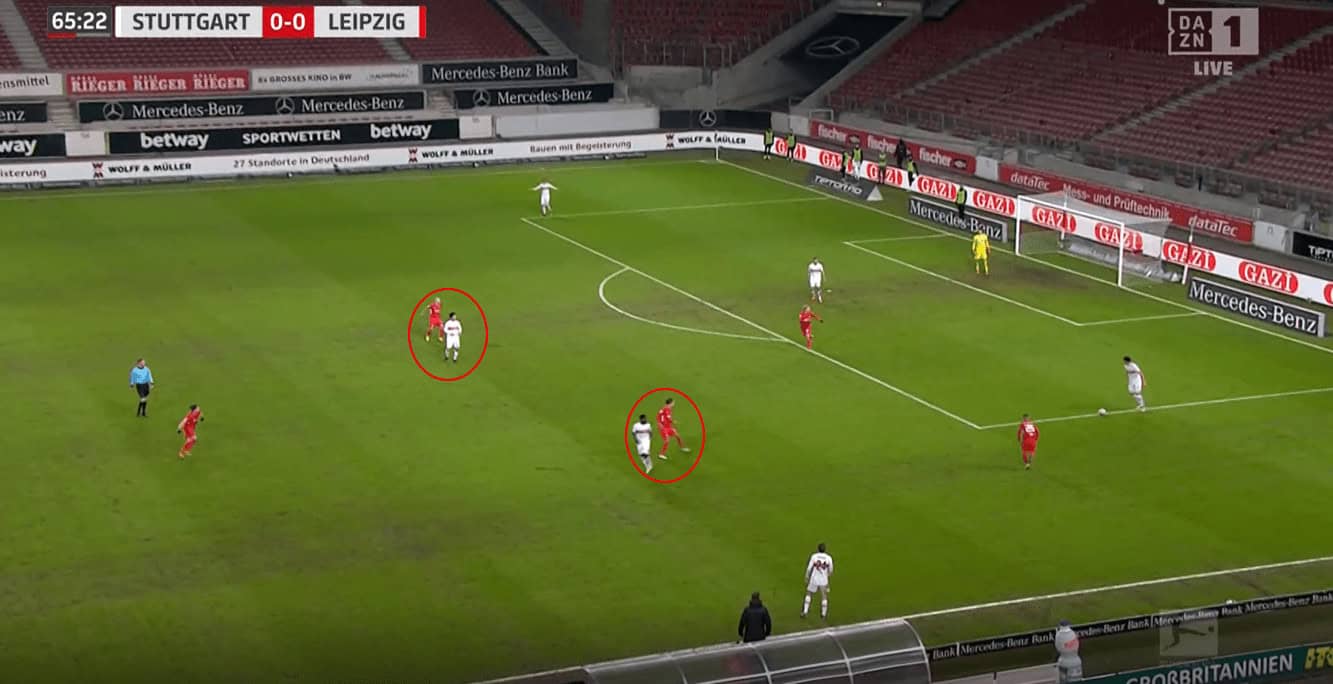
In their match against Stuttgart, Stuttgart looked to use this as a focal point in their build-up, and we can see an example of good pressing By Dani Olmo which helps to nullify this overload. We can see a centre back has possession and is under some relaxed pressure by Emil Forsberg, while Dani Olmo marks the ball near pivot. This means the ball goes to the wide centre back. Angeliño follows the usually pressing scheme of the 4-2-3-1 in this example, and so he moves out to press the wide centre-back, which increases the space the previously ball far pivot (Endo) has to operate in. Olmo therefore has to get across and cover both pivots within one play.
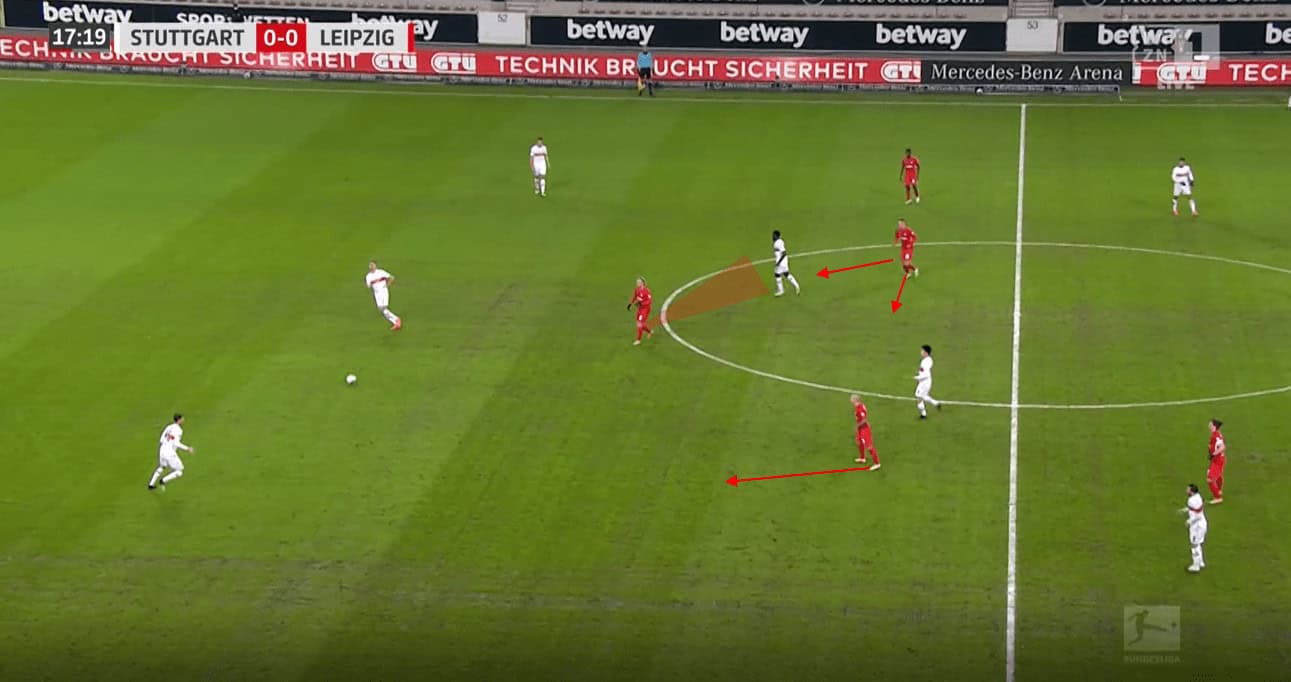
Angeliño applies pressure on the wide centre back, who plays the ball into Endo, but Olmo does well to across in time and apply pressure to Endo. This pressing movement by Olmo is vital as we can see the ball near central midfielder Sabitzer has been drawn out wide by a central midfielder (Castro). Therefore, if Olmo doesn’t come across to apply pressure, Stuttgart have a free player within the attack. To limit Olmo’s workload in this regard, Nagelsmann used another defensive strategy which I’ll detail within this next section of the analysis.
Asymmetry
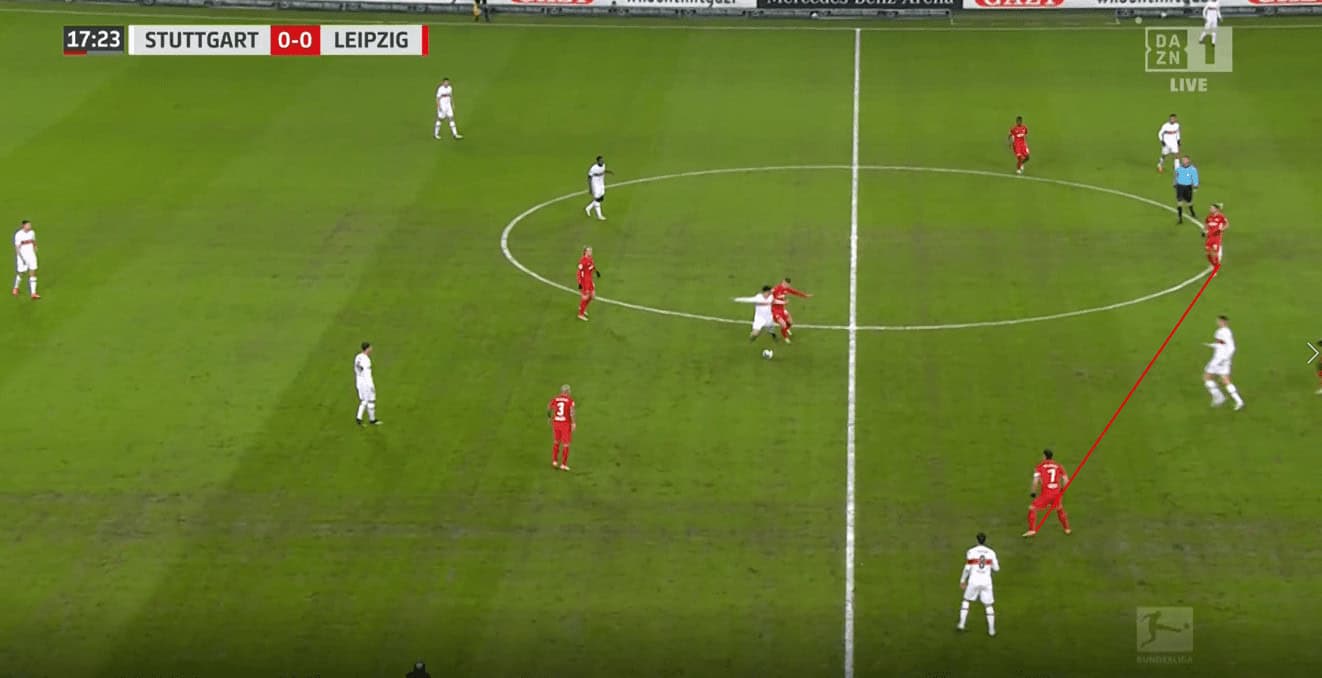
Nagelsmann has used the defensive strategy of asymmetry at times this season in an attempt to nullify opposition’s build-up, with two examples being seen against Hoffenheim and Stuttgart. We will first start with Stuttgart, who as I mentioned above looked to vary their build-up and find access through central midfield. To combat this, Nagelsmann couldn’t rely upon aggressive man oriented pressing and help from the full-backs, mainly because of Stuttgart’s positional play qualities such as pinning actions and switching of the ball, and so needed a solution to cut access to a double pivot when needed.
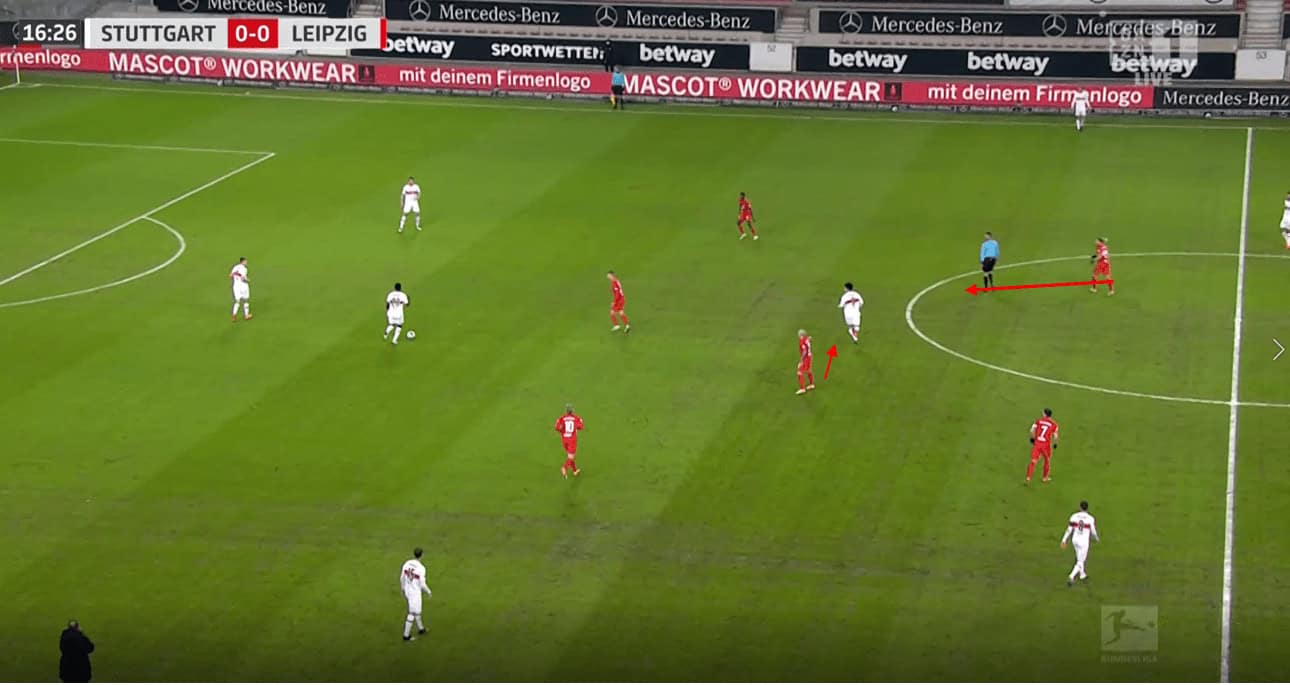
The solution came in the form of an asymmetrical 4-2-3-1, with left-winger Angeliño given the role of marking Stuttgart’s key player and Japanese international Wataru Endo. We can see the asymmetrical structure in action below, with Angeliño tucked in to keep Endo within his cover shadow. Dani Olmo could therefore stay with the ball far pivot, and the two deeper midfielders could stay deeper and mark nearby central options as they do here.

We can see another example here where Angeliño sits narrower and allows the pass out wide initially, in order to prioritise Endo not receiving the ball. Olmo again is allowed to fully commit onto the far pivot when the goalkeeper has possession.
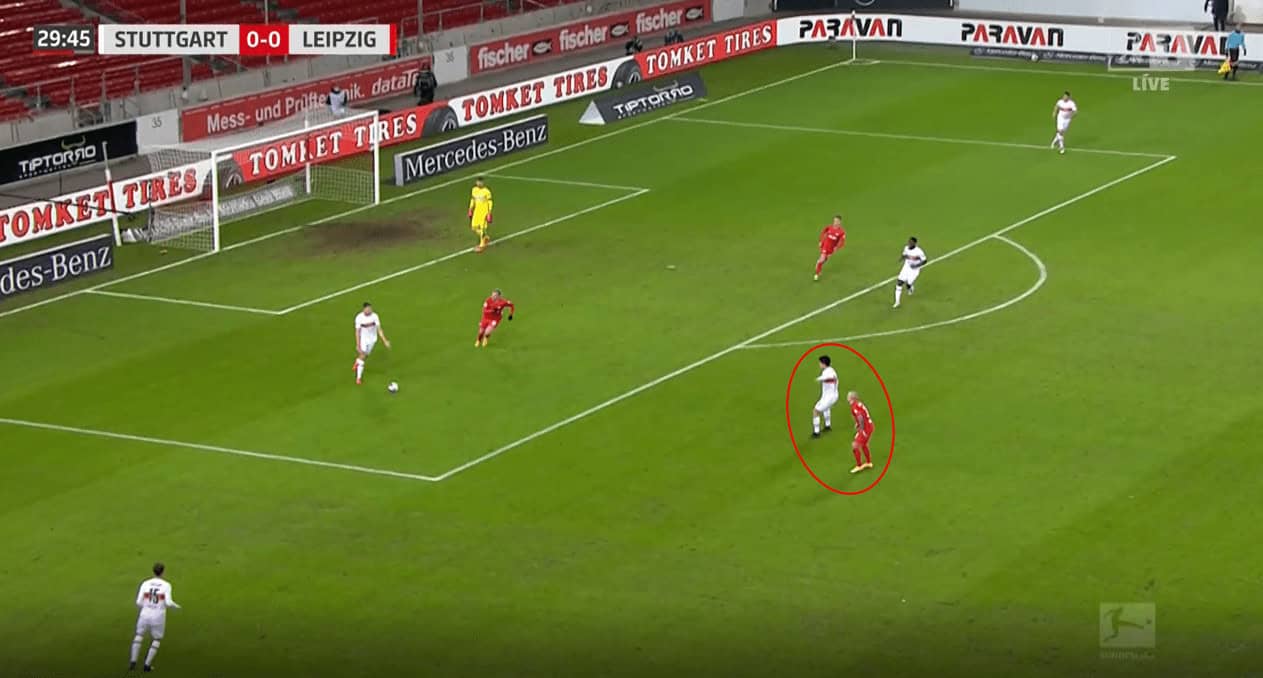
Angeliño then presses wider, and due to his pace and the angle of his run, he is still able to cut off the pass to Endo. Even if Endo does receive the ball here, he loses his advantage gained by dropping so deep, as he now has those two deeper Leipizg midfielders in close proximity ready to jump to press.
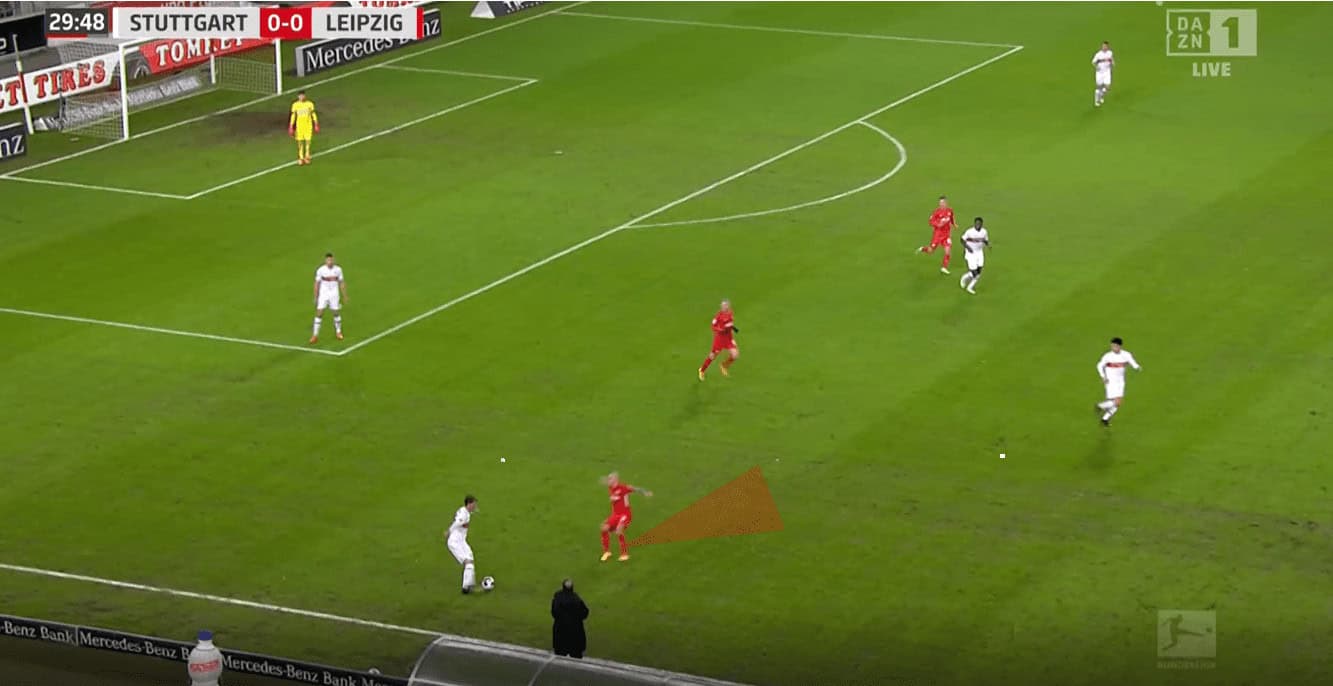
Here, now right winger Dani Olmo moves to press the centre back, while pressing ten Yussuf Poulsen marks the ball near pivot. Angeliño still comes across and stays tight to Endo, and so Stuttgart switch the play before then going long. Had this press been symmetrical on both sides, we would see Olmo hang back on Mangala while Poulsen marks the ball far pivot.
Angeliño didn’t mark in a strict man-oriented way, and when on occasion Endo would look to swap sides, Angeliño would not be able to follow. We can see below he looks to transfer Endo onto another player, which due to him not being pinned, is performed by deeper central midfielder Kevin Kampl.
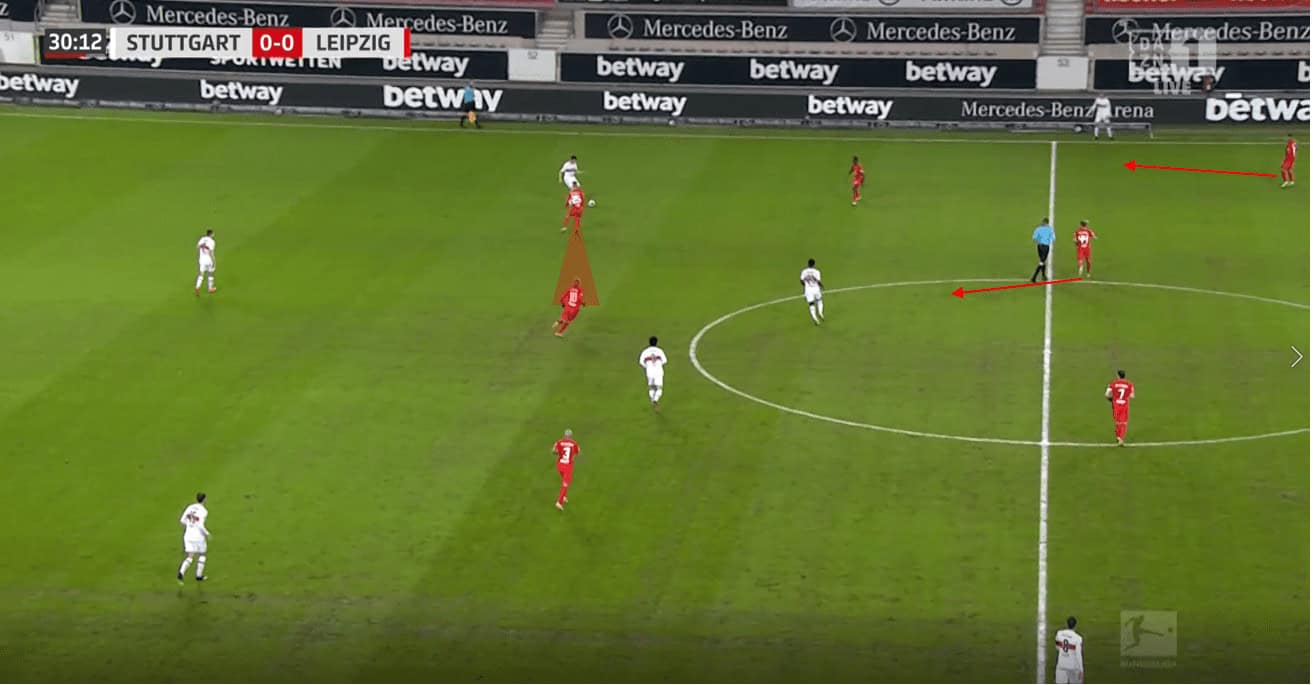
We can see here Olmo gets his presing angles wrong, with his cover shadow not covering the ball near pivot. No player is marking the ball near pivot, and so they rely on pressure from the deeper central midfielder, which successfully forces the ball wide, where Tyler Adams anticipates well and steals the ball.
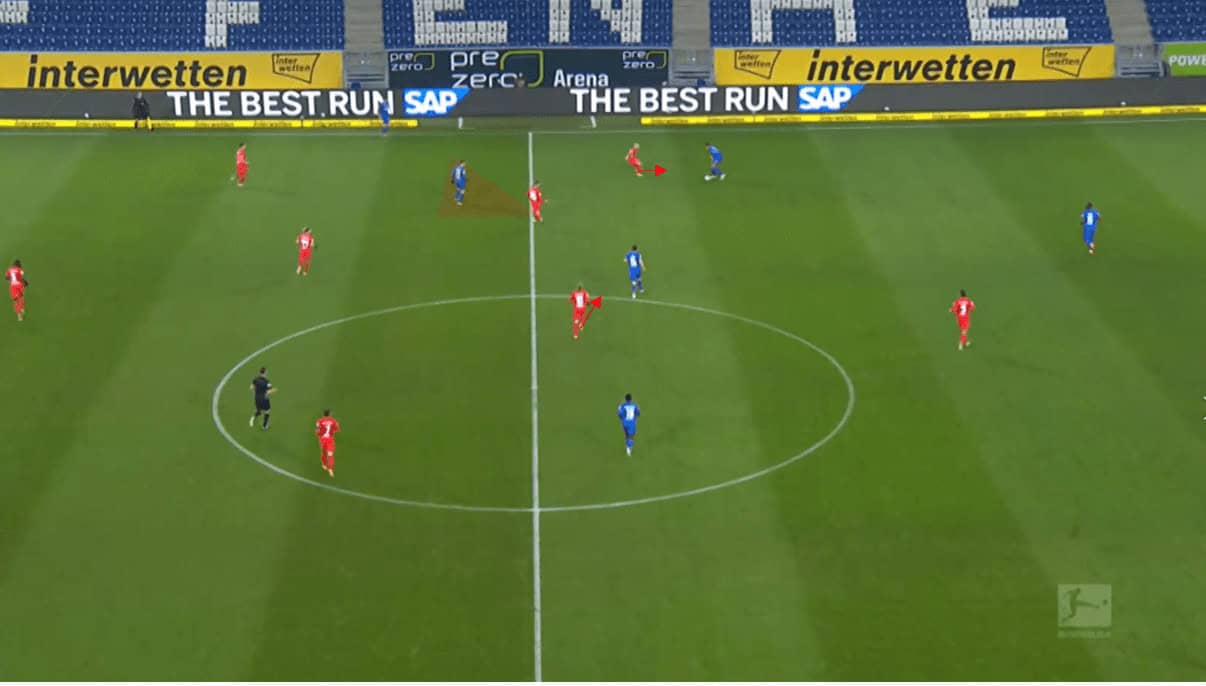
Against Hoffenheim, their shape was lopsided on both sides, and so was quite ball oriented and susceptible to switches in play. The reasoning behind this was to restrict the centre once again and prevent Hoffenheim from using overloads in the centre of the pitch. We can Leipsizg operating within their very narrow 5-2-3 shape below. The Hoffenheim full-back or wide centre back is pressed by the wing-back, while the ball side inside forward tucks in. The shape becomes so narrow because we see the Hoffenheim far inside forward Emil Forsberg press the nearby pivot. As a result, occupation of Leipzig’s right side becomes very poor, and occupation of this left side becomes very good, with covering players enabled in front of the defence. Having these players free in front of the defence was vital to Nagelsmann’s plan to deal with Hoffenheim’s ten within the 4-2-3-1.
Here, following a switch Leipzig were well prepared for, Leipzig settle into their 5-2-3 shape, which would also resemble a 3-1-3-3, with Kevin Kampl dropping deeper as he does here and the wing-backs pushing on. Far side inside forward Forsberg comes across again to mark the pivot, and so Olmo can focus on covering the half-space, while Kevin Kampl can look to nullify any potential midfield overloads coming from higher up.
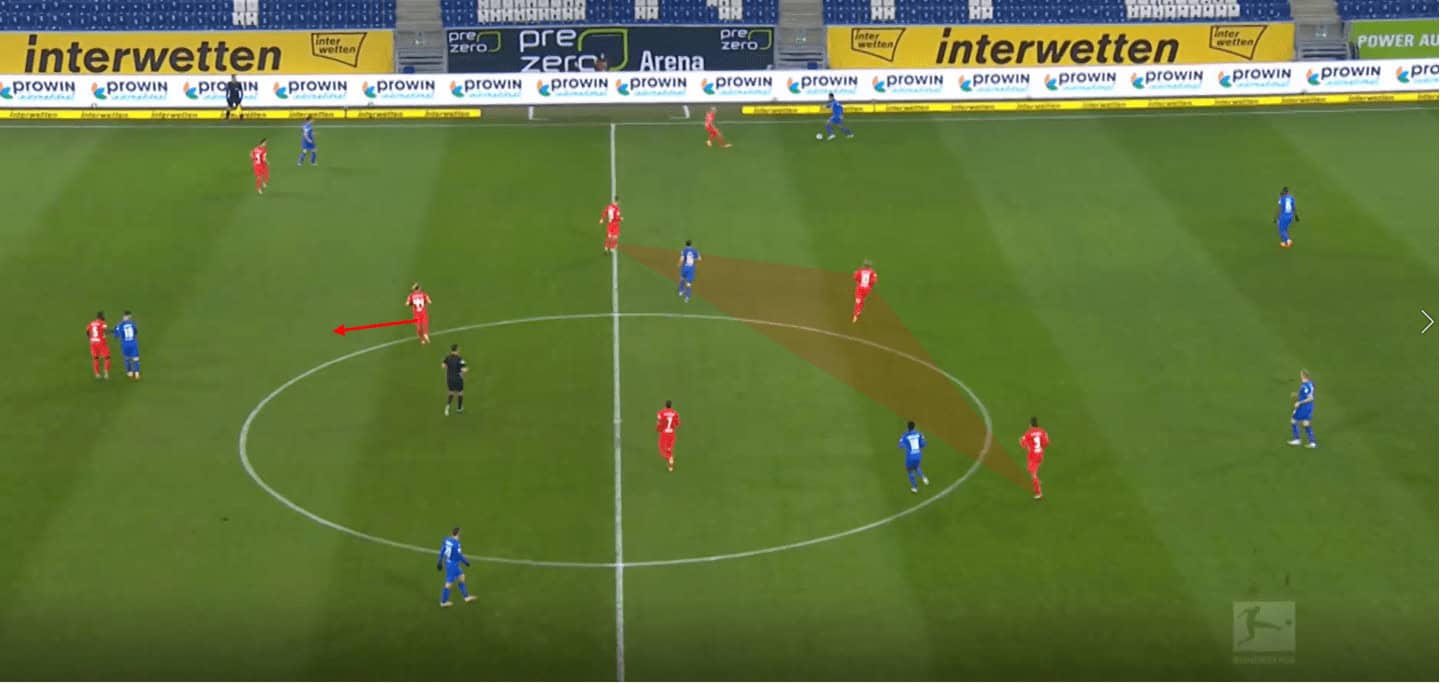
The system did have its advantages and is certainly an interesting idea, but for the large part it was actually fairly unsuccessful in high pressing, with Hoffenheim’s switches in play hurting the structure greatly. We can see an example of the very lopsided structure below, with the ball near inside forward (Forsberg) covering the half-space and moving forward to press, while Dani Olmo comes across from the far side and covers the nearest pivot. The wing-back has already pressed higher to force Hoffenheim backwards, and the switch isn’t cut off, so Hoffenheim switch the ball.

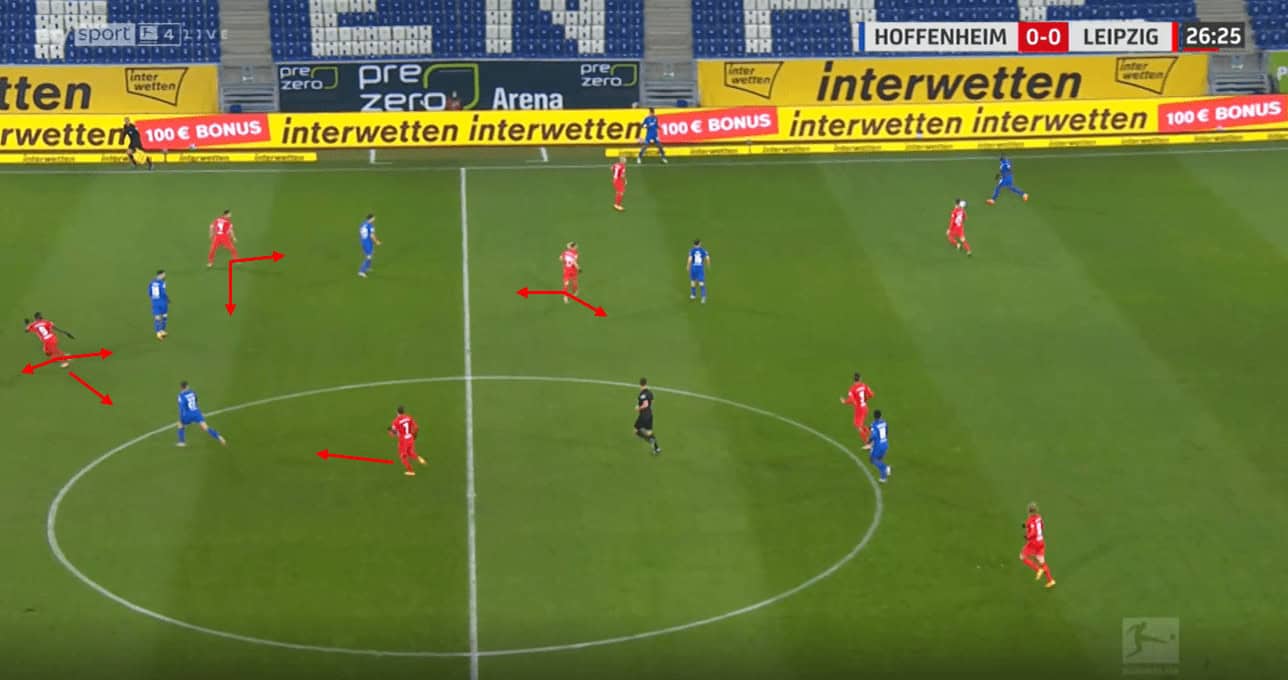
Once the switch occurs, we can see the problems Leipzig’s lopsided shape causes. Kevin Kampl can no longer sit deeper unoccupied in front of the defence due to the lack of coverage in the half-space, and weak pressure on the ball means Hoffenheim can play vertically. The wide centre back has to step higher in the half-space also due to the lack of coverage, and he is overloaded in front and to the side. Kevin Kampl is also overloadedwith two players nearby, and Dayot Upamecano looks to drop off despite a player being in front. Hoffenheim do an excellent job of preparing their shape offensively after the switch, and so they can create overloads everywhere and cause problems. Leipzig didn’t concede in the game, but their first half setup clearly had problems thanks to Hoffenheim’s good switching of play.
This brings me nicely onto the next two defensive strategies Nagelsmann frequently uses.
Adapting when unsuccessful and catering to the opposition
Nagelsmann’s coaching of his team in such a flexible way allows him to be able to press specific to the opposition’s shape and change his plan if the opposition adapt or start to exploit the formation, and Nagelsmann’s obvious tactical prowess means he can spot these problems early and devise a new solution. Below we will go through a few examples where Nagelsmann chose a specific formation to nullify the opposition, or adapted midway through the game to solve the problems the opposition faced. The Stuttgart game is a good example of an opposition specific plan implemented by Nagelsmann, but we have already covered this.
We will start with Hoffenheim, where above we already briefly explained the reasoning behind his initial tactical system, and then the problems it faced. So what was the solution?
To explain the solution, you have to first look at the route of the problem, with the main problem being that lopsided shape causing imbalance once Hoffenheim switched the ball. The asymmetry was caused by a need to press the pivot while maintaining coverage of the half-space and the back line. As a result, permanent coverage of the pivot was needed, along with midfield cover behind, and so Nagelsmann adopted their conventional 4-2-3-1 approach after half time.
We can see the clear change in structure below and the effect it had on the game. Hoffenheim’s 4-3-3 no longer posed a direct overload so to speak, with the only overload actively available being a double pivot receding the ball deeper, which is much more favourable to Leipzig than a player in behind becoming free. Leipzig though did a goof job of nullifying this potential overload, and adopted their 4-2-3-1 in a narrow fashion still. This meant that the pressing ten Olmo could cover the ball near pivot, while the far pivot became difficult to access and the two deeper Leipzig midfielders could occupy a higher central midfielder.
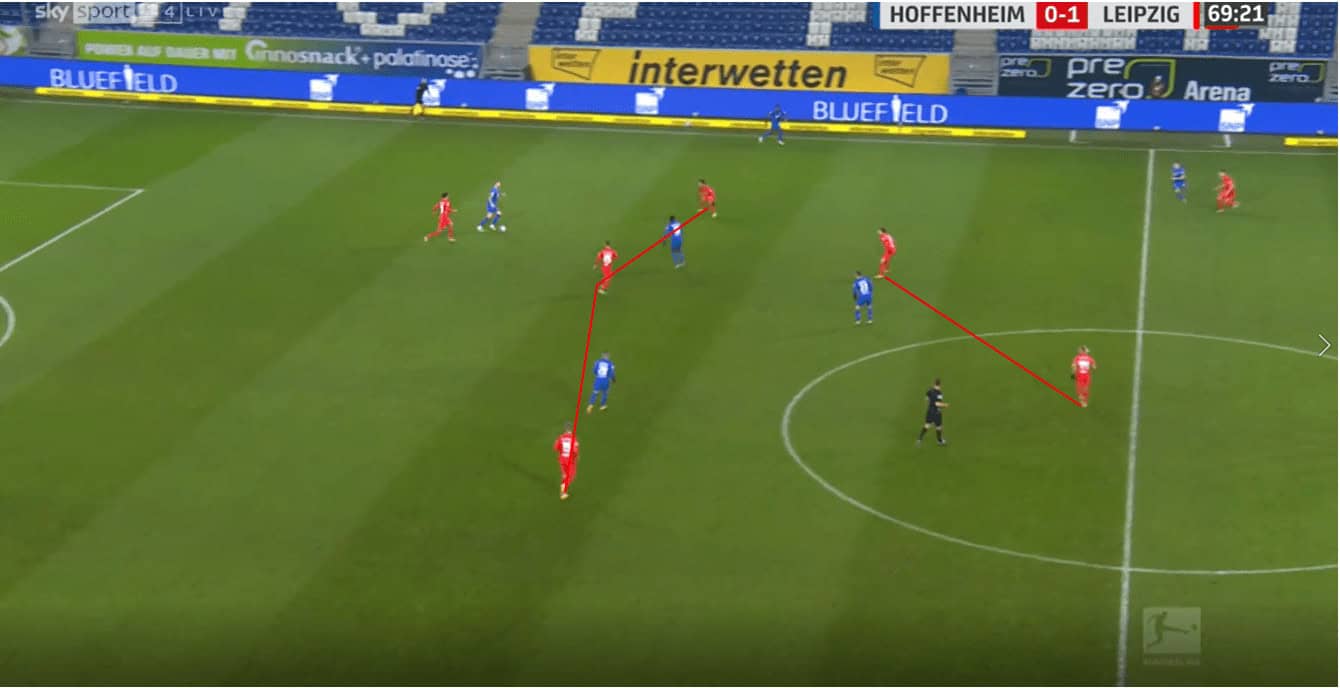
We can see here that if even if the overload can be created, the midfield is balanced enough that it can cut off the central passing options and prevent the ball being progressed. Olmo’s positioning allows Sabitzer to drop if needed, and because Sabitzer can drop, Kampl can move slightly wider, so even if the ball far pivot is found, he will be put under pressure and have nearby passing options cut off. We can see the far winger comes across well here and remains narrow, which is something commonly seen in the 4-2-3-1 on both sides (not the same thing as Stuttgart match).
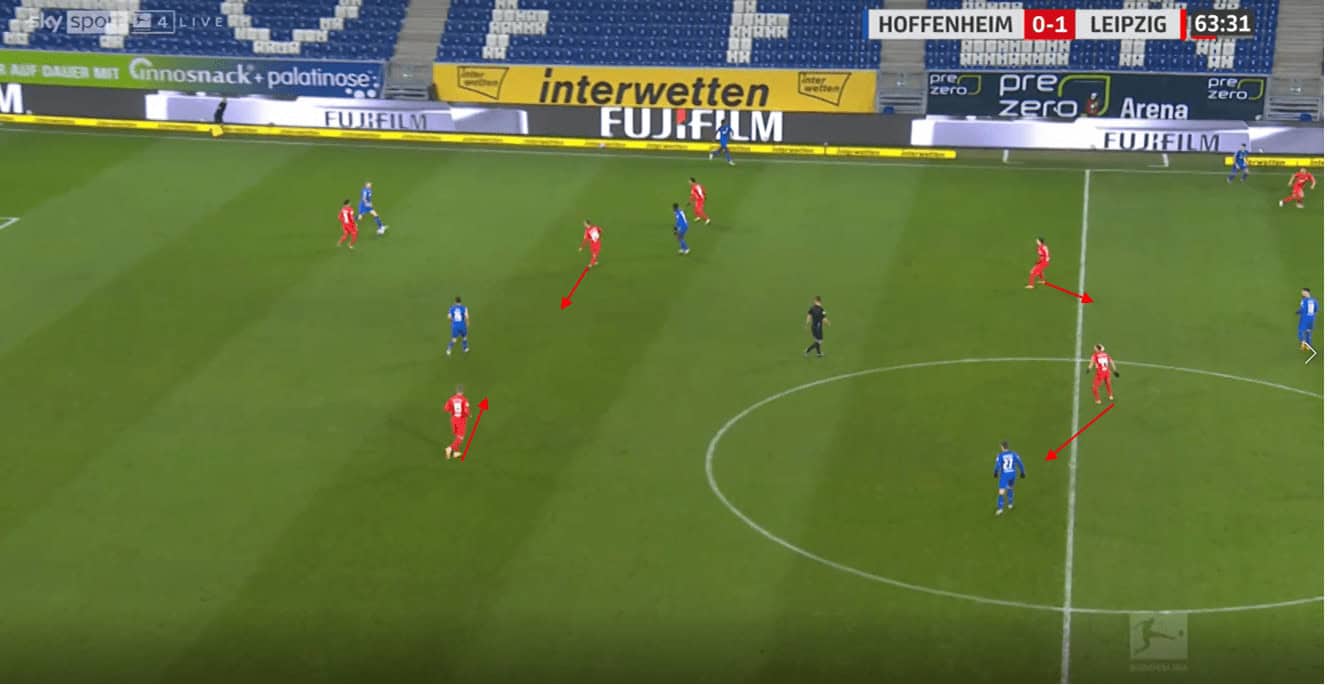
We can see in this example here, following an overload using a double pivot, Hoffenheim progress play forward, but because of that extra cover in midfield, as well as their aggressive full-backs and vertical compactness, Leipzig are still able to recover the ball.
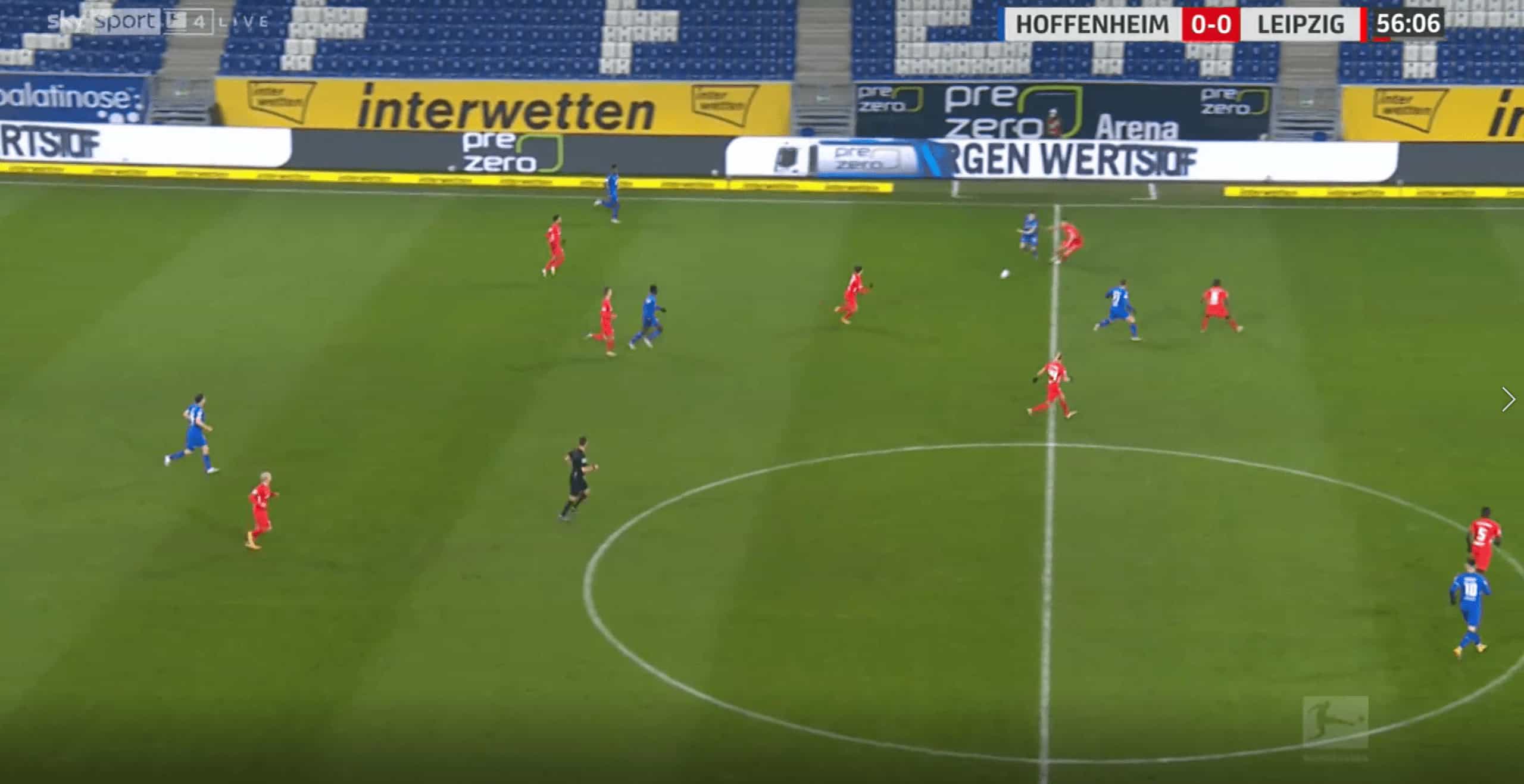
The 4-2-3-1 also brought with it the general principle of showing the opposition into a wide area, with the staggering within the 4-2-3-1 as well as the central occupation helping to trap Hoffenheim in these areas. This change in system greatly solidified Leipzig, with the Bulls only conceding 0.24 xGA from open play in the second half, leading to them winning the game 1-0.
A good example of Nagelsmann setting up specifically for the opposition is their game early in the season against Bayer Leverkusen, which they drew 1-1. Leipzig started the game in a back three, with their lineup seemingly resembling a 3-4-3 on paper. The interesting part of this 3-4-3 was the role of Yussuf Poulsen, who did not engage in the first line press and would often change Leipzig’s shape to a 3-4-1-2. Poulsen was tasked with the role of covering the ball-near Leverkusen pivot (often Charles Aránguiz), and so he would drop slightly deeper and look to cut off the pivot as a passing option. The two wingers would then be tasked with pressing the centre-backs, and they would usually cut the inside lane and show the pass to the full-backs, who were aggressive in their pressing. The Leipzig central midfielders could cover the nearby Leverkusen midfielders and acted fairly man oriented, and as a result, Leipzig could maintain a 3 v 3 and prevent their midfield from being manipulated and overloaded.
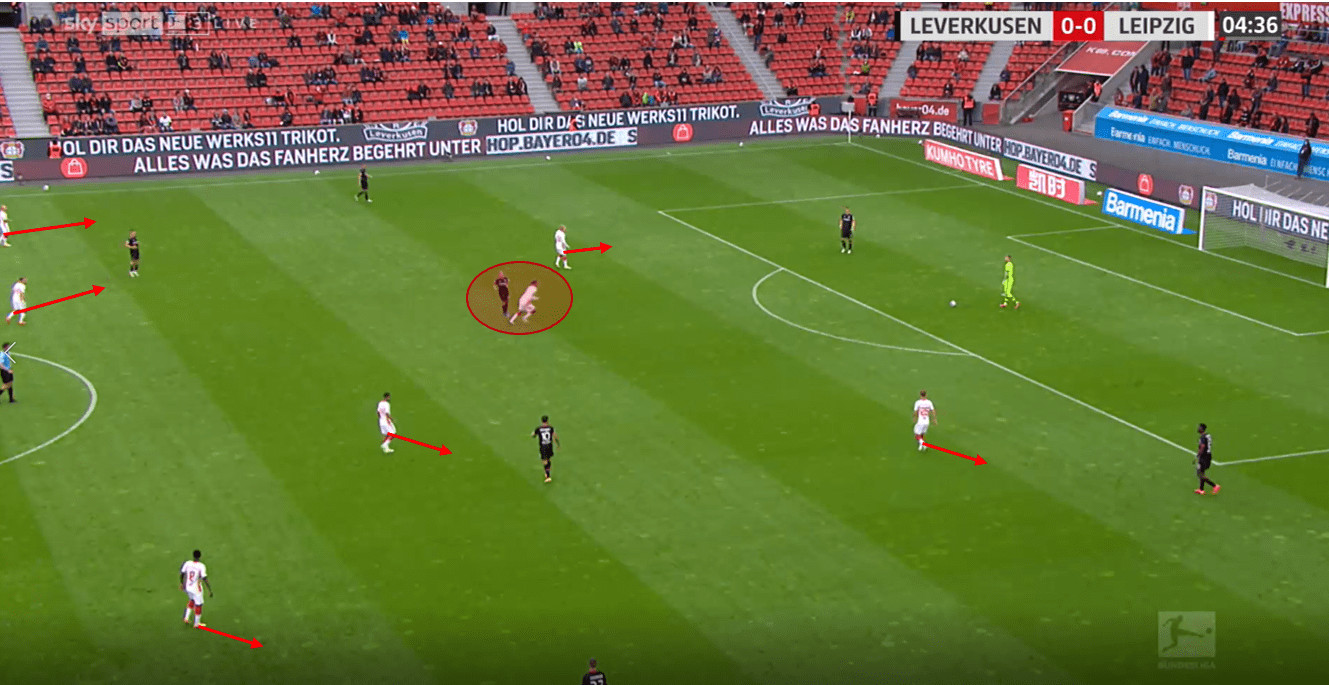
We can see here the ball is forced into a wide area, and the timing of the run by the left-wing back is good, with Bender receiving with relatively poor body orientation and central options marked. As a result, for the first 20 minutes of the game, Leipzig were all over Leverkusen and went 1-0 up quickly, with their usual patient build-up disrupted thanks to the lack of access to central areas.
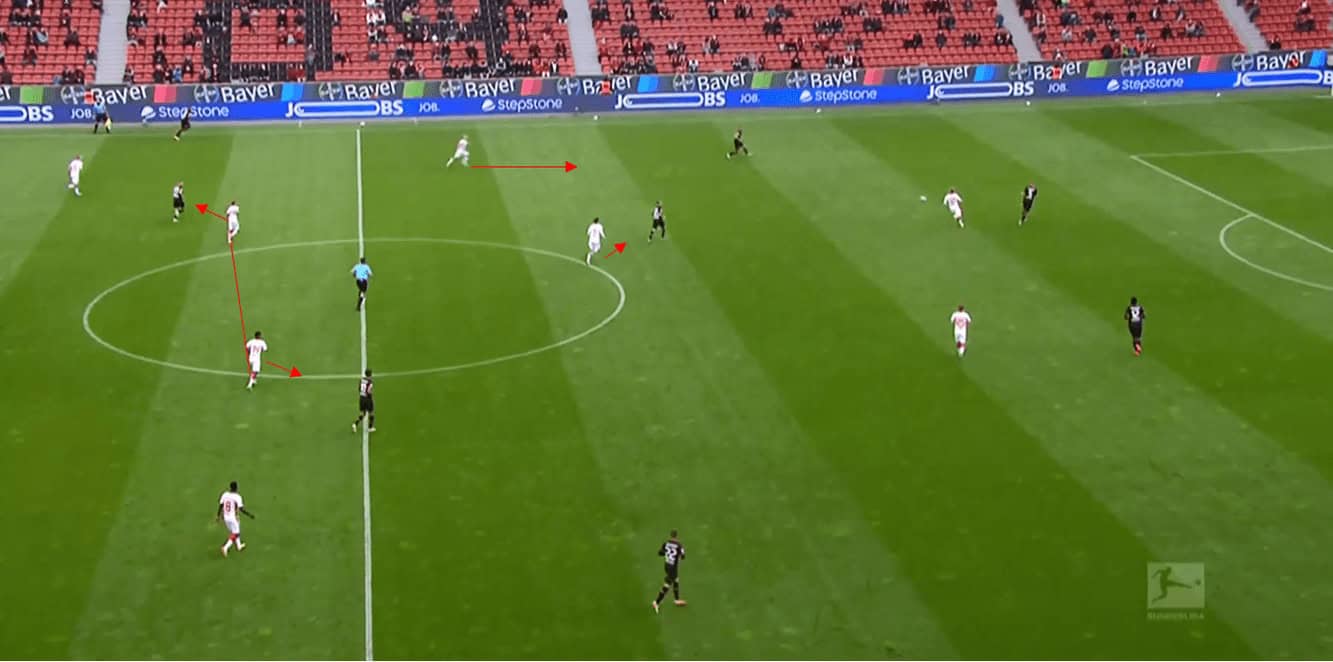
Leipzig would also situationally look to cut the wide pass in order to force Leverkusen centrally, however this was much rarer. Here they do just that and right full-back Tyler Ada,s is able to push forward well and steal the ball, launching a good counter-attack.
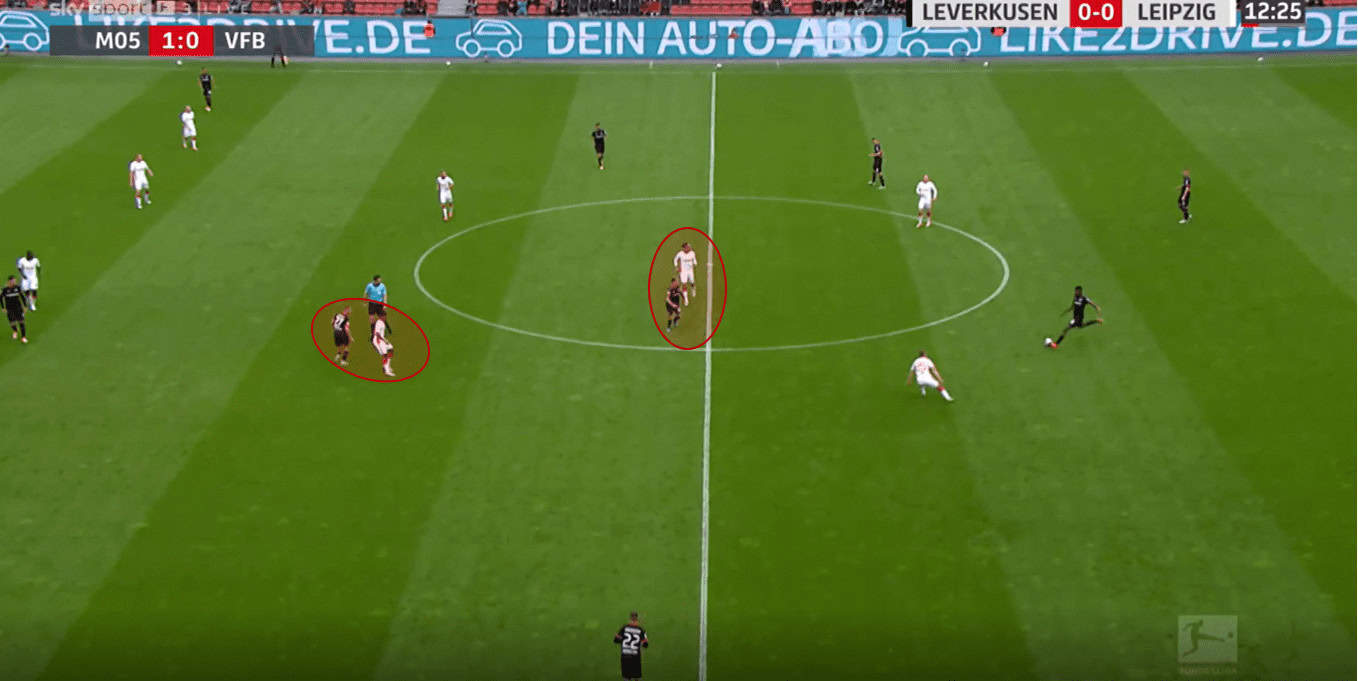
This 3-4-1-2 shape was going extremely well for Nagelsmann until Yussuf Poulsen went down injured after about 20 minutes, meaning he was forced to be replaced by new signing Alexander Sørloth.
This change seemed to disrupt the way in which Leipzig pressed, with Leipzig struggling to continue with that pressing scheme due to their spacing and players performing different roles. We can see an example of this below here where striker Sørloth now presses the backline while the left-winger Emil Forsberg keeps tabs on the full-back. As a result of Sørloth pressing the centre backs, the pivot is able to get free, and so Leipzig react by having right-winger Dani Olmo now covering the pivot. This keeps them stable while the ball is on Leverkusen’s right side, but when the ball is switched Leverkusen can stretch play more.

We can see here, a Leverkusen central midfielder receives the ball and is pressed from behind. Sørloth, having just pressed a centre-back, does not react and cover the pivot to prevent him from receiving. As a result, Leverkusen are able to access the overload they have created around Leipzig’s right central midfielder, with Diaby tucking in cleverly to create this advantage. Because of these problems, Nagelsmann set Leipzig into a more passive 5-4-1 just before half time, effectively just to sit tight until he could change things at half time.
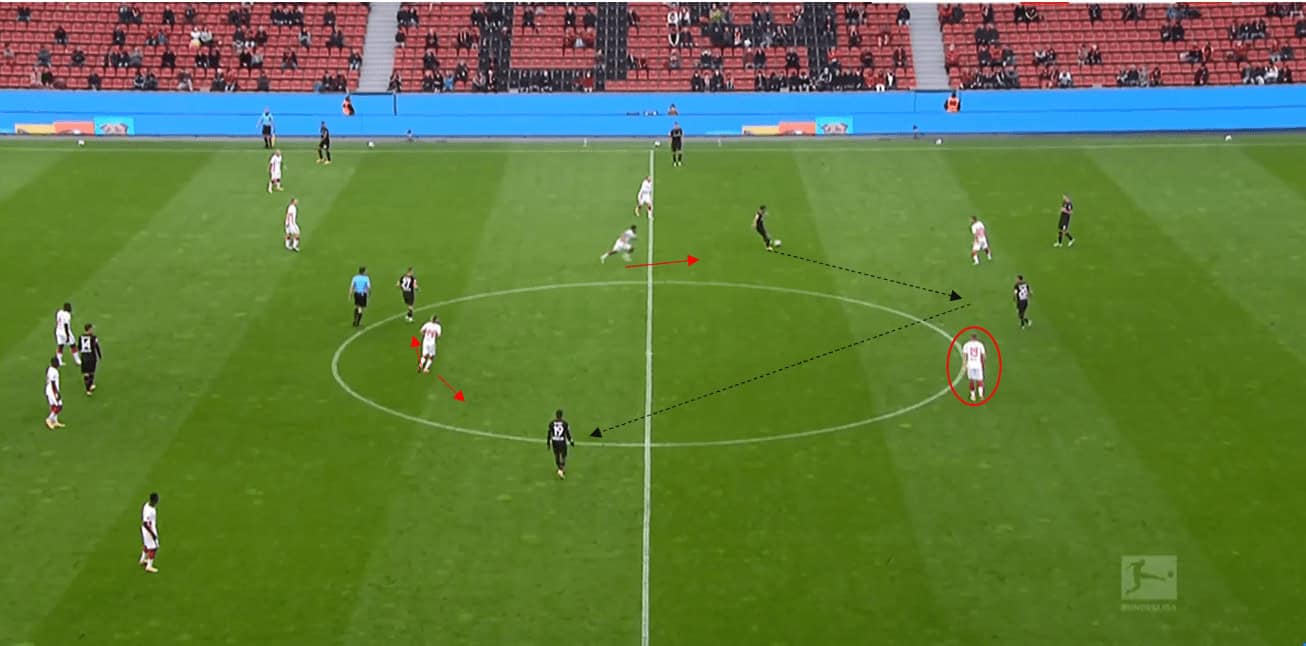
Nagelsmann decided to switch systems at half time and changed into a 4-2-3-1 formation. Previous right wing-back Amadou Haidara moved to central midfield while Mukiele filled in at right-back.
The thinking behind this switch to a 4-2-3-1 was simple- occupy the pivot. Following that late first-half confusion, it looked as though Nagelsmann wanted to reduce the load expected of Sørloth, as the Norweigan now had to simply press the centre-backs. Instead, fellow new signing Hwang Hee Chan was tasked with marking the pivot. The wingers would sit slightly deeper and press the full-backs when they received the ball. These changes allowed Leipzig to track the pivot in a simpler fashion, and they found success in doing so. This then, was a similar adjustment to the one made later in the season at Hoffenheim.

We can see below, that due to the more passive nature of the wingers, Leipzig adopted their usual method of using the 4-2-3-1 to trap the opposition in wide areas, and were successful in the game, conceding just 0.25xG in the second half and only 0.74xG in the whole game.
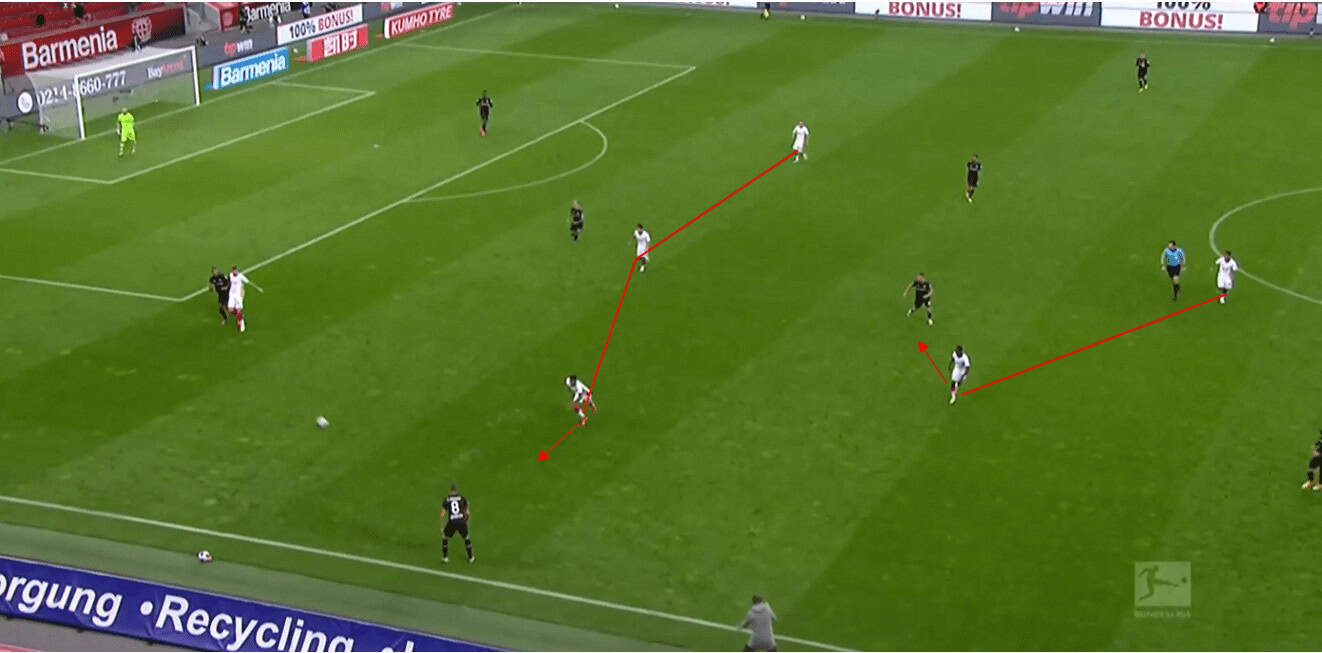
The most recent example we saw of Nagelsmann tailoring Leipzig’s defensive shape to the opposition was against Borussia Dortmund, where Leipzig opted for a 4-3-1-2, with again a big emphasis on forcing the ball into wide areas and having good coverage of the centre against Dortmund’s 4-2-3-1 with narrow inside forwards. We can see Angeliño stays in the half-space and roces the ball wide, before then pressing Meunier. Sabitzer could keep tabs on Dortmund’s number ten, while the Leipzig’s full-backs would be fairly man-oriented around the inside forwards. Nagelsmann likely didn’t choose a back three due to the threat of Haaland.
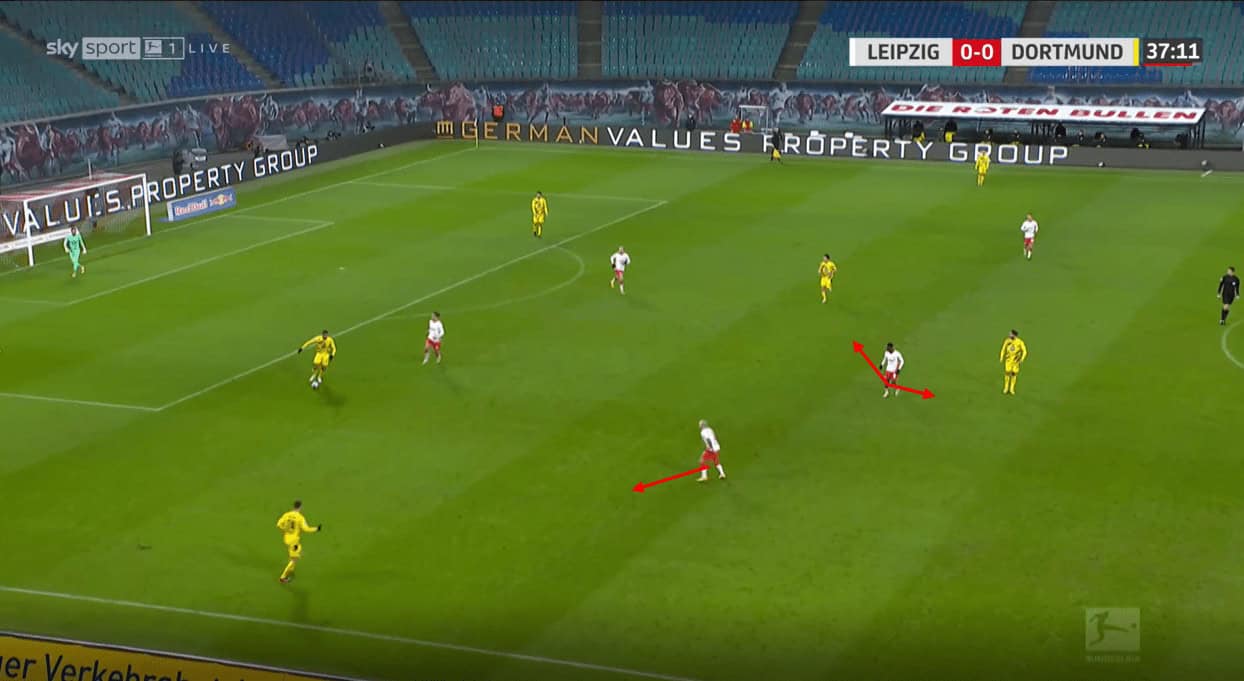
We can see an example of the full-back behaving in a more man oriented way here, with Halstenberg doing a good job of nullifying the overload created by Gio Reyna. Dortmund dropped into a back three to stretch the half-space, but Halstenberg’s aggression puts him into a situation where he should win the ball, and he is slightly unlucky not to.

We can see a really nice pressing scene below for Leipzig, with them again forcing Dortmund into a wide area and covering nearby passing options. Striker Poulsen applies pressure in front to force the ball wide, while left central midfielder Angeliño covers the half-space and only presses wide once the ball has been played. As a result, Angeliño covers the pass into the dropping inside forward, as does Haidara initially, with Haiadra able to jump more towards the pivot once the ball is wide, as the angle to the inside forward is very difficult due to the angle of Angeliño’s press.
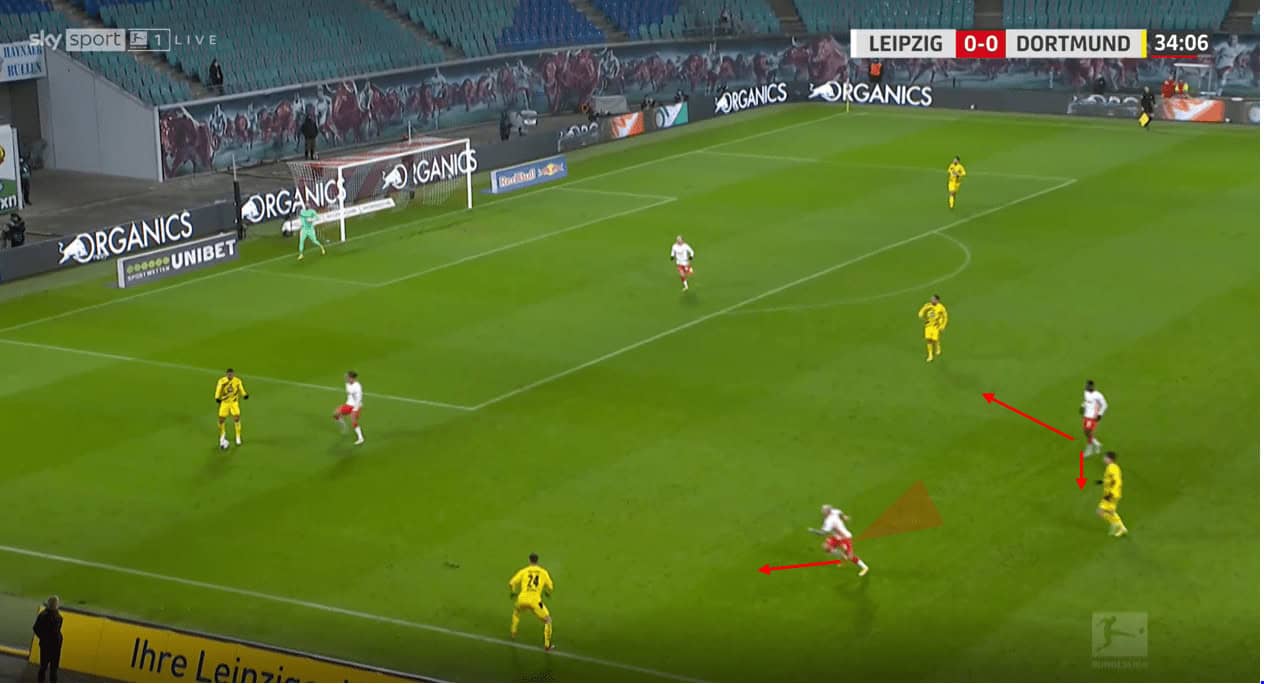 Leipzig may have lost the game 3-0, but this was little reflection of their overall pressing performance, especially in the first half, where Dortmund didn’t record a single shot.
Conclusion
Overall then, it is clear to see Nagelsmann is an incredibly tactically astute manager, but I would hope that if you are reading this you already know that. One of the real benefits of Nagelsmann’s philosophy around varying shapes is that it makes them very difficult to prepare to play, as you almost have to start predicting how Nagelsmann will nullify your own strengths so that you can overcome his adjustments. This is one of the reasons why I am looking forward to writing a tactical preview on their Champions League fixture against Liverpool, as Liverpool aren’t a team who adapt like Leipzig, and so it will be interesting trying to figure out how Nagelsmann will try to nullify and overcome Liverpool. It is also worth noting that I’ve only covered a few of the trends or ideas behind Leipzig’s pressing systems this season, and there are many more Nagelsmann principle and ideas which are not covered- but this article is probably long enough as it is.
Nagelsmann’s adjustments allow the game to be manipulated and for certain spaces/natural advantages between opposing shapes to be utilised, and his side’s commitment to the same principles, regardless of shape, make his side dangerous every week.

