
Burgos CF are a team currently playing in the Segunda Division, the second tier of Spanish football. After a mediocre season, finishing in 11th place and being the team with the lowest amount of goals involved in their games, Burgos have carried on their methods into the next season. After 11 games of the current season, Burgos CF have only just conceded their first goal in their 11th game, while keeping a clean sheet in 10 of the 11 fixtures so far. They are well on their way to beating last season’s total of 16 clean sheets in 42 matches.
The current manager, Julian Calero Fernandez, has worked wonders already by bringing Burgos back to the second tier, after being stuck outside of the top two tiers for the past 19 years. Burgos currently sit in 3rd place, with an eye on promotion to La Liga this season seeming more likely by the week. Burgos have been setting up in a 4-2-3-1 designed to counterattack the opposition. While the results have been excellent the xG data shows that they’ve been expected to score 9.79 goals and have slightly underachieved by scoring 8 goals this season. On the other hand, they’ve been expected to concede 12.43 goals, and have somehow only conceded 1.
This tactical analysis will come in a form of a scout report to explain the tactics behind Burgos’ strong start to the season, and how they have only allowed 1 goal to go in. This analysis will show how Burgos have set up tactically, to make life as difficult as possible for their opponents and also be devastating on the counterattack.
Defensive Solidity
One of the biggest reasons for the excellent defensive record that Burgos have earned, is the setup of the squad, led by the coach, Fernandez. They have been setting up in a 4-2-3-1 shape, in a low block. The team is very compact vertically, with minimal spaces being allowed between each defensive line. This means that there is no space for any opposition players to drop into and pick up the ball without the risk of an opponent being right behind them.
The defensive line also pushes up to help be vertically compact, while the keeper is responsible for sweeping up any balls that are played over the top. Opponents are forced to either play risky passes over the top or have to try to go around the sides of the defence, from which it is easier to defend the space.

Another key tactical point of the Burgos low block is the role of the three central midfield players. The midfield players are tasked with man-marking the central, creative, players from the opposing teams. Man-marking helps take those creative players out of the game. As a result, opposition teams must either pass sideways or go long. This style of play, while defensive, is very brave and prevents teams from properly creating chances or even getting into the final third.
The image below shows how the attacking midfielder of Burgos, is solely focused on the opponent. He is only looking at the other player, which is evidence of the man-marking tactics set up by Burgos. On occasions, when the centre forward can cut off half of the pitch and force play to one side, the wide midfielder tucks in and does the man-marking, as shown in the picture below. This allows the spare midfielder to cover central areas in the final third, preventing anyone from being able to drop deep to collect the ball.
In many other cases, when the striker fails to close off one side, the wide midfielder has to keep his position, and so the central midfielder has to do the man-marking. As a result, there are often massive gaps in the heart of the Burgos defence, which can be easily picked apart if the opposition centre forward drops deep to collect the ball.
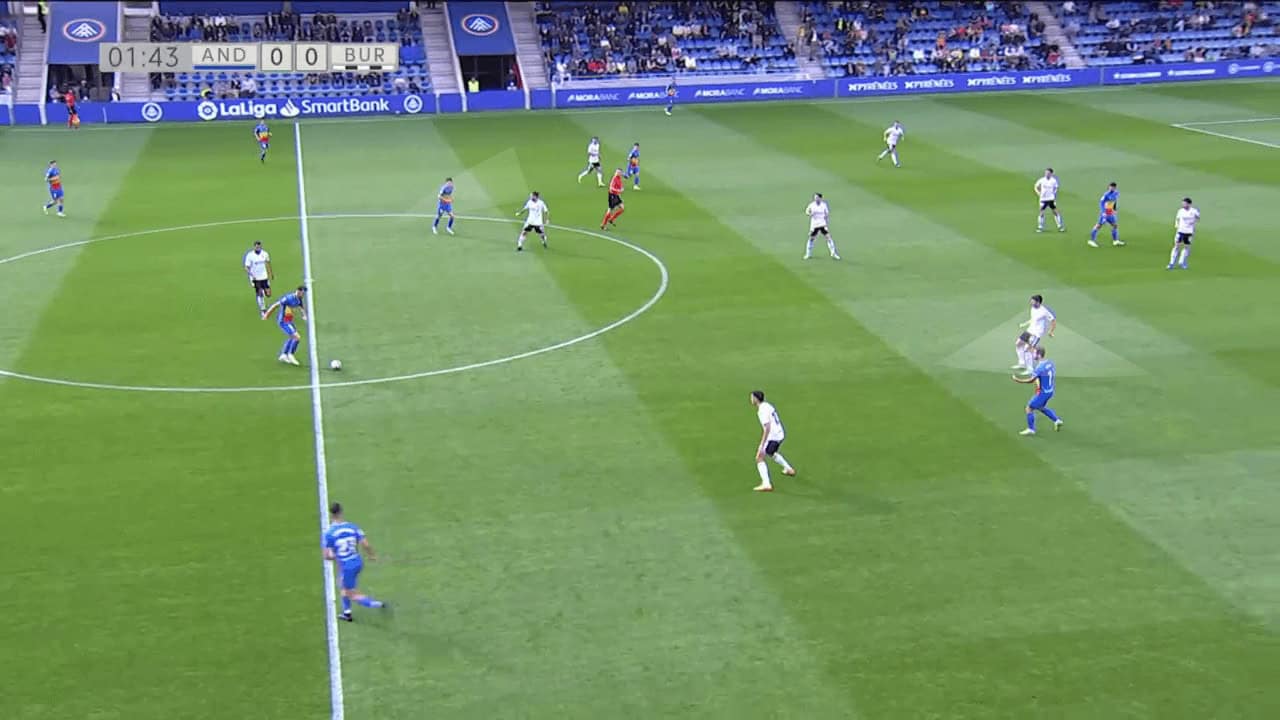
While the man-marking in midfield has been very effective, there is little room for error, and one player getting attracted to the ball can cause problems for the entire team. This image below shows how the attacking midfielder gravitates towards the ball, which causes him to lose his man. These situations can be devastating, as the Andorra midfielder is unmarked and running towards the goal, against a backline which is very high and doesn’t have the recovery pace to get back in time.
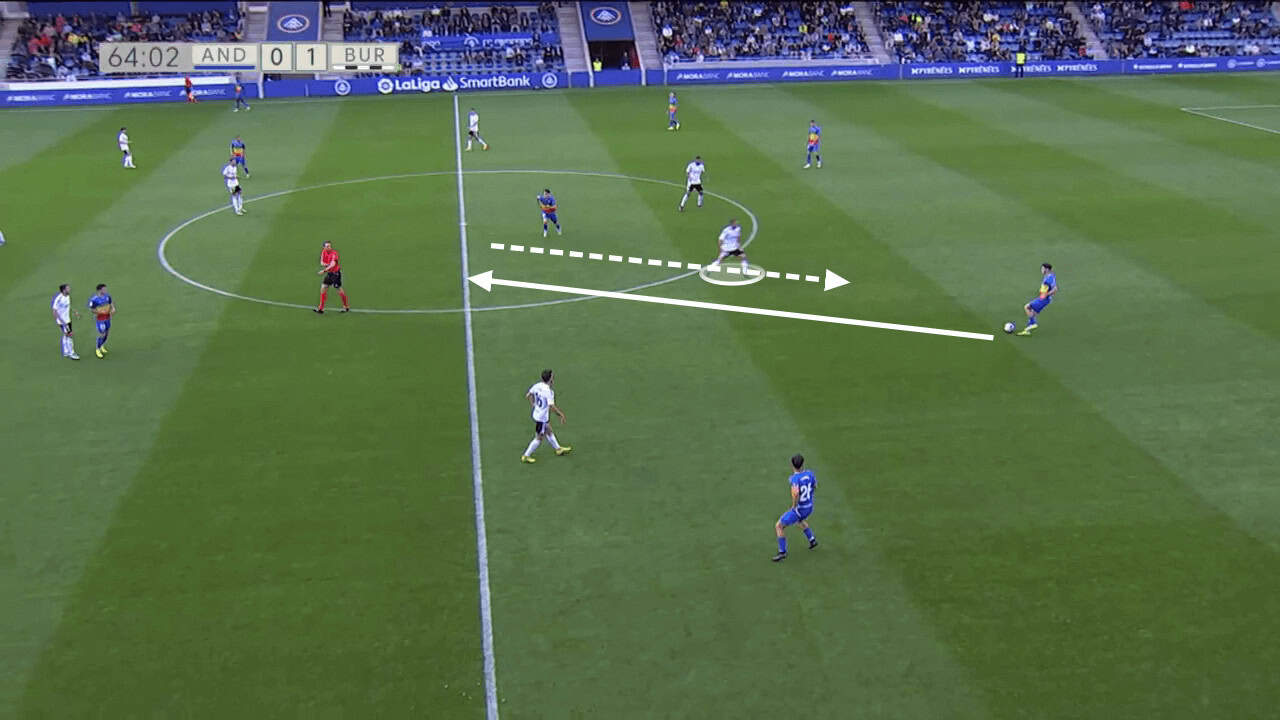
Furthermore, the man marking in the midfield zone means that it can be easy to run through the vacated spaces in the middle. When the opposition centre-backs have the ball, they are always left in 2v1 scenarios against the Burgos striker. This makes it easy for them to retain possession of the ball and the free defender can often drive forwards with the ball.
As the midfielders are busy, it is often easy for the opposition defender to run directly towards the box and either pick out a pass or have a shot on goal. We can see on the right of the image, the midfielder is busy man-marking, which leaves a path for the defender to carry the ball through.

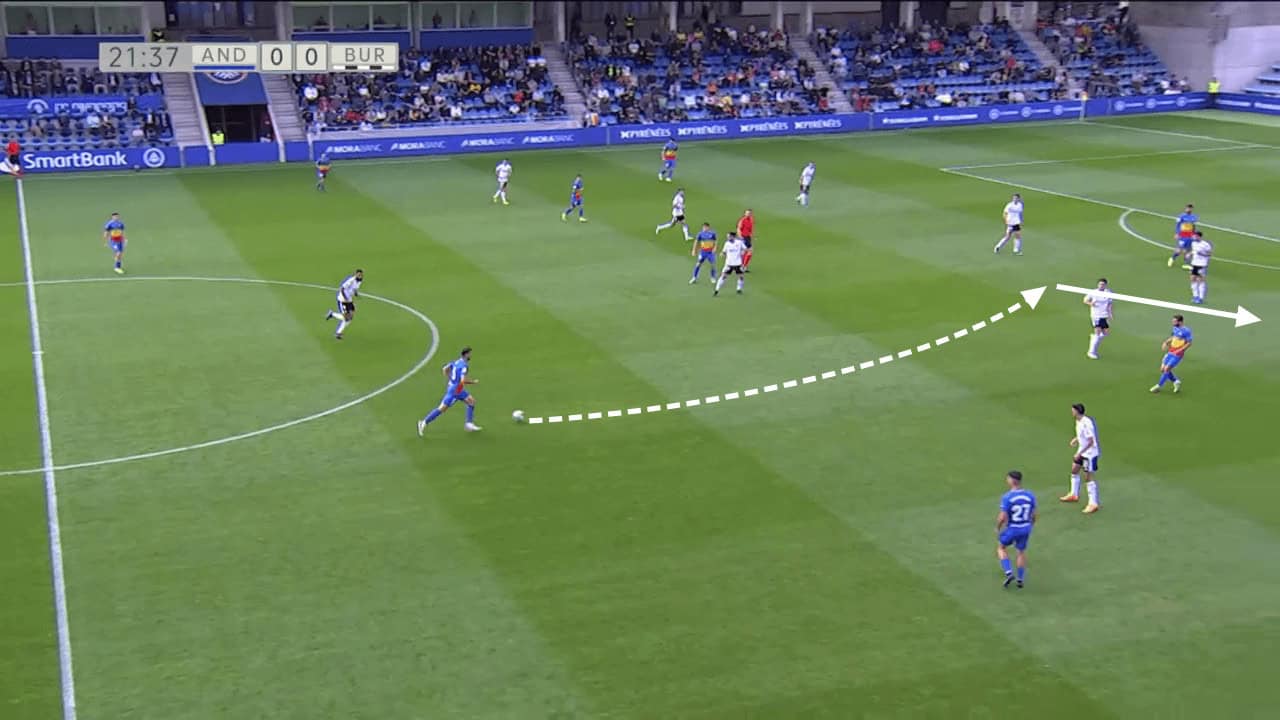
While Burgos aren’t usually worried about the centre-backs creating dangerous chances, they can often drive towards the box and have an easy pass to pick out, usually for the wide players on the wings. This image below shows the central defender driving towards the box without any pressure, from where he can play the ball to his wide player who is in a dangerous position from which he could create danger.
As a result, it is often very easy to push Burgos back and deep into their own half, as you can dribble towards the box unopposed. Burgos can be put under pressure, and be kept there due to their negative style.
Due to the negative style, Burgos are often pinned back and forced to defend their box for large portions of certain matches. Aitor Cordoba has been a key player for Burgos, with his excellent box-defending skills helping his team deal with crosses into the box constantly, all season. The image below shows where Cordoba has performed every defensive action, including a large number of interceptions around the six-yard box, showing just how much defending Cordoba has had to do around his own six-yard box.

Burgos have displayed a style which has been quite hard to play through, but once the dribble can be made, Burgos can be left very open and at risk. Furthermore, the lack of pressure means it can be easy to sustain pressure against them. So far, Burgos seem to have been very fortunate considering the xGA, but that is expected to soon catch up with them
Risk-free build-up
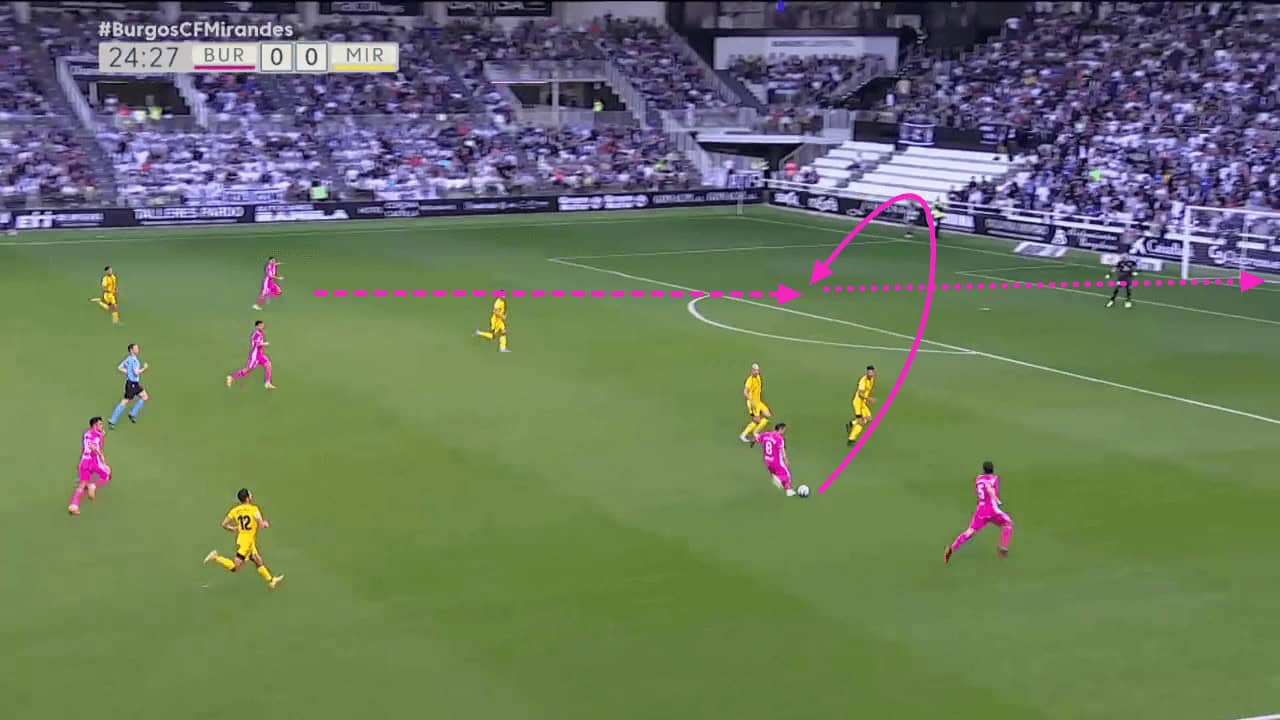
When Burgos have the ball, they are often very direct and try to bypass the opponents in as few passes as possible. From goal kicks, Burgos launch the ball long and try to win it high up rather than trying to play through the opposition press.
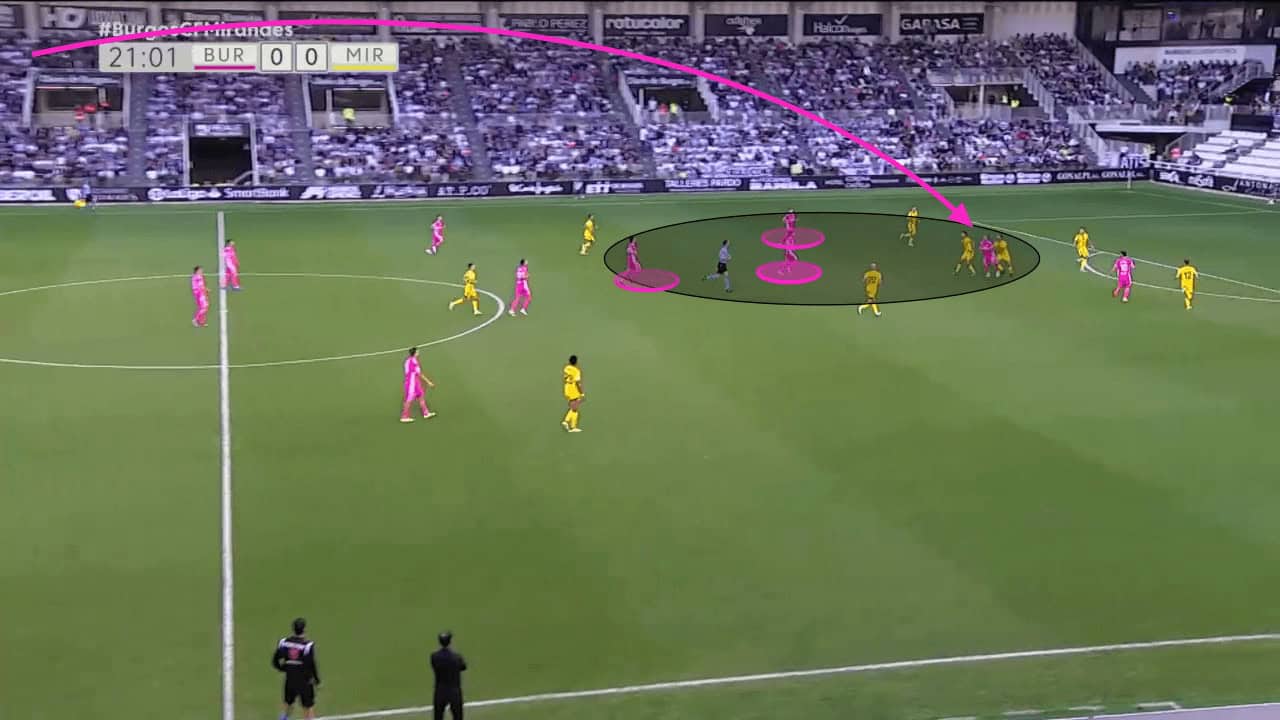
The image below shows just how far the goalkeeper, Jose Antonio Caro, can launch the ball from a goal kick. The ability to kick the ball so far helps push the opposition team back and allows Burgos to have a chance of winning the ball high up in the opposition’s third. In the image below, we can see that Burgos have purposefully surrounded the recipient of the ball with lots of pink shirts, in an effort to try and win the second balls around the opposition’s box from where they are very close to the goal.
This pass map from the goalkeeper below shows just how often Burgos attempt to go long rather than trying to play out from the back. The ability to kick the ball from his own box to the opponent’s box is extremely valuable and Burgos can create chances through one pass from the goalkeeper, especially during transitional situations.

Efficiency in the final third
The final aspect of Burgos’ impressive start to the season is their directness in the final third which helps create lots of counterattacking opportunities. Playing in a 4-2-3-1 allows Burgos to have four players high up the pitch in their rest offence if they manage to win the ball back. The four Burgos players are all good at combining together and playing the ball into space for their teammates.
The image below shows how having four players ready to counter can be extremely dangerous for opponents as the rest defence is not prepared to deal with such a large amount of runners. A 4v3 means that there will always be a free man for Burgos, who simply has to be identified, passed to, and will be through on goal with the opportunity to score.
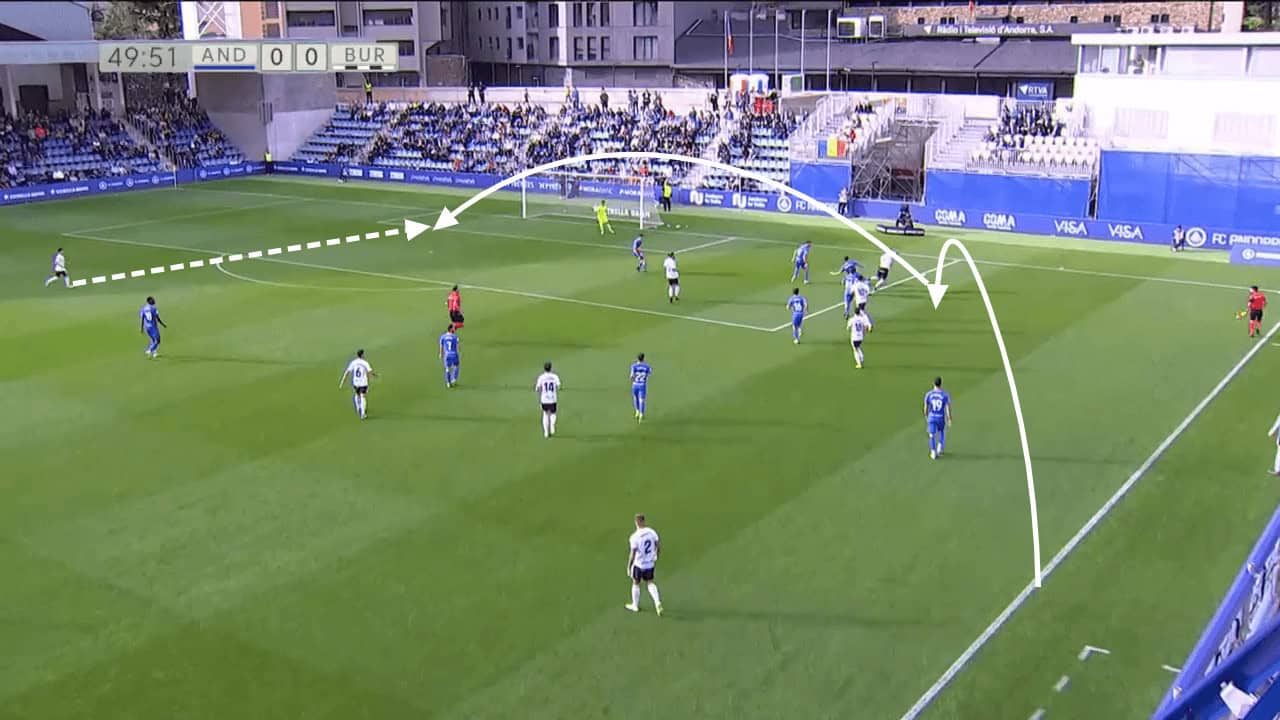
Burgos have also used the physicality of their centre forward, Mourad El Ghezouani, to retain the ball in the final third and use him as a reference point when they are not up against an open defensive structure. The image below shows how Burgos have created a chance from a throw-in by directly playing it to the striker, who uses his body to retain possession in the box, while simultaneously throwing his marker to the floor.
From there, he delivers the ball into the back post for an unmarked runner to get onto the end of. This results in a goal. Burgos haven’t always created too much in front of the goal due to their defensive style meaning they don’t get a large number of opportunities and it has to be perfect when you do get one.
Conclusion
In conclusion, this tactical analysis has illustrated that while Burgos have been innovative in their defensive strategies, there are many flaws which can be picked out, and the one goal conceded so far is more of a fluke rather than a brilliant defensive display. Burgos will have to be more consistent and aggressive with the way they defend or they will start to leak goals in the near future.
