
Benfica Women succeeded in winning the Campeonato Nacional Feminino of Portugal for the fourth time in a row as they were able to overcome the disturbance of Sporting CP and win the battle against them with two points of difference in the end. Moreover, this season represents a unique one for Benfica in terms of domestic titles as they were able to lift all titles possible: the Campeonato Nacional, the Supertaça de Portugal, and the Taça da Liga. On a European level, we can argue that head coach Filipa Patão helped the team achieve their best possible result even though their mission was not easy at all. In fact, Portugal had to play the two finalists of the tournament, Barcelona and Olympique Lyonnais, in different stages and in the end, it was very complicated to reach a more advanced round than the quarter-finals.
Benfica were put in a group with Barcelona, Eintracht Francfort and Rosengård and succeeded in winning two games against both Eintracht Francfort and Rosengård while drawing three times and losing only once. Perhaps the most notable and crucial draw and result that Benfica should be credited for achieving is their 4-4 draw against Barcelona in a match that was tiring for both teams. That being said, such games and results against one of the most powerful European teams can only highlight Benfica’s strong team personality and ability to be united, defend well and always be dangerous upfront no matter what defence they play against.
This positive mentality against the most powerful teams is not evident as most teams at the same level of Benfica in terms of players’ quality suffer when they play against Barcelona. Benfica, however, represents an exception because they have a unique mentality and attitude with which they were capable of reaching advanced stages in the UEFA Women’s Champions League despite playing in a not-so-powerful league in comparison with the WSL, the D1 Arkema, the Frauen-Bundesliga and Serie A Women. This further confirms the team’s huge efforts and their ability not to be impacted by the big change of rhythm when playing in the UWCL just after playing a Campeonato Nacional Feminino game.
It is true that the team failed to win over Olympique Lyonnais in the quarter-finals and lost 6-2 on aggregate. Yet, the work carried out by Patão has undoubtedly brought its fruits, and we should not forget that this was the first time a Portuguese team was amongst the final eight teams in the UWCL.
In this tactical analysis and scout report, we will be exploring Patão’s work at Benfica by looking at the team’s attacking tactics and defensive phase. The analysis will also focus on the team’s general tactics, preferred formations, key players, and the possible improvements that can lead them to achieve even better results in the UWCL.
Attacking tactics
When looking at Benfica’s statistics, we notice their very high possession rate compared to their opponents in general, with 62.62% for Benfica. This makes Benfica accustomed to playing with the need to score against teams that retreat to defend low, and therefore, it obliges Benfica to vary their attacking plans to be able to score. That’s why Benfica usually find solutions in front of goal, with 66 scored goals in the league this season in 22 games. Plus, Benfica scored an average of 2.53 goals per match, which is an outstanding average. Indeed, the level of some of the teams in the Portuguese league is not as high as Benfica’s, yet this can’t take the credit away from Benfica regarding their goalscoring numbers.
Patão has been relying extensively on the services of Kika Nazareth, Chandra Davidson, and sometimes Marie-Yasmine Alidou too upfront. The head coach varies her attacking plans according to opponents; she uses two strikers at times, one playmaker, and two strikers at other times, and she also relies on a single striker on other occasions.
Dealing well with second balls represents one of Benfica’s attacking strengths, especially during set-pieces when one or two Benfica players always wait to be first on second balls and either go for shots from a distance or provide key passes to unmarked players, as they did in the following example.
It is important to note that this was not just a single case but a recurrent action that helped Benfica score many goals this season, as they usually had the advantage on second balls.
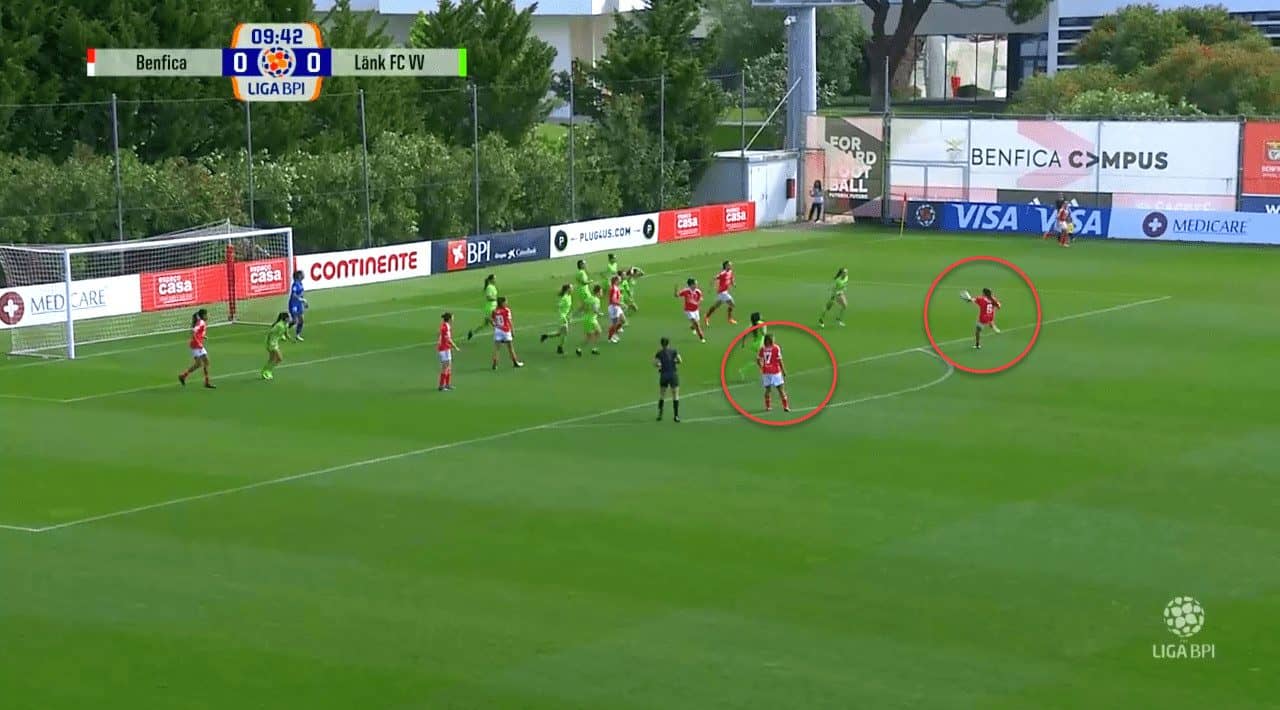
Moreover, Benfica proved on numerous occasions that they can deal very well with set-pieces and exploit them well to score goals, whether from corner-kicks or free-kicks, knowing that the team has a lot of players who are capable of winning aerial duels and being crucial in terms of finishing.
Also, the midfielders’ role has been pivotal to Benfica’s attacks this season. Patão usually demands that they provide key passes whenever possible, especially when the opposing defensive line is high, like in this example against Olympique Lyonnais.
Benfica’s midfielders are also asked to join the final third so often and provide passing options or penetrate by themselves towards the box, which makes the team’s attacking aspect even richer and more varied. Added to that, Patão’s continuous change of formations depending on the opponent’s strengths and weaknesses makes it complicated for these opponents to know what to expect from Benfica when they are in possession.
This goal action against Olympique Lyonnais not only highlights the midfielders’ key passing impact but also how smooth and quick Benfica’s actions can be even against powerful defensive teams like Olympique Lyonnais. Building on such actions can only make Benfica more confident and powerful, as this type of goal makes the players believe more in their ability to win against similar top teams in the upcoming UWCL.

Furthermore, the coordination between midfielders, wingers, and strikers is remarkable at Benfica, and the collective play is dominant and obvious to everyone who watches the team. The fact that Benfica does not have “star” players facilitates this team play and makes the team’s attacks look quicker and more natural yet surprising to opponents.
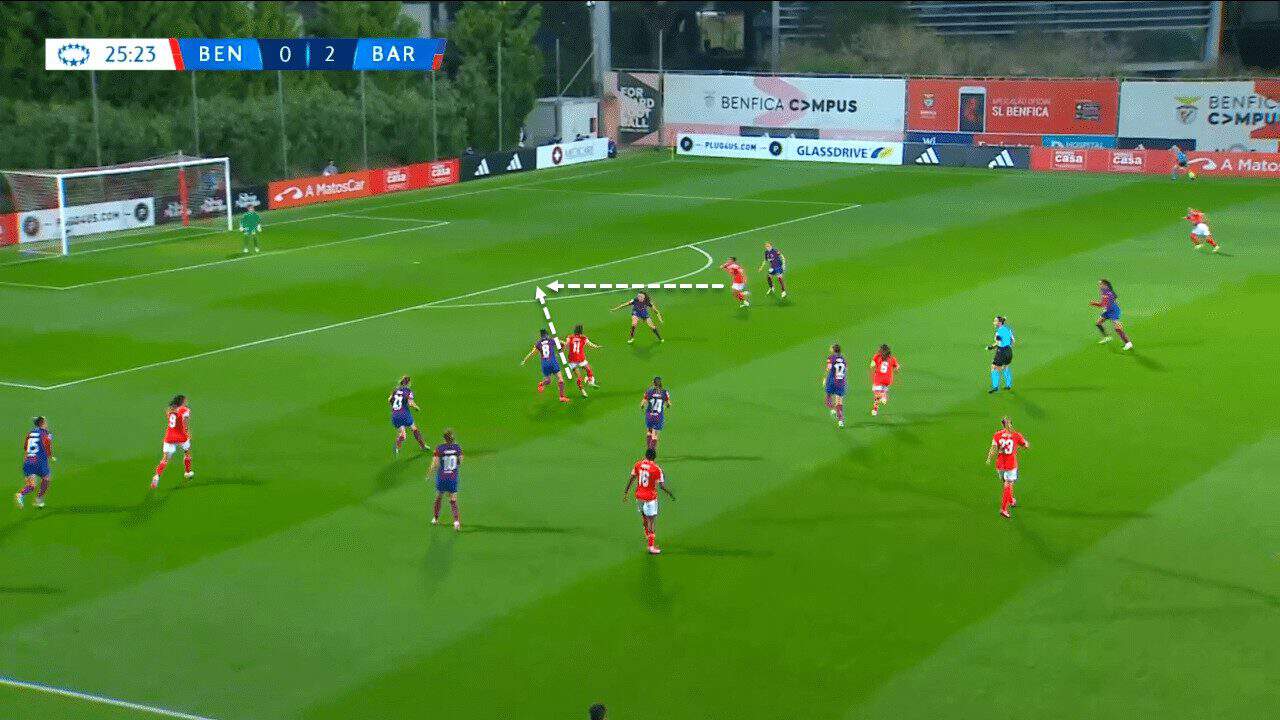
Being capable of attracting Barcelona’s defence to defend a bit higher and surprise them with key passes at their back to make Alidou in a one-on-one situation with the goalkeeper highlights Benfica’s ability to disturb world-class opponents even further. Also, Alidou, Nazareth and Davidson have been progressing a lot in terms of finishing, and that helps the team a lot in concretising the created chances and the work done by both wingers and midfielders.
Defensive phase and possible improvements
When it comes to the defensive phase, Benfica concedes 1.06 goals per game, wins 65% defensive duels and 49.1% aerial duels, and makes 40.28 interceptions per match. These numbers seem good, yet they can be improved, especially at a European level, because on the local level, they have just conceded 12 goals in 22 games.
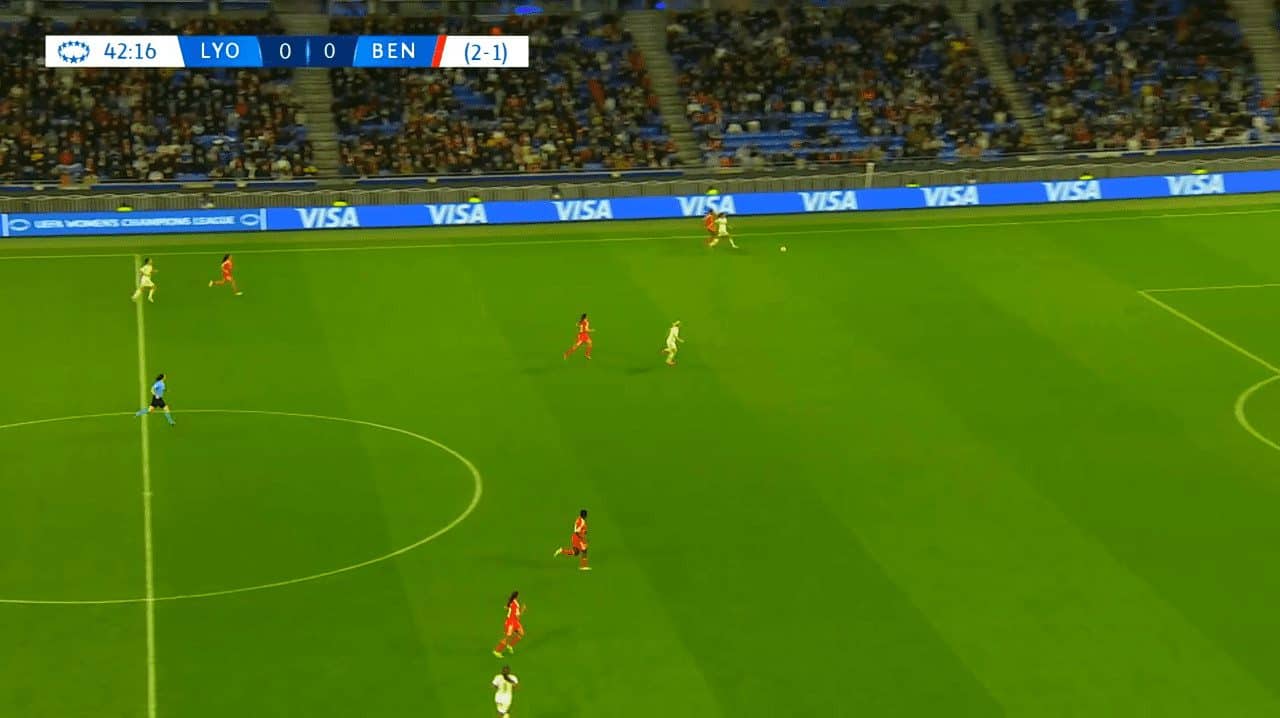
One of Benfica’s most problematic issues in the UWCL, especially against teams like Olympique Lyonnais, was letting them exploit the spaces left behind the defensive line as they preferred to keep it high at times. And at such a high level, advancing a lot and failing to retreat quickly enough can lead to conceding goals in a rapid and surprising way, just like what happened in this goal action against Lyon when the whole defensive line was in the middle of the pitch. Plus, the holder of the ball could not resist the high pressing and provided a wrong pass to the opponent.
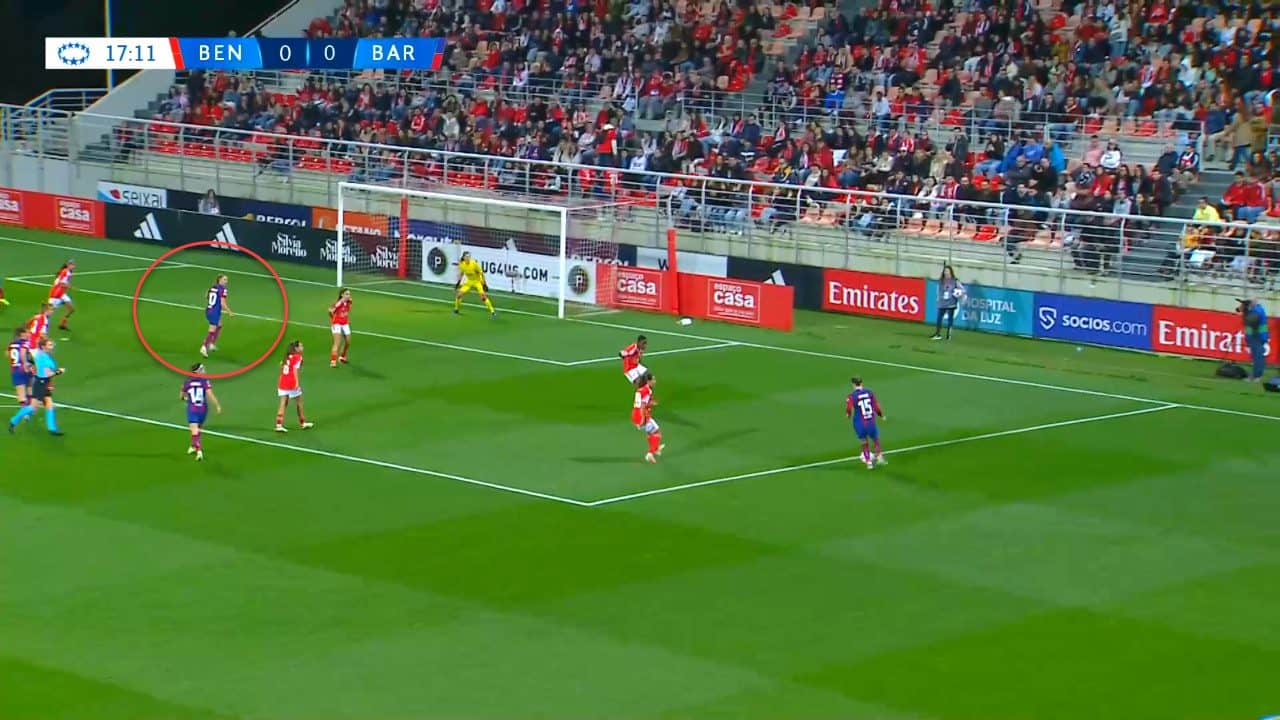
Another essential aspect that needs more attention from Benfica in the defensive phase is marking, especially inside the box. Although the team’s defenders are usually organised enough, they often fail to time their marking well and can leave players unmarked or mark them in a wrong way while leaving them the space and time needed to do what they want before getting disturbed.
The following example of a goal conceded against Barcelona highlights this recurrent marking issue that results in conceding goals that can be avoided if the defenders mark tighter and time their movements with more discipline.
Formations and key players
What characterises Patão is her excellent tactical flexibility, which allows her to impose her ideas and use formations as tools to achieve her tactical objectives. This makes Benfica’s playing style tricky most of the time, as opponents cannot know what to expect when they face this team.
She often uses the 4-3-3, the 3-5-1-1, the 3-4-1-2, the 3-5-2 and the 4-3-1-2 while alternating between these formations depending on the opponent and on her tactical plan. It is fair to say that Alidou and Nazareth have been exceptional for the team this season as they shined in the league as well as in the UWCL against though teams. Alidou’s finishing abilities were crucial during several games, and Nazareth’s ability to perform at her best as a striker at times and as a midfielder at other times tells a lot about her tactical flexibility as well and shows that she is a “joker” player who can give 100% in more than one position.
Moreover, Lúcia Alves’s continuous attacking contribution, pace, key passes, and crosses towards the box were more than useful for the team as she was the source of numerous scored goals this season, especially in the UWCL.
However, the area that needs some more improvements remains the defensive one. This team can go farther if it makes its defensive phase much more compact and allows fewer goals per season.
Conclusion
Benfica Women have been excellent this season as they achieved numerous objectives, such as winning all possible domestic titles and reaching the quarter-finals of the UWCL for the first time ever. They have to build on this success to strengthen the team intelligently and work on fixing their previous errors to reach more advanced stages in the UWCL and continue their domestic domination. To achieve that, some player reinforcements can be prove very useful to Patão ahead of the new season.
