
Sheffield United currently sit in second place in the Championship, 10 points clear of third-placed Middlesbrough in their bid to achieve automatic promotion back to the Premier League.
So far this season, the Blades have scored 51 goals, with 16 of those coming from either corners, free kicks or throw-ins. Without these crucial goals, Sheffield United would be 14 points worse off, and just outside of the playoff spots below Watford. The importance of these set-pieces cannot be underestimated, and Paul Heckingbottom has showcased his ability to be flexible with his team, by making the most of set-pieces with a team filled with physical qualities and aerial prowess. The sheer height and heading ability in this squad make it a no-brainer to attempt to use set plays, but the tactics behind the set plays have made the job much more simple for every player.
In this tactical analysis, we will delve into the tactics used by Sheffield United during attacking set plays with an analysis of how they have created many different high-quality chances from set plays. This set-piece analysis will look at the different methods they’ve used when attacking corners and free kicks and why these set plays will be key to their potential promotion this season. We will delve into their different perspective on the use of screens and how they use unselfish off-the-ball runs to create space where space seems impossible to find.
Variations of screens
Sheffield United’s most dangerous corner routines have arrived from the right-hand side, where their players could frequently attack out-swinging corners. Out-swinging corners are statistically easier to make the first contact with, due to the fact it becomes harder for goalkeepers to intercept crosses, and the ball curls away from opposition defences.
Screens can be set up in any way to create space in specific zones of the box depending on where zonal defenders aren’t present and have to be delivered into areas that the corner taker can consistently find. The first way in which Sheffield have utilised screens is by creating space as close as possible to the goal from central areas when facing zonal defences.
In the example below, Burnley are well set up inside their own six-yard box, but Sheffield United have a 4v3 overload around the penalty spot. Burnley’s defenders are all tasked with picking up the nearest attacker to the goal, meaning that there will be one Sheffield player unmarked who can attack the ball. Sheffield United’s job then becomes about getting the spare player as close to the goal as possible.
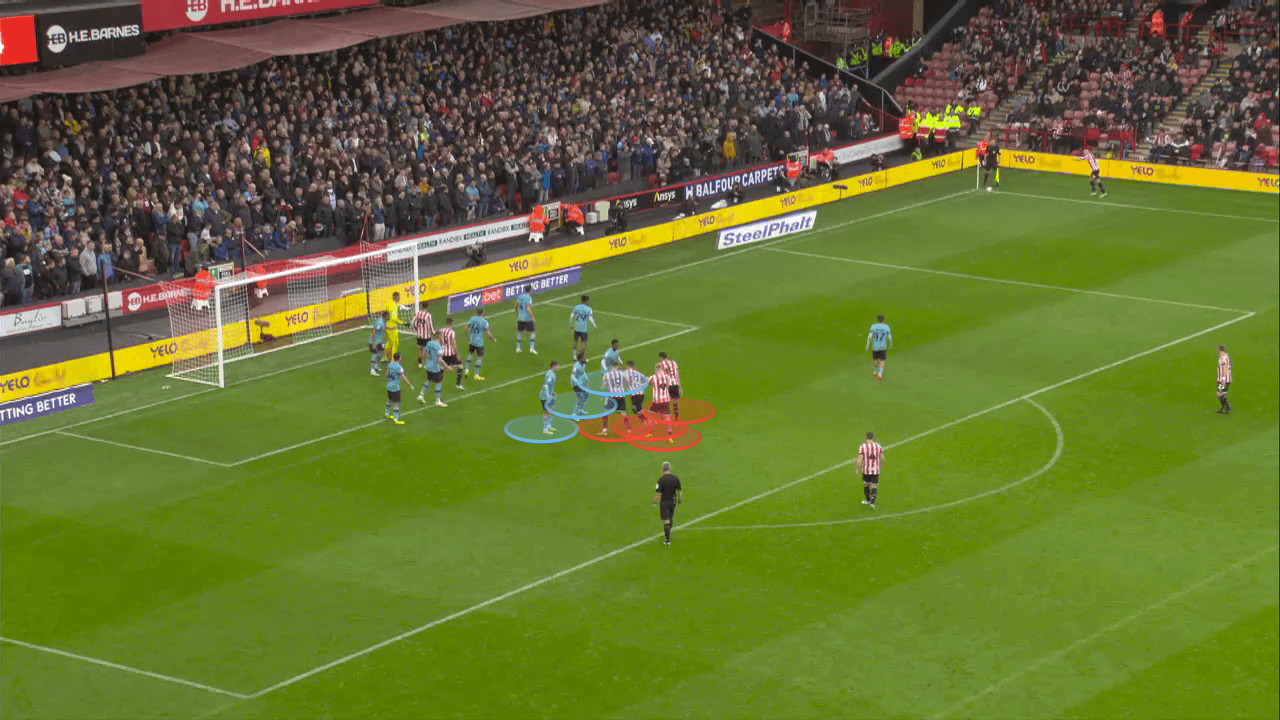
In order to allow the spare man to get as close as possible to the goal, the other three players sprint as close to the goal as possible to create space behind them. Once the three Sheffield players create the space, they each form a screen, combining to make a wall to prevent any defender from stepping up to the ball. From the image below, we can see that once the plan comes into effect, the free player has the opportunity to attack the ball with no interruption from between the six-yard box and the penalty spot.

When up against teams who utilised a man-marking defensive approach, with minimal zonal markers, the Blades have used screens to attack unmarked areas with ease. Once a big space inside the box is identified, an attacker only needs to create a yard of separation in order to be able to attack the space and get a shot on goal. In the image below, we can see there is a big space around the back of the six-yard box that no defenders occupy and so the Sheffield United player makes a darting run towards it.

In order to have the separation mentioned earlier on, we can see a teammate standing firm setting up a screen surrounded by two defenders. The angle can make the image harder to interpret, but the vertical red line shows a screen being set up, where the Cardiff defender ends up running while the other defender is still man-marking the same player. As a result, we can see a Sheffield United player with lots of space to attack around the back post, with no marker being aware of the space he is in.
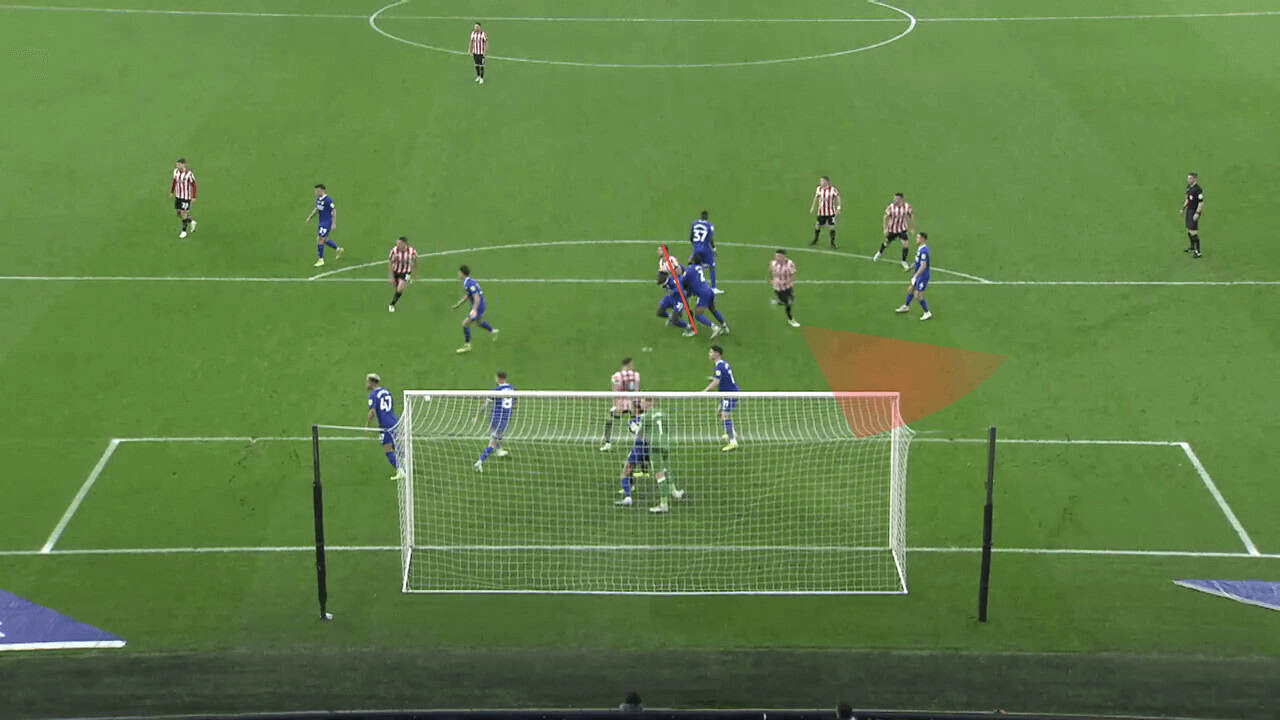
When the ball eventually gets delivered into the penalty area, we can see the nearest defender being around three yards away from the target player. Three yards of space is more than enough for an attacker to accurately track the flight off the ball and attack it without being disrupted. A free header from around nine yards to the goal leads to a good quality chance, with one of those bound to go in should a team be able to create a number of chances per game.
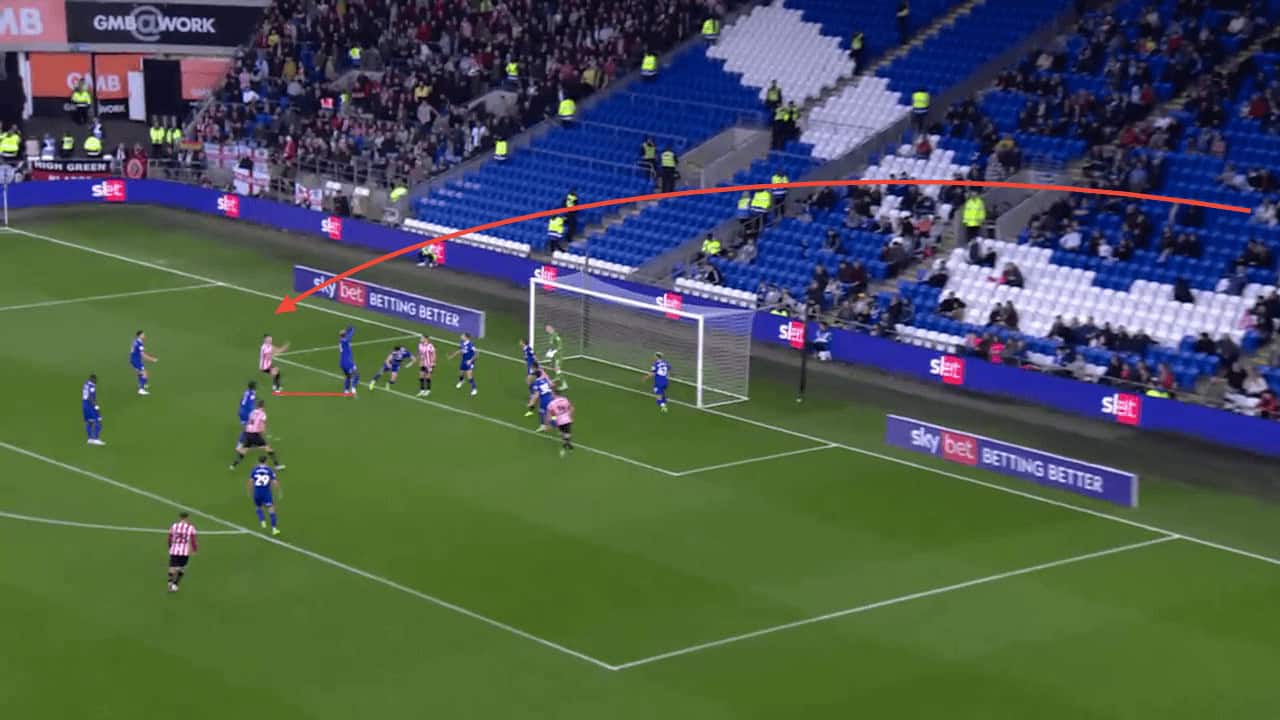
One final way in which Sheffield United have used screens is through screens from the blindside. This is another use of screens to allow players to attack unmarked zones in the penalty area against teams who don’t use man-marking. When teams crowd the six-yard box, it can be difficult to attack the area but also helps plan against it due to the predictability of the positions of the defenders.
The zonal defenders are static, and so screening them becomes simple, with defenders not having any opportunity to evade the screen. As a result, teams can target the back of the six-yard box, where defenders are unable to move backwards, and attackers can attack the cross from deep like in the image below.
Decoy runs to create space
Sheffield United have also been excellent at creating space around the six-yard box through the use of decoy runs, luring defenders away from dangerous zones with unselfish movements.
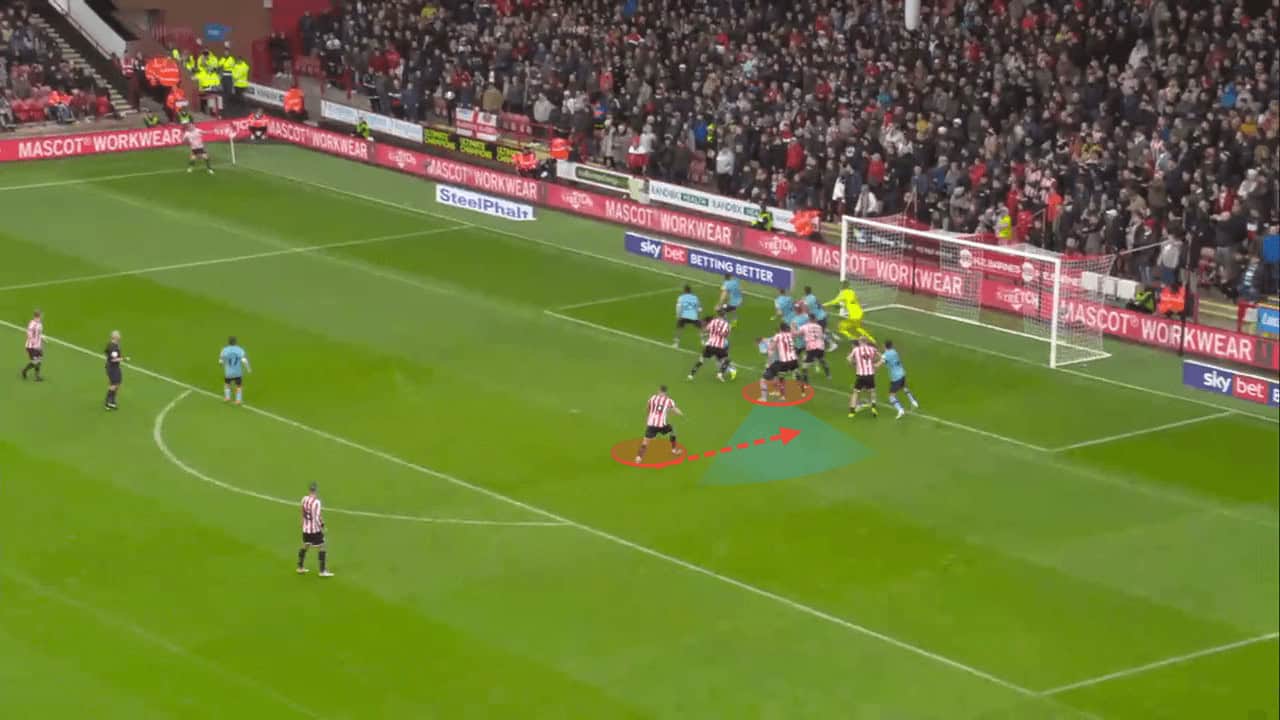
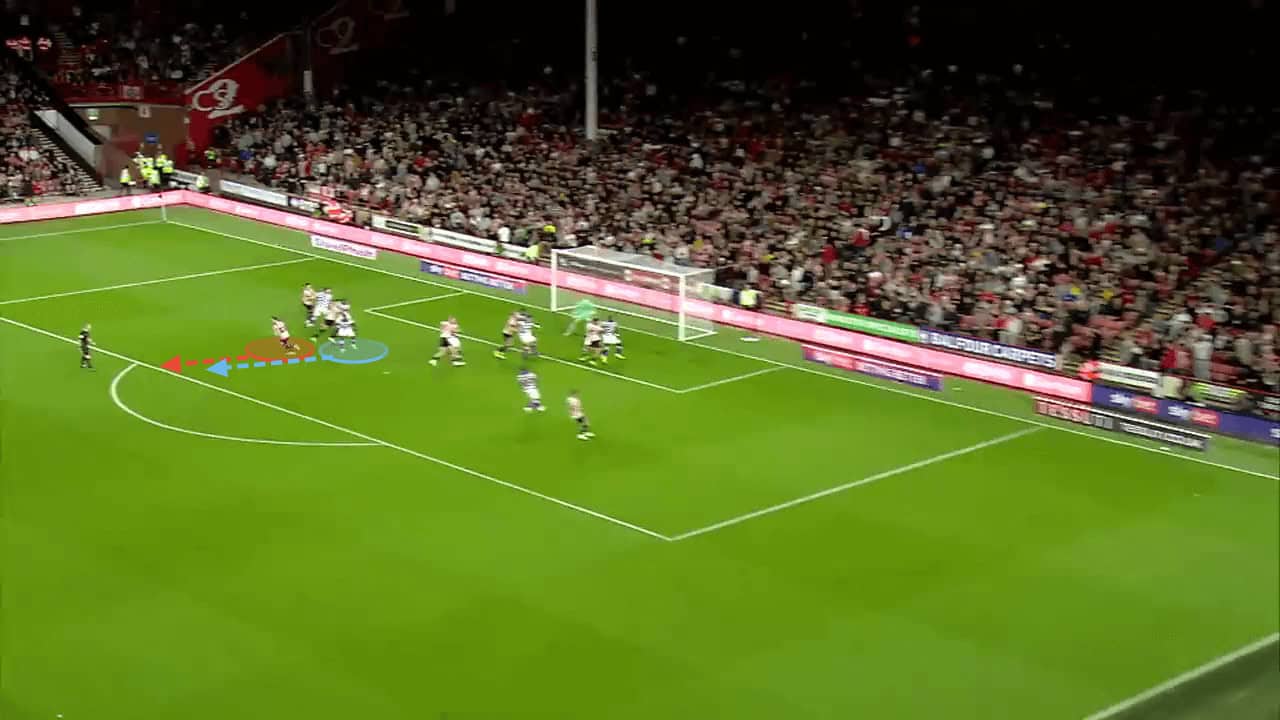
The image below shows an attacking corner, where the Sheffield United player (red) runs towards the edge of the box. This action has two benefits; an extra player is ready for the second phase, and a defender is dragged away from the target area. Having an extra player arriving at the edge of the box increases the likelihood of the attacking team winning the loose ball should it be cleared, therefore limiting any potential of being hit by a counterattack and increasing the attacking team’s chance of sustaining pressure following the corner.
The movement away from the box also drags a defensive marker away from the target area. While the quantitative difference remains the same, the space inside the box opens up which can be taken advantage of with pre-planned runs aimed at the open space.
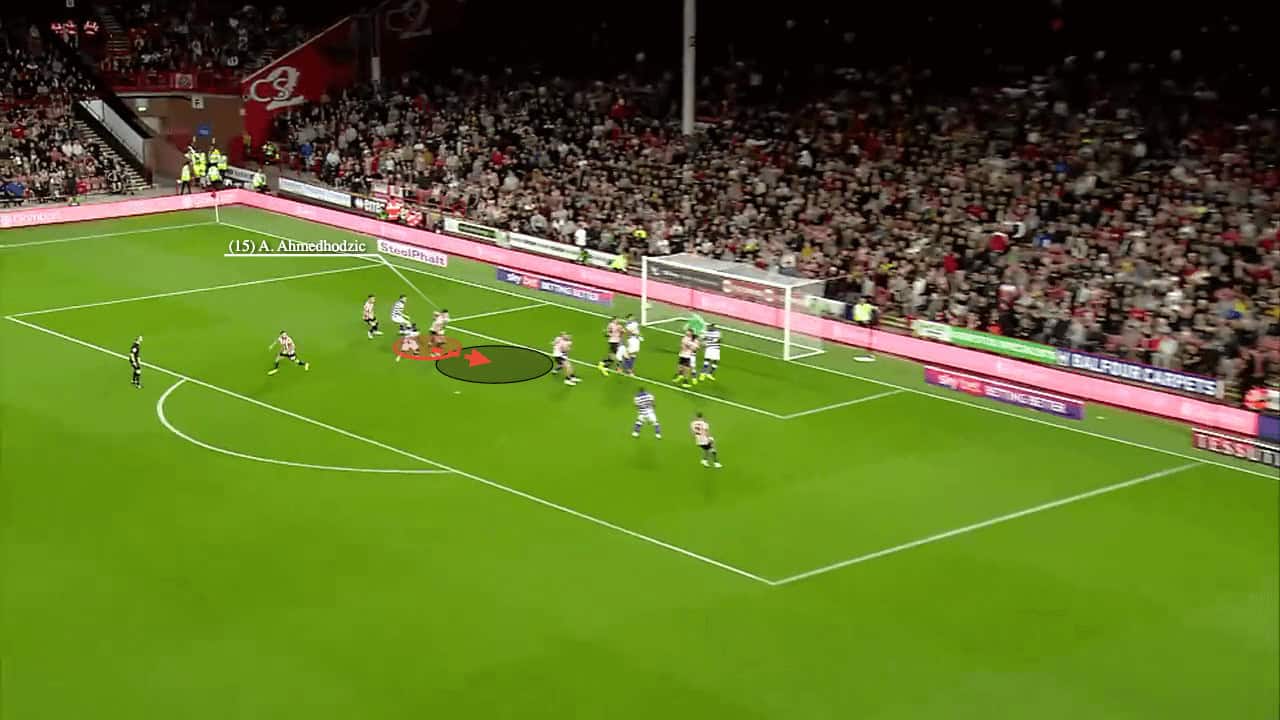
As the defender is dragged away from the penalty area, we can see the space open up between the penalty spot and the six-yard box. The space doesn’t have to be enormous for it to be taken advantage of as long as the delivery is somewhat accurate. Furthermore, because of the planned movements, Ahmedhodzic is aware of the space that will open up, and he can make a sprint into the black area to ensure he gets there ahead of his marker and perfectly times his run to sprint onto the ball, leading to a goal in this scenario.
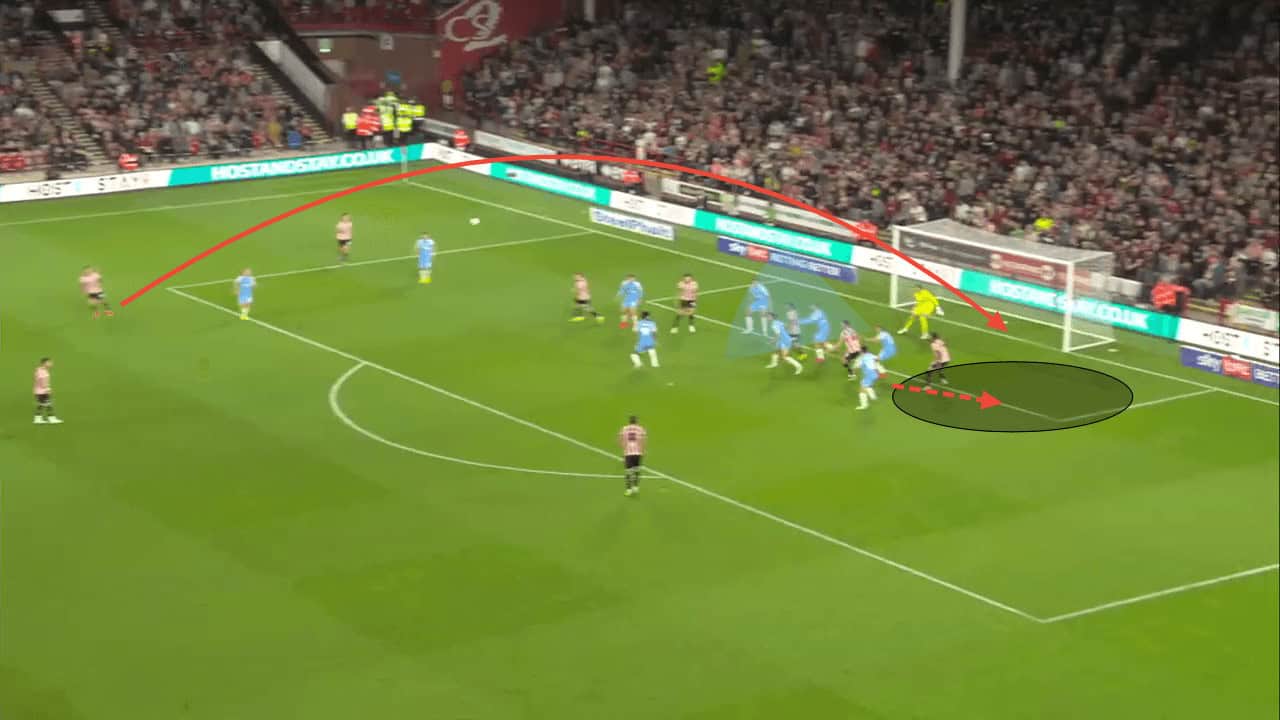
Sheffield United have also utilised short corner routines to be as unpredictable as possible from set pieces. Short corners are often used to shift the defensive block, by changing the angle of the cross, the defenders have to alter their body stance and positions.
One way in which the Blades alter the opponent’s defensive shape is by quickly passing the ball to the edge of the box. As the ball is passed, the defensive players quickly step up to shift the height of the defensive line and also naturally gravitate towards the ball. As this happens, the Sheffield United players sprint towards the goal, going in the opposite direction of the defenders, allowing them to have the momentum to get into the space behind the defensive line.
Furthermore, the defensive players all have their eyes fixed on the ball, meaning they can’t see what is going on behind them. As a result, the area at the back post is usually left open and there is plenty of space for the crosser of the ball to play the ball into.
Summary
This set-piece analysis has demonstrated the different methods Sheffield United have used to help them stay near the top of the table and on the track to returning to top-flight football.
The Blades are a well-set-up team who have plans set up to penetrate different defensive setups, whether they are zonal, man-to-man, or a mix of both.
Sheffield United’s set-pieces have been key to their success this season, and will likely be pivotal to them reaching any potential promotion or play-off campaign.
