
Screens have started to become more prevalent in football, primarily from corner kicks, taking inspiration from their common use in basketball.
A screen can be defined as when an off-the-ball offensive player plants themselves in front of a defensive player to prevent that defender from applying pressure on their teammate. Although there is no intent to go for the ball when performing a screen and could be seen as foul play, as long as the individual engages in a 50/50 tussle when shoulder to shoulder, or doesn’t initiate the physical contact when the orientation is different (facing the defenders back), it is in line with rules and can be performed consistently.
There are many different variations of screens, as they can be attempted anywhere in the box and can have differing effects on the outcome. A screen can come from the goal side, far side, blind side and in front of a defender. The fact that this method can be open to interpretation due to the different ways it can be used creates an infinite number of possibilities when creating set play routines.
In this tactical analysis, we will look into the tactics behind different uses of screens, with an in-depth analysis of how each screen has its own potential benefits and risks. This set-piece analysis will look at why the different variations can all be effective and hopefully inspire teams to develop their own corner routines incorporating screens, due to their unlimited unpredictability and high potential.
Traditional use of screens
Before diving into the different variations of screens, it has to be made clear that a screen can have different goals, depending on the coach’s preferences.
A screen can be used to:
1) help a teammate lose their marker
2) to immobilise a player inside a target area
3) to prevent a defender from reaching a desired area
An example of a screen with each different outcome will be explored below.
For example, in the image below, a screen could have three different possibilities depending on how it is used. In this case, the second option is being aimed for. Inside the target area, there is a 4v4 including four Bournemouth attackers, three Arsenal man markers and one zonal defender. Anyone outside the area will not attempt to clear the ball should it be crossed in precisely, as they are responsible for different areas.
Immobilising a player simply means preventing them from moving, rendering them useless in that particular set play. This method is most common when attacking the six-yard box centrally where the space is larger than it would be at either post.

Now that the 4v4 can be clearly identified, as well as the playing area (black circle), we can focus on how the screens can change the situation.
Below, we can see three of the four attackers engaging in shoulder-to-shoulder duels with their respective players, where it seems like their target is the ball but they are in fact ‘immobilising’ their markers by preventing them from being able to move inside the target area. Once all three Arsenal defenders are prevented from entering the area, it is clear to see the area remains the same in size, but there is only one attacker and one defender left.
This means that the attacker now has a large area to operate in, where it becomes easier to create space for themselves and win the 1v1 duel. A defender can’t stay as tight in such a large area, due to the risk of being outmanoeuvred and allowing the attacker to get in behind them, getting goal side. With the distance being gifted, the Bournemouth attacker can then use that separation to attack the ball with speed, providing him with the potential aerial advantage in the duel for the header should the defender reach it in time.
Defenders struggle in 1v1 situations in open areas, especially as they run the risk of giving away a penalty if there is too much contact, with the spotlight on them as no one else is attempting to go for the ball.

The tertiary aim of a screen is to prevent a defender from reaching a desired area. This option can be utilised when there is already a clear overload in a certain part of the box. With the overload, one player can sacrifice themselves as the screen, with the safety of mind that at least one teammate is unmarked and free to attack the ball with no defensive pressure.
This example below illustrates the sacrifice being made. At the back side of the six-yard box, we can see a 3v1 in Arsenal’s favour. Seeing as the area is so close to the goal, only one piece of contact is needed, a header at goal. This means that all three Arsenal players don’t have to attack the ball, and so one or two can focus on preventing defenders from getting into the target area. As there is only one defender near, Martinelli sacrifices his chances of scoring a goal by running up behind the Sporting defender and preventing them from moving backwards into the target area.
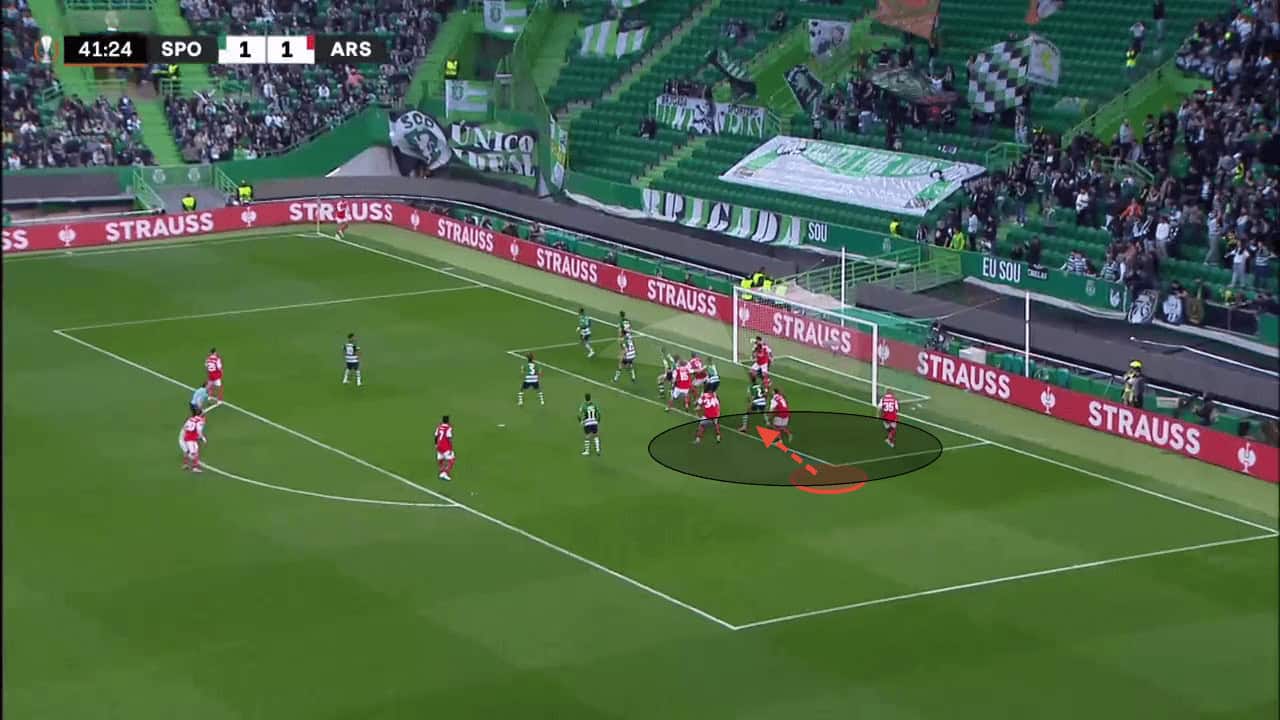
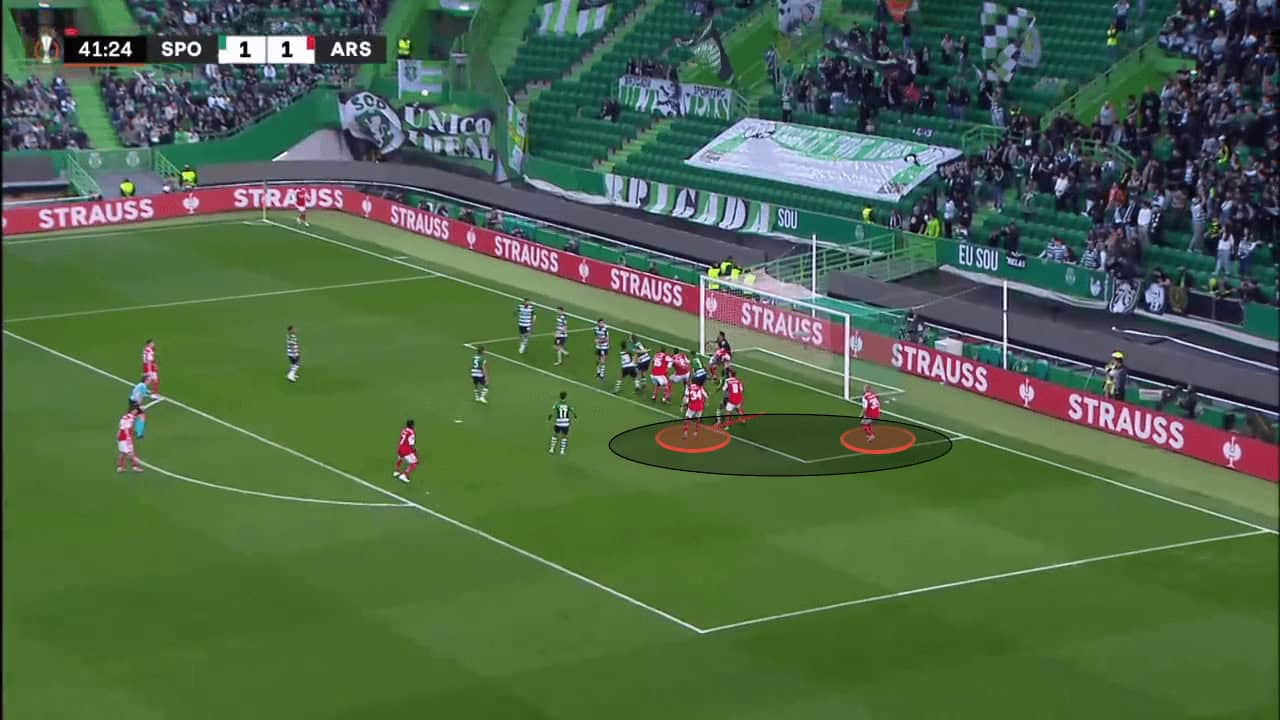
We can see below that two Arsenal attackers are free to attack the ball at the back post as there is no defensive presence in that area. It is important to note that in order to prevent defenders from entering a target area, the attacking team must be absolutely sure of the target area in different routines so that they can position themselves in the correct place and have overloads inside the target area before the kick is taken.
Furthermore, with a routine like this, where a screen comes in from a defender’s blindside, it is even harder to avoid the screen as they cannot see it coming, and as a result, the screen has a higher rate of being successful. Often, by the time the defender has evaded the screen, the attacker is already making contact with the ball.
The primary role of a screen is to help a teammate lose their marker. This means allowing a teammate to attack the ball unopposed when the original positioning of the players doesn’t involve any overloads. The primary difference between this and the third role of a screen is that with this method, the player attacks the ball where he may move into areas filled with defenders, but the unopposed run at the ball provides the attacker with enough momentum to outjump the static defenders and header the ball with additional power. The screen without any overloads has the lowest chance of being successful, due to the multiple moving parts in a corner, and potential physical disparities.
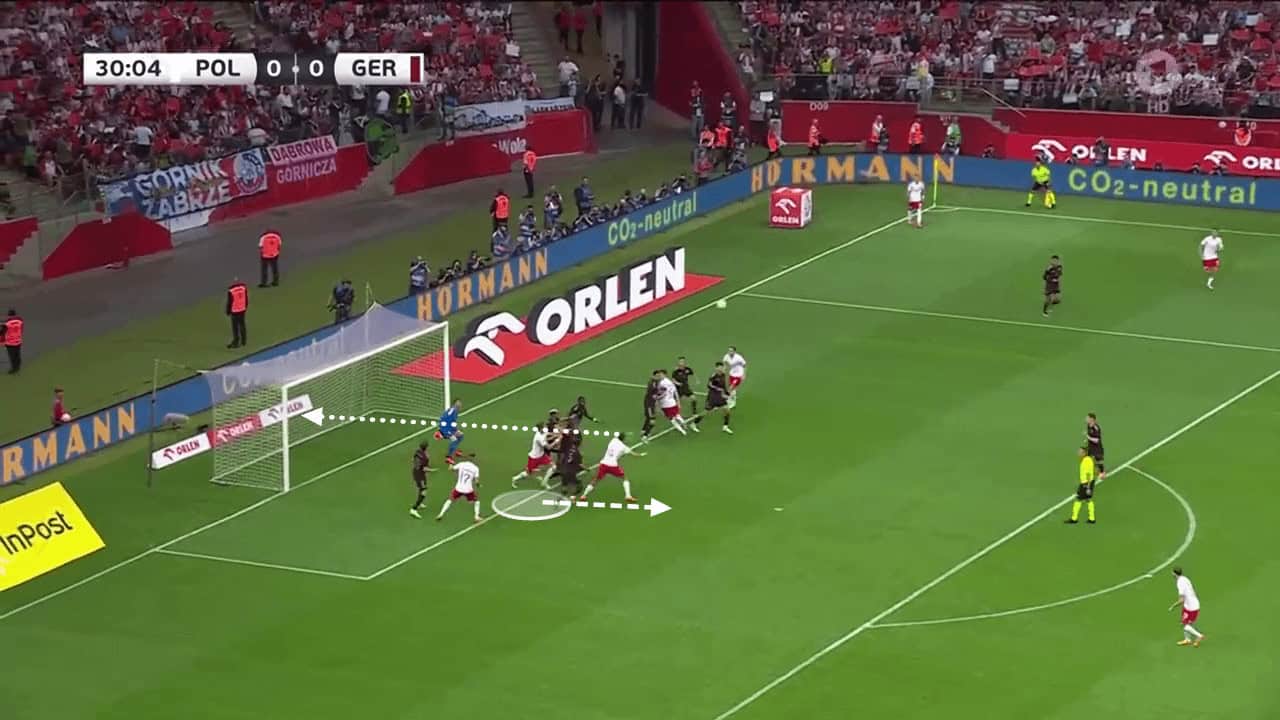
If a screen is effective, there are two ways in which an attacker can attack the ball: with forward separation or backward separation. In this example, there is a 2v2 on the edge of the six-yard box. The close starting position means that the defenders have to stay close to each other as well which provides the potential for the attacker to screen two players at once. As the attacker has the potential of holding two players in one place without altering their position, the further attacker can attack the ball without interruption.
Screening two players at once is more complex, so opting for backward separation, where the defenders have to get past the screen, is the more favourable option as it provides the attacker with additional time.
Backwards separation may not seem optimal, as the defender has to travel away from the goal. However, there are two main reasons why backward separation is effective in these scenarios.
Firstly, the close proximity of the ball to the goal means that power isn’t necessary. While a more powerful shot gives goalkeepers less time to react, being six yards out from goal already means it is almost impossible for goalkeepers to react to shots, unless it is within their silhouette. In addition, an attacker only needs minimal space to thrust their head at the ball. All the separation a player needs to attack with a header is already there between their shoulders. This means that even if the attacker has to step back to go for the header, they will be able to redirect and power up their header with the slight movement of the neck from one shoulder to the other. With it being a first-time effort, attackers don’t need lots of space as there is no need to control the ball.
Below is an example of an attacker using the space within his shoulders to attack the ball with enough venom to ensure the goalkeeper can’t reach it.
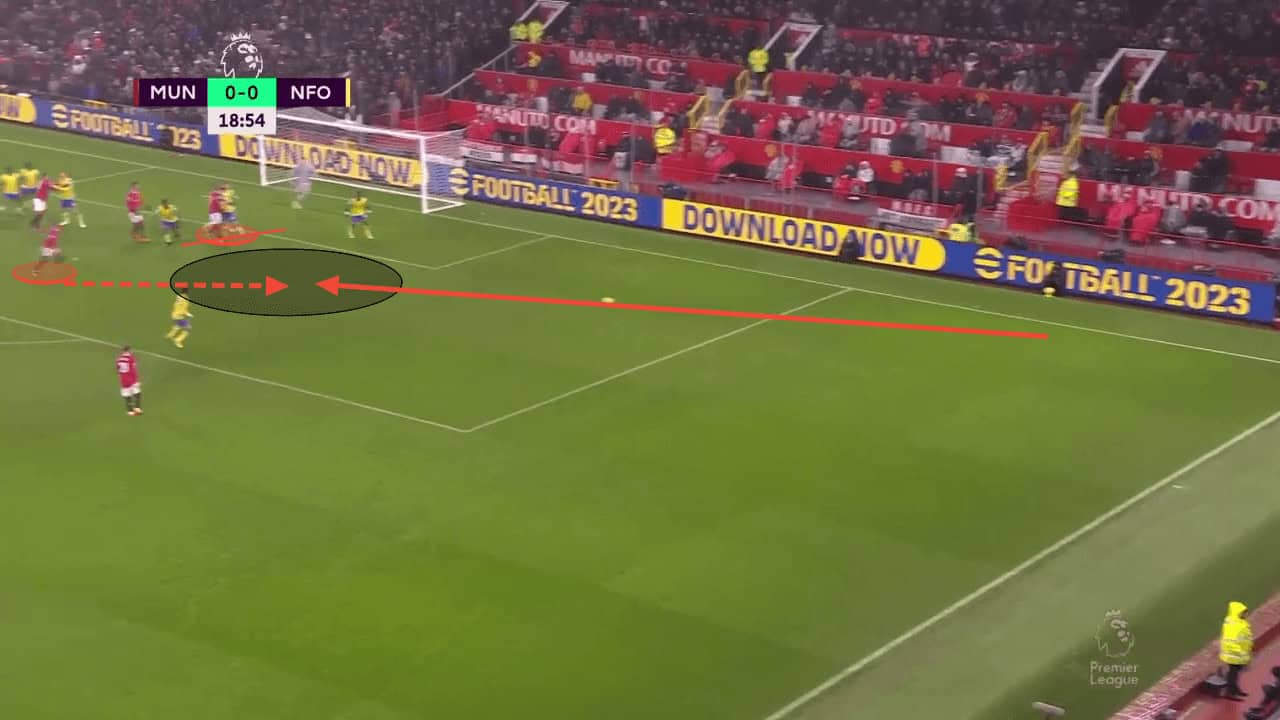
An alternate way in which screens can be used to prevent defenders from reaching target areas is through the use of deep arrivals from outside the box. In order for the target area to be unmarked, yet still accessible for an attacker, there needs to be an overload present or for someone to attack the area from deep. While in an earlier example, Arsenal were afforded space at the back side of the six-yard box, this sort of space will never be afforded on the near side of the six-yard box if a threat is present. As a result, the only way to expose such a space on the near side is for a player to arrive from a deeper position. Being able to attack the ball from a deeper position means that the target player is less likely to be tracked, and by the time someone tracks him, the attacker will already be in motion and hard to catch.
The example below shows Manchester United making the most of this space, with the use of the screen to prevent the zonal marker of that area from being able to clear the ball. No other defender is responsible for that area and as they don’t realise the screen was made, no one thinks to cover the area. This resulted in Marcus Rashford being able to float into the area unmarked and have an unopposed shot on goal from just outside the six-yard box.
Anchors
In the above section, we have gone through the different aims of screens, and how they function depending on the orientation of the attacker and defender. We’d like to highlight possibly the most efficient and underrated way to perform a screen. This type of screen is when an attacker is ball-side of a defender, which from corners means standing directly in front of them, with the attacker’s back facing the defender’s front.
This method in open play can be likened to attackers pinning a defender or holding the ball up with a defensive presence behind. However, from dead ball situations, and without the intention of going for the ball, rather ‘immobilising’ a defender, this method should be referred to as an ‘anchor’.
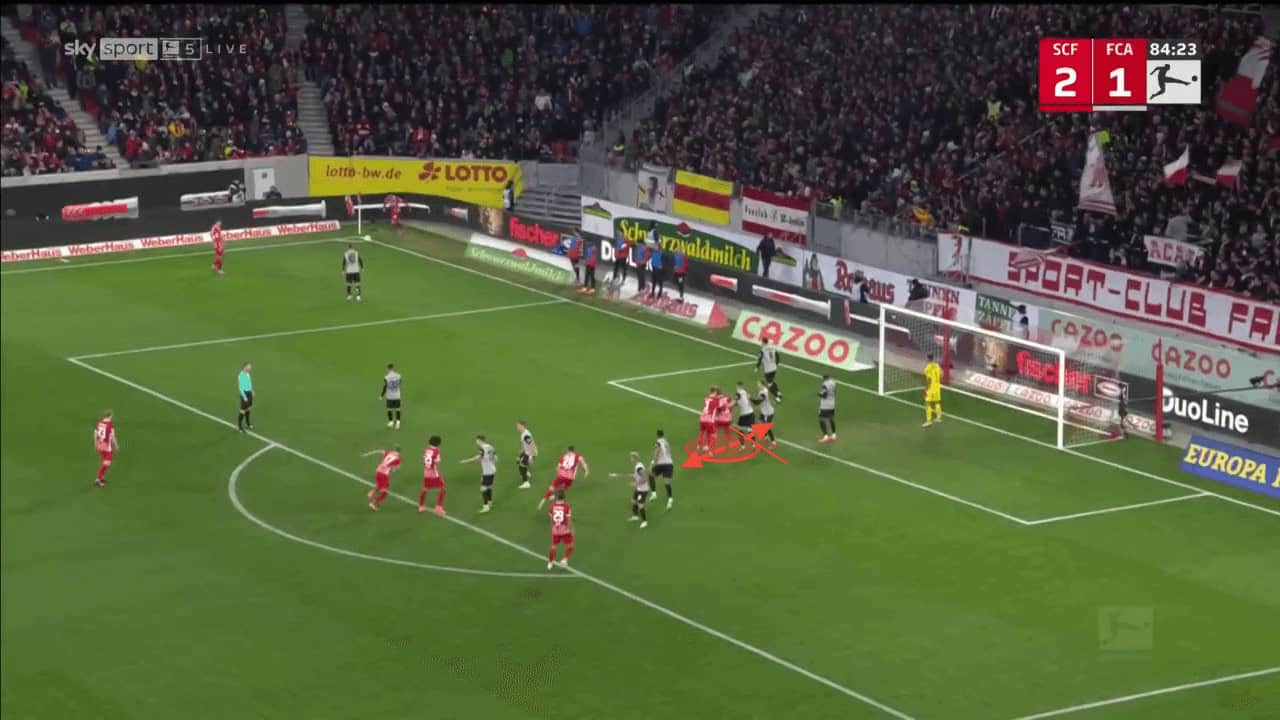
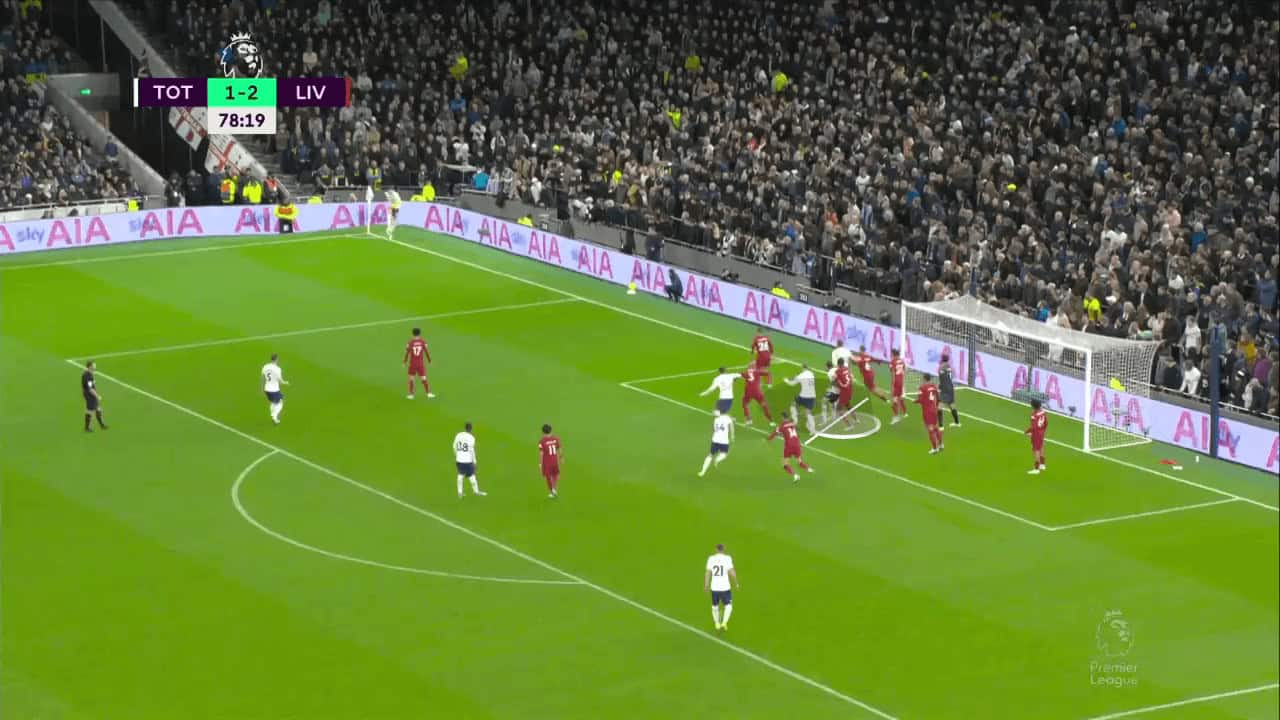
The example below highlights how Tottenham Hotspur use this method, with the Spurs attacker positioning himself in front of Liverpool‘s second zonal defender and putting his arms around him, which creates space in the black-shaded area. The risk of the corner remains high, with the corner having to clear the first zonal defender, and there is no guarantee that an attacker will make the first contact, as they are not arriving unopposed.
However, the potential of this corner is higher than any other kind. If an attacker can outmanoeuvre their marker, or if other attackers can combine the different uses of screens to help a teammate lose their marker, that potential free player is able to arrive within six yards of the goal where they have the chance to attack the ball unopposed, where only the slightest glance of the ball is needed to result in a goal.
While the delivery has to be the most precise in this method, the screen has the highest potential success rate due to the mechanics involved for the screen provider. Anchors, with their small size, are able to weigh entire ships down to their spots thanks to their pointed ends on either side. If someone tries to drag an anchor away, its rough edges dig into the seabed, preventing the ship from moving.
In a similar way, an attacker is able to dig his feet into the ground, planting himself in front of a defender. A player’s feet can be compared to the anchor, where if someone tries moving them, his studs scrape across the floor preventing the upper part of their body or legs from moving out of place.
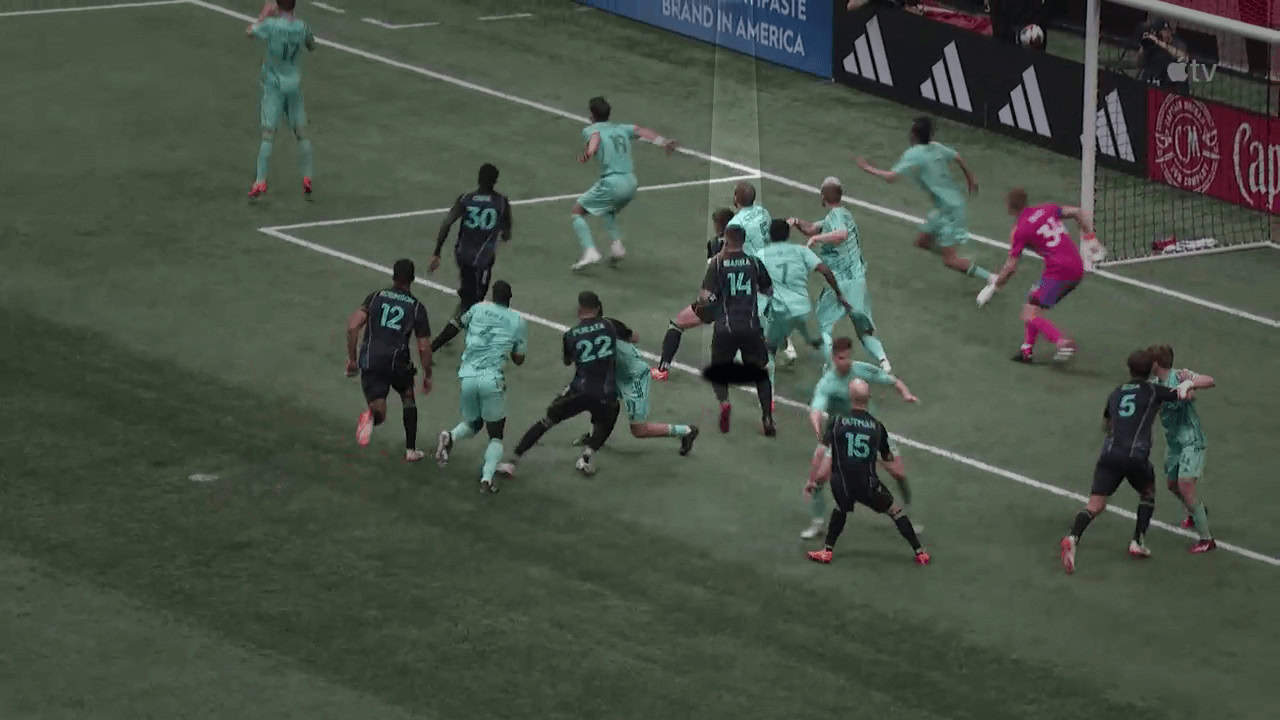
Below we can see the example of a player planting his feet into the ground, preventing the zonal marker from being able to attack the ball and being stuck in place. The wide stance of the legs helps an attacker be closer to ground, making it hard to shift their body weight, whilst the attacker also places his arms around the defender to prevent the defender from simply moving around him. The only way for a defender to evade such a screen is by stepping backwards, but opposite movement from the ball can be costly in a set-piece scenario which might last two seconds. A defender can’t afford to be stepping backwards if the ball is being delivered, as they won’t be able to attack the ball in time.
Conclusion
This tactical analysis has detailed the multidirectional potential of screens, and why it is imperative that they become more commonly seen in competitive football. Screens can be adapted in hundreds of ways to attack different desired target areas inside the box. The variations can be incredible, so it is a surprise to see there are still teams who attack corners in old-fashioned methods, relying on each player to win their individual battle, without any targets in mind.
Tactically creating space for the player with the best header of the ball or creating a high-quality chance for someone unexpected are something which can be crafted with the help of screens. The potential of screens has no ceiling with how well they can work, as long as they are prepared beforehand, just like any tactical innovation within football or any other sport.
There are screens which are on a spectrum going from high risk (traditional goal side) to low risk (anchor), whilst the difficulty of the cross accuracy can also be put on a spectrum of high to low risk depending on the target. It is up to coaches to determine how well their players can perform the different screens and how accurate their corner takers are to develop different routines making the best use of their players’ unique strengths.
In the future, there is potential to explore how these individual screens can be grouped, to form large-scale screens or variations of them. There are clusters, trains and many other variations of large-scale screens, which have the same aims although they are achieved through different methods, and rely on teamwork and coordination from a group of players.
