
Ternana currently sit in 10th place in Serie B, with the club being rumoured to be bought by Premier League minnows Fulham‘s owner Shahid Khan. Seemingly an average side, statistically they don’t stand out and could just as easily be in a promotion battle as a relegation battle come the end of the season.
Ex-Napoli player Cristiano Lucarelli started the season in charge, but after a poor spell lost his job, only to be given the hot seat back 3 months later. In what has been an inconsistent season, Ternana have stood out as a side which is extremely creative from dead-ball situations, having scored 9/30 goals from set-pieces. Although they have scored a large number of goals, they have underperformed especially from corners, with only 4 corner goals, although they’ve created a large volume of high-quality chances from these scenarios.
In this tactical analysis, we will look into the tactics used by Ternana, with an in-depth analysis of how they have been able to use several different routines to create numerous high-quality goal-scoring chances from both corners and free-kicks. This set-piece analysis will look at the reasons behind the different routines used and why they have been so effective, especially from free kicks.
Corner methods
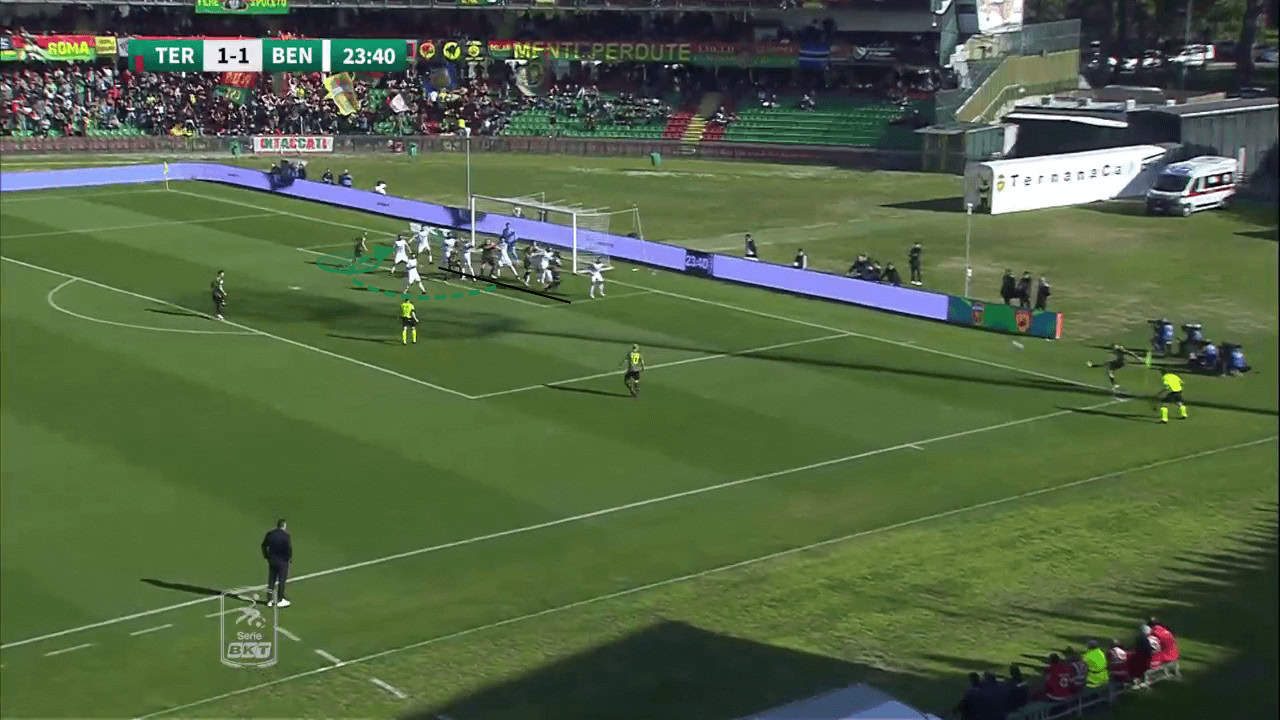
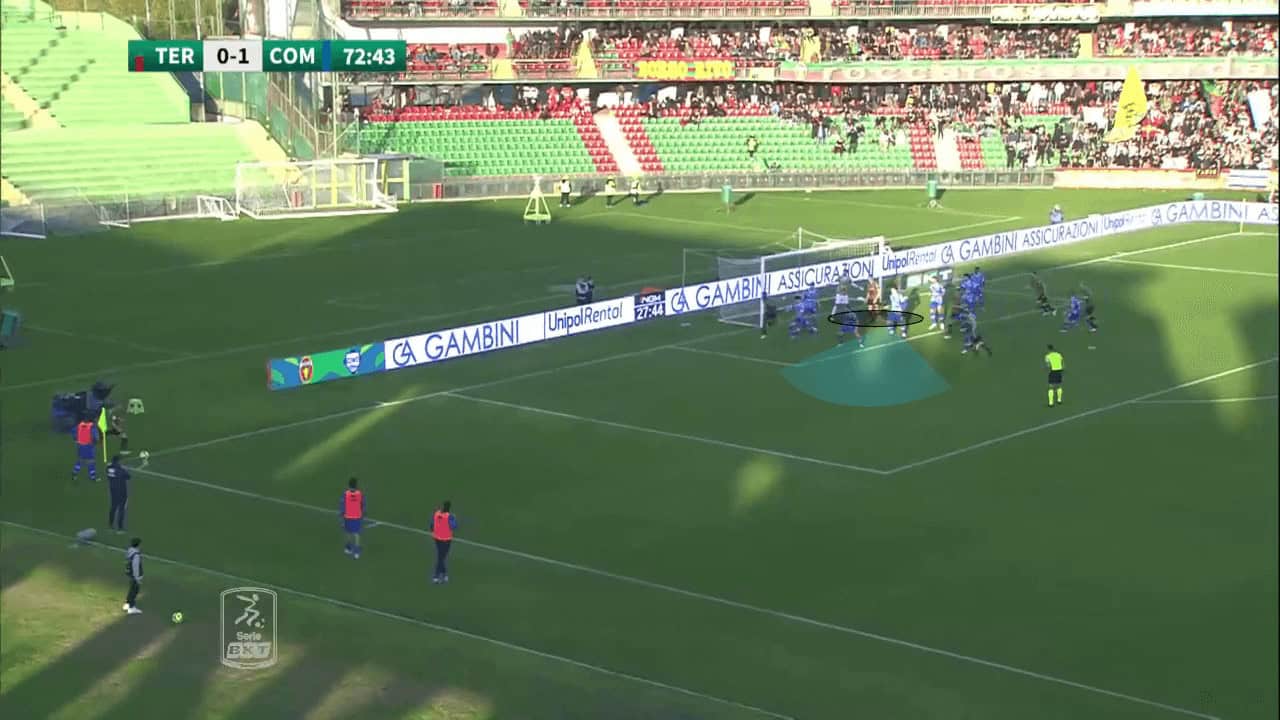
Ternana have utilised many different methods, depending on the defensive setups they have come up against. Against zonal defensive blocks, space inside the six-yard box is extremely limited. In these cases, Ternana use a cluster of five players inside the six-yard box to act as a large screen, preventing any defenders or the goalkeeper from clearing the ball from inside the zone marked below. The cluster allows for the ball to be delivered into the six-yard box, where it can be attacked from a dangerous area without allowing the defensive team to attack the ball, although it has to clear the near zonal marker.

When inside the cluster, it also becomes extremely difficult to man-mark attackers as every attacker is tight, making it hard for defenders to track the individual movements. As a result, if an attacker can float away from the cluster into an open area without being tracked. Pictured below, we can see the attacker peeling towards the back half of the goal after initially starting around the front post.
The black line also displays the area which is blocked off by the Ternana players. As a result, as long as the ball is delivered further than five yards away from goal, the defenders will be unable to clear it, and the ball can reach the back half of the six-yard box where the runner identified can attack the ball, using the momentum of his movement to out jump any static zonal markers on the back half of the six-yard box.
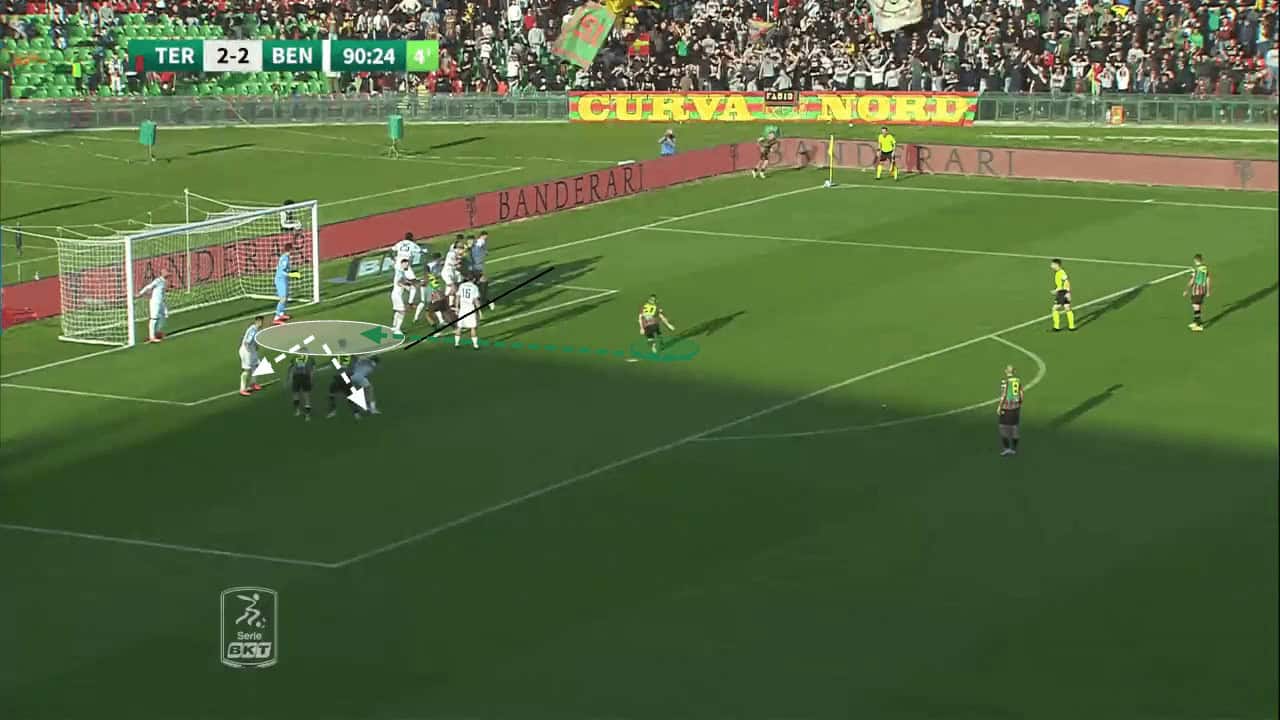
When the defending team has cover at the back post, Ternana have used decoy players to create space. The image below displays two attacking players who have spread to the back of the six-yard box which encourages the two defenders to follow them. As a result, the space inside the white area highlighted is created.
The cluster around the near side of the six-yard box remains, still preventing the defending team from making the first contact. This allows the player highlighted in green to attack the ball from deep. While the defending players are rooted, it becomes extremely difficult for them to win the aerial duel against the player with a run-up.
The use of decoy runners is extremely effective against man-marking defensive set ups. With each defender latching on to an attacker, it is simpler to manipulate the position of the defending unit, thus allowing Ternana to drag defenders away from the target area.
We can see pictured below, the players in blue acting as the decoy runners, who drag their markers away from the target area (green circle). The players in green then all attack the six-yard box, with the use of body feints to attempt to dismark themselves. The player in red is used to get onto the end of any loose balls or attack the ball in case the runners from deep fail to make contact with the ball.

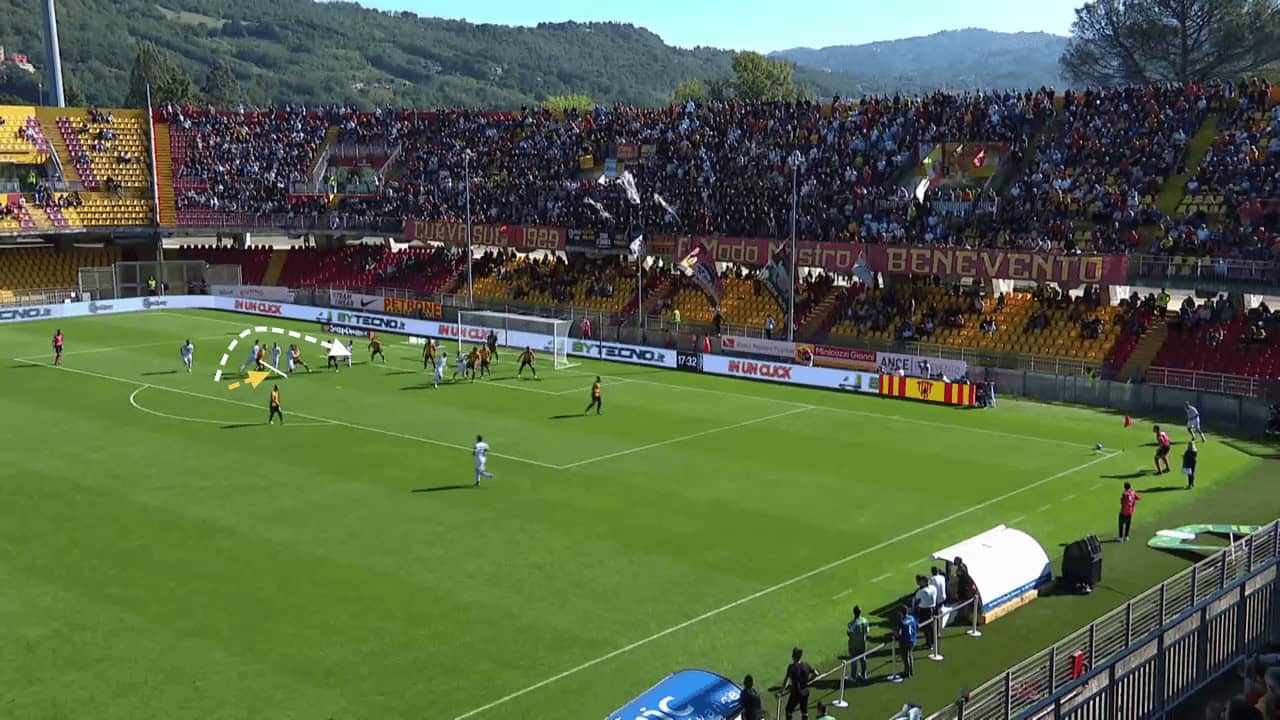
Ternana have also used a variety of different methods when coming up against mixed zonal and man-to-man marking defensive systems. Against mixed defences, the zonal players are spread around more than usual, meaning there are more gaps to attack and more space to deliver the ball into. With this method, the space is there to penetrate, however, it becomes trickier for attackers to create separation from their markers. Ternana have the task of creating separation for an attacker which can usually be done through the use of a screen.
In the scenario below, the Ternana attacker makes the run towards goal which is tracked by his marker, whilst a teammate arrived from the defender’s blindside, blocking his path to prevent the defender from tracking the run. The defender ends up being forced to stop his run whilst the attacker can attack the six-yard box from deep, although on this occasion the ball crossed in isn’t quite accurate enough.
The final method that Ternana have utilised to create chances from corners is the use of an attacker floating in from behind the goalkeeper to arrive inside the six-yard box unmarked. This isn’t a direct method of chance creation, but rather a security blanket for any missed near-post crosses.
The image displays the runs Ternana have made when delivering the ball into the front edge of the six-yard box. The green players attack the ball, whilst the players in red attack the back post to get onto the end of the flick-ons or rebounds. The player in blue is then able to float into the space between the goalkeeper and zonal markers, where the ball will land if the ball is missed by the players attacking the cross.
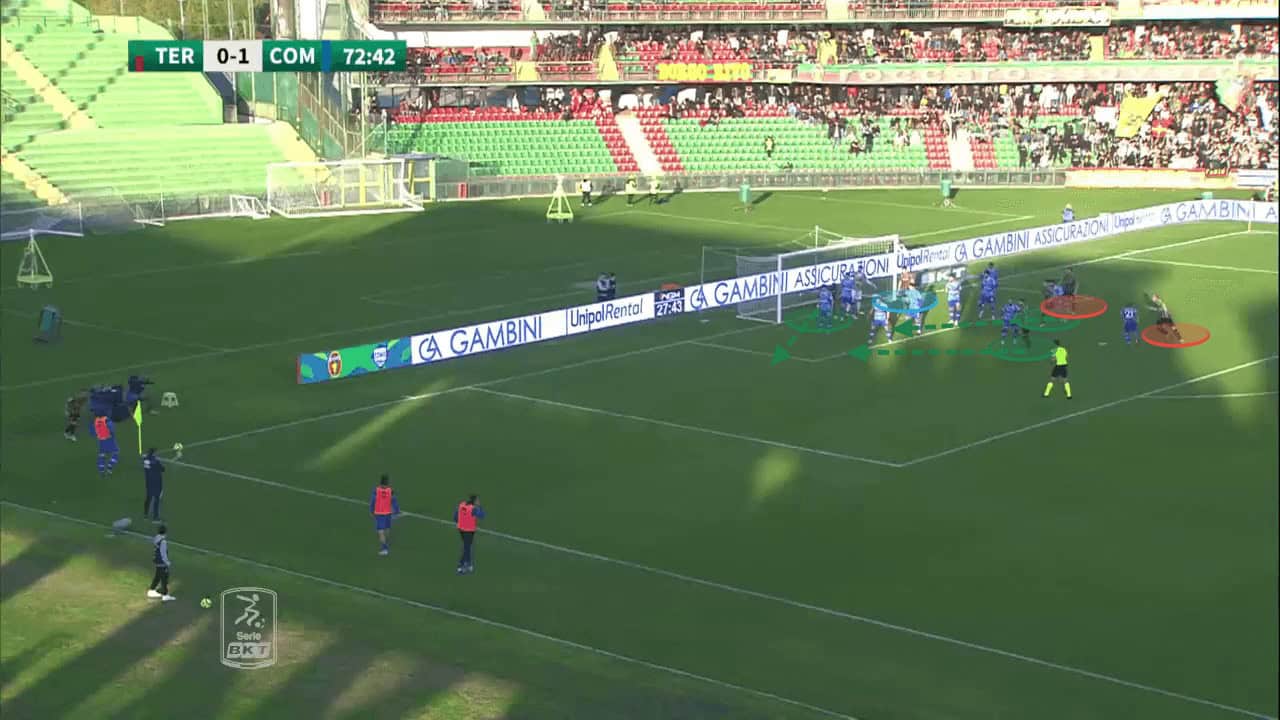
Arriving into the black area after starting behind the goalkeeper allows the player to be unmarked, with the goalkeeper acting as a marker and being responsible for any ball floating into their area. However, once the ball is crossed flat, and if missed by the first attackers, it will bounce into the black area, from where the attacker can arrive unmarked. The zonal markers on the six-yard line are shown below, looking towards the ball and being unable to track the run coming in from their blindside.
Free kick routines
Ternana have also utilised several different creative routines from free kicks which have enabled them to be unpredictable from every kick. The first and most reliable method for creating chances from wide free kicks has been the use of doubling up on the last defender, furthest away from the ball. When the Ternana players double up against the last defender, he is left with two choices to make. He has to decide which runner to track, with the runner closer to the goal being the more dangerous one.
Pictured below, we can see the decoy run (blue) being made across the face of the last defender, which attracts the player to step out of position. As a result, the Ternana attacker at the back post can arrive inside the six-yard box completely unmarked. The players in red are used similarly to their corner methods where they clean up any loose balls or rebound at the back post, where the ball will end up during the second phase. The ball can then be floated in, where the slow flight of the ball makes it easy for the player at the back post to connect with the ball.
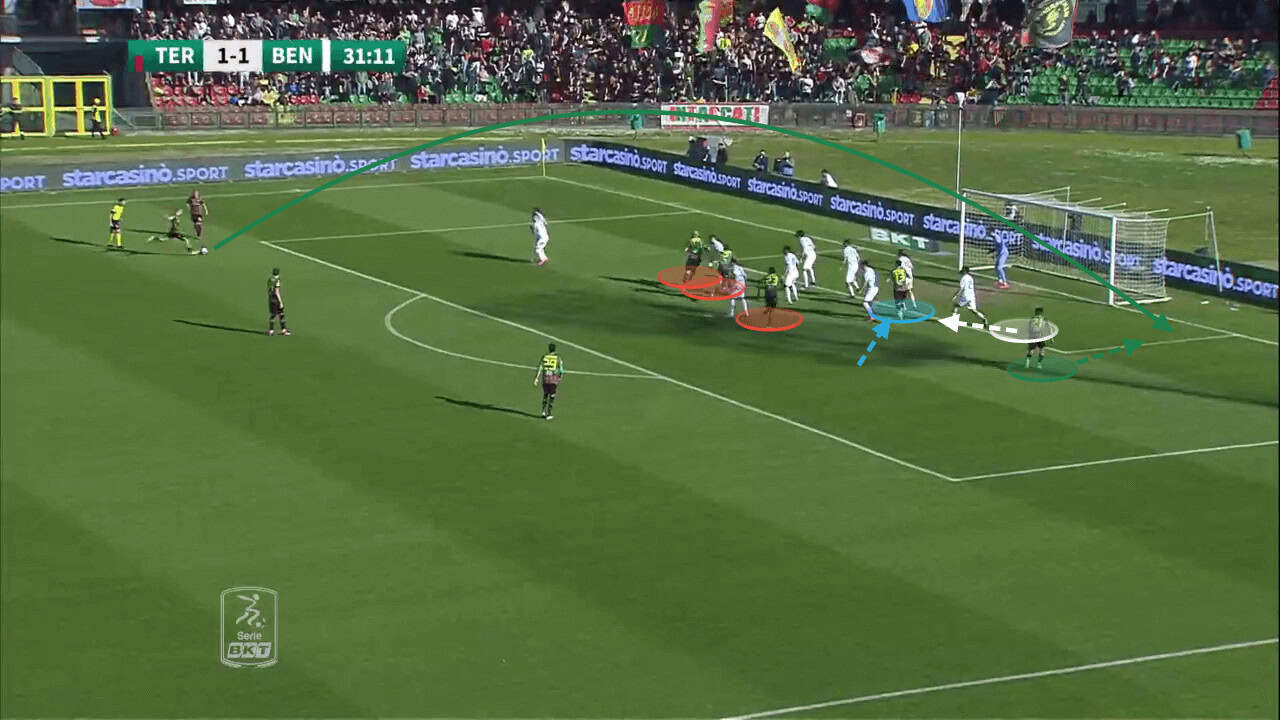
At the back post, the Ternana attacker attempts to hit the ball towards the far post. The tight angle makes it difficult for the shot to be scored from, but aiming the shot at the far post allows for the players in red to attack the ball should it be going wide of the goal.
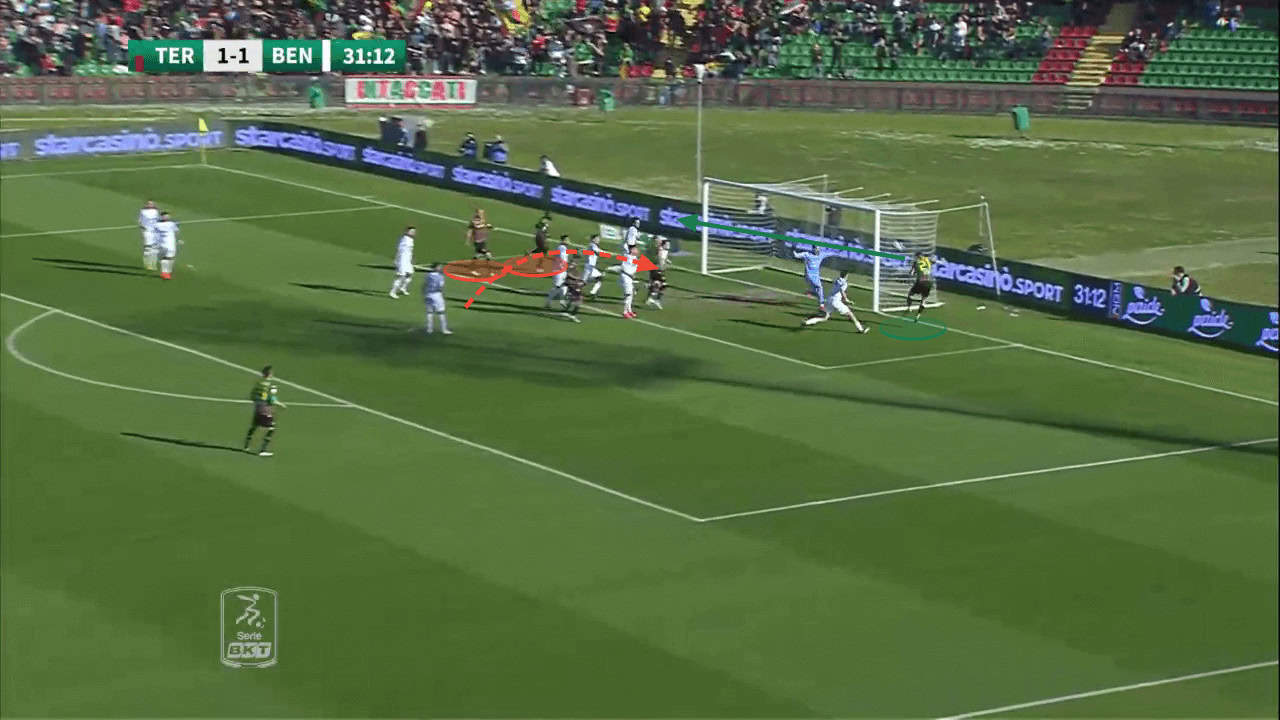
We can see here, the ball is then headed in from a few yards out after the routine has allowed Ternana to create a clear-cut chance. The players at the far post are scattered around to make sure one of them can reach the ball, no matter where the ball may bounce to.
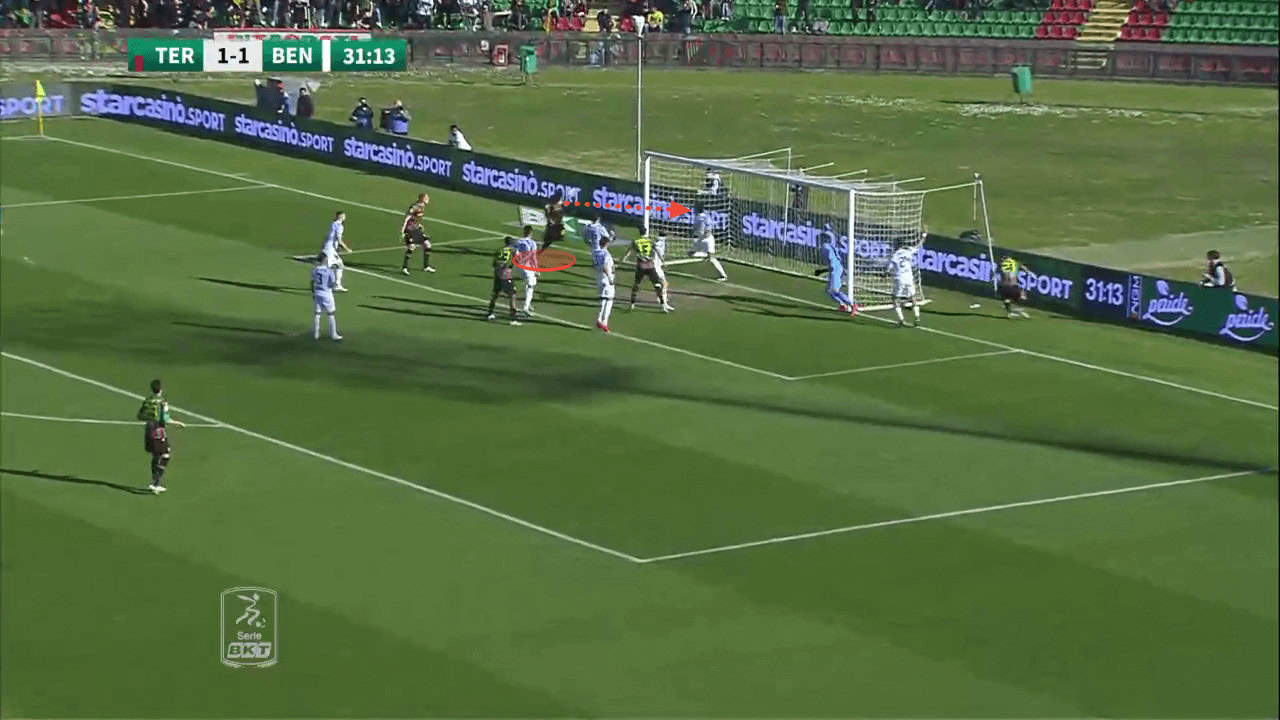
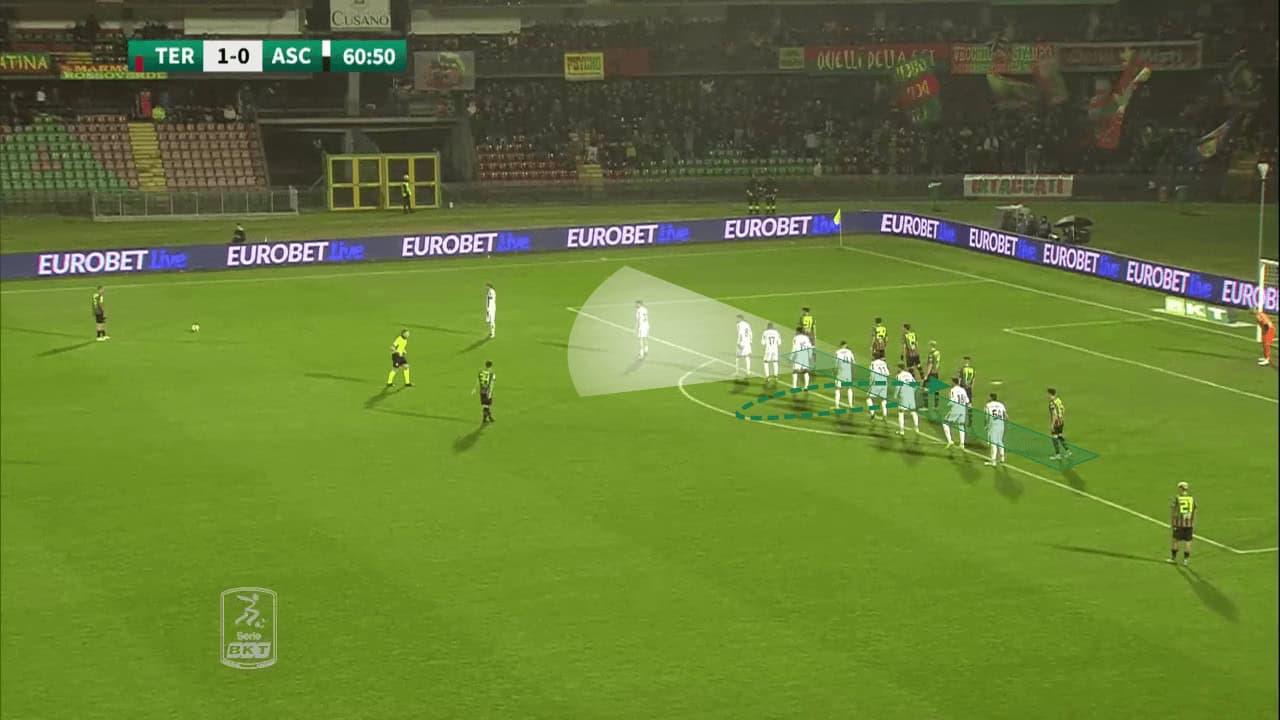
Another unconventional method has been to alter the starting positions of the attacking players. In the image below, Ternana are the team in the striped kit, with every attacker starting in an offside position. As the kick is about to be taken, the Ternana players then all quickly shuffle to be onside before attacking the box. Making the late movement going from being off to onside allows the attackers to attack the box unmarked.
The image below displays every defender looking at the ball to be ready to time their movement to retreat into the box. This means that the defending team cannot see the attacking players, so when they step onside in the last moment, none of the defenders have time to reorganise themselves to mark an attacker. As a result, every attacker can make their run without a tight marker interrupting their move, so they can attack the box with speed.
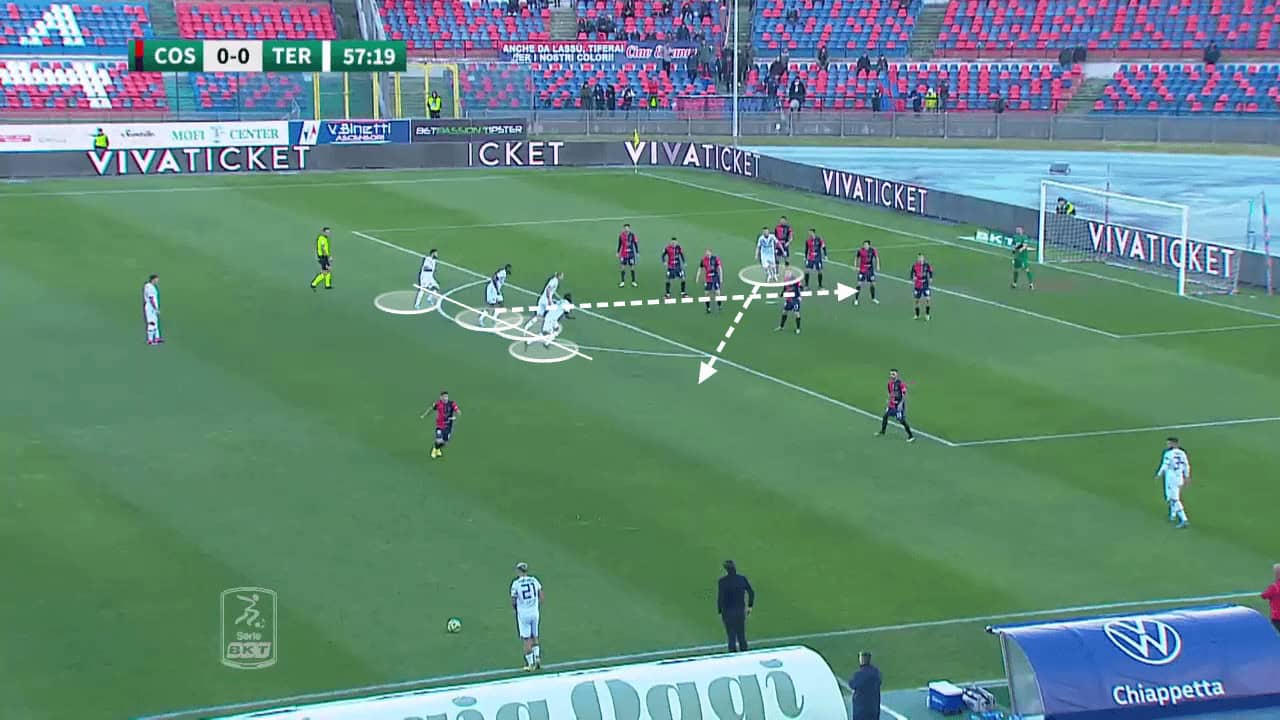
One final method Ternana have used when attacking free kicks from wide areas is to use opposite movement to create space for certain players. In the image, we can see four Ternana attackers lining up side by side, around 12 yards away from the first set of defenders. The deep starting position allows the attackers to make their runs into the box with momentum, where they will be able to outjump the defenders. The first set of defenders are tasked with blocking the runners as well, however, attempting to block a run from deep is likely to result in a penalty being given away due to the attackers already being in motion.
The opposite movement comes from the player who starts inside the 18-yard box. His movement towards the edge of the box allows him to arrive on the edge unmarked, in an attempt to flick the ball on should it be under-hit by the free-kick taker. It is also used as a method to drag the zonal defender out of his position around the penalty spot.
Summary
This set-piece analysis has detailed the numerous different ways Ternana have used both free kicks and corners to be a dangerous side from dead balls. Their chance creation from dead balls has been a constant in a season of ups and downs, which has involved Cristiano Lucarelli leaving and returning to his post in the same season.
Their set-pieces have clearly taken up a lot of time on the training ground, although their inconsistent finishing has meant that Ternana haven’t stood out as a dangerous dead-ball side from corners.
