
We are just two games into England’s EURO 2020 campaign, and already there is a vocal sense of discontentment with the side’s performances so far. England were scrappy, dogged, resolute and all those adjectives which basically mean that they were not a good watch in both their matches so far, against Croatia and Scotland, and while they have not conceded a goal yet, the Three Lions have also scored just once. A win and a draw from two matches is nothing to be sniffed at, especially in international football where it is rare that the most entertaining or ‘open’ sides win tournaments. Nevertheless, while Gareth Southgate ponders his team selection for the Czech Republic, there is one area of England’s play that has gone slightly under the radar, but it evokes memories of the 2018 World Cup semi-final run and has the potential to be similarly effective this time around. Yes, we are talking about England’s set-pieces.
One of Southgate’s key priorities with England has been to make them dangerous from set-pieces. This is an area that can bring a lot of benefits to sides during matches, given the number of set-piece situations that take place every game, and it is even more important at international level, since teams do not get anywhere near the time together that club sides enjoy. Thus, it is difficult to create structures in possession and patterns of play, but using set-pieces can be a big advantage towards creating chances and scoring goals. England’s set-piece prowess was one of the biggest reasons behind their World Cup run – they scored nine of their 12 goals at the tournament from set-piece situations (you can read Stuart Reid’s excellent analysis of England’s routines from that tournament here) and while it has not been as successful yet, we have seen some interesting set-piece tactics used by Southgate and his team this time around as well. Thus, this set-piece analysis will take a look at England’s tactics from set-pieces, including attacking throw-ins, so far at EURO 2020 and highlight the routines that could be extremely successful in the matches to come.
Throw-ins
It is slightly baffling that coaching throw-ins is still considered something ‘beneath’ many coaches and players, and teams are regularly ridiculed for having dedicated throw-in coaches, with Thomas Grønnemark and Liverpool being the most high-profile example of this. However, throw-ins are the most frequent set-piece opportunities in matches, and therefore need to be coached so that teams can take advantage of them to retain possession or build attacks. England have had some interesting patterns from throw-ins in both their matches so far, which have already led to chances being created.

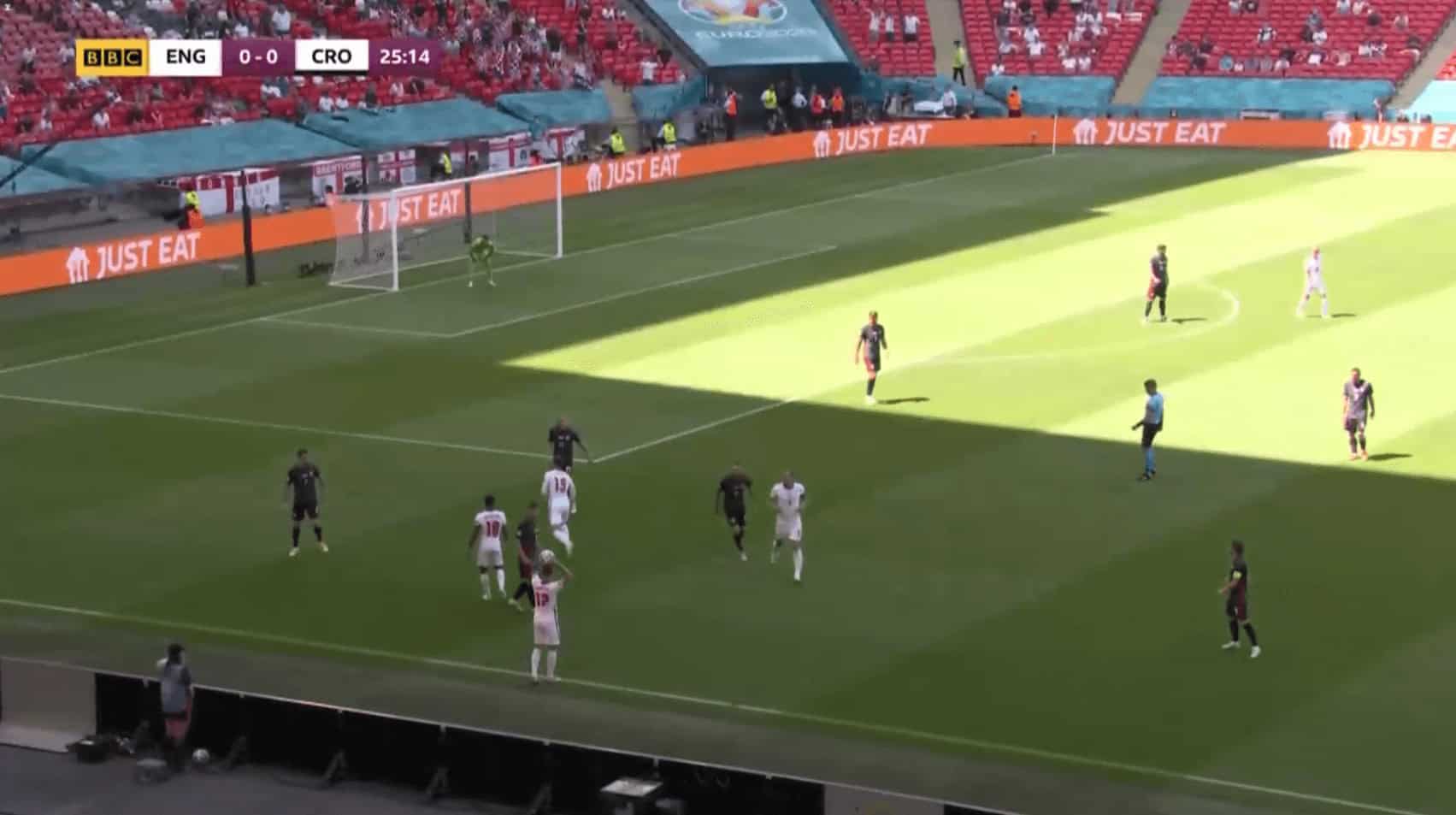
The first example we are looking at was in the immediate build-up for Phil Foden’s early chance against Croatia, where he hit the post. England have a throw-in around midway in their own half, with Kieran Tripper, the left-back, taking it. Notice how Harry Kane moves away from the central space and out wide, with Raheem Sterling then poised to run into that very space that he vacated.

That is exactly what happens – Sterling gets away from his marker just as Trippier is about to throw the ball, and is therefore able to run onto the ball in a lot of space. The two Croatian defenders are sitting off, which means that the Manchester City man is able to drive forwards with the ball at his feet and lay it off to Foden on the edge of the area, from where he would hit the post.
Kane and Sterling have already combined in this way a couple of times at EURO 2020, with Kane being used to open passing lanes up rather than as the actual target of the throw, while Sterling is the player to run onto the ball due to his pace and ability in tight spaces.
Here, Trippier is once again taking a throw on the left. Kane drops off and moves to the right, while Mason Mount goes towards the left.

Mount and Kane’s opposing movements quite literally opens the gates for a central passing lane for Sterling, and Trippier obliges with the throw into the highlighted space.
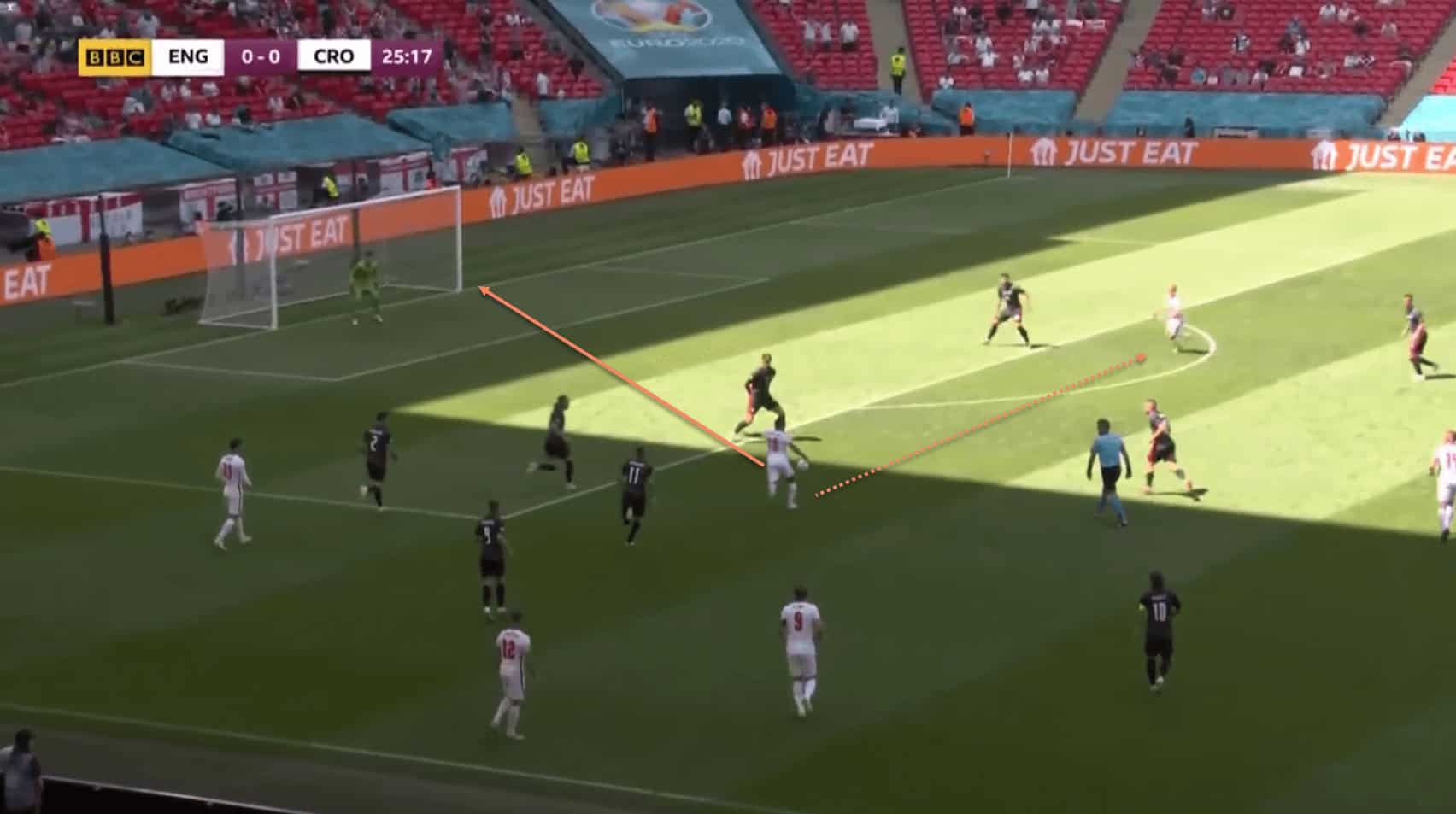
Sterling is again in space in front of the Croatian backline, who have sat back, and he is able to take a shot on goal. Although his execution of the shot was poor, the throw-in routine itself worked perfectly, and Sterling could have also potentially played a pass across the area towards Foden here.
These situations show that England are definitely spending time working on throw-in routines, and this is an excellent strategy, as it allows them to both retain possession when needed, and also create these sort of situations – especially as it is unlikely that opponents have been working on how to defend these situations.
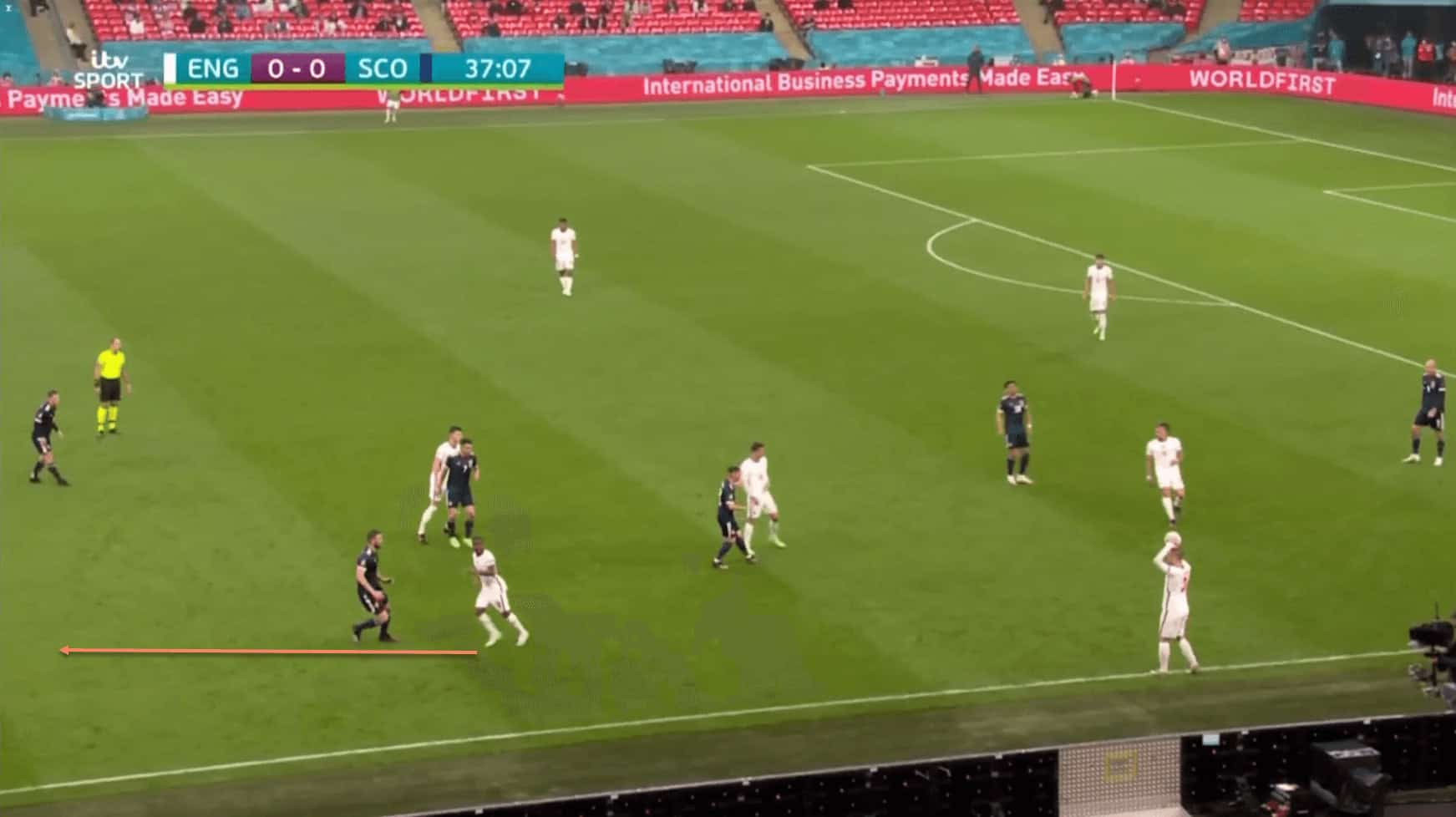
This is an example from the Scotland match – another throw-in deep in England territory, with Luke Shaw on the ball, and Sterling attempting to make a run into space.
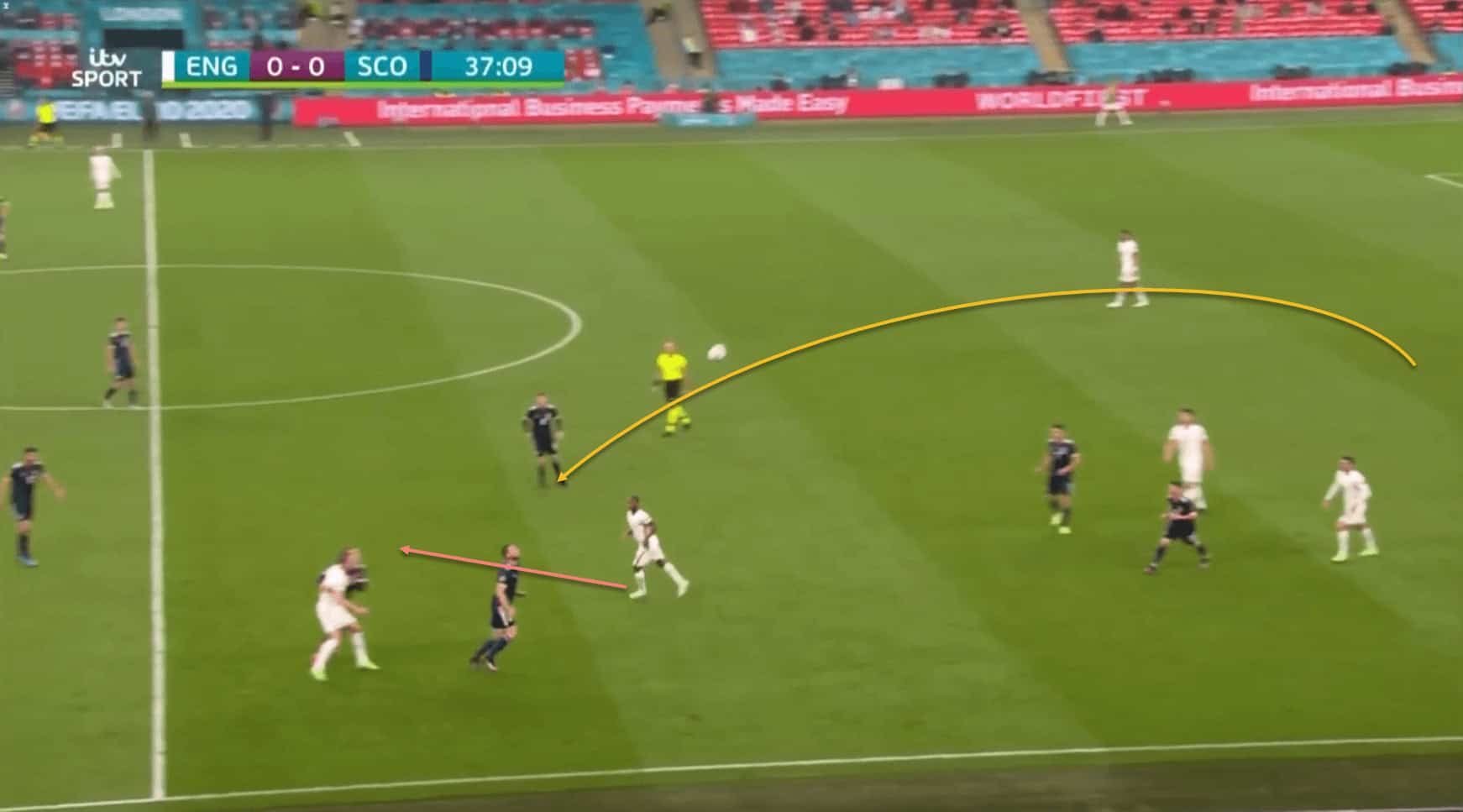
Note how Sterling’s marker has been attracted towards the ball and has left him free – he does clear the ball here, but a slightly better throw towards Kane could have resulted in the England captain being able to flick the ball on for Sterling to run onto in space.
These sort of situations have occurred far too often in England’s two games so far for them to be coincidental or the result of players working out these scenarios while on the pitch. England are definitely working on their throw-ins on the training ground, which is extremely refreshing to see, and we have already seen how this has helped them create opportunities in the final third of the pitch.
Free-kicks
England have not had too many free-kicks from the sort of areas where you could reasonably expect routines to be put into play, but there have still been a couple of intriguing situations that have been created so far.
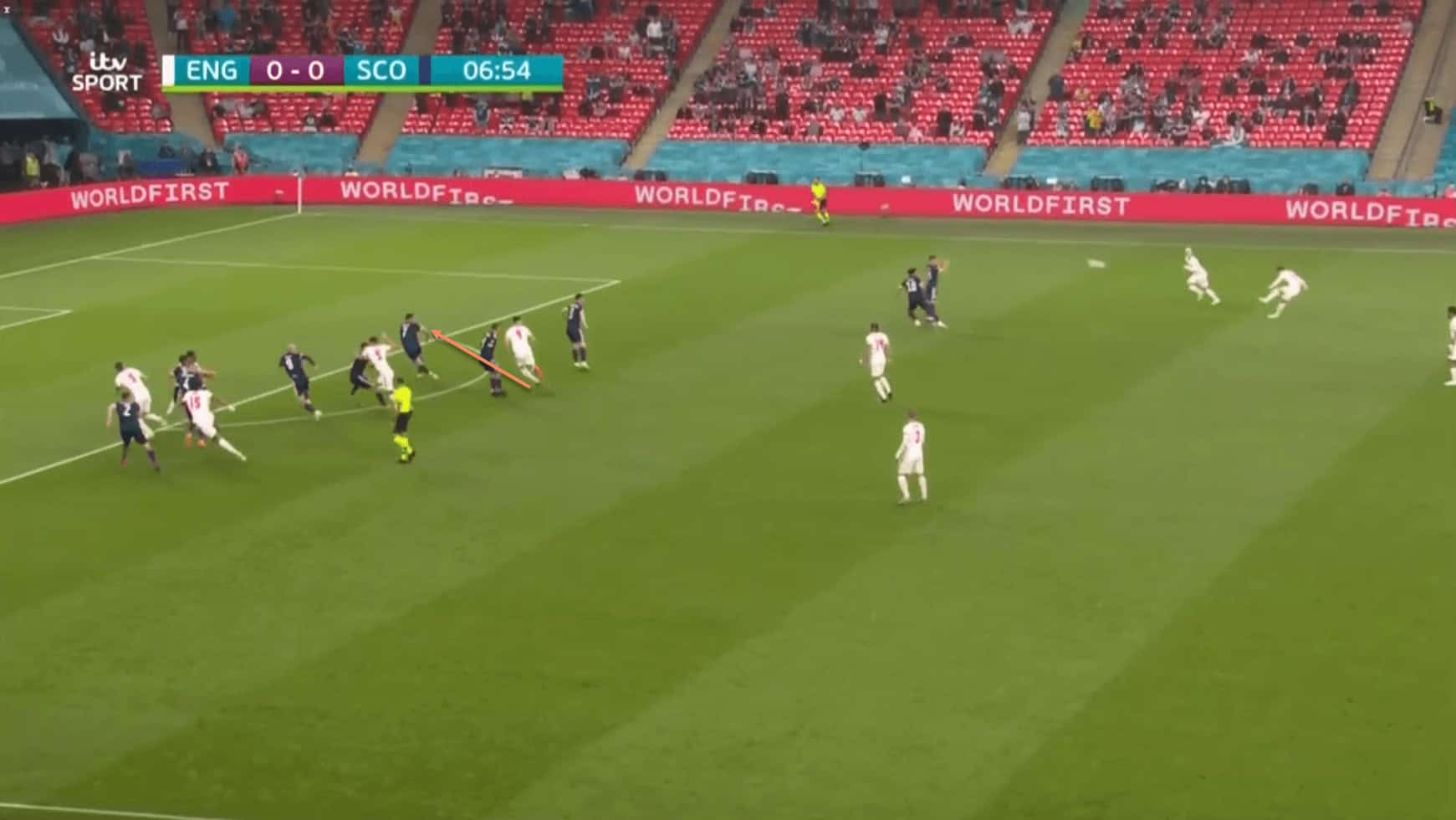
As Mount takes this free-kick, note how Declan Rice makes a run towards the near post area here, having already gone past the player marking him.
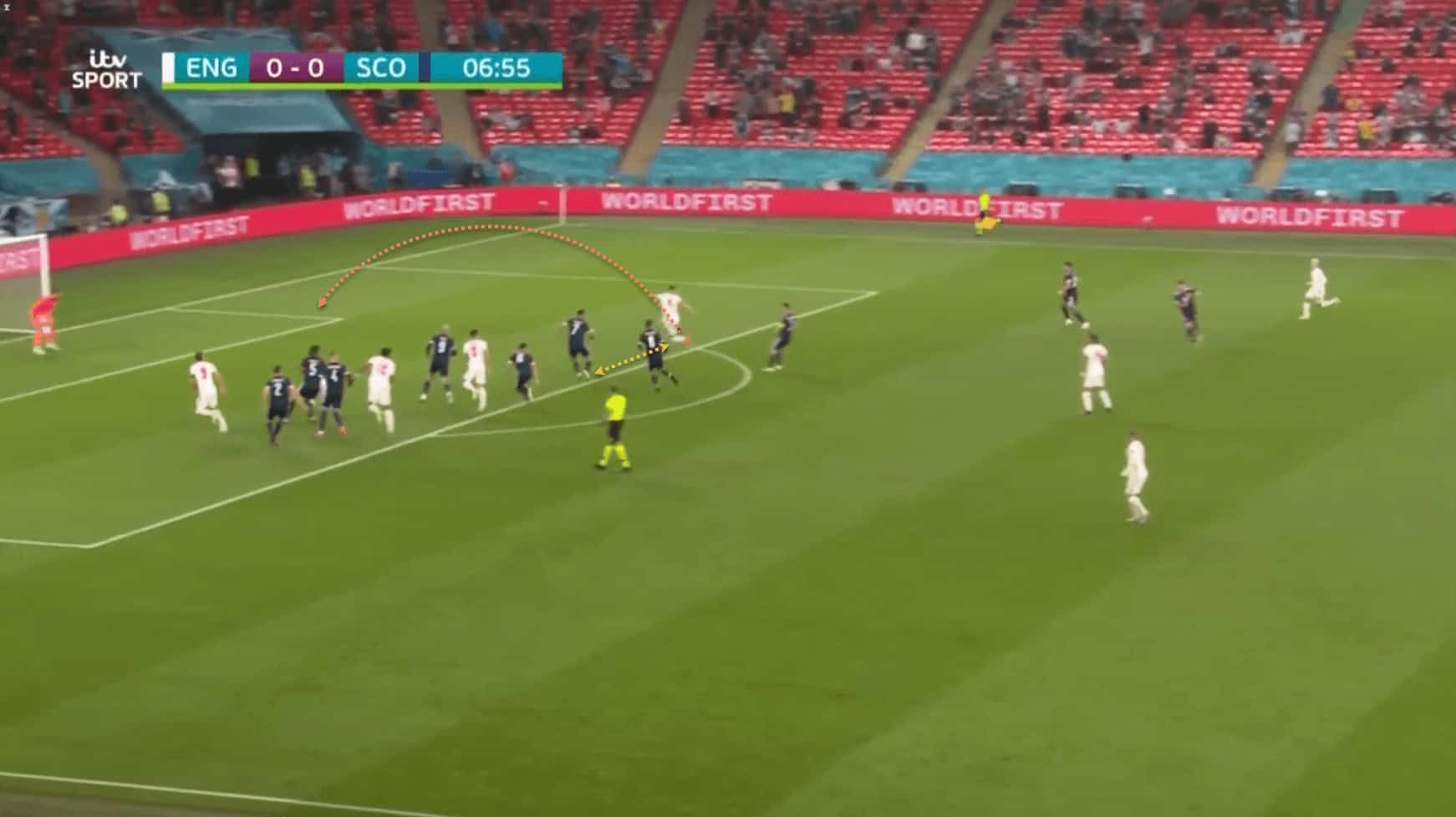
The free-kick was aimed towards that area, and while Rice gets into a slightly awkward position and can the resulting flick only goes through to the goalkeeper, you can see the idea here. Tyrone Mings (second England player from the left) has managed to get away from Scott McTominay, and a better flick could have presented the Aston Villa man with a good opportunity in front of goal.
Italy’s goal against Wales in their third match in Group A used a similar tactic, and shows the potential value of a run across a marker to the near post from these situations.
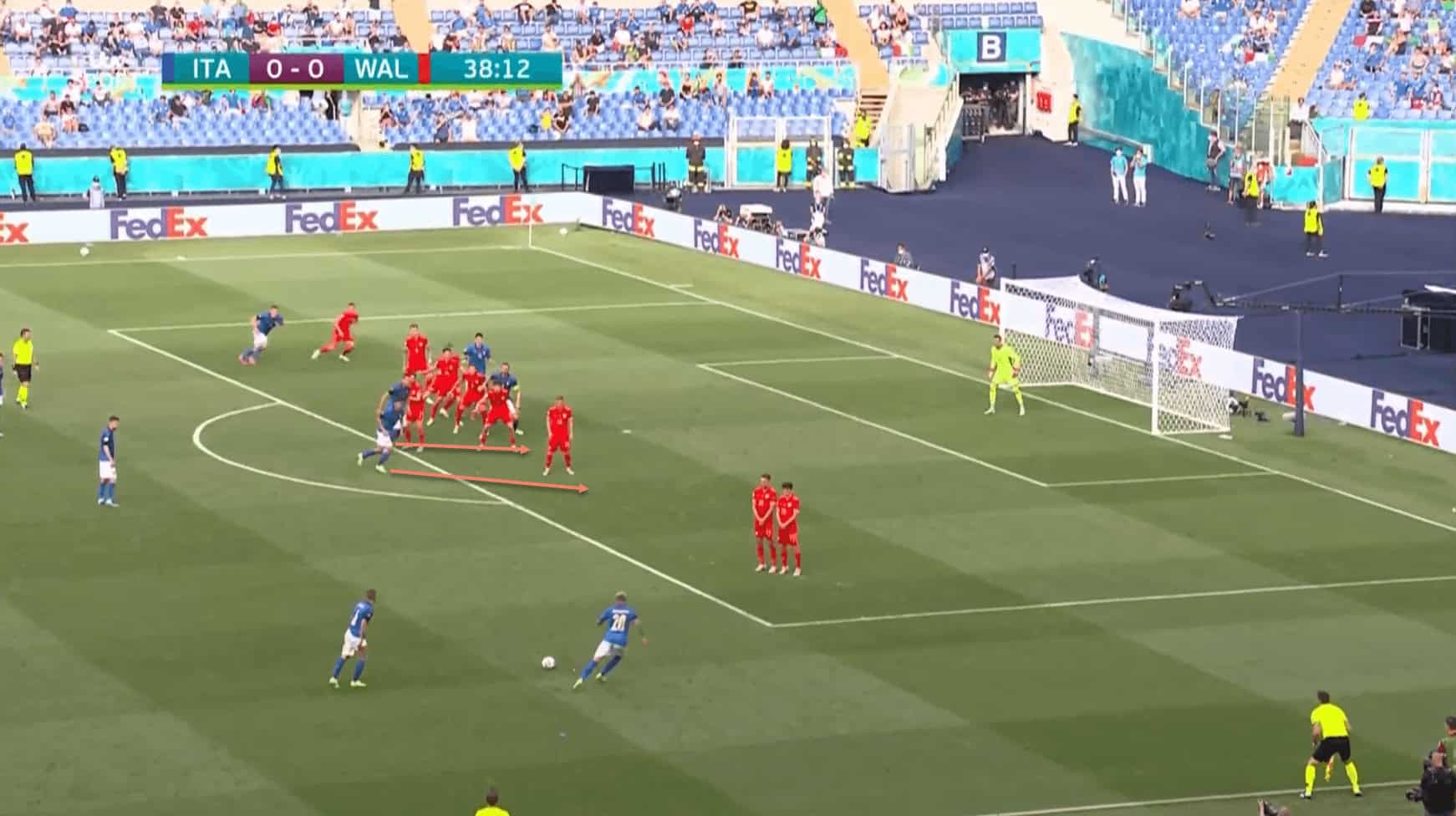
As Marco Verratti prepares to take the free-kick, there are two Italian players attempting to make a run into the near post area, while the likes of Leonardo Bonucci serve as decoys, straying offside and forcing the Wales defensive line to drop just a little deeper.
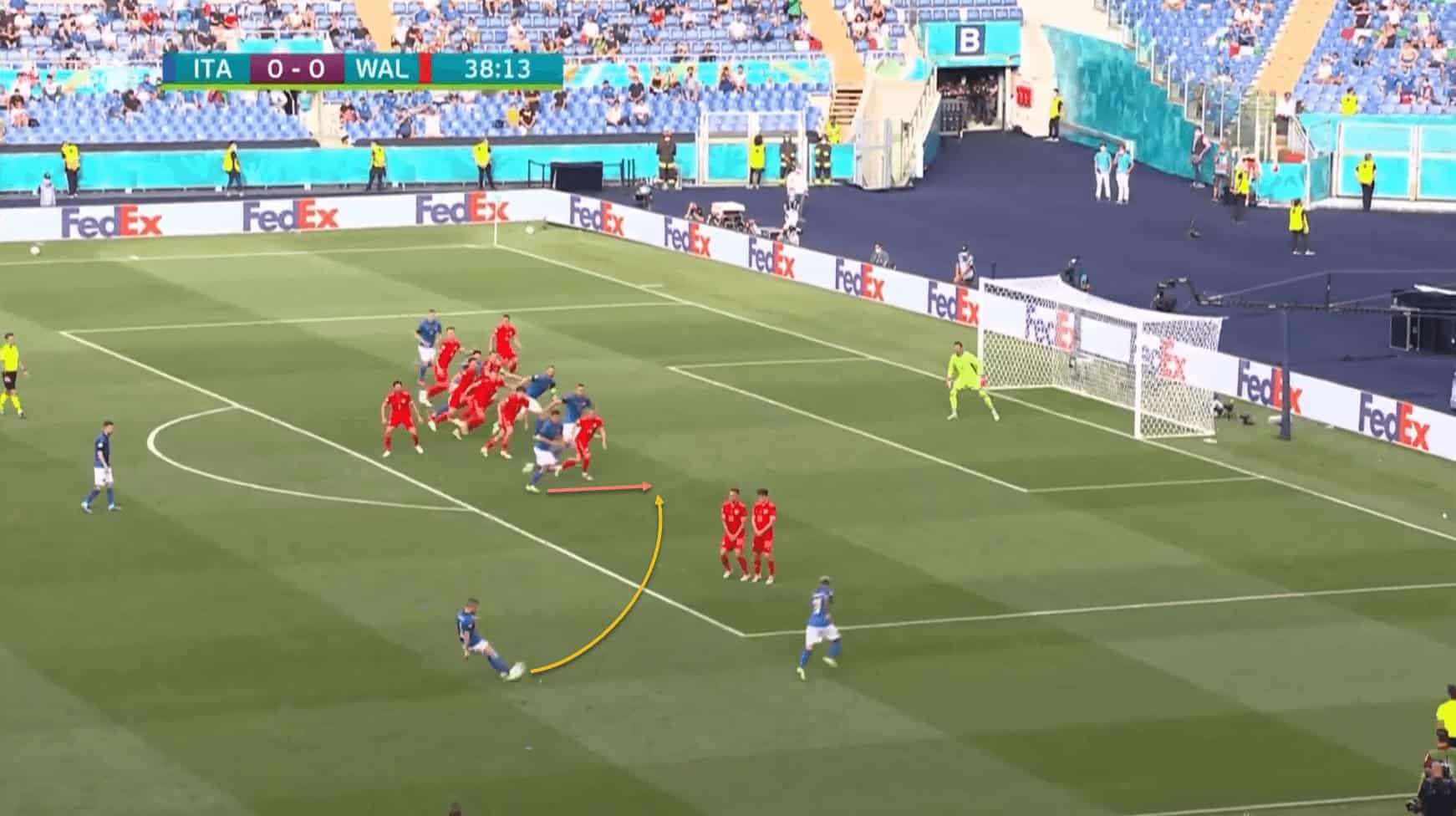
Verratti swings the ball in low and towards the first man, Matteo Pessina, who is able to get ahead of the nearest Welsh player…
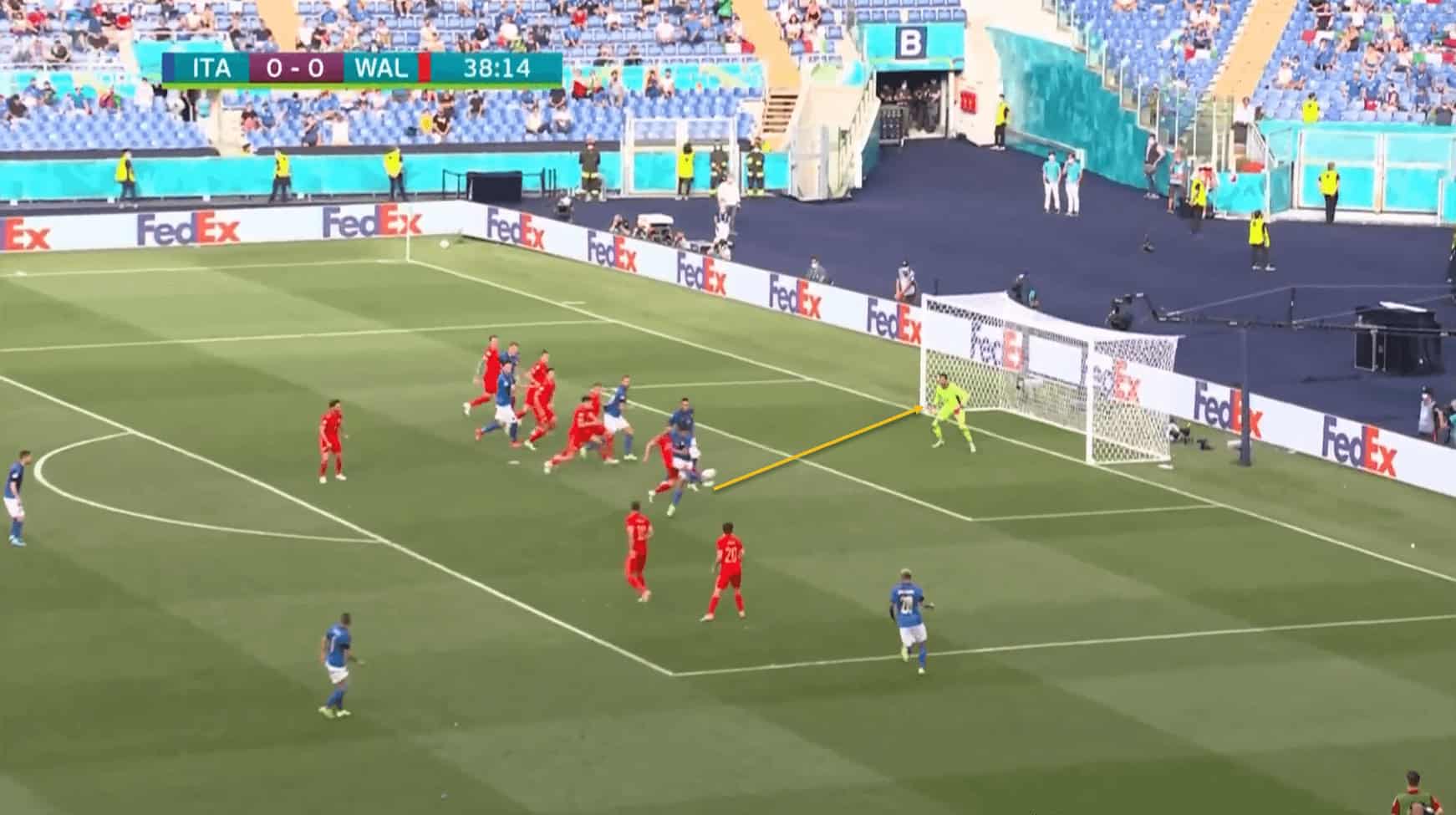
…and guide the ball into the far corner with a deft touch.
Of course, these are different situations – the Italy free-kick was from around ten yards further up the pitch and therefore closer to the penalty area, but we can see how a near post run, combined with a low, flat delivery, can catch opponents out.
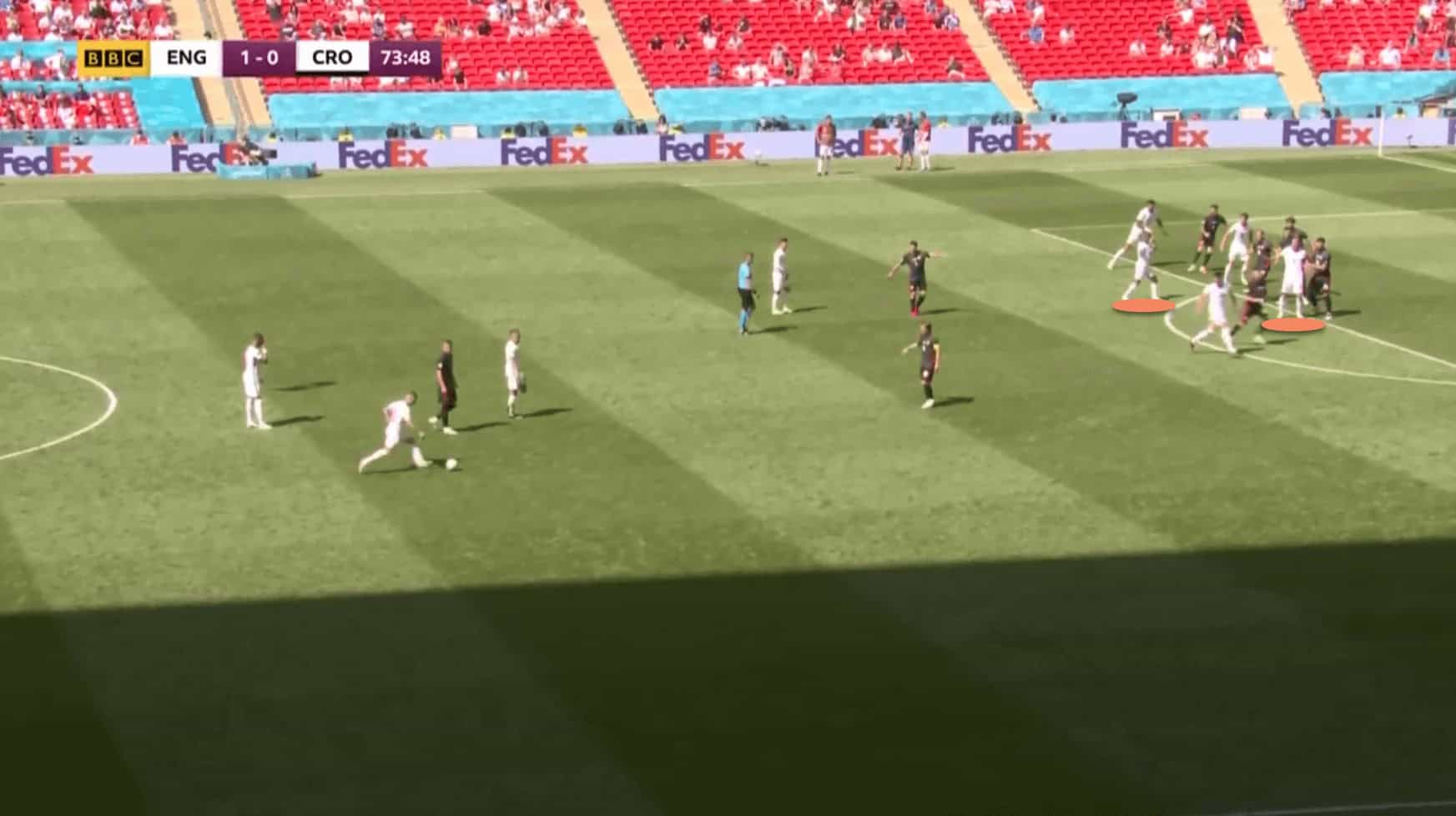
This is a free-kick from a deeper position, in England’s first EURO 2020 match against Croatia. Harry Kane is part of the scrum at the edge of the area, while Raheem Sterling is deeper and will probably attempt to make a late run into the box.
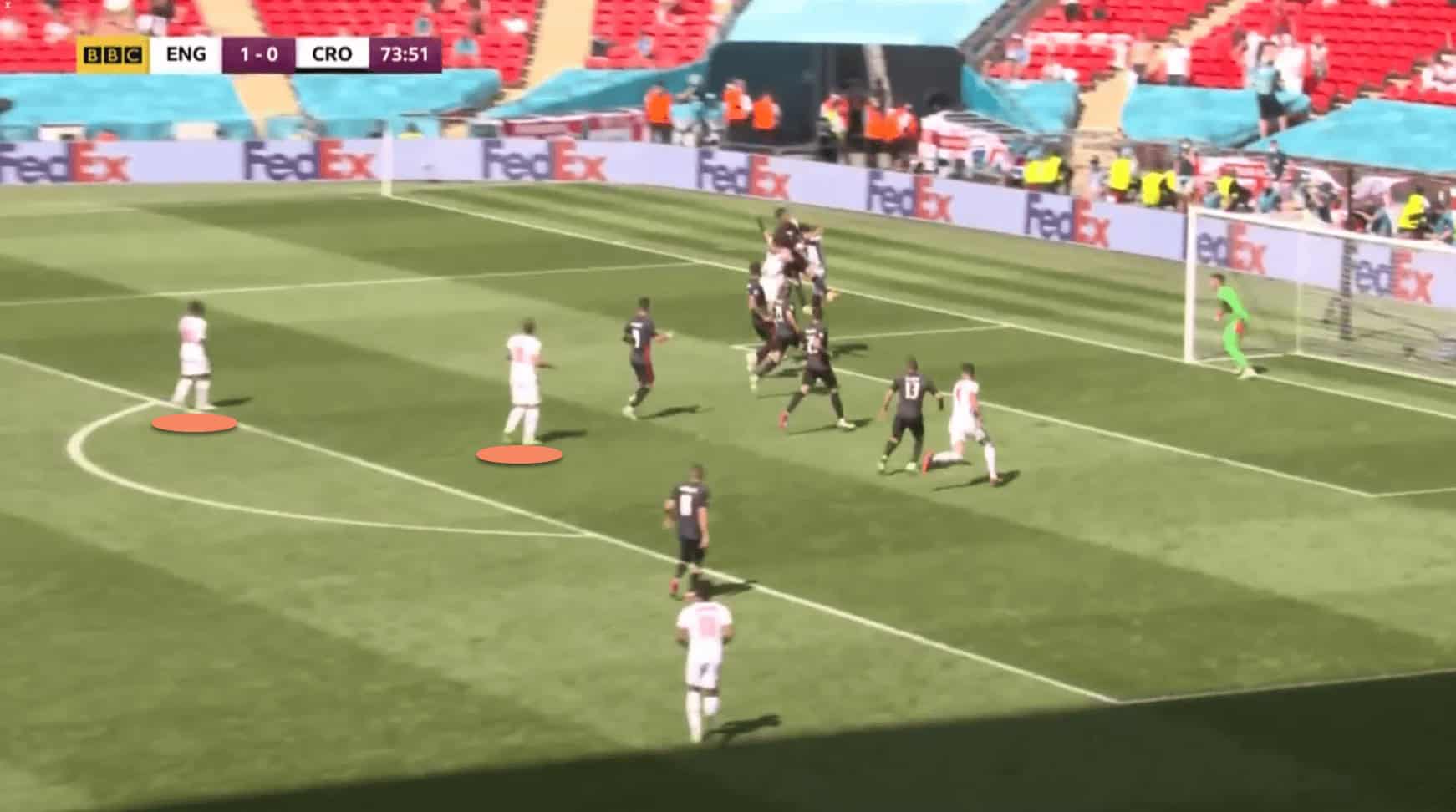
This becomes relevant as we see the ball delivered to the far post by Trippier. Kane, having seen the ball go to the back post, does not make a run into the six-yard box – he hangs back, while Sterling is just getting into the area. Both players are thus in a lot of space, with the Croatian defenders attracted towards the ball and therefore naturally moving deeper.
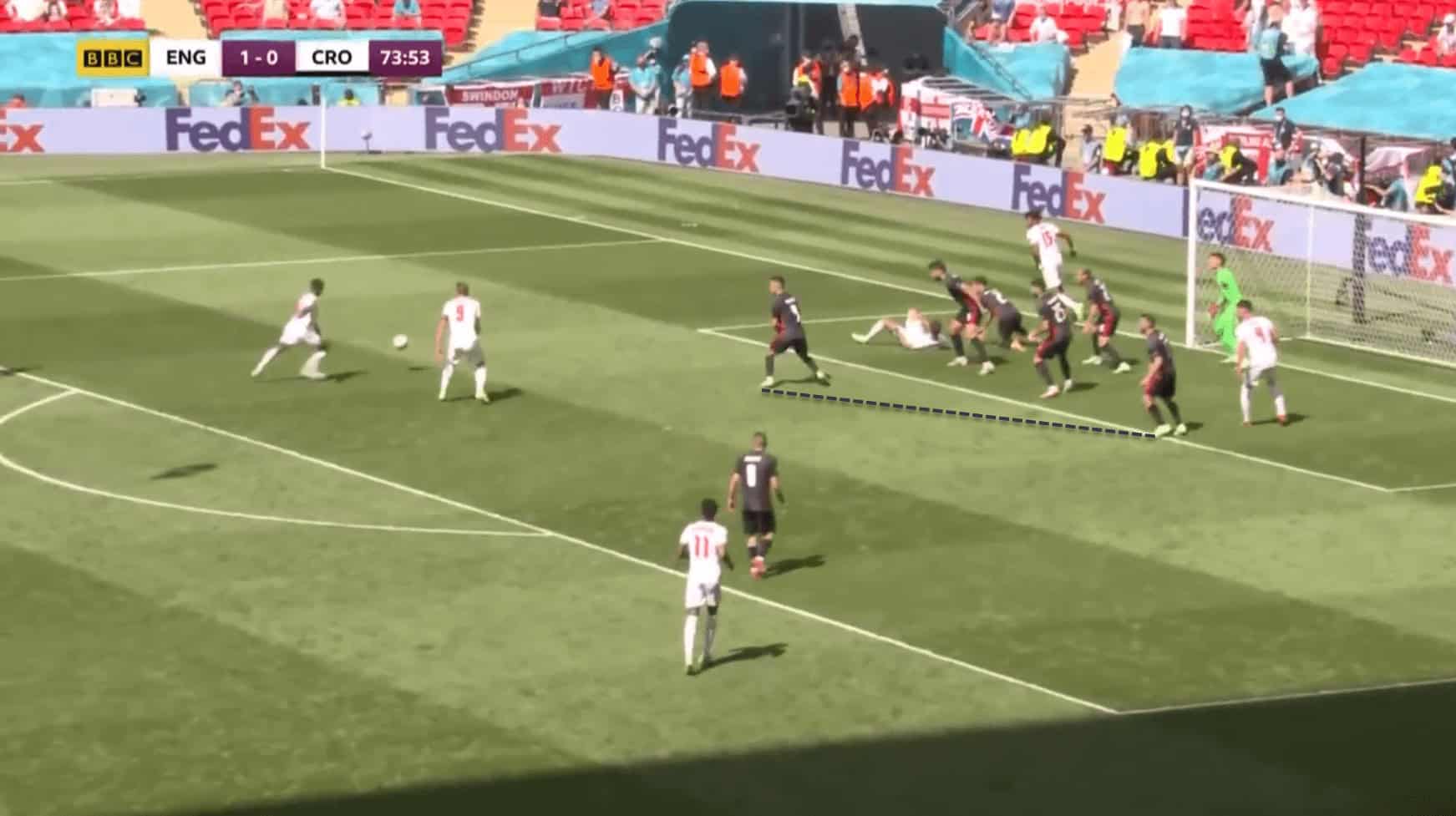
The ball is initially cleared by the Croatian defender, but it falls to Sterling who is in acres of space for a shot on goal. Once again, his execution of the shot itself is poor, but this was another example of intelligent positioning by England. Trippier had delivered a slow, lofted ball into the box, and it was therefore quite likely that even if a Croatian defender managed to get the first header, he would not be able to get enough power on it to get it clear of the penalty area. It therefore made a lot of sense to have a couple of players stay on the edge of the box to get on the end of such clearances, which is exactly what happened.
Corners
England have been largely excellent in terms of the routines used from corners, and while they only have John Stones’ header against the post in the opening moments of the match against Scotland to show for it, there is a strong chance of the Three Lions scoring from a corner sooner rather than later if they keep this up.
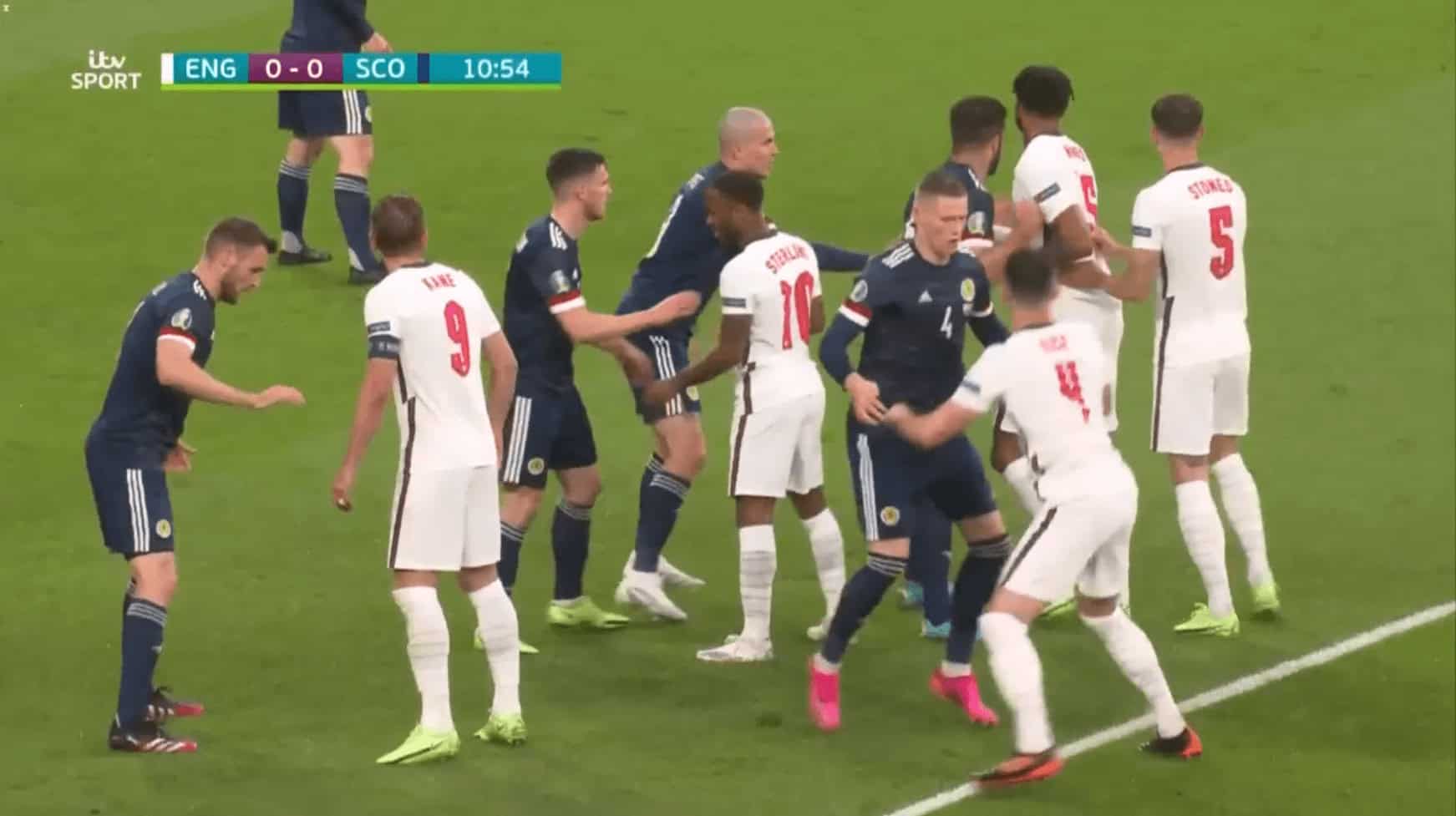
This is the setup on the edge of the Scotland area for the aforementioned corner. Stephen O’Donnell is picking up Kane, McTominay is on Rice, Andy Robertson is marking Sterling, while Stones and Mings are forming a two-man queue in front of Lyndon Dykes and Grant Hanley.
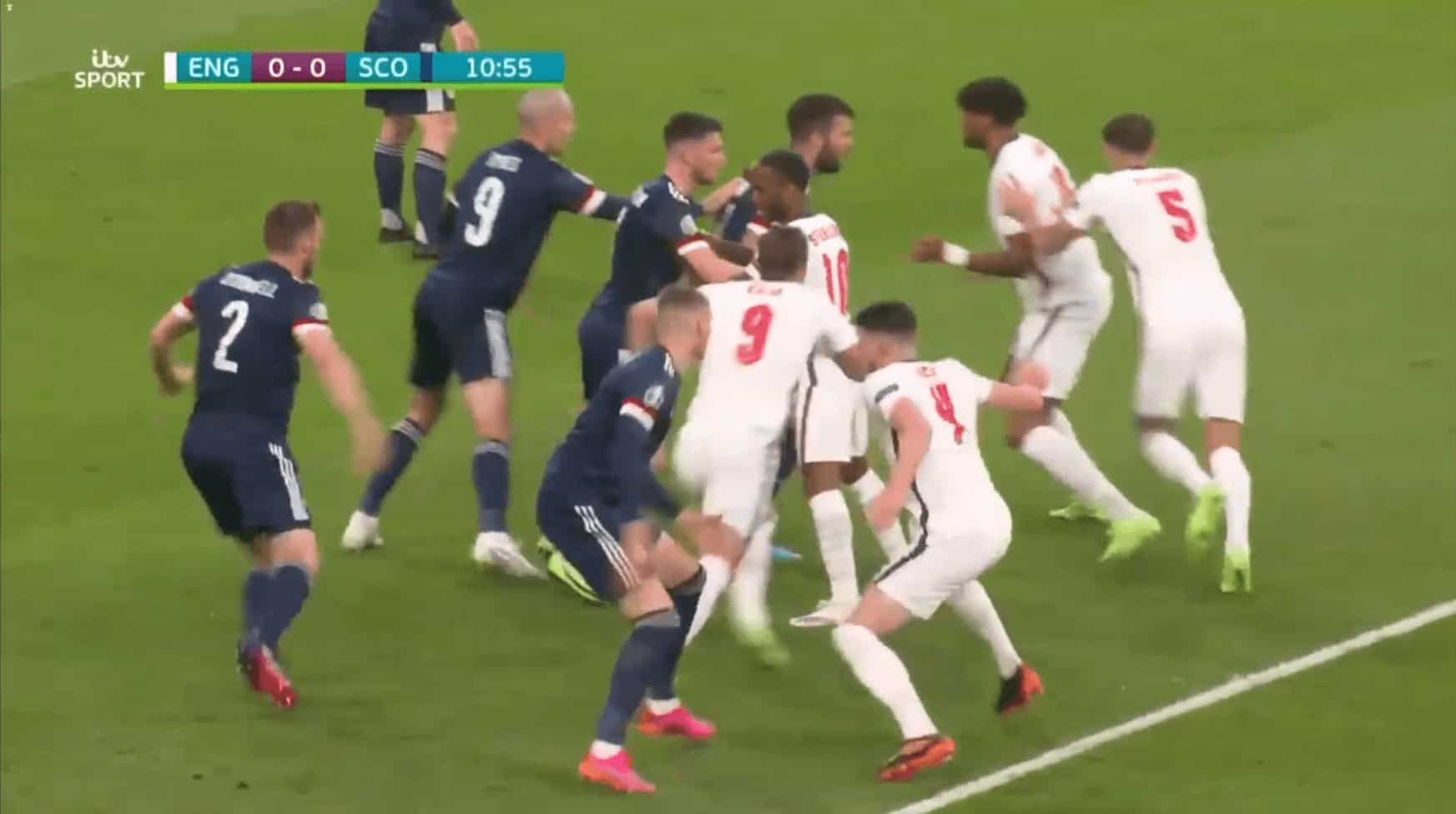
As Mount runs up to take the corner, Kane peels away from O’Donnell and runs around that central block, creating separation between him and the Scotland wing-back. At the same time, Stones stays behind Mings, using him as a shield to prevent Dykes from getting to him.
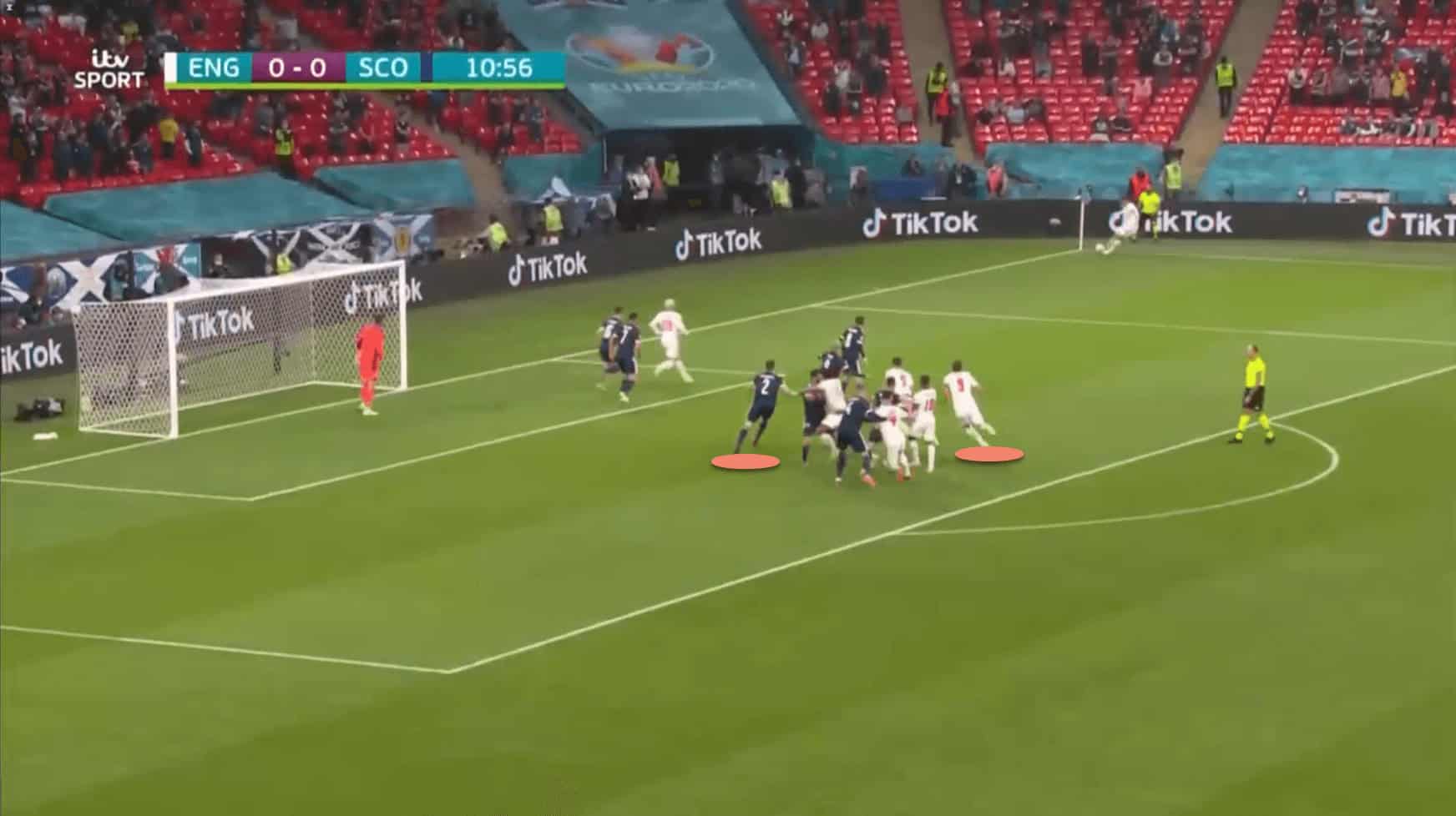
Note the distance between Kane and his supposed marker O’Donnell here as the corner is taken. Stones has also managed to get free in front of Kane, as Mings moves away and occupies Hanley.
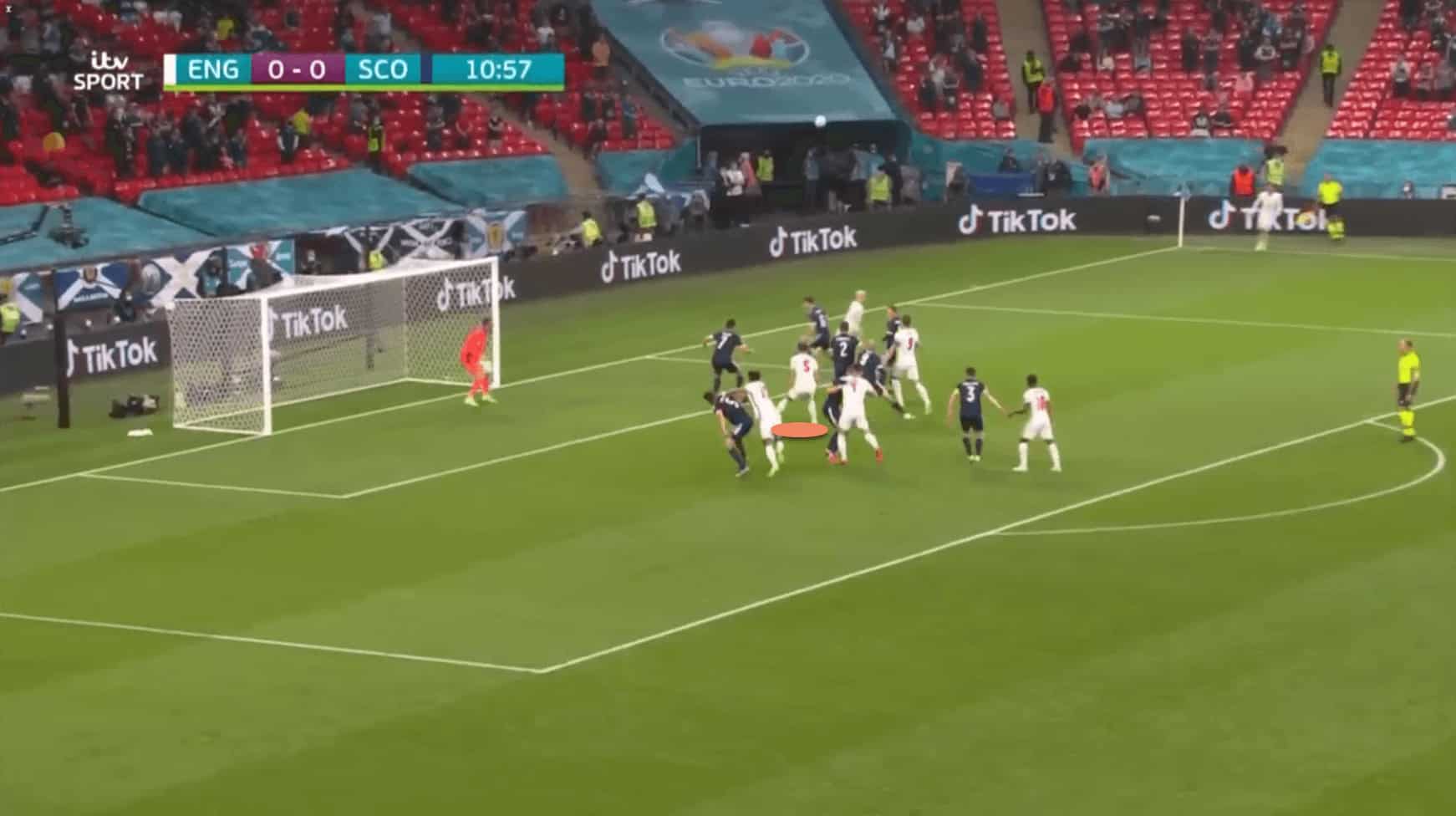
Dykes is caught ball-watching and is therefore on the wrong side of Stones, who is now free and is able to jump uncontested to head the ball – unfortunately, he can only find the post rather than the back of the net.
This was a situation where England used blockers in an intelligent manner to get a player or two free in the box, and there have also been examples of clever movement from the Three Lions from corners.
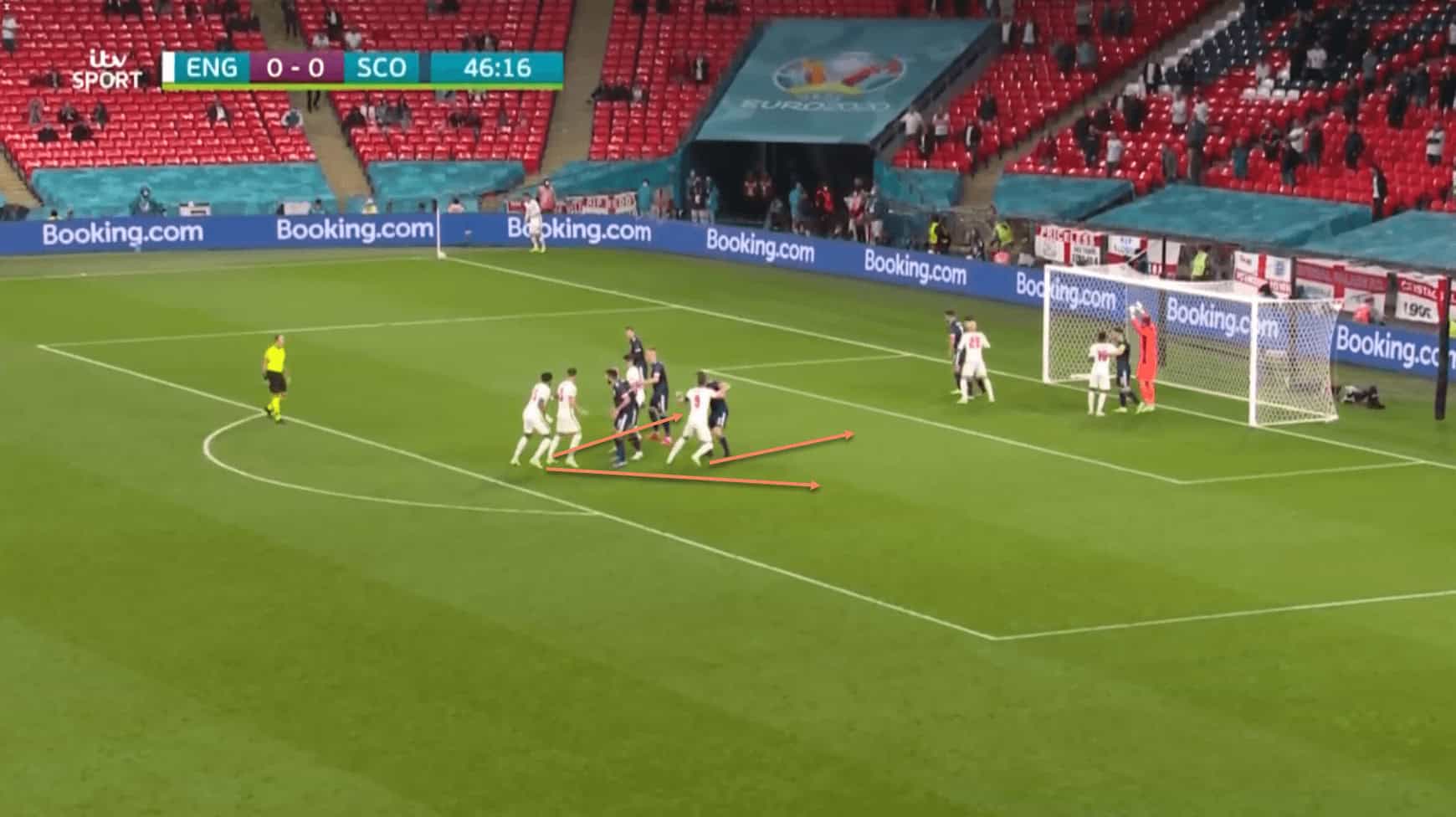
Another corner from the Scotland game – this time it is a right-footed player taking it from the left, so it will be an inswinging corner. Stones and Mings once again form a two-man block behind Kane, and their respective runs are marked out, with Mings going towards the far post and Stones moving more centrally. Declan Rice is level with Kane and being marked by McTominay again, and he will attempt a run to the near post area.
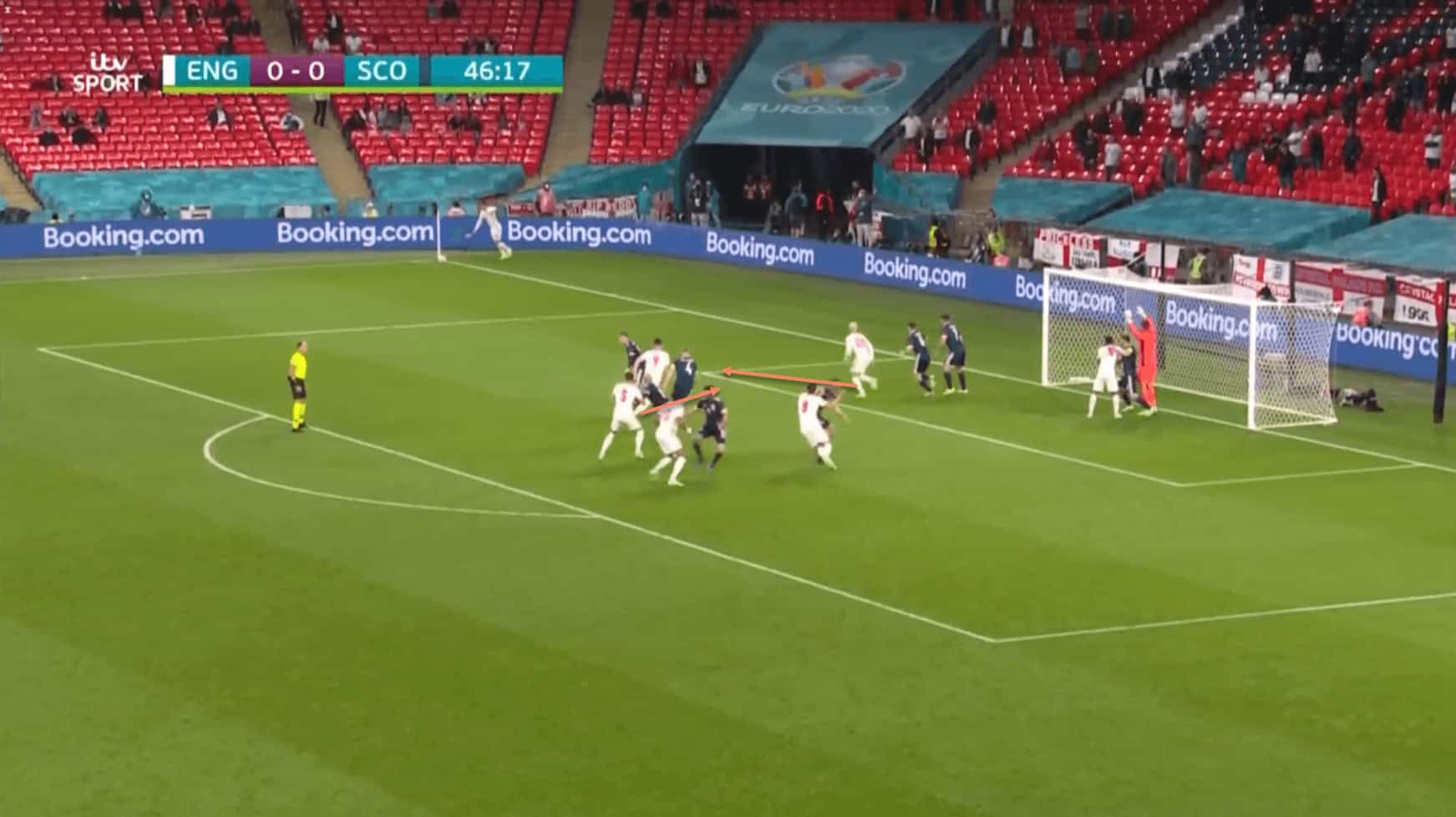
Phil Foden is at the near post, and he darts into space as Mount runs up to take the set-piece. Meanwhile, Rice is also making a run into the same area, drawing McTominay away and therefore leaving Stones alone in a favourable duel against Dykes.
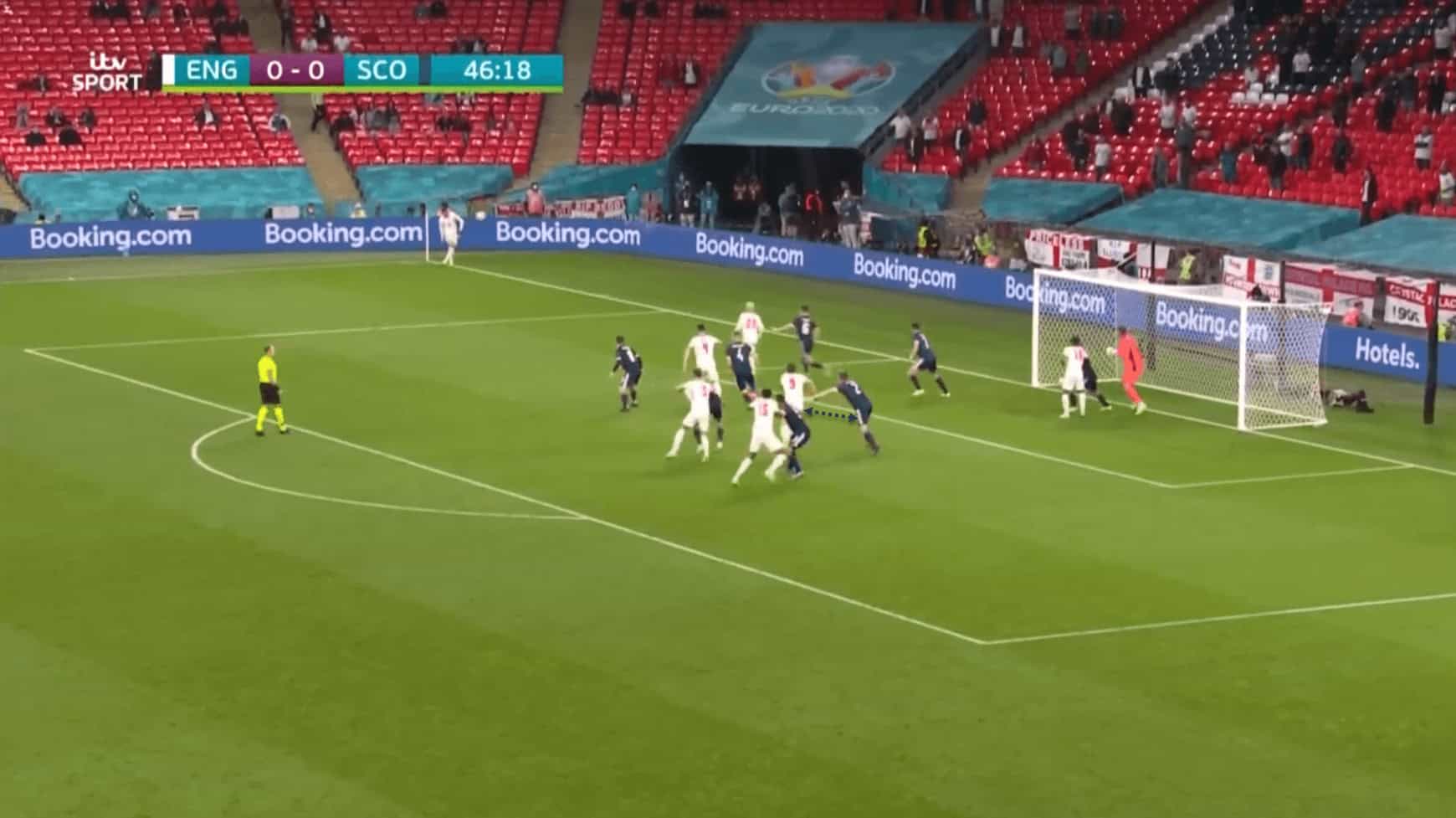
As the corner is taken, Kane has managed to get away from O’Donnell, with Stones also winning his duel with Dykes.
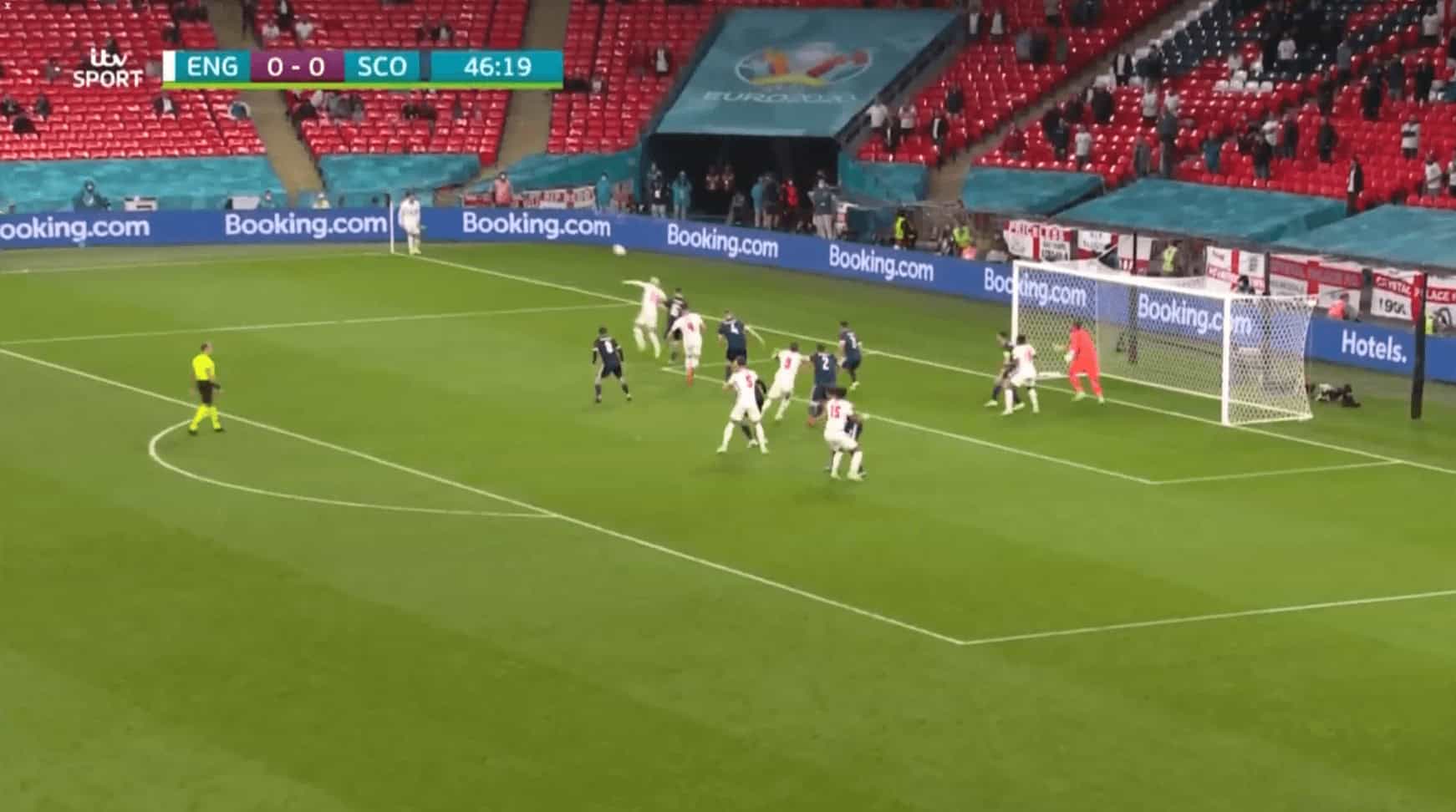
The ball goes to the near post, where Kieran Tierney wins the header against Foden. Note how Kane has managed to get ahead of O’Donnell centrally, with Stones also looking likely to win a duel with Dykes if the ball arrives in that area.
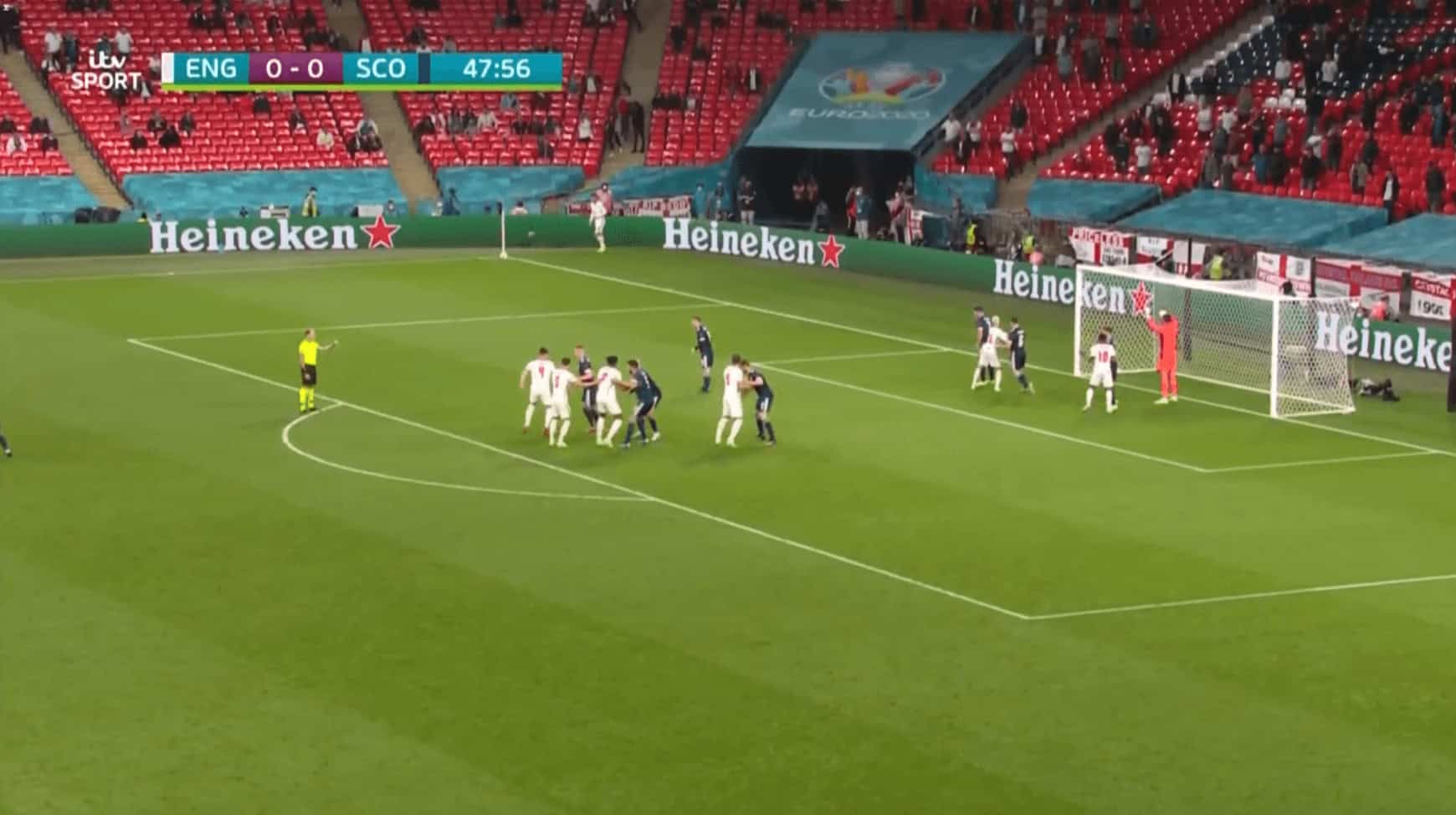
England won another corner just a couple of minutes later, and it was again a similar setup, with Foden at the near post, Sterling attempting to interfere with the goalkeeper, and Kane, Mings, Stones and Rice in similar positions to where they were for the previous corner.
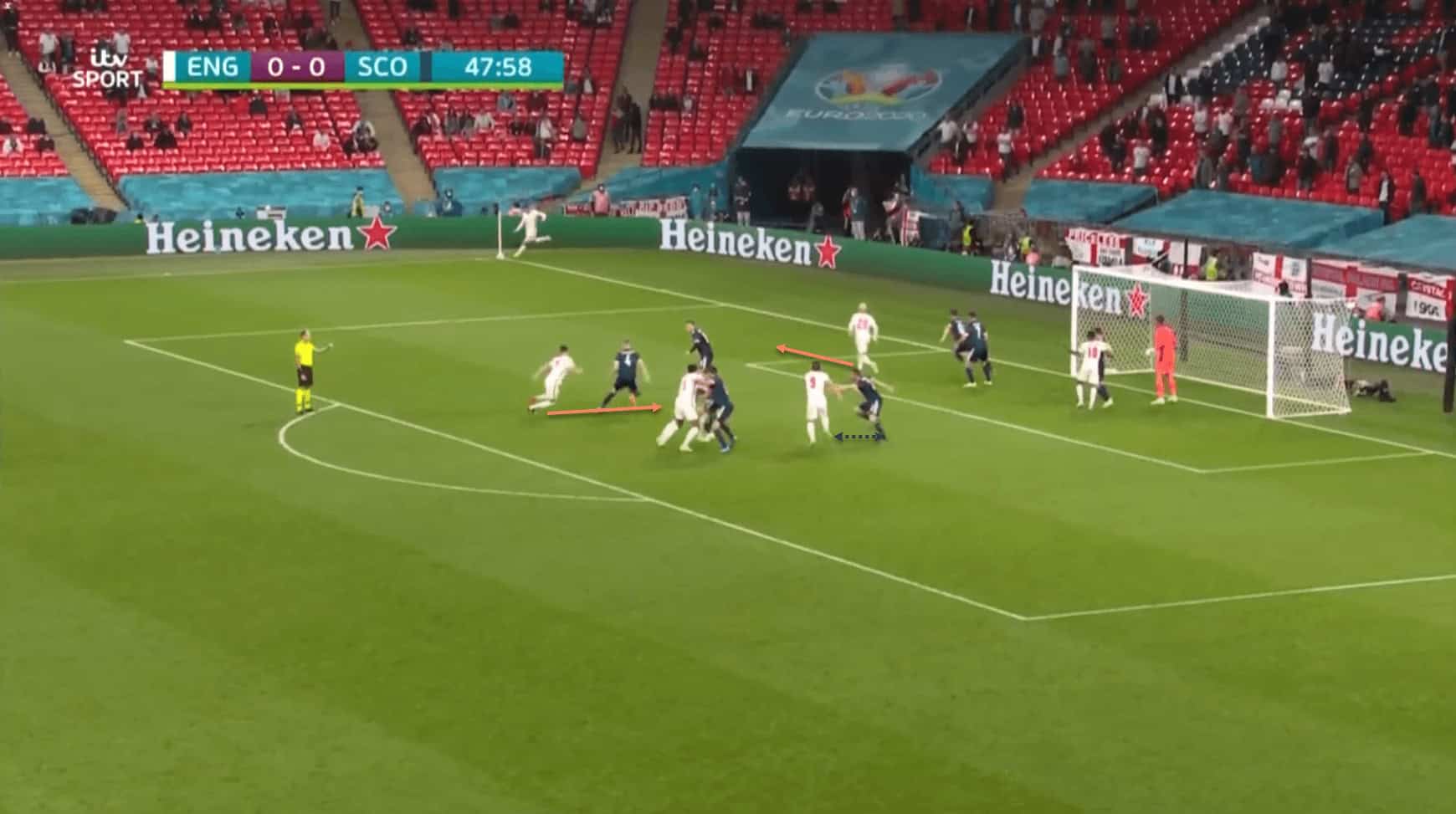
Once again, we see a similar situation play out. Foden runs towards the ball anticipating another near-post delivery, Rice attempts a run into the same space, and while Mings and Stones are being blocked off, Kane is again able to get separation from O’Donnell centrally.
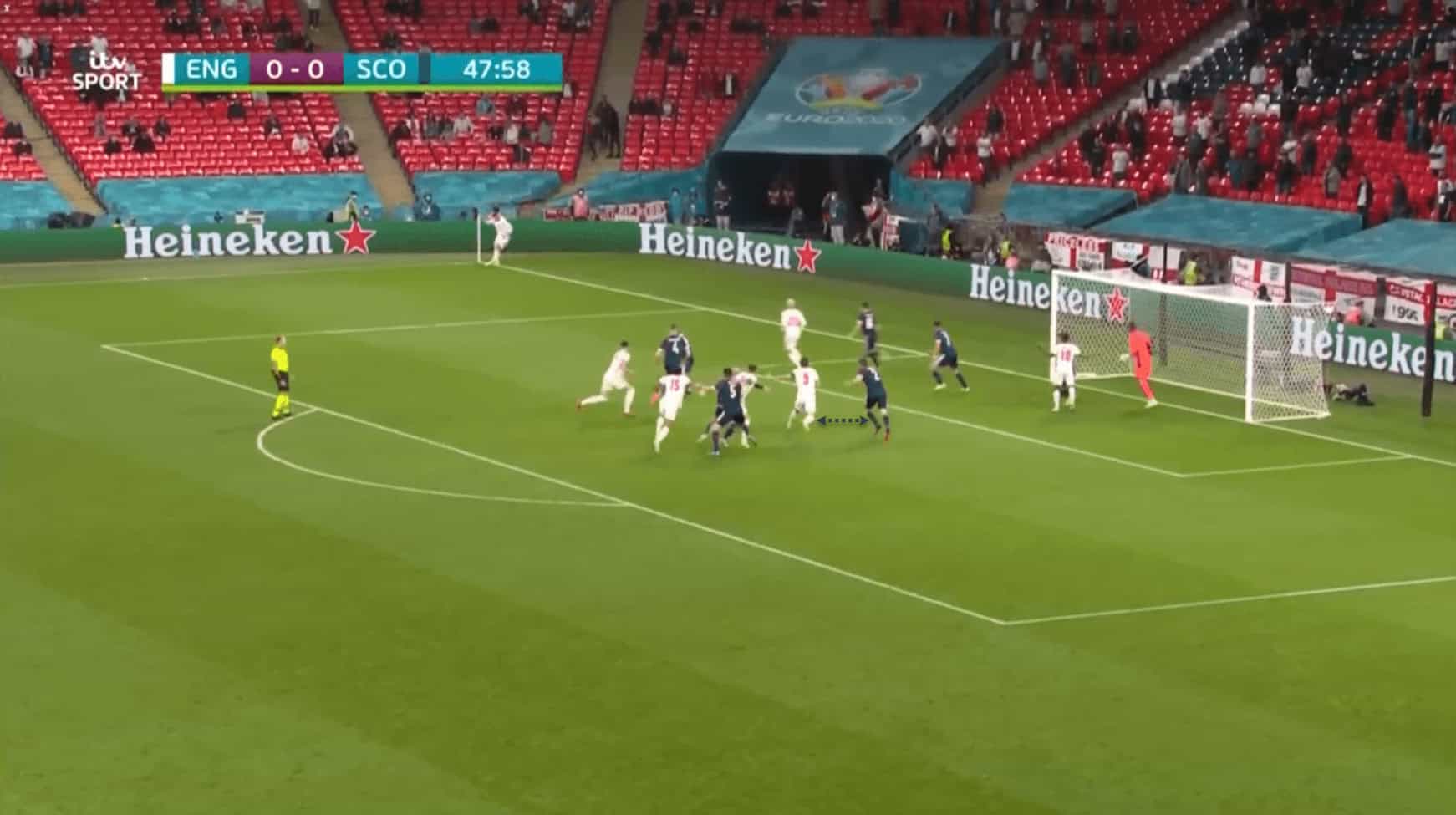
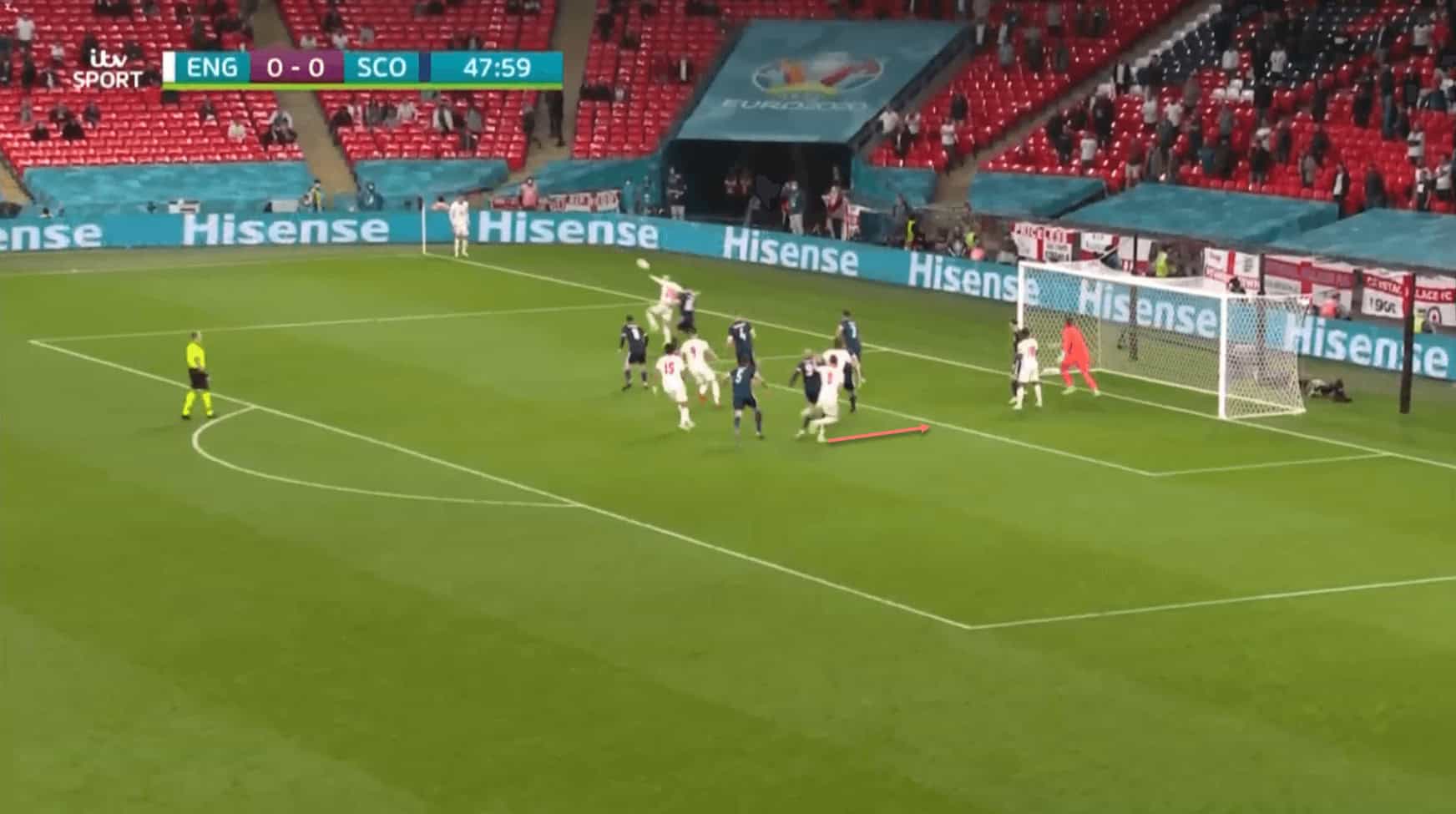
These two images show the outcome. While the corner is again delivered to the near post, with Foden winning the header this time but only sending it over the bar, it is interesting to note the positions of his teammates in the box. Stones manages to get a run on Dykes and is therefore in space, with Kane also beating O’Donnell – England therefore had two of their best headers potentially in space centrally around the six-yard area if the ball had managed to reach them, which shows how this approach was working well, and it just needed better delivery from the set-piece taker, or a more accurate flick-on from the man at the near post.
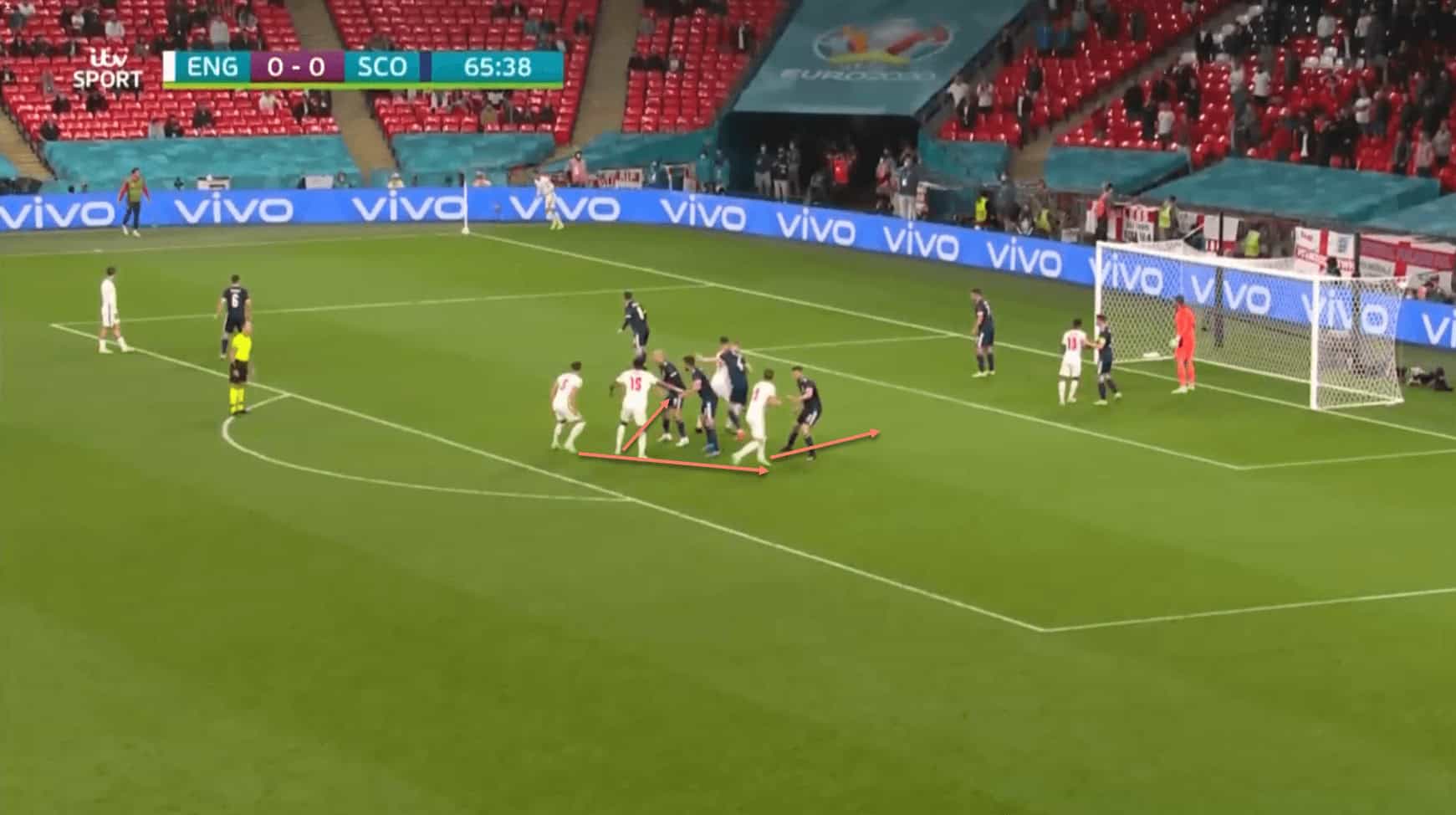
Later on in the same match – Foden had been taken off for Jack Grealish by this time, so there was nobody accompanying Sterling in the six-yard area at this point. Note the runs being made – Stones and Mings have switched here from the setup in the first corner, with Stones now going to the far post and Mings attacking the central area.
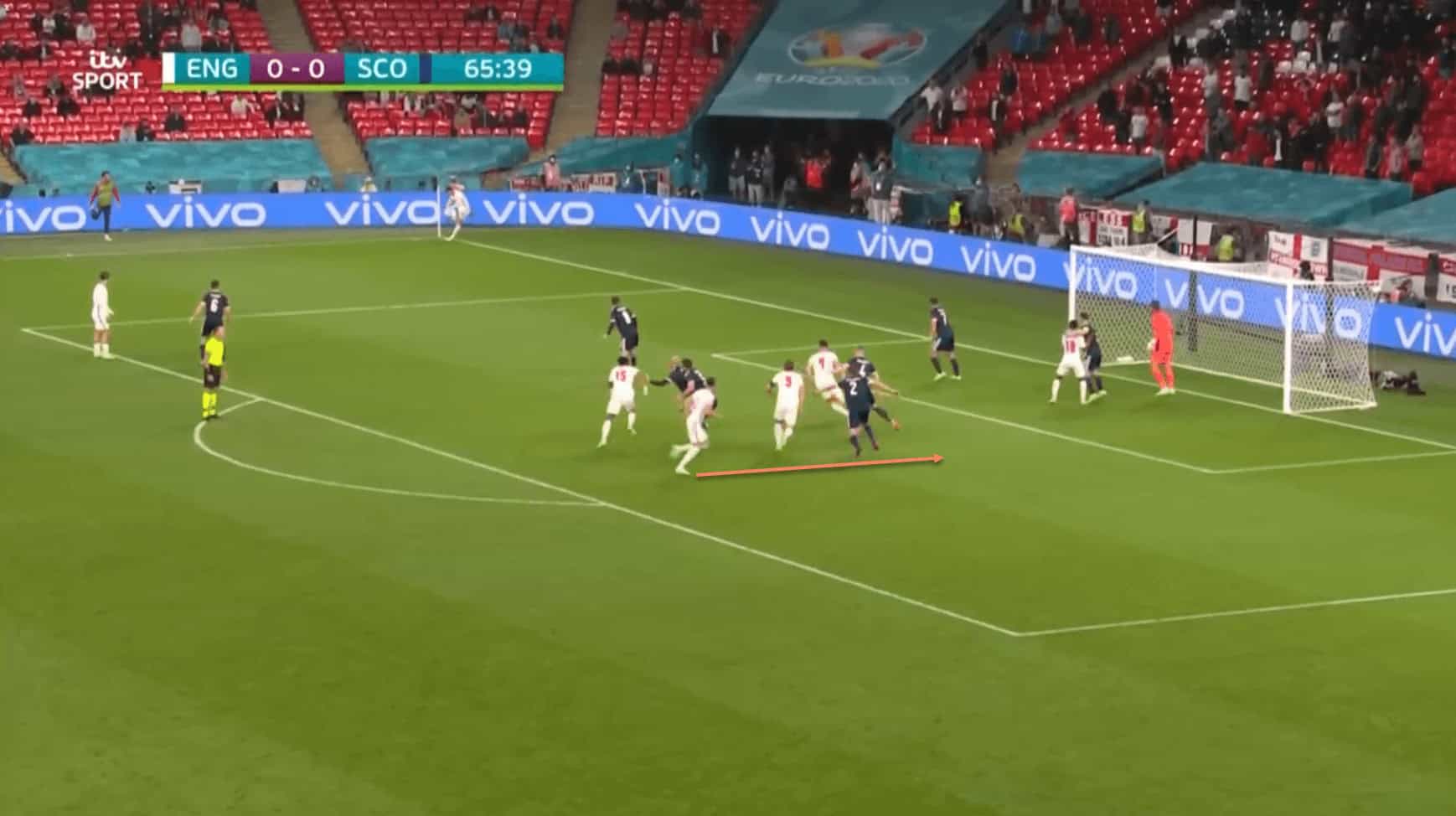
As the corner is taken, all three of Kane, Mings and Stones have managed to get some degree of separation from their markers, with Hanley in particular caught ball-watching and therefore allowing Stones a free run into the area.
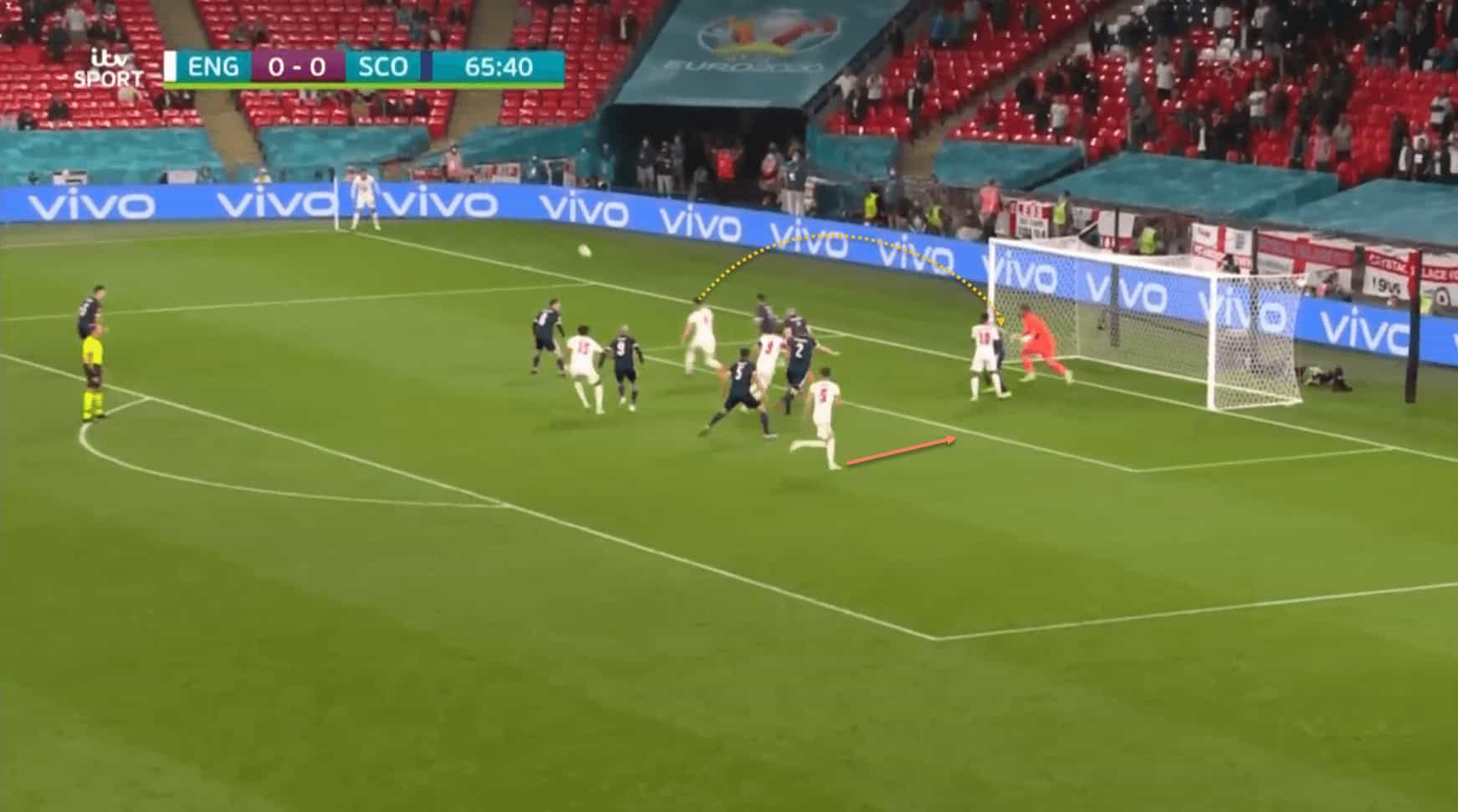
Rice has managed to pull away from McTominay, and is therefore in a good position to flick the ball on to the far post, where Stones would have had a tap-in. Unfortunately, Tierney manages to get a foot in here and clear the ball.
England’s setup from corners has been quite interesting, with the use of Mings and Stones as a two-man block allowing at least one of them to get a run on their marker, with the other player blocking off access. Kane has usually been positioned a few yards ahead, and he had the beating of O’Donnell positionally almost every time. While this may also be down to poor Scottish defending of these situations, we can see how England are operating with some set routines, and with Harry Maguire set to return to the XI soon, their aerial prowess will only be boosted as they progress at EURO 2020.
Conclusion
England’s set-piece expertise was a big reason for their run to the semi-finals of the 2018 World Cup, and while they have not yet had the same level of success, we can see a lot of good ideas in place. We believe that England just need to execute these situations better – this is where you can see the value of a good set-piece taker such as Trent Alexander-Arnold (injured and had to pull out of the squad) or James Ward-Prowse (not included in the squad). Our set-piece analysis has shown how England’s tactics from these situations have largely been pretty good, and you can probably expect a goal from such situations in the upcoming England matches.
