
In 2020/21, Inter Milan won the league, breaking Juventus‘ era of dominance in the Serie A. However, due to financial difficulties, key figures including Antonio Conte, Achraf Hakimi and Romelu Lukaku all left, leaving the club on what looked like a downward trajectory. In the following season, without their key players, Inter Milan still put up a great display where they were in the race for the title until the last day, finishing in 2nd place, losing out on the Scudetto to rivals AC Milan.
Fast forward to now, Inter currently sit in 5th place in the Serie A, 11 points behind league leaders Napoli who are yet to lose a league game. With 23 games to go, Lukaku returns from injury, where his influence was key to their previous title campaign. Inter will be playing catch up, but a £100 million asset could be the push Inter need to come-back to the top of the Serie A.
From a set-piece point of view, Inter currently sit top of the table in the top 5 leagues, in terms of shot-creating actions created from dead balls with 47 shots being created from free kicks, corners, and throw-ins. I Nerazzurri are the most creative team in Europe from set-pieces, due to the brilliance of their set-piece takers, Hakan Çalhanoğlu and Federico Dimarco, aerial quality among the likes of Lukaku, Dzeko, Acerbi, De Vrij, Skriniar, Bastoni, Martinez, Dumfries and the well-drilled set piece routines set up by Inter’s coaching staff.
Averaging around 3 shots per game from set pieces, Inter have been a threat all season from dead balls and will hope to become more efficient from these situations, to help them climb up the league.
In this tactical analysis, we will delve into the tactics Simone Inzaghi has used to make Inter Milan so dangerous from corners and free kicks. The set-piece analysis will show the different ways that Inter have been able to get their heads first to so many dead balls. Furthermore, the analysis will look into the movement and routines used, and why this may be the catalyst to leading them into a title charge.
Creation from Corners
Inter have two main ways of creating chances from corners. The first method is through a heavy focus on overloading the front post. The aim is to make some sort of contact at the front corner of the 6-yard box, to redirect the ball across the face of the goal from where the onrushing Inter players can react to a second ball quicker than the static defenders they are up against.
During this variation of corners, five players begin in the box. Four of these start around the goalkeeper, to prevent him from coming out to claim the cross. The other player will move towards the back post to cover that area of the goal in case a shot is misplaced and bound to go off target. Lautaro Martinez always makes the run towards the front of the 6-yard box while the other three float around the 6-yard box, to react to any flick-ons or rebounds.
As seen in the image below, Martinez starts inside the goal. This allows him to begin unmarked, and he can move towards the ball, from the blindside of the opposition defence. As the defenders can’t see him, he can arrive at the planned location, the front corner of the 6-yard box, without any competition for the ball. From corner to corner, the distance Martinez has from his marker depends on their reaction time after he makes the move.
If the defender tracks Martinez, he has less space available for him to aim for, which forces him to flick the ball across the goal to his teammates. However, if Martinez times the run to perfection, and doesn’t get tracked by a defender, he can open up his body and aim the header towards the near post which results in a goal, like in the example below.

This sort of corner is extremely difficult to consistently perform, due to the accuracy required by the corner taker to perfectly hit the ball over the first defender, and then for it to drop onto the area where Martinez makes his rehearsed run. However, due to Çalhanoğlu’s set piece quality, he can consistently hit the target area, which has allowed Inter to create many chances through this corner variation.
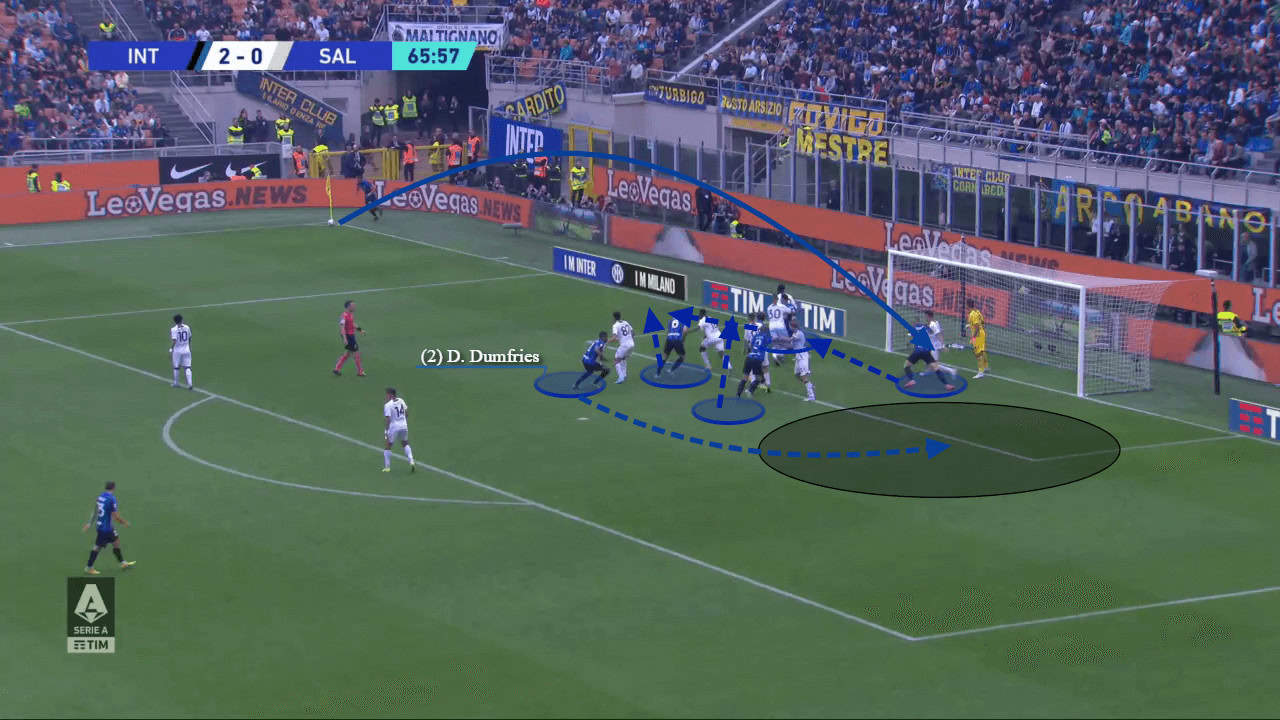
One variation of the near post overloads is to then target the area that is left open at the back post. Teams that prepare for Inter’s corners are aware of their preference to target the near post. In doing so, teams often leave the back of the 6-yard box unmarked, which Inter have used to their advantage. In this variation, the runs are almost identical, to lure the defending team into marking the front post, however, the player who usually hangs at the back post instead starts around the near post. This leaves the back post completely free, and all that is required is one body feint or quick movement to create separation from their marker and arrive at the back post unopposed.
The image below shows this routine in effect, although the goalkeeper manages to come out and claim it. Inter could adapt this to try to have someone marking the keeper, to prevent the cross from being intercepted early.
The other main method of creating chances through corners is through even spacing of players during out swinging corners, where individual quality is more relied upon, although Inter do have it in abundance. During these corners, players start clumping together. The starting position of the Inter players is similar to the love train but split into two groups, the ‘setters’ and the ‘finishers’. In each group, we can see three players all in close contact with each other, which makes it hard for man markers to stay tight to their man.
As the corner is about to be delivered, all the players make runs into the different locations highlighted below. The dispersal of players leaves each individual with a clear 1v1 situation, where the overwhelming strength of the Inter players’ aerial quality often leaves them in an advantageous position. Rather than trying to create and attack open spaces, Inter trust their players to win their individual battles, to dis-mark themselves and get onto the ball before the man marker.
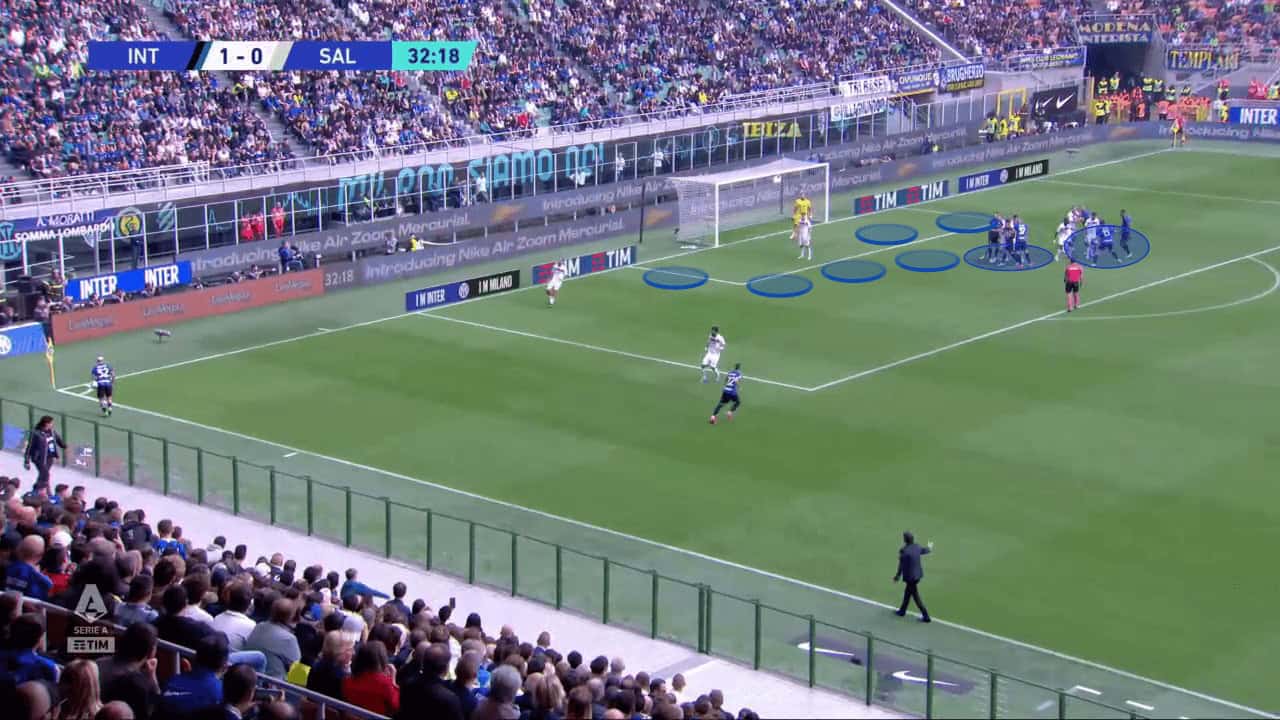
As mentioned before, there are two distinct groups during such corners. The ‘setters’ are tasked with running towards the front post and aiming to get in front of their markers to flick the ball across the goal. The ‘finishers’ start slightly deeper, and attack different areas around the back post where they gamble on the ball being flicked into their path for a simple finish into the goal from less than six yards out. These players are usually the ones with a nose for goal and must have the reaction times to be quick enough to react to a change in direction of the ball so that they can sort their feet and body position so that they can place the ball in the back of the net.
With three players all running towards the back half of the goal, they can cover almost any location the ball ends up in, and so they have the freedom to sprint at their specified area so that their marker can’t keep up with them.
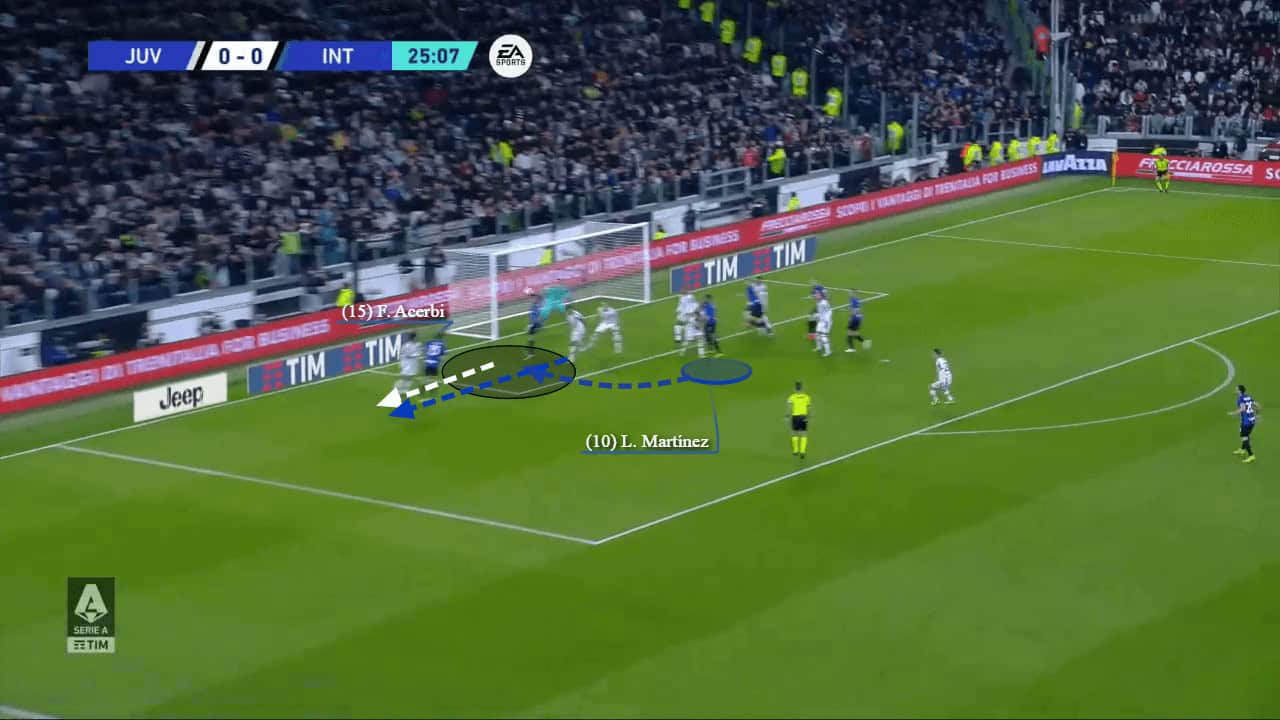
A slight variation to this method is to use decoy runs to open up a specific zone in the box. As we have specified earlier, Inter prefer to deliver the ball towards the near edge of the 6-yard box, from where they can flick the ball across the goal. When opposing teams guard this area zonally, Inter have shown creativity to free up the target space.
In the example below, Acerbi makes an early run through the target area and past it which lures the defenders into thinking the ball is about to be delivered. As the run is made, the zonal marker then naturally follows the spare man ahead of him, leaving his zone unmarked. This is all pre-planned, so Martinez knows to attack the free space, which Dimarco finds and plays a cross perfectly on the 6-yard box’s near corner. From this delivery, Martinez flicks the ball across the goal, but the forward players lack the reaction time to accurately redirect the ball into the back of the net.
As mentioned earlier, here we can see the clear distinction between the two groups of Inter players when setting up for out-swinging corners. The image below encapsulates the two groups both playing their part in the opening goal in the game against Sassuolo. The ‘setters’ are seen all attempting to get to the ball first, to flick it on towards the goal. While it may look like they are competing with each other for the same ball, the goal for them is clear, and they show the determination and belief in the coach to put their heads on the line for the loose ball.
We can also see the three ‘finishers’ who all make runs at the goal, but with spaces between them, so that they cover all possible paths the ball can take should the first ball be won by an Inter head. The image shows how the late runs from the Inter players are unmarked, as the defenders are caught on their heels, and the extra distance the Inter players have had allows them to gain the separation from defenders to be able to arrive unmarked inside the 6-yard box. Edin Dzeko ends up scoring following the flick-on in this specific situation, with a tap-in from 5 yards with a value of 0.64xG.

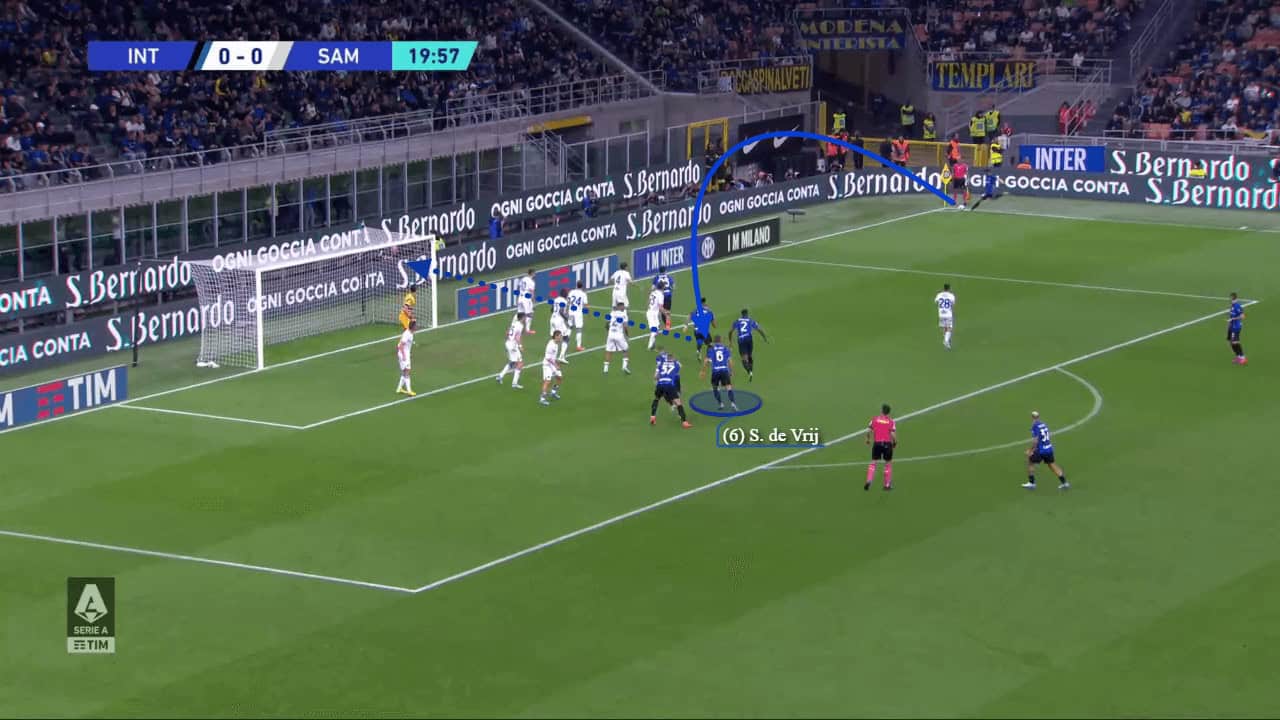
All of these variations have so far discussed how Inter deal with man-marking situations. When teams approach Inter with a zonal defence, their approach changes as well. A zonal defence means that the 6-yard box is more congested making it harder to attack it, but as a result, the area between the 6-yard box and 18-yard box is open. Usually, teams are happier to let a player have a headed effort from 12 yards than six, but for the powerful aerial battlers of Inter, it makes little difference.
In such situations, ‘setter’ players still attack the 6-yard box, to prevent the zonal markers from stepping up, while the ‘finishers’ hang around the penalty area rather than attacking the 6-yard box. The three players who hold their position then have lots of space around the penalty spot which means they can make headed efforts on goal with little interference from opposing defenders. In the image below, Stefan de Vrij perfectly shows why the distance doesn’t matter as he powers a header into the top corner from the penalty spot.
Çalhanoğlu and Dimarco have both been instrumental to the set-piece success, thanks to the precision in their deliveries. The map below displays all of Dimarco’s shot assists. While some of these are from open play, a majority are from dead-ball situations, where he has 4.05 xA from 13 starts all season, although poor finishing from teammates has resulted in him not yet having an assist.

Free-kick Methods
Inter have also shown ingenuity in deeper free-kick situations. In these situations, it is hard to power the ball at the near post as players have to start further away from the goal, and the keeper has more space to step up and claim any crosses. However, Inter have still displayed their aerial threat in such situations.
From wide crossing opportunities, Inter have utilised blindside runs to give their players the extra advantages in 1v1 situations to overcome their opponents. In these kinds of situations, Inter players all space themselves out evenly in order to attack the box. They all look to have the intent to get to the ball, although the plan is just to distract the opposing defenders, to allow someone else to attack the delivery.
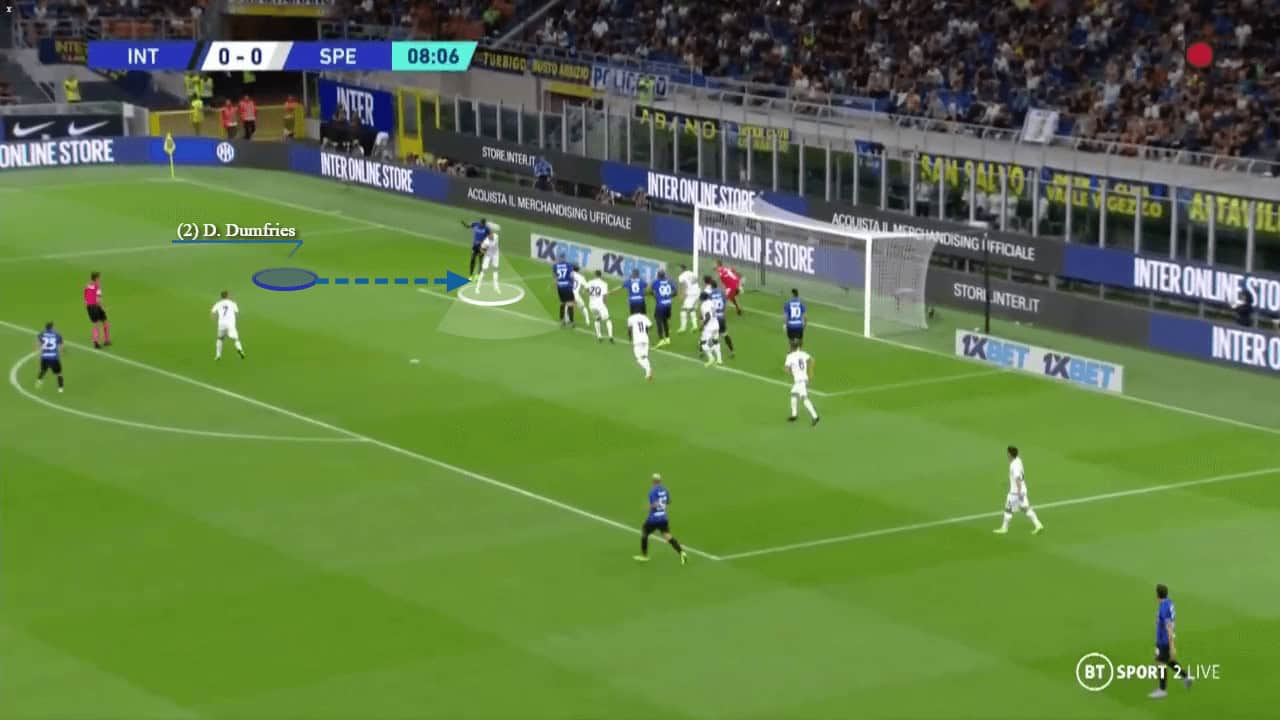
In the situation below, it’s Dumfries, but it can be anyone. He hangs behind the back of everyone, appearing to be positioned there in case everyone misses the ball and he can prevent it from going out of play. That is not the case. Instead, Dumfries makes a darting run into the box, off the back of the defender who has to focus on the ball. This results in the defender being completely unaware of any imminent danger, but Dumfries is actually competing for the header and has the run-up to allow him to jump higher and earlier than the opponent.
The image below shows this late run in action, and how the defender is being outjumped thanks to the run-up Dumfries has on him.
Another way in which Inter hand themselves advantages during free kicks is through the different starting positions of their players. Some players start in and around the defensive line, to occupy them and distract them from the real danger.
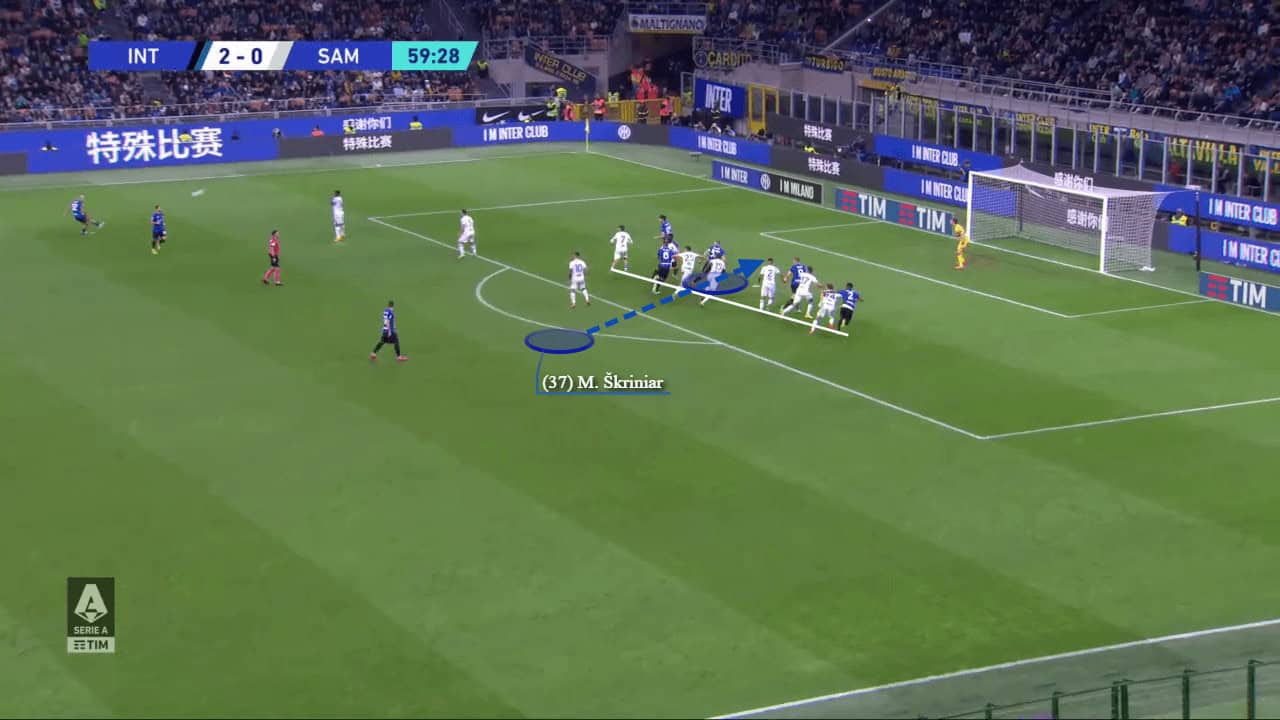
In these situations, the real danger is the player who is slightly deeper, but as a result, can have a run-up ahead of the free kick being taken. If the timing is right, a run from deep can allow a player to be in line with the defenders as the free kick is taken but will hand the attacking player, Skriniar in this case, the necessary momentum to get ahead of the defensive line once the kick is taken.
The image below shows us how Skrinirar is the furthest player forward just after the kick is taken, meaning he can compete for the header unopposed, as everyone is on the wrong side of him.
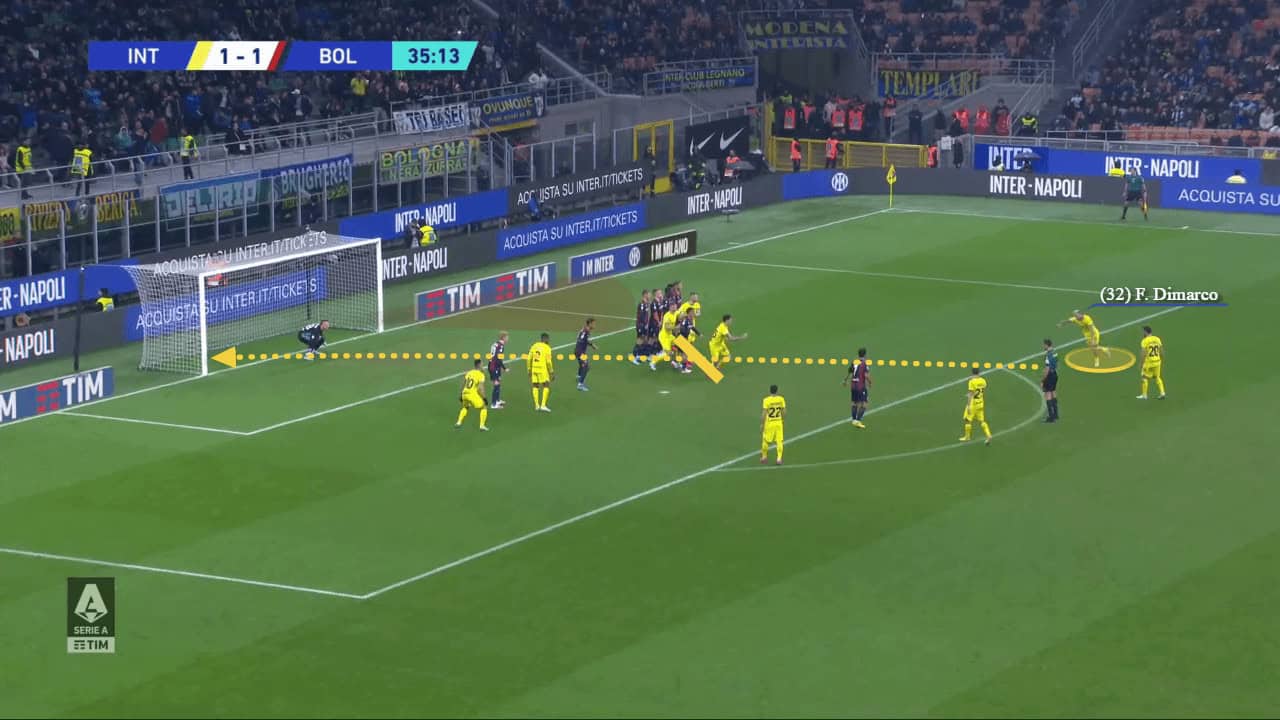
One final way in which Inter have set up to become more dangerous from set pieces is through something that’s become fairly common in this day and age. Inter set up their own wall beside the opposition during direct free-kicks. This approach has been proven to reduce the goalkeeper’s reaction time, which is vital during close-ranged free kicks.
In the example below, we can see Dimarco about to strike the ball, as the wall starts to separate. The timing is crucial, and if done right, can mean that the goalkeeper only sets his eyes on the ball when it’s 12 yards away, meaning he has virtually no chance of reacting in time. The reduction in reaction time, combined with the excellent ball striking of Dimarco makes it extremely difficult for any goalkeeper to have a chance of saving a free kick from such a short range.
Summary
This set piece analysis has displayed all the different facets Inter Milan possess, which have allowed them to statistically become the most creative team from dead ball scenarios.
Inter have a number of chance-creating methods for both corners and free kicks, which makes them unpredictable, and impossible to adequately prepare for. The return of Lukaku will strengthen Inter’s likelihood of scoring from set pieces, which they hope will continue to give them the goals needed to keep earning points to stand any chance of catching up with Napoli’s points total.
11 points is an attainable target, and as long as the open play performances remain consistent, the continuation with these set-pieces could be enough to propel them up the Serie A table.
