
Over the last 18 months or so, Marco Rose, at Borussia Mönchengladbach, has developed a clearly defined system, with distinct individual roles which require a high level of tactical understanding. Each player has to recognise his role in the team, and how that fits into his team’s tactics.
It may then be surprising to hear that, Jonas Hofmann has been trusted by Rose to be selected in a variety of positions, from defensive-midfielder, all the way to a centre-forward, as we saw in Gladbach’s most recent fixture versus Borussia Dortmund. In this analysis, we will explore how he utilised all over the pitch.
Standing at 5’9” / 175cm, Hofmann mixes a great gas tank with agile body movement to help his team in and out of possession. He reads the game incredibly well, he nips in with interceptions in both wide areas and central zones and once the ball is won back, he takes his time on the ball to reel opponents in, before finding a teammate in space with a clever pass. This scout report will analyse further where he excels and where is limited.
In this tactical analysis, we will cover his different roles in Rose’s system, where he stands out statistically, and in-game examples of how he provides great value to this Gladbach side.
Player profile
Hofmann was born in western Germany, in the town of Heidelberg in 1992, and was then scouted by Hoffenheim at the age of 12. After spending seven years with the club, rising through the ranks at their academy, he switched to Borussia Dortmund in 2011, where he would go on to make his professional debut under Jürgen Klopp in the 2012/13 season, after their back-to-back Bundesliga triumphs. Although it would never really work out at Dortmund, he earned a move to Gladbach in 2015/16, and he has been with the Foals ever since.
In Rose’s 4-2-3-1 system, Hofmann has formed one half of a double pivot, left-midfield, left-wing, right-wing, and as a centre-forward. Predominantly, (just about) he has been used as a winger on either side of the pitch, though he is not your typical wily wide operator who looks to receive the ball and take it past his opponent. Hofmann prefers to make runs beyond the opposition’s defensive line, either down the half-space, or an angled run from a wide zone into a more central area. This is not to say he is an incompetent dribbler though; he certainly is not.
Depending on his position within a match, Hofmann can either be the football equivalent of a ‘quarterback’, occupying the ball in deeper areas and hitting vertical passes towards wide men in space, or he might be the wide man in space himself, being found by a fellow teammate. Regardless of which position he plays in; his mindset is to attack the opposition as quickly and directly as possible. He possesses decent pace and remarkably steady balance, allowing to turn on the dime in swift fashion, which is useful in more crowded central areas.

Hofmann’s player profile, created by the wonderful Sathish Prasad (@SathishPrasadVT on Twitter).
Hofmann’s many roles in Rose’s system
Under Rose, Gladbach mainly use a 4-2-3-1 formation, but they have experimented with a 3-4-3, 3-5-2, and 4-4-2 in a few matches. Therefore, let it be understood that when we speak about Rose’s tactics in this piece, we will be referring to a 4-2-3-1 system. In this system, they revert to a 4-4-2 out of possession, where the attacking midfielder and the striker will work in tandem as the first line of press.
In possession, they will move into a 2-4-3-1 formation, where the full-backs form part of the midfield, in Rose’s narrow tactical setup. Hofmann’s nips in defensively and fits in well to Gladbach’s man-marking pressing system. They press from the front, but only when the opportunity arises, i.e., a pressing trigger. Hofmann is clever at identifying these moments, whether that be the centre-back passing sideways or backwards, or otherwise.

In a double pivot, Hofmann will offset the positioning of his midfield partner; he will stay back when required, shuttling across to protect the back four, or he will roam up the channels and act as a facilitator in the build-up. Whether that be positioning himself in areas of space or making runs to drag opponent defenders out of space. We saw this executed perfectly against RB Leipzig, as he worked brilliantly in tandem with Florian Neuhaus.
When Hofmann operated as a centre-forward against Dortmund, he worked tirelessly to lead the press, cut off passing lanes, and hassle any opponents deemed uncomfortable on the ball, especially in initial counterattacking scenarios. For Gladbach’s first disallowed goal versus Dortmund, the Foals had just lost possession in the final third, and before three passes were combined together, Hofmann was ready to win the ball back.

After Gladbach lost the ball, the ball is played into Brandt’s feet, who passes it sideways to Bellingham, and Hofmann distinguishes the weight and trajectory of the pass to intercept/pile on the pressure.
In his role as a winger, he will form part of the second line of the press, often looking to cut off passing triangles that opposition may look to utilise as a form of ball progression. He will move across the pitch with his team, which is important considering how narrow Rose likes his side to play, but he will typically be the widest player in the press in these moments. Once he wins the ball back, Hofmann’s immediate intention is to play the forward pass.
Hofmann’s passing & creativity
Easily Hofmann’s greatest asset is his passing. His short/medium passing is adept, he can both slow down the tempo when necessary and play the direct, vertical pass required to speed up the tempo and expose a team on the counterattack, or against a team who deploy a high press. He attempts more long-range passes than the average winger, but nor he is awfully reliant on them.
His success rate on these efforts is not the highest, sitting at 52.2% this season, but these are often ambitious, and when successful, usually quite dangerous. His passing talent meshes well with the pace and movement of his teammates, such as Pléa or Thuram. These two particularly benefit from Hofmann’s vertical efforts, which usually find them in space around the penalty area, where they can combine and deal real damage.

Scatter plot of Bundesliga wingers’ passes to final third per 90 compared with xA per 90.
In the final third, his movement often allows him to go unnoticed inside gaps within the opposition’s defensive structure. This means that Hofmann’s will occupy dangerous spaces inside the penalty area, where he will call for the ball to be played to feet, before laying it off to a teammate who is better placed to finish the opportunity. We saw a brilliant example of this against Frankfurt last season, where he assisted Pléa.

Here, Hofmann drives down the core of the Frankfurt defence and receives the ball in the penalty area.
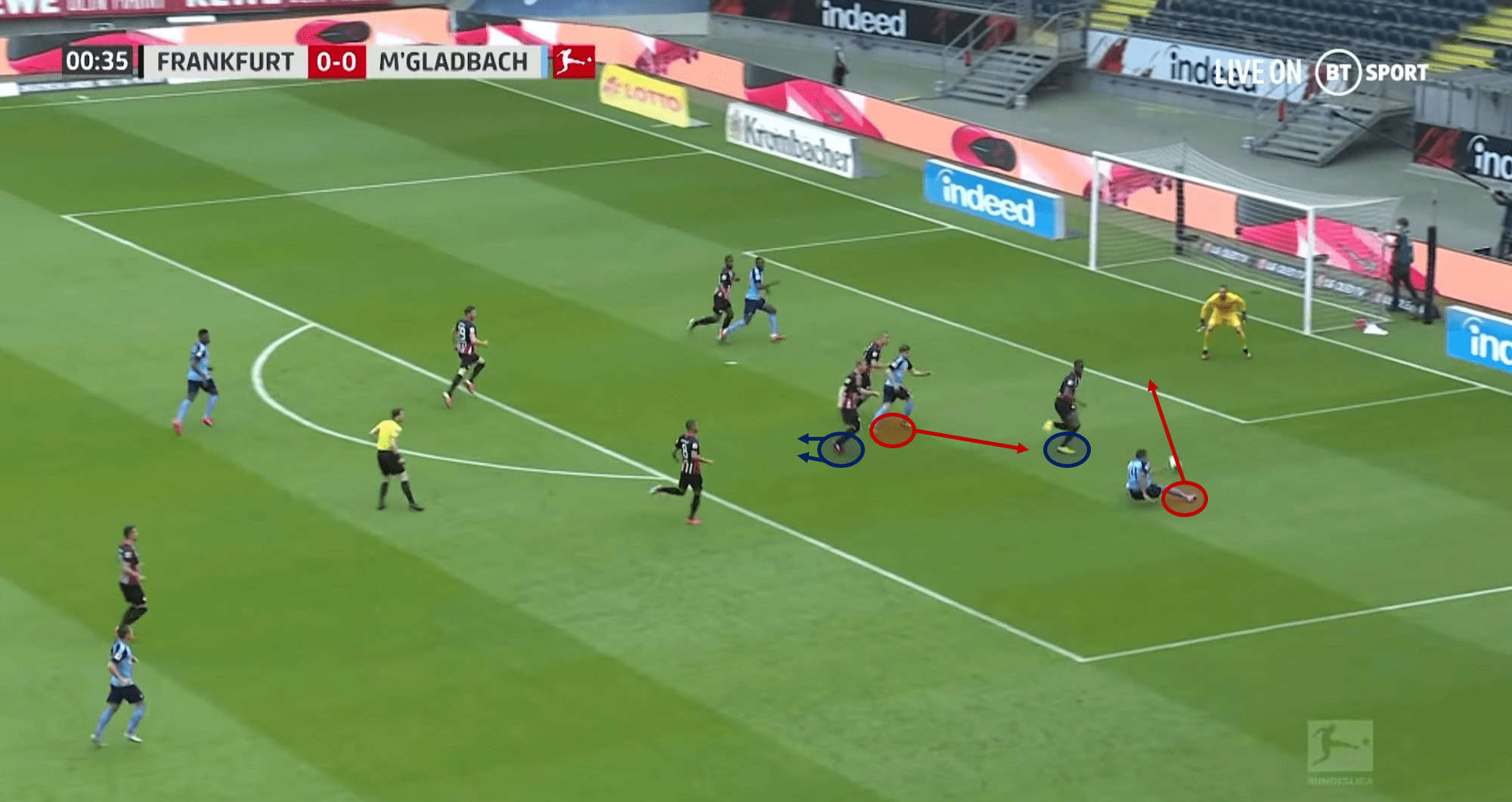
Unbeknownst to Martin Hinteregger, Pléa slips behind him and latches onto Hofmann’s through ball and slots it into the bottom left corner.
Hofmann has exceptional vision. It is one of his most important assets, which is supplemented by his passing technique, which is generally excellent. His passing accuracy this season sits at 78.7%, which is good for a winger, though this has risen to 84.2% playing as a defensive midfielder against Leipzig, it has also dropped to 65.2% against Wolfsburg, where he played as a right-winger.
His success rate varies from position to position, and what type of opposition he comes up against. For example, in that game against Wolfsburg, he was marshalled brilliantly by Jérôme Roussillon in tandem with Maximilian Arnold, giving him little space to manoeuvre and execute the type of passes he would have liked to have achieved in that game.

Hofmann’s passing & progression radar in the 2020/21 Bundesliga season so far.
From this radar, a few things we can notice through the eye test are reinforced through his statistics. Hofmann is an active participant in possession compared to other wingers in the division, who when on the ball, looks to play forward-thinking progressive passes with purpose. Due to the ambitious nature of these attempts, his success rate suffers, but when they land, typically quite dangerous, as we mentioned before.
Hofmann’s ball carrying & finishing
Hofmann can be described as a player with good shooting technique and solid ball carrying fundamentals. When in range and space, Hofmann is a player who is unafraid to pull back the lever and shoot at the goal. He does not always generate the most power on his efforts, rather focusing on precision, as he aims for either bottom corners of the net, to a decent degree of success.
In terms of his dribbling ability, he was introduced into the Bundesliga predicated on his strong ability to carry the ball at his feet. Over time, as Hofmann has gained more experience, and unfortunately picked up more than a handful of injuries, and his once-great speed is not what it once was. This has ultimately forced him into adapting his game, which has done so excellently over the last few years, into less of a direct operator.

Scatter plot of Bundesliga wingers’ dribbles per 90 compared with xG per 90.
Hofmann’s shot volume does not sit within a high bracket – he attempts just 1.3 per game – but an xG of 0.27 per 90 ranks highly amongst other Bundesliga wingers, which is impressive given the various other roles that the German plays in this Gladbach squad. His shot locations are typically on an angle, most often from the right side, striking across the body, although he is not opposed to shooting with his left.
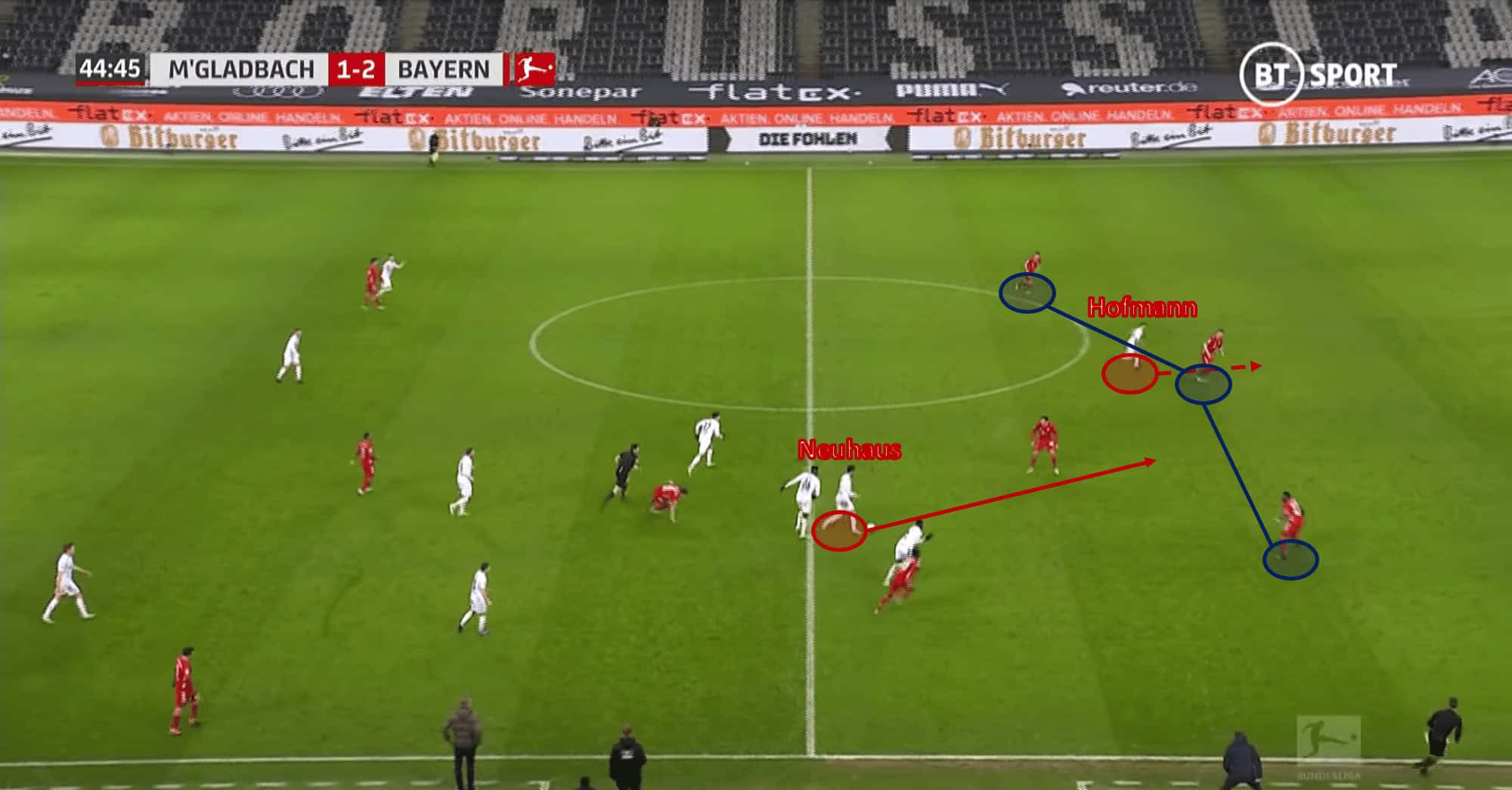
And he’s off – Neuhaus wins the ball back in midfield and Hofmann sprints behind Bayern’s high line.
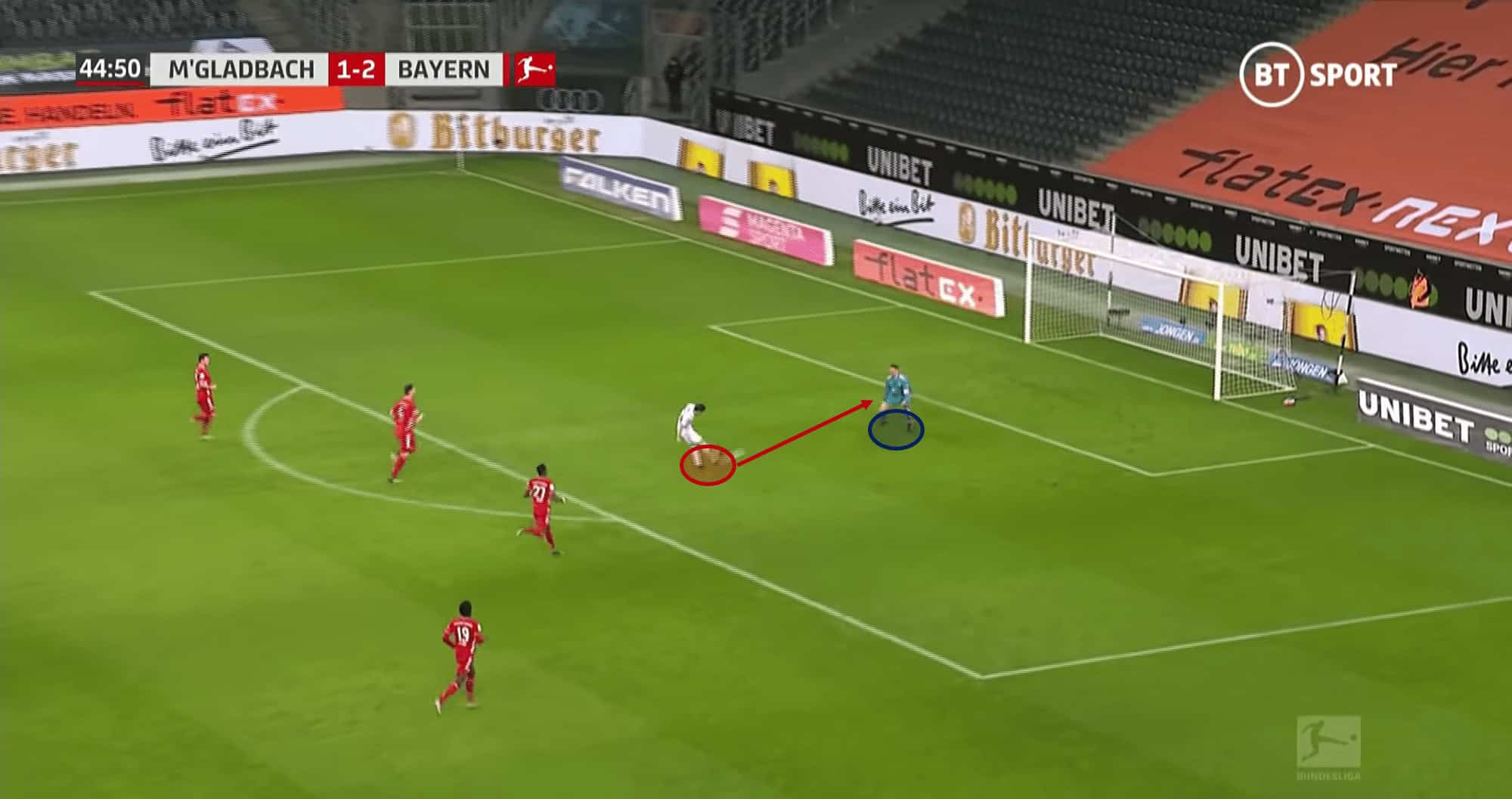
In yards of space, Hofmann slows down his movement, opens up his frame, and strikes across the body into the bottom left corner.
Now, when it comes to Hofmann’s dribbling ability, the German has fantastic balance and mobility to take the ball past his man initially, but a problem arises after the fact. He simply does not have the pace against most top-level defenders to burn past them down the wings, and he has adjusted his game as to dribble and be direct far, far less often. However, in tight areas, he can occasionally produce a couple of smart touches to evade pressure.
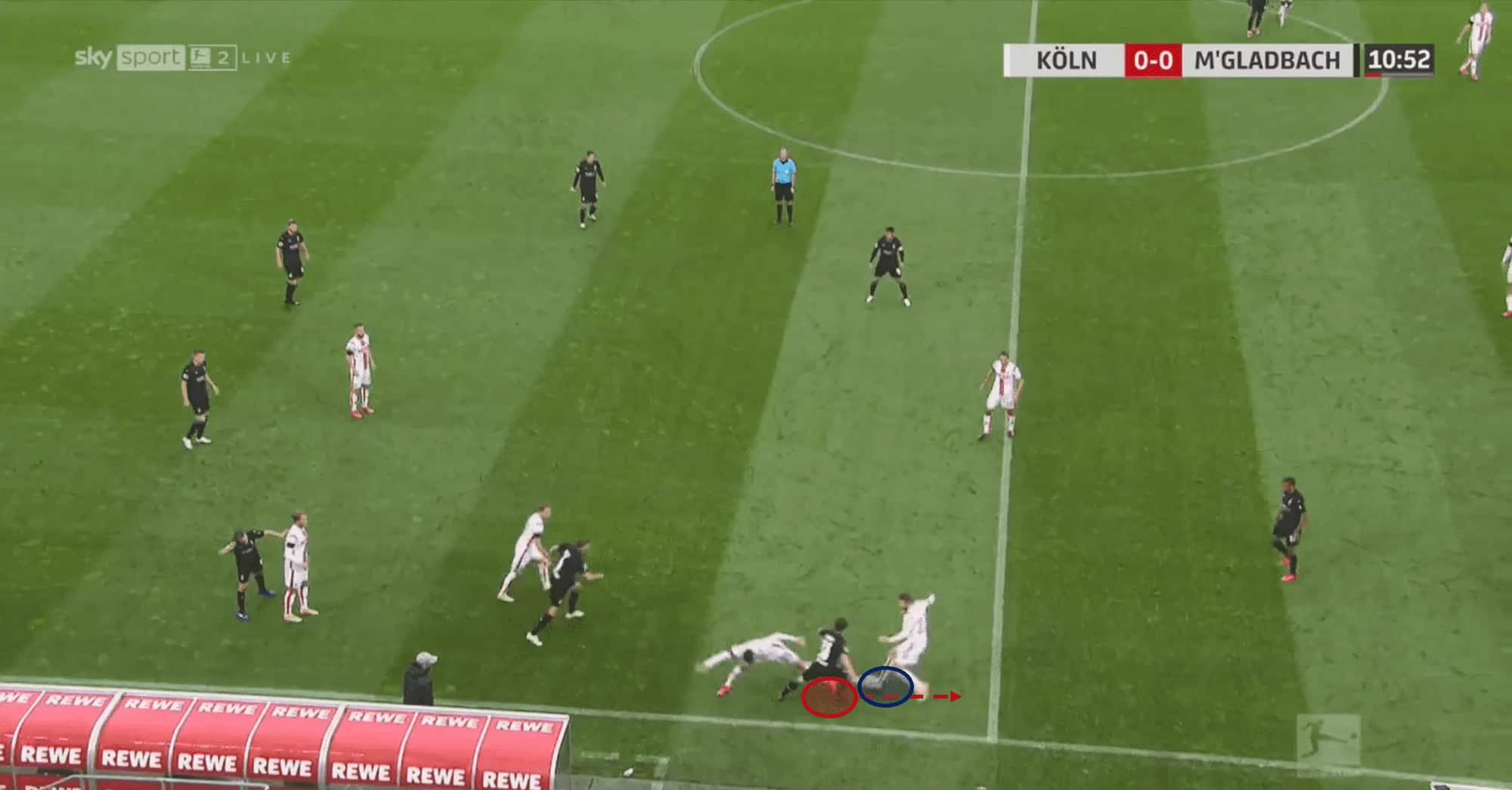
In a tight space, being pressured on both sides, Hofmann simply knocks the ball through the opponent’s legs and carries the ball up the pitch from there.
Sometimes, an awkward first touch can place in him uneasy situations where he will lose the ball as soon as he retains it. On these occasions, he will rush his actions on the ball, and either run into a cul-de-sac, where play naturally breaks down, or he will run beyond the ball and lose it that way. Safe to say his dribbling is not his best asset anymore, but it is certainly functional.

Hofmann’s attacking & creativity radar in the 2020/21 Bundesliga season so far.
Again, the data support our statements of Hofmann as a player. He is a smart, creative player (somewhat assisted by set-pieces) who does not have a high shooting output, but he takes shots from good locations, making his xG/Shot quite high. His dribbles numbers are low, but given his low attempts, his low success rate is not too much of a worry for his side, though this is certainly a weakness in his game overall.
Hofmann’s defensive diligence
In the modern game, you cannot be a passenger out of possession, and Hofmann does not fit in that category at all. Rose’s trust in Hofmann as a player is predicated by his diligence on the defensive side of the game. The German understands what is required from Rose’s pressing system; when to lax off and recuperate energy and when to cut off passing triangles or harry the opposition ball carrier.

Scatter plot Bundesliga wingers’ defensive duels per 90 compared with defensive duels won %.
Hofmann is 2nd in the Gladbach squad for pressures with 236 across the season so far, only behind Lars Stindl, who frequently leads the press alongside the centre-forward up top. Hofmann is only successful with 22.9% of his pressures, but this is not to say he is an ineffective presser, while he applies pressure on one side of the opponent, another teammate will often nip in and recover the ball for his side.
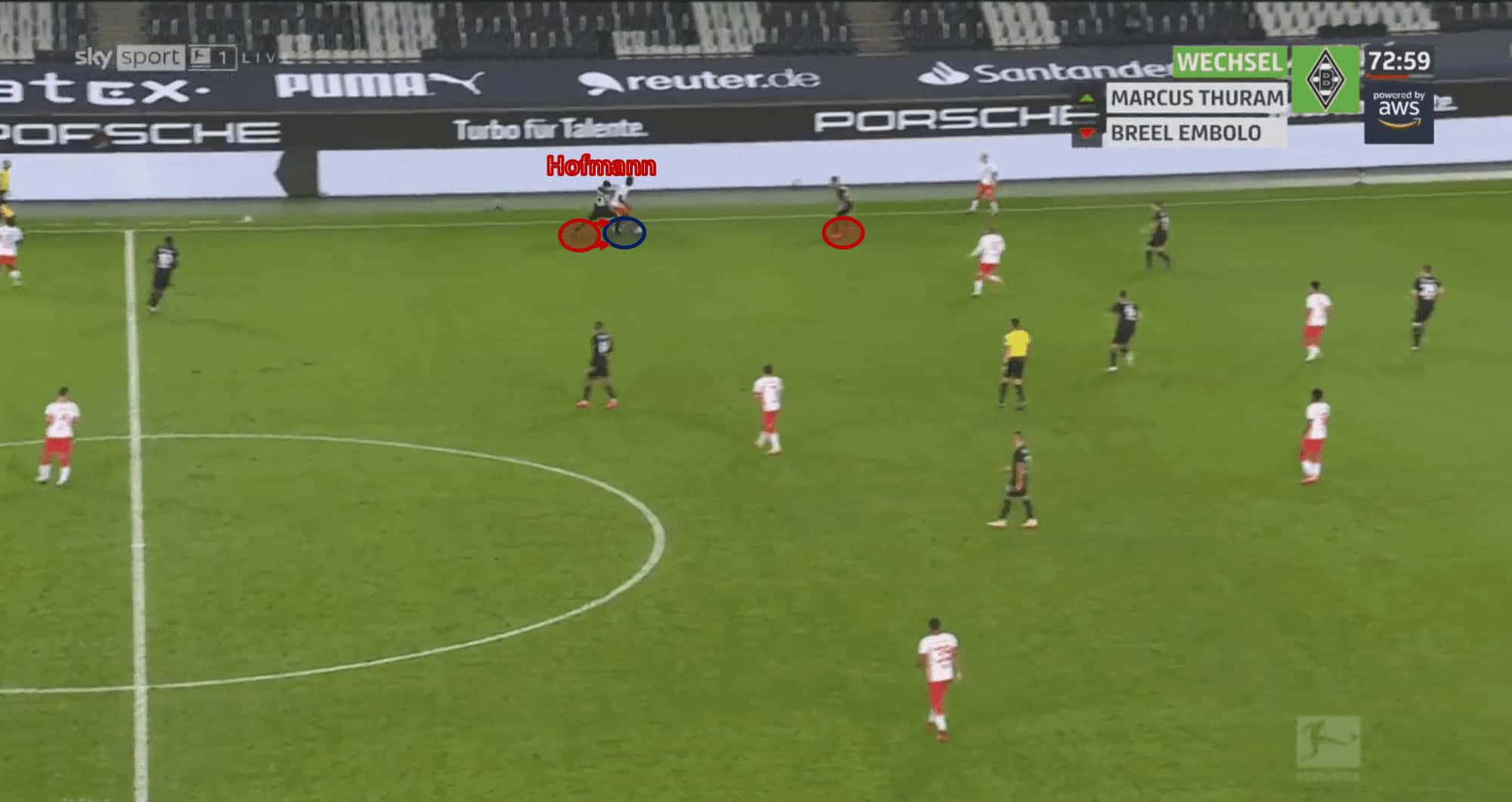
In a wide zone, Hofmann applies pressure to the ball carrier, which can result in two positive scenarios; he applies pressure, and his teammates recover the ball, or he tackles the ball himself.
In wide areas, Hofmann will typically apply pressure to any traffic that comes down the wide channels, be that through a ball carrier or an attempted progressive pass. As a centre-forward, Hofmann will assist Stindl, who leads the press, in cutting off passing lanes, while Stindl will hassle the ball carrier himself. This is an effective method of recovering the ball for their side, but the majority of their defensive actions occur in the midfield.
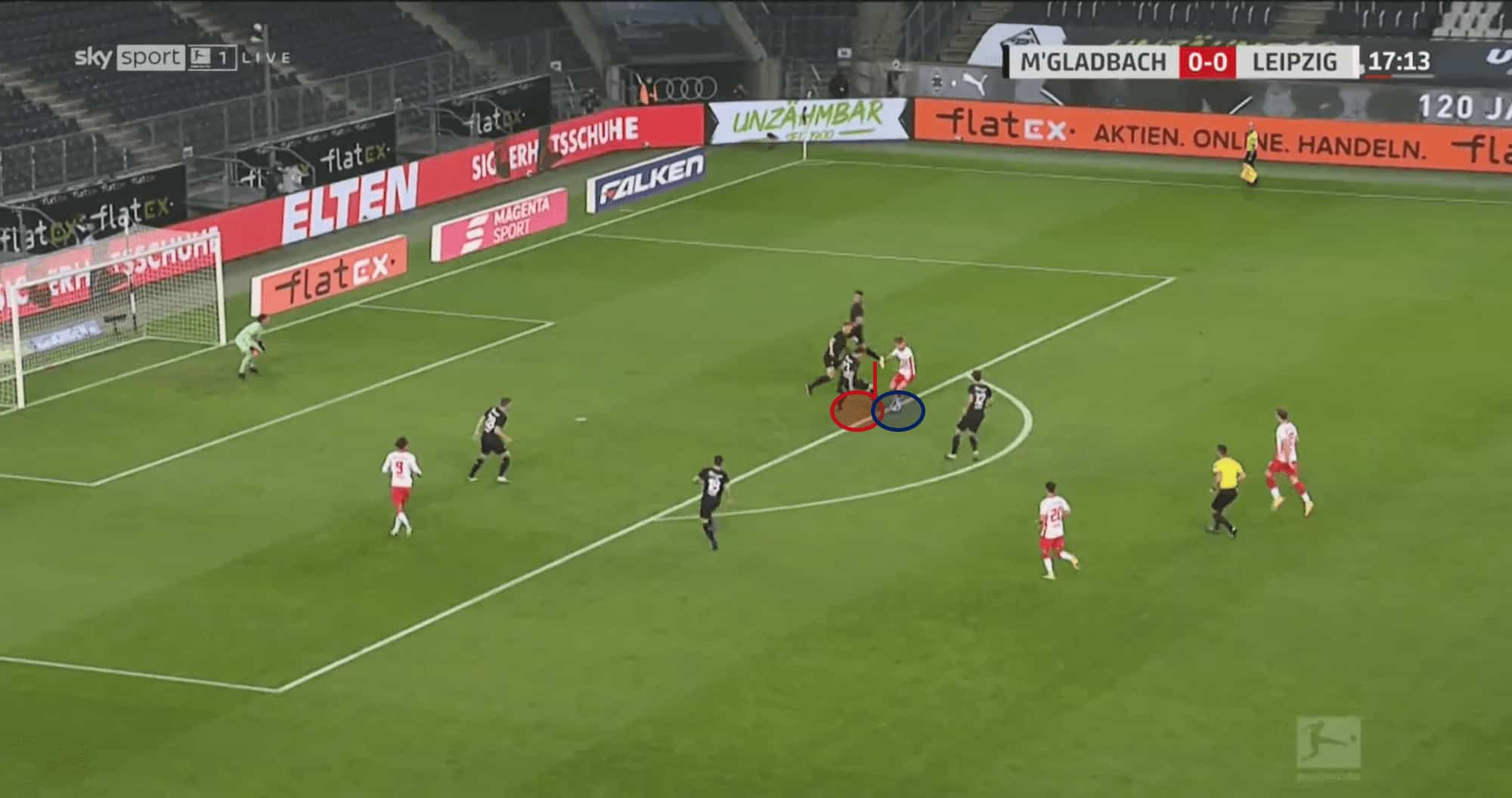
On the edge of the penalty area, Hofmann dispossesses the opposition with a clean tackle, setting his team on the counterattack.
As a defensive midfielder against Leipzig, Hofmann was a proactive defender, who looks to get in the opponent’s vicinity to win the ball back, often forcing his opponent out wide. Gladbach prefer to force their opponent’s into wide zones, considering how narrow they operate, meaning they can protect valuable zones inside the penalty area with several bodies.

Hofmann’s defensive actions radar in the 2020/21 Bundesliga season so far.
From all this, we can understand that Hofmann applies himself out of possession, and the statistics back this up once again. He contends for a high proportion of defensive duels, although his success rate is admittedly low, even for a winger. His tactical understanding supplements his reading of the game, and his PAdj interceptions are high as a result.
Forecast for the future
Hofmann, aged 28, should stay with Gladbach for the foreseeable future. Rose trusts the German implicitly, and he clearly rates his application, but there is an air of suspicion that he needs to manage his game time considering his injury history. He is becoming evergreen at the Foals, the fans love him (especially after that MOTM display against Bayern Munich), his manager loves him, and I bet he loves playing for the club at the moment. Rightly so, he’s earned it.
