With just under a year remaining on his Châteauroux contract, 23-year-old centre-forward Andrew Jung (192cm/6’3”, 82kg/180lbs) is currently one of the most highly sought-after players in France’s second tier, Ligue 2. Jung is coming off the back of a successful 2020/21 campaign which he spent out on loan at US Quevilly-Rouen Métropole (QRM) in France’s third tier, Championnat National. He helped the impressive Bruno Irles-led side to a second-place finish and promotion from Championnat National to Ligue 2 for the 2021/22 campaign, ending the season with 21 goals, making him the top scorer in Championnat National. Meanwhile, his parent club Châteauroux suffered relegation from Ligue 2 to the third tier for next season, finishing dead last with just 23 points.
Now back at Châteauroux, it’s been reported that Jung favours a permanent move away from his parent club, intending to ply his trade at a higher level in Ligue 2. This has allegedly piqued the interest of several second-tier sides, including his home last season QRM, as well as Nancy, Auxerre, and Toulouse – all of whom will be hoping to compete for promotion to Ligue 1 next term.
So, with no shortage of interest from Ligue 2 clubs in the in-form striker and less than a year remaining on his Châteauroux contract, perhaps a move away from Stade Gaston Petit to a second-tier side is inevitable this summer. In our tactical analysis piece, in the form of a scout report, we’ll provide tactical analysis of some key strengths and weaknesses to Jung’s game. We’ll analyse his successful role within Irles’ QRM tactics last season and we’ll share our view on how his potential new club should utilise him to get the best out of him next season.
Clinical finishing, attacking positioning and movement
As mentioned in our intro, Jung scored 21 goals for QRM in Championnat National last season. He managed to score this many goals from an xG of just 13.9, which essentially tells us that he successfully finished more chances than he would have been expected to based on the quality of shooting opportunities presented to him.
Jung took a relatively high number of shots per 90 for a Championnat National striker last season (2.24). This proved to be a very good strategy on behalf of QRM because of how clinical Jung was in front of goal. Firstly, the 23-year-old was very accurate in front of goal last season, with 53.85% of his shots hitting the target. This impressive level of accuracy and directional control over his shots naturally played a big part in him converting so many of his chances and played a big part in him getting so many chances, with his team undoubtedly becoming more and more confident with presenting chances to Jung, knowing he is reliable in goalscoring situations.
Thanks in part to his accuracy, as well as the quality of his shots in terms of power and placement, Jung generated the best goal conversion rate (32.308%) of any striker to have been on the pitch for 800 minutes or more in France’s third tier last season. This shows us that despite taking a lot of shots, Jung continued to convert his chances at a very high rate. This, along with his xG overperformance highlights that last season, Jung was a very clinical finisher.
Intelligent positioning and movement played an important part in Jung enjoying the chances that he did, and as a result, being so clinical and scoring so many goals last term. So, what was Jung’s role at QRM? And how did he move and position himself to regularly create the best possible chances for himself?

Figure 1 shows our first example of Jung in action for QRM last season. Here, we see the striker sitting in the right centre-forward position in the 4-4-2 system which Irles’ side primarily lined up in last term. We also see a teammate on the right-wing in possession just inside the opposition half, with Jung dropping in between the lines to make himself an option to receive the ball to feet. At times last season, Jung did receive a short pass in this type of position. On these occasions, he likes to receive the ball at pace, as he’s good at controlling the ball with his first touch and he also often likes to play little flick-on passes which pacey passes allow him to do.
Jung was constantly moving for QRM last season – he was really only ever static up front when dangerously occupying a threatening open space. A lot of the time, his movements were quite subtle. However, he was constantly scanning his surroundings and making at least slight adjustments to his positioning, if not more dramatic movements into different areas of the pitch. We see an example of the latter in figure 1. He was constantly looking for ways to marginally improve his positioning to make himself a better passing option and to put himself in a better position should he receive a pass. As we’ll go on to see in figure 2 in just a moment, Jung demonstrated his restlessness in this passage of play by quickly redirecting his movement.
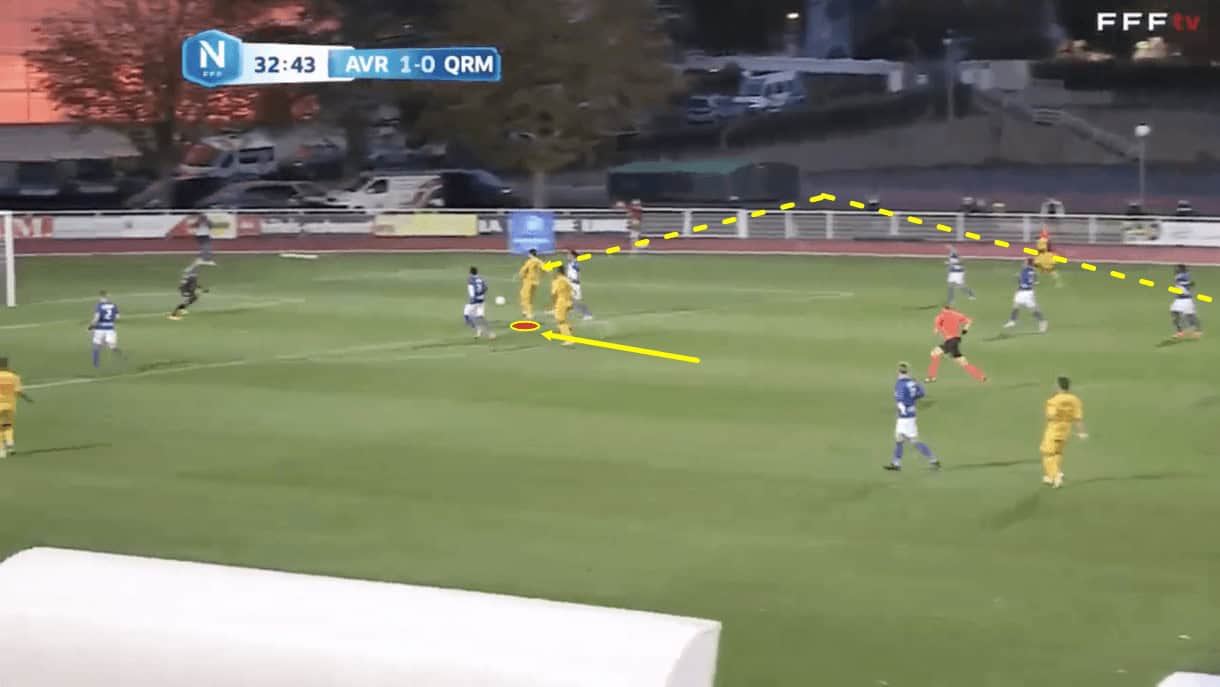
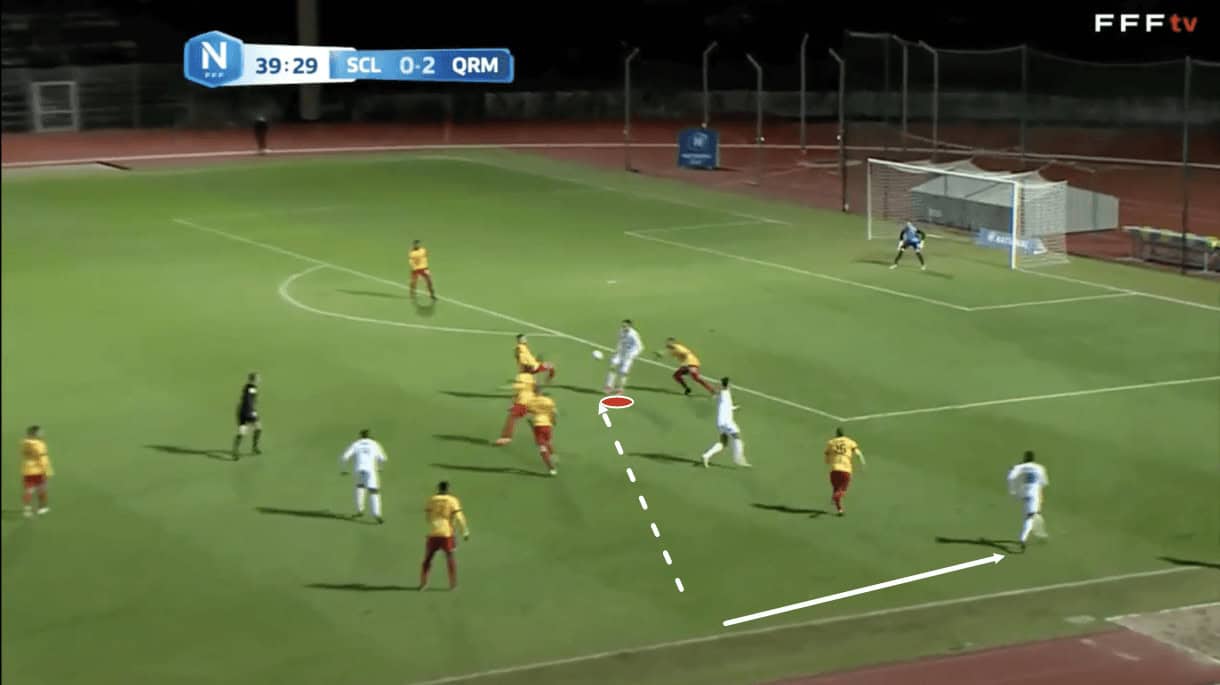
As his teammate on the right wing took another touch to bring the ball forward and as the near opposition centre-back took a step out to close the space behind Jung in case he did receive the ball to feet, the striker quickly changed direction and darted in behind the opposition backline. We see the result of this in figure 2, where Jung successfully ended up on the ball inside the opposition box, on the end of a lofted through pass from a teammate.
While Jung dropped deep for a moment just before figure 2, as we saw in figure 1, he quickly changed direction to run in behind as soon as the defender made a move out from the backline and didn’t receive the ball to feet. Jung did, at times, drop deep to receive passes and help his team progress upfield but in general, he wasn’t very active in chance creation. He completed just 2.34 successful attacking actions per 90 last season, which is low for a Championnat National striker, while he also completed just 14.71 passes per 90, again, low for a Championnat National striker. This highlights how he wasn’t very involved in attacks other than the very last part – shooting.
So, it was very common to see Jung making these darting runs in behind the opposition backline. He’s not extremely quick, especially with the ball, and can be caught by quick defenders over a long distance, but as we saw in this example, he’s good at creating space for himself via his movement and positioning. When he’s already in the final third and creates enough space for himself to get onto the end of a pass behind the opposition backline, he proved to be very dangerous, however.
In the final third, there often isn’t a great distance to cover after receiving the ball behind the backline and this suits Jung. He does best when either receiving the ball in space and in a position to shoot immediately or when receiving the ball in behind the backline where he’s already done the majority of his running and doesn’t need to carry it much further before shooting. As we’ll explore in greater detail later in this scout report, you don’t want Jung to have to beat multiple men with the ball, rather, he should be positioned high, in or around the penalty area, in or near shooting positions.
Additionally, it’s worth noting the side of the box that Jung is moving into here. The 23-year-old is right-footed and here, we see him entering the right side of the penalty box. Some players like to open their body up and shoot across goal from the opposite side of their preferred foot – so, right-footed players shooting from the left. However, this isn’t Jung. This forward much prefers to hit powerful, low, drilled shots across goal from the right. A lot of his goals came from this type of situation last season – this is a clear comfort zone for Jung. He forged a lot of shooting opportunities from this position via his movement and his teammates were aware of his preference and accommodated him by creating lots of opportunities like the one we see in figure 2.
Knowing that he likes to shoot from this position and he was so clinical last term, we feel it would benefit Jung’s next club to prepare to create lots of chances for him to shoot across goal from the right again.
We see another example of how Jung’s positioning and movement helped him to create chances for himself in figure 3. Just before this image, the striker dropped slightly deeper, making himself available to receive a pass to feet while a teammate was in possession on the right-wing. The ball ultimately did make its way to Jung and as it did so, the near opposition centre-back reacted by running towards him and attempting to challenge him for the ball.
Jung is incredibly calm in these situations. At 192cm and 82kg, he is quite a big forward and he’s pretty good at using his size to his advantage. Additionally, while he’s not a good dribbler over a longer distance, this is mainly due to his lack of speed and ability to turn at pace – so, perhaps his agility. He does have great technical ability on the ball, however, and just after figure 3, we saw him control the ball excellently while turning to position himself to face the opposition goal.
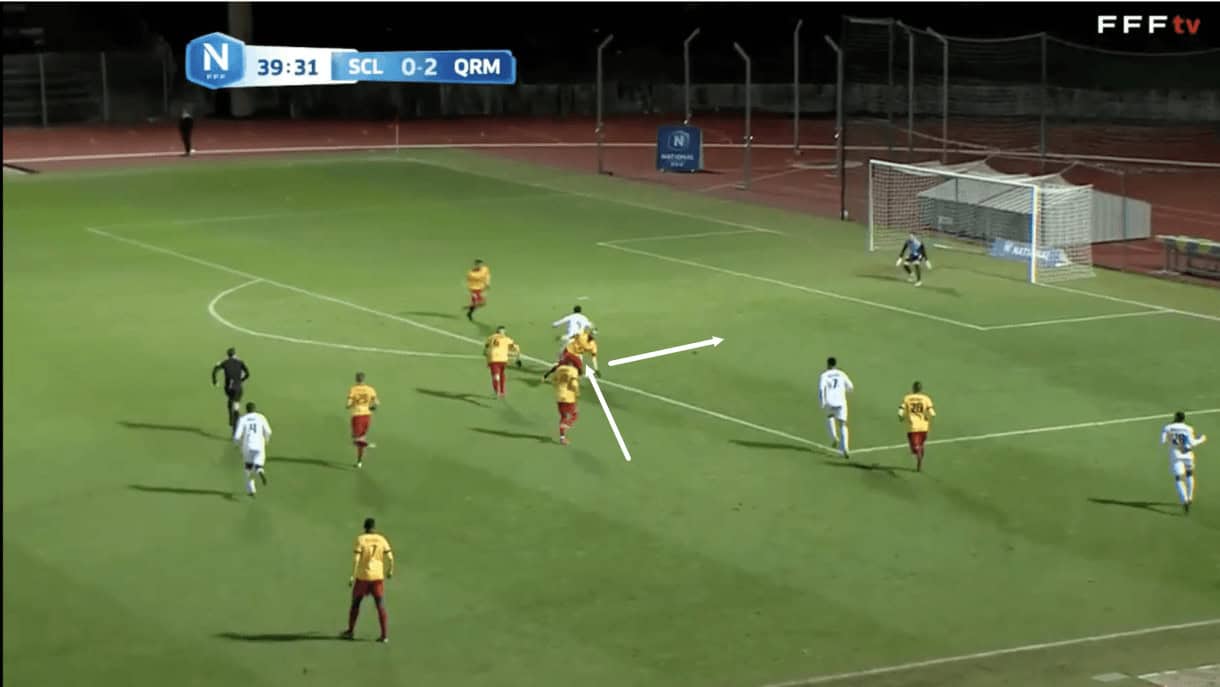
As Jung turned, he leaned into the near opposition centre-back and this led to the scene we see in figure 4, with Jung spinning past the centre-back and leaving him in his tracks. As play then progressed, the striker moved into his favoured right-sided position in the box to shoot. This passage of play highlights how Jung can influence the game when dropping slightly deeper. He is good at using his mix of size and technical quality to control the ball and beat the man. If it’s just one player he has to beat in these situations, then Jung is reliable. However, against more than one man, he struggles.
This is why Jung’s movement and ability to find space is so important. He can create situations where he’s isolated with an opposition defender and benefit from them like this.

Like Jung is generally not heavily involved in chance creation inside the final third, he doesn’t play a significant role when his team progresses into the opposition half. Again, this is evident from his low number of passes per 90 and low number of successful attacking actions per 90. However, he’s capable of contributing to this phase. We see an example of one occasion where he did here in figure 5, where a teammate picked Jung out while progressing into the opposition half with the forward dropping deep, away from the opposition backline.
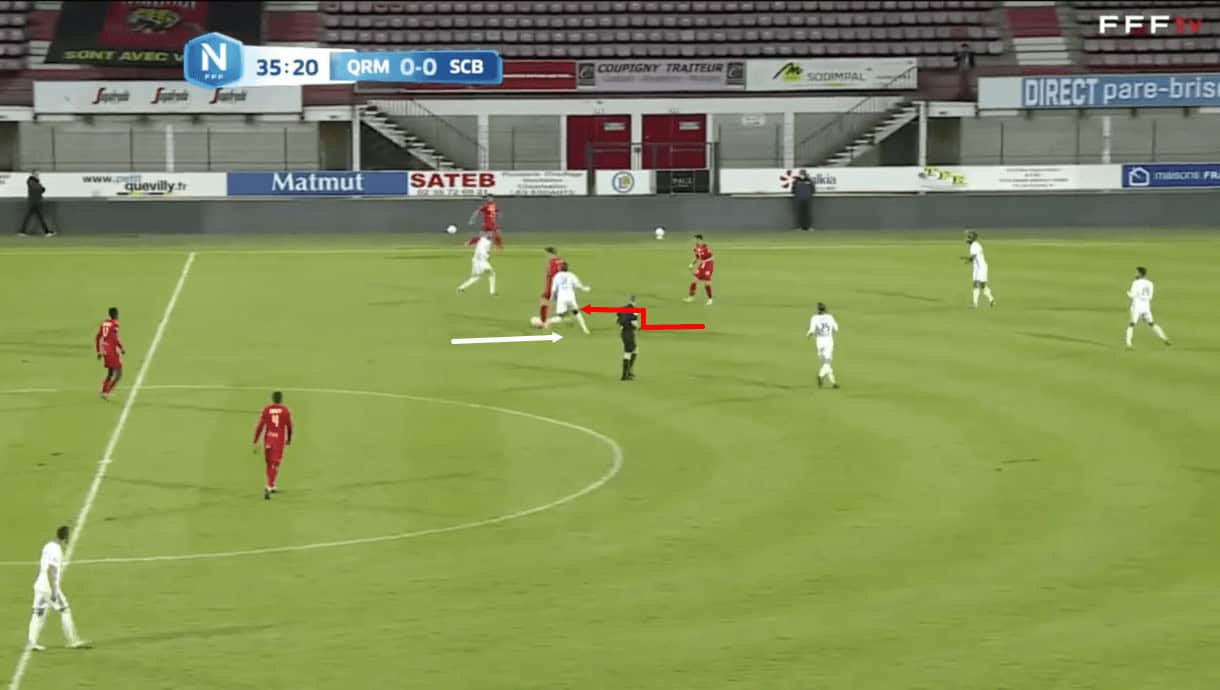
As we see in figure 6, Jung successfully controlled this ball very well and as an opposition midfielder pressed aggressively from in front of him, he evaded the press very well by moving the ball quickly between his feet and ended up beating the man before turning and playing the ball to another teammate inside the opposition half. So, while Jung didn’t contribute a lot in ball progression and chance creation last season, that’s not to say he couldn’t do so. His combination of size, constant movement, eye for space, and technical quality make him an asset in these situations.
Ball control and dribbling
As mentioned in the previous section, Jung isn’t the man you want to try to beat multiple opposition defenders – he’s not much of a dribbler in this sense. As a result, he doesn’t tend to make many dribbles. The forward made just 2.24 dribbles per 90 last season – a very low number for a Championnat National striker, while he also ended the 2020/21 campaign with a 43.08% dribble success rate – also pretty low for a Championnat National striker.
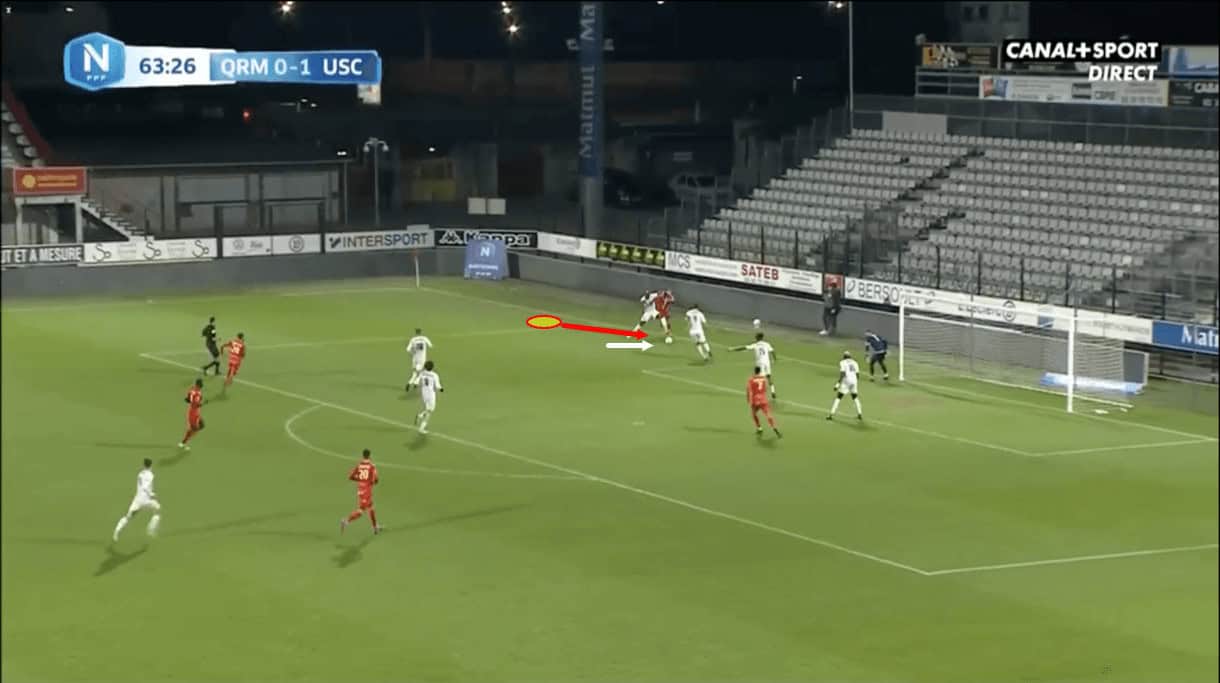
In figure 7, we see an example of Jung coming out on the losing end of a 1v1. Just before this image, he was positioned in front of the defender in the circled area just on the edge of the box, having moved into this position after being on the receiving end of a through ball. He ended up trying to take the ball past the near defender on his inside, but the defender was able to get between Jung and the ball and cleanly put a stop to this attack quite easily. This was due to a couple of reasons.
Firstly, Jung isn’t very quick, so it was difficult for him to take the ball past this defender, as the opposition player simply had more time to read Jung’s movement and react with a successful defensive action. Secondly, while Jung has a large frame and uses it well to back into opposition defenders as we analysed previously, he can be unbalanced quite easily while dribbling and the opposition defender managed to do this very well in figure 7 through a thrust of his hips. This sent Jung off course, increased the distance between the attacker and the ball, and again made life easier for the defender who could regain possession.
Jung isn’t a great crosser as well as not being great at beating men on the ball. He’s much better on the receiving end of crosses than the providing end. As a result, we feel he shouldn’t end up outside the width of the penalty area much, if at all. His strengths lie in more central positions – and generally close to goal, where he proved to be clinical last season, making up for the fact that he didn’t contribute a great deal on the ball in the rest of the attacking phases. His efforts were concentrated on finding space through intelligent movement, controlling the ball well when he did receive it and finishing ruthlessly and he delivered in these areas.
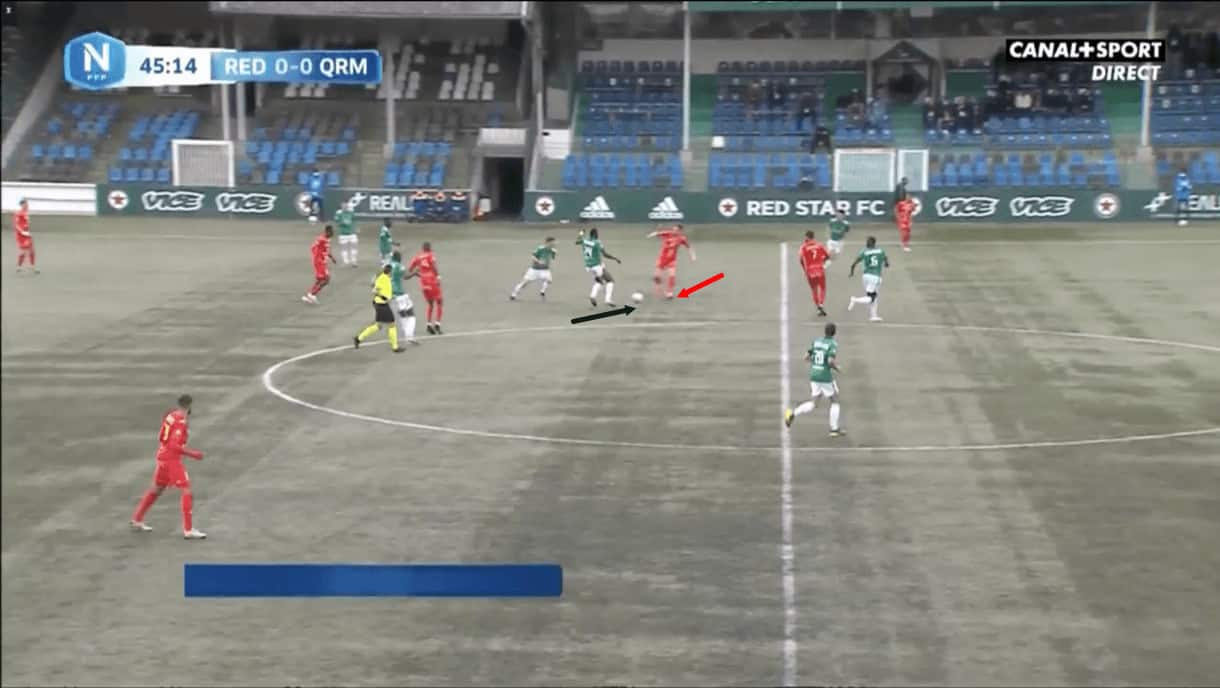
As mentioned previously though, Jung does have great technical ability. His dribbling struggles are mainly due to his pace and agility. However, he demonstrated excellent ability to retain possession and beat players through subtle little movements, which we see an example of in the passage of play starting here in figure 8. Here, we see an opposition midfielder pressing Jung, with the 23-year-old not exactly keeping the ball very close to his body here.
This is an area where Jung can improve – he sometimes allows the ball to get too far from his body. However, sometimes, as was the case on this occasion, this works out very well for the striker.
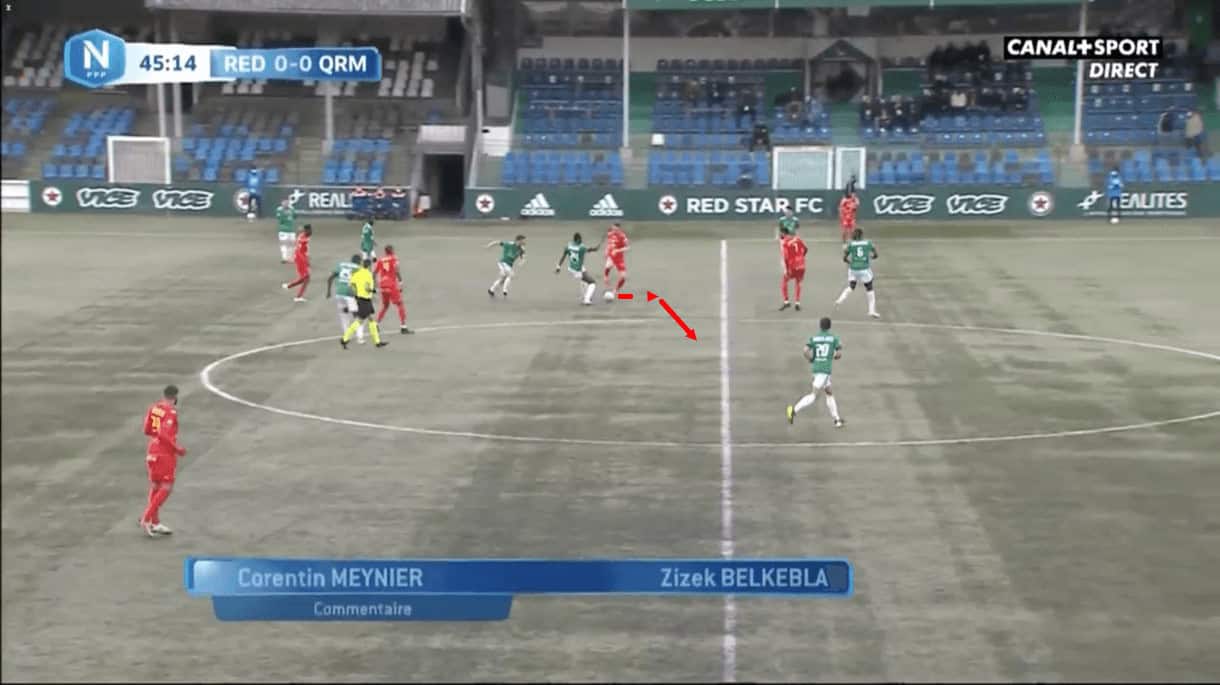
In figure 9, we see that as the opposition midfielder pounced, Jung evaded the challenge with a neat ball roll. This moved the ball out of the defender’s path and onto Jung’s left foot, which he used to knock it forward and continue the attack for QRM. Jung effectively baited the opposition player into a challenge and escaped through some quick footwork with the ball, leaving the opposition player in his tracks.
This passage of play highlights the benefits of Jung’s technical quality. Jung excels when he doesn’t have to dribble over a distance but instead can use his technical quality to evade a challenge in a smaller area. So he does have good ability on the ball which his team can utilise, he just shouldn’t be required to cover long distances with the ball. He can perform well in tight spaces, however.
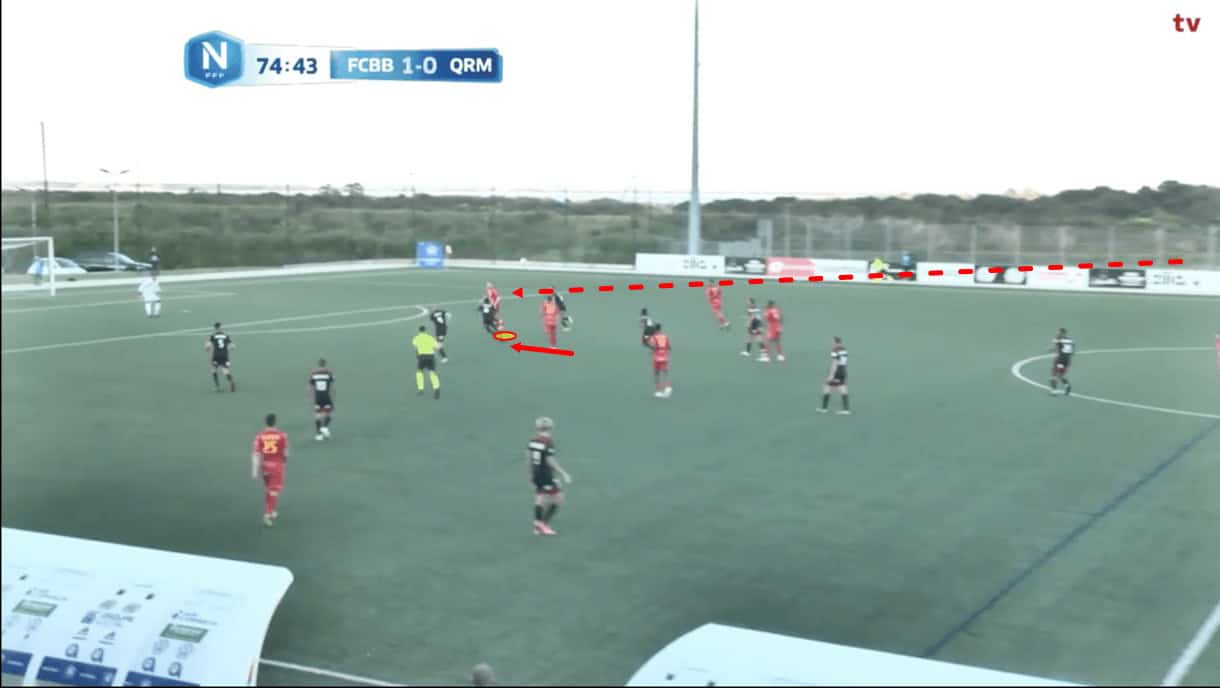
Another notable aspect of Jung’s technical quality is his excellent first touch. Jung was often the target of long balls at QRM last season. This was partly due to his size – he made for a relatively easy target in that sense – but also due to his impressive ability to kill the ball with his first touch. His team was comfortable launching long balls to him, knowing that he could control those balls with ease, putting his side in a potentially advantageous attacking position. We see an example of a long ball being aimed at Jung in figure 10, with the striker occupying the centre-forward position.
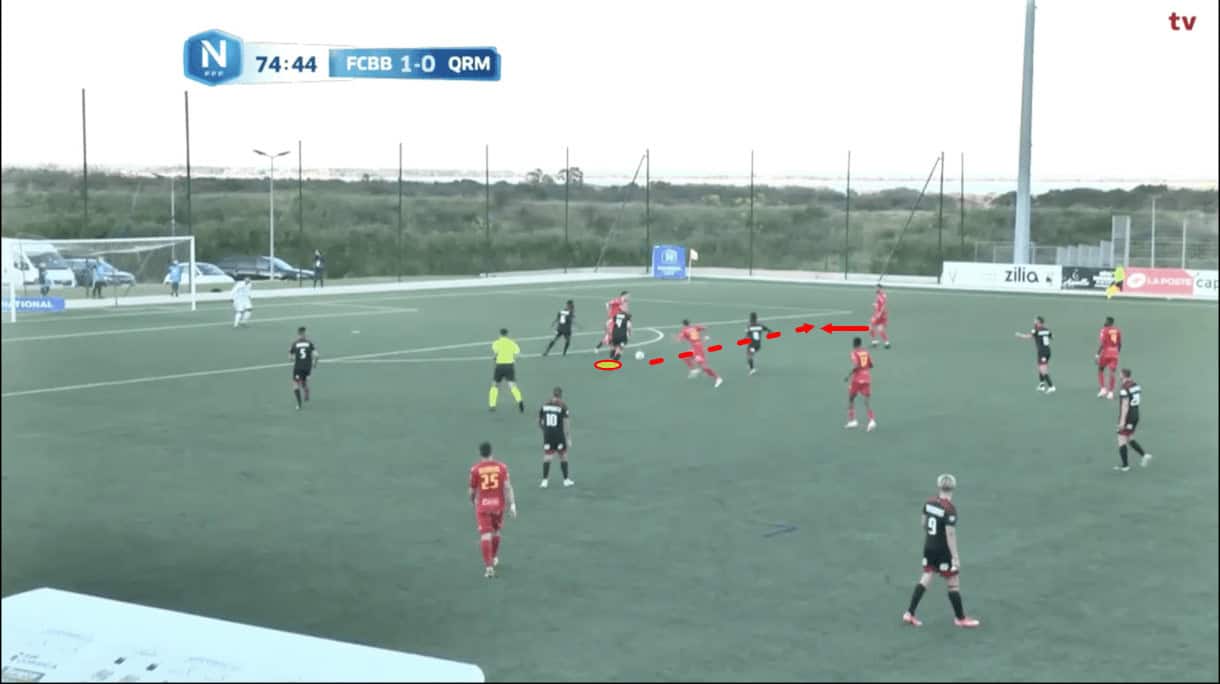
As play moves on into figure 11, we see that Jung was able to kill the ball while turning to face an open teammate in the right half-space. The 23-year-old played the ball through to this player, helping his side to progress into the box. This passage of play highlights how effective a tool Jung’s masterful first touch can be for his team. He makes these long balls more effective because of how well he can control the ball and progress the attack, as he did in this example.
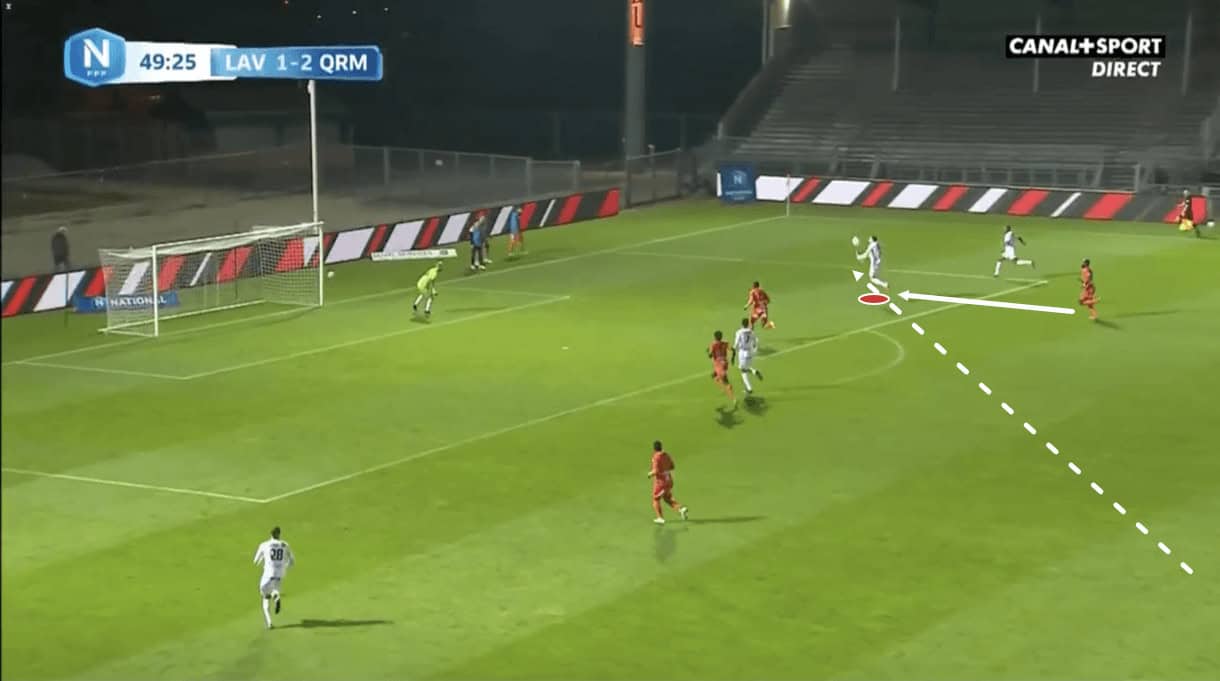
In the previous passage of play, we saw Jung controlling a long ball as it dropped to a low position, however, in figure 12, we see an example of Jung controlling a high ball which was played across the field, with Jung occupying his favoured position on the right side of the box. The striker is just as effective at controlling these pacey high balls as he is at controlling balls at a lower height. He’s great at judging the flight of the ball and simply killing it with his first touch. This is a very useful tool for his side, as Jung can act as an effective target for various types of passes – even seemingly difficult ones. He manages to make these passes work through his movement and his ball control.
As it would appear from figure 12, Jung is good at using his long legs to reach for balls in seemingly hard-to-reach positions. He’s good at controlling balls in these situations, as was the case in figure 12, as well as taking shots and making passes despite the ball being in an awkward position.
Aerial ability
Aerial duels were a big part of Jung’s game last season. He contested 6.2 aerial duels per 90 – a high number for a Championnat National striker. In fact, Jung was one of the greatest aerial threats in France’s third tier last season, as he managed to score four headed goals, the joint-most of any Championnat National centre-forward.
Along with the technical quality of Jung’s headed shots, his size played a part in making him such an aerial threat – it was difficult for defenders to compete with the 192cm, 82kg centre-forward in the air. As well as his size, however, Jung’s movement and positioning also played a key role in making him such an effective aerial threat.
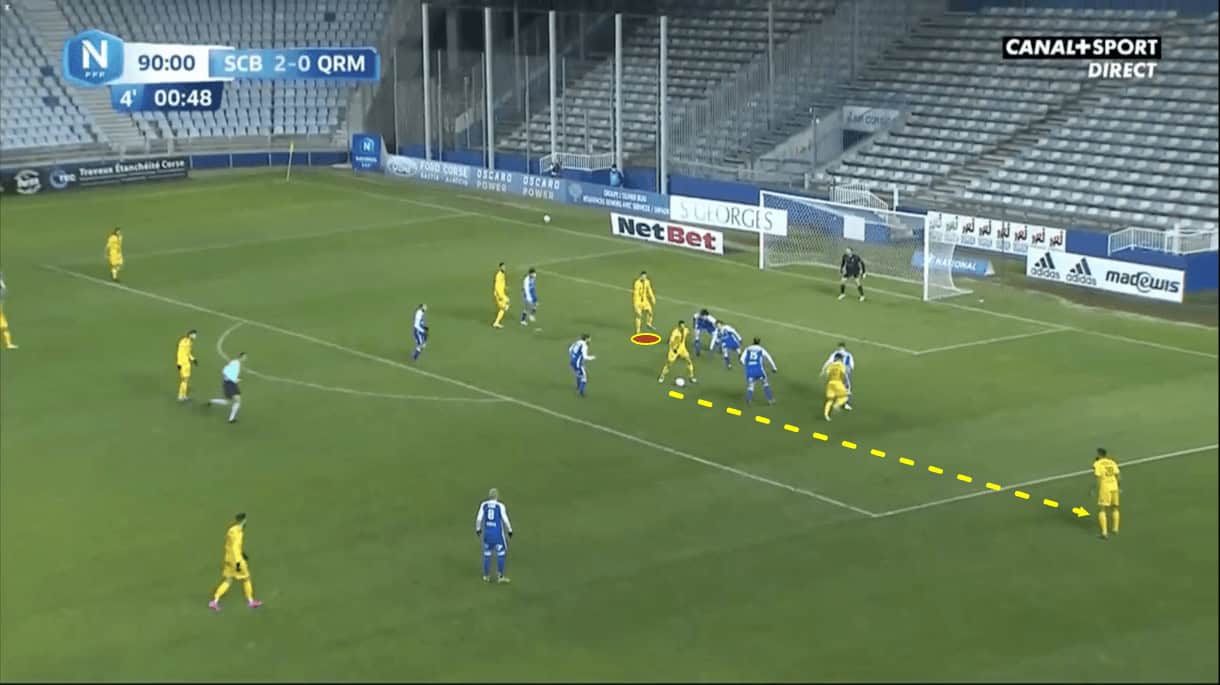
This passage of play beginning with figure 13 highlights how Jung’s constant movement, which we discussed earlier, made him a greater aerial threat. Firstly, here in figure 13, we see Jung circled in the box, enjoying plenty of space thanks to his movement and hoping to receive a pass from his teammate. However, the teammate either didn’t see Jung or didn’t feel comfortable trying to pass to him in this situation and instead opted to play the ball out to a free man in even more space on the right-wing.
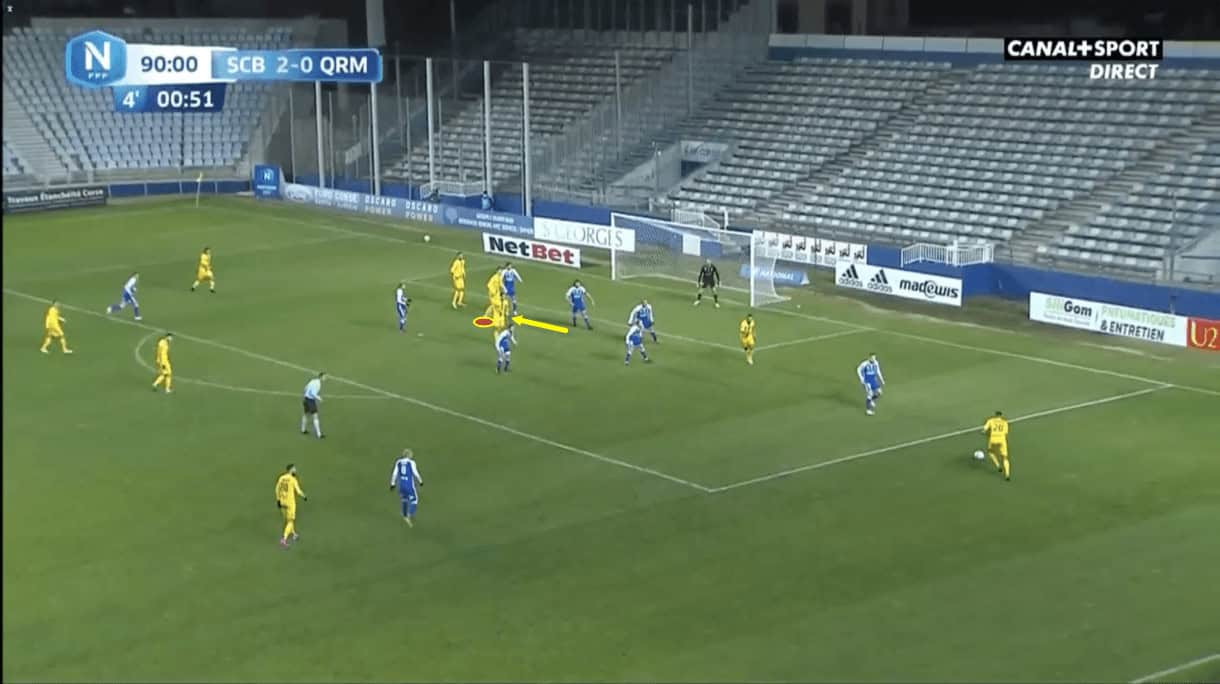
Moving onto figure 14, as the ball moves out wide, Jung drops further back in the box, moving to the far side of the goal and increasing the space between himself and the crosser. Jung likes to get onto the end of crosses from this kind of position. He loves to be positioned at the far end of the goal relative to the position of the crosser. He always tries to position himself in this area.

Just before figure 15, the wide man sent a high, lofted cross into the box and as he did so, Jung adjusted his positioning ever-so-slightly once again. He essentially just took a quick step away from goal, increasing the space between himself and the nearest defender that little bit more and making it more difficult for that defender to impact his jump and ultimately contest this aerial duel.
Jung likes to be positioned at the far end of the goal relative to the cross because he likes to be able to aim ahead with the option of either directing a header to the far post just in front of him or the back post to the side of him. He doesn’t like to perform glancing headers, he prefers to use his neck power to direct the ball with the full goal in front of him to aim for. This evidently served him well last season.
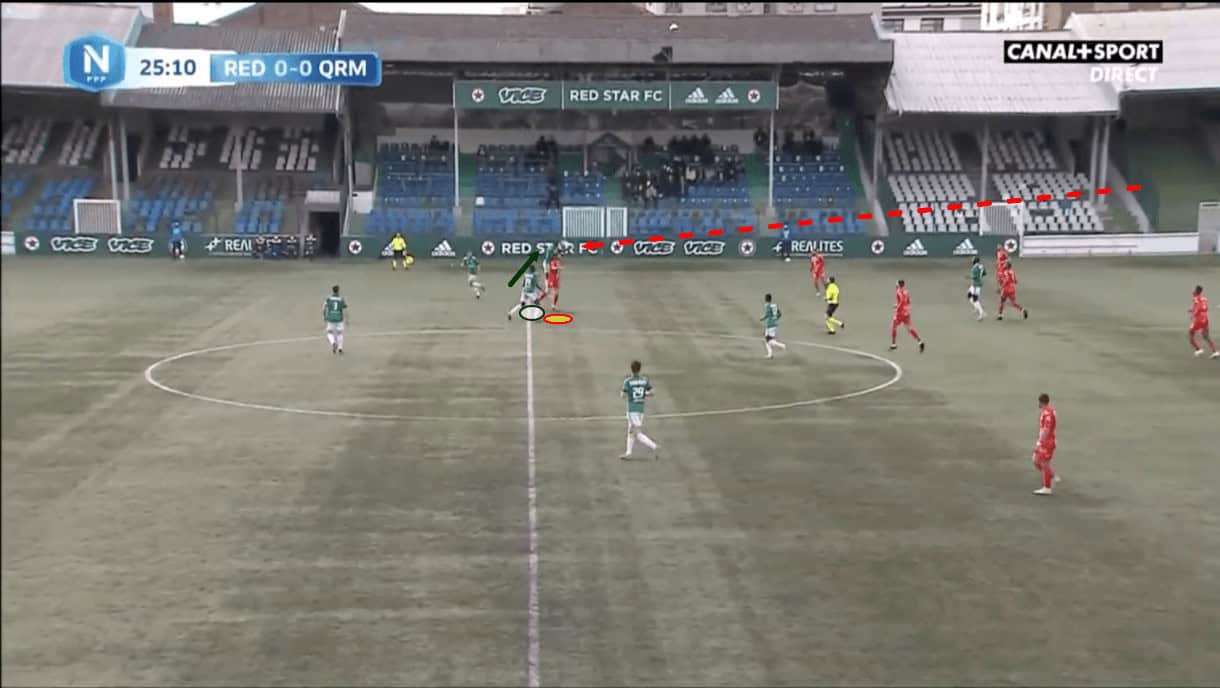
As mentioned previously, Jung was often the target of long balls from the back last season with QRM. He loved to back into defenders or run in behind and control these balls with his body or his feet. He did this very effectively last term. However, sometimes these long balls required Jung to contest aerial duels in deeper positions, where a flick on or a headed pass to a deeper teammate would be necessary. The 23-year-old ended the 2020/21 campaign with a 33.89% aerial duel success rate – relatively average for a Championnat National striker, which highlights that he wasn’t bad in these situations and can perform this role well, but didn’t excel in this role either.
In figures 13-15, we saw how Jung used intelligent positioning and movement to create a favourable aerial duel in the box, however, in figure 16, this was impossible as the long ball limited the amount he could adjust his positioning and create distance between himself and the defender before contesting the aerial duel. With an opposition defender right behind Jung, the striker was out-jumped and lost the aerial duel well. This highlights that while he’s a great size of a striker and can adjust his positioning to create favourable aerial duels, Jung isn’t incredibly athletic, doesn’t have the greatest jump height and can be beaten physically in these types of aerial duels where it’s more difficult to increase the space between him and the opposition defender.
Again, Jung contested a large number of aerial duels for a Championnat National striker last season and came out of them with a decent success rate – so this isn’t a major concern, however, it’s worth noting that he isn’t perfect in the air and can be beaten physically, especially in these deeper aerial duels.
Conclusion
To conclude this tactical analysis, in the form of a scout report, looking at Andrew Jung, we feel he’s an exciting forward who could be best described as an extremely good finisher and an aerial threat. Additionally, Jung has demonstrated great technical ability as well as intelligent movement and positioning. His profile reminds us a little of 2018 World Cup winner Olivier Giroud, of EPL side Chelsea – and who has recently been linked with a move to AC Milan – in terms of his size, aerial threat, low level of involvement in passing plays for a striker, and technical quality. Jung even has that similar quality to Giroud in that many of his goals are very easy on the eye and he can use his long legs to control awkward balls and make impressive passes.
Jung is not a great dribbler over a distance, isn’t a great crosser, isn’t much of a creative passer and isn’t very fast. However, his role at QRM last season did well at hiding these weaknesses and playing to his strengths. If allowed to play in central, advanced areas of the pitch, played through into the right side of the box where he loves to shoot from and given plenty of aerial goalscoring opportunities in that far side of the box position which we looked at, then Jung is a great asset and will perform well. Don’t put him in positions where he has to dribble a lot over a distance, deeper positions or wider positions. Make him the focal point of the attack, let him sit higher than any other player the majority of the time, and play to those preferences of his in terms of positioning and movement and he can thrive in either a non-possession based, more counter-attacking side, like QRM last season, or a possession-based, more positional side. We feel he has the qualities to perform in either in the correct role.