
One of the most tantalising ties of the UEFA Champions League’s Round-of-16 draw kicked off its first leg on Tuesday evening, as Ligue 1 leaders Paris Saint-Germain played host to LaLiga table-toppers Real Madrid in Le Parc des Princes. Mauricio Pochettino’s star-studded side — with a starting XI consisting of (GK) Gianluigi Donnarumma, (RB) Achraf Hakimi, (RCB) Marquinhos, (LCB) Presnel Kimpembe, (LB) Nuno Mendes, (RCM) Danilo Pereira, (CM) Leandro Paredes, (LCM) Marco Verratti, (RW) Ángel Di María, (CF) Lionel Messi, (LW) Kylian Mbappé — earned a 1-0 victory thanks to main man Mbappé’s 94th-minute winner.
Despite winning the game by just one goal, and only managing to score that winning goal in the dying moments of the game, PSG produced a dominant performance that had Madrid hanging on by their fingernails going into second-half stoppage time, as is highlighted by their accumulation of 2.39 xG to Madrid’s 0.18 xG, per Wyscout. PSG’s 2.39 xG was generated from their total of 22 shots in this Round of 16 tie, while three-time UCL-winning mastermind Carlo Ancelotti’s Madrid — with a starting XI of (GK) Thibaut Courtois, (RB) Dani Carvajal, (RCB) Éder Militão, (LCB) David Alaba, (LB) Ferland Mendy, (RCM) Luka Modrić, (DM) Casemiro, (LCM) Toni Kroos, (RW) Marco Asensio, (CF) Karim Benzema, (LW) Vínícius Júnior — managed just three shots all game in a toothless attacking display.
Granted, Madrid were away from home on Tuesday and with the away goals rule being scrapped for 2021/22, Los Blancos didn’t have much of an incentive to approach this game with a gung-ho attitude but it’s clear even solely from the aforementioned stats that they failed to contain Les Parisiens to an adequate extent and were lucky to leave the French capital with just a one-goal deficit to overcome in the second leg. It’s difficult to imagine Ancelotti’s side producing as dominant a performance at Estadio Santiago Bernabéu in the return leg, though stranger things have certainly happened in this competition, notably against PSG in Spain.
This tactical analysis piece aims to highlight the key role that PSG’s midfield played in their dominant performance on Tuesday evening. In the wake of their impressive display, Verratti has rightly been showered with praise, along with the game-winner Mbappé. However, the strategy and tactics on display from the get-go by Pochettino and Paris were interesting and effective both in controlling the game and denying Ancelotti’s side opportunities to execute their own game plan, pinning them in their own half and relentlessly posing the Spanish side problem after problem. I hope that this tactical analysis shines a light on the crucial yet contrasting roles that the three members of PSG’s base midfield line played in their side’s first-leg victory on Tuesday, as well as the intelligent game plan produced by their renowned Argentinian strategist.
Leandro Paredes and Marco Verratti
The first and main topic I’m going to discuss in this tactical analysis is the link-up between Leandro Paredes and Marco Verratti, and how crucial it proved to be for PSG on Tuesday. Wyscout registers the number of passes made in one way or the other between every set of two players on the pitch as ‘passing links’. Versus Real Madrid, PSG’s top passing link was Paredes and Verratti, with a whopping total of 50 passes made between the two midfielders, primarily moving from Paredes to Verratti (28) but with plenty moving from Verratti to Paredes as well (22).
For reference, PSG’s next top passing links were Paredes-Messi with 32, Paredes-Kimpembe with 29, Verratti-Messi with 28 and Verratti-Mbappé with 26. So, with 50 of PSG’s passes being played between Paredes and Verratti, it’s clear that the link-up between the two men was a common theme in PSG’s game on Tuesday. Additionally, the remaining four links making up PSG’s top five further highlight the progressive nature of Paredes’ and Verratti’s respective games in Le Parc des Princes, with Paredes also frequently finding Messi between the lines via progressive passes, while Verratti frequently linked up with both Messi and Mbappé in more advanced areas, putting his press-resistance and ability to make lots of clean, deep completions to good use.

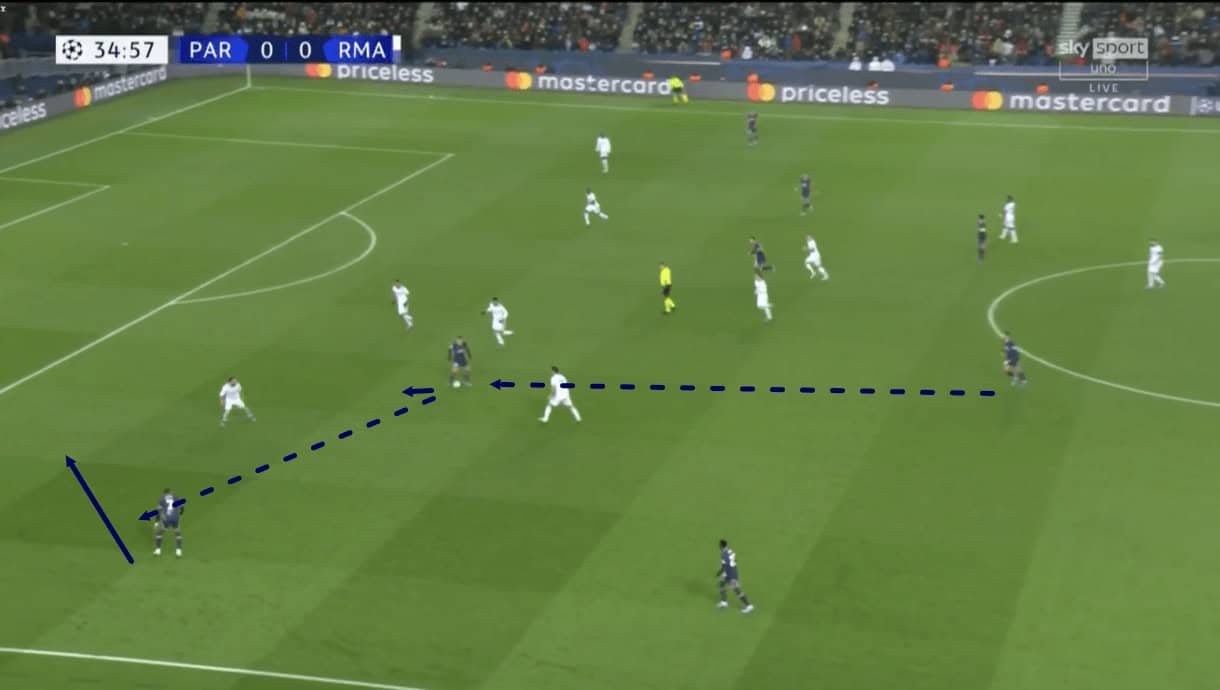
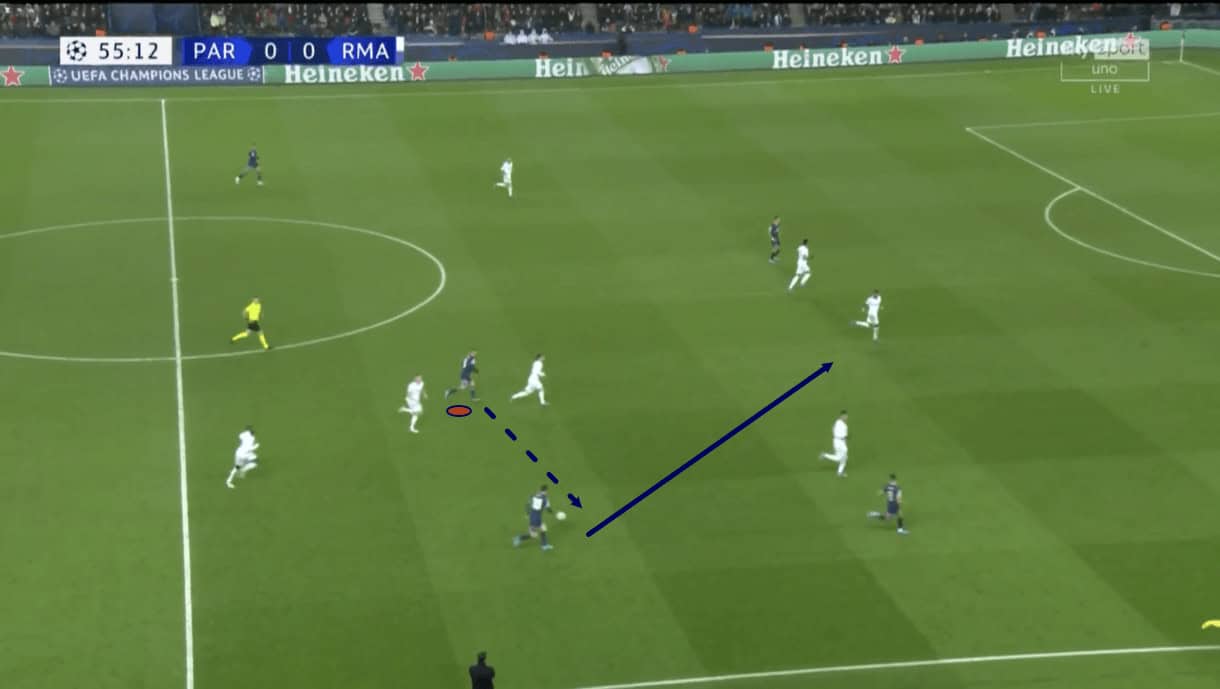
Paredes typically operated as the central, deep-lying playmaker in PSG’s 4-3-3 in possession — a role that he performs to the highest standard you’ll see in world football today. Paredes’ positioning, spatial awareness, scanning, ball reception, decision-making and execution of the pass are routinely top-notch, hence why Pochettino entrusts him with this crucial role at the base of PSG’s midfield just in front of the backline. Figure 1 shows an in-game example of Paredes receiving in this position while his team is building their attack just inside the opposition’s half, aiming to progress into the final third at this moment.
Just before this image, Marquinhos drove forward with the ball from his right centre-back position, attracting Real bodies towards him and freeing up space for Paredes to receive a lateral pass once positioned right beside him at the base of midfield, essentially forming a temporary double-pivot. By attracting bodies towards him via his carry, Marquinhos didn’t just create space for Paredes to receive but also created a clear path for Paredes to pass the ball to Verratti between the opposition’s backline and midfield line — a very threatening position, especially for a player like Verratti who’s extremely comfortable under high pressure with both carrying the ball out of pressure thanks to his mobile hips and overall agility as well as coolly playing pinpoint passes under pressure, linking up with the likes of Mbappé and Messi just outside the penalty box after attracting opposition players towards him, thus creating additional space for Mbappé or Messi. This ability in tight spaces is why Verratti is so good in the more advanced ‘number 8’ role within this system.
In figure 1, after Marquinhos has played his pass, we see Paredes quickly scanning to spot the movement and positioning of Verratti before controlling the ball, orientating his body towards the Italian between the lines and executing a midfield-splitting ball into the 29-year-old’s feet.
As play moves on into figure 2, we see that Verratti successfully receives Paredes’ progressive pass, which was also intelligently played to the advanced ‘8’s stronger right foot, which is further away from DM Casemiro allowing Verratti to take the ball on the half-turn and immediately link up with Mbappé on the left-wing.
This is one of the big situations that PSG loved to create for Mbappé on Tuesday — isolating him 1v1 vs the opposition’s full-back via a quick passage of progressive play to advance into the final third and the penalty box.
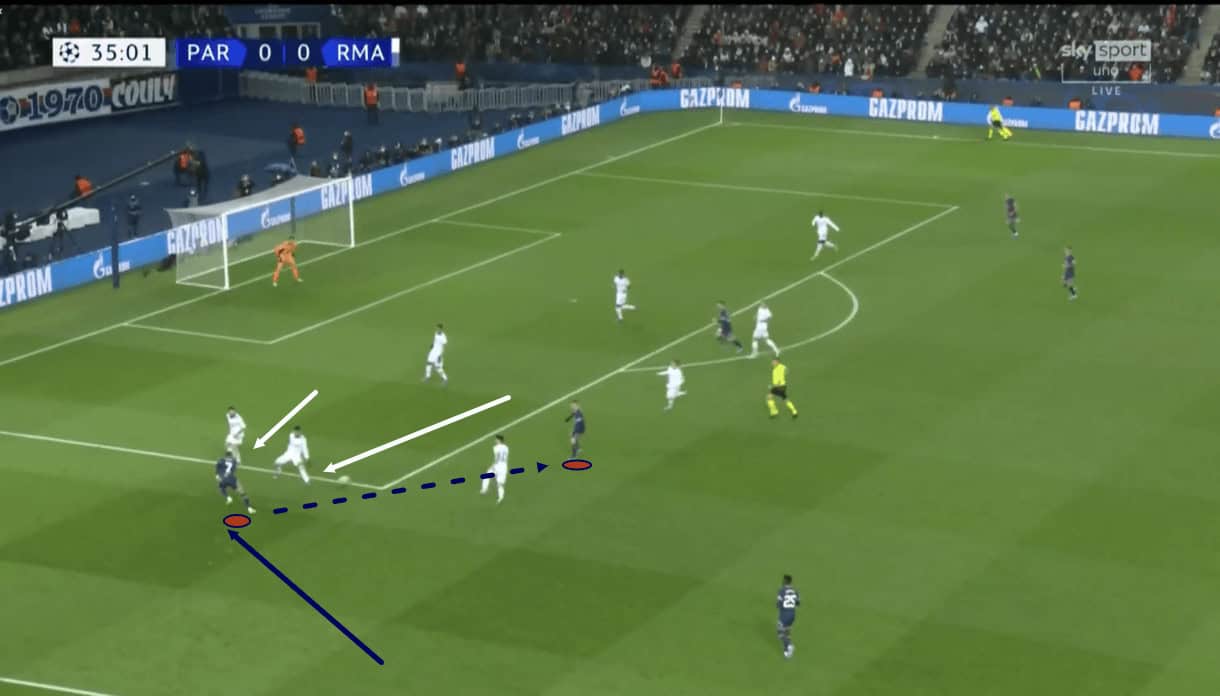
On this occasion, as play moves on into figure 3, we see that DM Casemiro came over in support of the right-back to prevent Mbappé from enjoying a 1v1 versus Carvajal on this occasion. While this movement from the holding midfielder stifled Mbappé’s direct plans, it also created an opportunity for the 23-year-old Frenchman to send the ball back to Verratti in the more central position but this time with no Casemiro lurking around to press him immediately. This was a good decision from Mbappé and it was well executed.
However, in fairness, Real dealt well with the situation by closing down Verratti, as he receives, from multiple angles and knocking the ball out of his control. This kind of situation happened a few times on Tuesday and many of them ended up with the same result — Madrid’s pressure increasing a significant amount as the ball arrives in an advanced central area, where stopping the attack becomes paramount. However, this was an interesting battle between the two sides as Verratti’s press resistance was also on display on several occasions, beating Madrid’s aggressive pressure in the advanced, central areas and finding a way to continue the attack.
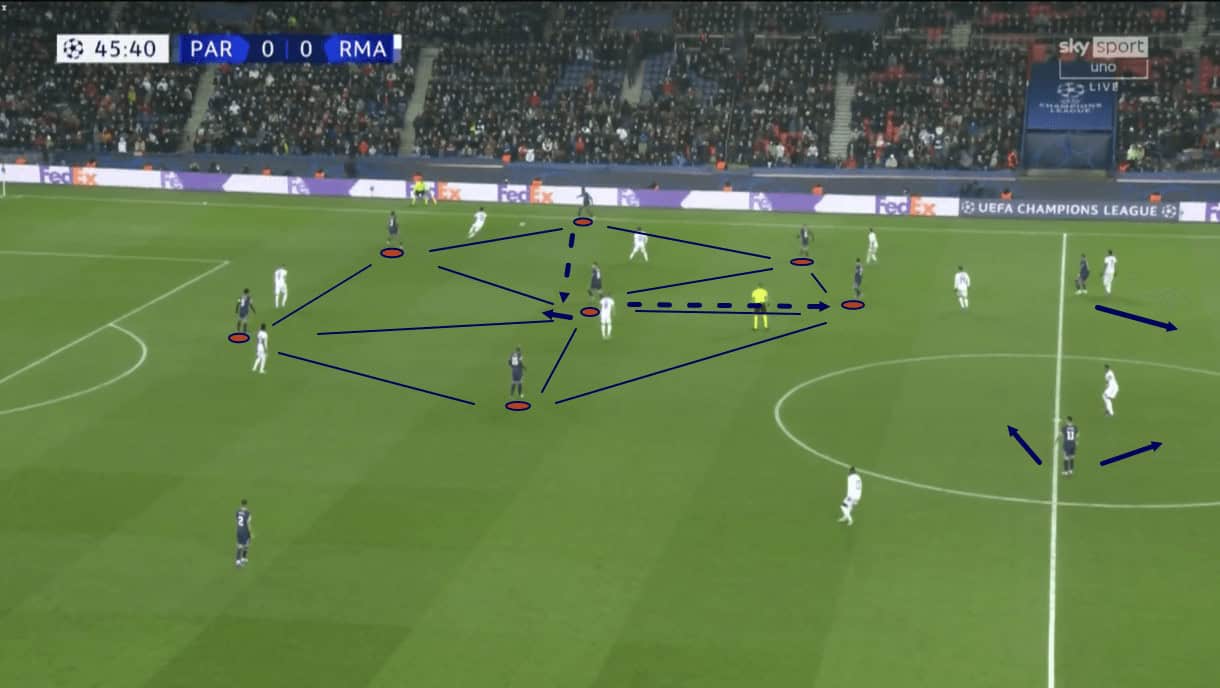
As figure 4 shows, Paredes’ role on Tuesday was to be at the centre of PSG’s ball progression, a job he performed to an expert level. Figure 4 shows PSG in the build-up phase from Tuesday’s game, orientated towards the left-wing on this particular occasion. Even with PSG’s general offensive shape orientated towards the left on this occasion, Paredes role remains consistent, with the Argentinian midfielder tasked with sitting at the base of central midfield, in front of the centre-backs but with Verratti to his left, Pereira to his right and Messi ahead centrally. In being positioned like this, Paredes, Verratti, Pereira and Messi essentially formed a diamond which was a common sight versus Madrid, with Messi frequently dropping deep to essentially play as a ‘number 10’.
PSG’s shape in figure 4 resembles a training ground rondo but with Paredes in the centre. The ball moved around the perimeter until an opening was created for PSG to play into the centre of the structure. That opening was eventually created when Kimpembe passed the ball to left-back Mendes and Paredes dropped slightly deeper to remove himself from Modrić’s cover shadow, making himself available for Mendes to find in his deep central position.
From here, Paredes was able to receive on his stronger right foot, turn to face the opposition’s half and then fire the ball into Messi’s feet in space at the tip of the diamond, allowing the dribbler to receive, turn and drive forward into the opposition’s half with the ball. On doing so, Messi was given the option of finding PSG’s furthest forward player, Mbappé, running in behind from the left-wing or linking up with Dí Maria who’d sometimes offer an option in behind similar to Mbappé but on the right and sometimes come short to offer Messi a passing option he could find to feet. All of these options for the Argentinian creator, however, stemmed from his compatriot Paredes initially making himself available and then finding Mess with a line-splitting progressive pass.
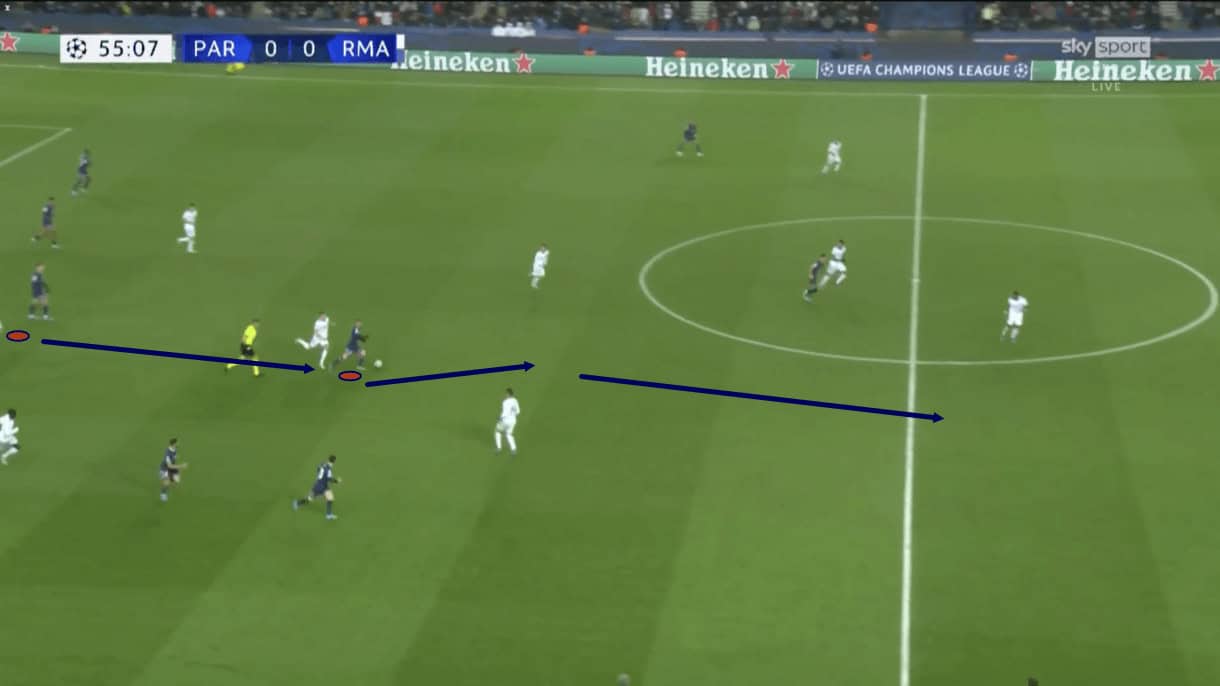
Similar to receiving in advanced areas, retaining possession there and getting key attackers Mbappé and Messi on the ball, another key part of Verratti’s role in this game was to progress his team upfield, either via passes, similar to Paredes, or via carries which was something more unique to his role. We see an example of the latter in figure 5, where Verratti picked up the ball on the edge of his own box having just been defending a Real attack and drove forward, carrying the ball at pace while demonstrating excellent agility and balance by seamlessly changing direction to throw challenging defenders off course and avoid their attempts to dispossess him.
Verratti’s dribbling ability is an excellent element of his game — the Italian is brilliant at driving forward with the ball while changing direction at pace while keeping the ball under his control. Mentally, he also exudes confidence in such situations, bravely charging upfield and targeting space between defenders knowing things could get tight and backing his ability to get out of tight areas, again through his agility, balance and ball control.
On this occasion, as we see in figure 6, when Verratti entered the opposition half, he attracted increased pressure from Madrid’s midfield towards him, creating space for Messi deep on the right-wing — also thanks to an intelligent, unselfish run from Dí Maria. Verratti then finds Messi in space to receive and carry the ball forward into the final third. So, PSG entered the opposition’s half from the edge of their box through a single progressive carry from Verratti while the Italian then had the intelligence to pass the ball off to Messi when the opportunity presented itself, allowing one of the world’s best dribblers to drive into space himself for the final stretch before breaking into the final third.
Lionel Messi
For the next section of analysis, I’ll spend some time discussing some key points on Messi’s role in PSG’s tactics versus Real Madrid. Firstly, yes this is an analysis of how PSG’s midfield controlled the game versus Los Blancos, and yes, Messi’s base position was centre-forward in this game on paper. However, as we’ve already seen, Messi didn’t operate on the highest line, he played a freer role, often operating as a ‘10’ but mainly enjoying the freedom to drop deep and occupy space wherever he found it behind the most advanced line.
What was the purpose of this? Why would you want Messi operating deeper rather than occupying centre-backs at all times? Is it a case of Messi losing a step of pace and needing to start deeper than he otherwise would or is it a deliberate plan from Pochettino and his coaching team? I’ll attempt to provide satisfactory answers to all those questions in this section of analysis. Firstly, however, it’s worth noting that this was a role Messi grew into towards the latter years of his time at Barcelona and not something entirely new that’s just started in Paris.
So, while Messi did play a specific tactical role within this system that required him to effectively be a presence in front of the midfield line but behind the forward line, this was probably more of Pochettino tailoring the system to suit Messi as it was Pochettino asking Messi to play a certain way for the sake of the system.

Messi’s role in the system is evident from the above map in figure 7, highlighting where he engaged in his offensive duels; the Argentinian typically engaged with defenders on the edge of the final third.

Compare this with Mbappé in figure 8 and we see a clear contrast in the two star attackers’ behaviour, with the younger Frenchman operating far higher and typically engaging defenders in a more concentrated area on the left side of the box. From this position, Mbappé was able to 1. Win his side a penalty in the game and 2. Create an opening for himself to score the winning goal.
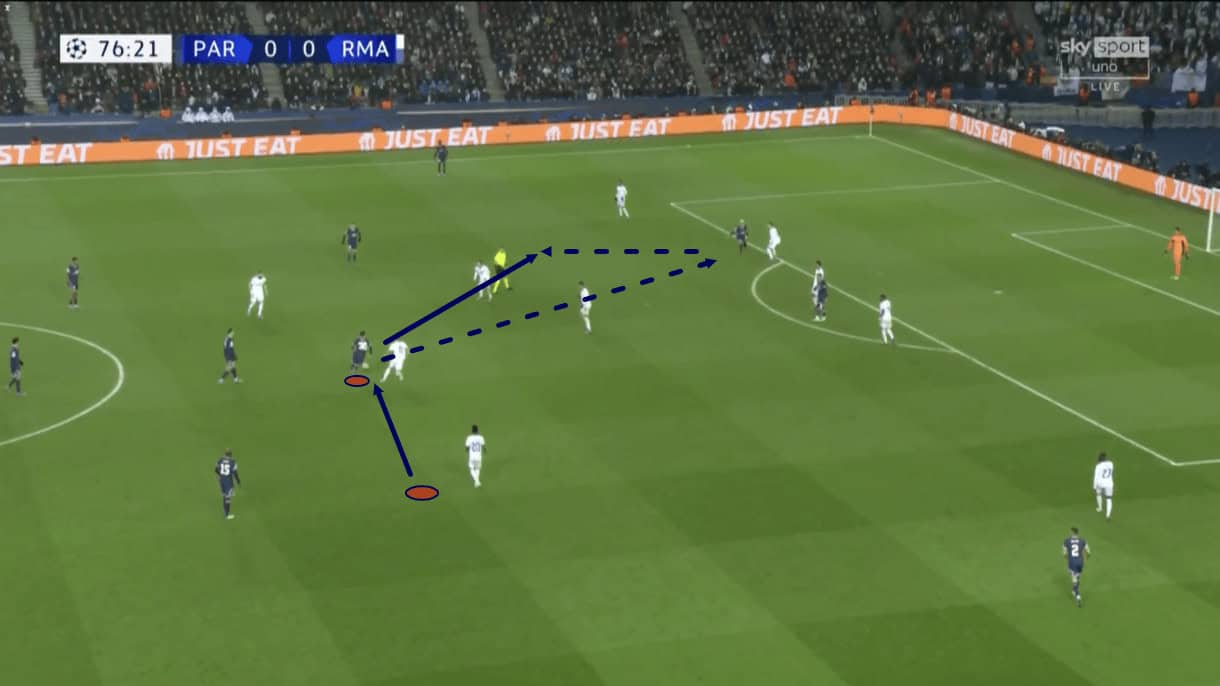
Messi’s role required him to constantly carry/pass the ball into more threatening areas for the players occupying the most advanced line at that time to capitalise on. Take figure 9, for example, just before this image, Messi picked up the ball in this deeper area, towards PSG’s right-wing. Moving on into figure 9, we see that the Argentinian has carried the ball more centrally, casually beating a defender with his dribble as is routine for the 34-year-old, and progressed into a direct passing lane linking him with substitute Neymar operating in the left half-space at this moment. As play moves on from here, we see Messi fire the ball between the narrow gap of Real Madrid’s defensive shape to find Neymar, continue his run into a more advanced position and pick the ball back up off the Brazilian in a far more threatening position than the one in which Messi initially picked up the ball.
So, while Messi may not have stolen the headlines on the surface in this game, he played his role in possession of effectively being the most attacking midfielder perfectly. In this role, he was required to improve PSG’s threat and the value of their positioning at a given time and play a key role in terms of progressing into the final third, which he undoubtedly did as Messi ended this game having played more progressive passes than any other PSG player, per Wyscout.
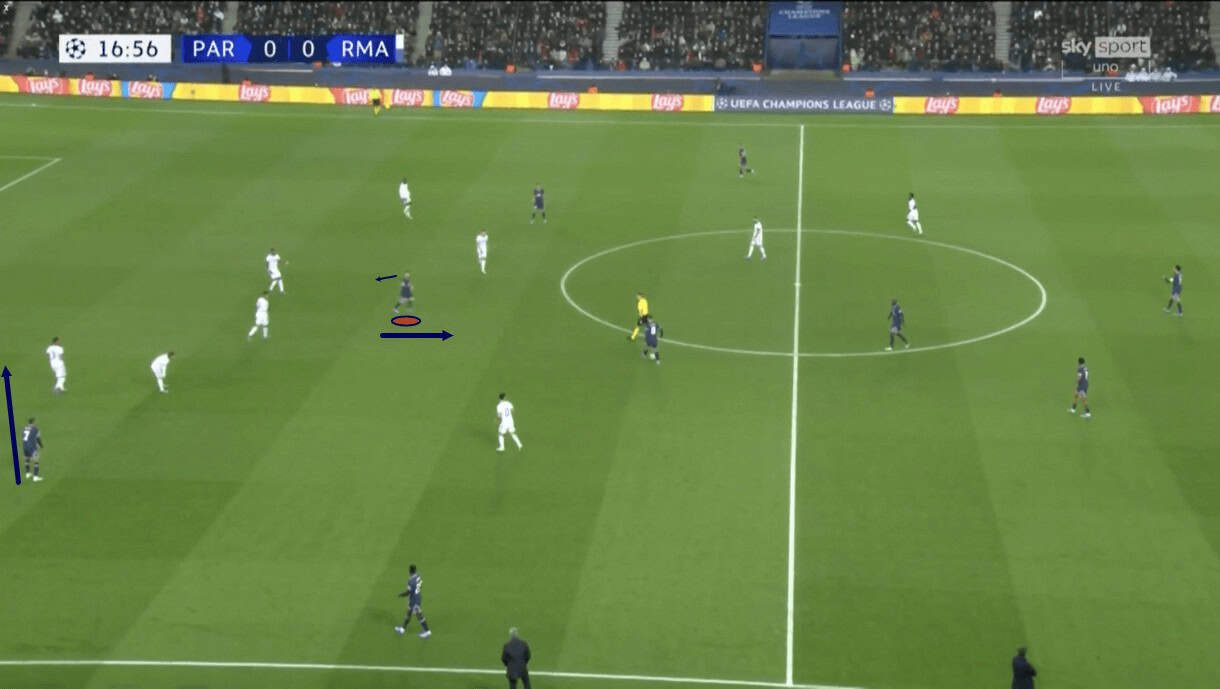
Messi’s ability to link up with Mbappé was another influential factor in his specific role within PSG’s system for this game. Figures 10-11 highlight a passage of play in which Messi’s link-up with Mbappé and the threat it posed to Real Madrid’s defence was clear. In Mbappé, PSG have a rapid, threatening runner with elite finishing ability who can blitz behind the opposition’s backline and find himself in 1v1s with the ‘keeper provided the pass is good, and in Messi, Les Parisiens have an elite playmaker who can find space in front of midfield but behind the forwards to receive the ball, turn on a dime and fire a good pass into Mbappé’s pass. In this regard, the two profiles are an excellent match.
Firstly, in figure 10, we see Messi dropping deep to get away from the Madrid backline, while scanning to check if they’re following him and check for Mbappé’s movement, and making himself a more viable passing option for the midfielder. Of course, with Messi making himself available, this is the likely pass here and the one the ball carrier opts for.
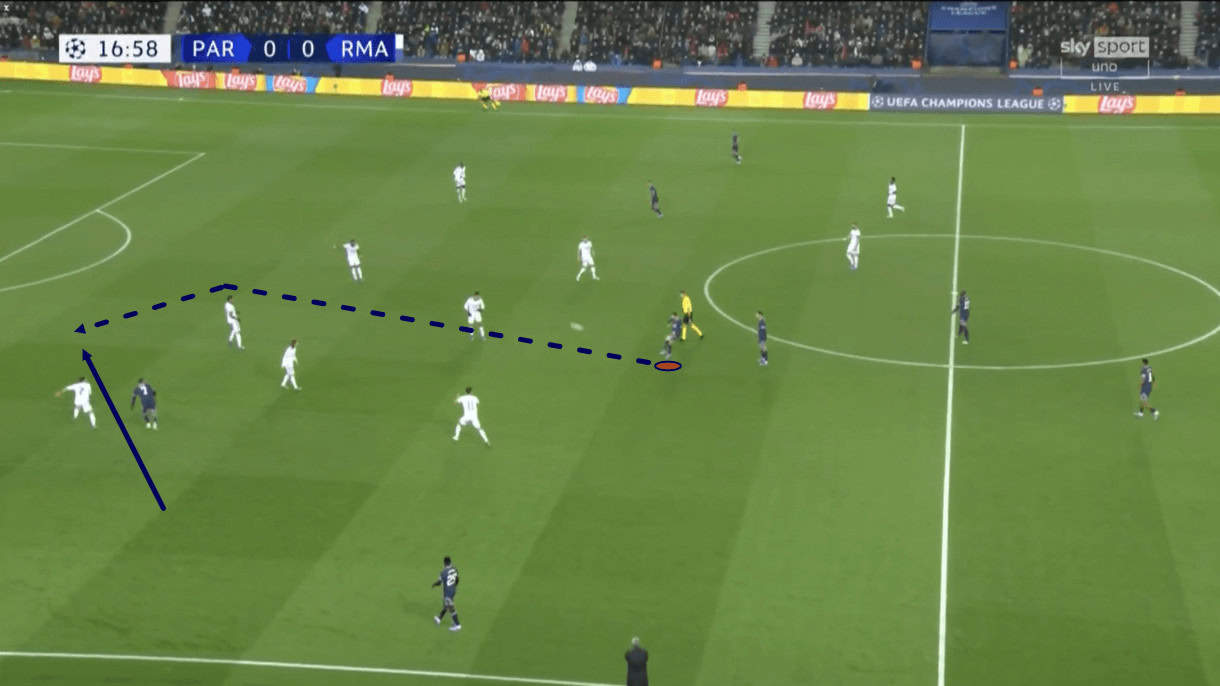
Moving on into figure 11, as Messi received the ball, he came back a little bit further to increase the space between him and the Madrid players while keeping an eye on Mbappé’s movement. At the time time, Mbappé was well aware of Messi’s capabilities and likely intent here, thus made his probing run in behind the opposition backline. Then, after moving slightly deeper, Messi turned and fired a lofted through pass into Mbappé’s path, setting the Frenchman off in behind Madrid’s backline and creating a dangerous goalscoring opportunity.
This is a perfect example of how these two profiles can work very well together and in PSG, we have two world-class players representing those profiles, leading to textbook plays like this manifesting on the grandest of stages. These two passages of play highlight exactly what was expected of Messi on Tuesday — finding space where there was very little due to Madrid’s deep, central congestion, progressing his team into more valuable areas time after time and finding the runner (Mbappé) with dangerous through balls when attacking space behind the opposition backline.
Danilo Pereira
Pereira had by far the most understated midfield role in Pochettino’s setup versus Madrid but it was no less important than any of the other roles in the system when it came to making everything tick. Alongside Paredes, Verratti and Messi in midfield, PSG had someone in Pereira who while perhaps capable of doing more, restricted himself to playing a support role at all times, being where his team needed him from a practical standpoint which facilitated the creativity and freedom of expression on display from the other Paris players.

As PSG transitioned from the build-up into the progression and chance creation phases of attack, their full-backs advanced, their wingers came narrower, Messi dropped deeper and, most notably for this particular section of analysis, Pereira dropped from right central midfield into more of a right centre-back position. PSG’s shape in the progression phase, as described above, is visible in figure 12.
Pereira’s willingness to drop out of midfield, remove himself from the centre of the action and occupy the right centre-back position gave his teammates the protection they needed in possession. This gave Hakimi and Mendes freedom to push into the opposition’s half uninhibited because due to Pereira’s movement, PSG’s back-two became a back-three which provided greater coverage across the width of the backline. Meanwhile, this 3-2 structure could safely transition into a 3-1 structure without being too weak thanks to Pereira’s movement too, giving Verratti the licence to carry the ball forward as we know he likes to do.
Particularly in defensive transitions, Pereira’s positioning on the right side of defence provided his side with additional coverage that helped them to shut down attacks easier before they advanced into more threatening areas. His presence behind the midfield allowed the full-backs and central midfielders to securely press more aggressively, knowing they had a three-man backline behind them to provide an extra safety net while his movement to the backline to form a three-man structure also gave him and left centre-back Kimpembe greater access to the wide areas, helping them to confront attackers should they break away down the wings too.
Meanwhile, in possession, the 3-2 structure perhaps created more preferable passing angles to a 2-2 structure and certainly made it more difficult for Madrid to press PSG’s backline. This helped PSG to progress into the midfield area regularly, without much trouble, while the wide centre-backs were also better-positioned to advance and support the midfielders if needed in the 3-2 structure.
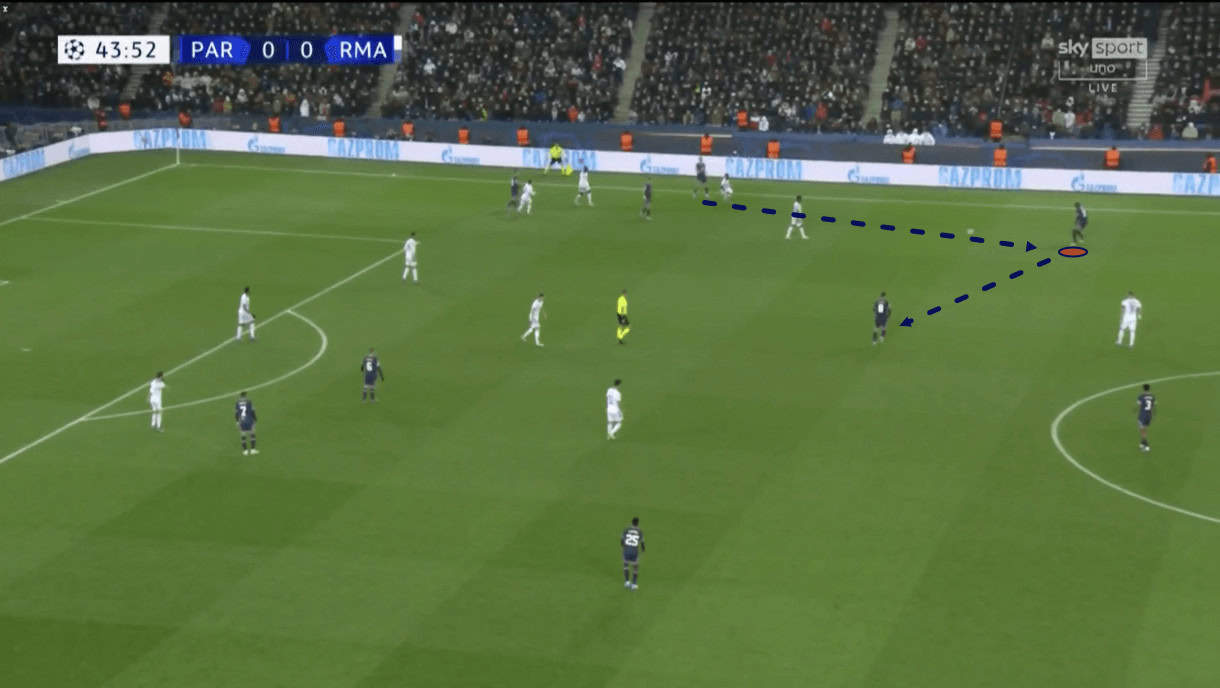
As PSG progressed into more advanced areas of the pitch, Pereira was always on call to be positioned in an area where he could act as a safe way out of pressure for the more advanced players, should Madrid’s defence shut them out and prevent them from progressing any further. Take figure 13, for example. Here, just before this image, Messi had carried the ball forward from deep before laying it off to Hakimi on the wing. However, Hakimi got trapped out wide and with Madrid bodies making all possibilities for further progression difficult, the right-back simply opted to send the ball back to Pereira, who was positioned in support of the more attacking players on the right-wing in an area of little pressure, as highlighted in the image above.
One key part of Pereira’s game was that he gave players like Hakimi more freedom to attack knowing they had defensive cover behind them but it was also that in attack, should things get too difficult in the advanced areas, Pereira would be positioned in just the right spot to receive a pass and get the team out of danger. However, as this example shows, getting the team out of danger was just half the job — the Portuguese midfielder also ensured his team kept the pressure on Madrid, which was, perhaps, just as significant.
As soon as he receives the pass from Hakimi here, Pereira turns inside and plays the ball into Paredes, who’s also in plenty of space. The direct pass from Hakimi to Paredes would’ve been impossible here because of the positioning of Madrid’s players but thanks to Pereira’s intelligent positioning and simple play, PSG found a way to quickly get the ball into their creative deep-lying midfielder in acres of space. In this way, Pereira acted like a support bridge, at times. Not the flashiest thing around but extremely practical and crucial to making the team’s plans come off.
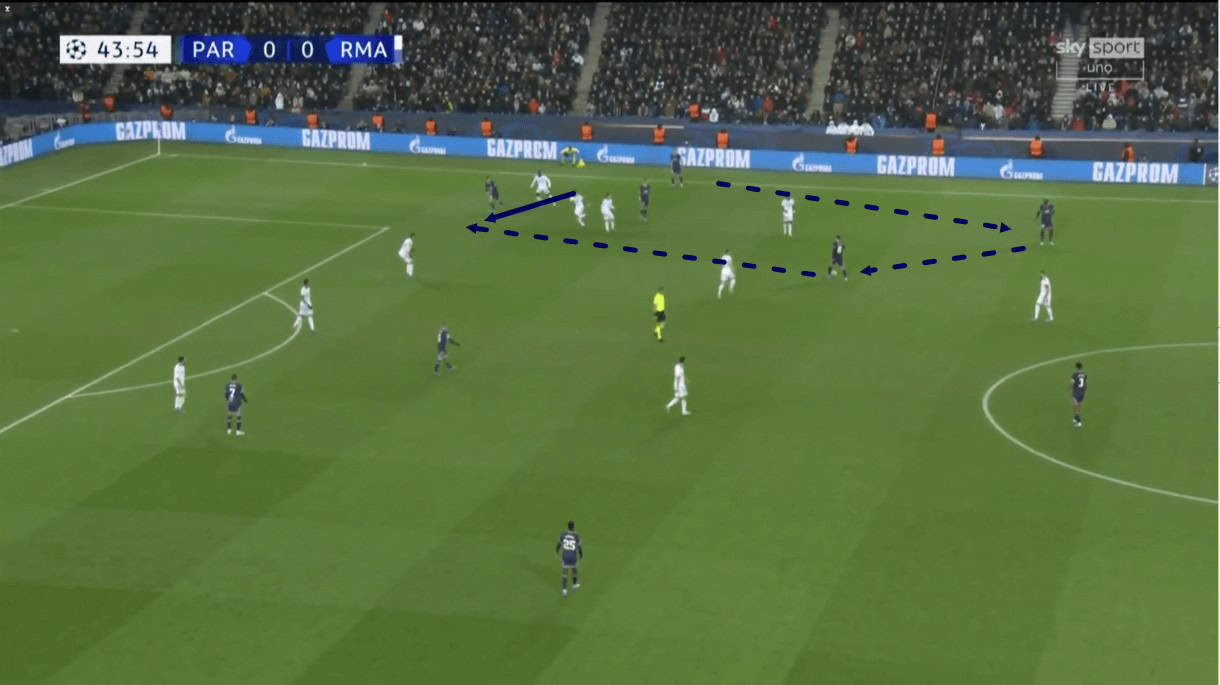
Here, as play moves on into figure 14, we see that on receiving the pass from Pereira, Paredes was then able to pick out a defence-splitting through ball into the running path of Messi, highlighting how running the play back through Pereira breathed new life into what appeared to be a struggling attack before. This shows how Pereira and Paredes played key roles in keeping the pressure applied to Madrid, preventing them from forcing turnovers and patiently going backwards to attack again from a different angle, all of which proved highly effective for PSG in their efforts to control the game versus their Spanish rivals on Tuesday.
Defending
For the final section of analysis, I’ll spend some time looking at PSG’s defensive tactics with a particular focus on the responsibilities of their midfielders. Firstly, as is evident from their 9.5 PPDA to Real Madrid’s 24.43 PPDA, PSG defended far more aggressively than their opponents in this game.


PSG’s defensive duels map (figure 15) and interceptions map (figure 16) highlight where on the pitch they typically engaged with Real players to regain possession and as is evident from the maps, PSG were very active on the edge of Madrid’s own third, preventing them from entering their half on plenty of occasions, while they were also very active in wider areas, with very few defensive engagements occurring in deep central areas. This is indicative of the fact that PSG engaged Madrid high in more advanced areas to prevent them from progressing into highly valuable/threatening areas at all, rather than collapsing into a low-block, packing those areas and making them difficult to play into through congestion.
PSG didn’t deploy the most aggressive press you’ll ever see in this game, generally engaging Madrid players around the centre-circle or forcing them into wide areas before increasing the intensity of their press there while using the sideline to their advantage too. However, it was very effective at winning the ball in the most desirable areas and preventing Madrid from progressing into more threatening positions.
The intensity of pressure from PSG’s midfielders — especially Verratti and Paredes — wingers — especially Dí Maria, who played an excellent defensive game, and full-backs, both of whom delivered a solid and intense defensive performance, was crucial to making these relatively aggressive pressing tactics work.
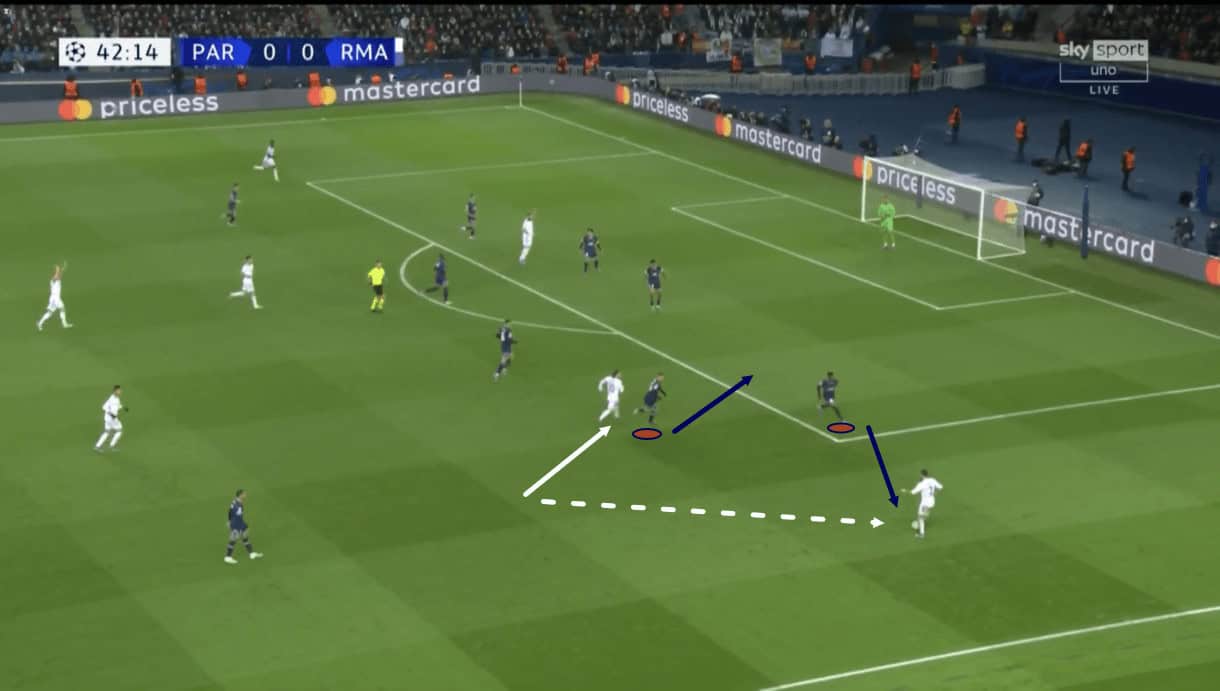
On the occasion that Madrid progressed beyond PSG’s midfield and got a winger into a 1v1 situation versus the full-back, PSG’s wide midfielders (Verratti and Pereira) had a crucial role to play to prevent Les Parisiens’ backline from being picked apart. This is seen in figures 17-18. Firstly, in figure 17, we see that as Madrid’s right-winger receives the ball, PSG’s left-back, Mendes, begins pushing out from the back to close him down. This creates a gap in the defence between him and the left centre-back which could’ve been exploited by a Madrid runner, which Modrić tried to do on this occasion, as we see in the image. However, Verratti tracked the runner and plugged the gap opening in his team’s backline, essentially filling in as a makeshift full-back while Mendes went out to press the winger.
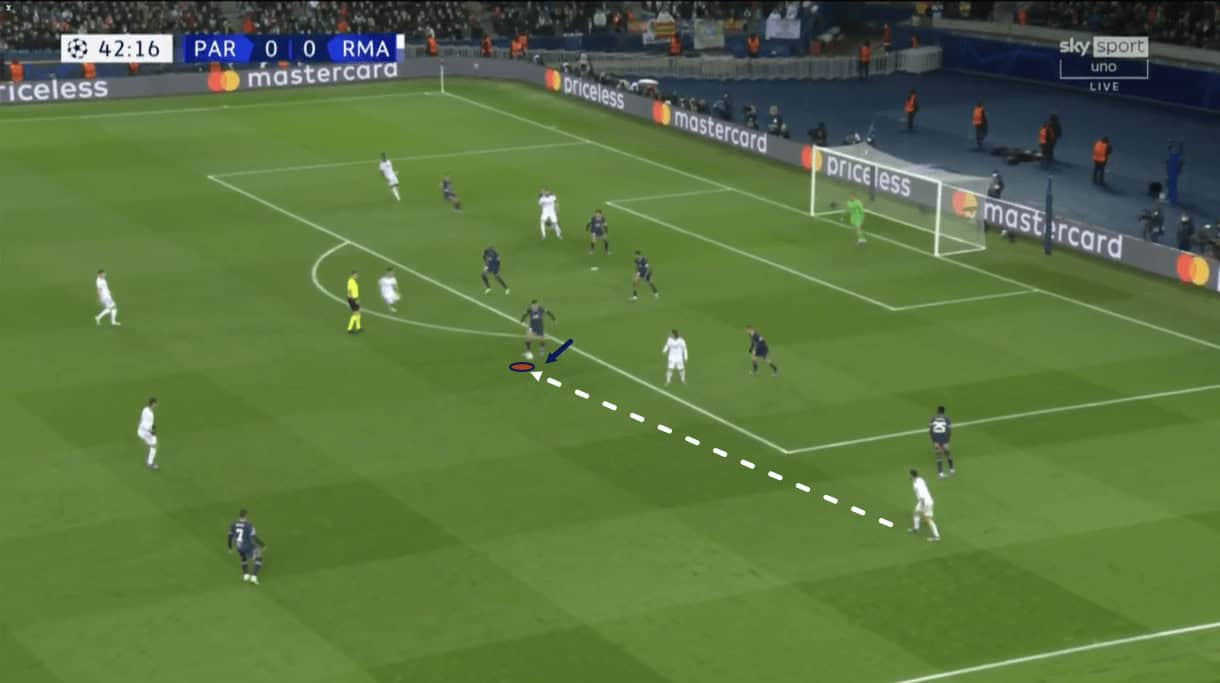
This was effective in nullifying Madrid’s threat here, as their attempt to pull the PSG backline apart and exploit the space opening, as a result, was thwarted. As play moved on into figure 18, we see that the winger, as a result, attempted to play the ball beyond Modrić into the teammate occupying zone 14. However, Paredes was on hand to step out and intercept the pass, regaining possession on the edge of the box and kickstarting a counter-attack for PSG.
Conclusion
To conclude this tactical analysis, it’s clear that PSG had a variety of profiles in their midfield that combined to create a winning formula versus Real Madrid in Le Parc des Princes. Of course, this was just one leg and in Carlo Ancelotti, Los Blancos could have no better coach in European competition to create a counter-strategy for the return leg at the Bernabéu, so all is very much still to play for.
The purpose of this tactical analysis piece was to highlight the successful tactics and impressive execution of Les Parisiens in the first leg and I hope that from this analysis, Pochettino’s game-winning plan and the midfielders’ game-winning performances are clearer. I felt it was an entertaining performance to watch and eagerly anticipate the return leg in the hope it throws up just as interesting an encounter.
