
‘The King is dead, long live the King’. This traditional proclamation of the transfer of royal power, upon the death of one monarch to his successor, felt like it could have been used at Stamford Bridge last night, given the speed with which the Thomas Tuchel era is now in place at Chelsea. The German coach had a whirlwind 48 hours, by his own admission, only landing in England around 24 hours before the game against Wolves, and thus only able to take charge of one training session before the match. Nevertheless, he was able to stamp enough of his identity on the side, with Chelsea looking and playing quite differently to how they had done under Frank Lampard. It will take some time before Tuchel is able to fully impart his ideas and tactical principles to the squad, but this was a solid base on which to start his reign, so to speak, and Chelsea fans should be encouraged by various aspects of their team’s display, even if there is a lot that needs to improve as well.
This tactical analysis pieces will look at three things that Thomas Tuchel did in the game against Wolves which were an improvement over Lampard’s tactics, while also stating some obvious and immediate areas where improvement is needed as well.
A fixed-yet-flexible shape, in and out of possession
Upon receiving the teamsheet ahead of the game, most observers would have expected Chelsea to line up in a 4-2-3-1 formation. Those, however, who are familiar with Tuchel’s work, may have sensed that it would actually be a different shape in operation, as proved to be the case when Chelsea took to the field.
In fact, according to Wyscout, Chelsea played in a 4-2-3-1 for the majority of the game, showing how Chelsea’s shape is still up for debate –

It is quite clear that Chelsea had something of a hybrid shape. In possession, the Blues were in a 3-4-3 or 3-4-2-1 shape, with captain César Azpilicueta tucking infield to play as the third centre-back alongside Thiago Silva and Antonio Rüdiger, while Ben Chilwell and Callum Hudson-Odoi were the wing-backs. Jorginho and Mateo Kovačić formed the midfield pair, with Hakim Ziyech and Kai Havertz given free roles ahead of them, and behind Olivier Giroud. The team’s shape when on the ball can be seen clearly here –

We can see the three centre-backs, with the midfield pivot, and Chilwell and Hudson-Odoi pushing up to be in the same horizontal line with the two playmakers, and finally, Giroud as the lone centre-forward.
This is borne out in Chelsea’s passing map from the match as well –

Why was this then a hybrid shape? It was intended to be a 4-2-3-1 when out of possession, with Azpilicueta moving out to the flank, Ziyech moving a little more central, and Hudson-Odoi staying high and wide. However, Wolves rarely had extended spells of possession on the ball, which meant that Chelsea did not really snap back to this shape, and continued to play in their 3-4-2-1. We can expect to see this come to the fore more as Chelsea play teams with more ambition than Wolves, but it is encouraging that Tuchel has already managed to instill some of these ideas within the squad in the space of a single training session.
Havertz and Ziyech as ‘free eights’
One of the most pressing items in Tuchel’s in-tray would have been the question of rejuvenating Kai Havertz. The German playmaker, bought at great expense from Bayer Leverkusen in the summer, has looked a little lost at Stamford Bridge, having been played in a variety of roles and positions by Lampard without being able to show anything similar to his performance levels in the Bundesliga. Of course, a positive COVID-19 diagnosis which affected him physically, along with a couple of niggling injuries, combined with the fact that he is having to adapt to a different league and country during these unprecedented times, are all mitigating factors. Nevertheless, it did seem as though Lampard did not really know how best to deploy Havertz without destabilising the defensive balance of the team.
Tuchel, on the other hand, made Havertz central to his plans, quite literally, along with Ziyech. The duo were fielded as twin playmakers, or ‘free eights’, behind Giroud, with their main task being to receive possession in the half-spaces and between the Wolves’ lines. This would force the Wolves centre-backs to either come out and engage with them and therefore leave space in behind, or stay back and allow the man in possession to turn and pass or run.

Notice the positions that the duo have taken up as Jorginho drives forward with the ball. They are on either side of the Wolves midfield duo, while also in the wide half-spaces where it is so difficult for opposition defenders to step out and engage them due to the risk of leaving space in behind.
The Wolves defence largely allowed both players to receive the ball between the lines, content to sit back and deny Chelsea space behind. However, there were a few occasions where one of the centre-backs did step up to engage, and one such example shows us exactly why Tuchel wanted Ziyech and Havertz to play in this manner.
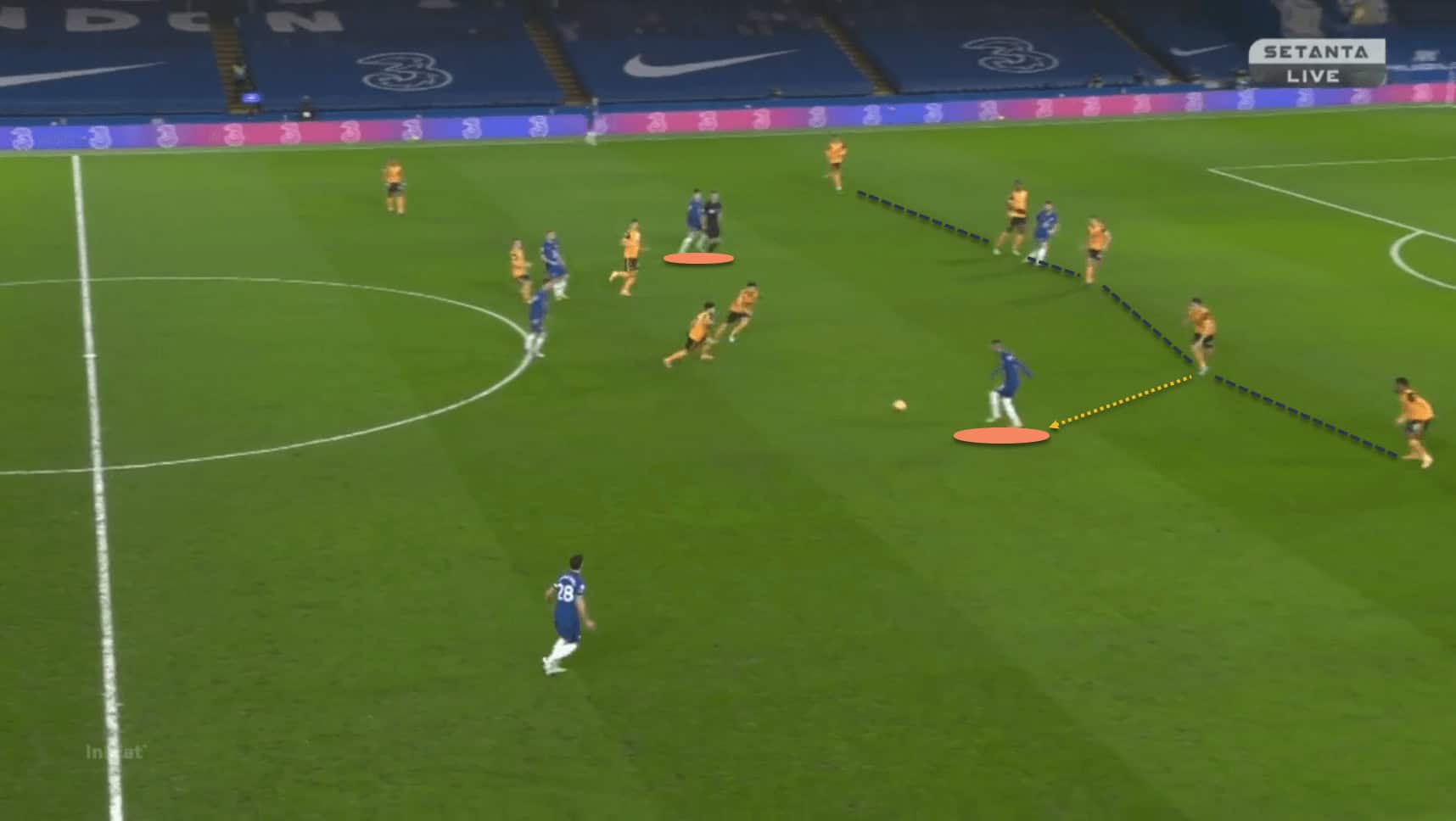
Moments after the start of the second half, Havertz and Ziyech are in similar positions, either side of the Wolves midfield duo, and in the half-spaces. Ziyech receives the ball from Kovačić, which prompts Max Kilman to step out of the defensive line to close him down.

We can immediately see the space that is now created between Nélson Semedo and Conor Coady due to this. Ziyech opts to pass to Hudson-Odoi, who is wide on the right, and the move culminates with a low cross towards Giroud being cleared by Wolves.
This example also shows one of the issues with Chelsea’s system, or rather the personnel, last night. Giroud is a striker who prefers to drop deep and combine with midfielders and wide attackers. In that sense, he would have enjoyed last night, given that he was able to drop off the Wolves backline and play quick combinations with Havertz and Ziyech. However, for all the possession that Chelsea had, they suffered from a lack of penetration. Almost all of their play was in front of the Wolves defence, and they only sporadically threatened in behind through Hudson-Odoi, and Chilwell on rarer occasions. In the image above, Giroud makes the run highlighted in blue, when perhaps a better option might have been to make a curved run ahead of Coady into the highlighted space. However, Giroud’s lack of pace means that he would have struggled to get away from Coady, which is why he probably didn’t attempt this run in the first place.
Now imagine if this was Timo Werner instead. The German would have offered an alternative run, and in general, would have looked to run in behind, which would have helped push the Wolves defence deeper, giving the two playmakers even more space. At the same time, it would have offered Chelsea more penetration. We can expect to see Werner starting games for Chelsea in the near future, and we may even see Tuchel use a twin striker system, with Werner operating as an inside forward off the left, to better suit him and his capabilities, rather than use him as a lone centre-forward.
Chelsea’s tactics for build-up and progression
There were other aspects to Chelsea’s play when in possession which were also quite interesting. One of the central tenets of positional play is for constant player movement to take up spaces on the pitch which are vacated by other players. We saw this to quite an extent with Chelsea, although Tuchel would have wanted more flexibility and movement. Another interesting tactic was the use of a 3-2 shape in the build-up phase, which allowed for easy ball progression.
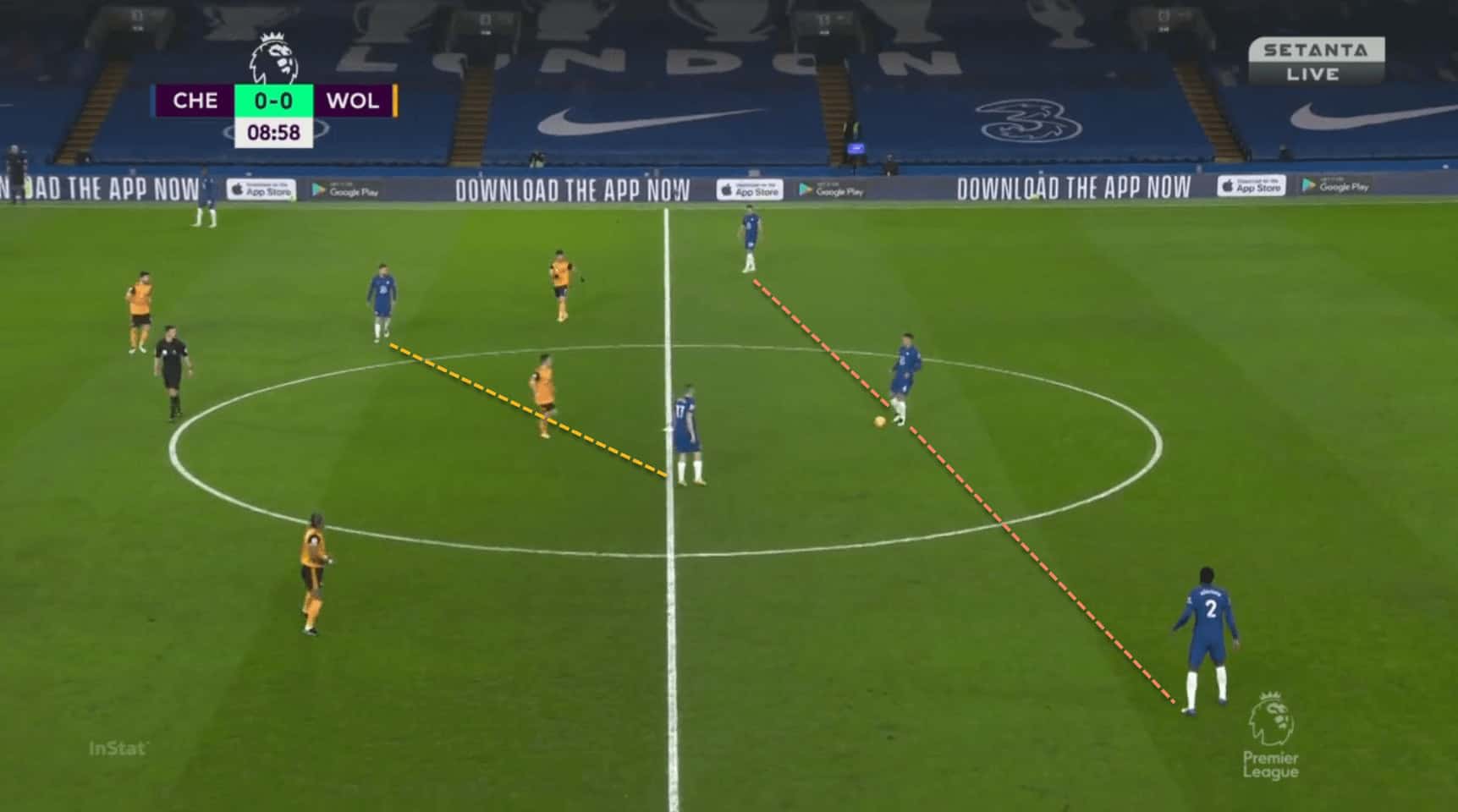
The three defenders and two central midfielders form this 3-2 shape, and easily outnumber the Wolves attackers, which allows for the ball to be progressed easily into central areas. Occasionally, Azpilicueta would move a little higher and wider, especially to support Jorginho, since the Italian would often be the higher of the two central midfielders, as we can see in the above image as well.
Another fascinating tactical outcome of this shape was the creation of a ‘box’ shape in midfield –

The two central midfielders, along with the two attacking midfielders, often formed this sort of shape during the game. As can be seen from the image, they are outnumbering the three Wolves players in that zone, once again allowing for the ball to be progressed centrally into dangerous areas. This is something that Pep Guardiola has used quite frequently, most notably and recently at Manchester City, where David Silva and Kevin De Bruyne would be the ‘free eights’, with Fernandinho and one of the full-backs tucking inside forming the base of the box. The aim remains the same – to maximize possession and territory, and make it easy to progress the ball centrally. It will be interesting to see if Tuchel sticks to this, since he is known to change formations and systems quite a lot based on specific opponents, even if the general tactical principles stay the same.
Chelsea also employed quite a few positional rotations down their right flank, which is where the majority of their attacks came from. Hudson-Odoi stayed wide on the right, but we often saw Ziyech dropping quite deep to try and drag out a Wolves centre-back and thus create a gap for the England winger to burst through. Azpilicueta would also advance from centre-back at times to create an overload, although this was occasional.
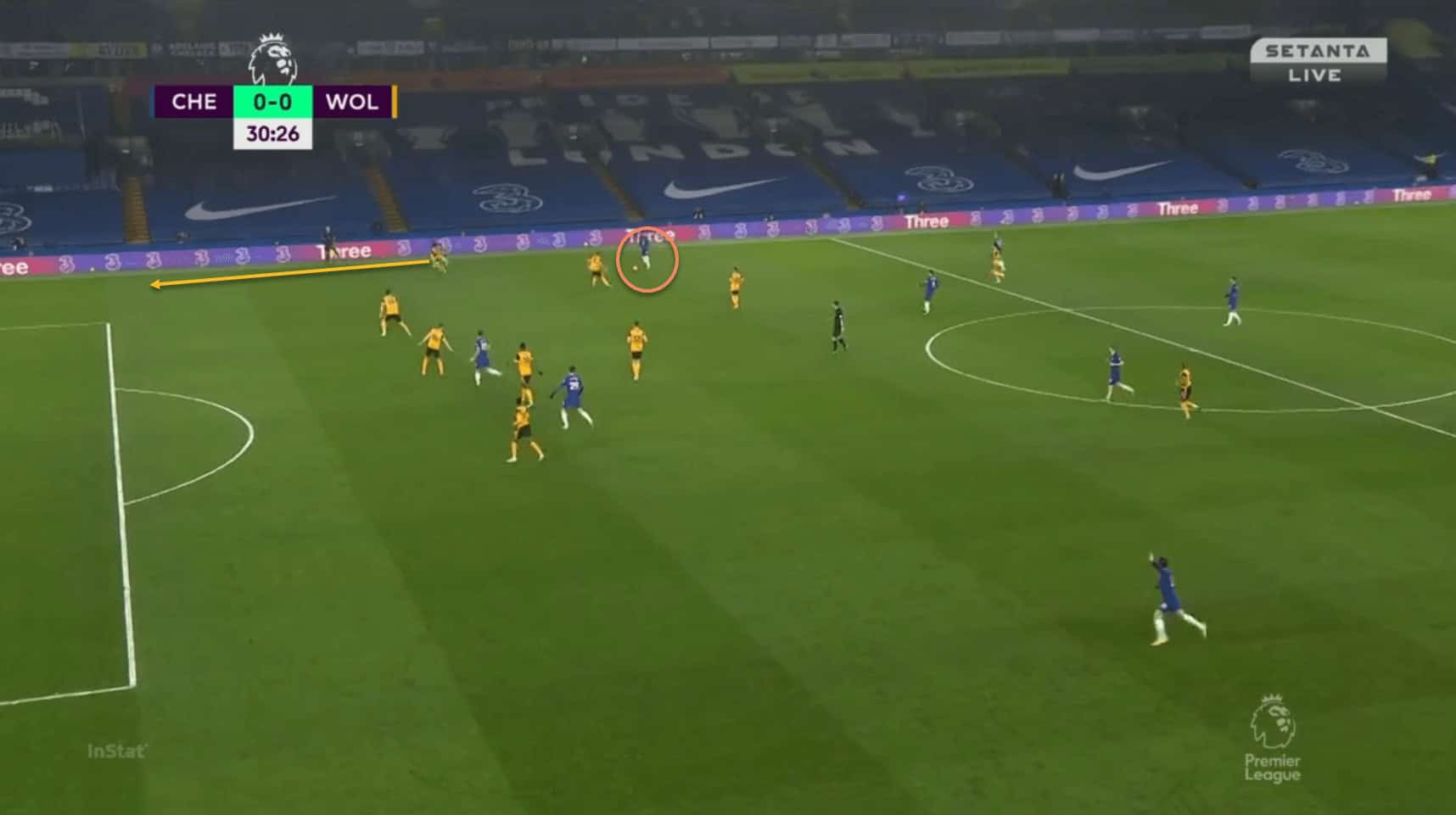
Note how the Moroccan has dropped deep here, drawing a Wolves player to him, with Hudson-Odoi running past him and into the space.
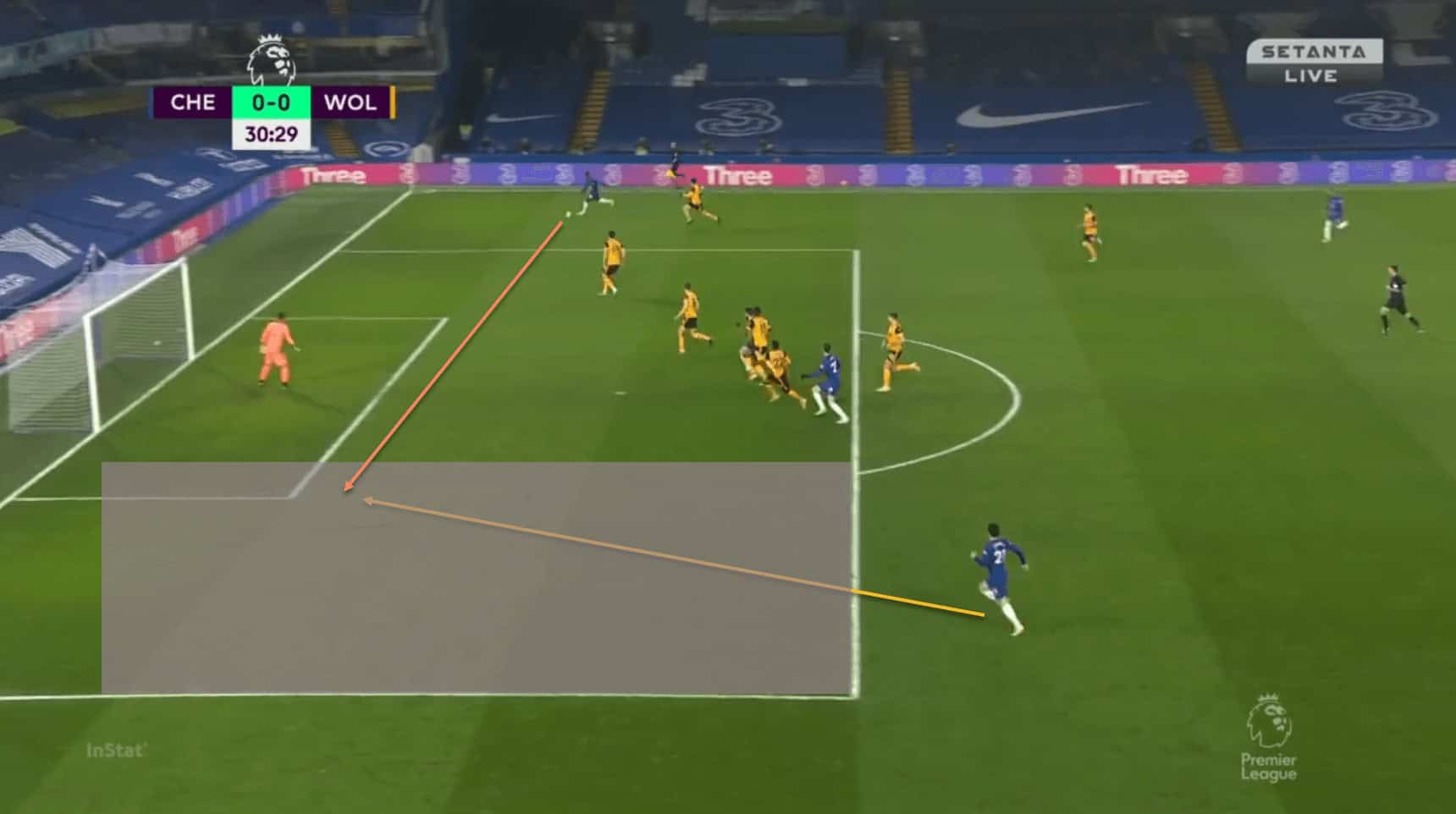
Hudson-Odoi is able to get away from the Wolves defender and send in a low cross for Chilwell, who has oceans of space in the box to run into. The left wing-back was not able to control the ball cleanly though, and the chance went away.
This occurred quite a few times, in that Chelsea often looked to build-up down their right, and then quickly switch the ball to the left where Chilwell would be waiting in a lot of space.
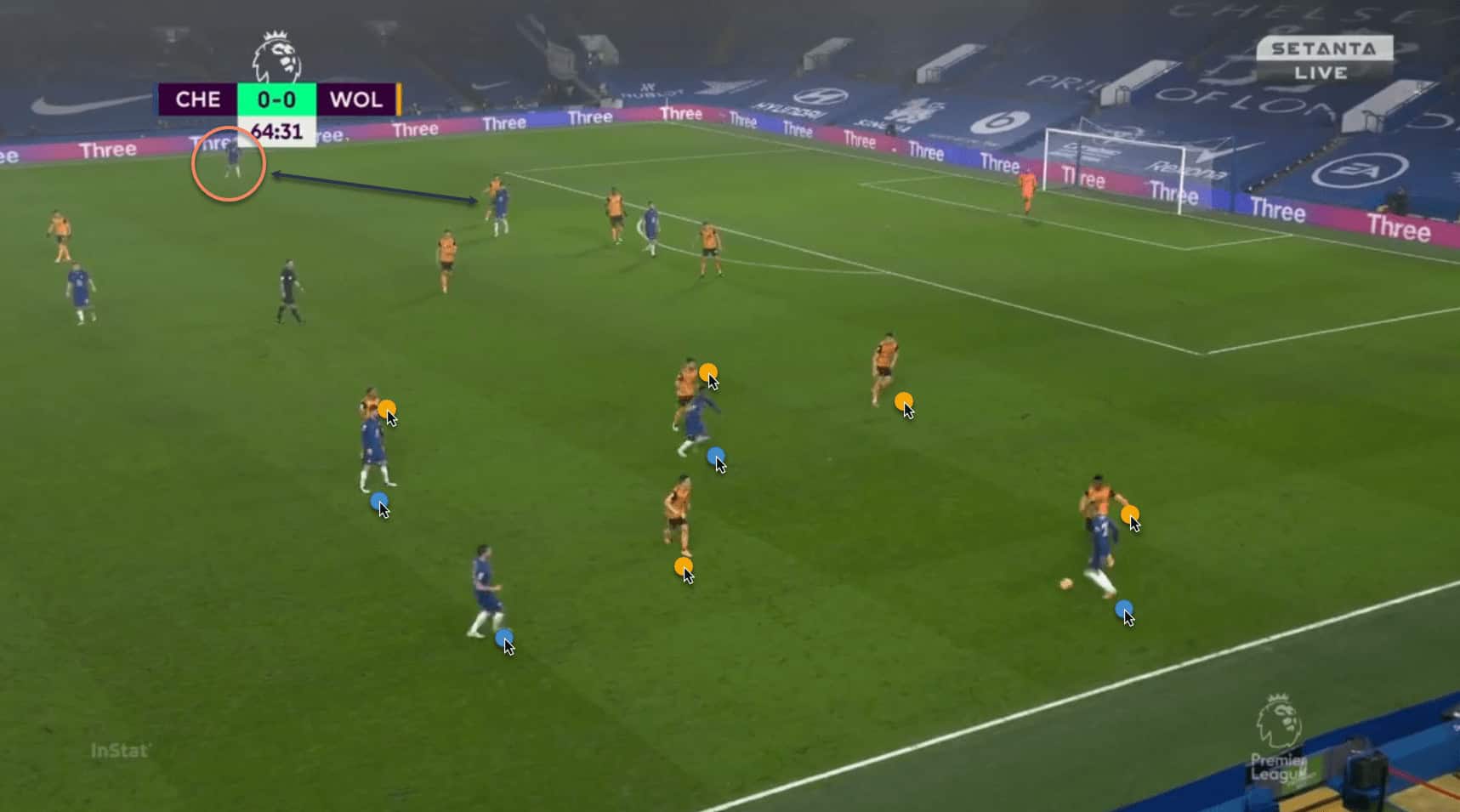
Note how Azpilicueta has stepped up from the defensive line to support Chelsea’s ball possession, while Jorginho has also come to right flank. This has drawn five Wolves players to this side of the pitch, and this, combined with Chilwell’s high and wide positioning, means that he is in space on the left.
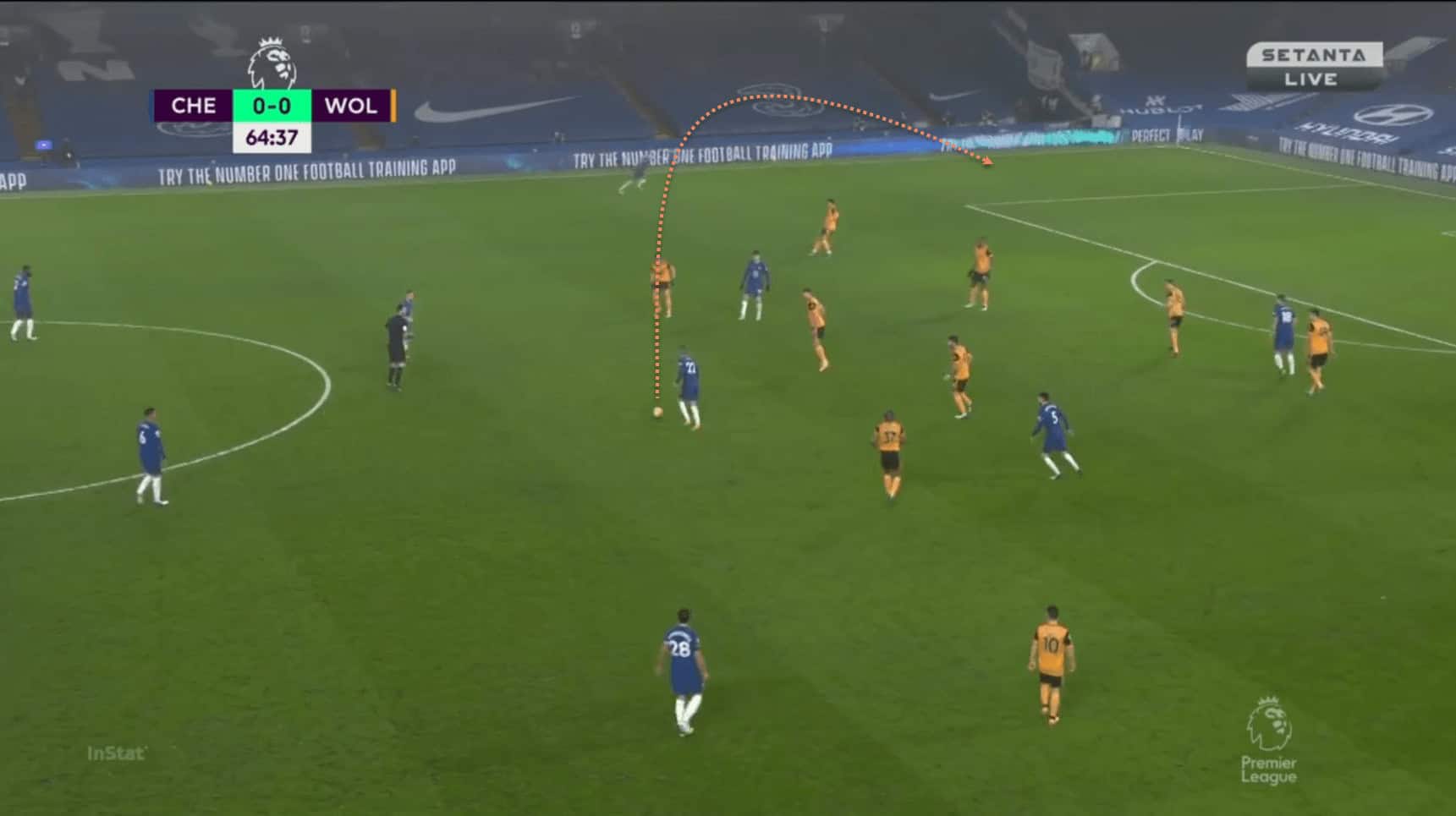
After a quick exchange of passes, Ziyech moves into a central position and plays the pass over the top to Chilwell, from where he advances to the touchline and sends in a low cross which Wolves only just manage to clear.
We saw Ziyech and Hudson-Odoi swap positions too, and this also caused Wolves a few problems on occasion.

Ziyech and Hudson-Odoi have effectively exchanged positions, and as Jorginho plays the pass to the England winger, he draws Semedo towards him by dropping off, which then creates the space for Ziyech to receive the ball with a first-time pass around the corner.
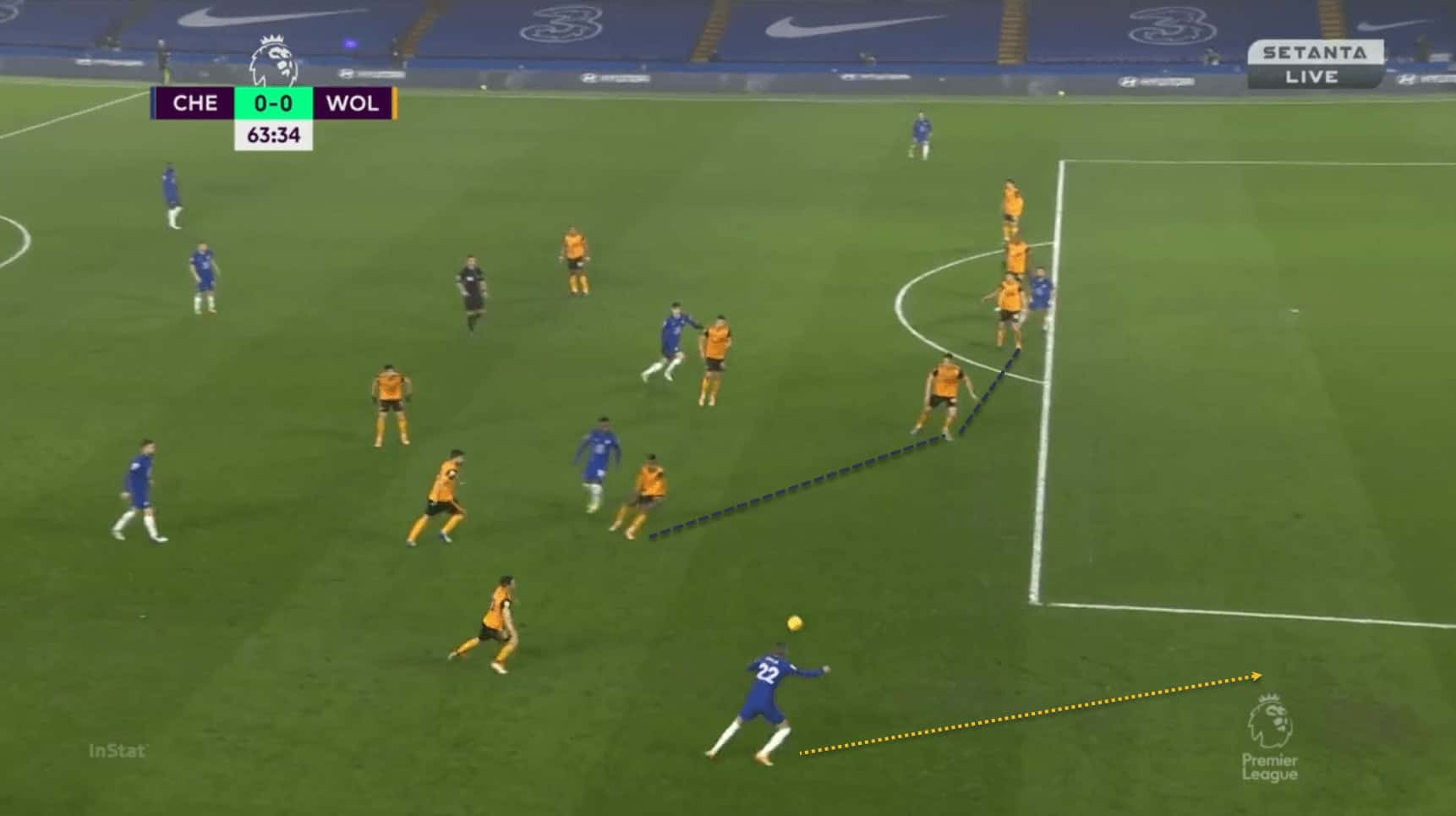
That is exactly what happens, and Semedo’s charge has now opened up the space for Ziyech to drive into.

The Moroccan delivers a low cross for Giroud at the front post, which he does not control cleanly, having got in front of Coady, and once again a half-chance goes begging.
Thus, we can see that while the basic structure for Chelsea, especially in possession, was fixed, there was some positional rotation within it in an attempt to prise open Wolves’ defence. While the Blues may not have been successful in this regard, they did manage to create a few half-chances, which, with better first touches by the player receiving possession, could have led to a goal or two. Tuchel was quite satisfied by this display, and it is a very solid base on which he can now work regarding specifics and tweaks to bring in that cutting edge that was lacking today.
Final thoughts
Chelsea were utterly dominant in this game, at least in terms of possession, recording nearly 76% of possession, according to Wyscout, with 880 attempted passes, which is much higher than what they had been notching under Lampard. However, as stated earlier, there was a lack of cutting edge, but this will come with time as Tuchel gets more training sessions under his belt. For now, Chelsea fans can be encouraged by the fact that we can already see an idea of what the German manager wants to do in and out of possession, with the players having shown that they can also adapt quickly to this change, and thus it will be interesting to see this style of play develop as Tuchel looks to bridge the gap to the top four in the Premier League.
