
The UEFA Champions League gets back underway this week, with the first tie seeing RB Leipzig take on Liverpool, with the game acting as RB Leipzig’s home game despite being played in Budapest. The two sides are on opposite trajectories at the moment, with RB Leipzig the only consistent contender to Bayern Munich in the Bundesliga this season, while Liverpool are coming off the back of three consecutive defeats in the Premier League.
Nagelsmann’s Leipzig clearly pose a big threat to Liverpool’s hopes of having a run in the competition, and Nagelsmann has a track record of devising excellent game plans that can secure results, and so this only adds further to their threat in cup competitions. Thankfully, the two teams I have watched the most of this season are probably RB Leipzig and Liverpool, and so in this tactical analysis, I will preview the tactics of both teams, assessing how Nagelsmann may set up in and out of possession to exploit Liverpool, and also show how Liverpool can exploit Leipzig.
Breaking the Liverpool press
Part of the tactical conundrum RB Leipzig pose is their excellent flexibility and fluidity between shapes, and so when analysing them before a game it can be difficult to nail down an exact shape they are likely to play against you. When Leipzig are in possession then, you certainly rely on nailing down their general principles and structuring your press so that it can deal with adaptations that are thrown at it- which thankfully Liverpool’s press is pretty good at.
Leipzig manager Julian Nagelsmann has come up against Liverpool before during his Hoffenheim days, where both games were tight in terms of performance but Liverpool comfortably went through in the end, in part thanks to a excellent free-kick from a young English full-back called Trent Alexander Arnold. This tie though did show Nagelsmann’s ability to coach a team to play through Liverpool’s press, and we can see a few examples below of how this was achieved.
Hoffenheim used a 3-1-4-2 structure in their home leg against Liverpool and aimed to nullify Liverpool’s cutting of the passing lanes into the full-back. We can see the general shape to the game here, with Liverpool’s pressing scheme unchanged since this game back in 2017. Roberto Firmino’s role is made slightly more difficult against a back three in that he now has to press a centre back while keeping a pivot in his cover shadow. The inside forwards press from out to in, so the opposition are showed the inside lane, and it was this inside lane which Hoffenheim looked to use to access their wing-backs.
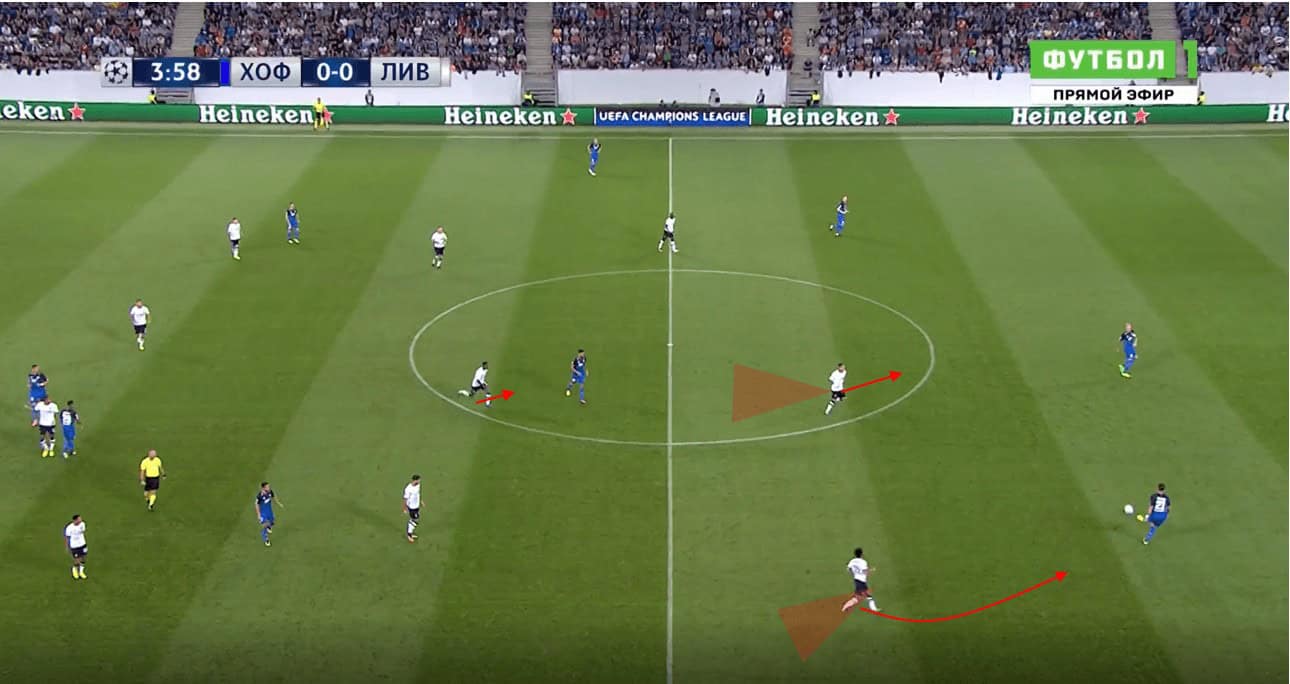
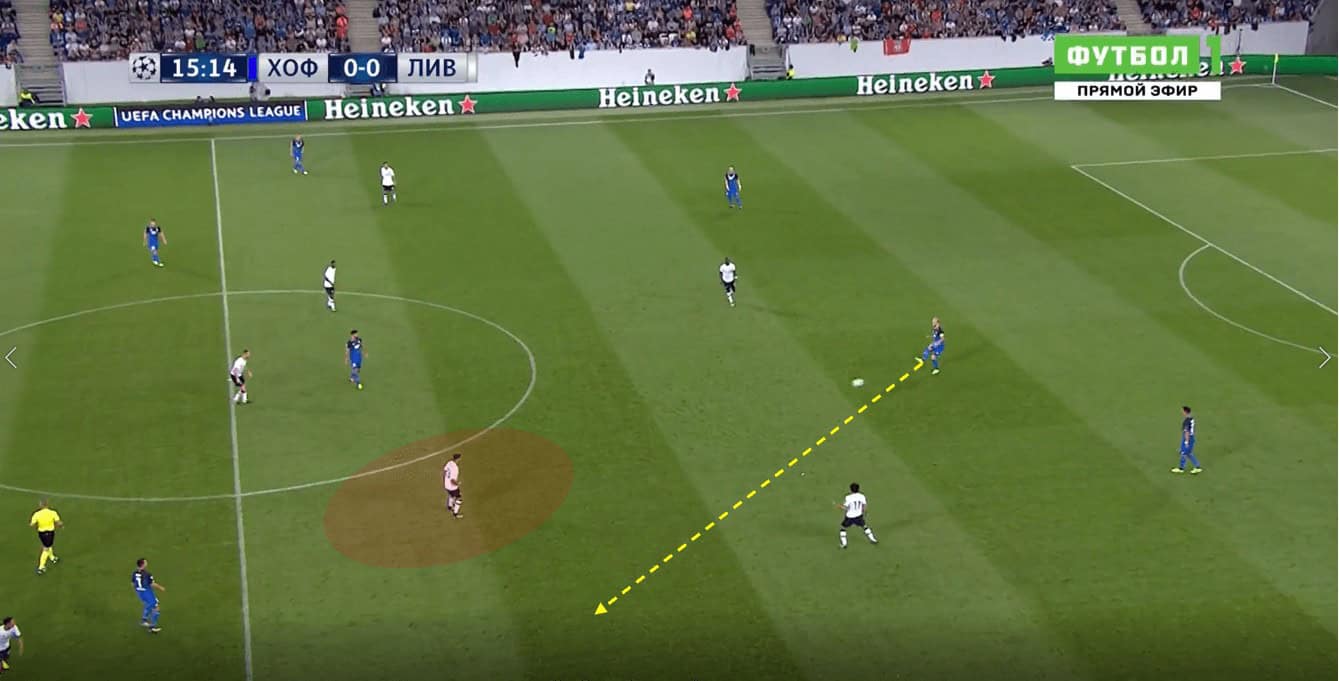
They achieved this by using that back three and by occupying Liverpool’s central midfielders, as we can see below. The back three allowed for quicker circulation of the ball from side to side, and also reduced Liverpool’s general intensity towards the ball, and this meant with quick circulation that the single pivot (Kerem Demirbay) could be accessed away from Firmino’s cover shadow. Here he takes up a slightly wider position deliberately in order to occupy the Liverpool right central midfielder (Emre Can). With Salah oriented towards pressing the widest centre back, he stays higher to give himself a good starting position and angle to press from, and so the lane between these two players is open. Full-back Alexander-Arnold is pinned in place by a striker, and so he cannot move, and Hoffenheim create a free player.
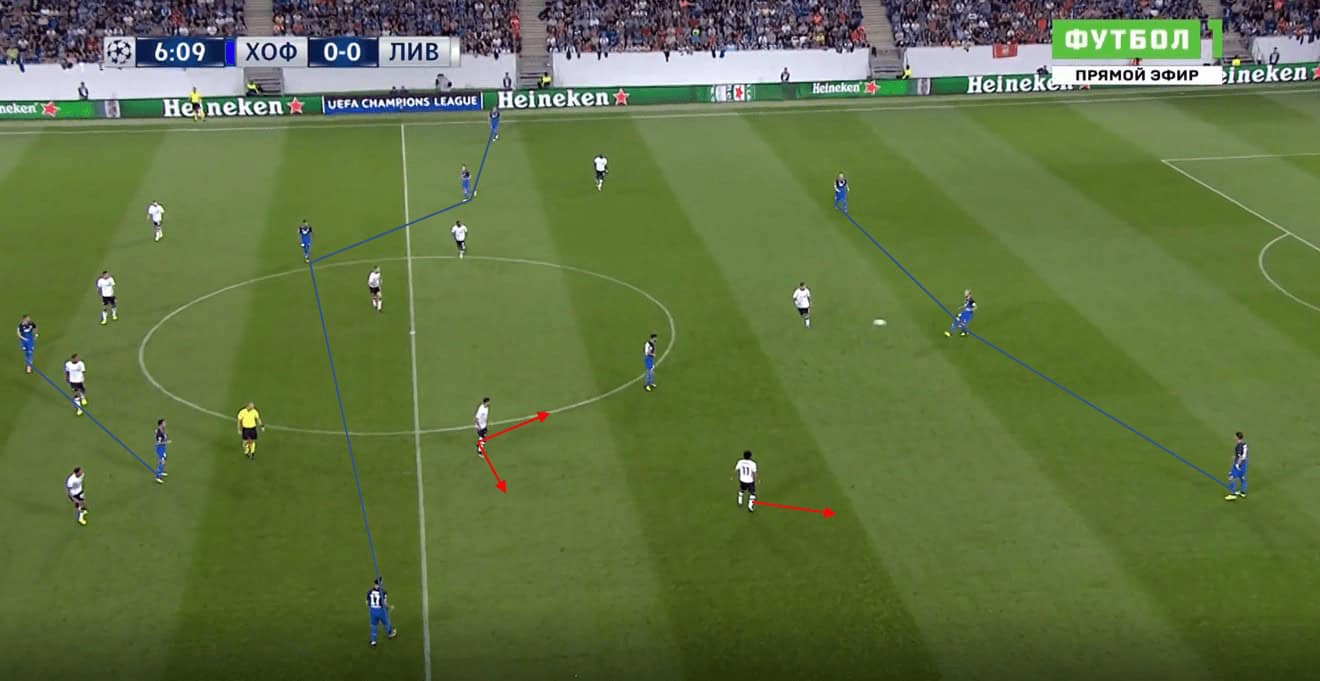
Emre Can is not even occupied by a player directly here, but he does not want to commit too wide as this isn’t the conventional position for a central midfielder, and he also wants to cover a central lane. As a result centre back Kevin Vogt can play a simple pass through, and again we see Alexander Arnold is pinned, and so doesn’t want to gamble early to press the wing-back (who is off-screen). To solve this, Salah would have to drop much deeper (almost in the same line as Can), or Can would have to adjust his angle to limit space, which then has an effect on the rest of Liverpool’s midfield. Alternatively, Liverpool had to be more aggressive and ensure Vogt wasn’t given this much time and space on the ball.
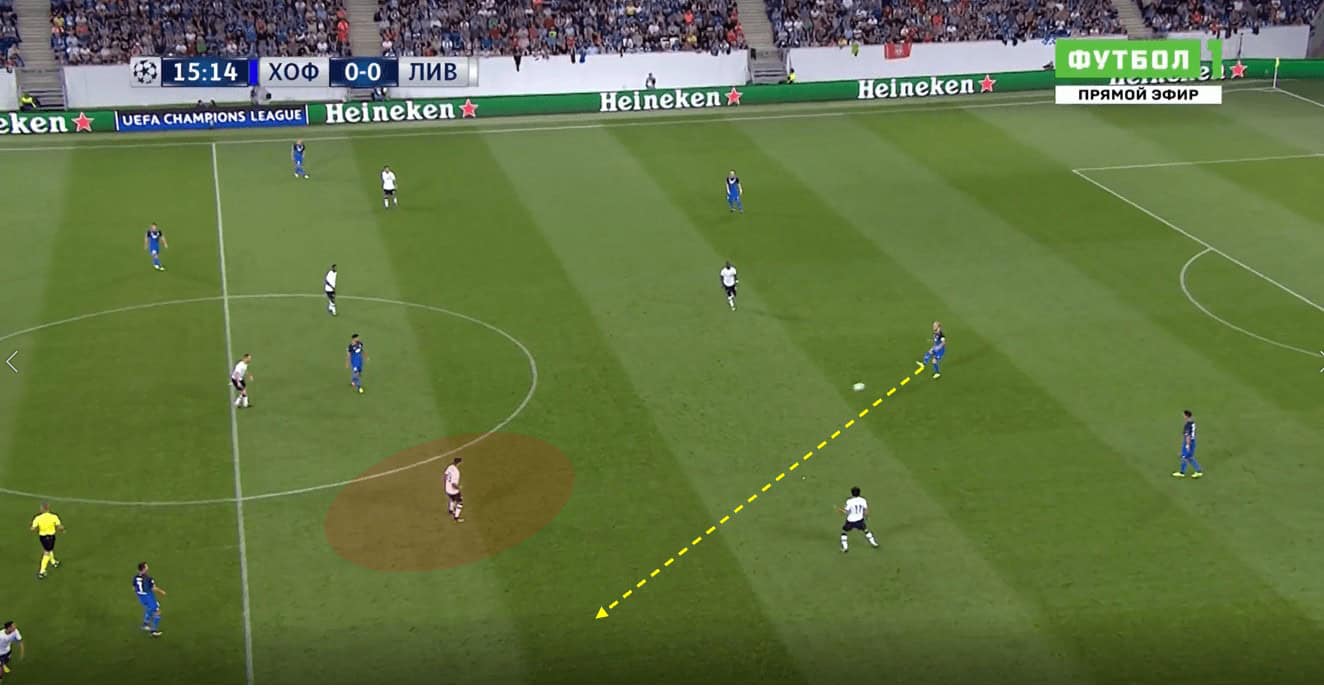
Once the ball was in these areas, Hoffenheim aimed to create an overload on the full-back (in the half-space) using a striker and a midfielder between the lines. We can see Alexander Arnold is outnumbered 2v1, with Hoffenheim also having runners centrally who could exploit space.
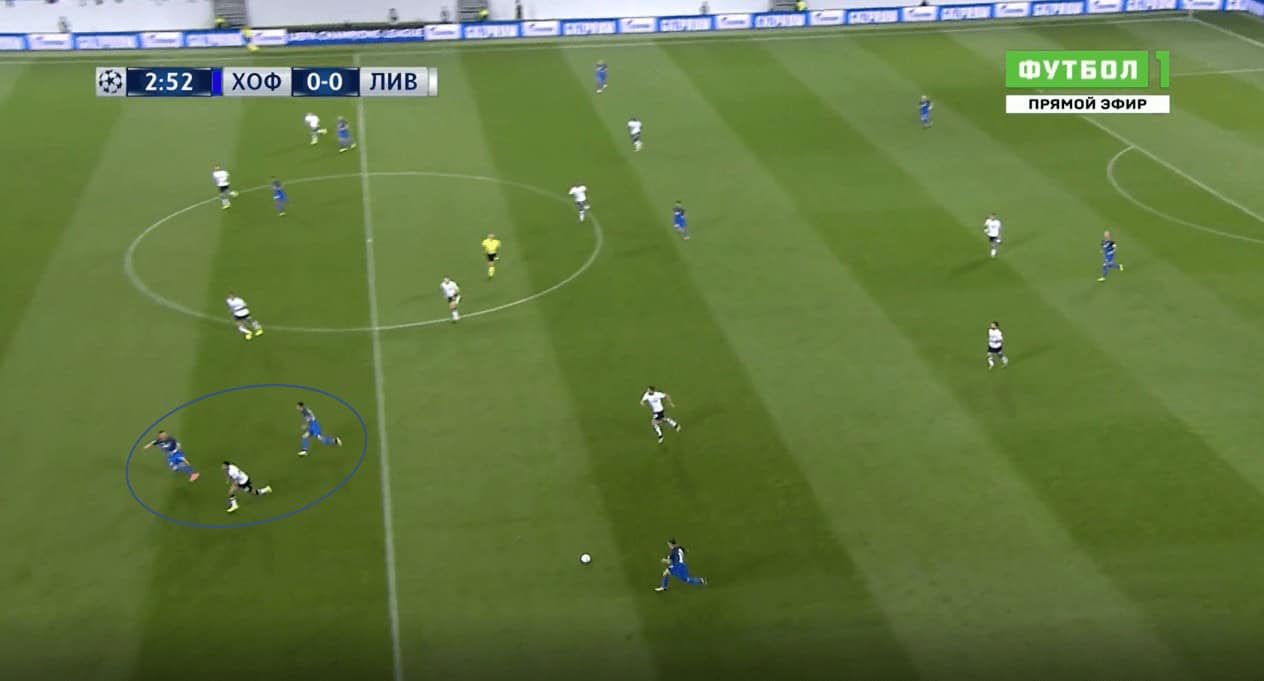
Hoffenheim use the same concept of occupying the wide central midfielder to exploit space again here, with Demirbay again positioning himself more towards the wide central midfielder in order to occupy them. Demirbay points for the pass to be played into the half-space, and you can see the numbers Hoffenheim get around this area, although their movements are timed poorly. Again Wijnaldum should really prioritise cutting the passing lane and leave Henderson to deal with Demirbay should he receive the ball, but again it’s quite easy to say that watching from a good angle and replays.
Another method of accessing a wing-back is to dribble and make diagonal passes or dummy a pass to then cut back in, but this is easier said than done when a Liverpool player is pressing. Dayot Upamecano has a track record of being quite skilled in this regard though.
Centre backs moving forward as a six
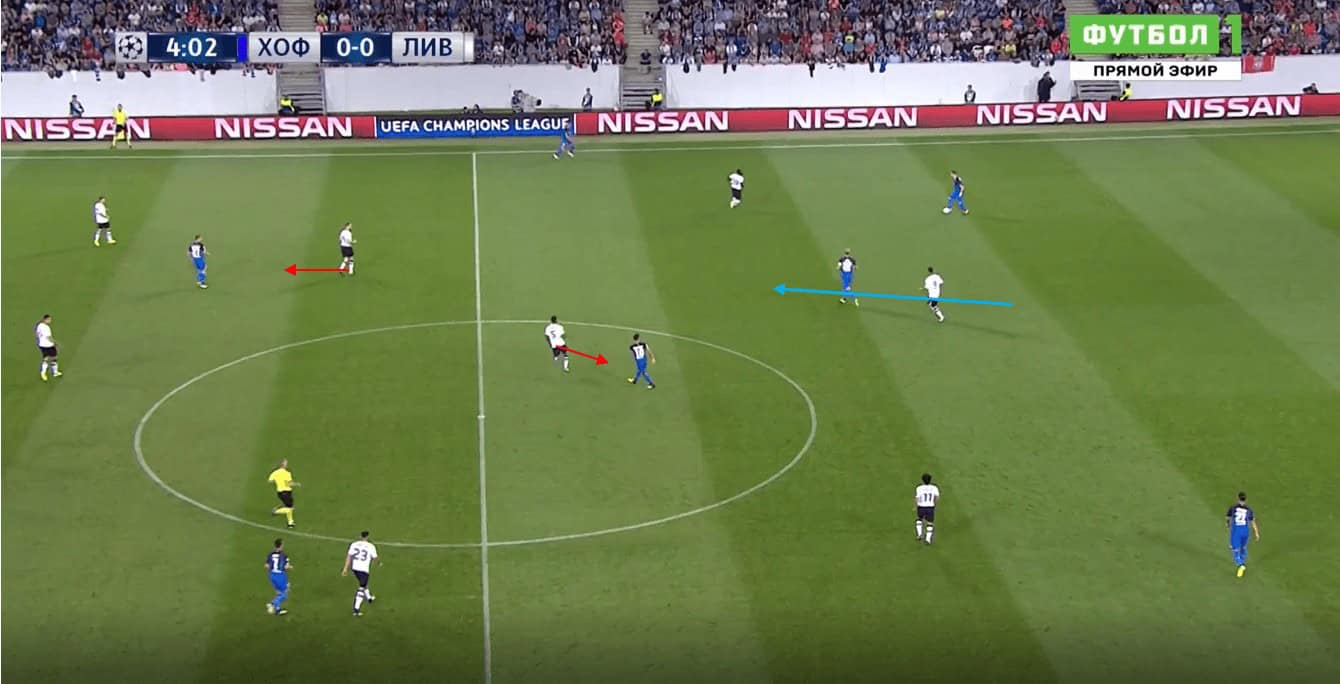
Another concept we saw briefly in this game is Nagelsmann’s use of the middle centre back as a number six at times, something which he has continued to do with RB Leipzig. This can be done more statically from goal kick situations, and can also be done dynamically as it is here by Kevin Vogt. Vogt receives the ball and plays it wide, and then immediately moves forward into the empty space ahead of him to receive the ball again. We can see all of Liverpool’s midfield is occupied, and so this opens up the opportunity for an overload.
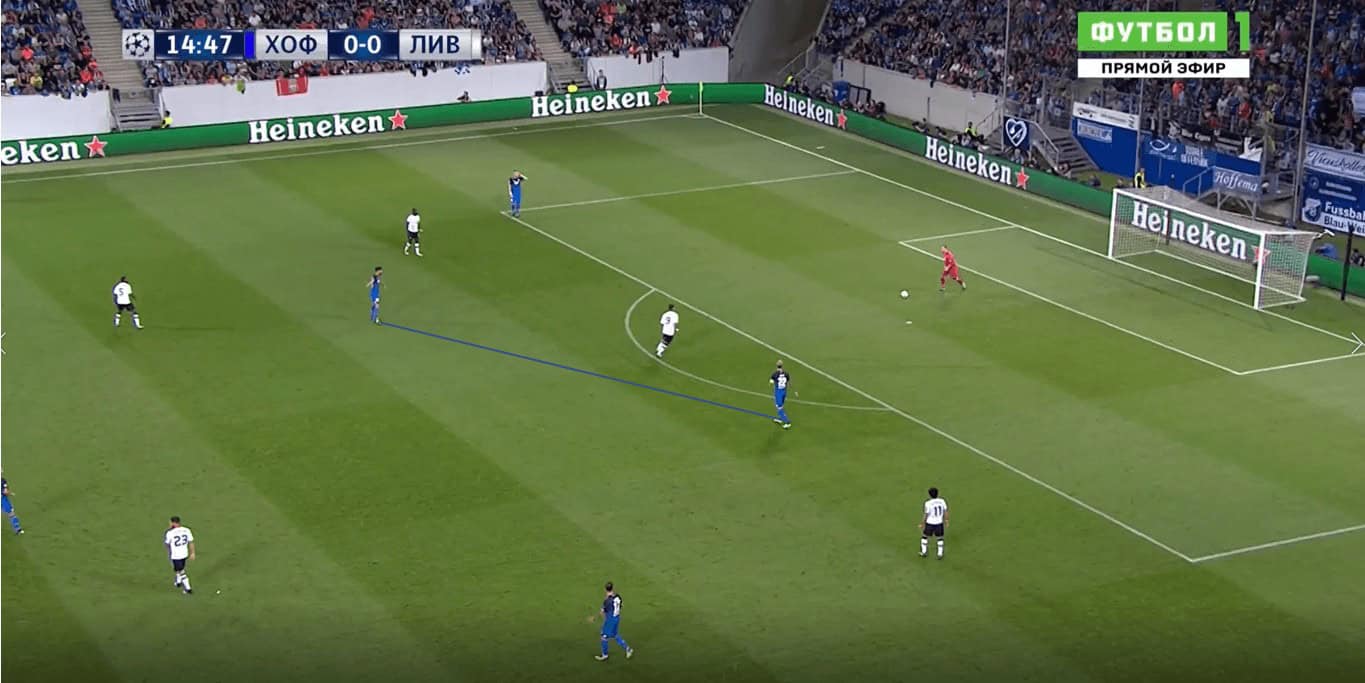
Here Hoffenheim use their goalkeeper to good effect, with Baumann here basically taking on Vogt’s role, meaning Vogt can push on to become a six. Firmino doesn’t cover either player with his cover shadow particularly well, and so again Hoffenheim get the chance for an overload.
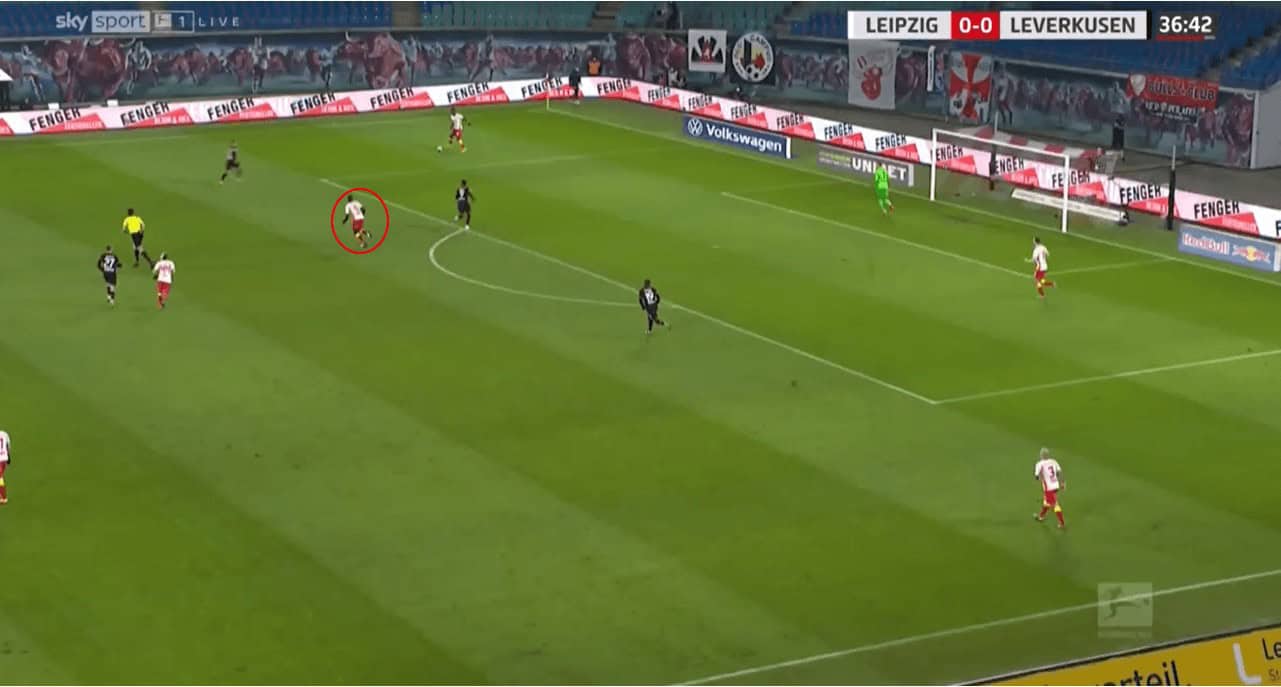
Bayern Munich bound Dayot Upamecano is used to this role in deeper areas, with the Frenchman often pushing higher while the Leipzig centre backs split from the goalkeeper.
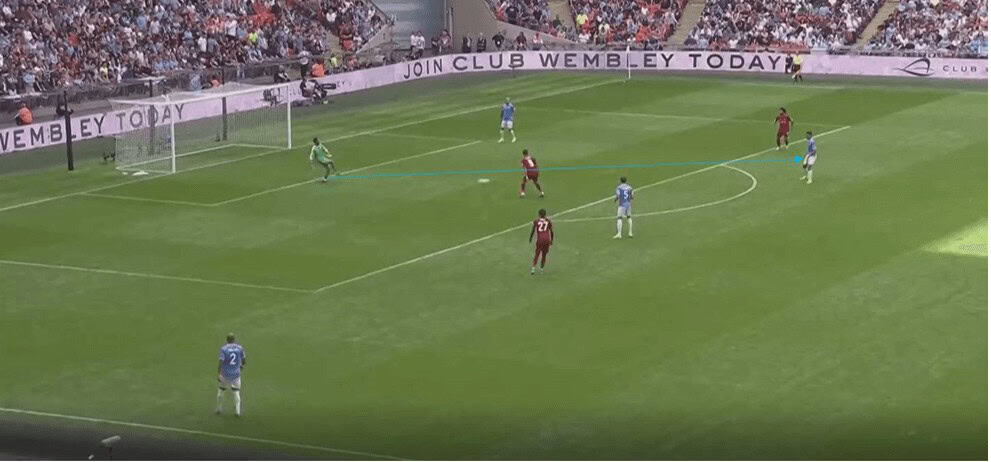
Manchester City used a nice asymmetrical structure from a goal kick to overload Roberto Firmino and to open the passing lane into this overloading player, with John Stones pushed higher here in the six space in Firmino’s cover shadow.
Overloads in midfield
Again another concept we saw in the Hoffenheim-Liverpool game which has been replicated recently has been the overloading of Liverpool’s central midfielders with good spacing and pinning. Man City gave the best examples of this using a 4-2-2-2 in lockdown last season, in a game they won 4-0. We can see this structure illustrated here, with the general idea being to create an overload on the ball near central midfielder, in this case Liverpool’s left sided midfielder. A double pivot is used again which overloads Roberto Firmino, and therefore can cause either one or two central midfielders to match up against the double pivot, and therefore space elsewhere is conceded. This follows the same concept as Nagelsmann’s 3-1-4-2 as it is exploiting the same passing lane, but the method of doing so is slightly different.

We can see in an example here from this game an example of this overload, with Rodri sitting in front of Henderson for Kevin De Bruyne to then drop slightly wider to receive the ball in the half-space. Firmino will have to press intelligently and efficiently against Leipzig in order to protect his central midfielders from being overloaded, as Leipzig are more than capable of creating overloads in midfield.
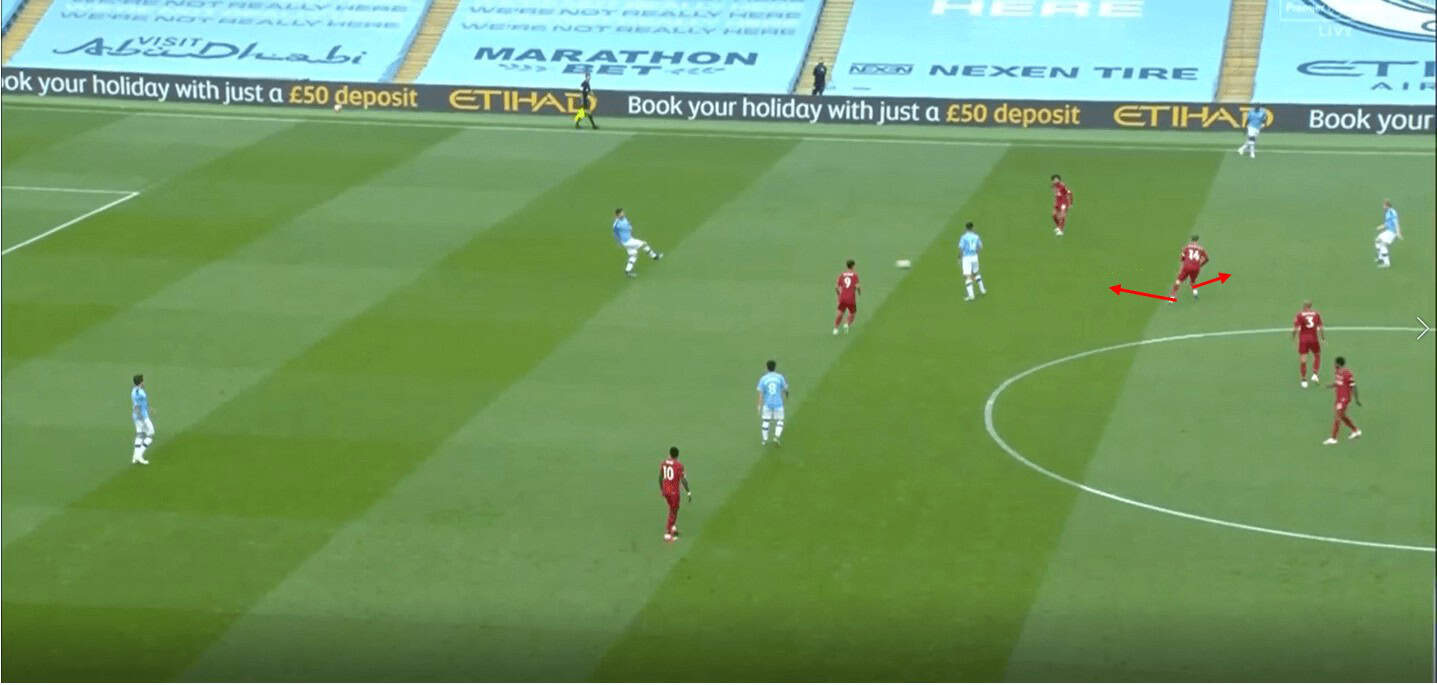
In the most recent game between these two, City’s fluid shape allowed them to drop into a similar structure, with an overload created around Thiago here and Alexander-Arnold pinned.
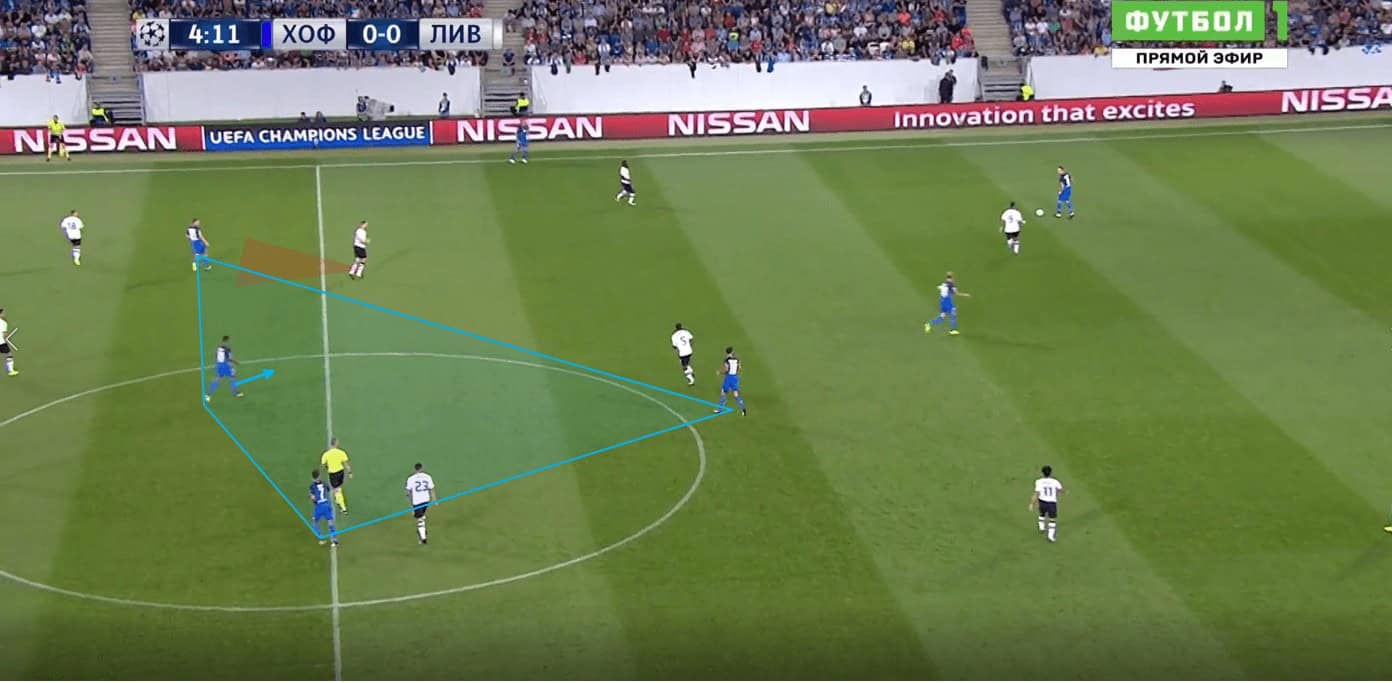
Hoffenheim’s 3-1-4-2/3-1-5-1 structure was able to create midfield overloads by dropping players deeper to occupy midfielders. We can see below Hoffenheim overload Liverpool 4v3, with the use of a single pivot in a central area opening up the central most passing lane for a dropping forward.
Leipzig’s shape is fluid in and out of possession, and a 3-1-5-1 structure is a common positional play structure used by Nagelsmann, with their first line being extremely adaptable within this. Tyler Adams and Amadou Haidara can both start as either wing-backs or central midfielders, and often fluctuate between both roles during games, and so Liverpool have to be aware of this and prepare to adjust their press against a back three or four.
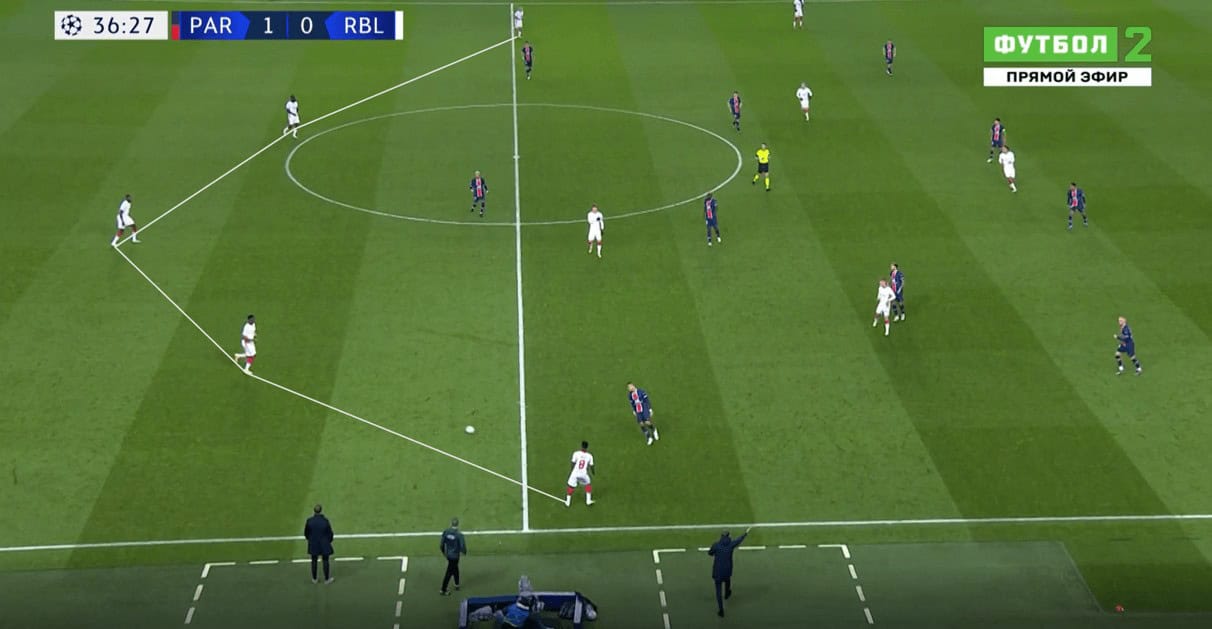
This section has focused mainly on Leipzig breaking the press through short build-up play, but they are also more than capable of playing a more direct style of football, and recently took advantage of high pressing Leverkusen and their more man-oriented approach. Leipzig often looked to play more direct, and so would attract the press from Leverkusen before going over it. Here we see Leverkusen get quite man oriented in midfield and press very high, and so Mukiele lofts the ball over the top of the Leverkusen midfield. The Leipzig midfielders deliberately drop deeper to increase this space between Leverkusen’s lines.
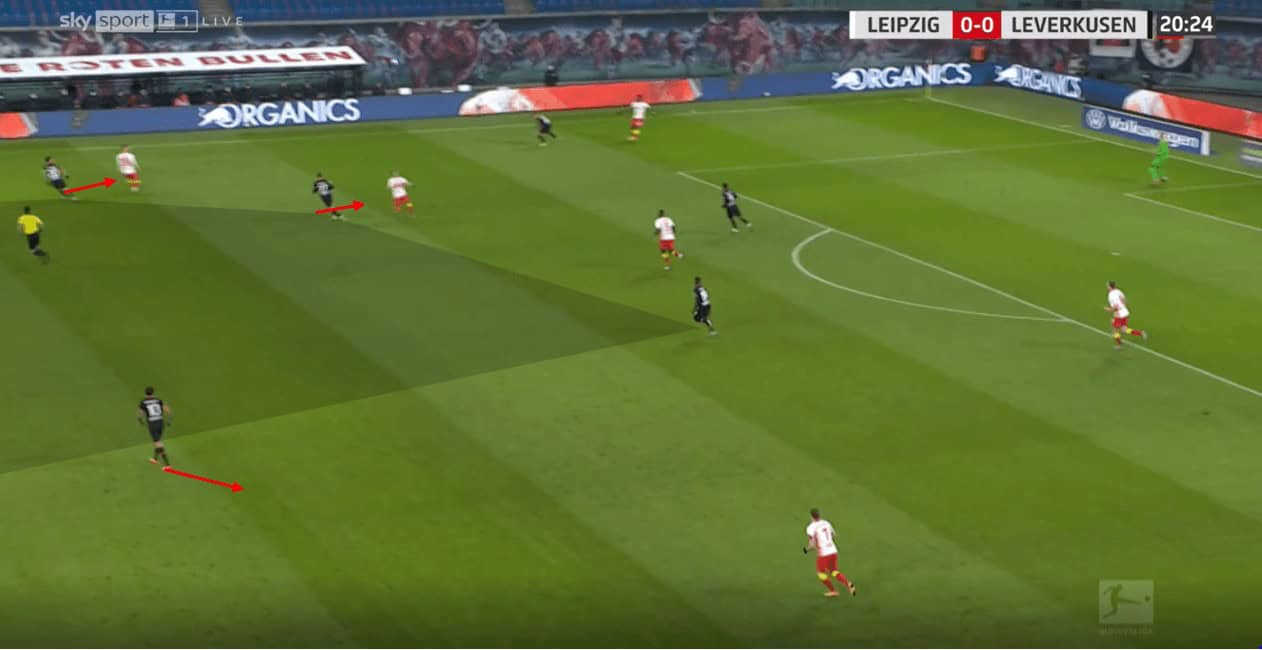
Because of this space then, when the ball is played direct, a player can drop off and receive the ball freely, as Sørloth does here. Players such as Angeliño and Sabitzer are then ready to exploit the far side and get in behind with up, back, through combinations. Because of this threat in direct play, I expect Liverpool to use more of a mid-block at times as they did against Hoffenheim, with Alexander Sørloth or Yussuf Poulsen both capable of winning aerial duels, particularly against Liverpoo;’s depleted back line.
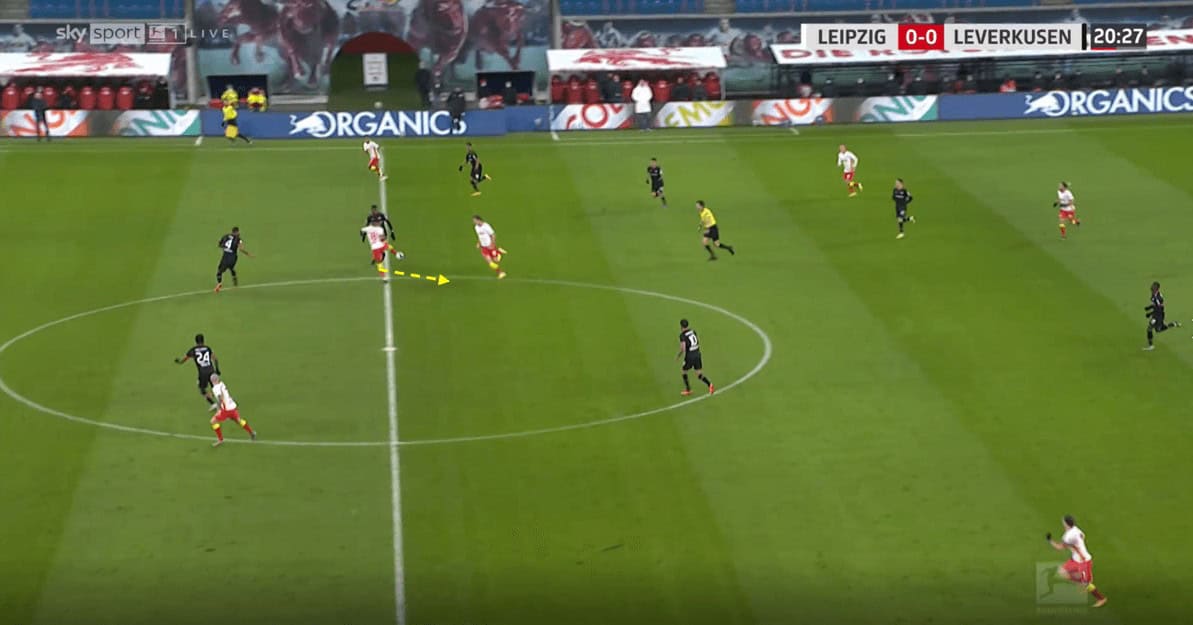
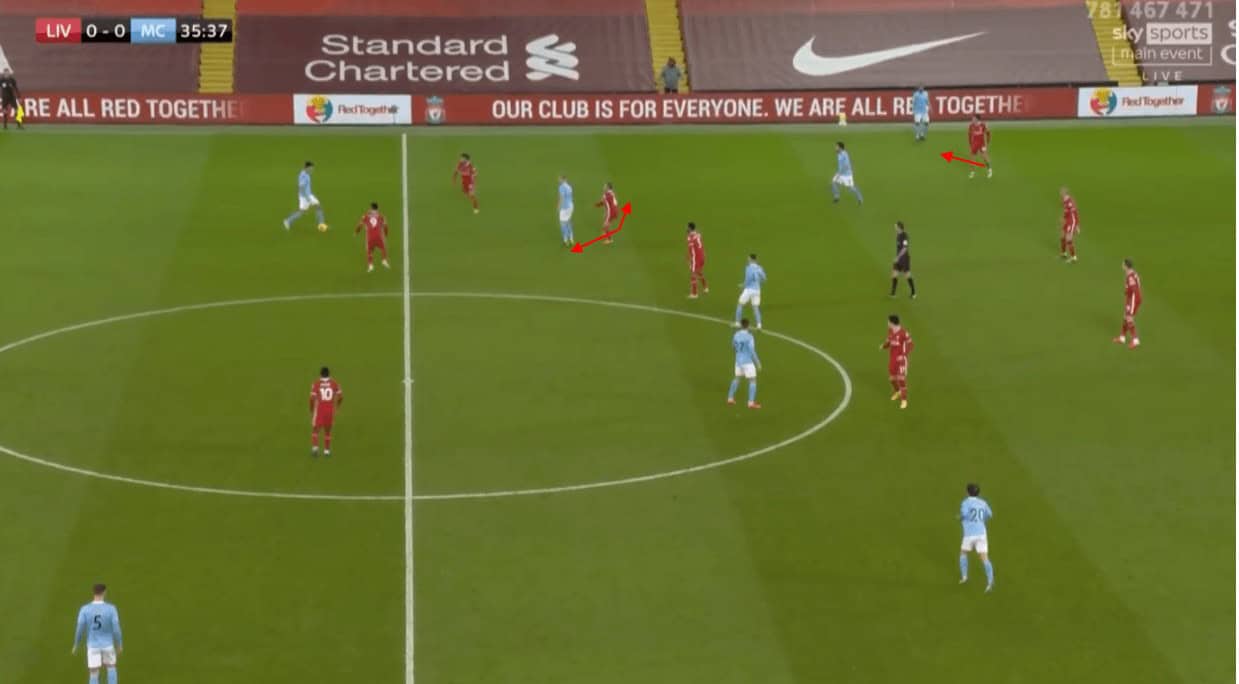
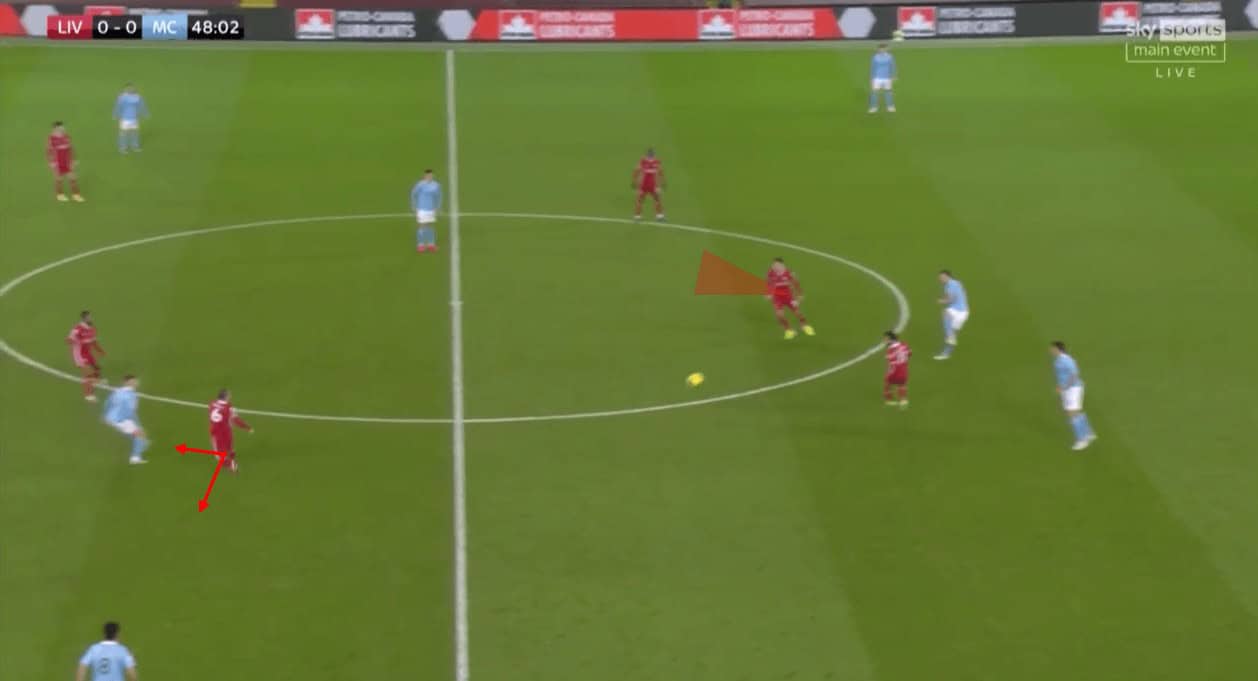
You will also notice that in this example left wing-back Angeliño has inverted while a central midfielder has dropped wider. Leipzig did this in build-up a few times, and this movement could confuse or overload Liverpool’s press, as we saw Manchester City do recently. Here Cancelo inverts from full-back as a pivot on the right side, and so Firmino cuts off this right side pass, therefore showing the left side more. A player drops to occupy Thiago, and so he becomes overloaded by a forward and the wide central midfielder. Rodrio drops very close to the the ball playing centre back, as this helps to trigger Salah’s press which increases the size of this passing lane. This is more or less a combination of most of the concepts discussed so far, particularly if you rewind a few seconds to see Rodri initially forms a double pivot with Cancelo.
How will Leipzig press?
Many people who haven’t watched Leipzig play will likely assume they are a high-intensity ultra-aggressive pressing side, but Leipzig are much more methodical and pragmatic in their approach. I recently wrote an analysis which detailed Nagelsmann’s tactical adjustments and flexibility to the opposition, and so this section will detail some of their common pressing structures, and will also try to look at a different adaptive approach specifically designed for Liverpool’s build-up.
We can see evidence of Leipzig’s flexibility here by looking at their formations used this season according to Wyscout, with fluctuations between three and four at the back formations clearly seen. They have more recently preferred a 3-5-2 shape, but their go-to formation is the 4-2-3-1.

This 4-2-3-1 follows the usual conventional pattern of most 4-2-3-1 presses, however Leipzig are especially good at shifting in their second line of the press (the three).
An example of the 4-2-3-1 system being implemented can be seen below against Werder Bremen, which was a game in which Leipzig clearly wanted to be aggressive and press high against Werder Bremen’s short build-up play. We can see the basic structure of the two first lines of pressure here, with striker Yussuf Poulsen applying pressure to usually the central centre back or wherever possible, in order to force the ball into a wide centre back. Wide centre backs would be pressed by the Leipzig wingers from in front, who would show the Bremen defenders outside. Dani Olmo often acts as the pressing ten within the 4-2-3-1, and it is his role to occupy the ball near pivot. The aim behind this and most Leipzig presses is to show the opposition into a wide area.
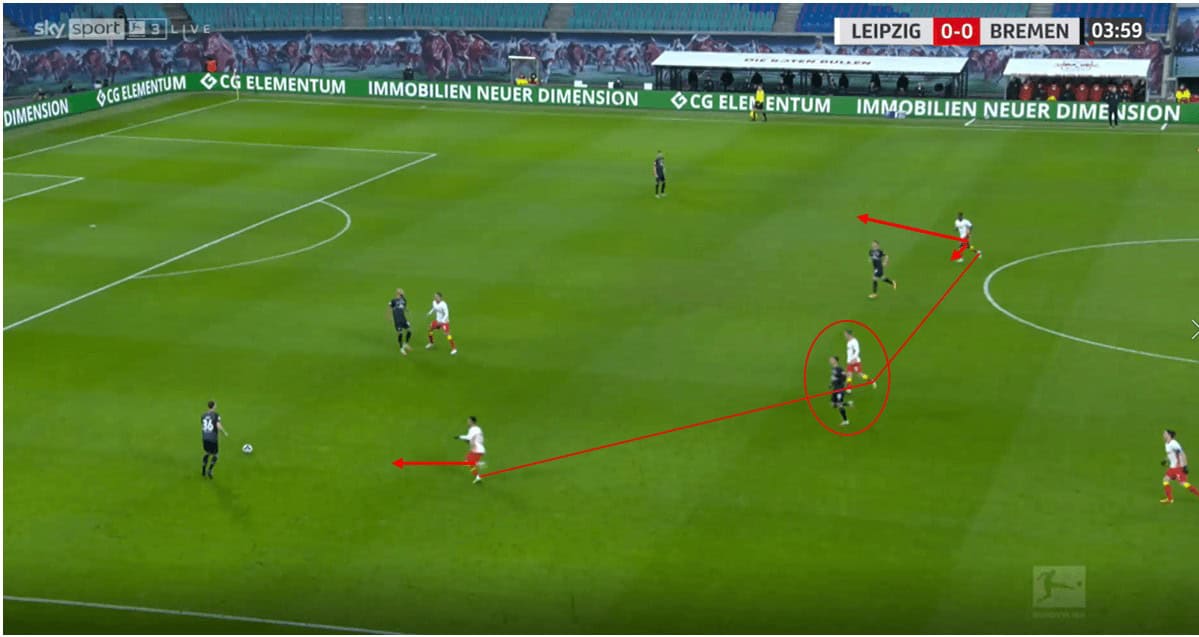
Once the ball is forced wide, Leipzig’s aggressive and man-oriented pressing kicks in, with the full-back pushing very high to press the wing-back, while the two deeper midfielders for Leipzig cover the centre and the forward dropping deeper in the half-space. As I’ll touch on later, the full-backs are very aggressive within this system Players remain tight in this area, and so the opposition find it incredibly difficult to work possession from out to in, meaning possession is often lost as it is here. This very aggressive approach is mainly used against weaker teams in the Bundesliga though, and so I don’t expect them to be this aggressive against Liverpool if they are to use this formation.
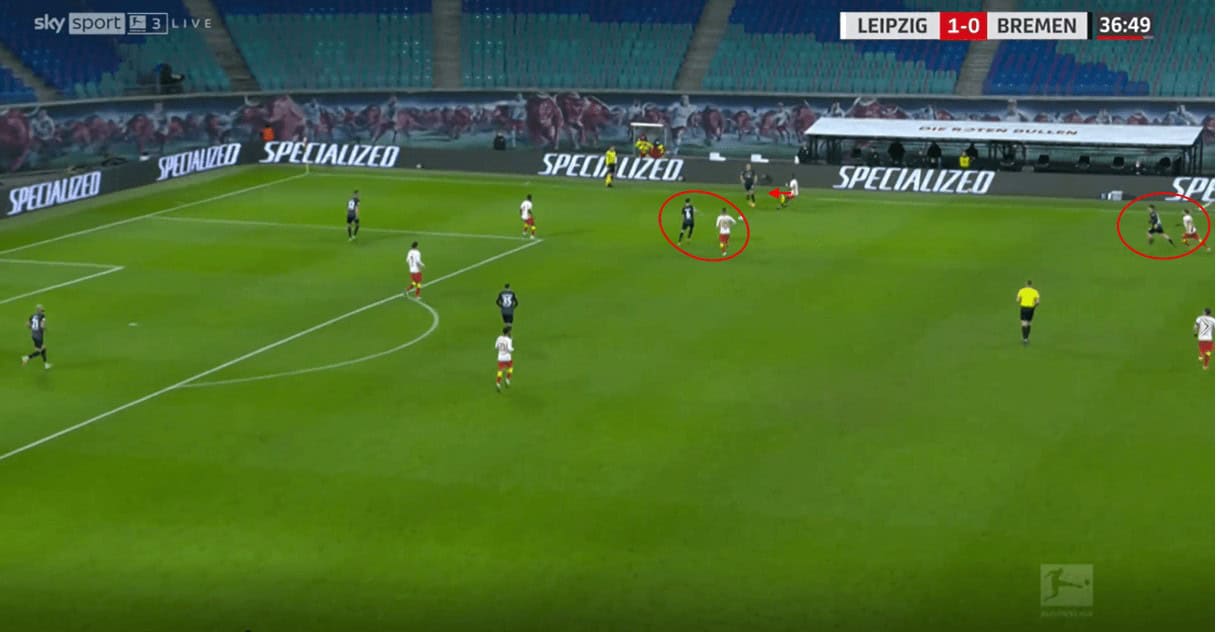
The main disadvantage to this 4-2-3-1 press in particular is the presence of only a single pressing ten, and so often Leipzig are forced to manage the overload placed on this pressing ten, with the two deeper midfielders rarely able to press that high up the pitch. We can see an example here of Werder Bremen overloading Marcel Sabitzer and the pivot zone. Dani Olmo (circled) acts as the pressing ten, and from the goalkeeper, marks the nearest pivot. The ball gets played across, and Omer Toprak moves from centre back higher to from a double pivot. We see potential options for covering Toprak through Poulsen and the nearest winger, however these tactics are sometimes difficult to use situationally and can have damaging effects, such as the less pressure being applied to the ball or the wider pass being freer. Leipzig manage the overload well here though, restricting space around the receiver and forcing the pass backwards and then wide, where the full-back is then able to push higher and press.
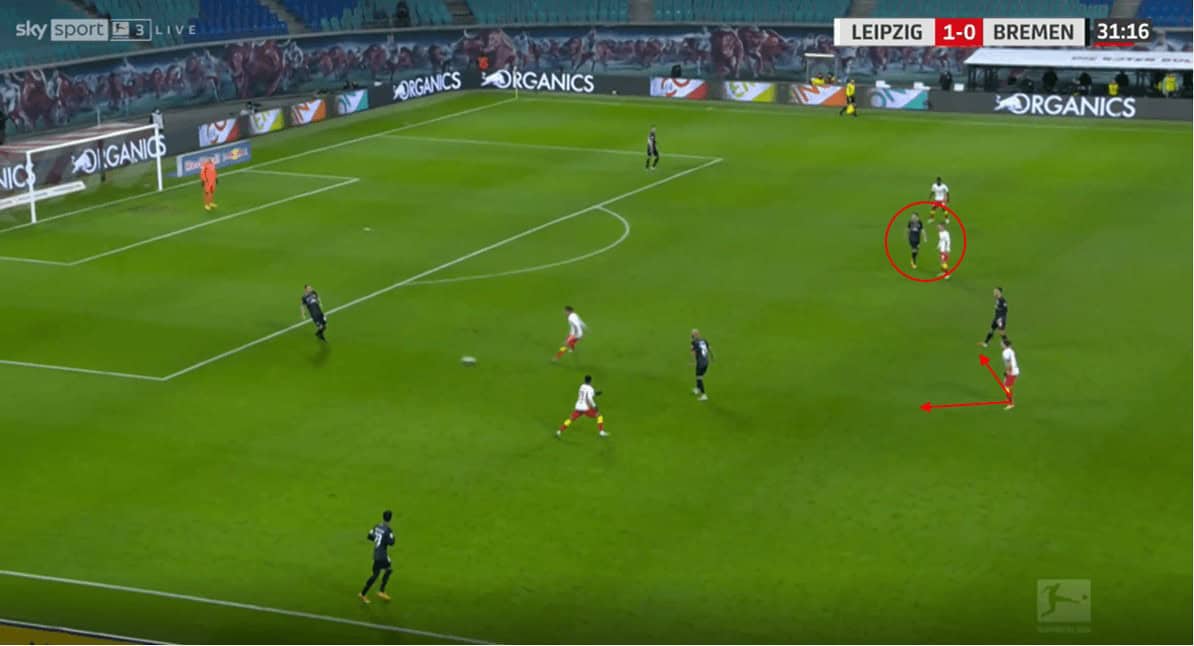
Against Stuttgart Leipzig used more of a mid block structure as we can see here, and Stuttgart really looked to try and use their double pivot where possible, which led to Leipzig trying to balance between the two. Liverpool are not really a team who drops into a double pivot often though, with usually a back three and/or a single pivot formed, and so the 4-2-3-1 in this kind of shape seen below could work.
We can see this 4-2-3-1 shape in a mid-block below, with the aim being to force the ball into wide areas and then cover central options. The 4-2-3-1 would be more of an aggressive option simply because of the number of players it commits higher up, but the three man midfield covers Liverpool’s, unless Firmino drops deeper to receive. Wingers stay centrally compact until the ball is played wide, where they then press the full-back and rely on full-backs and central midfielders to cover the half-space. The benefit of a 4-2-3-1 would also be the numerical superiority in the back line, which Nagelsmann seems to like.

Liverpool will drop into a back three throughout the game using a central midfielder, and against back threes Leipzig will usually commit a winger to press a wide centre back. This leads however to a full-back having to press a wing-back, which temporarily forms a back three and leaves the half-space fairly exposed. The midfield three isn’t really needed, and so unless this adjusts well to help fill the half-space every time (e.g. ball near central midfield tucks in), Liverpool could progress the ball quickly. My alternative would be to have the pressing ten jump into the first line, and so situationally form a 4-4-2 structure with narrow wingers forcing the ball into a wide area. As I wrote about in my recent piece on defending the half-space, being forced to press full-back to full-back often leads to poor defensive structure, unless the half-space is protected properly by someone else.
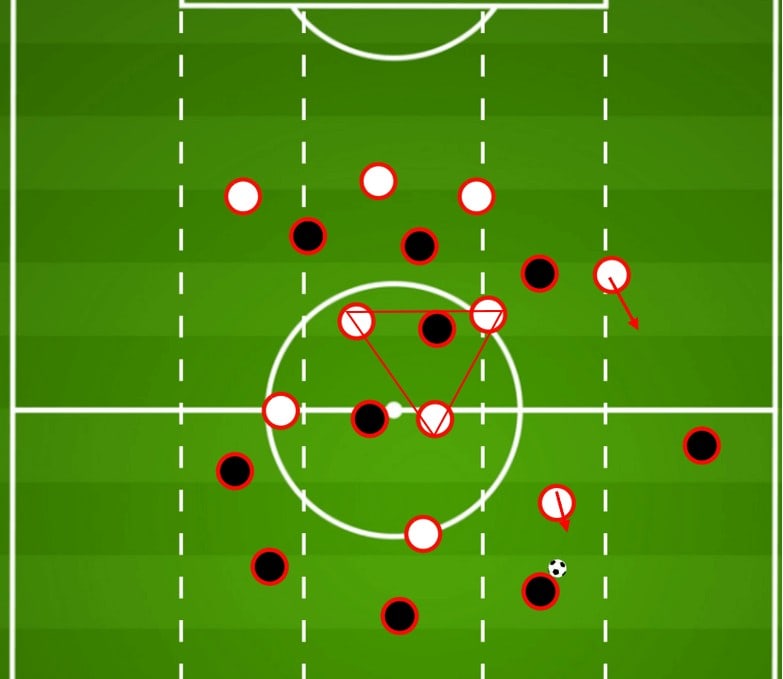
When thinking about what kind of shape Nagelsmann will employ, a good starting point is how many will make up the last line. When coming up against a 4-3-3 this season, Nagelsmann has only used a back three once (against PSG), as he seems to have a principle around always having +1 in the last line. Seemingly then, a back three would be unlikely, but because of his recent use of this system, as well as the benefits it could have against Liverpool, I think a back five/three will be used.
The system I am outlining here is the 3-1-5-1, which moves into a 3-1-4-2 when pressing the first line. Liverpool’s centre backs are pressured by the Leipzig striker and ten when needed, who jumps from a deeper position and cuts central lanes with this pressing run. Leipzig match up 3v3 in midfield, but can also go to 4v3 if the striker can press intelligently across the two centre backs, which means one central midfielder can move to become more zonally oriented around the half-space. Wing-backs jump higher to press wing-backs, but the half-space and central area should now be more secure thanks to having more central midfielders within this space.
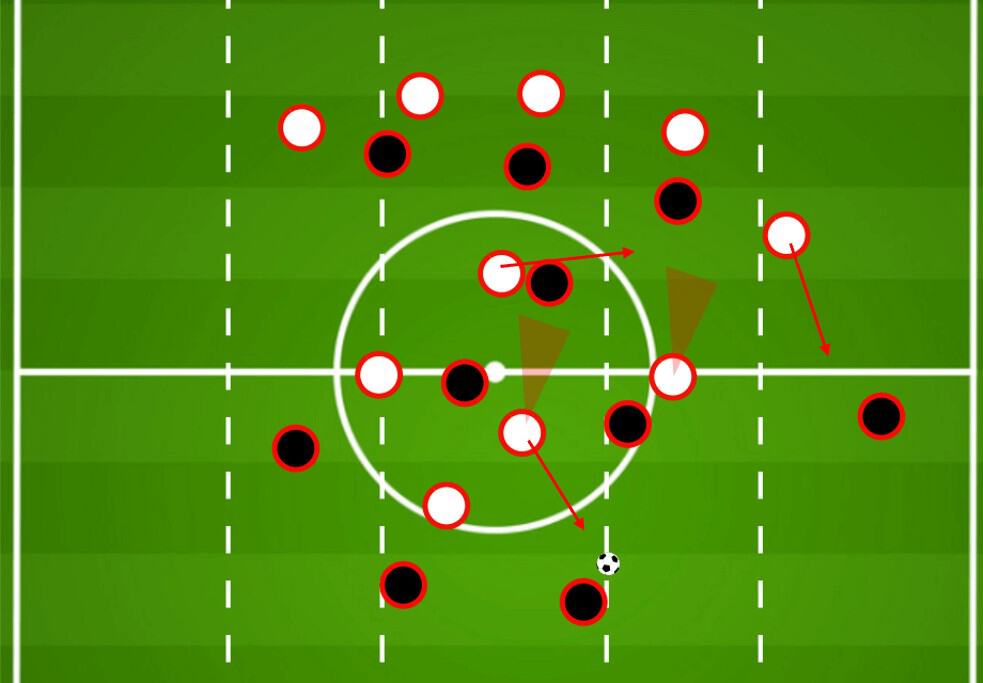
Once the ball is forced wide, Leipzig can apply pressure and should be able to cut off central options, but Nagelsmann may want a 2v1 to be maintained around the half-space, which again would be reliant on the midfield’s shifting as a unit to cover the three Liverpool central midfielders. Liverpool may try pinning actions against the wing-backs to prevent them pressing, but if Leipzig stay more compact as a unit and close to the ball, the impact of these pinning actions can be lessened. Nagelsmann in the past has used players who were more man oriented in the half-space, and so central midfielders would drop to form a back six at times to cover this space.
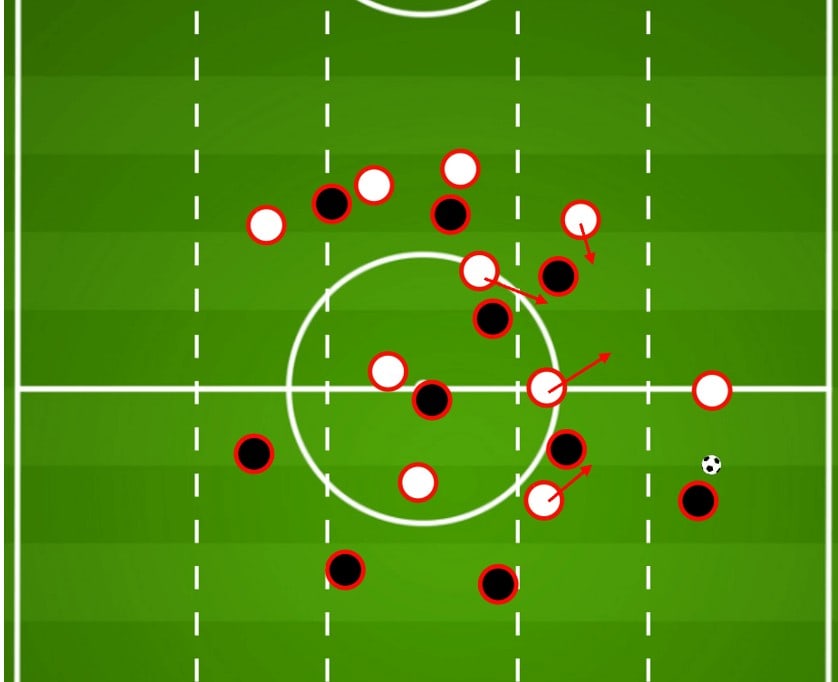
When Liverpool drop into a back three, Leipzig can comfortably commit two players into the first line of the press, as they still have numerical superiority in the central areas now. The pressing ten (likely Olmo) jumps higher to press and looks to cut central lanes, which allows for the ball near central midfielder to shift across to the half-space slightly more. The deeper midfielder (six), no longer has a player to mark really, and so he can become much more oriented towards players within the half-space, making it difficult for Liverpool to progress. If Liverpool then look to create double width, Leipzig will be keeping the inside forwards further from goal and in areas they don’t really want to be, but they will have to shift well and potentially commit a wide central midfielder to press at times to press a wing-back, especially if Liverpool can pin those wing-backs effectively.

Conclusion
This tactical preview has sought to provide some insight into RB Leipzig’s style of play and how they may look to set up against Liverpool. Nagelsmann is notoriously difficult to predict which is all part of the challenge, and so writing previews on Leipzig is always a challenge. The final section simply looks at a potential system I believe could work quite well if executed properly, and it also maintains pressure on the ball and gives counter-attacking opportunities thanks to its structure. It will no doubt be interesting to see how Leipzig set up and go about their game plan, as well as how Liverpool then look to influence this game plan.
