
It is finally time. After four years of waiting, the FIFA World Cup final is finally here. This edition of the World Cup was certainly a historic one, filled with upsets. From Germany’s surprising elimination in the group stages to Morocco’s underdog story, this World Cup will be one to remember. A lot has changed since the last edition in 2018. Not France though.
The world champions have reached the final in consecutive editions for the first time in the nation’s history. On the other side, PSG’s Lionel Messi has led Argentina to their second final in eight years. Unlike 2018, this year’s World Cup final has no favourites. Both entered the competition as favourites to win it all, and one month later, here we are.
Argentina’s path was far from easy. La Albiceleste suffered a shocking loss to Saudi Arabia in their opening match, leaving many to wonder if Messi’s last dance on the biggest stage would be any different. Their tactical evolution since then has been fantastic though, and Lionel Scaloni has yet to repeat a starting eleven in the tournament. In fact, Argentina’s tactical flexibility may be their biggest weapon coming into this final. At any rate, they are coming into this final in their best form yet, after a convincing 3-0 win over Croatia in the semi-final.
France’s road to the final has been the complete opposite. Aside from a strange loss to Tunisia in the group stage, when they were already qualified, Didier Deschamps’ side has impressed in every single match. Without many tactical changes throughout the tournament, French stars Kylian Mbappé and Antoine Griezmann have brought this fantastic squad all the way to the final.
This tactical analysis preview will provide you with everything you need to know ahead of the long-awaited FIFA World Cup final. With a closer look at France’s tactics, we can preview how Lionel Scaloni may adapt his Argentina side to the threats of Mbappé and Griezmann. Nonetheless, La Albiceleste’s functional approach to possession could prove extremely dangerous to the French. This analysis will take an in-depth look at the tactics behind this historic final.
Team news and lineups
Didier Deschamps suffered two blows ahead of the Morocco semi-final – Adrien Rabiot and Dayot Upamecano. Liverpool’s Ibrahima Konaté stepped up for the Bayern Munich centre-back without a problem, and the 23-year-old could certainly start alongside Raphaël Varane in the final. Rabiot was a much bigger miss, and while Youssouf Fofana performed well in the semi-final, the Juventus midfielder should definitely be back in Deschamps’ lineup.
France’s starting eleven should then come with no surprises. Hugo Lloris will be in goal, with Jules Koundé, Konaté, Varane, and Theo Hernández forming a back four. In the midfield, Real Madrid’s Aurélien Tchouaméni forms a double pivot with Rabiot. Griezmann will pull all the strings at the number 10 position, flanked by Ousmane Dembélé and Kylian Mbappé. Up top, Olivier Giroud is the centre-forward. This 4-2-3-1 has proved successful in every single match so far, so it is no surprise that Deschamps will continue using it.
Argentina’s team selection is far more complicated to preview. As mentioned, Scaloni has yet to repeat a starting lineup, and the 44-year-old likes to constantly change formations as well. La Albiceleste should not have any big misses, with Ángel Di María and Marcos Acuña back in action for Sunday’s game.
Emiliano Martínez will definitely be in goal, and ahead of him, Scaloni will probably go for a back four. This back four would be made up of Nahuel Molina on the right, Cristian Romero and Nicolás Otamendi as the centre-backs, and Marcos Acuña on the left. In the midfield, Enzo Fernández and Rodrigo De Paul are the only two guarantees. Whether Scaloni will opt for Di María right from the beginning or not remains unclear.
The most likely option is repeating the same eleven from Croatia, which would see a midfield of Leandro Paredes, Fernández, De Paul, and Alexis Mac Allister with Lionel Messi and Julián Álvarez up top. If Di María were to come in, either Paredes or Mac Allister would make way for him. Enzo Fernández performed extremely well in a more advanced position, so keeping Paredes could be an alternative. However, Mac Allister has also been important in the attack.
Due to France’s lethal attack, if Di María were to come in, Paredes would be likely to stay and Mac Allister to make way. At any rate, Argentina’s flexibility allows for all these changes without losing their style of play or effectiveness. This analysis will cover all possible scenarios, and how they may impact the tactics in the game.
Adapting to France
Didier Deschamps’ attack is undoubtedly giving Scaloni a headache, as at least some sort of adjustments must be made for it. On one hand, England proved that being overly cautious against France may not always be the best alternative. Gareth Southgate’s side essentially sacrificed their attacking nature in fear of Mbappé, and it kept them from being as dangerous as they can be. Nonetheless, the danger posed by France with the ball must still be considered. In this first part, we will explore how exactly France like to attack, and how Argentina could adapt to it.
Les Bleus have only averaged 51.97% possession in the competition so far, but their work in this phase is extremely lethal. In possession, Deschamps’ 4-2-3-1 turns asymmetric, with the fullbacks having opposing functions. Theo is in charge of providing support in the final third and linking up with Mbappé. On the other side, Koundé tends to tuck in and form a back three with the centre-backs.
In the midfield, Tchouaméni becomes a single pivot behind Rabiot and Griezmann. Although Griezmann likes to generally occupy the right half-space, he has the freedom to roam wherever he wants to, especially to create overloads on the left. Both wingers remain wide, although Mbappé comes inside a bit more than Dembélé. This creates a dangerous overload on the left, and on the right, Dembélé is extremely dangerous in isolated scenarios.

Argentina’s defensive structure, regardless of the height of the block, tends to be in a 4-4-2. Up top, Álvarez is extremely hard-working as Messi tends to be relieved of most defensive duties. This 4-4-2 can be created in multiple ways, and it provides balance wherever the opposition chooses to attack.

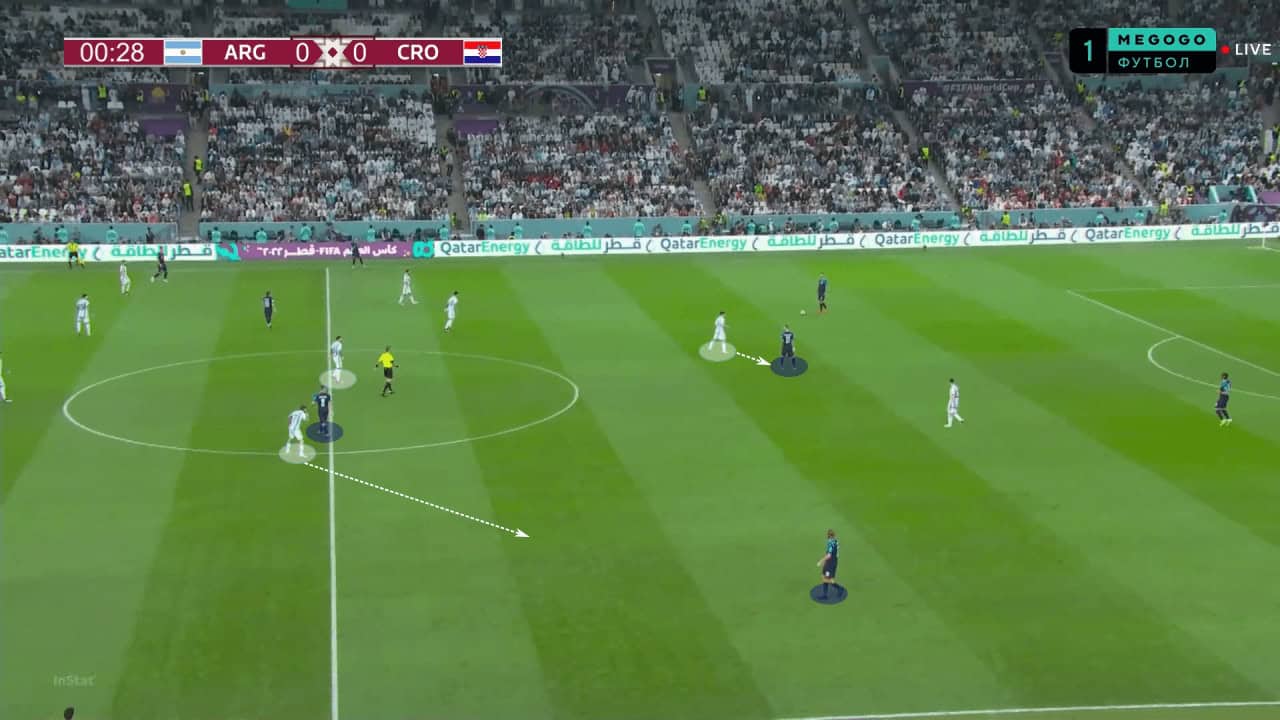
Against Croatia, Di María was on the bench. De Paul was then in charge of defending the opposition’s left side. Similar to France, Croatia provided a dangerous dynamic on the left with Borna Sosa supporting Ivan Perišić. Rodrigo De Paul had no problem jumping to Croatia’s left-back and defending that wide channel.
In the instance below, although the opposition builds on the left, De Paul’s body language shows he is ready to jump wide on the right if needed. This option allows Argentina to have a compact midfield, but also to defend the wide areas when required. A special note can be made to Álvarez’s positioning, marking the opposition’s defensive midfielder and letting the centre-backs have the ball.
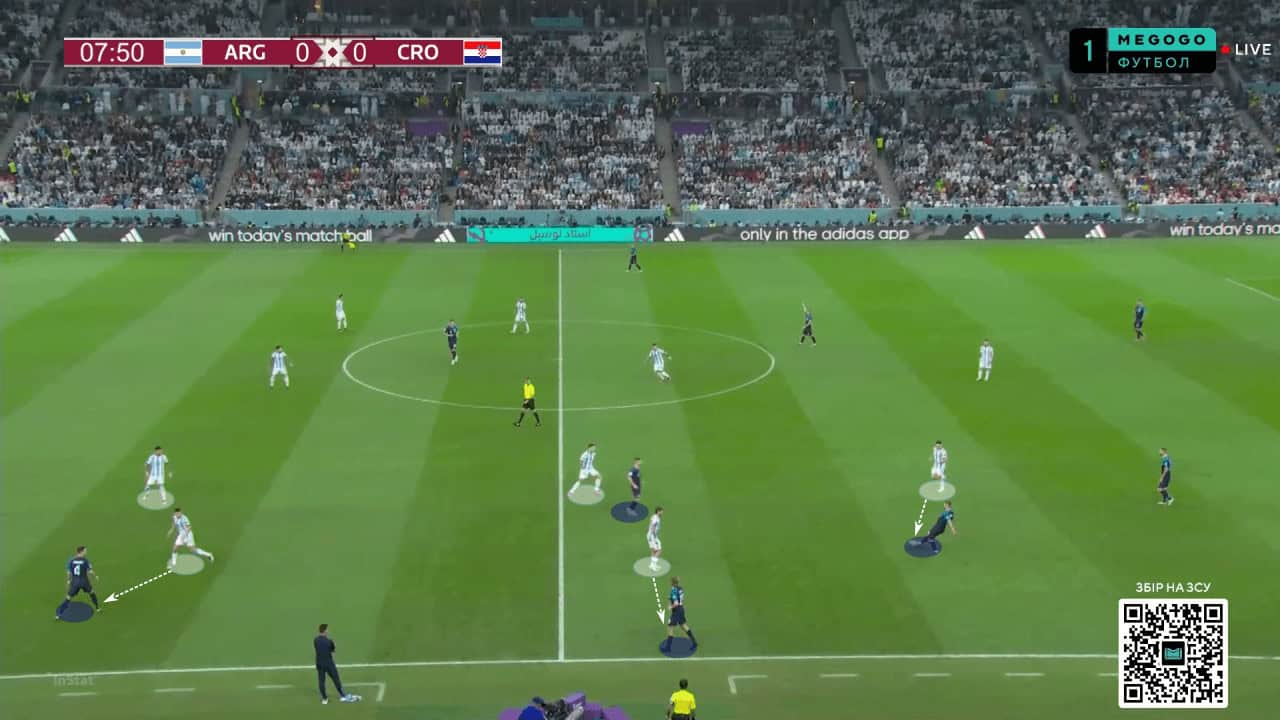
In this second instance, we are able to see Argentina’s entire defensive organisation shifted over to the right. De Paul is able to mark the opposition’s fullback while Paredes provides support, picking up Croatia’s midfielder. Álvarez is also tracking back to apply pressure to Croatia’s ball carrier. Further back, we are able to see Molina picking up Perišić (who would be Mbappé on Sunday), while Romero provides cover.
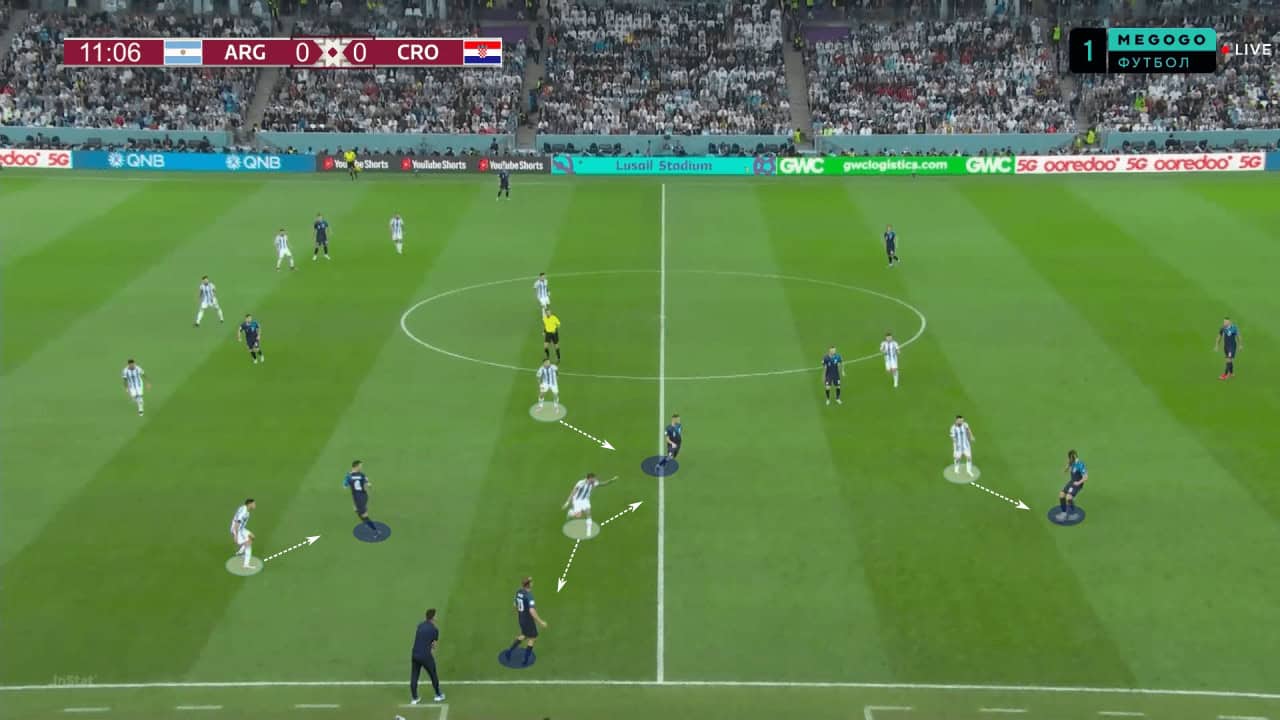
France’s centre-backs are extremely dangerous on the ball though, so Argentina must be very careful with allowing them time on the ball. Against Morocco, Les Bleus’ first goal came after Varane was able to break the lines and find Griezmann in the final third. Both Varane and Konaté are very good ball-playing defenders.

The solution to this may be Lionel Messi dropping slightly deeper out of possession. France will not have the ball for long periods of time (unless they are trailing), so a little sacrifice may be required from the Barcelona legend. This pressure does not have to be extremely aggressive, but France’s centre-backs must be made uncomfortable, as seen below.
Functional game
The next puzzle becomes Argentina’s possession. Scaloni’s functional possession style provides a question France have yet to face in this competition. Naturally, La Albiceleste may start a little cautious, without committing too many numbers forward. As they become comfortable in possession, however, they will start attempting to break France down in their usual ways.
This functional approach to possession has been growing in popularity, and it can be found in sides like Napoli, Croatia, and Fluminense. In a word, it is more natural. This can be dangerous in multiple ways, but the unpredictability it provides is perhaps the biggest.
In Scaloni’s system, both fullbacks push extremely high to maintain width. In the midfield, there is no set structure. Messi likes to drop in and freely roam. De Paul is generally on the right while Enzo (or Mac Allister) remains on the right. However, there is no defined shape, and the players are constantly roaming in the central channels.
France can be expected to deploy a defensive organisation similar to the semi-final, where Giroud was man-marking the opposition’s defensive midfielder. Mbappé is usually relieved of defensive duties while Griezmann roams between the midfield and the attack picking up the extra man. Dembélé tracks back more while Rabiot drifts a bit wide to cover for Mbappé.
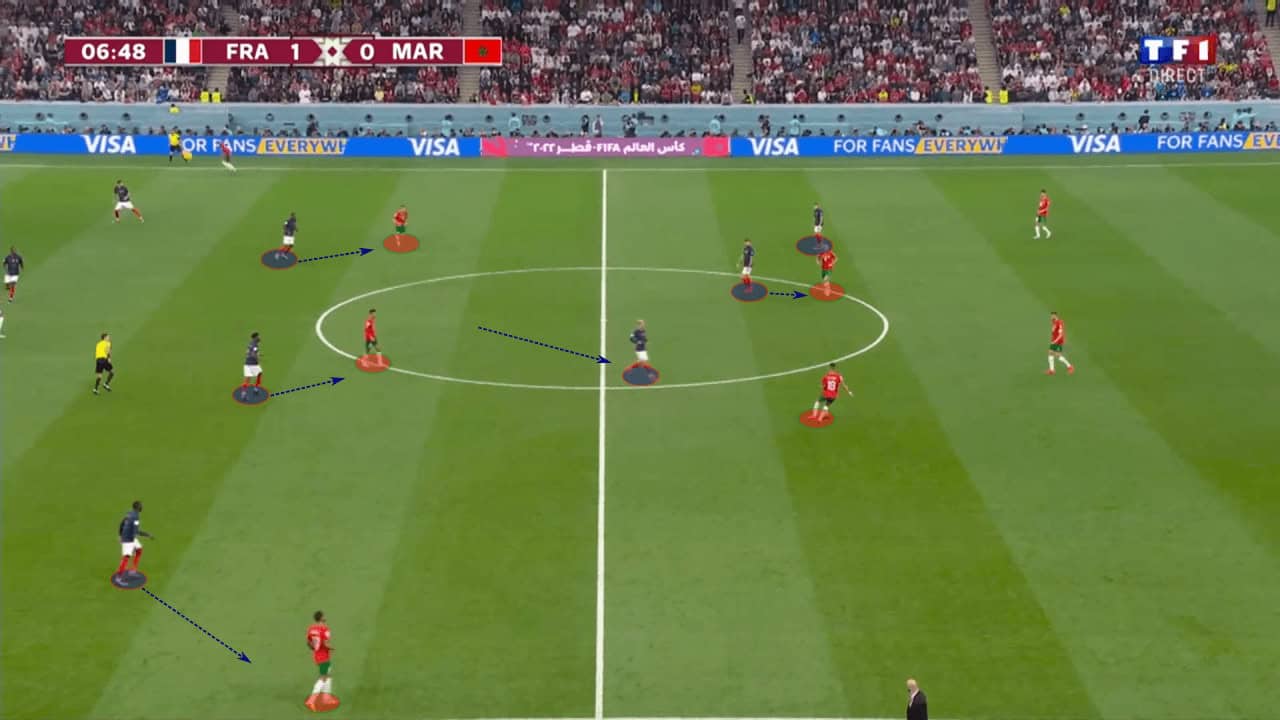
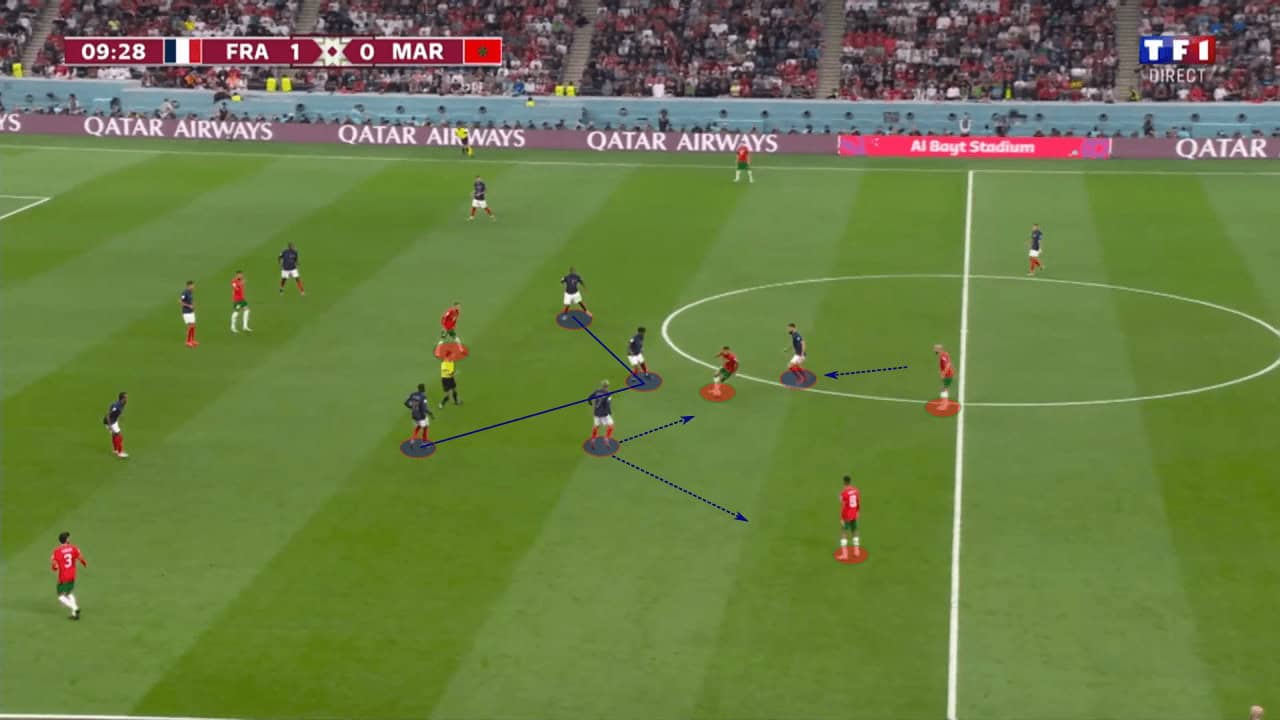
The reason a similar approach should be taken in the final is because of how effective this structure is at compacting the midfield. In the image above, we can see the initial structure, in a more rested scenario. Below, Morocco attempt to create through the middle. France quickly pack the middle and keep the opposition from progressing. With the line of three, and then Griezmann and Giroud, these five players make it extremely hard for the opposition to have any success in the middle – where Argentina thrive.
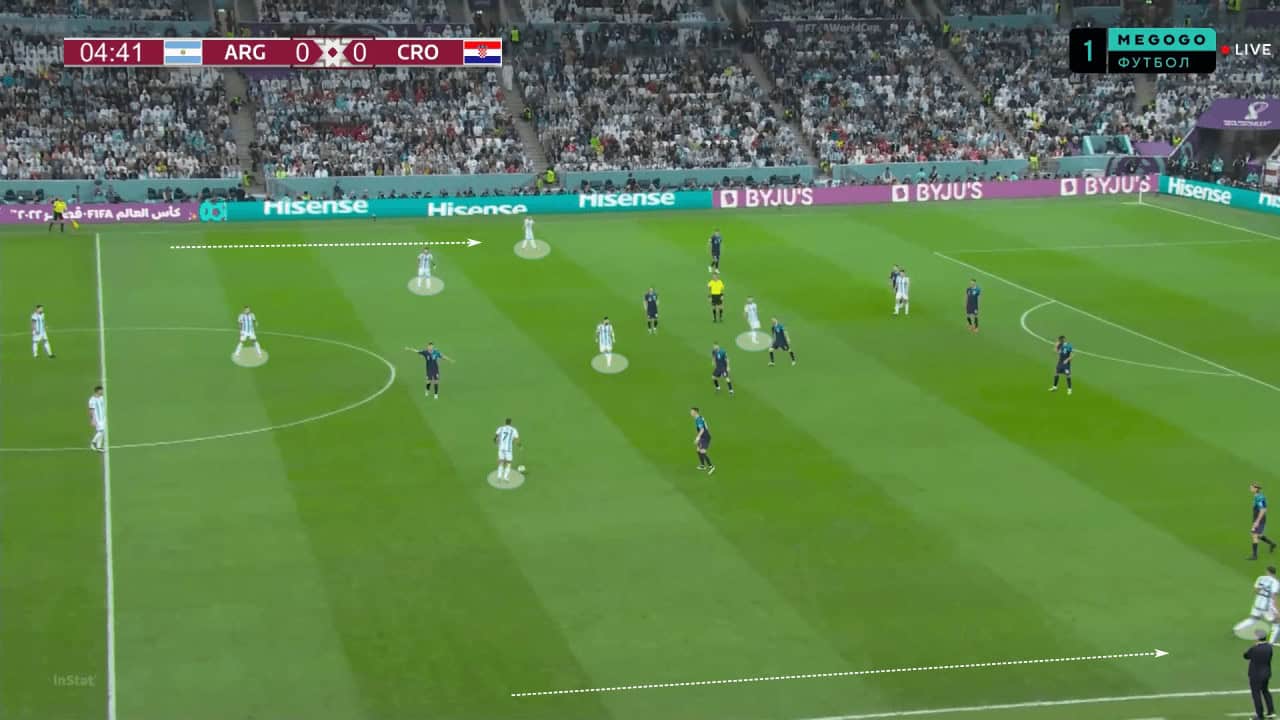
Argentina certainly have a few cards up their sleeve though. Against Croatia, Zlatko Dalić made it extremely difficult for Scaloni’s men to progress centrally as well. Argentina’s pass map provides the first clue as to how they managed to play around that. In the opposition’s half, there is a balance between passes to the wide channels and passes back into the midfield. Their patient approach to the ball allows them to go from side to side, attempting to stretch the opposition and create spaces to play through.

In the example below, they maintain maximum width through their fullbacks. As they recycle possession back to the right side, Croatia’s midfield line of five becomes stretched, and Argentina are able to exploit that as seen below.

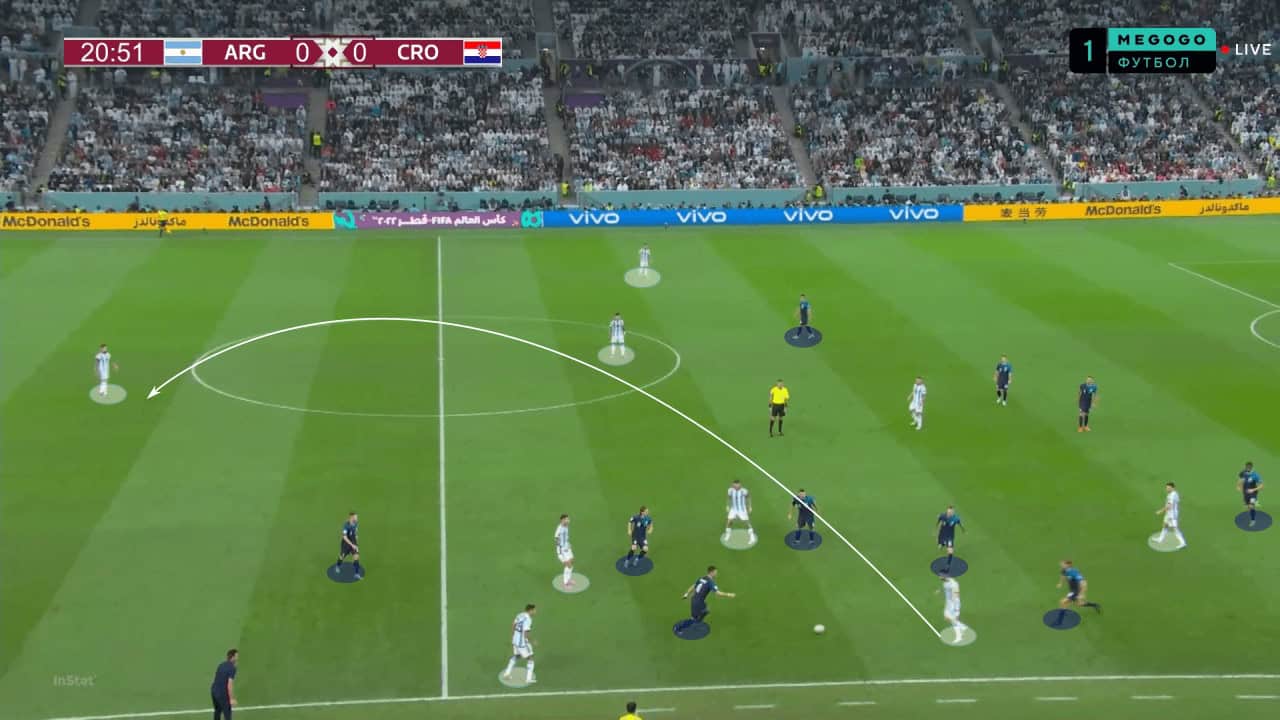
Another resource they can use is the famous attract and switch. Scaloni’s approach to possession likes to concentrate players around the ball and create numerical superiority. This will naturally attract a large number of defenders around the ball. With a quick switch, as seen below, they are able to invert the play and attack an unorganised and outnumbered weak side.
The Di María alternative
The introduction to Ángel Di María could provide a different dynamic to the game in and out of possession, whether he starts or comes off the bench. The Juventus forward is perhaps the only true winger in this Argentinian squad, and with such talent and experience, he could be the game-changer.
Being a winger, Di María occupies the wide channel on the right. As we saw earlier, against Croatia, this space was occupied by Molina, the right-back. With Di María in play, Molina could begin in a slightly more cautious position, providing immediate pressure on Mbappé in case the ball is lost. When he chooses to push higher, Molina would create a 2v1 scenario against Theo since Mbappé does not track back on that side. If Rabiot shifts wide to cover, the midfield line would be stretched, and dangerous space would be created.
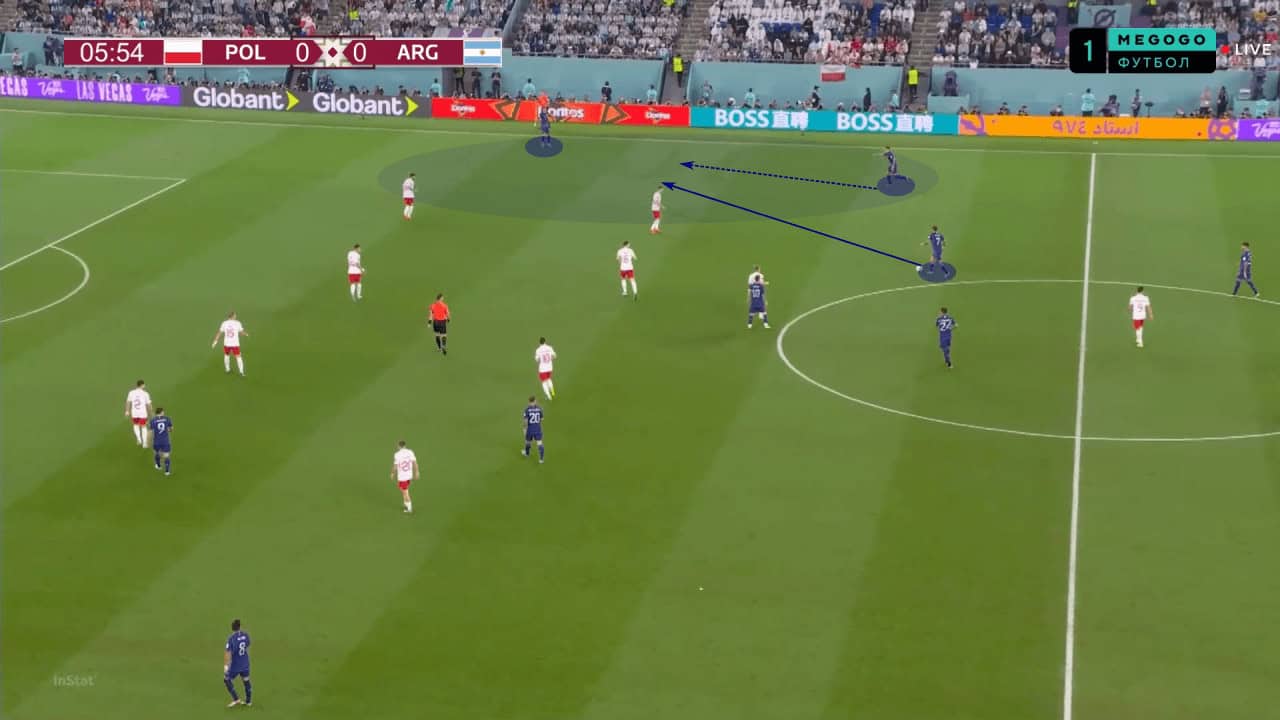
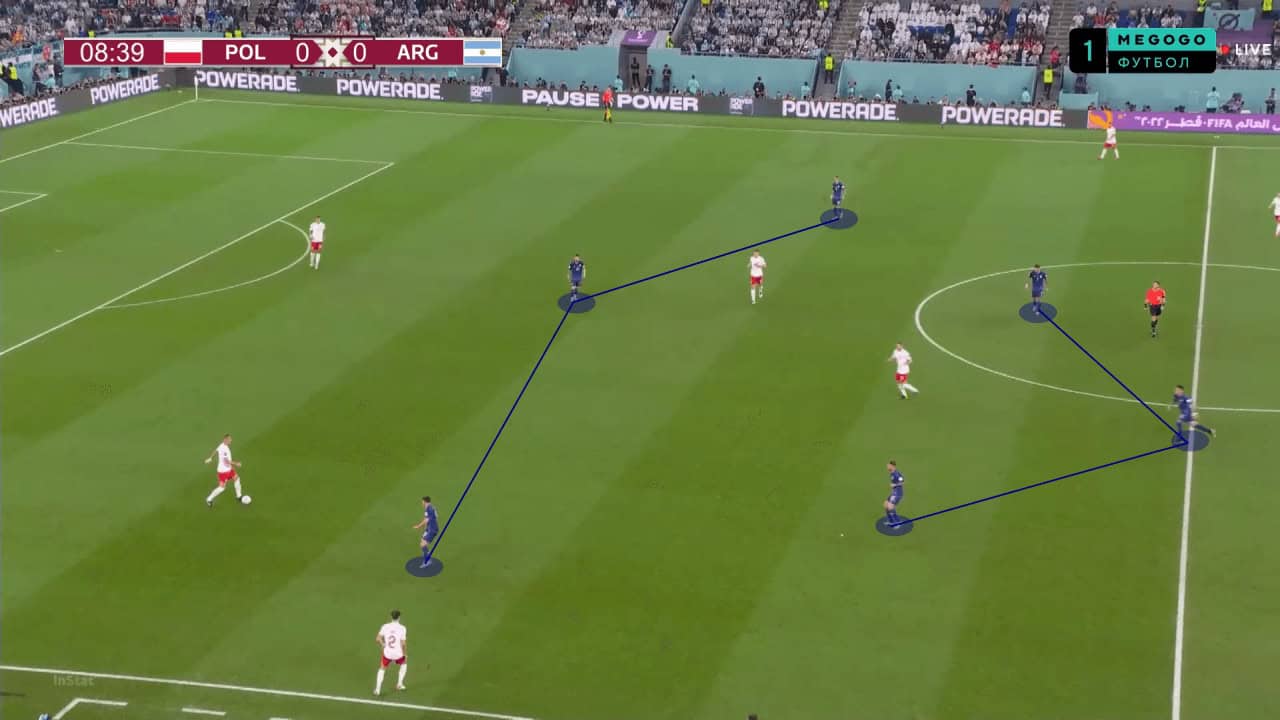
In the last match of the group stage, against Poland, Ángel started the game. Consequently, in Argentina’s touch map for those 90 minutes, we are able to see a slight overload on that right side in the opposition’s half. The introduction of Di María in the final, especially against France’s left side, could be the key.

Defensively, this would prove no problem at all. In Di María’s heatmap for the World Cup below, we are able to see how much the Juventus winger tracks back. In stages out of possession, despite his age, he would be able to track back and provide support against France’s dangerous left side.

If Di María starts, De Paul would come in more centrally. Nonetheless, the latter would still be able to shift wide and provide cover on that wide channel. In fact, it would be a much safer approach than without Ángel. Against Poland, when De Paul started alongside Ángel, his heatmap shows how much he would support the right side of the defence.

Finally, Di María’s selection would allow Argentina to begin the game with a slightly higher block, attempting to gain control of the game early on – when France are especially dangerous. In this scenario, Álvarez would become a left-winger and they would press in a 4-3-3. This higher block is extremely unlikely should Di María not start.
Conclusion
The World Cup final is finally here, and it could not be more exciting. Lionel Messi and Kylian Mbappé lead their nations in search of a historic third World Cup title. Both nations come into this final with full force and in excellent form.
Tactically, this encounter is just as balanced. France’s lethal attack will certainly create problems for Scaloni’s men, so it will be interesting to see how Argentina adapt to it. On the other hand, their functional style of possession could prove extremely dangerous to France, despite their secure defensive system.
Finally, Ángel Di María and the dynamic he introduces could provide the edge for la Albiceleste.
The stage is all set. Who will find eternal glory?
