
Unless you’re Ipswich Town or Coventry City, your club has one game remaining in the 2023/24 EFL Championship season, and the relegation battle is seriously heating up.
Rotherham United’s fate has been sealed for some time now – they’ll be playing League One football next season, but who will be joining them?
Five teams are in the frame for a potential drop, from Huddersfield Town in 23rd to Blackburn Rovers in 19th – Birmingham City, Plymouth Argyle, and Sheffield Wednesday join them on the list of potential relegation teams come the final whistle at the end of matchday 46.
This tactical analysis will provide a preview of the remaining fixture each team between 22nd and 19th has to play in this extraordinary relegation battle, providing insight into what each team can expect from their respective opponents.
In this tactical preview, we’ll examine the tactics they could encounter and highlight any of their own strengths they could tap into.
While Huddersfield could still technically avoid the drop, it would take a couple of freak results for them to climb their way to safety.
For this reason, they are not included in this tactical review.
Blackburn Rovers
1994-95 Premier League champions Blackburn Rovers go into their final game of the 23/24 campaign having won two of their previous six games – those wins coming away at Leeds United and Sunderland: two huge and somewhat surprising victories.
However, they recently fell to a 3-1 defeat to relegation rivals Sheffield Wednesday – how important will that be in the long run?
Rovers travel to already-crowned champions Leicester City on the final day, needing just a point to ensure their Championship status.
What can Blackburn expect from the 2015/16 Premier League champions, aside from the fact that they’ll likely look to dominate possession?
Let’s take a look.

As mentioned, Leicester are a side that likes to dominate possession and play at a high tempo.
The image you have in your head is likely one that mirrors something we see from the likes of Liverpool or Manchester City, with the opponent sat deep and having to defend the opposition dictating the play, passing from side to side while looking for an opening.
While Leicester replicates that image in their own game, the element of playing quickly can sometimes overrule the need for typical possession retention.
In a nutshell, Leicester like to move through the thirds quickly, making penetrating passes where possible.
In the aforementioned scenario, they do this higher up the pitch, but as the image above depicts, they also do it deep in their own half.
The aim of the short passes at the back is to draw the opposition out, creating space in midfield while also seeking a numerical advantage higher up.
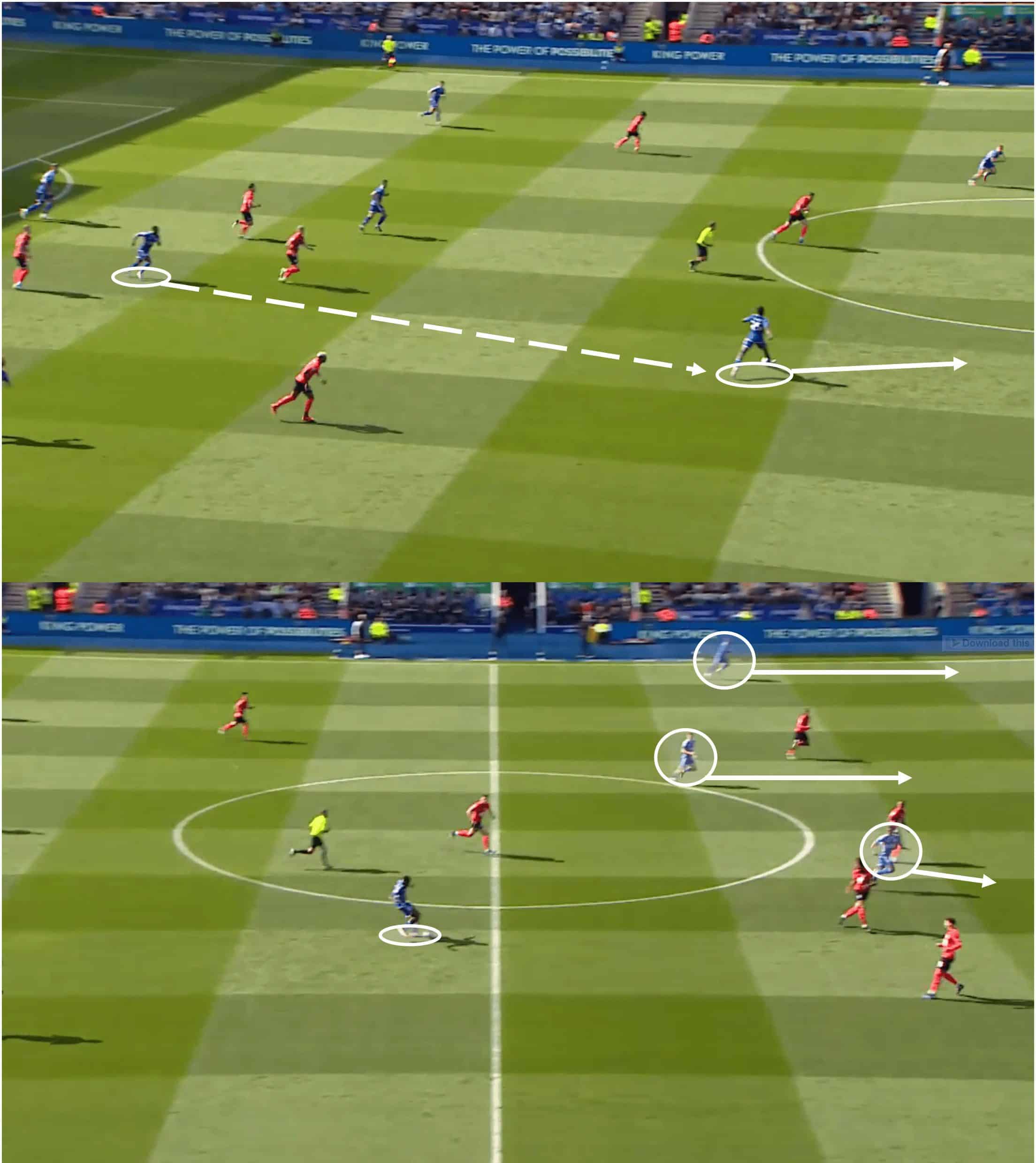
Following that initial pass from the keeper into the deep midfielder, a neat turn fools the oncoming opponent, allowing for the next pass into midfield – as we mentioned, Leicester will look for that player to receive the ball in space, space to drive into with time to make their next decision/move.
As the attack starts to take shape, as we see in the bottom image of the two above, Leicester will have an array of attacking options, making different runs in different zones as they look to enter the final third.
Blackburn will have to be very aware of this.
However, it can be extremely difficult to find the balance between pressing Leicester’s backline high up and sitting back to avoid the above scenario.
Leicester values progressive passes and through balls, so having the right defensive preparation to anticipate these could frustrate the Foxes.
Another area that Blackburn must be ready for is Leicester’s aerial threat.
The champions have bagged an impressive 14 headers this season.
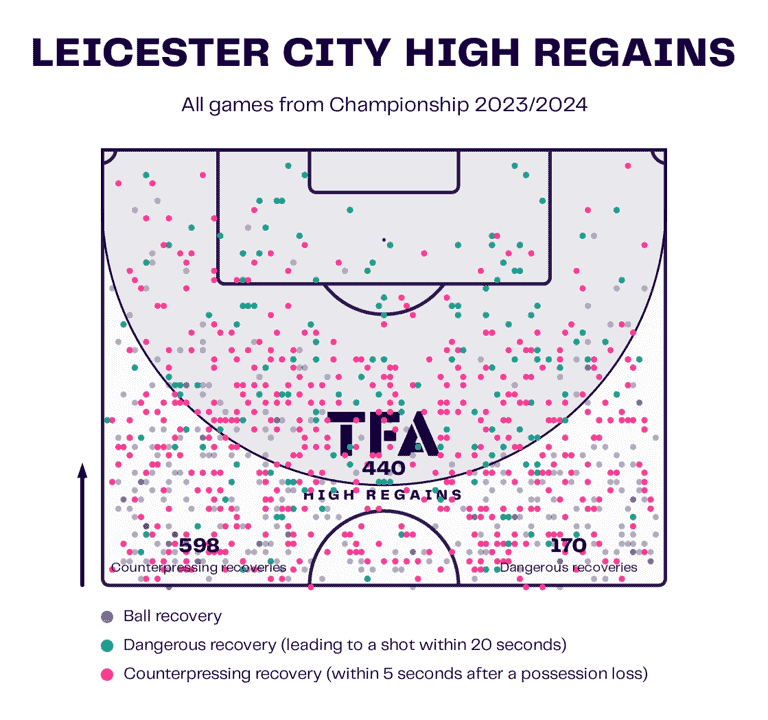
Not only do Leicester like to be engaging and aggressive on the ball, but they also apply similar traits out of possession, ranking high in Championship statistical ratings for several pressing metrics.
One area in which they are not as active, however, is counter-pressing recoveries, which they average somewhat lower than the league average this season.
This brings us to Blackburn’s attacking approach.
We know that Leicester isn’t one to be highly aggressive in the counter-press, so once Blackburn wins the ball back and they see Leicester try and regroup, do Rovers look to hit them quickly or try and build a period of sustained possession and pressure themselves?
This season, Blackburn have demonstrated one of the Championship’s higher match tempos.
Still, they may rethink their approach to one with more caution and patience.
After all, a draw will guarantee their safety, and Leicester average a high number of counterattacks per 90, so Blackburn will want to avoid being sucked into that trap.
Sheffield Wednesday
Another former Premier League team, Sheffield Wednesday, needing just a point in their final game, have had their share of ups and downs in recent years, not to mention the ongoing ownership situation.
Manager Danny Röhl has received heaps of praise from Wednesday fans for giving them hope of survival since he arrived earlier in the season.
The Owls face Sunderland away on the final day of the season, with the Black Cats essentially having nothing to play for.
Wednesday’s form going into this one has been fantastic.
They have lost just once in their previous six (a 2-0 defeat to Middlesbrough) and picked up three wins along the way, including the 3-0 thrashing of play-off contenders West Brom.
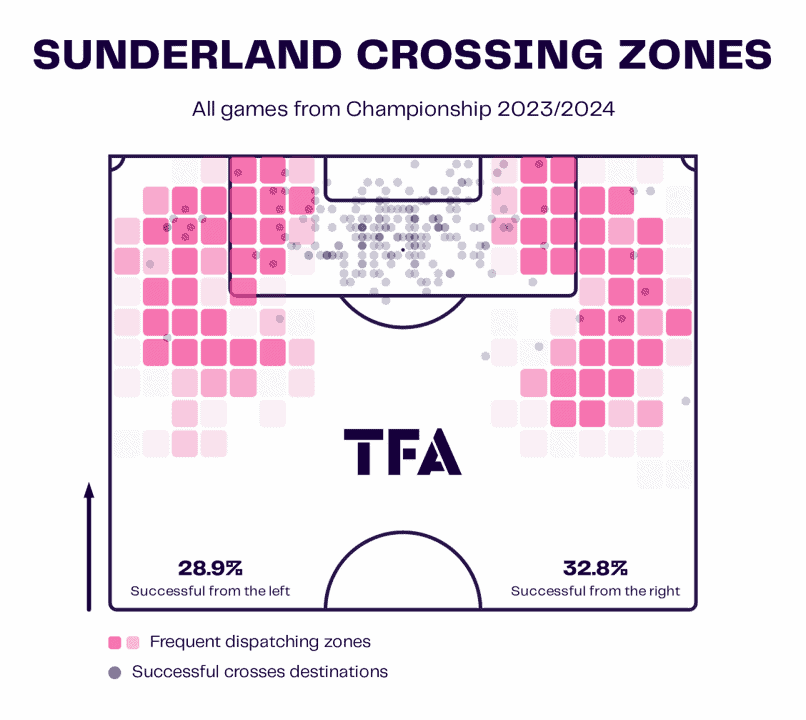
Sunderland is another team that likes to dictate play and control possession, but their activity in the final third is more physical and aerial than you may anticipate.
The Black Cats have scored a respectable nine headers this season and offer 14.32 crosses per 90 – both numbers beating the league average comfortably.
Headed shots from crosses are not the only way Sunderland can hurt Sheffield Wednesday, though.
The north-east club has a high shot attempt average, indicating that they can cause damage from a range of attacking avenues.
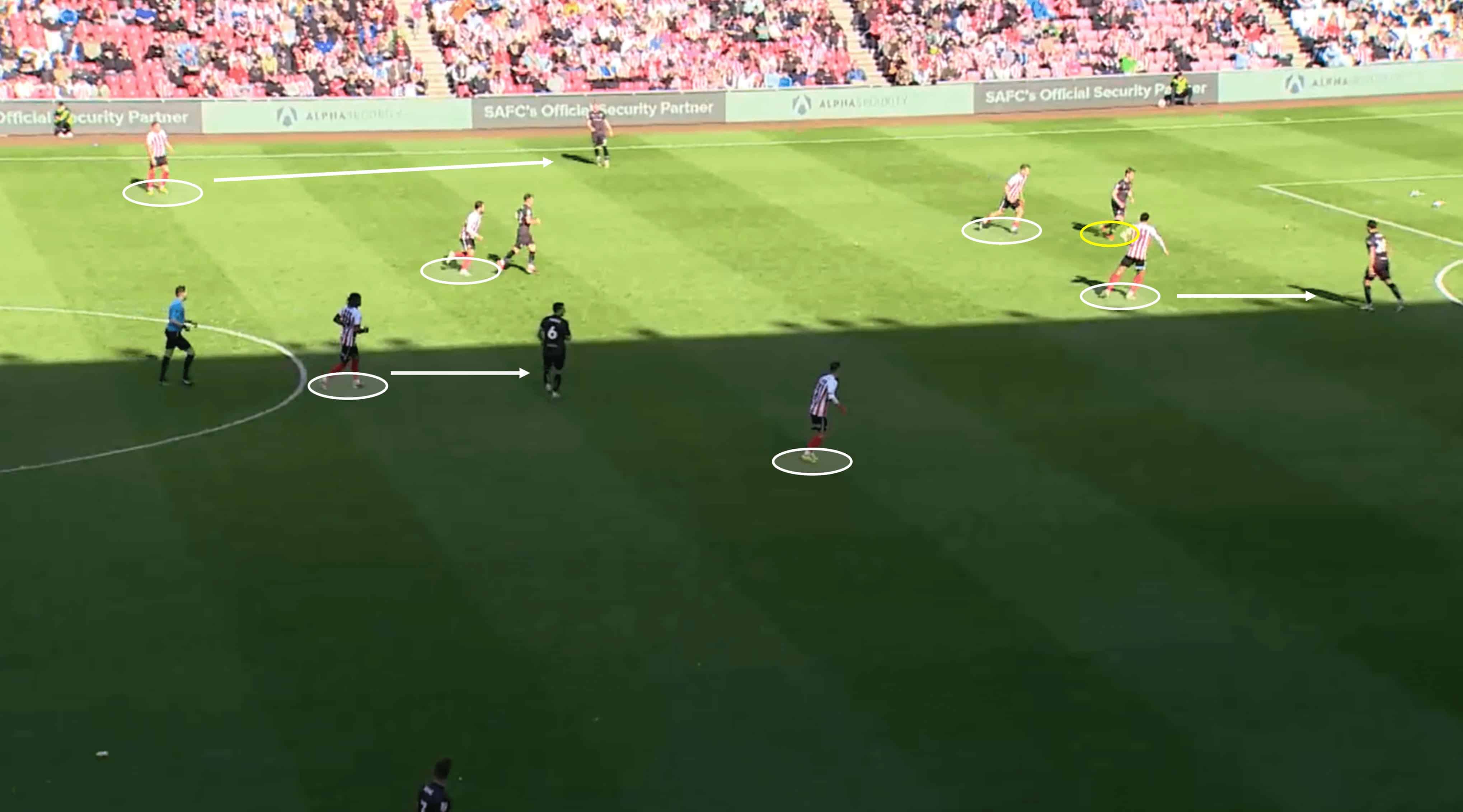
Similar to Leicester, Sunderland have the desire to press high and be defensively active high up the pitch, as you see above.
They’ll likely look to put pressure on Wednesday at the back while man-marking the nearby passing options in midfield and at full-back – something the Owls and Danny Röhl are likely anticipating.
Although their low PPDA, high challenge intensity, and a high number of high regains per 90, Sunderland shows signs of avoiding the counter-press, according to the data at least.

One of Wednesday’s biggest weapons, when the opponent has the ball, is their counter-pressing activity.
The map above gives you a taste of just how effective they can be in retrieving the ball quickly in any area of the pitch.
This could be something we see more of against Sunderland as they may look to disrupt Sunderland’s possession-based game plan.
Plymouth Argyle
Last season’s League One champions had to act quickly in December/January as their manager at the time, Steven Schumacher, left the club to take over at Stoke City.
Argyle appointed former England U20 manager Ian Foster, and the club was in the drop zone at the time.
Their recent form has given fans hope.
They have won three of their previous six, including a sensational victory against league leaders Leicester.
They face Hull City on the final day, a team that needs a win and nothing less (and other results to go their way) if they’re to make the Championship playoffs.
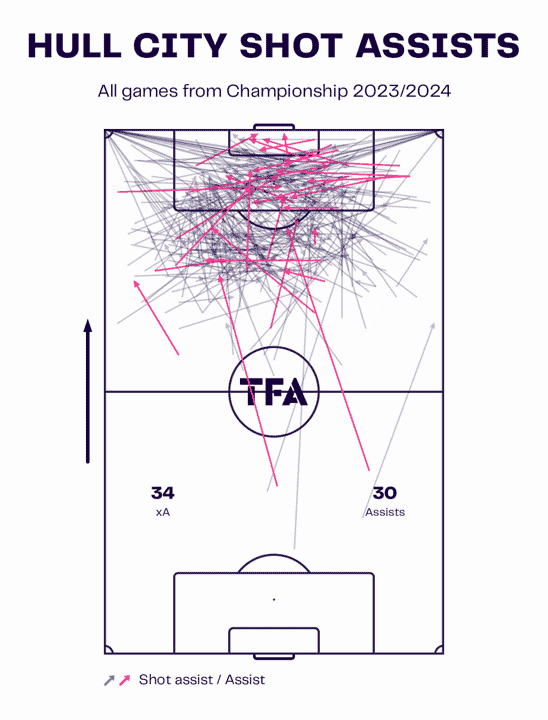
Hull prefers to play a quick game with short passes.
Their attacking focus is often on central penetration, which explains their low cross-tries rate.
The map above gives us an insight into this, with much of their chance creation and many of their assists coming from central areas.
We may see Plymouth deploy a high central presence in midfield to try to limit the threat of through balls from central midfield areas—something else that Hull is inclined to do.
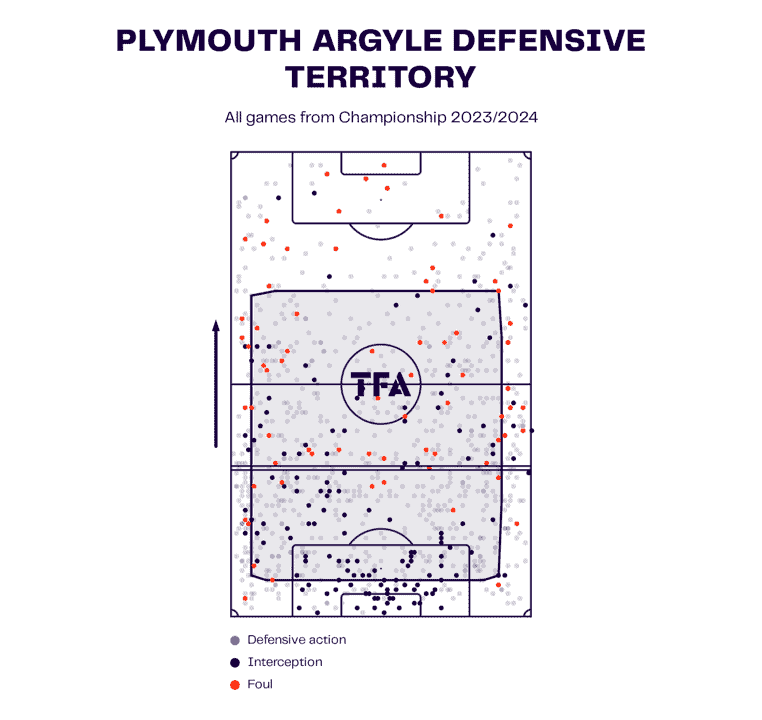
Plymouth’s defensive performance mirrors that of many teams in a relegation battle.
They are often more reserved in their pressing, opting to stay deeper and compact as a unit—something that we do see from Argyle.
In terms of combating that central attacking threat from Hull, Plymouth will be looking to utilise their ability in interceptions – they make 42.66 interceptions per 90 (third-highest in the Championship), so stopping opposition passes is something of a speciality area for them.
As you can see in the visual above, they show the ability to make interceptions in deep central midfield areas and inside their own box—traits that, if executed well on the day, could go a long way toward limiting Hull’s central threat.
Birmingham City
Another club that has experienced managerial turmoil, Birmingham City, has had several different figures leading the club this season, which has likely contributed to the club’s finding itself amid the relegation battle.
After starting the season strongly with John Eustace, the Blues controversially sacked their manager to bring in Wayne Rooney—an experiment that failed after just 15 games.
Tony Mowbray replaced the England legend, but the veteran manager recently vacated his position due to health reasons.
Gary Rowett will oversee the club for the remainder of the campaign.
Rowett has been able to continue Mowbray’s work regarding Birmingham’s strong defensive record, conceding five in their last six games—in which they’ve lost twice, won twice, and drawn twice.
The Blues face Norwich City on the final day, who know a draw will be enough to secure their play-off spot.
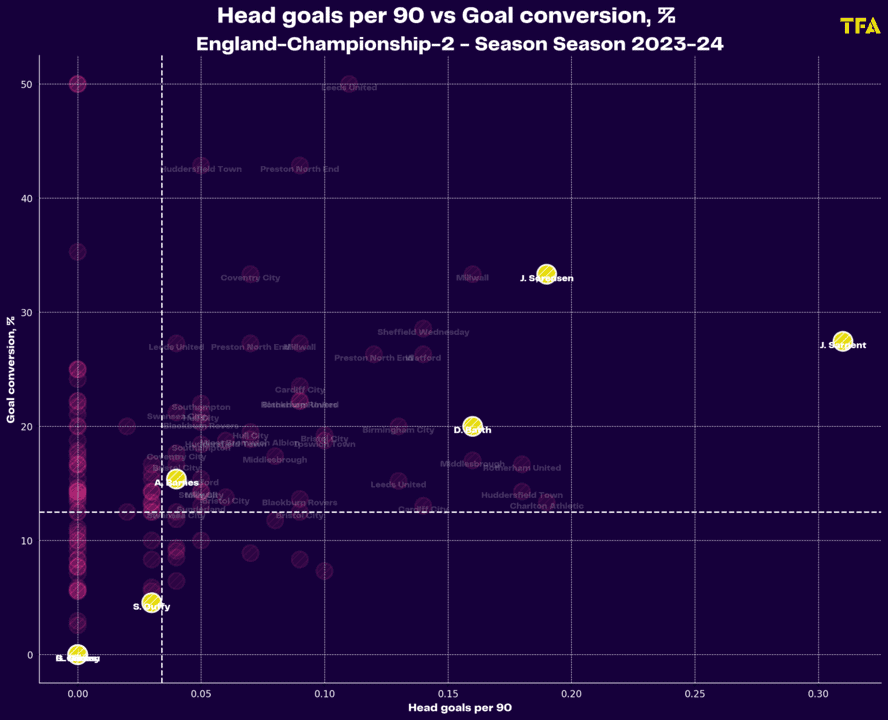
Norwich City have one of the best records in the Championship regarding scoring headed goals and bagging from corners, which is why they also like to attempt a high number of crosses.
The Canaries aren’t possession-reliant like some of the teams in this analysis, but they have a clear attacking identity.
The graph, containing stats of Championship CBs and CFs, shows us just how deadly Norwich can be in front of goal, especially with headed shots.
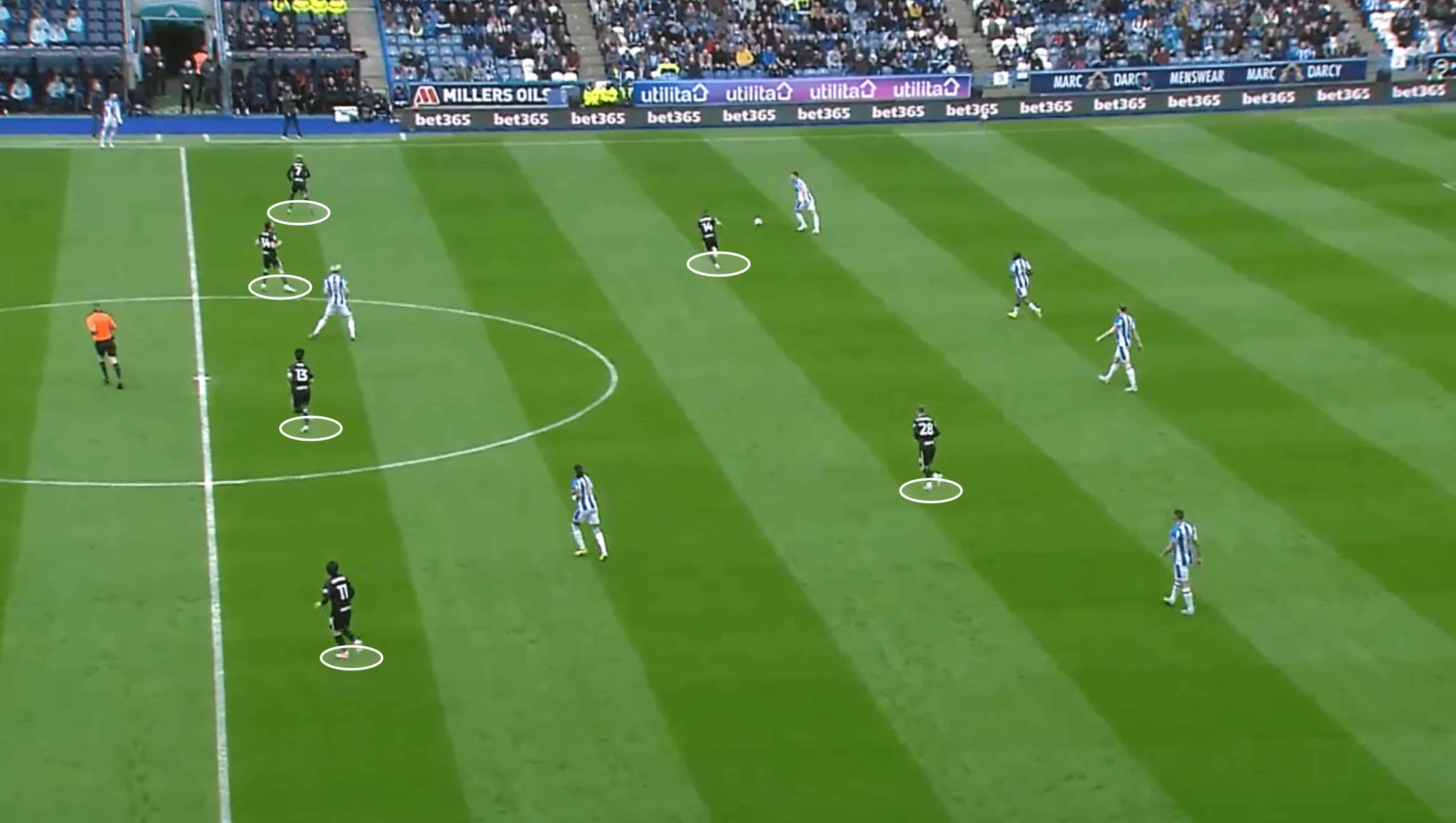
Birmingham is one of the more aggressive sides in the Championship.
They boast a low PPDA and high challenge intensity, showing that they like to take the fight to the opponent rather than inviting pressure on the backline.
However, despite the base data suggesting they’re a high-pressing team, further data research, paired with match viewing, shows that the Blues are structured in terms of when and where to be more aggressive.
The image above shows us part of that.
While minimal pressure is often applied to the backline, the midfield unit will be close to the halfway line, looking to block passing lines into the front men while also making it difficult for the opponent to find nearby passing options.
In a nutshell, it’s an aggressive mid-block from Birmingham.
They have a high interception average, and they’ll need to use that to good use against Norwich on Saturday to try and limit their attacking activity on the flanks. Birmingham will want to avoid facing crosses and/or aerial battles in their own box due to Norwich’s threat in those areas.
In terms of their attacking prospects, according to the data, Birmingham enjoys a counterattack, which on paper, pairs well with their aggressive mid-block.
They’ll have to execute both right to hurt their opponents.
Conclusion
If you’re a supporter of one of the clubs in the relegation battle, hopefully, you now go into the final weekend of the season with an idea of what your club should expect to face.
Of course, there will be some surprises, twists, and turns, as there always are at this point in the campaign.
With Huddersfield effectively already down and Blackburn and Sheffield Wednesday both needing just a point to secure their status in England’s second division, the most significant task arguably lies with Plymouth and Birmingham – it could come down to the finest of margins come the full-time whistle on Saturday evening.
That is not to say that Blackburn and Sheffield Wednesday have easy tasks ahead of them, either!
Who will be playing EFL League One football next season?
