
To say Sheffield Wednesday are having a tough time would be an understatement.
On and off the pitch, the Owls have had their fair share of destruction.
Of course, there’s the ongoing situation with owner Dejphon Chansiri, which has largely mirrored the lacklustre season on the pitch for the most part this year.
This season is the club’s first time back in the EFL Championship since 2020/21 – Darren Moore guided the club to promotion via the playoffs last season, but shockingly walked out of the club shortly after.
Xisco Muñoz then replaced the former Doncaster Rovers player, but he was sacked after just 12 games, during which he failed to secure a single victory.
Eyebrows were raised when 34-year-old Danny Röhl was appointed as the club’s next manager – the German coach’s first-ever managerial job.
His coaching CV was the only thing providing hope for Wednesday fans, as he had no previous managerial experience to judge him by.
Röhl has previously worked as a first-team coach at clubs such as RB Leipzig, Southampton, and Bayern Munich; he has also served as the assistant manager of the German national team, so his coaching pedigree is unquestionable.
Despite a challenging start to life in South Yorkshire in terms of results, fans were encouraged by the noticeable improvement in performance, which appears to be growing week by week.
Shortly into Röhl’s reign, assistant manager Chris Powell urged the club’s fans to be patient with the EFL’s youngest manager, and it looks like their patience is starting to pay dividends, with the club currently on an unbeaten run of three games, winning two and drawing with promotion favourites Leicester City.
This scout report will provide a Danny Röhl tactical analysis of how Röhl’s Wednesday side have played in those three games as we look to pinpoint the key tactics behind the Owls’ transformation in form.
Off-the-ball intensity
One of the most glaring differences in a Sheffield Wednesday performance now is how they approach things out of possession.
In a short space of time, Röhl has instilled a tremendous work rate and unit cohesion, enabling the team to close down the opposition at the right moments.
This segment of analysis discusses some of the key elements in Wednesday’s pressing.
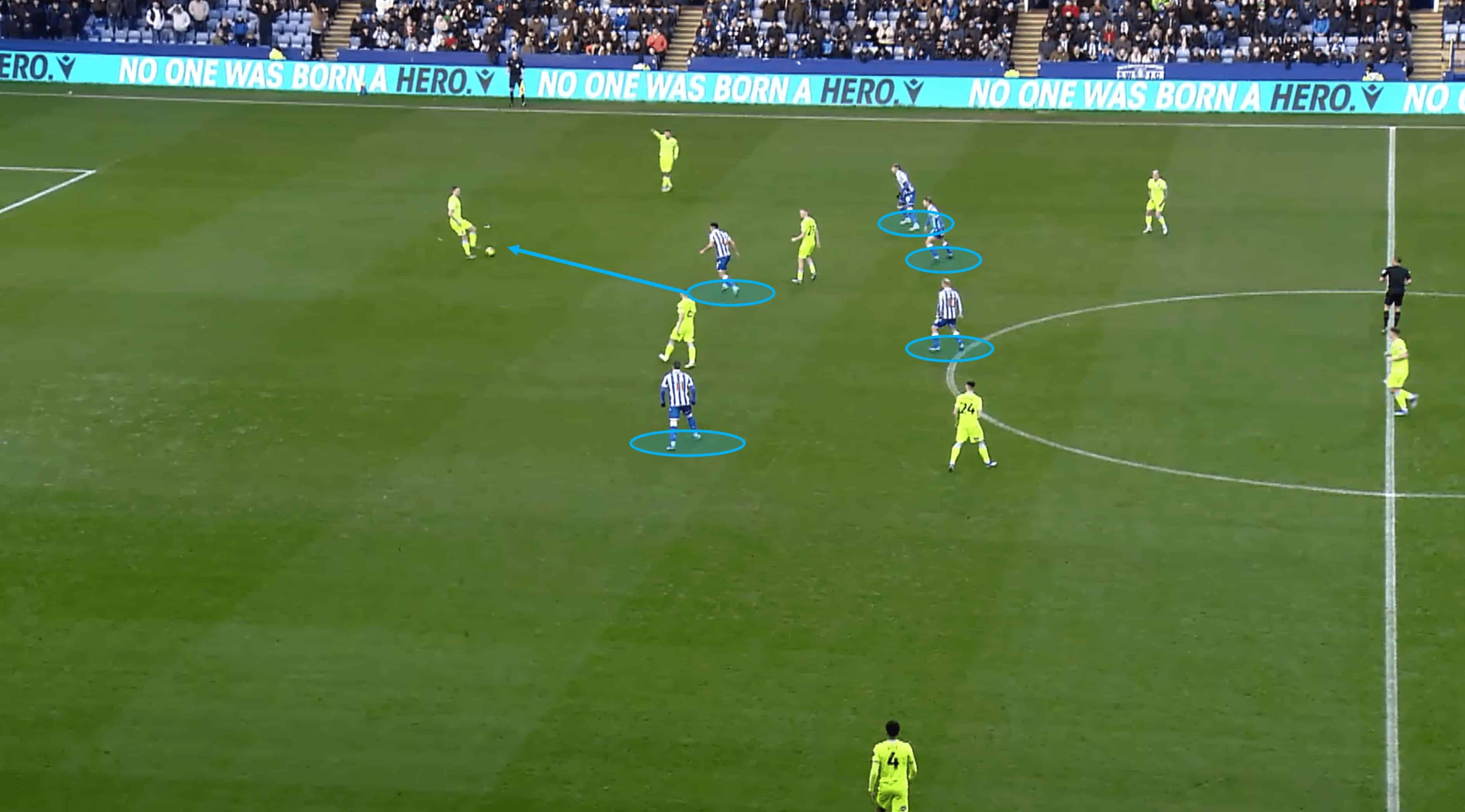
Perhaps the most striking thing about the image above is the narrow width of the Wednesday pressing group.
This particular move aims to prevent Blackburn from playing out into the midfield, significantly halting their attacking prospects.
More often than not, academy product Bailey Cadamarteri, in that lone striker role, has the job of pressing the opposition defenders, with the widest of the midfield block closing the full-backs down when required.
Interestingly, Wednesday executed this move immediately following a Blackburn kick-off – another indicator of Röhl’s intent and tactical ideologies.
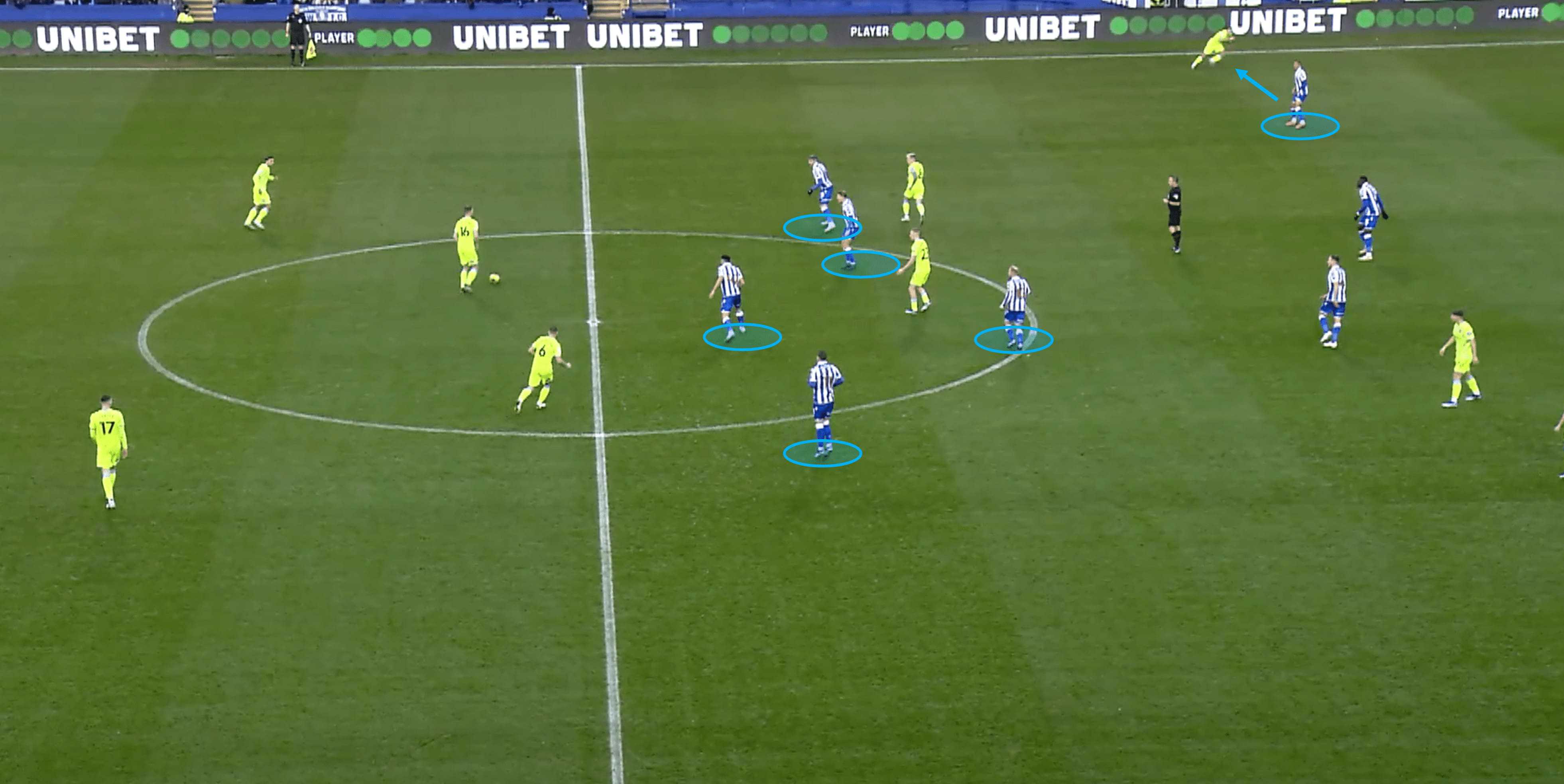
This move appeared frequently against Blackburn – a move explicitly tailored to combat Rovers’ tactics, a clever move by Röhl, and a testament to the work done behind the scenes to prepare for this tactic.
Teams shaping up this way is not a common sight.
In this example, Wednesday’s CF and midfield unit have dropped deeper and are awaiting the right moment to close down the ball, but Wednesday’s back line remained at a good depth, allowing the Owls to play in a mid-block formation.
As before, the narrow shape of the front pressing group stops Blackburn from playing into the midfielders, making it difficult to build an attack.
Their widemen were pushed far up the pitch, which, of course, poses a potential threat, but the Wednesday full-backs deal with this as any full-back would and simply mark that danger.
But notice the lack of a Blackburn presence in the areas where you would expect to find the RB/LB – there is nobody there, so there is no need for Wednesday to have players out there right now, especially when they can be put to better use in a central position.
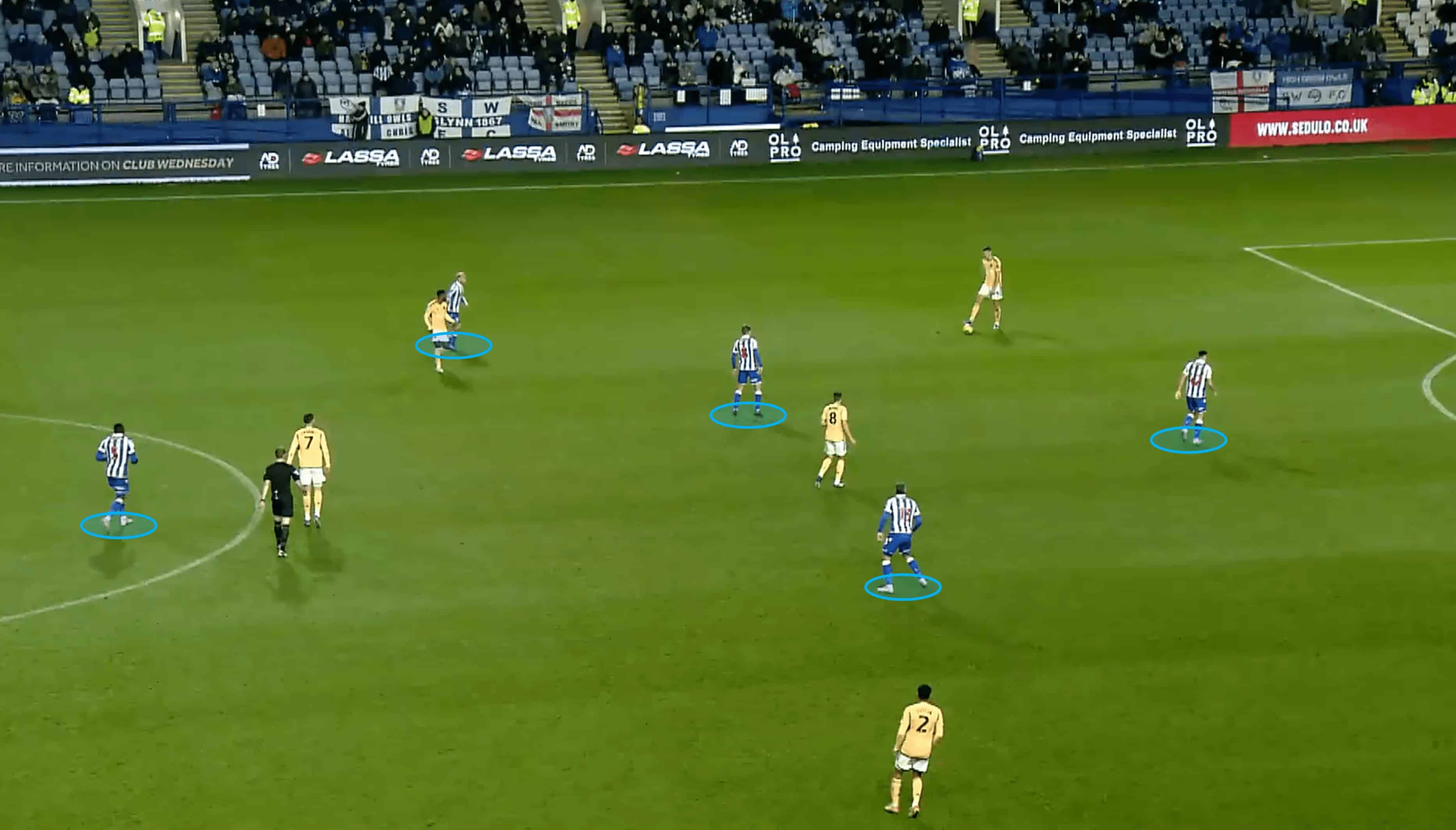
The next example occurred in the game against Leicester City, resulting in a well-deserved 1-1 draw against one of the most feared teams in the Championship this season.
We mentioned earlier that Röhl deployed a tactic that was tailored to combat the opposition’s predicted tactics, and we see another example of that here.
Tactical flexibility and versatility are crucial components of Röhl’s philosophy, and he knows how to effectively set up his team accordingly.
This time, the midfield unit is far less narrow than in the previous examples, yet it is still positioned high up the pitch.
However, they are also less active in the sense that their aggression levels are lower – waiting for Leicester to make their next move, which has been made difficult by the Owls’ marking and positioning.
However, the aggression and intensity do return once a trigger occurs – in this case, Wednesday were triggered by Leicester’s passing around the back.
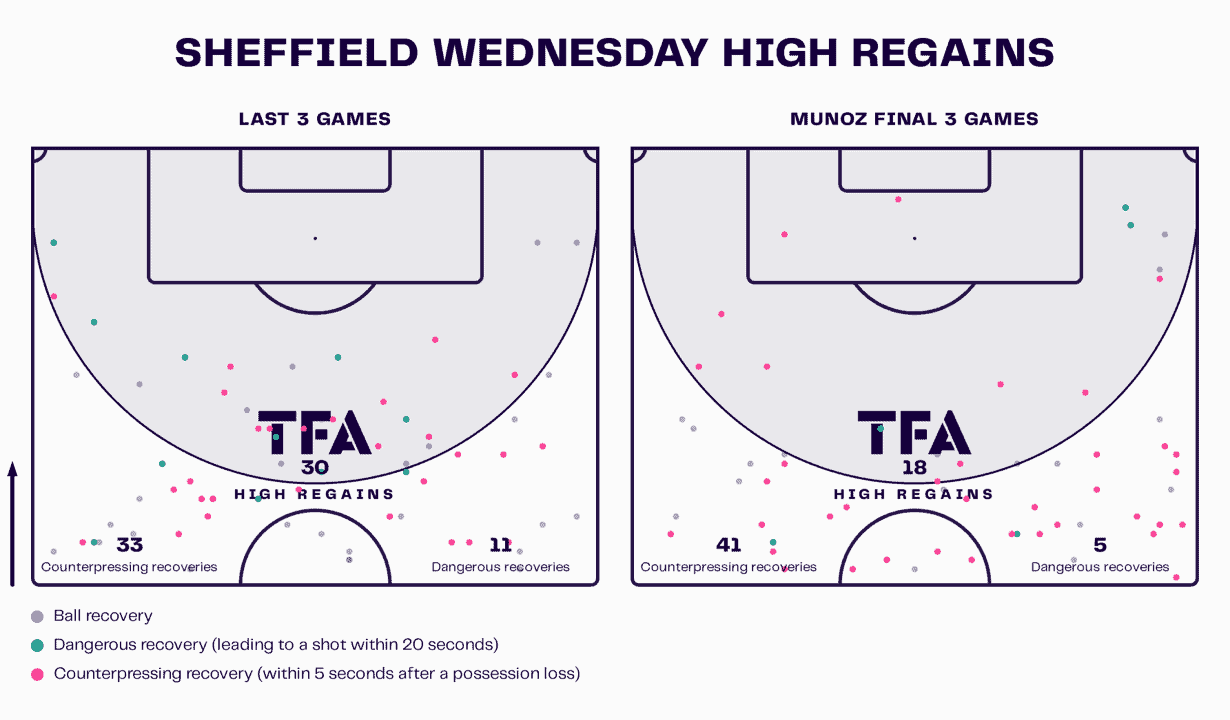
We are focusing on Röhl’s most recent three fixtures as Wednesday’s boss, due to the pickup in form and the increase in performance quality, as it looks like he is really building something at Hillsborough.
When comparing Wednesday’s pressing stats in that time frame to the final three games during the Muñoz era, you see a stark difference – a difference that really paints a picture of the confidence Röhl has instilled into this team.
While Röhl’s side has made slightly fewer counter-pressing recoveries in the three games compared to Muñoz’s, they are far more effective in making recoveries in the final third, as well as making dangerous recoveries.
This highlights Wednesday’s ability to execute a press and use the ball to good impact afterward.
Attacking transitions & general improvement in front of goal
Being impactful during attacking transitions goes hand in hand with a high-intensity pressing approach of the ball, and Röhl seems well aware of this.
The Owls have displayed a fresh hunger and determination in their performances since the German coach arrived, and that carries into their team ability in attacking transitions.
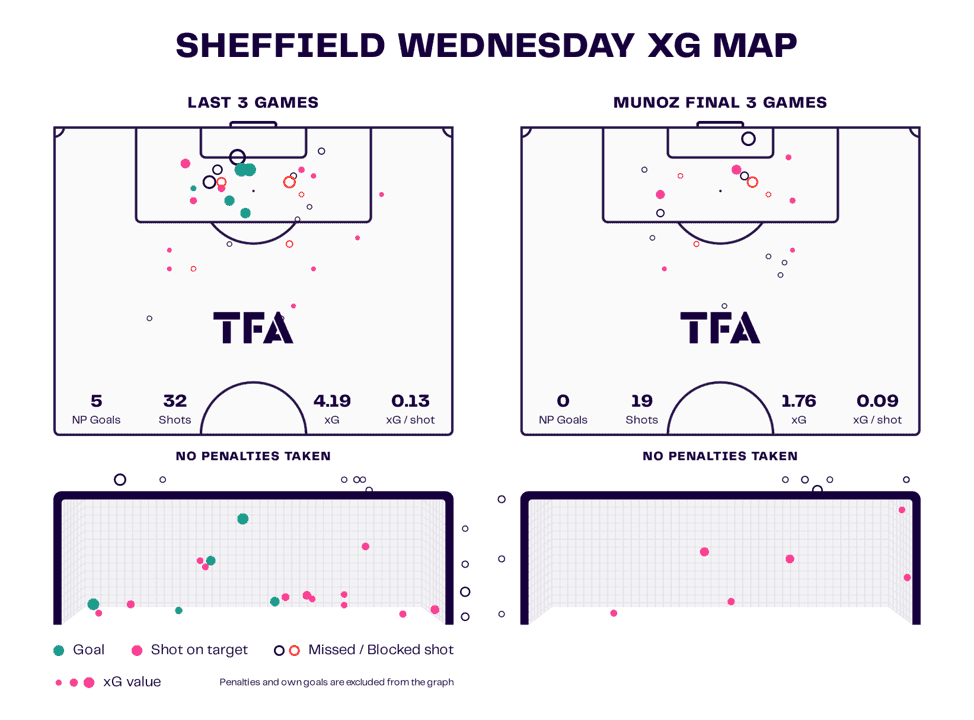
This is another comparison of Röhl’s most recent three games against Muñoz’s last three, summarising the club’s improvement.
Under Muñoz, the Owls seriously lacked tactical direction, which severely impacted squad confidence, and losing was quickly becoming a habit – as was their struggle in front of goal.
Now, Wednesdays aren’t blowing opponents away with huge scorelines, but they are creating more chances of higher quality and scoring more goals, and that looks like it will only continue to improve as Röhl gets more time to work with his players.
Wednesday still have the league’s lowest goal tally, netting just 13 times in 20 games.
However, eight goals have been scored under Röhl’s leadership – compared to five goals in 11 games under Muñoz.
These attacking improvements have already started to claw back some vital points for the Owls.
Both managers have earned two clean sheets this season in their respective reigns, but while Muñoz’s both came in 0-0 draws, Röhl won both of his clean sheet games.
Wednesday has shown attacking quality this season, especially in attacking transitions, which is why we included this goal breakdown in this segment of the analysis.
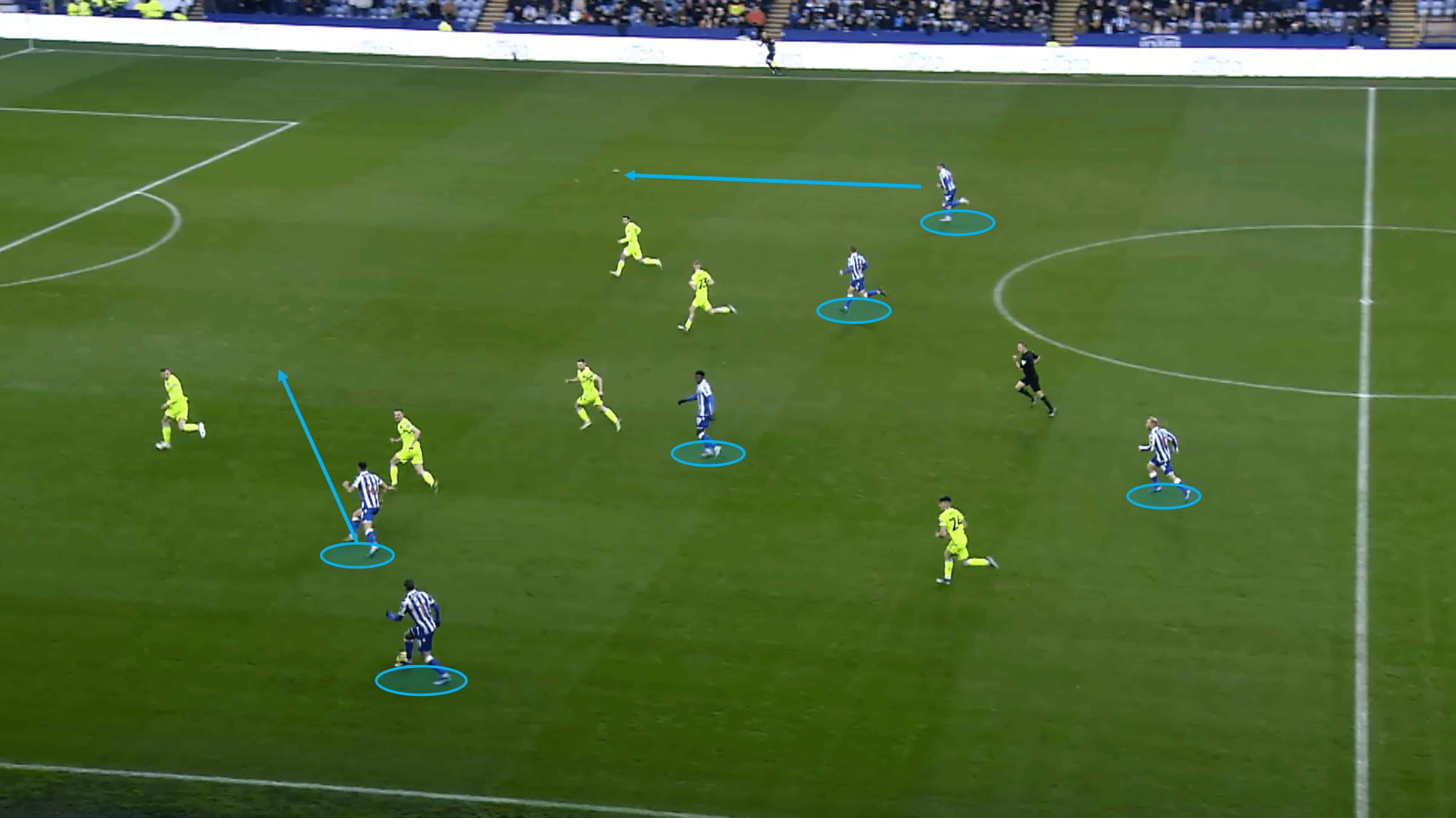
We’ve analysed their intensity and success in executing a press and making recoveries, but what do they do when they win the ball back? Usually, when the opportunity is present, they instantly look to attack.
These moments are the ones that really prove the rise in confidence within the squad, as well as how quickly the players have bought into Röhl’s ideas.
Expect to see several players present in a Wednesday breakaway attack, including most of the midfield unit.
Runners in wide areas add another dimension to the attack, and Cadamarteri’s hunger to get into dangerous spaces gives the opposition defence something to consider.
While often playing a supporting role, the midfielders provide a strong presence to the attack and make it difficult for the opponent to clear the danger.
Their off-the-ball movement has been a critical part of their attacking success.
It will likely be something Röhl looks to utilise going forward, regardless of whichever tactical direction he takes from week to week.
Midfield shape in build-up phases
So far, Danny Röhl style of play has been opting for 4-3-3 or 4-1-4-1, which, as you can imagine, sees differences in shape and positioning, but the principles and aims remain largely the same, and that is no exception with the midfield unit.
That unit has been crucial to Wednesday’s possession phases, providing a tactical identity through its unique shape and positioning.
In this segment, we discuss the role of the unit in the build-up phases, while also examining Barry Bannan’s impact in the engine room.
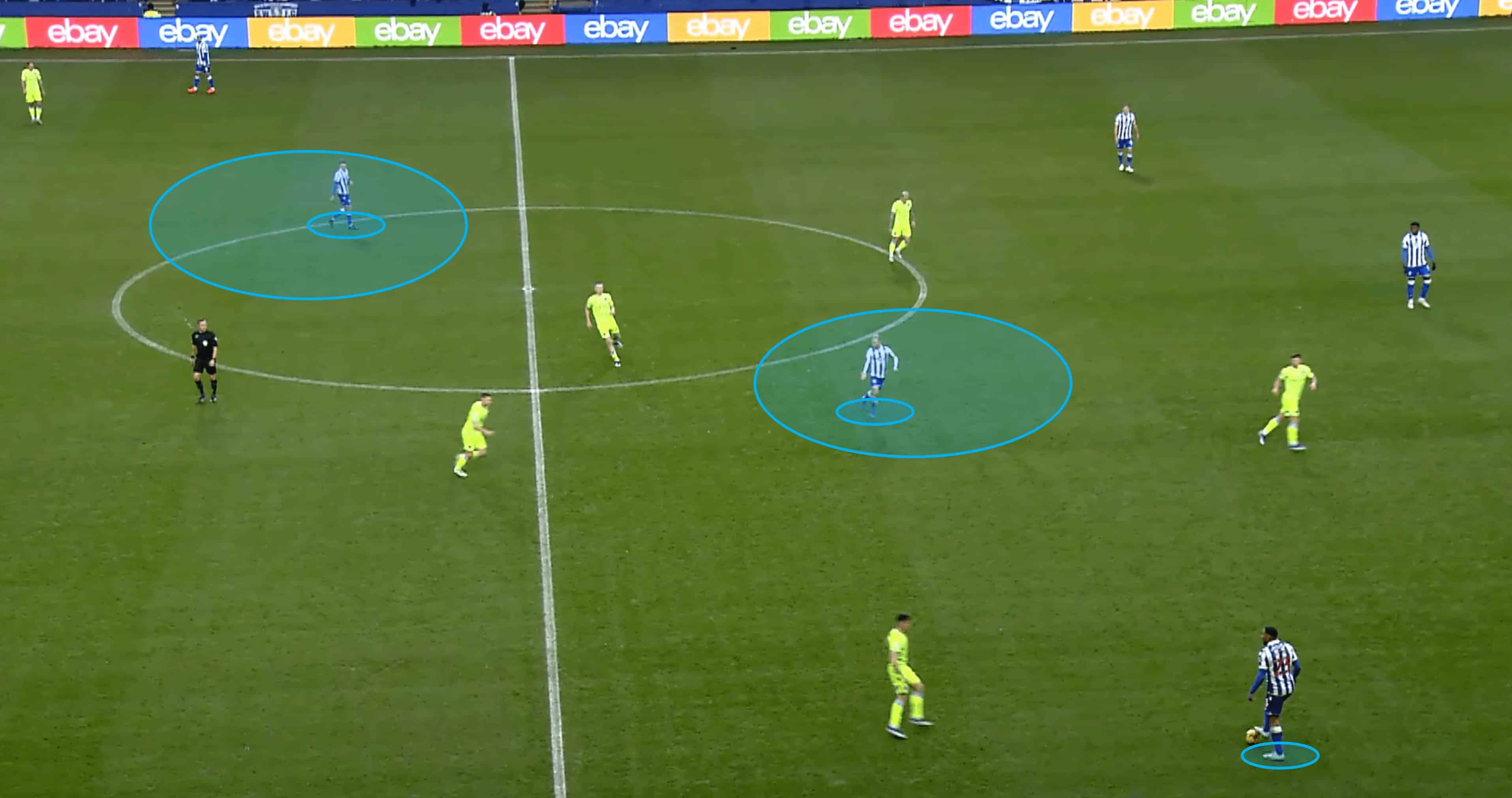
A far cry from their narrow nature when out of possession that we examined earlier, Sheffield Wednesday’s midfield unit often has the freedom to maintain a considerable distance between them.
This gives the Owls the flexibility to play through the midfield third, as they can take up numerous positions and angles to receive the ball from the defenders.
The space aspect also gives the opponent a headache, as these tactics have an element of unpredictability.
The example above provides a glimpse of this.
Bannan is seen dropping into the deeper playmaker role, looking to be the initial close link between the back four and the midfield before playing the ball forward himself.
Notice how both Bannan and his highlighted teammate have a great deal of space – this is another advantage of the shape fluidity: the third midfielder (Wednesday played a 4-3-3 in this fixture) isn’t even in the shot, he’s that far up!
Certainly, an interesting and unique dimension was added to Wednesday’s possession phases.
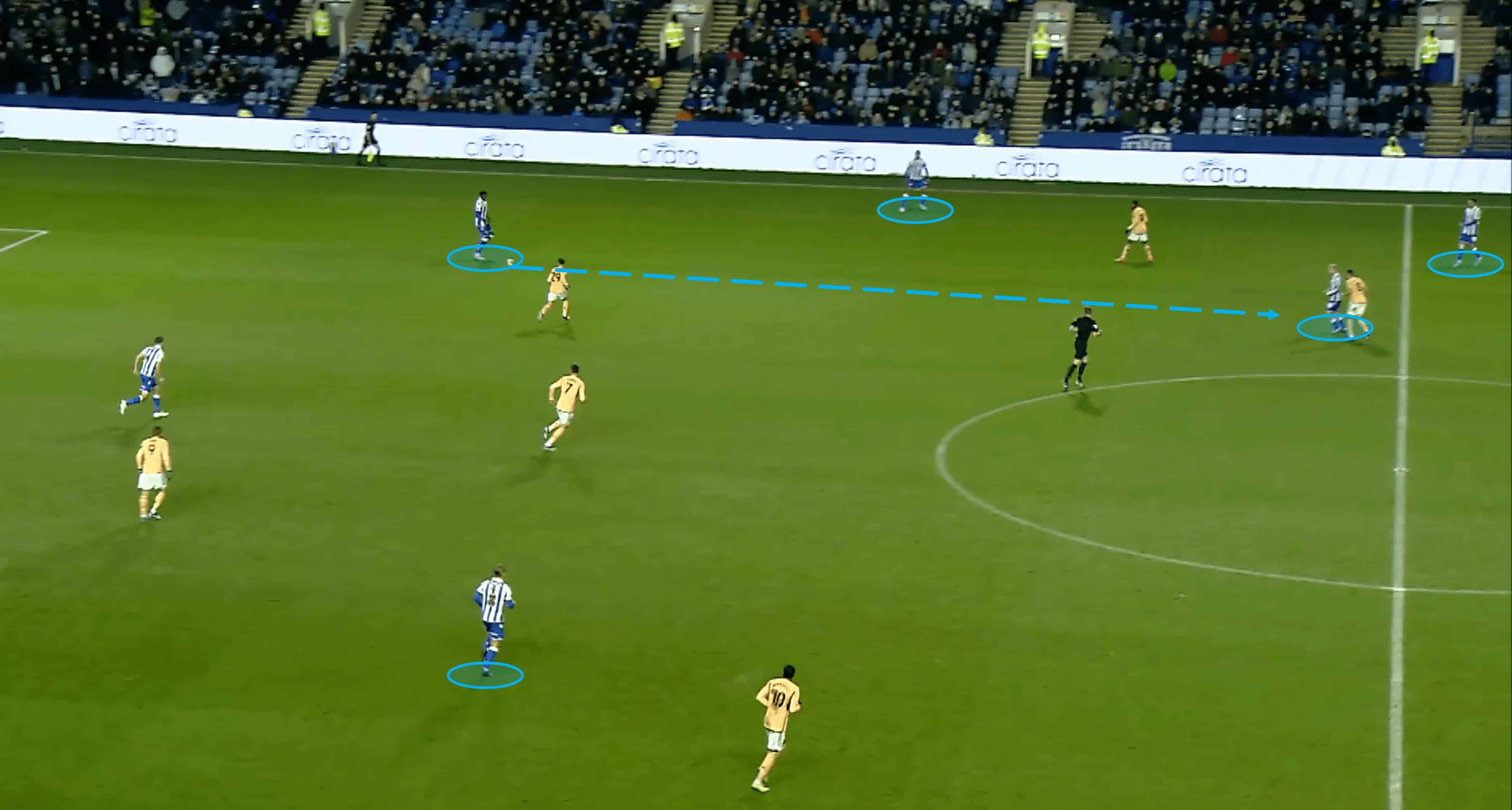
What we see more of from Wednesday’s midfield unit, whether it’s a 4-3-3 or 4-1-4-1, is Bannan positioning himself in a location where he can receive the ball and instantly combine with the full-back and/or winger on that same side.
Again, though, notice the distance between him and his highlighted midfield teammate – this forces Leicester to keep a wide shape to combat the width of Wednesday, creating space for the Owls to utilise.
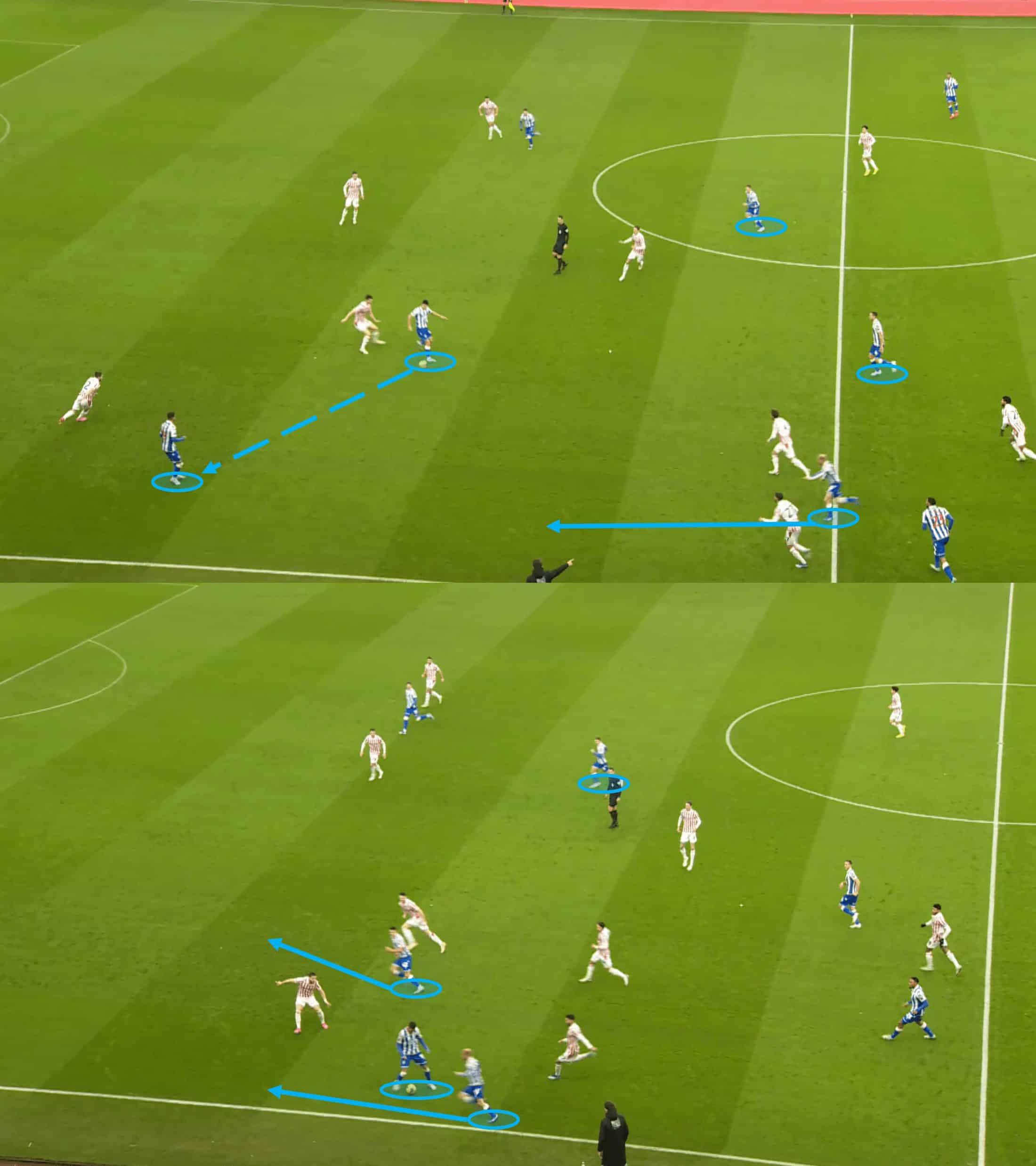
We touched on Bannan’s role in combining with the flank players, which is a crucial feature of his role under Röhl.
The Wednesday boss seems to recognise the Scottish midfielder’s technical qualities and wants to get the most out of them, which is why we see him operating in many areas across the pitch from week to week.
Bannan is no stranger to effectively becoming an extra winger on the left flank, as evidenced in the analysis image above, where he can be seen combining with two teammates, making an overlapping run down the line.
While it is true that the Owls’ midfield unit has been given considerable freedom in general by Röhl, it seems that Bannan has been given more license to roam and get involved at any stage of possession.
Conclusion
Sheffield Wednesday is not out of the woods yet by any stretch of the imagination, but its improvement is undeniable, and now the results are starting to reflect that.
Keeping key players fit will be difficult due to the intensity of Röhl’s tactics, so it may not be a surprise if the Owls look to make a couple of additions in the January transfer window to help keep things fresh.
Ironically, while Röhl is remarkably young for a Championship manager, the average age within his squad is 27.8 years – the second oldest team in the division.
Danny Röhl will undoubtedly have to draw on that experience, especially during periods of pressure.
Let’s not forget that Röhl is the youngest manager in the EFL, and while he has impressed so far, mistakes and learning curves are inevitable.
That said, it is safe to say that Wednesday fans are more hopeful about their future now than just a couple of months ago.
