
The second day of action in the World Cup proved to be an exciting one, with USA and Wales providing the main event at the end of the day. Although it was only the first matchday in Group B, there was a lot at stake in Al Rayyan. With England being the clear-cut favourites out of the group, the second qualification spot is up for grabs between USA and Wales. With these circumstances, there was a certain knockout feel to this match.
The nerves were naturally high for both sides. For Wales, this is their first World Cup appearance since 1958. Led by former Real Madrid player and UEFA Champions League winner Gareth Bale, the pressure is on the Dragons to make it count. On the other hand, Gregg Berhalter leads a young yet golden American generation. With both nations looking to make a statement in this World Cup, the stakes could not have been higher.
The match proved to be a tale of two halves, with both teams enjoying their fair share of success. The final result of 1-1 was fair – if there is such a thing in football. Although Wales had a superior xG of 1.17, when the penalty is taken out of the equation, both teams sit around a similar value.
USMNT were the superior team in the first 45, with 66% possession and 0.55 xG compared to Wales’ 0.03. In the second half, the switch was flipped and although possession was split at 50/50, Wales had a much superior xG of 1.14 to 0.3.
In this tactical analysis, we will examine how each team looked to impose their tactics throughout the match. More specifically, this analysis will explore how exactly the USA were able to control the game and impose themselves in the first half, as well as how Rob Page was able to turn the match around and climb back to a draw in the second.
Lineups
As usual, the tactical battle began an hour before kick-off. When the team sheets were released, the starting line-ups were quite unexpected. Giovanni Reyna’s absence from the starting eleven was a surprise, especially as many thought the 20-year-old would be the creative key to breaking down Rob Page’s low block. Similarly, the Premier League’s Brenden Aaronson was also left out of Berhalter’s midfield.
The 49-year-old North American manager lined up the USMNT in their usual 4-3-3. With Arsenal’s Matt Turner in goal, the backline consisted of Sergiño Dest, Walker Zimmerman, Tim Ream, and Antonee Robinson. The midfield, which was the root of many supporters’ confusion, was composed of Tyler Adams, Weston McKennie, and Yunus Musah. Up top, Christian Pulisic was on the left, Josh Sargent in the middle, and Timothy Weah on the right. Rather than going for a more technical and creative midfield, Gregg opted for a more physical one. While this proved successful out of possession, the North Americans could have inflicted much more damage with the ball.

For Wales, Page lined up the Dragons in a 3-5-2. Depending on the match or scenario, Page likes to switch between a 3-5-2 and a 3-4-3, as both formations provide distinct tactical dynamics. Nottingham Forest’s Brennan Johnson was surprisingly left out of the squad as the 48-year-old manager opted for a 3-5-2. Wayne Hennessey was behind Chris Mepham, Joe Rodon, and Ben Davies. Connor Roberts and Neco Williams were the wingbacks while Ethan Ampadu, Aaron Ramsey, and Harry Wilson composed the midfield. Daniel James and Gareth Bale were the two centre-forwards. Kieffer Moore’s absence from the starting eleven was also a surprise when the team sheets came out, but Page quickly realised his mistake and introduced the Bournemouth striker at halftime.
Control through pressing
Before the match, it was expected that Gregg Berhalter’s side would dominate possession. Although their final possession figure was 58%, in the first half, this control was much more significant. What allowed for such high control of the game, however, was not solely their work in possession. From the very beginning, USMNT looked to press high and aggressively to keep Wales from constructing any real danger.
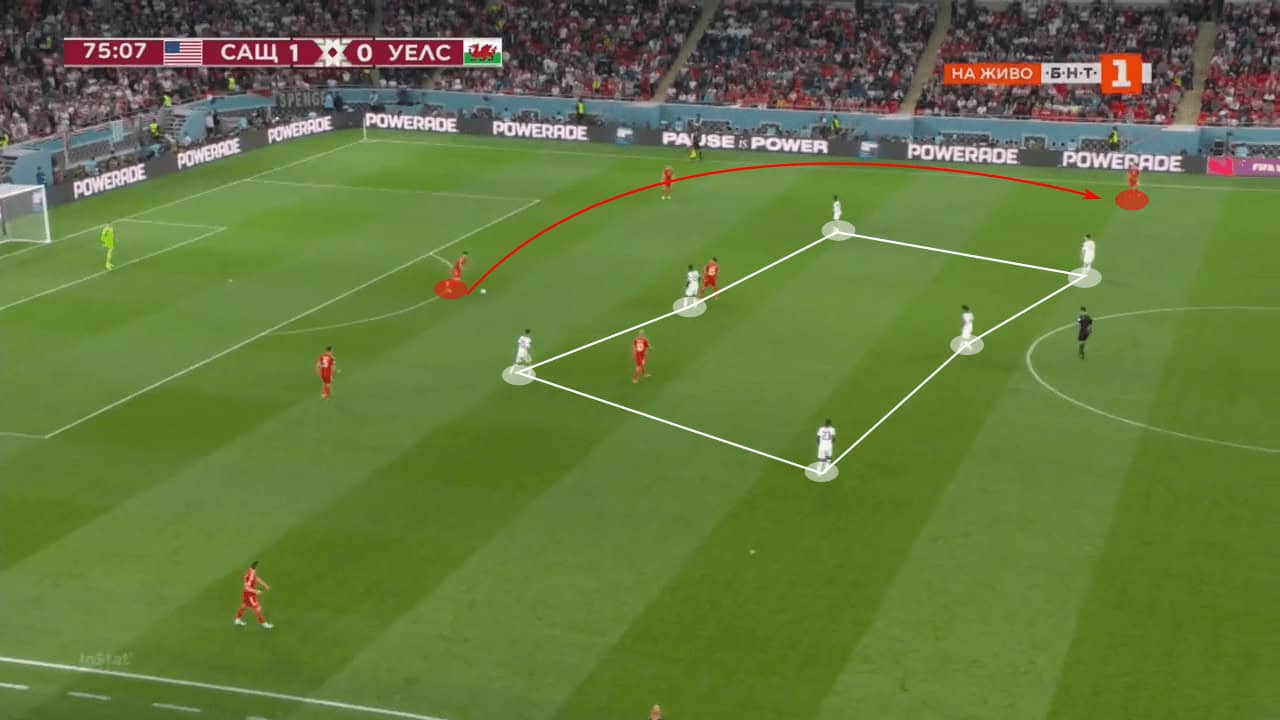
Their 4-3-3 structure was naturally superior to Wales’ back three in a high block, and this was at the root of why their pressing was initially so successful. The front three evenly paired up with Page’s three centre-backs, and in the midfield, there was also an even 3v3 battle. USMNT’s pressing structure can be seen below.
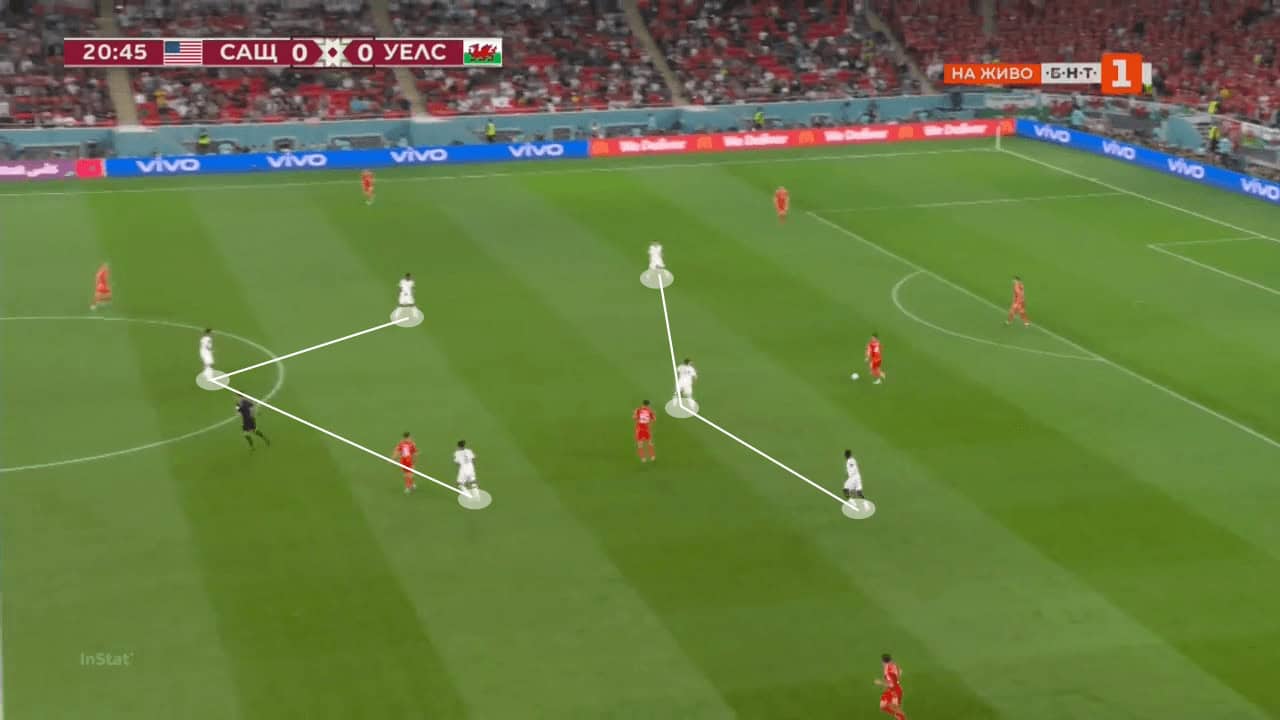
Rather than pressuring Joe Rodon, Josh Sargent was tasked with nullifying Ethan Ampadu. The Norwich City forward sat in front of the Welsh midfielder and through constant scans, he was able to keep Ampadu from receiving the ball. Meanwhile, the two wingers pressured the wide centre-backs.
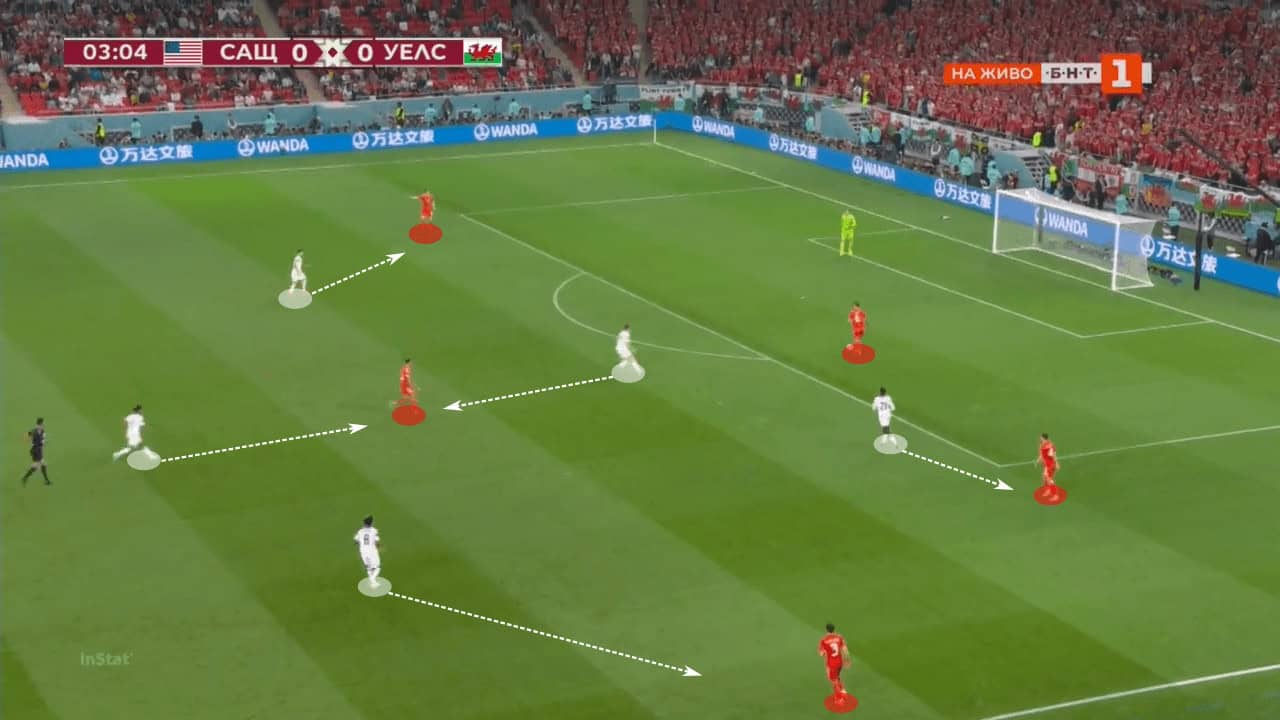
In a very compact manner, Berhalter’s high block shifted from side to side as Wales looked to build out of the back. For instance, when Mepham attempts to play out of the right side, the USA shift their entire block over with coordinated shifts in marking. Sargent remained on the six, and Yunus Musah followed Ramsey who had shifted wide. Adams was tasked with picking up Bale, who occasionally dropped deep to provide an option.
Although they initially had man-marking roles, once the phase of play began to develop, the Americans adopted a coordinated zonal marking system to remain compact and keep the intensity high.
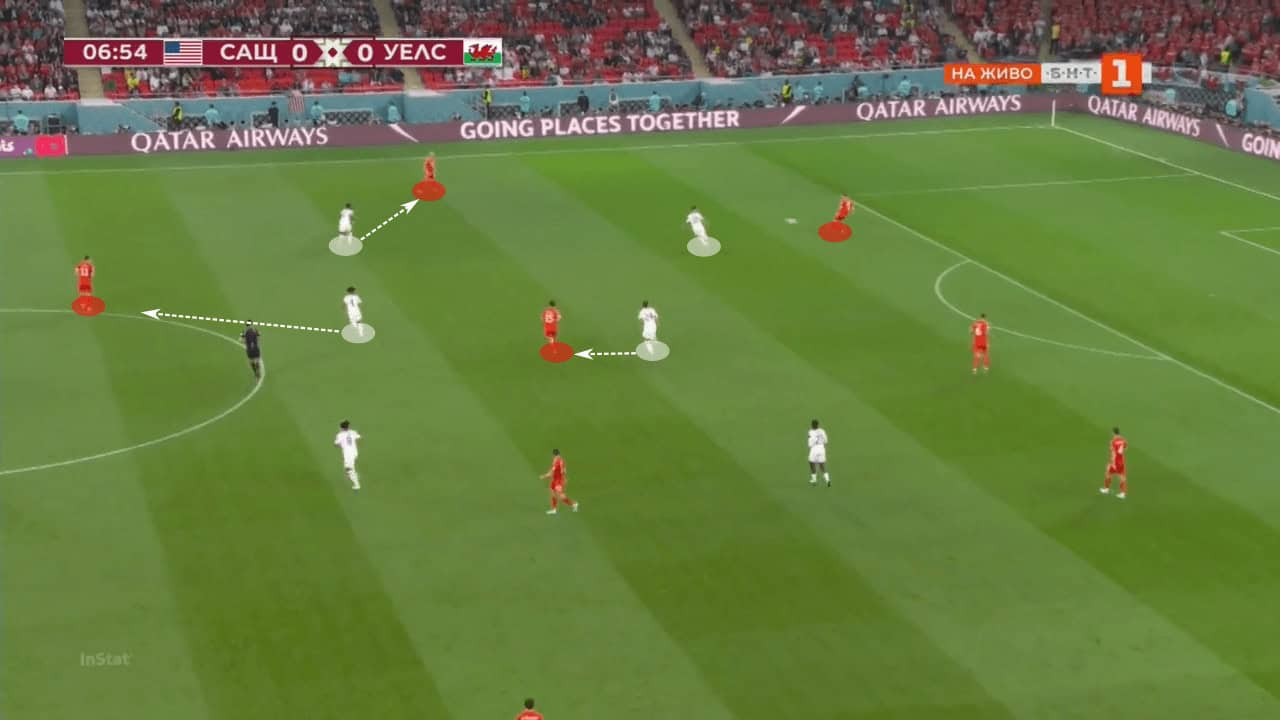
In the first half, Page’s men adopted many strategies to try to manipulate and play through USMNT’s high press. Above, we saw how Ramsey sprayed out to the wide channel while Connor Roberts pushed up high. Later on, they tried the opposite. In an effort to drag Yunus and create space for Roberts, Ramsey pushed up high and wide almost as a right winger. Yunus, however, stayed put while Robinson picked up Ramsey. With effective communication and coordination, the Americans were able to keep Wales from constructing any real danger in the first half.
Solutions to low block
In possession, the US looked to assert control and organise themselves across the pitch. Through many tactical variations, Berhalter deployed a complex attacking system looking to progress through the thirds with absolute control of possession. Page’s mid and low block, on the other hand, made this a very difficult task. Rather than instantly sitting deep, Wales confronted the US with a compact and organised mid-block. Even in lower blocks, Page’s men made it extremely difficult for the Americans to advance with danger.
Although they began in a 4-3-3, Berhalter’s men had no set shape in possession. Rather than an idealistic structure through which they were meant to attack, the Americans had multiple variations and rotations in their attacking system. These looked to manipulate, stretch, and disorganise Wales’ defensive structure at any given time.
Between the fullbacks, Robinson was the much more attacking one. As seen below, Dest often looked to sit deep while Robinson provided maximum width and depth. To fill this space left by the Fulham left-back, Yunus Musah would drop into the left-back role. Pulisic drifted inside into the left half-space while Weah stayed in the wide channel on the right. Finally, McKennie was in charge of filling the right half-space.
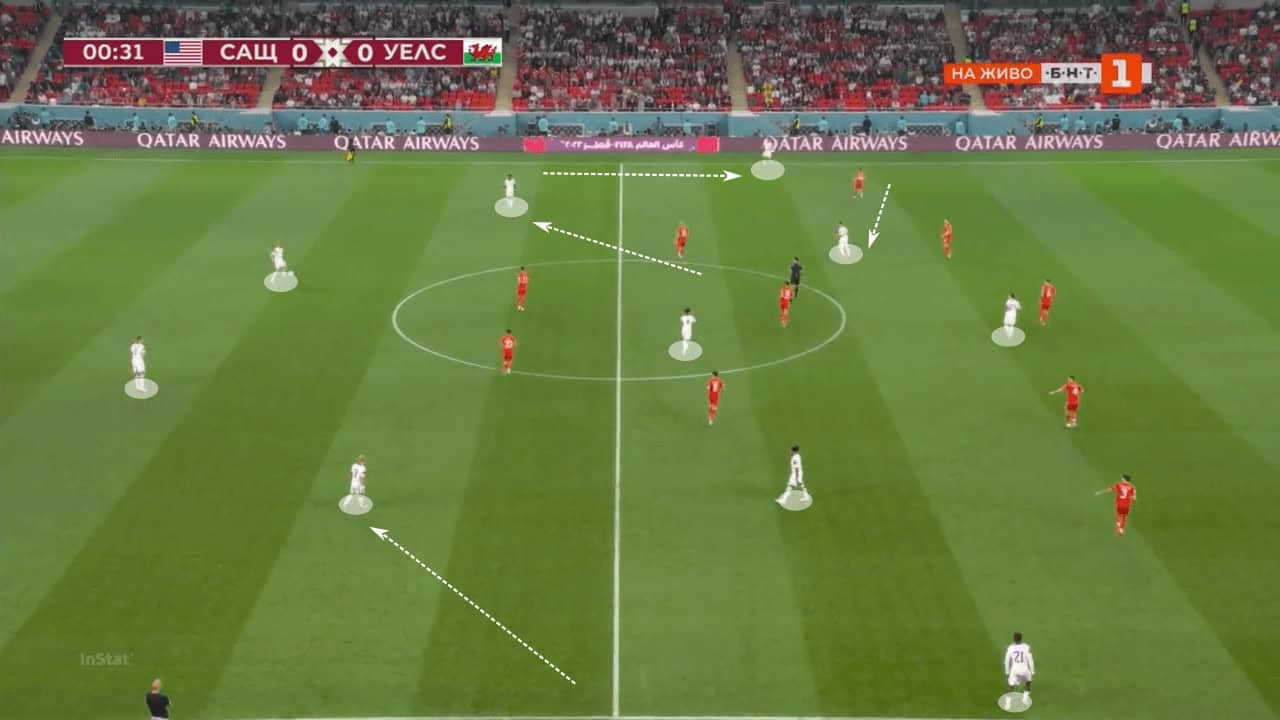
As mentioned, their structure was constantly changing. Nonetheless, a few principles were always followed. The main one was to constantly maintain maximum width and depth. This was often done through an attacking line of five, which looked to pin Wales’ backline. This saw them adopt a 2-3-5 or 3-2-5 structure quite often.
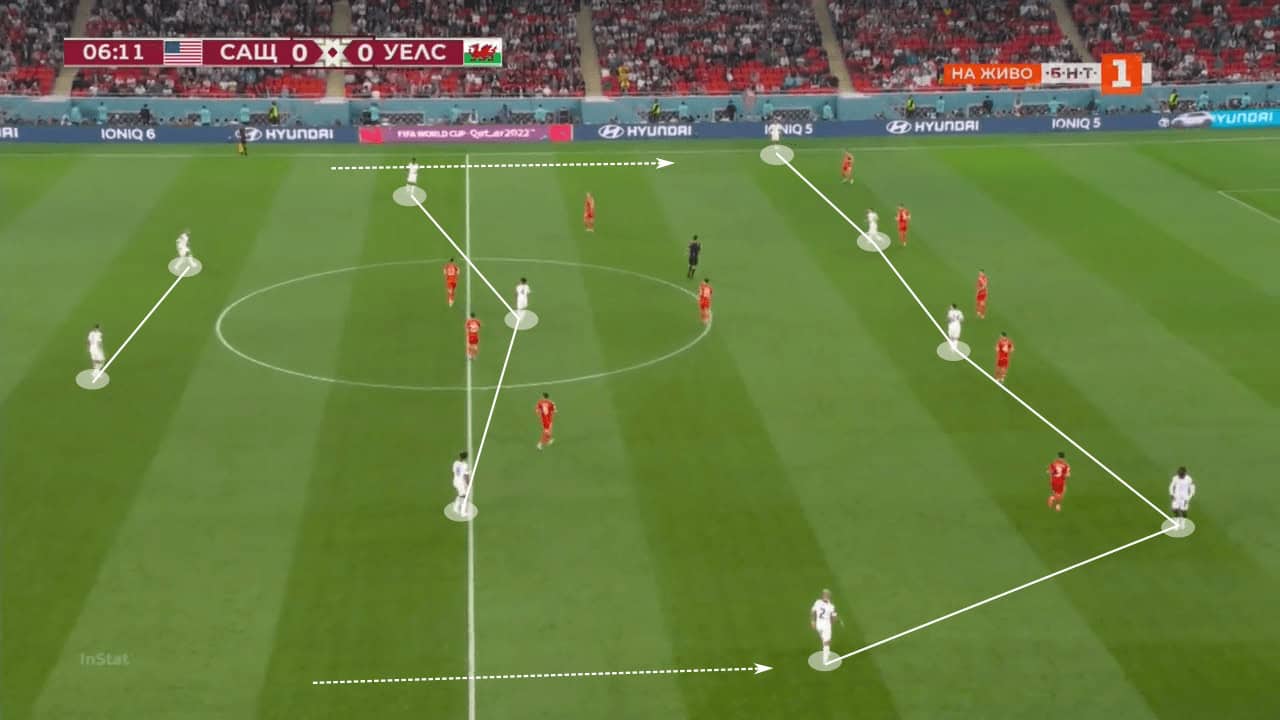
Gregg’s men, however, were immediately met with a red wall in the middle third. Page instructed his side to begin with a compact mid-block and keep the Americans from effectively entering the final third. In their 5-3-2 structure, they shifted from side to side and created numerical superiority around the ball.
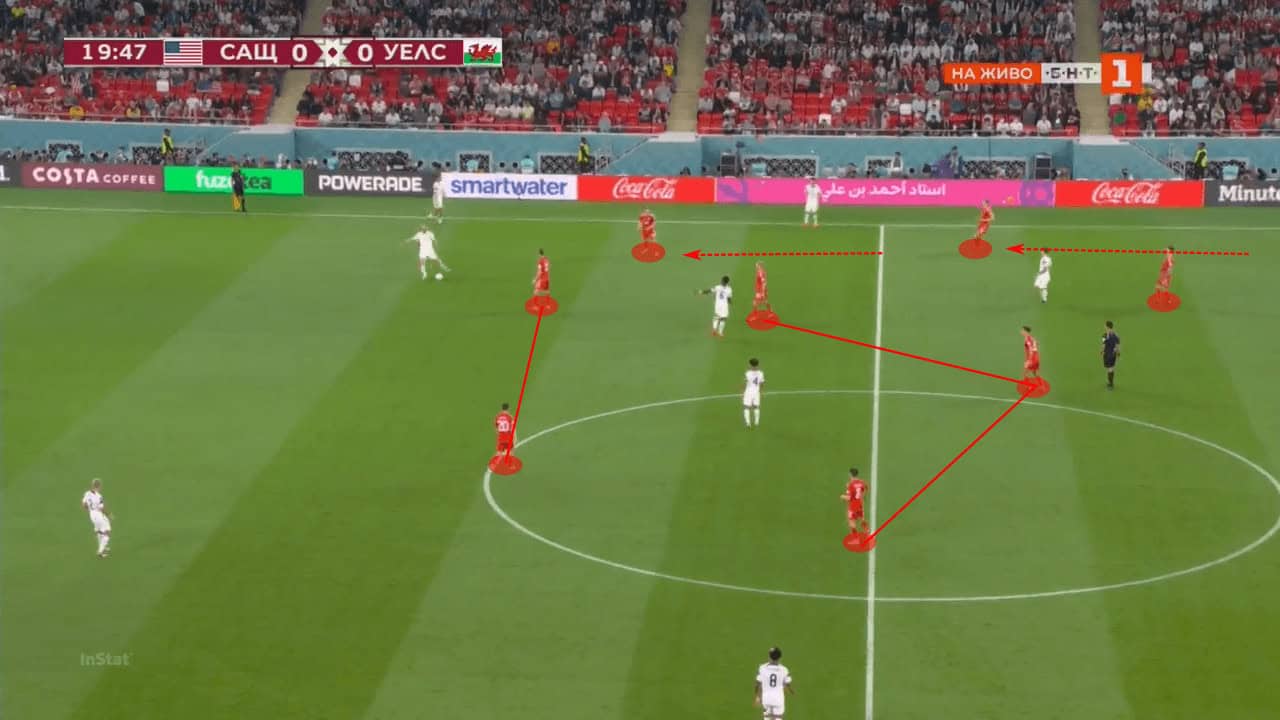
In lower blocks, their 5-3-2 structure was much clearer. The space between the defensive lines was extremely limited, and as USMNT looked to create wide overloads, Wales safely and compactly shifted from side to side.
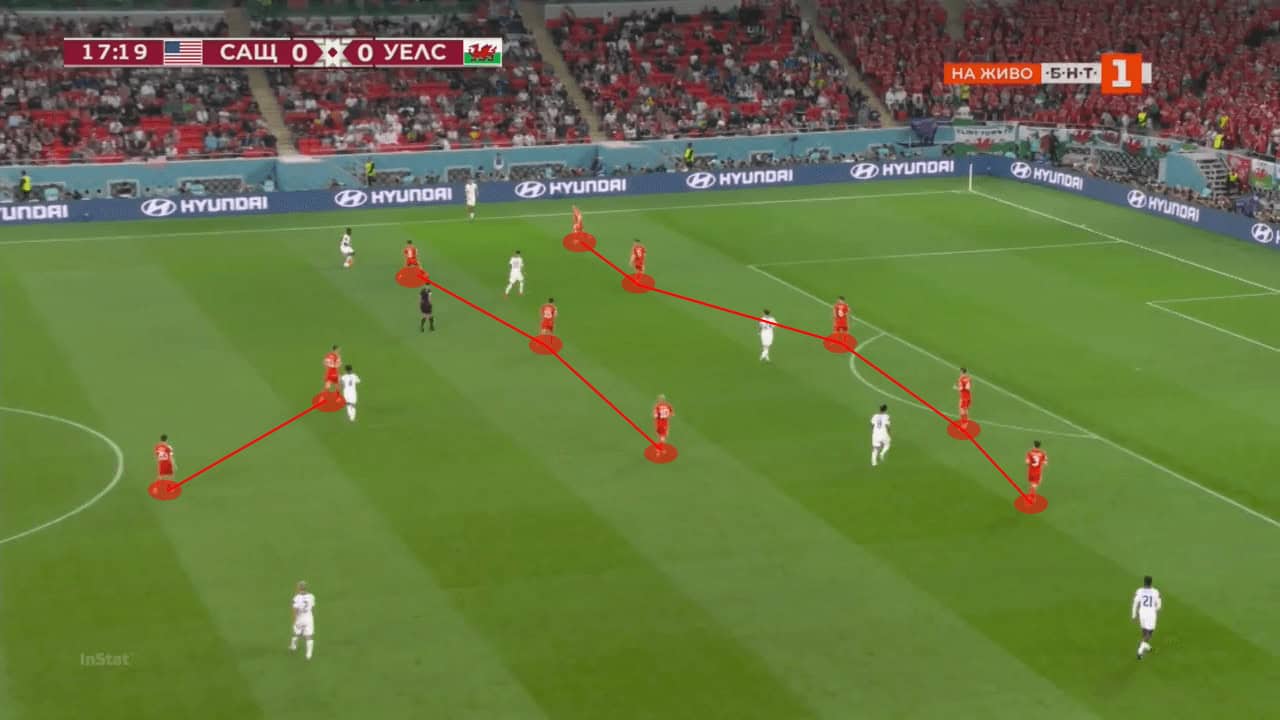
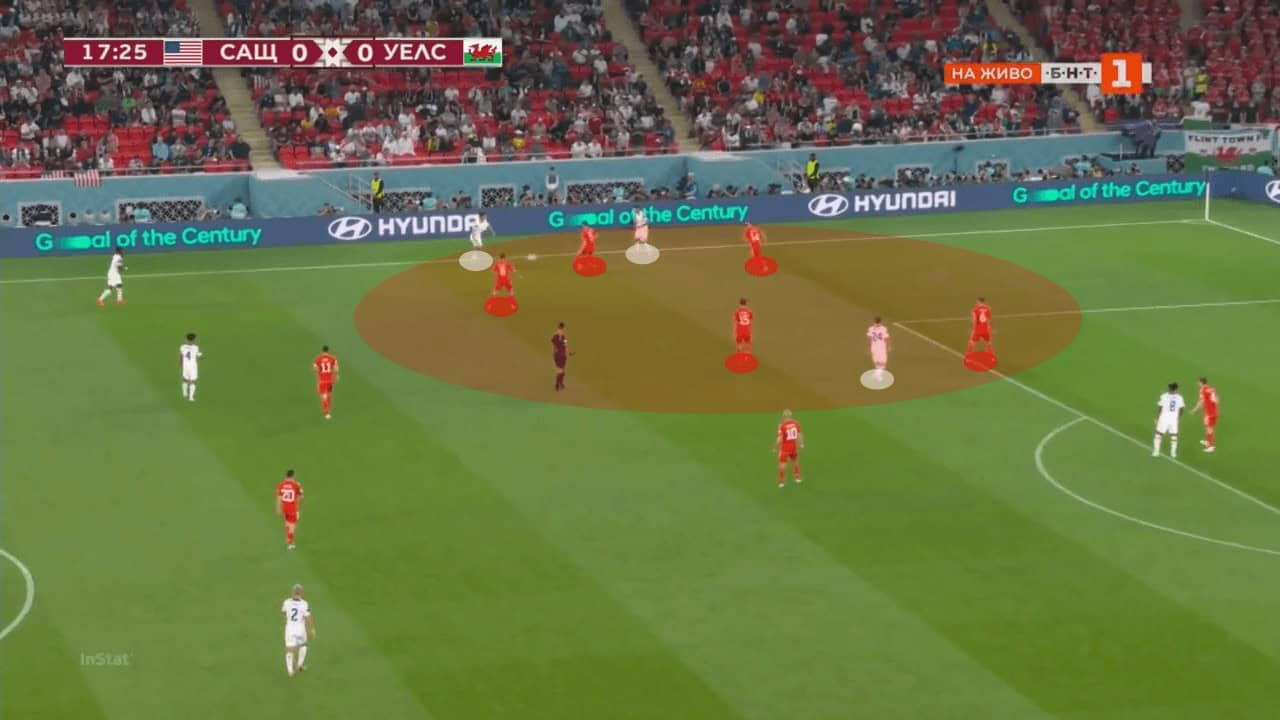
Although the USA were able to reach the final third in the wide areas, they often struggled to create anything from it. This was due to the numerical advantages of Wales’ low block. As seen below, they were constantly able to create superiority in the wide areas and keep the US from going inside.
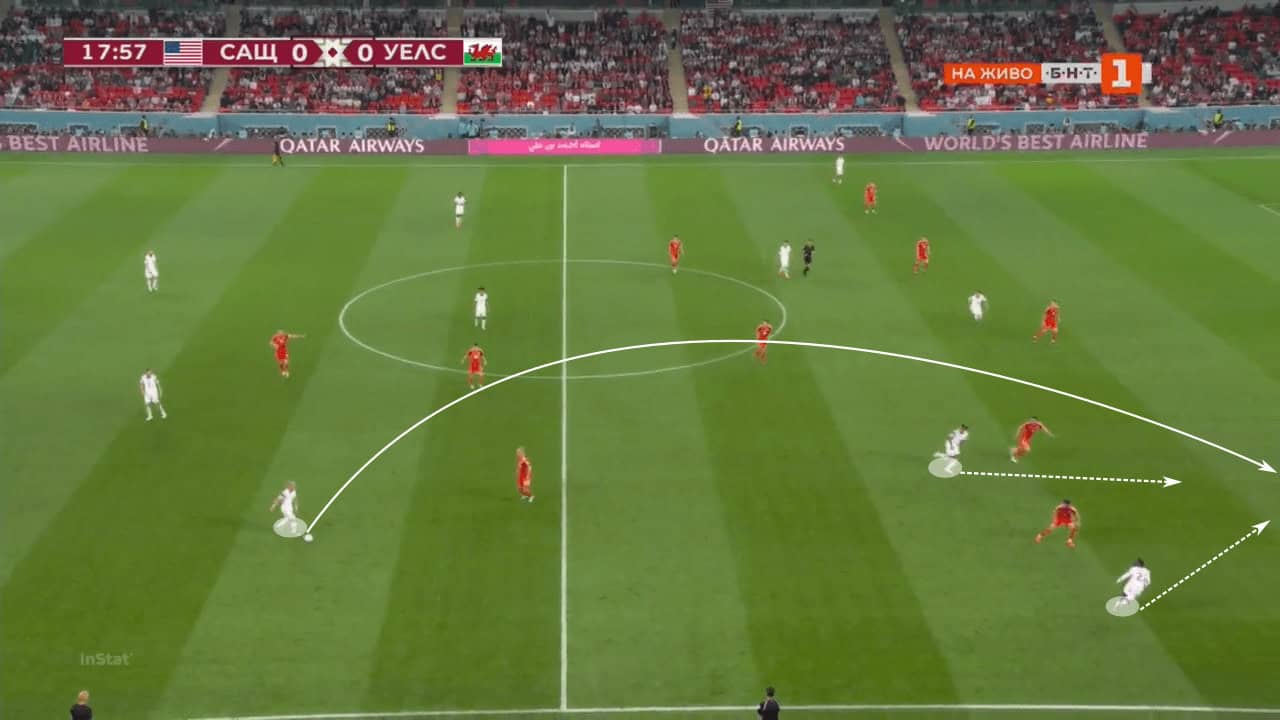
Gregg’s side found a couple of ways around Wales’ tight defensive structure though. The first was taking advantage of their high defensive line in a mid-block. After the unsuccessful attempt above, the Americans recycle possession back and invite Wales to advance their defensive block. After the Dragons do so, players in USMNT’s ‘front five’ began attacking the space behind to receive balls over the top. Even if long passes were not played, they still managed to lower the backline and create space.
The other answer was Chelsea’s Christian Pulisic. The 24-year-old is undoubtedly one of the USA’s most talented players, and in this match, he was responsible for finding the edge in the first half. Through his movement, Pulisic was able to find gaps inside Wales’ defensive structure. With his individual talent, he was able to create a few opportunities in the first half.
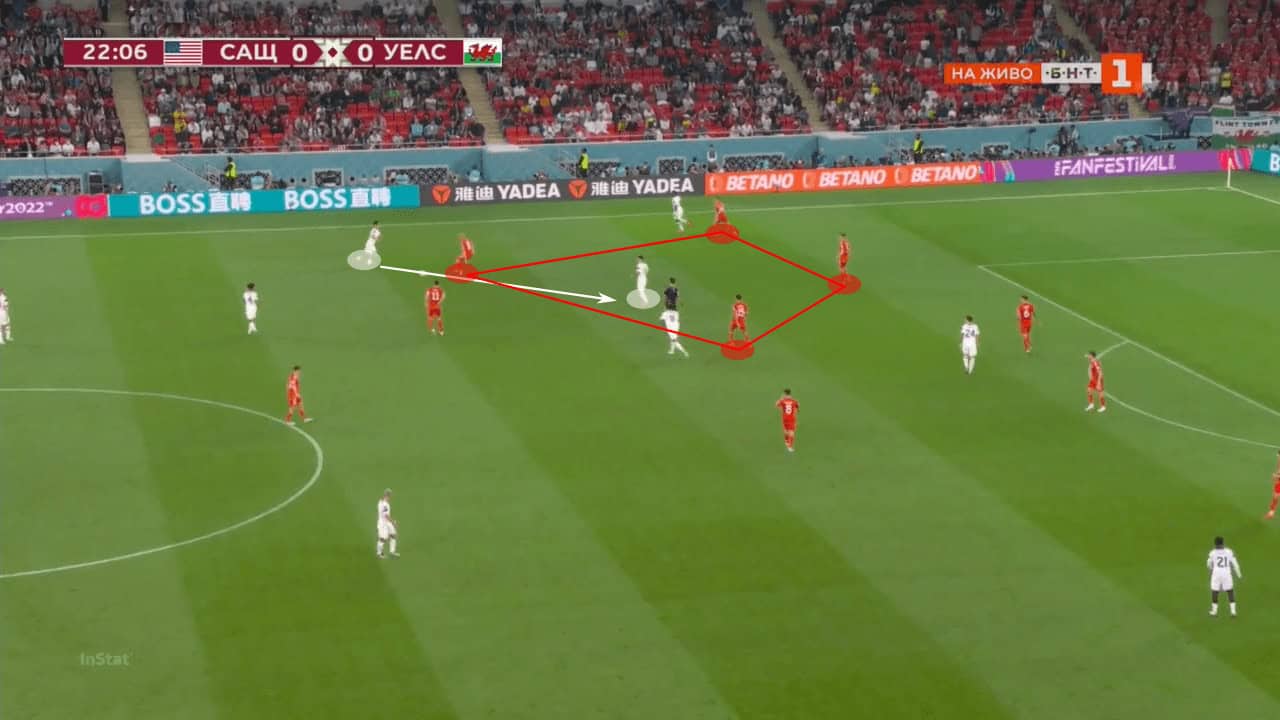
The most notable, of course, was their goal. After a direct sequence of passes, Pulisic was able to drive at Wales’ high line in a transition-like scenario. Weah makes a diagonal run behind Rodon and receives a perfect through pass from the Chelsea forward.

Wales reaction
With so much at stake, America’s goal naturally sparked an immediate reaction from the Welsh. Rob Page’s men advanced their block and upped their intensity without the ball in an effort to regain control of the match. This began toward the end of the first half, and after halftime, the changes were properly made.
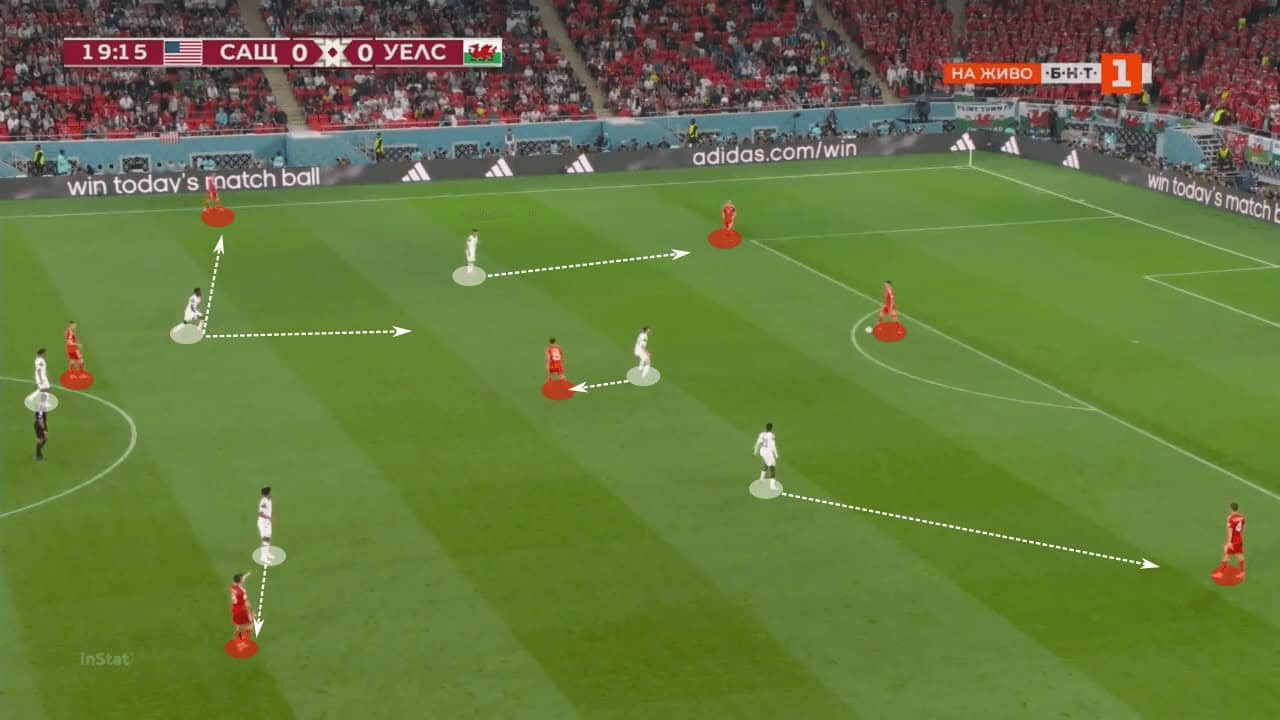
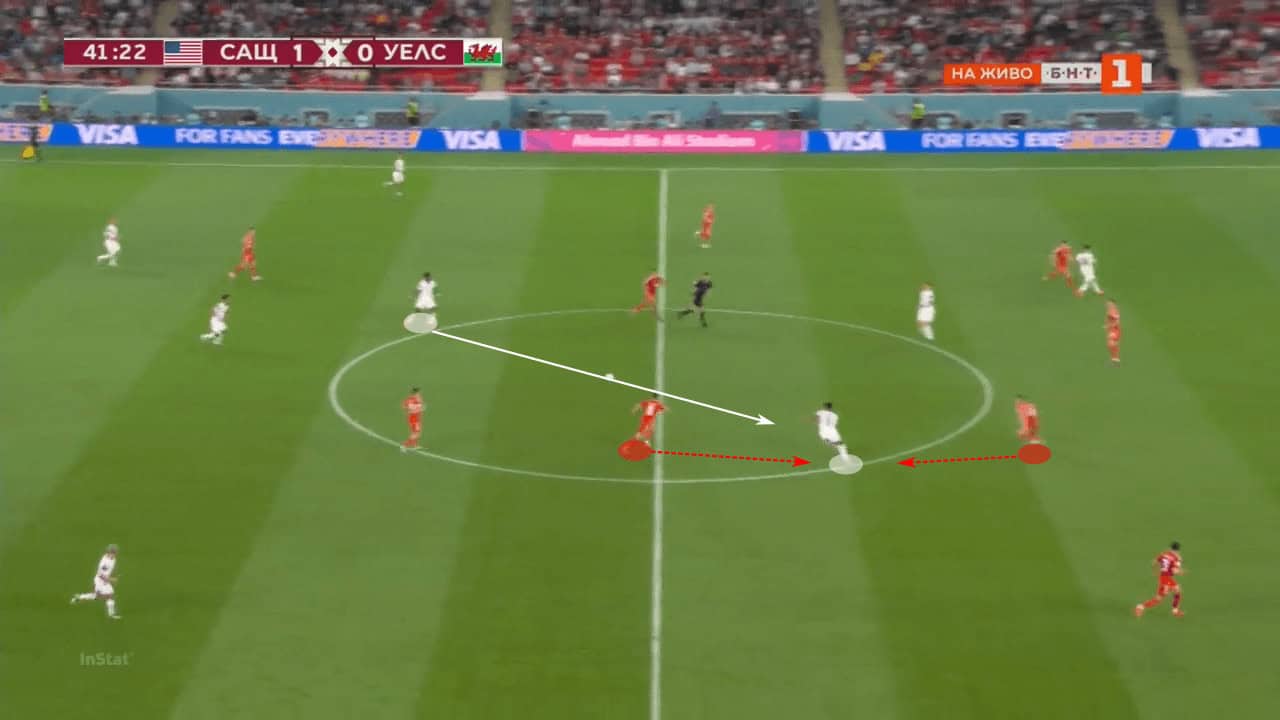
Nonetheless, in the last 10 minutes or so of the first half, Wales began fighting back. This was clearly seen through the switch in their aggressiveness off the ball. For instance, as seen below, when USMNT attempted to play through their mid-block, Wales were much more intense in their pressing.
It was only in the second half, however, that proper changes could be seen. Page’s men came into the second half with a very aggressive high press. In their high block, they roughly maintained their 3-5-2 structure, with Kieffer Moore and Gareth Bale now leading the forward line. While the two strikers remained on the centre-backs the entire time, the midfield trio along with the wingbacks were quite fluid with their marking.
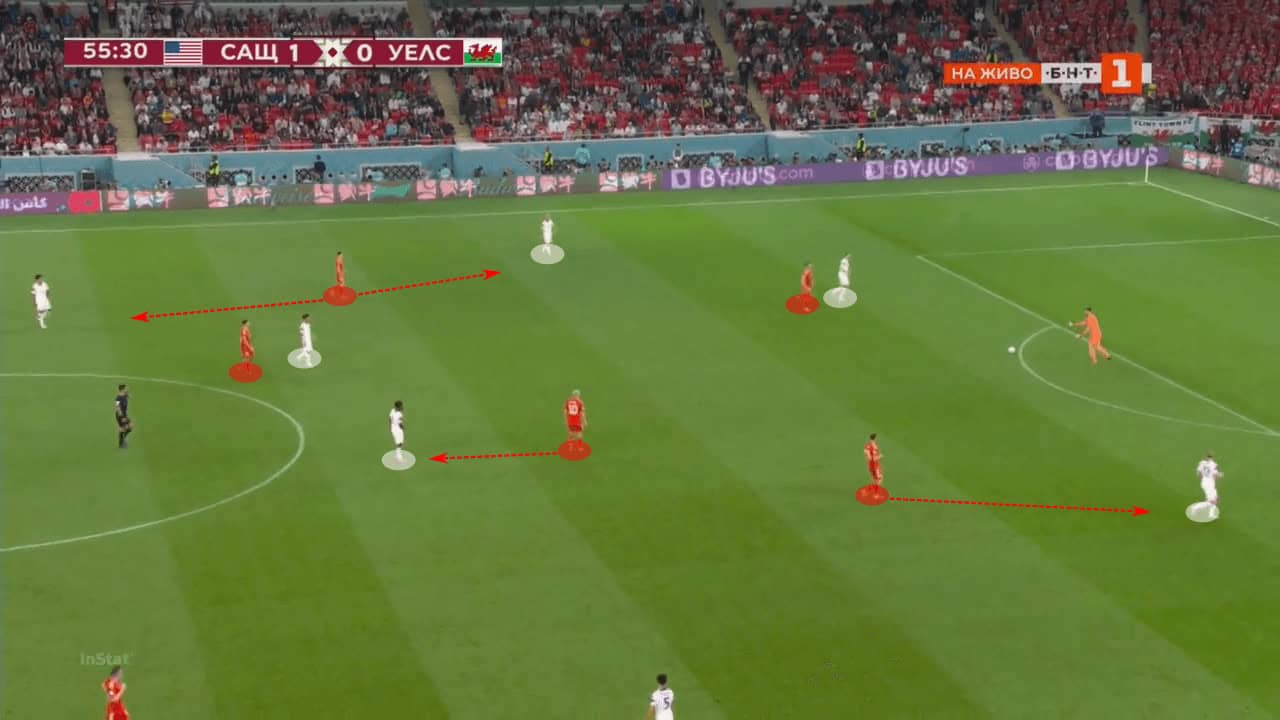
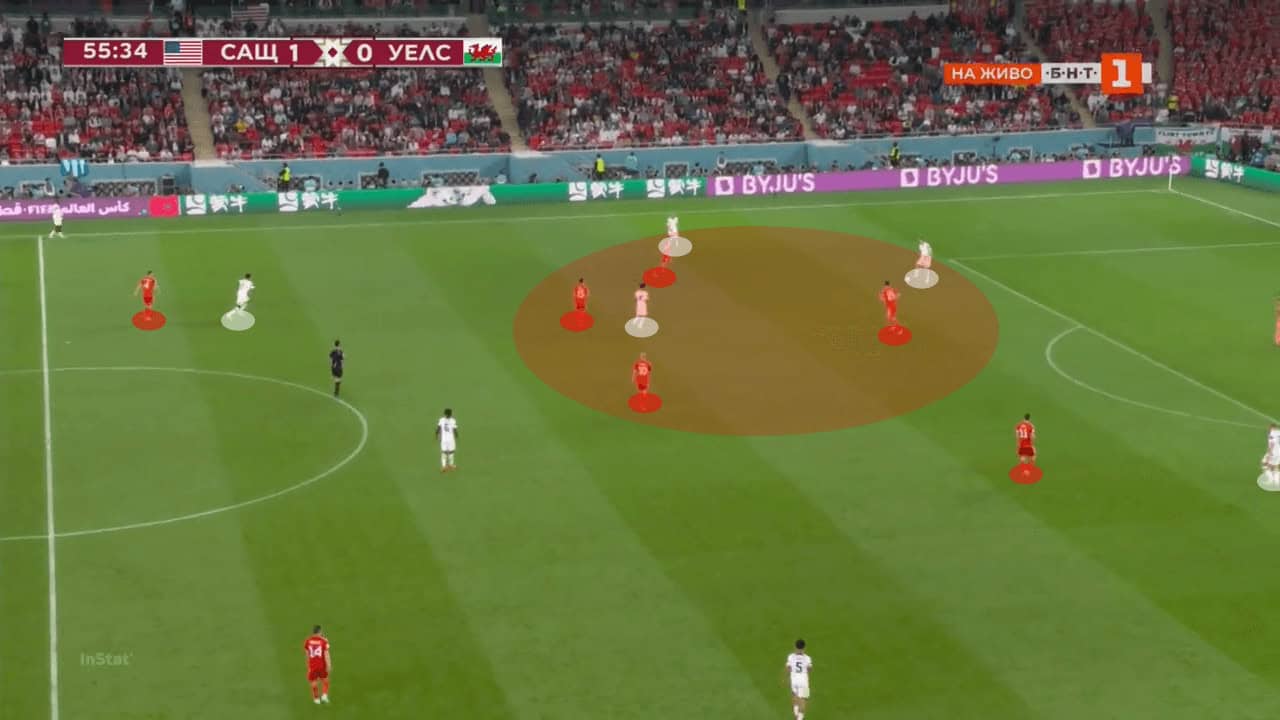
If the opportunity was there, the Welsh would look to make another step forward and overwhelm the opposition into giving the ball away. In the instance below, just a few seconds after the image above, the midfield trio steps up to pressure the opposition and create a 4v3 superiority. This sort of overwhelming press happened multiple times in the second half and was responsible for Wales climbing back into this game.
Vertical game
Rob Page’s Wales are known for their direct and vertical style of possession, and that is exactly how they were able to find success in the second half. Wales were much superior in the last 45 minutes but unlike the UMSNT, it was not through possession. Although the possession metric was split 50/50 in the second half, the European side created more and better chances than the Americans. They were able to stretch the game and turn it into a series of vertical attacks – something the US was not entirely comfortable with.
The first change in possession happened in the build-up. In the first half, Wales were significantly struggling to play out of the back and create any meaningful threat. As a consequence, Page’s men came back from halftime with a different approach to this stage of possession. With a much more narrow structure, the Welsh looked to overload the central areas and build through the middle.
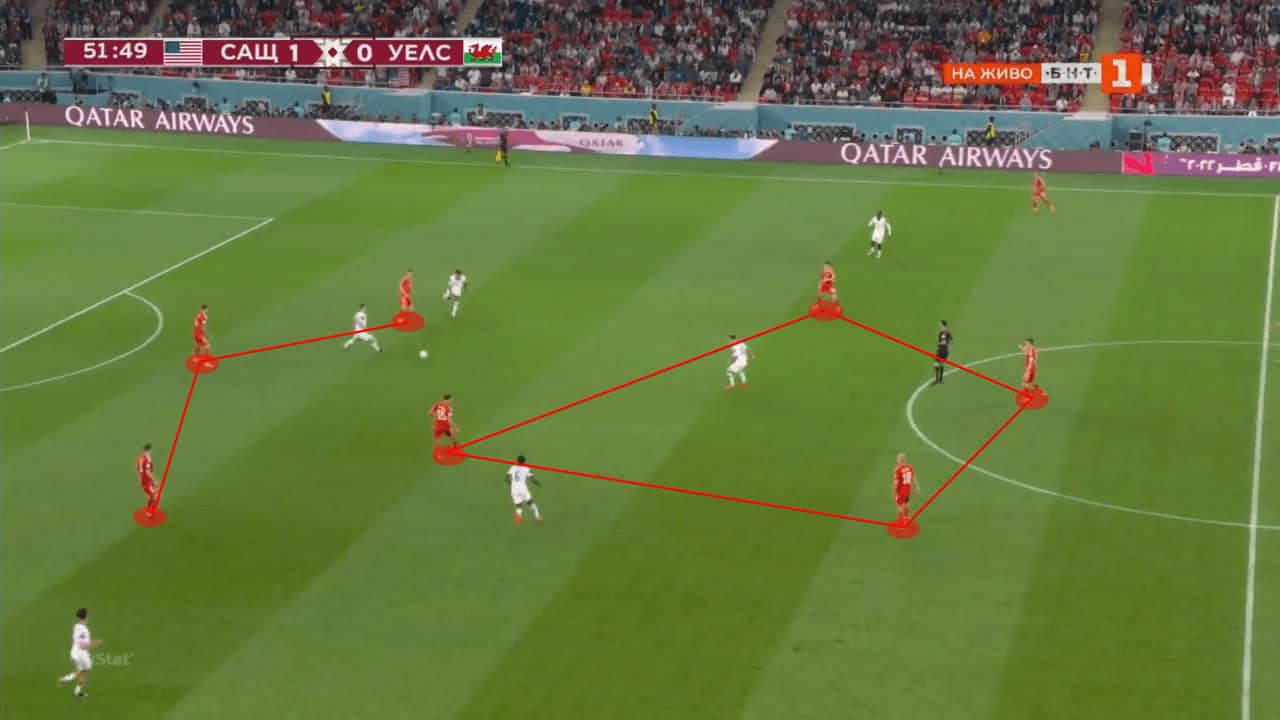
Especially Ramsey, players were showing for the ball in the central lanes while the wingbacks were the only ones maintaining width. This naturally caused confusion in USMNT’s high block. In the instance below, Kellyn Acosta is stuck between marking Ramsey and Roberts. As Ramsey is left with time and space, he receives it from Rodon before quickly turning and playing another vertical pass.
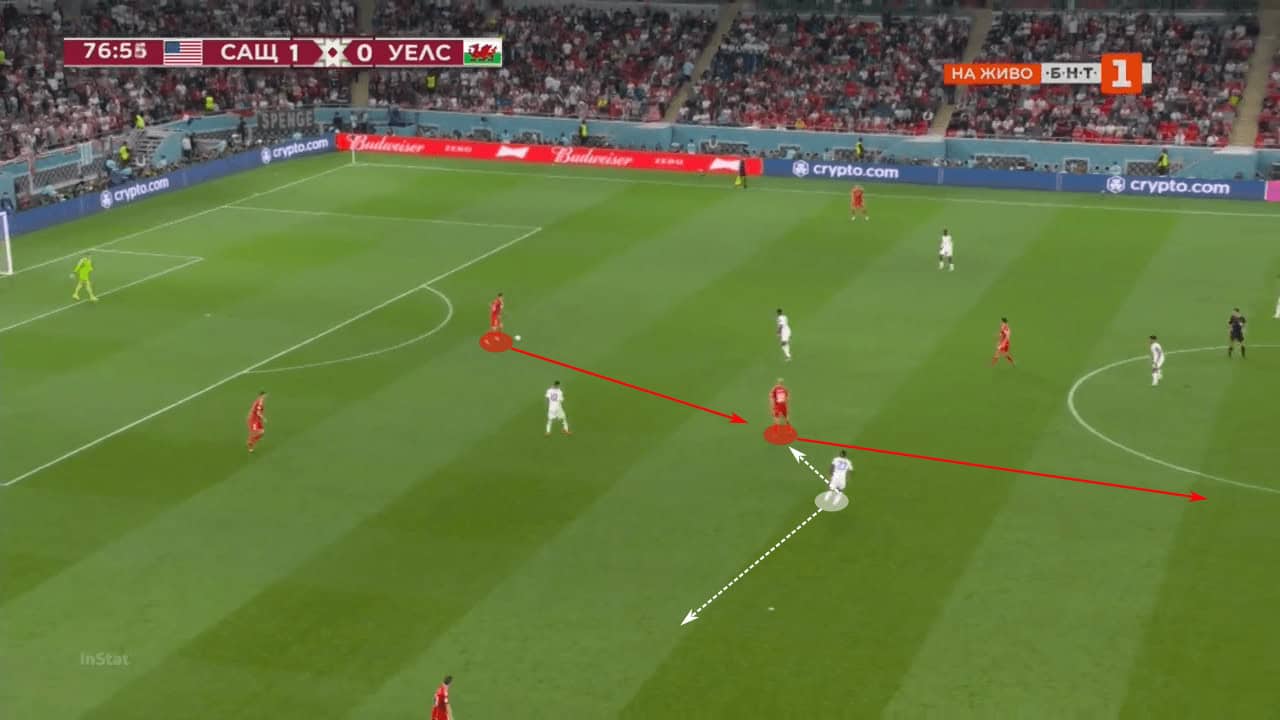
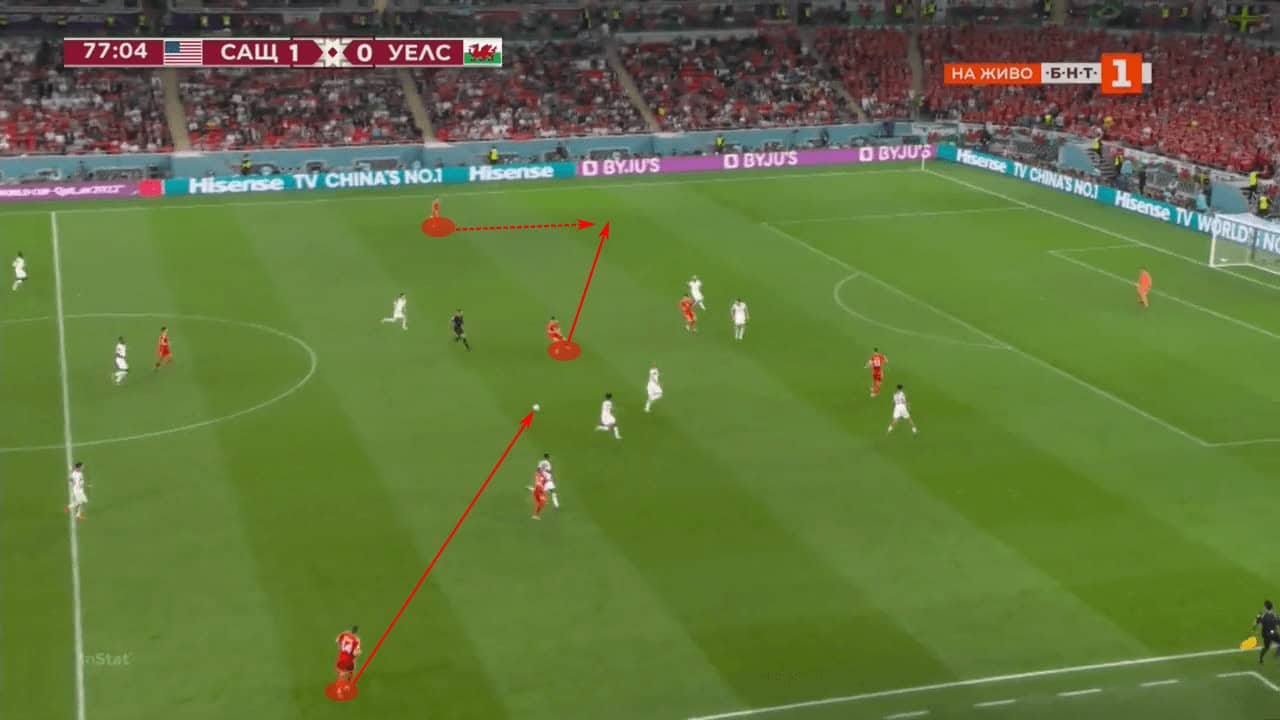
With Gregg’s high block being forced to remain compact in the central lanes, Wales’ wing-backs were left with time and space on the wide channel. With their normal vertical approach, Page’s men were able to find these outlets who would then drive at the opposition’s backline and create transition-like scenarios.
These scenarios often looked like the image below. The USA are struggling to get back and reassemble their defensive organisation while Wales looked to perform quick vertical passes to reach the final third and create danger.
Conclusion
The first matchday of Group B saw the USA and Wales face off in what proved to be a fascinating tactical battle. The final result of 1-1 was fair, considering the match was a tale of two halves. In the first, USMNT assumed control of the game and imposed themselves as they tried to break down Wales’ defensive structure. After going down 1-0, Page’s men reacted and climbed back to earn a point.
While England look set to run away with the group after their dominant 6-2 win over Iran, the second place is still up for grabs. After today’s result between the two nations, it will essentially come down to who can get a result against England, and who scores more against Iran.
