
It’s perhaps no surprise that Xabi Alonso has moved into management.
Alonso seemed to get better with age and was highly valued by Pep Guardiola in his final playing years due to his intelligence and vision on the football pitch and his similar football ideals to Guardiola.
The former Liverpool, Real Madrid, and Bayern Munich midfielder has returned to the club where his playing career began to start the next chapter in his life – as Head Coach of Real Sociedad B.
Real Sociedad’s first team are, of course, flying this season in La Liga, currently sitting in third place.
At the time of writing, Sociedad B sits in eighth place in their league, the Segunda Division B, essentially the Spanish third tier.
Following a disappointing dip in form, they are still only five points off the top and have a game in hand.
Unsurprisingly, Alonso’s side plays an exciting brand of possession-based football.
This Xabi Alonso tactical analysis will highlight some key facets of Alonso’s approach in possession by examining their overall principles and patterns of play that help them achieve these principles.
Xabi Alonso attacking shape
According to Wyscout, Real Sociedad B have predominantly played a 4-2-3-1 formation under Xabi Alonso’s tactics.
While his side most often looks like this, or perhaps plays with a 4-4-2 initially, out of possession, when they have the ball, their shape in front of their back line is fluid.
Given that this piece is examining Sociedad B in possession, we will focus on their shape when they have the ball.
If we look at the three images below, we can see the variations of Sociedad B’s shape.
If we take them “lining up” in a 4-2-3-1, this might be how they press in this particular game.
However, as soon as they win possession, there is a transition into one of the other two shapes.
For clarity, I have retained the labels of each player from the 4-2-3-1 image, allowing us to see where each player moves to.

Interestingly, in the fluid 3-3-2-2 formation, where the pivot drops between the two centre-backs, the right-back then has the freedom to push forward as well, allowing the right-winger to drift inside and provide an immediate option in the half-space.
Sociedad will switch between the 3-4-3 and this 3-3-2-2 frequently throughout the game, and the players have the freedom to move into these areas when the opportunity arises.
The first thing to notice about these shapes is the apparent width provided by the wing-backs in this shape.
Alonso looks to leave plenty of space in the central channel, where his centre-forward can act as a false 9 and drop deep to receive possession.
The wing-backs and double pivot mean there is plenty of space left behind these four players for the centre-forward to do just this.
Alonso also prefers to play with a very narrow back three, supported closely by a double or single pivot, like in the image below.
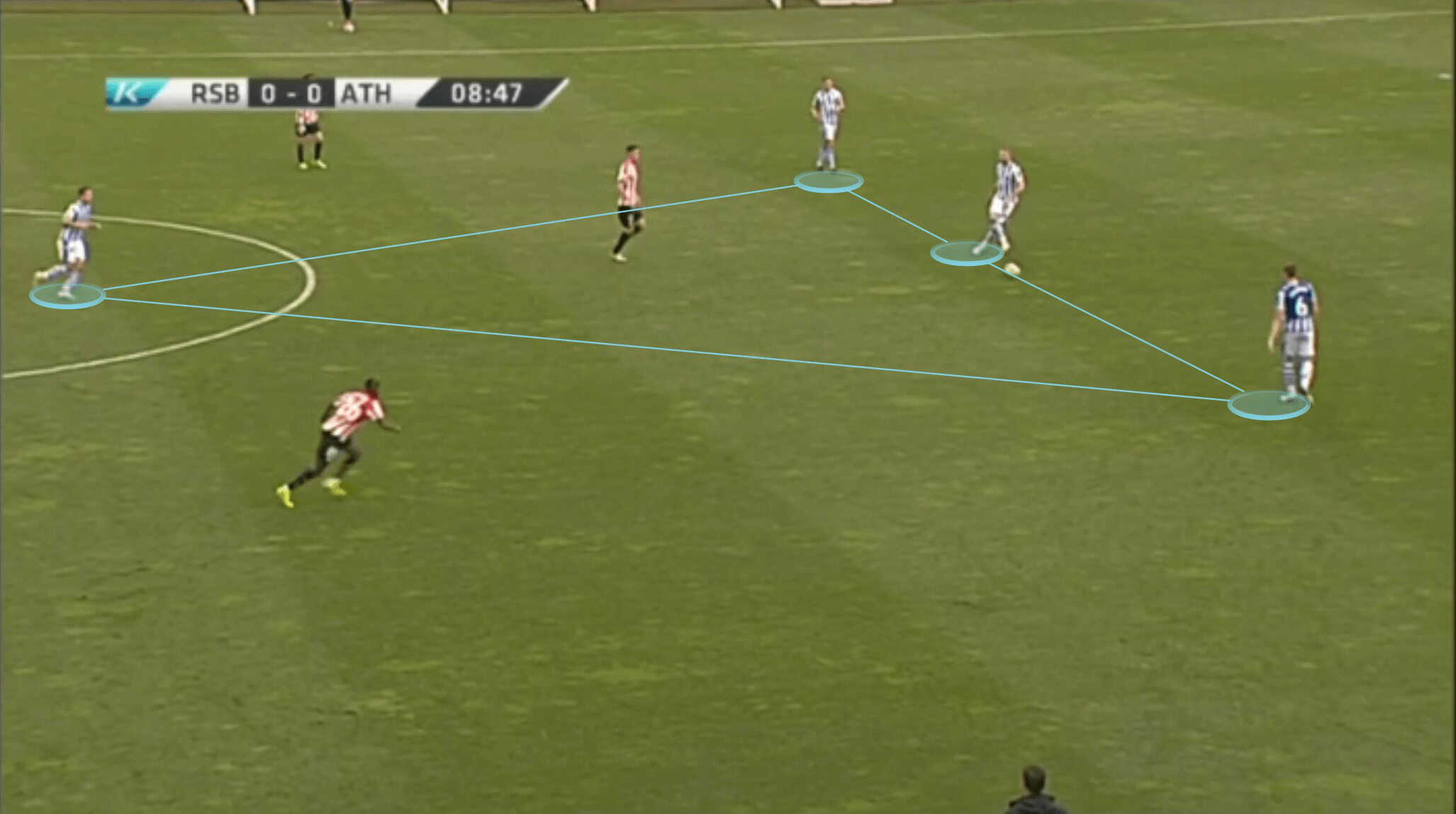
This shape naturally draws the opposition’s press narrow, and with the wing-backs’ feet on the touchline, there is an easy outlet for the back three should they not be able to play centrally.
As well as offering an option beyond the first line of press, the pivot/s aim is to draw the opposition’s midfield forward in this phase and allow Sociedad’s wide centre-backs in the back three to either play a straight, line-breaking pass in the half-space or to find the false 9 with a diagonal through pass.
As we will see as we delve through some of Sociedad’s in possession tactics, on a basic level, Alonso does everything to manipulate the opponent’s positioning
Narrow the opposition before using width in attack
With width always being provided in possession, Alonso initially seeks to break down the opposition through the central channel or half-spaces.
If they can work through their opponent this way, then that’s a great outcome, but with their focus on playing quick, forward passes through the centre of the pitch, they naturally narrow the opposition’s defensive shape, but at no point do their wing-backs tuck inside.
This width is always available, and once the opposition’s defence is suitably narrowed, Sociedad will use it to get behind the back line, using their whipped crosses or pull-back crosses to beat the opposition.
During the initial build-up, there are generally two pivots offering central options whilst two wing-backs on either flank, as described earlier.
We can also see how the half-spaces are left vacant.
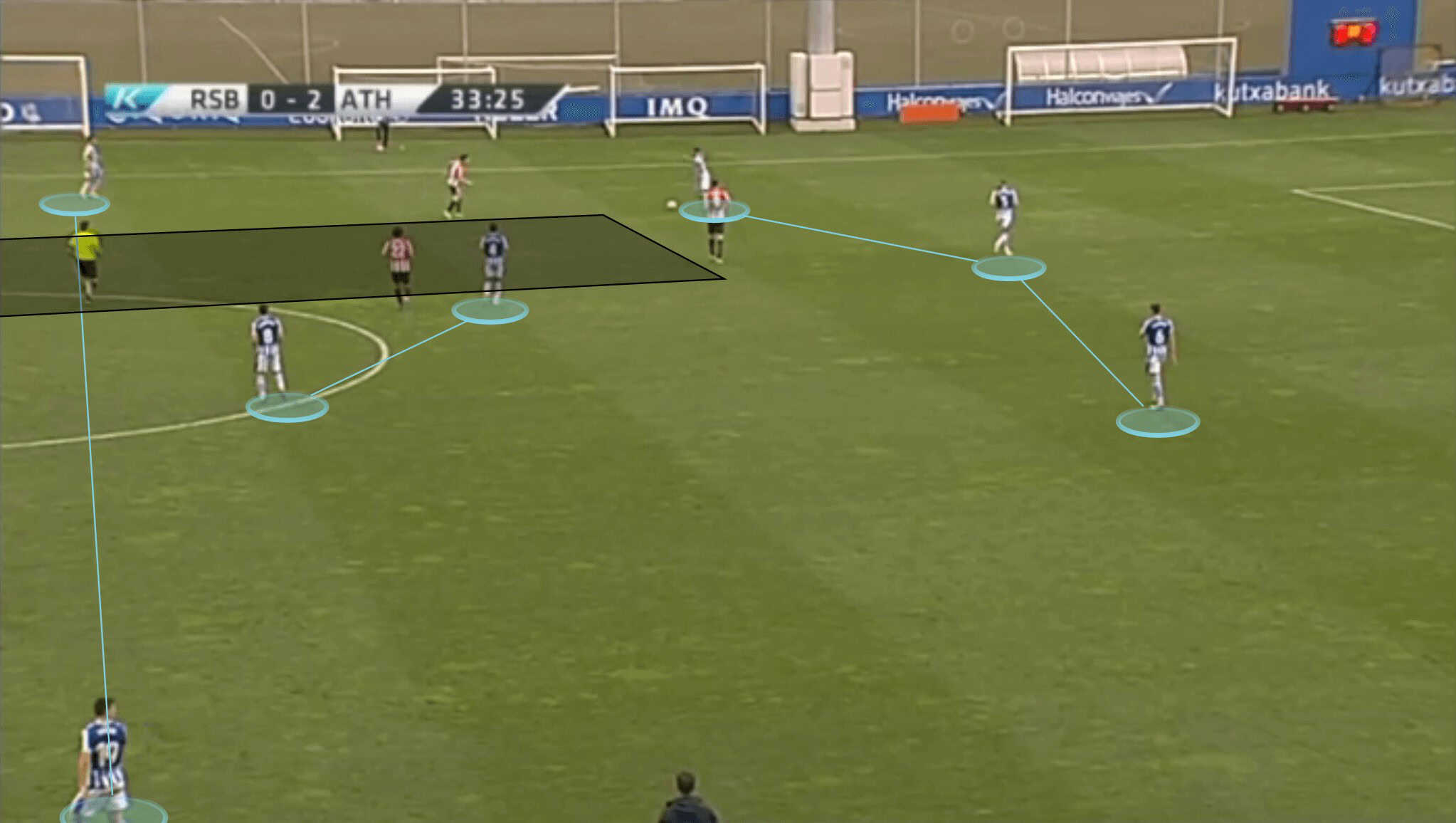
Alonso wants his side to play forward whenever possible, and should the option arrive, his defenders have the freedom to break lines with forward passes, like in the image below.
By leaving these spaces vacant, Sociedad can play the ball forward quickly and provide immediate options around the new ball-carrier.

The narrow positioning of the full-back in this back three also provides good coverage for Sociedad on defensive transition.
If the ball is lost in midfield, as shown in the image below, we can see that, apart from the right winger, who is out of the picture, Sociedad’s shape is already compact, and the right-back is tightly marked to his centre-backs.
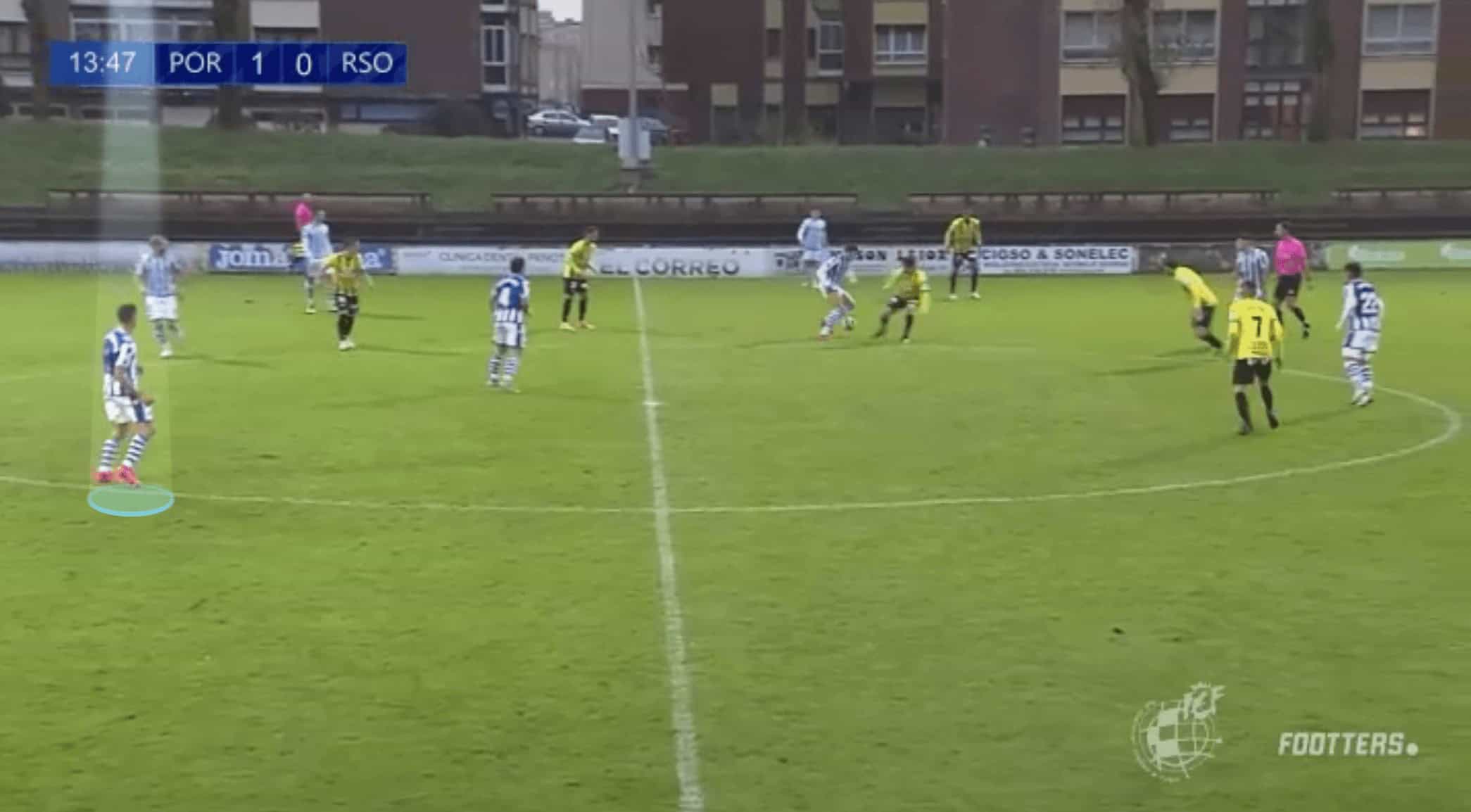
The two wide centre-backs are also permitted to drive forward on the ball.
There is more space in the half-spaces than in the central channel and these players can push forward in possession, progressing the ball forward.
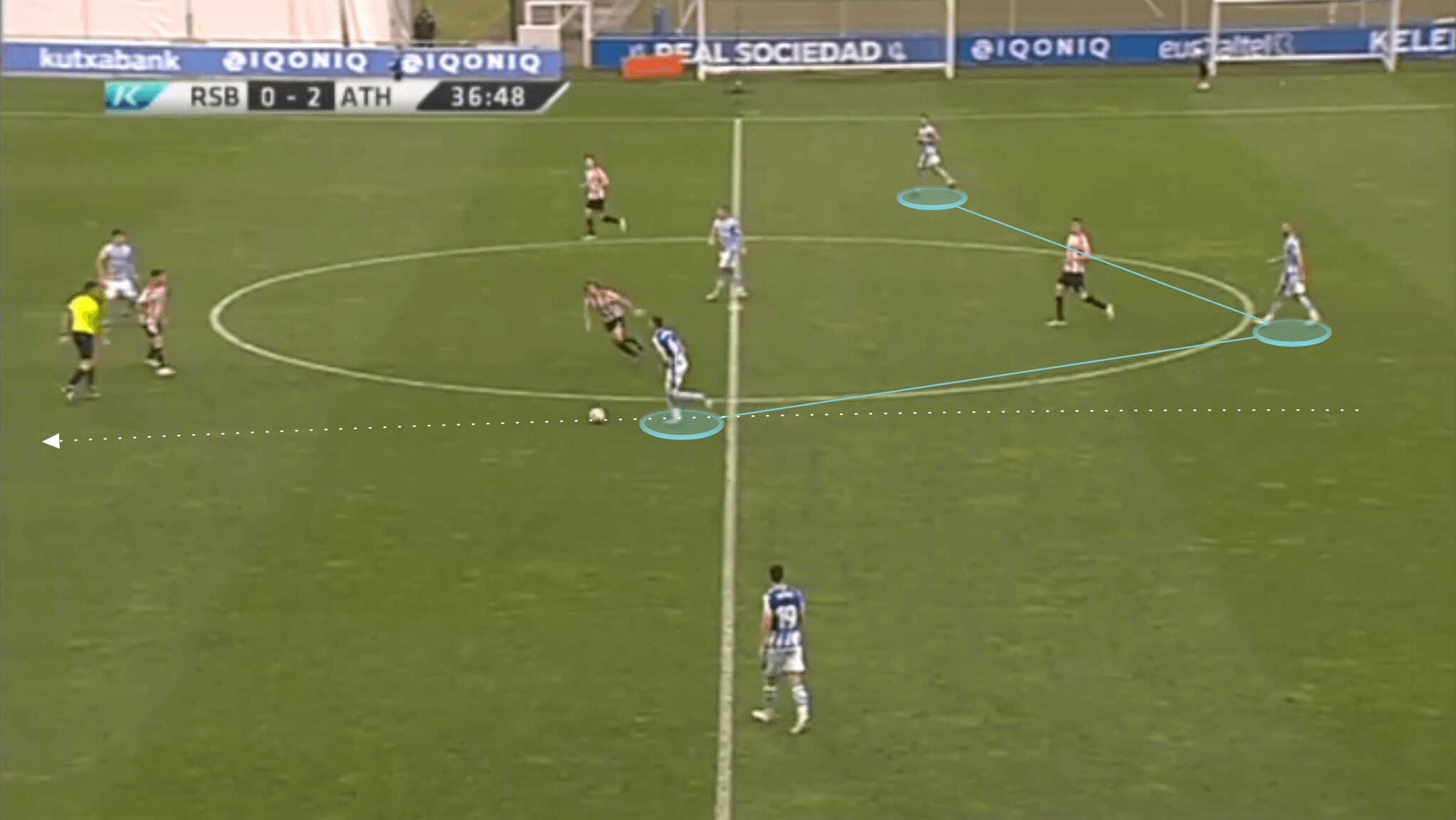
As they do this they narrow the opposition’s defensive shape, and are subsequently able to work the ball wide either to feet or providing a through pass for the wide players, thanks to the angle provided by their positioning in the half-space.

The wide centre-backs in the back three are also permitted to help create overloads down their flank, particularly if there is a switch of play and their attackers can’t switch across quick enough to support the wing-back in possession.
With the centre-back doing this they can create the overload whilst allowing their attackers to stay central, stretching the opponent’s back line.
There is still protection in defence, with two defenders left behind and at least one of the pivots positioned deep enough to delay the opposition should a transition occur.
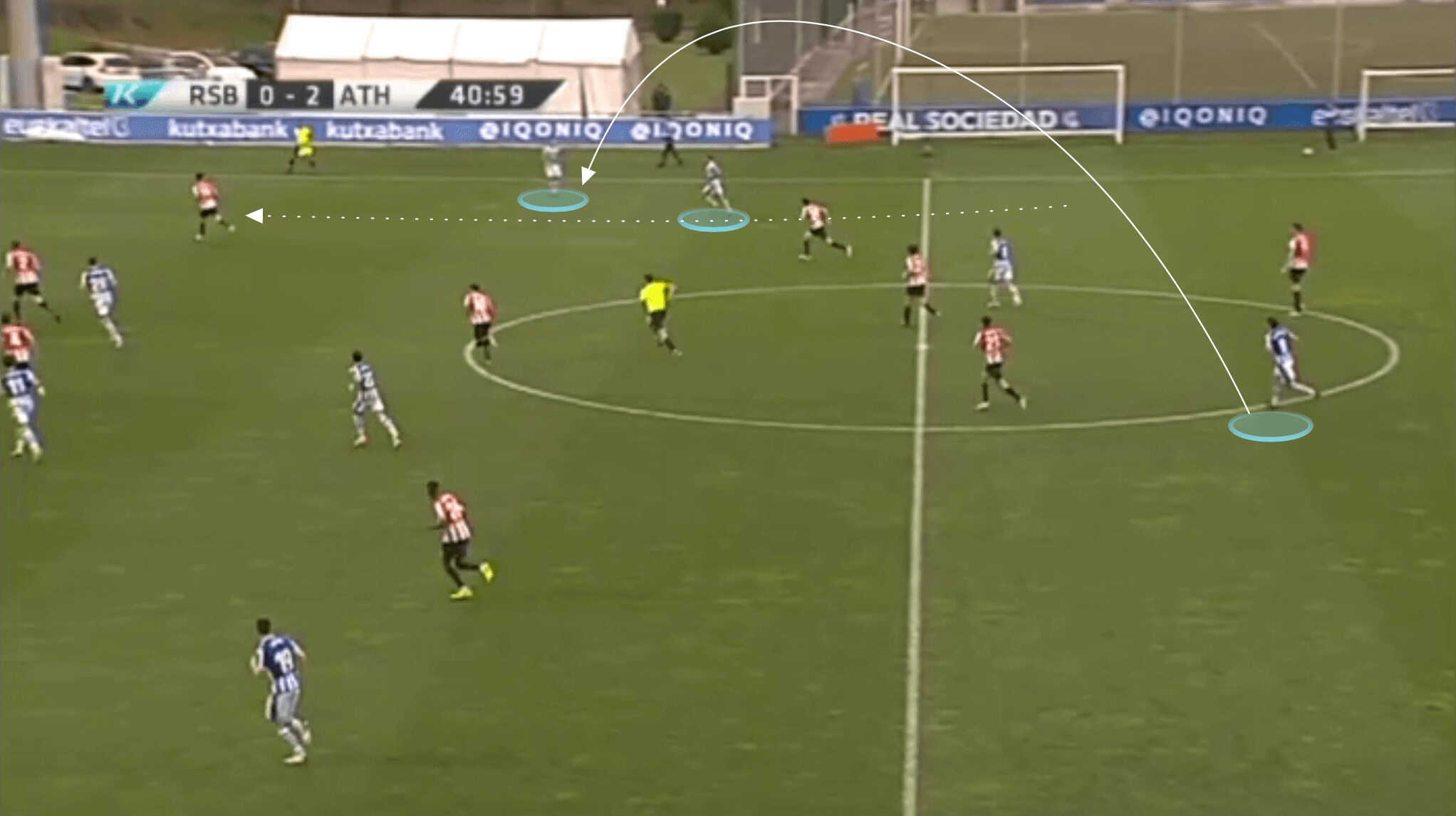
Regardless of what formation they use, Alonso likes to use a front two, which we will discuss more later on, and this front two are supported either side by two wingers.
These can be both wing-backs, or the number 10 will shift either side as well.
In doing so, there is always a wide outlet for the attack, but the height and width of their attacking four pins the opposition defence back, making it risky for centre-backs to follow the false 9 into a deeper area, at the risk of leaving a gap in their overstretched back four.
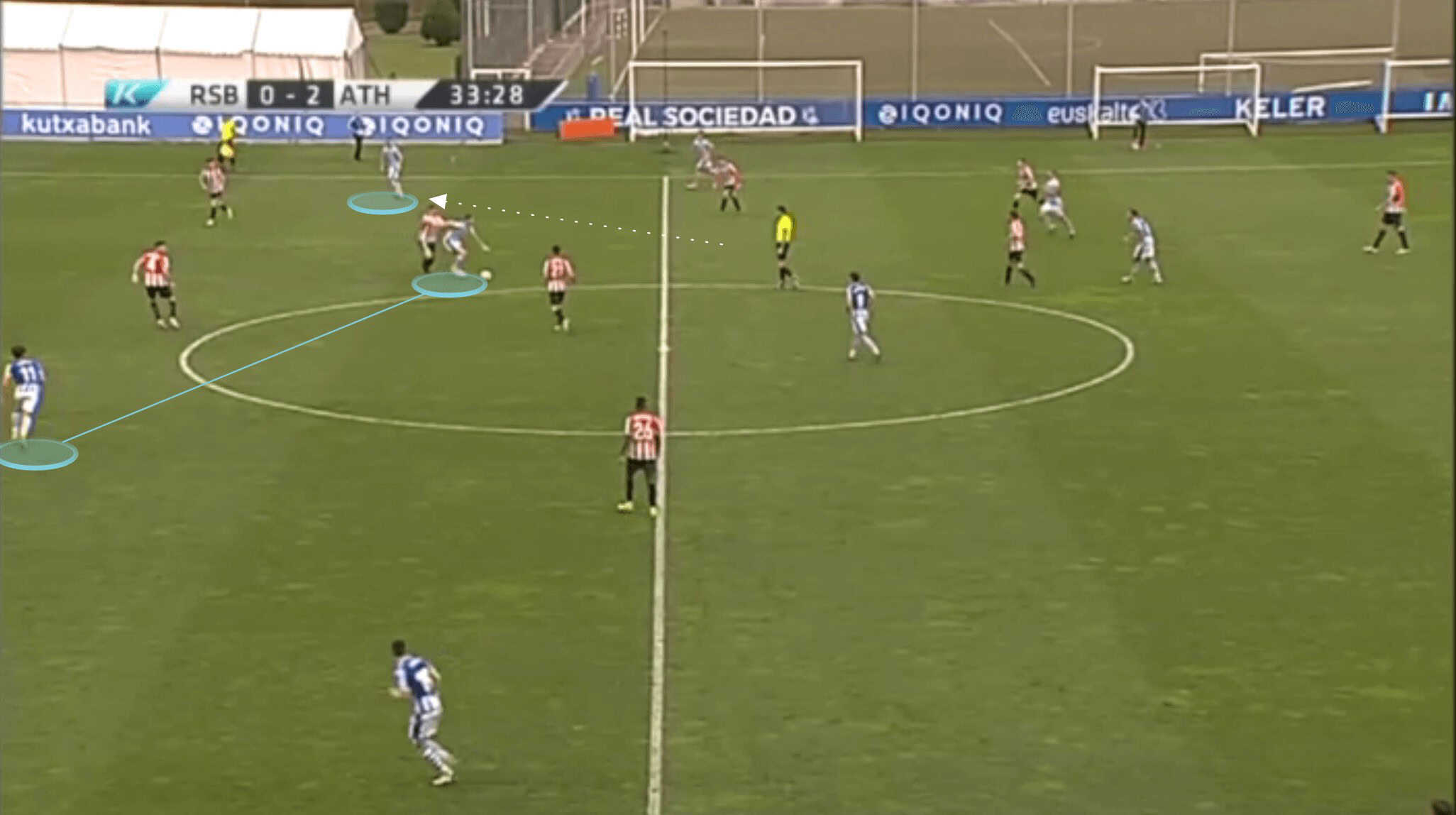
Draw the opposition defence out of balance by using a fluid attacking shape and rotations
Alonso’s Sociedad have constant movement off the ball when they have possession.
This can create passing options for the ball carrier and provide space for the ball carrier to drive forward, just as the pivot does for his centre-back in the image below.
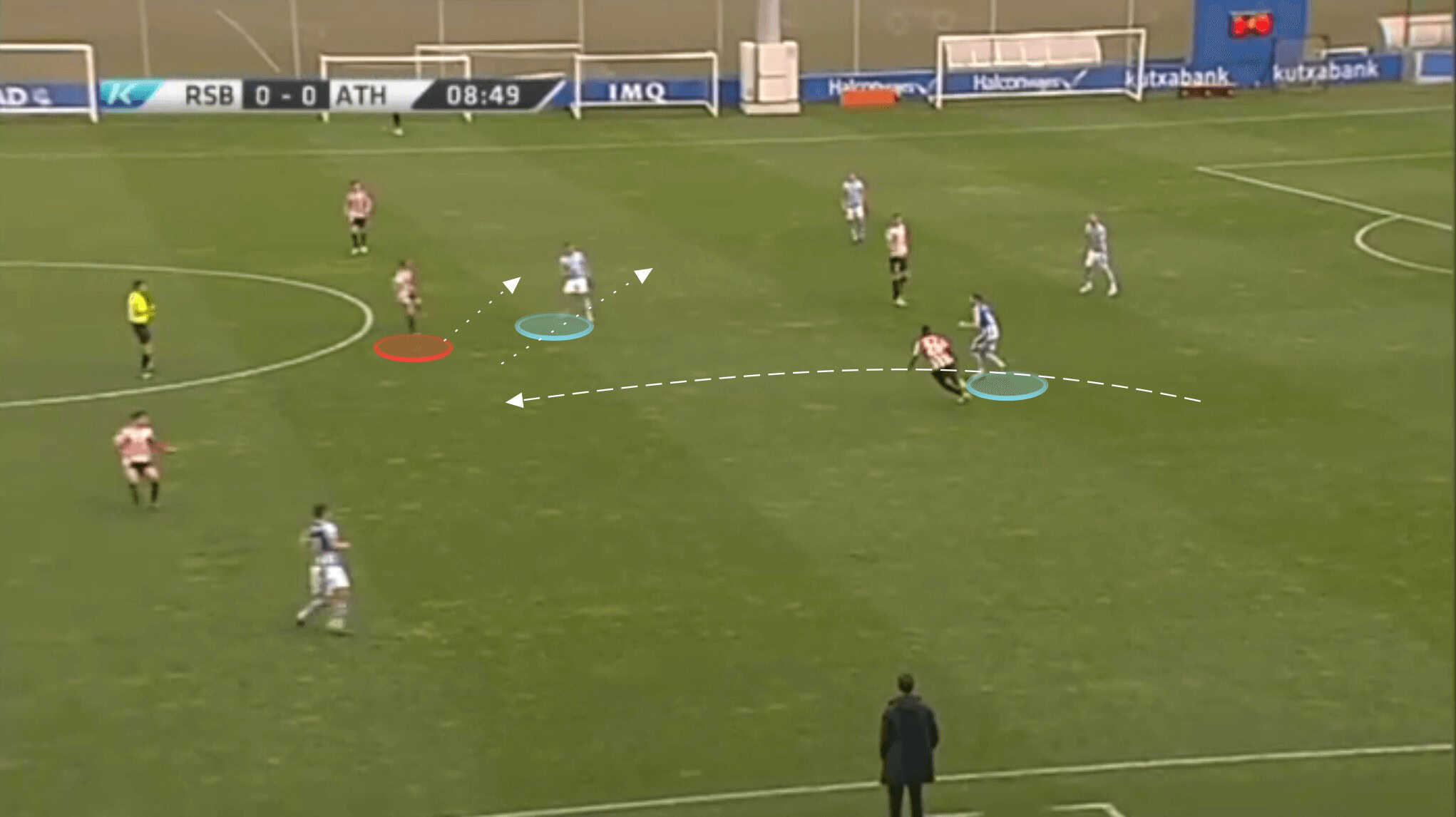
Every movement off the ball has the intention for drawing a defender out of position, and as such Sociedad are prolific at breaking down teams and creating spaces in behind for through passes.
As they play out from the back in the image below, the left-back pushes high into a wing-back position to support the central-midfielder.
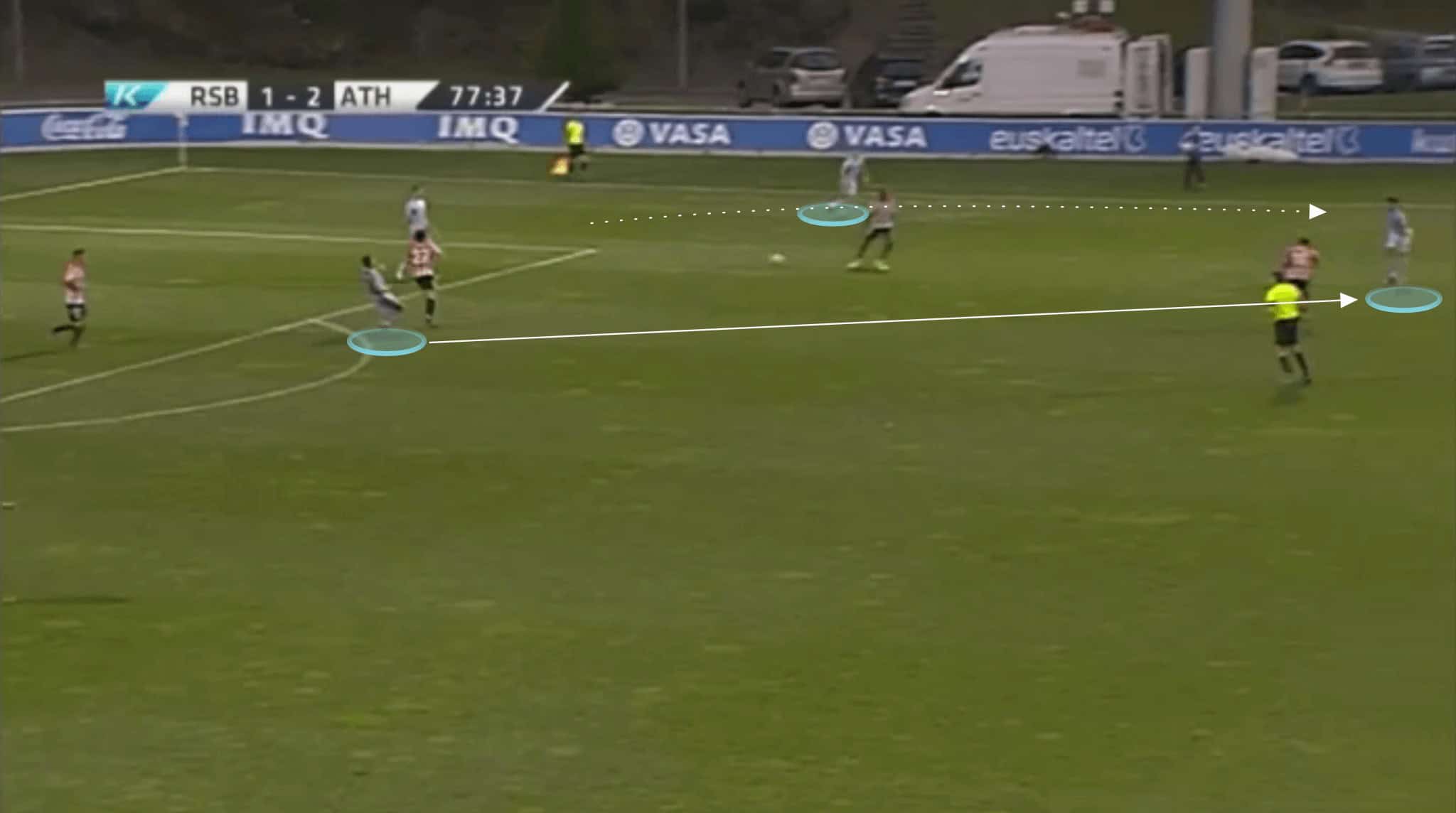
And in turn, this central midfielder pivots and plays forward to the centre-forward who has dropped into the half-space.
The midfielder instantly gives an option for the return pass, and the left-back continues running forward, giving Sociedad a clear numerical advantage around the ball.
The run of the centre-forward draws the opposition right-back away from the defence.
Even with a front two this wouldn’t be a hazardous move as the opposition right centre-back could fill this gap should the player he is marking make a run into the space vacated by the false 9.
But Sociedad’s “10” drifts forward to play as a second striker in response to his false 9’s movement.
The presence of two forwards means the opposition centre-backs have to remain compact.
If both centre-forwards stay central, they must let the numerical overload play out, which they do.
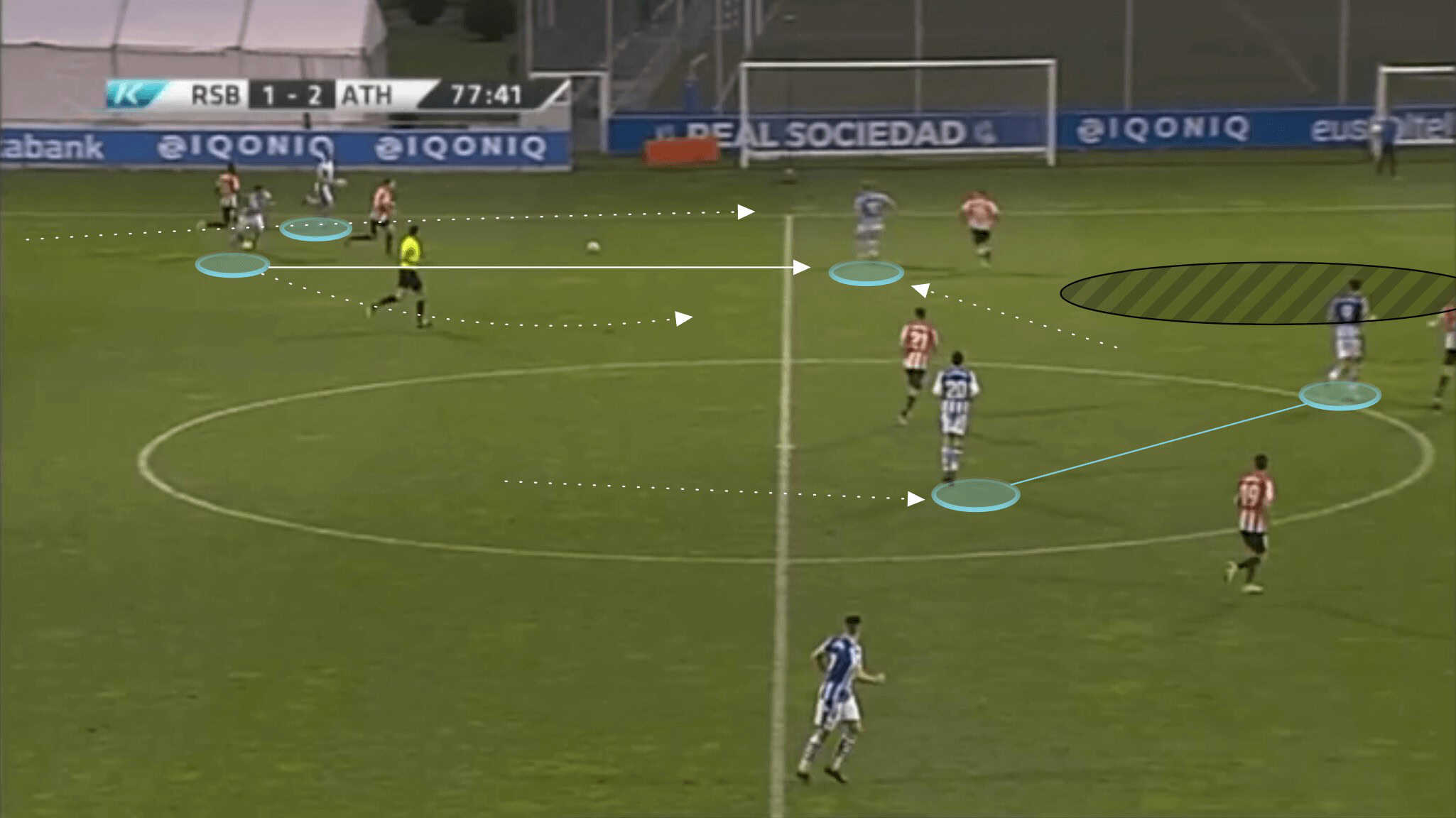
Sociedad repeatedly looks to find this pattern, and even if teams look to block this pass through the half-space, their slick, quick, passing football can eventually lull the opposition out of their shape when Sociedad shows patience in the build-up.
One of the pivots will often engage in possession initially to attract man-marking from the opponent and then move into the vacant left-back position after the full-back has pushed high into a wing-back position.
This movement from the pivot drags their marker with them and opens the half-space that the false 9 has moved into, as shown in the example above, and the pattern repeats itself.

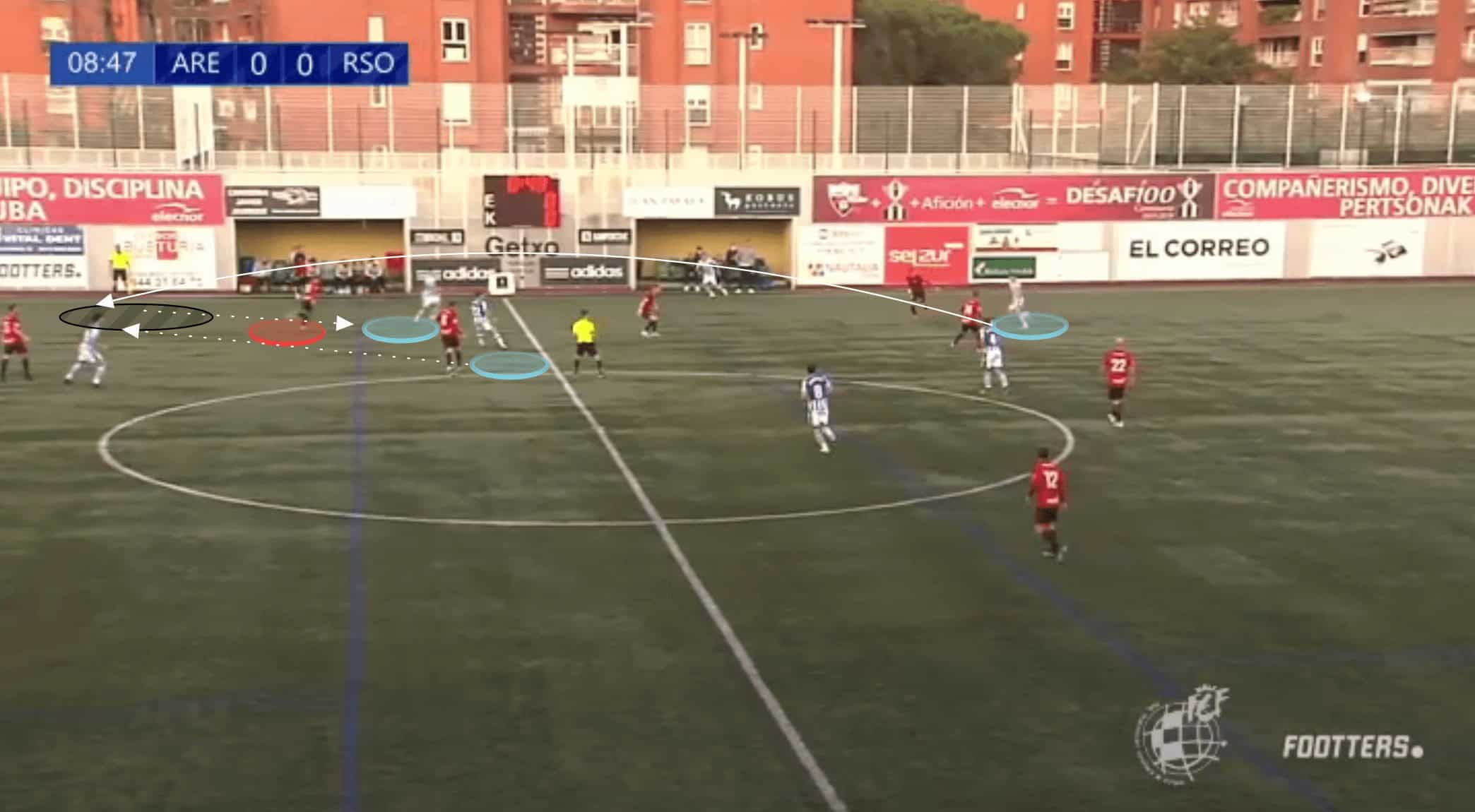
The two players operating in the forward position and the number 10 work closely together, using swift but simple rotations to draw the defence out of the back line and present through-pass opportunities for their centre-backs in possession.
The simple pattern is as follows.
Two centre-forwards sit relatively narrow, occupying the back four as much as possible.
The ball-side centre-forward then drops looking to receive to feet, dragging their marker with them, as the “10” in turn pushes forward filling the space his teammate has just left open.

It’s a fundamental pattern, but it’s so down that it frequently presents opportunities behind the opposition’s back line for Sociedad, as shown in the image below.
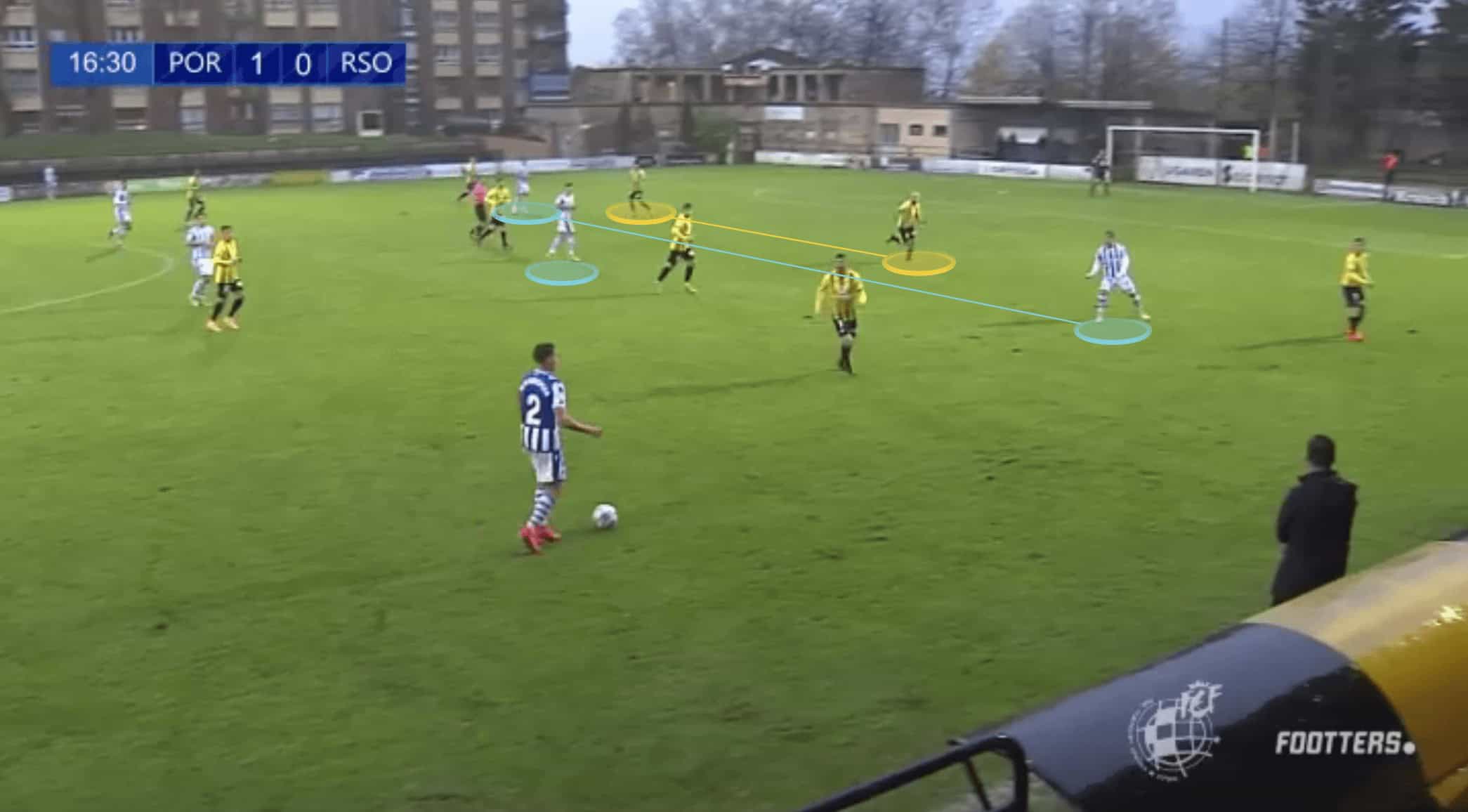
The two forwards don’t always play so close to one another, and in fact often do a terrific job at creating space between the opposition centre-backs in what should be less than threatening areas of the pitch.
Below we can see how the two forwards are split and the “10” sits perfectly equidistant between them.
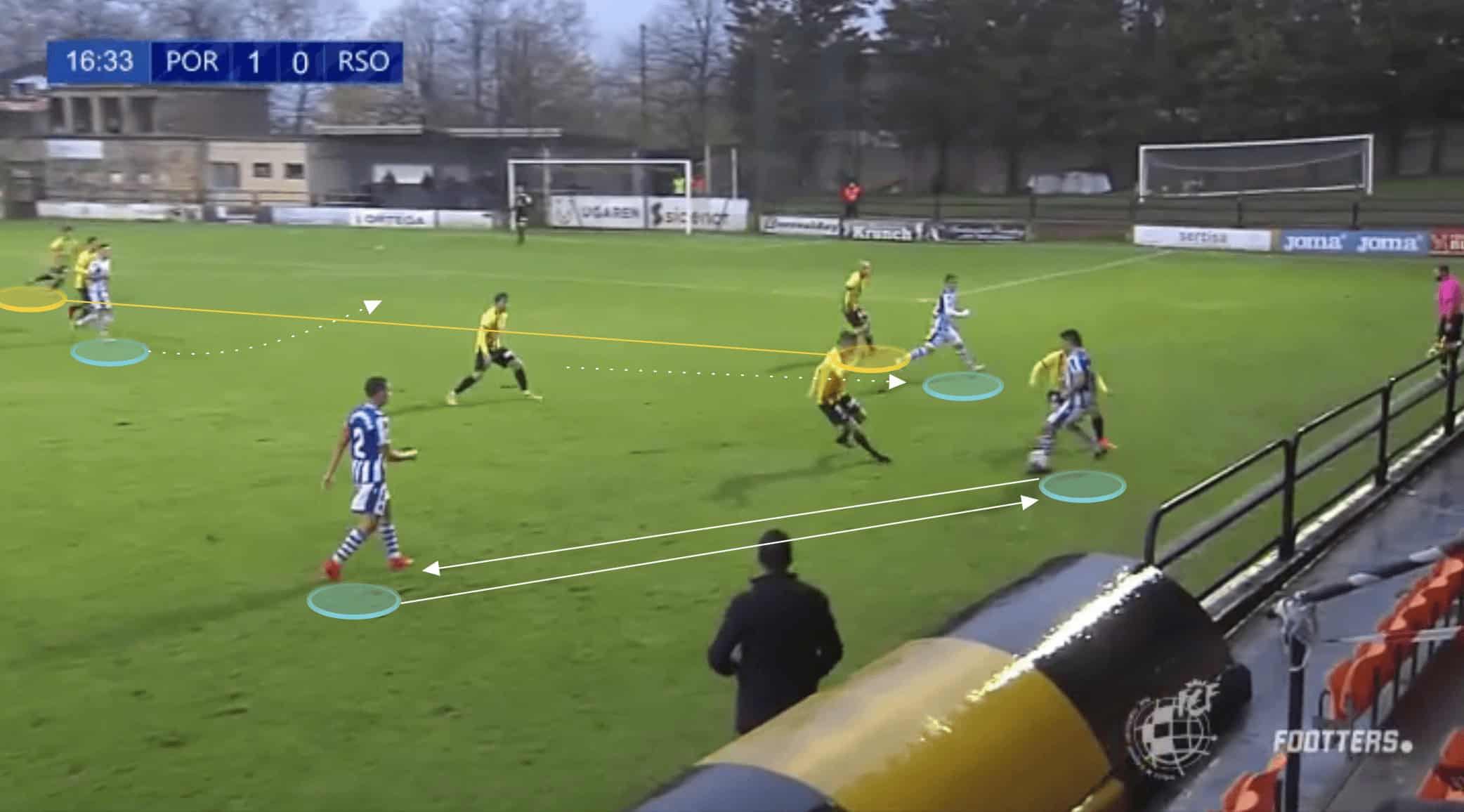
Sociedad’s right-back and winger engage in a quick one-two to draw the attention of the opposition’s left-back, bringing them forward and ensuring the opposition centre-back must engage the forward.
The ball-side centre-forward moves laterally to try and create an overload.
If the centre-back doesn’t follow him then he can create this overload and Sociedad can work the ball down the line.
But if he does follow the forward, which he does, and the second centre-forward remains where they are, it leaves a vast gap for the 10 to move into to receive the through pass.
Flattening and stretching the opposition to facilitate through passes
Sociedad do a terrific job of creating great angles for through passes.
They do this by flattening and stretching the opposition defence to create opportunities for these passes.
The stretching, of course, comes from the width that is always provided in their attacking shape.
The flattening comes from ensuring the centre-backs are both occupied by centre-forwards on the same horizontal plain.
We can see this happening in the image below where there is width in the attack and two centre-forwards close to the opposition centre-back.
The attention is in the detail though, and for the through pass to be as devastating as possible it’s essential that the centre-backs are looking to move forward rather than ready to turn and cover any through passes.
That’s why Alonso’s centre-forwards look to operate between the lines.
The centre-backs are then ready in their minds to press these players if they receive a pass through the lines.
However, as we can see in this image, there is a third man, most often the number 10 or the more advanced pivot, ready to make the run in behind between the gap.
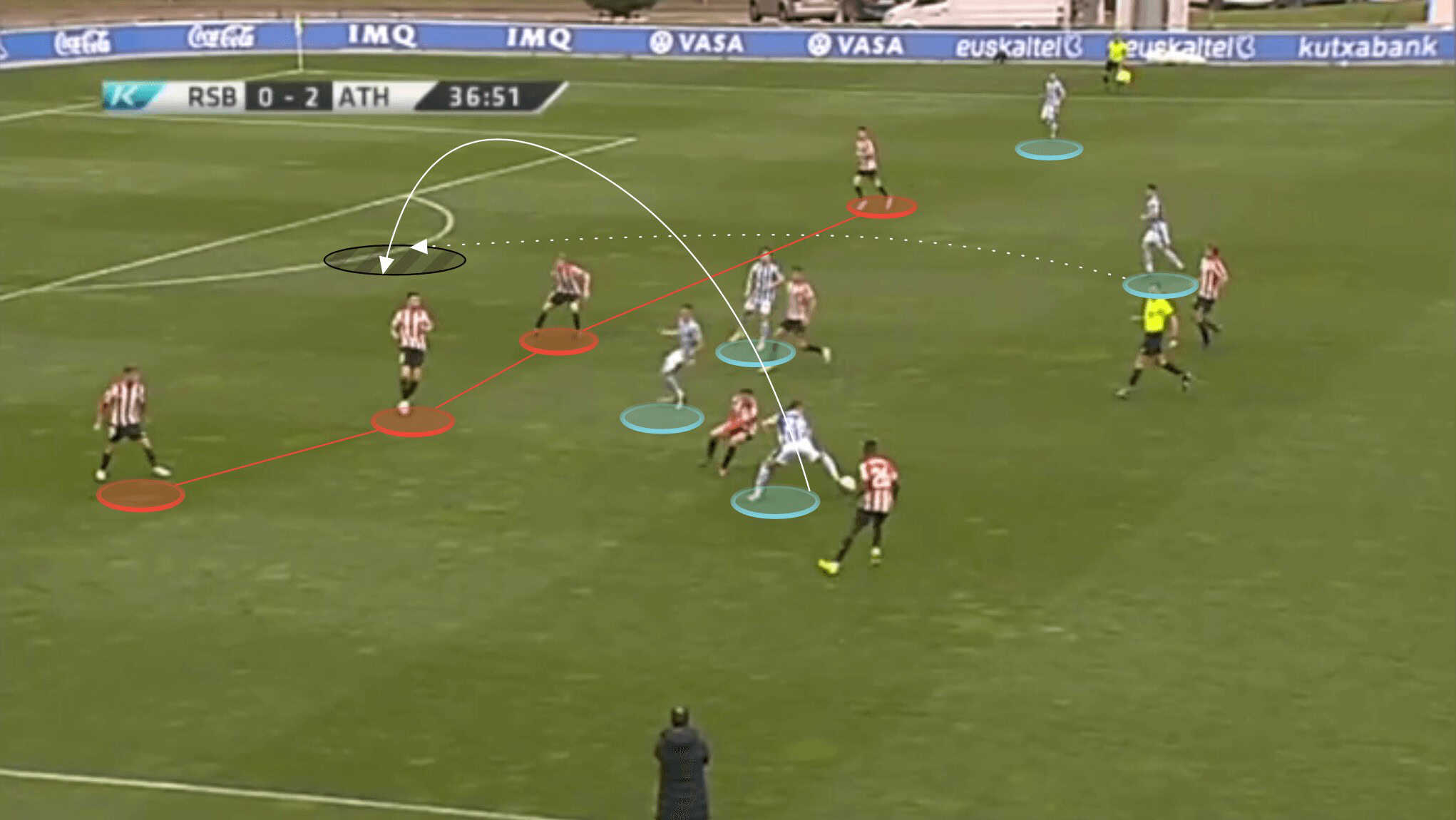
We can see a similar example in the image below, where the centre-backs are occupied by two players, again playing between the lines, and this time, there is a third attacker playing on the shoulder of the full-back.
This is important in this example as their presence ensures the right-centre-back has to be aware of two players and must play with a more open body position, or risk not seeing the blind-side run in behind.
We can see in this image that there are two options for the through pass for the ball-carrier.
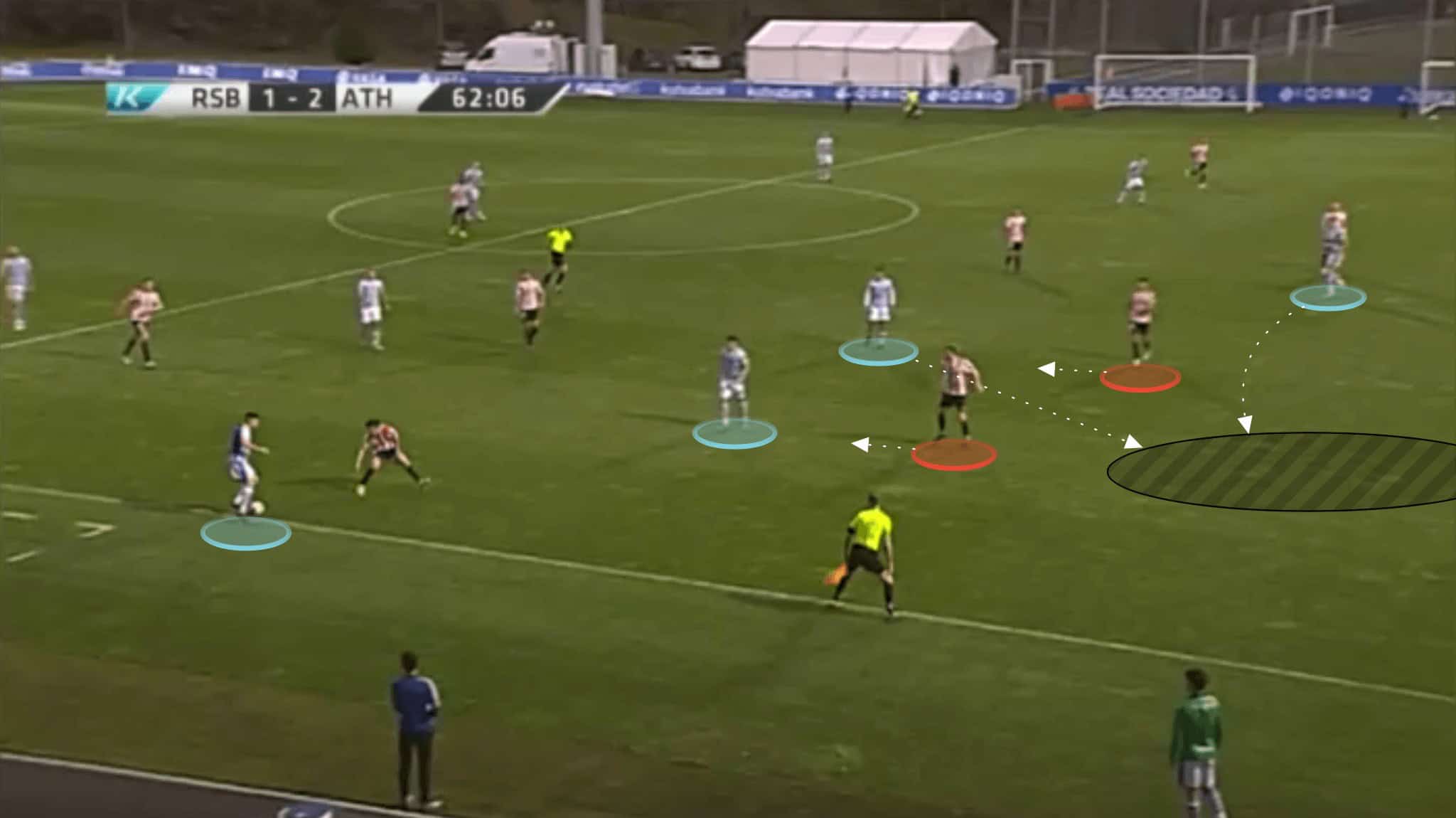
The ball is instead played inside, and the forward’s positioning on the opposition right-back becomes even more important. This player can’t cover their centre-back should the ball be played in behind, for they have to be aware of this player’s movement.
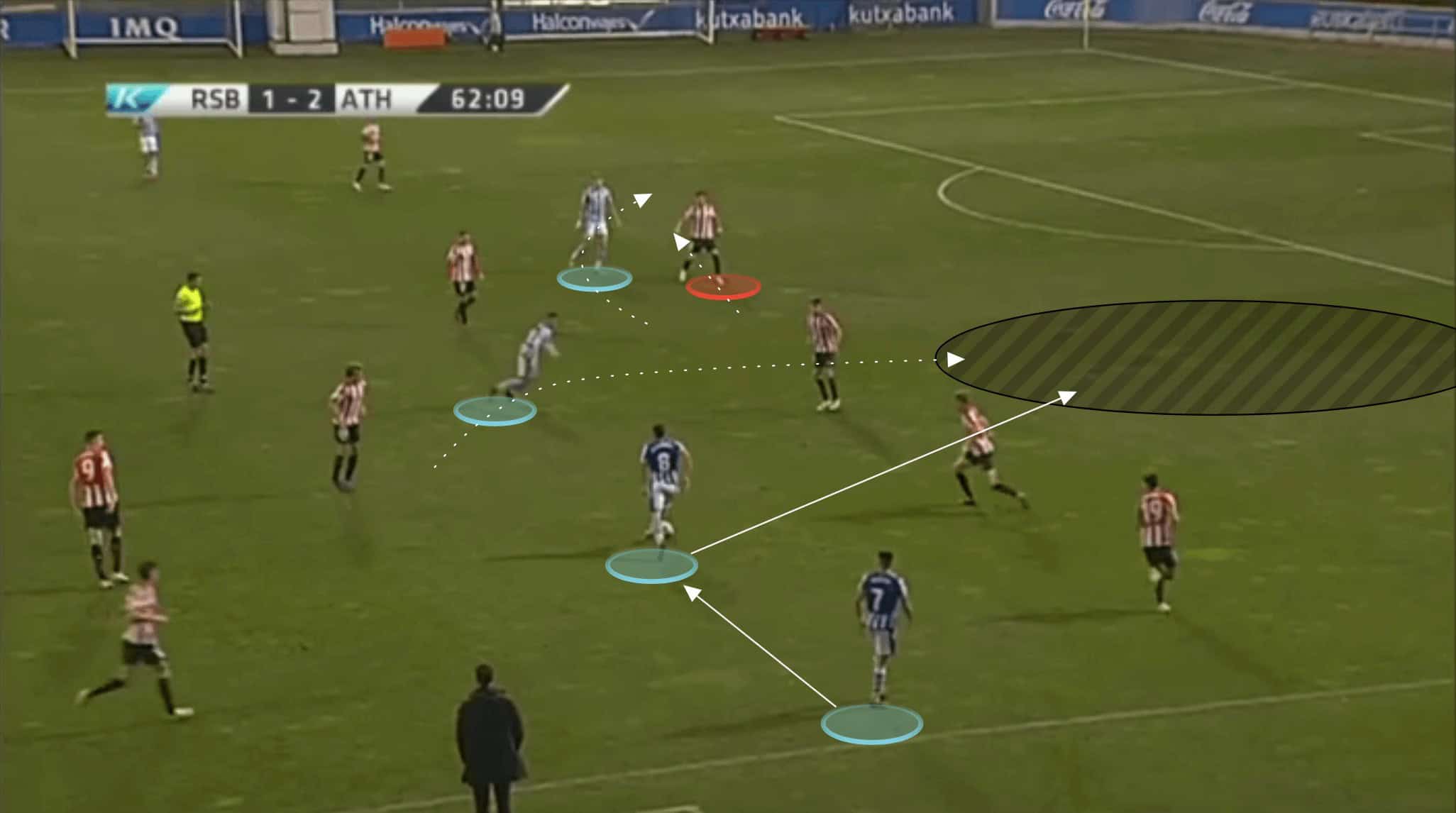
The deeper positioning of the central attacker, who is shown making a run in behind to meet the through pass, means the centre-back is flat, ready for this player to receive the ball to feet, rather than on the half-turn, ready to cover the highlighted space.
The opposition’s flat back line is perfectly set for the ball-carrier to split open with the through pass.
Conclusion
This analysis has focused solely on the possession tactics of Xabi Alonso’s Real Sociedad B.
Still, hopefully it has highlighted some interesting passing patterns and demonstrated how this exciting young coach seeks to fulfil his attacking principles of play.
