Olympique de Marseille will return to play in the UEFA Champions League after two seasons without doing so.
A second-place finish in last season’s Ligue 1, which Les Phocéens had not achieved since 2022, brought them back to Europe’s top competition.
After a turbulent path within the locker room, Roberto De Zerbi once again demonstrated his value as one of the leading figures in the generational change of coaches.
With his firm hand and the flexibility of his positional and attraction-based game, the Italian brought fresh ideas to a tournament that stands out for its physical rigour and the large number of duels that usually dominate on the pitch.
Before arriving at Marseille, De Zerbi tactics had already drawn attention in Europe with his time at Brighton & Hove Albion, Sassuolo and Shakhtar Donetsk, where he had combined organised pressing with quick transitions and flexible positional play.
That experience allowed him to experiment with complex possession structures and off-the-ball movement, which he now seeks to implement and refine at Olympique de Marseille.
After a strong pre-season, Marseille have not had the expected start to the league: two defeats against Stade Rennes and Olympique Lyonnais have overshadowed their only victory against Paris FC.
However, the team does not seem to have lost its identity: there is a high volume of movement, while attraction runs and overlaps both inside and outside seem to flow on the pitch.
Although some pieces still need adjusting on the board, De Zerbi’s team still seems to operate effectively.
They have already faced teams with five-defender lines in the first three matchdays, such as Rennes and Paris FC.
Through positional structures and rational occupation of space, they play with patterns that favour flexibility and organic runs.
In this tactical analysis, we analyse some of the behaviours and dynamics that De Zerbi’s Olympique de Marseille show on the pitch, even if they are not fully polished.
Olympique De Marseille Offensive Structures
In possession, Roberto De Zerbi formation at Marseille alternates between 3-2-5 and 3-1-6 structures, designed to maximise rational occupation of space and generate numerical advantages against the opposition’s defence.
In the 3-2-5, two central midfielders secure the base of the team, providing passing options and facilitating ball circulation.
At the same time, the five attackers occupy the last line and open interior lanes for runs and combinations.
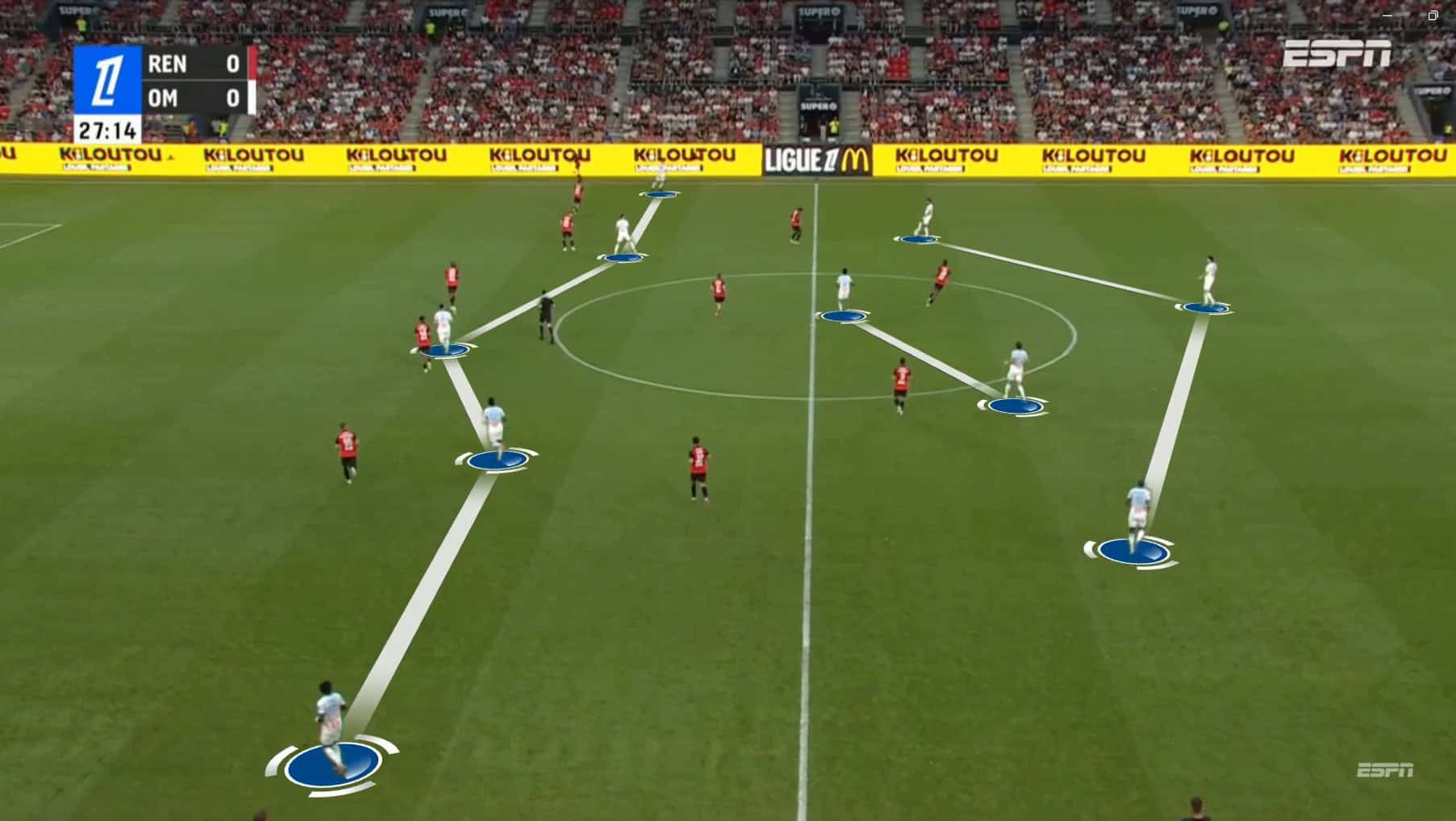
When the team seeks offensive density in the final third, they shift to a 3-1-6, with a single midfielder at the base and up to six players projected forward.



![Lazio Vs Napoli [0–2] – Serie A 2025/2026: Maurizio Sarri Zonal Marking Weaknesses And Unsuccessful Attacking Choices – Tactical Analysis](https://totalfootballanalysis.com/wp-content/uploads/2026/01/Lazio-Vs-Napoli-tactical-analysis--350x250.png "Lazio Vs Napoli [0–2] – Serie A 2025/2026: How Antonio Conte Tactics Exploited Structural Flaws – Tactical Analysis 7")