
In a surprising turn of events, Celta Vigo has bid farewell to Rafa Benítez and his coaching staff, marking the end of their tenure merely eight months after their appointment.
The decision comes amid Celta’s struggle in La Liga.
The club is currently precariously positioned in 17th spot, just two points clear of the relegation zone.
Their recent 4:0 defeat against league leaders Real Madrid seemed to be the final blow that led to this abrupt departure.
In an official statement, the club cited the inability to meet the expected results as the primary reason for parting ways with the former manager of Real Madrid, Liverpool, and Chelsea.
Despite their gratitude towards Benítez and his team for their professionalism and dedication, Celta Vigo is now left to chart a new course in their pursuit of success.
In the build-up to Benítez’s departure, Celta’s performances had been inconsistent, epitomised by a heartbreaking draw against Cadíz, where they surrendered a two-goal lead in the dying minutes of the match, followed by a narrow victory over Almería.
These recent outings only served to underscore the growing concerns within the club regarding their league standing and overall performance under Benítez’s leadership.
In this tactical analysis, a scout report, we analyse their performances and discuss the tactics used by Benítez at RC Celta de Vigo.
Rafa Benitez Manager Profile
Rafa Benítez has an illustrious managerial career, leading some of the most renowned football clubs globally, including Liverpool, Chelsea, and Real Madrid.
His tenure at Anfield, particularly, is remembered for his achievements and his memorable exchange with Sir Alex Ferguson during his time in charge of Liverpool.
After a hiatus following his departure from Everton in 2022, Benítez returned to the sideline, taking the reins at Celta Vigo in July 2023.
Despite facing a turbulent spell marked by poor performances, the determined Spaniard remained steadfast in his commitment to the club, refusing to step down from his role as Celta boss.
During his tenure, which spanned 33 games, Benítez’s Celta side endured a challenging run, losing 14 league matches.
As a result, Celta Vigo languished in 17th place in the LaLiga standings, with a slim two-point cushion above the relegation zone.
Rafa Benitez Data Analysis
Celta Vigo’s performance this season paints a grim picture.
With just 24 points garnered from 28 games, they are precariously 17th in the La Liga standings, a mere two points clear of relegation territory.
With a relatively young squad averaging 26.8 years, Celta faces challenges similar to other teams battling relegation.
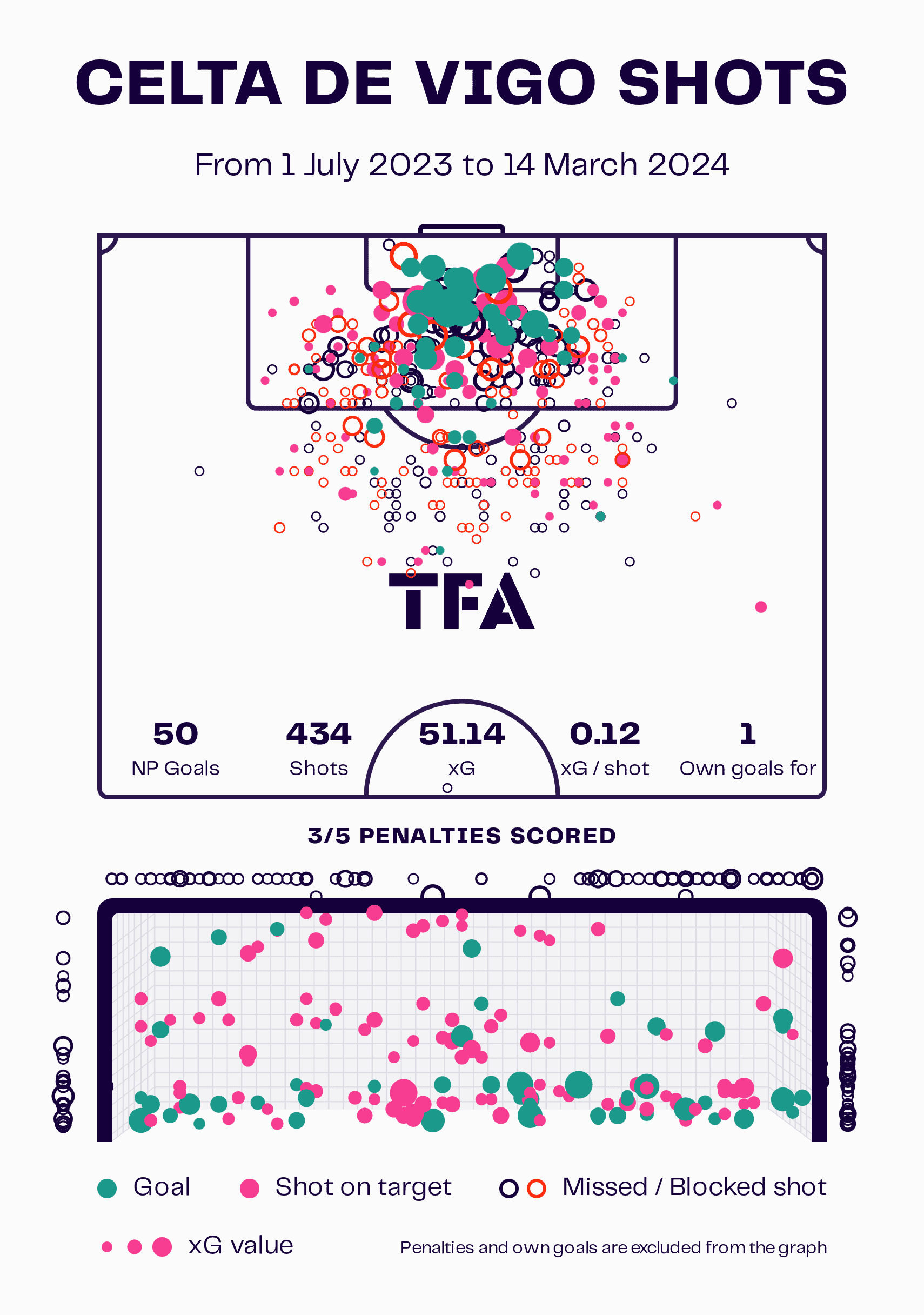
Offensively, Celta has struggled to consistently find the back of the net, tallying only 30 goals so far.
Despite generating an xG of 38.58, they’ve underperformed in converting chances into goals.
Their offensive output stands at a meagre 0.95 goals per game, ranking them among the lowest in the league.
Despite crossing often, their success rate is dismal at 29.6%, indicating inefficiency in delivering quality balls into the box.

However, their biggest struggles lie in progressing the ball into dangerous areas.
They average only 38.89 passes into the final third per 90 minutes, a statistic that ranks among the lowest in La Liga.
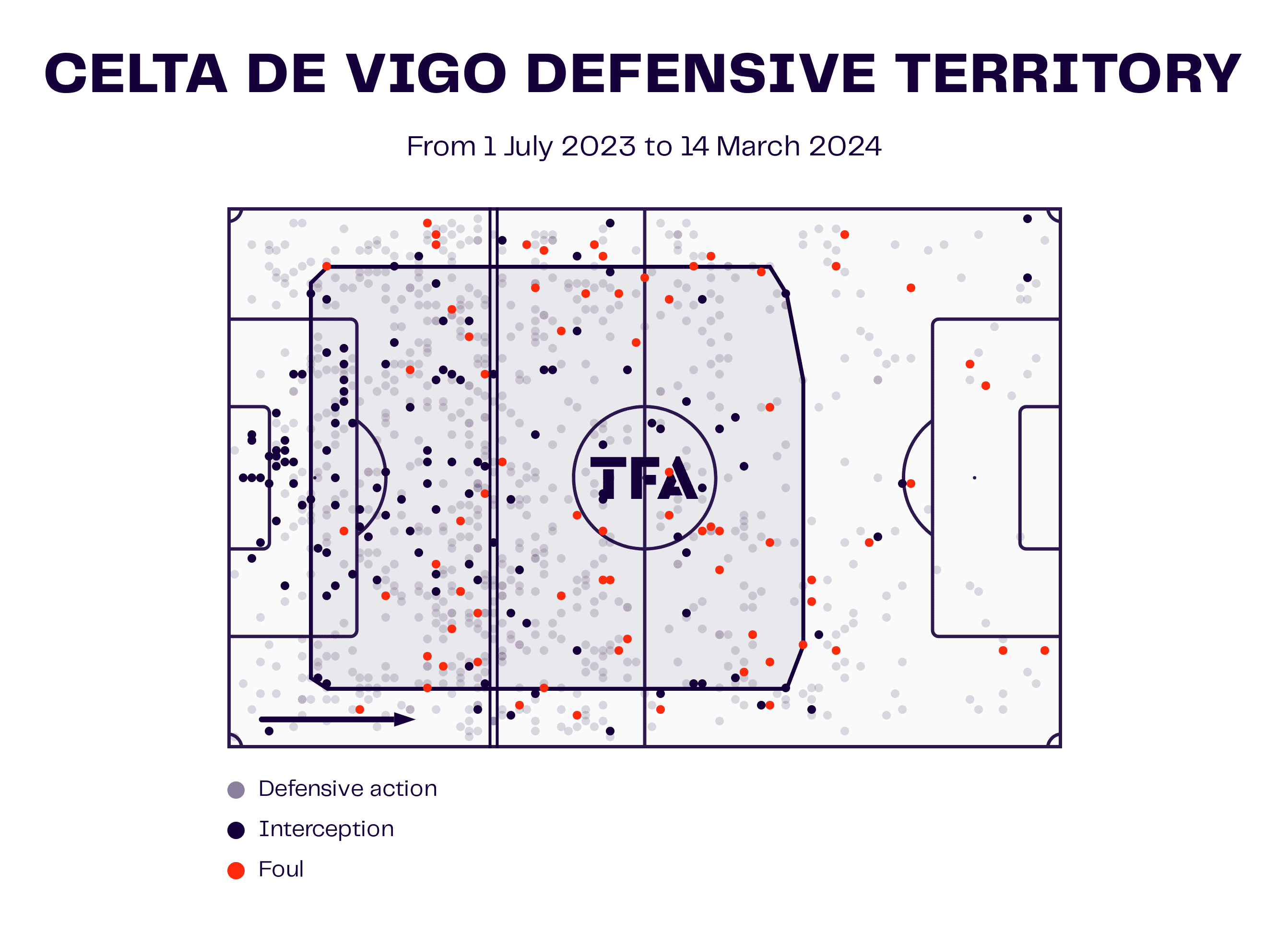
Furthermore, Celta’s problems in the build-up phase are evident, as opponents exploit their vulnerabilities by applying high-pressure tactics, as reflected in their PPDA against (passes per defensive action against) value of 8.99.

Celta engages in a high number of defensive duels and interceptions, highlighting their defensive approach.
Still, they’ve conceded 43 goals, slightly lower than the expected goals against at 48.95.
Moreover, their possession share of 42.4% is one of the lowest, while they’re conceding an average of 1.36 goals per game, further underscoring their defensive frailties.
The team’s defensive stability and organisation require attention, as evidenced by their high number of goals conceded.
Finding the right balance between defensive solidity and offensive creativity will be crucial for the new coach to implement a successful strategy.
Rafa Benitez Tactical Analysis
Under Rafa Benitez’s tenure, Celta Vigo has undergone a tactical shift towards a more conservative and defensively-minded approach compared to their previous seasons under Eduardo Coudet.
The strategic decision behind Benitez’s appointment was to instill a sustainable identity and elevate the club’s standing from the previous campaign, despite facing the challenge of a comparatively weaker squad.
Tactically, Celta Vigo predominantly employs a 4-4-2 formation out of possession, although Benitez has experimented briefly with a 5-3-2 setup earlier in the season.
However, there hasn’t been a consistent midfield pairing throughout the campaign, with several combinations tested, including Carlos Dotor and Fran Beltrán, Tapia and Hugo Sotelo, Tapia and Dotor, and Beltrán and Luca De La Torre.
Statistically, Celta Vigo allows opponents more time on the ball before engaging in defensive actions, as evidenced by their negative league-leading PPDA (passes per defensive action) of 13.66.
Despite criticisms regarding their playing style, which is characterised as less entertaining, their underlying numbers suggest they’re not performing at relegation-level standards.
Regarding goal distribution, Celta Vigo has succeeded from set pieces, contributing six goals out of their total 30.
However, their conversion rate from open play remains a concern, with only nine goals scored in such scenarios.
Despite taking a significant number of shots, their conversion rate stands at a mere 6.4%, indicating a need to capitalise on scoring opportunities.
Moreover, the absence of prolific scorer Iago Aspas has left a noticeable void in their attacking output, with no other player stepping up to effectively fill the gap.
This reliance on Aspas highlights a lack of diversity in goal-scoring contributors, which could be a focal point for improvement in the tactical setup moving forward.
Individual Players
The departures of key players, such as Gabri Veiga, Javi Galán, and Hugo Mallo, have undoubtedly left a significant void in Celta Vigo’s squad this season.
Veiga, who contributed 15 goal involvements last season, departed for Al-Ahli in Saudi Arabia, leaving behind a notable absence in the attacking midfield role.
Similarly, Javi Galán, a pivotal figure in Celta’s attack with over 3,000 minutes played last season, and Hugo Mallo, a stalwart right-back for over a decade, also departed, further weakening the team’s defensive and attacking capabilities.
In contrast, the arrivals at Celta Vigo this season have fallen short of expectations.
Despite being the seventh-highest spenders in the transfer market, the team is underperforming, currently ten places below its expected position.
Also, with an overall market value of €112.30 million, Celta should theoretically be positioned six ranks higher.
This discrepancy suggests a notable underperformance compared to the quality of their squad.
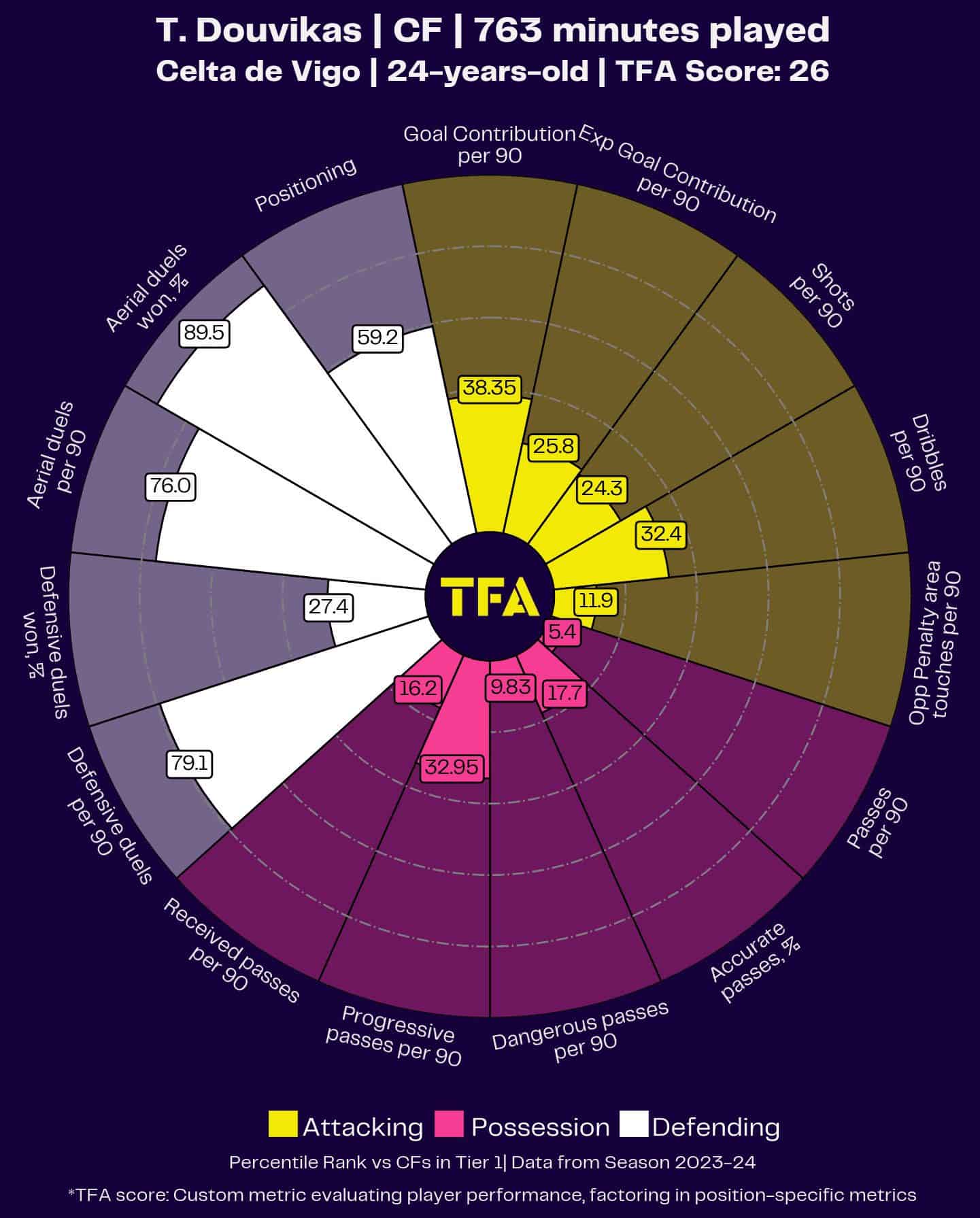
Notably, their most expensive signing, Anastasios Douvikas, has struggled to make an impact and earn regular playing time under Benitez’s management.
Similarly, Carles Perez, who was one of their standout players last season while on loan from Roma, has failed to replicate his previous form since making his move permanent for €5.2 million.
These disappointments in the performance of new signings have further compounded Celta Vigo’s struggles this season, highlighting the challenges they face in maintaining competitiveness in La Liga.
Star player Iago Aspas’s dip in form has been a significant factor in Celta Vigo’s struggles in front of goal this season.
Aspas, who has been a linchpin of Celta’s attack for years, has struggled to replicate his usual sharpness and prolific goal-scoring form.
Iago Aspas holds a special place in the hearts of Celta Vigo fans, having returned to the club after less successful stints at Liverpool and Sevilla.
His influence on the team’s performance has been immense.
He often serves as the focal point of their attacking play.
However, this season has seen a departure from the norm, with Aspas failing to maintain his usual standards.
Despite boasting a high combined expected goals and expected assists total in La Liga this season, standing at 13.98, Aspas has struggled to convert these opportunities into tangible goals and assists.
While physically, he appears to be in good shape, luck has seemingly deserted him on the pitch, leading to a frustrating period for both Aspas and the team as a whole.
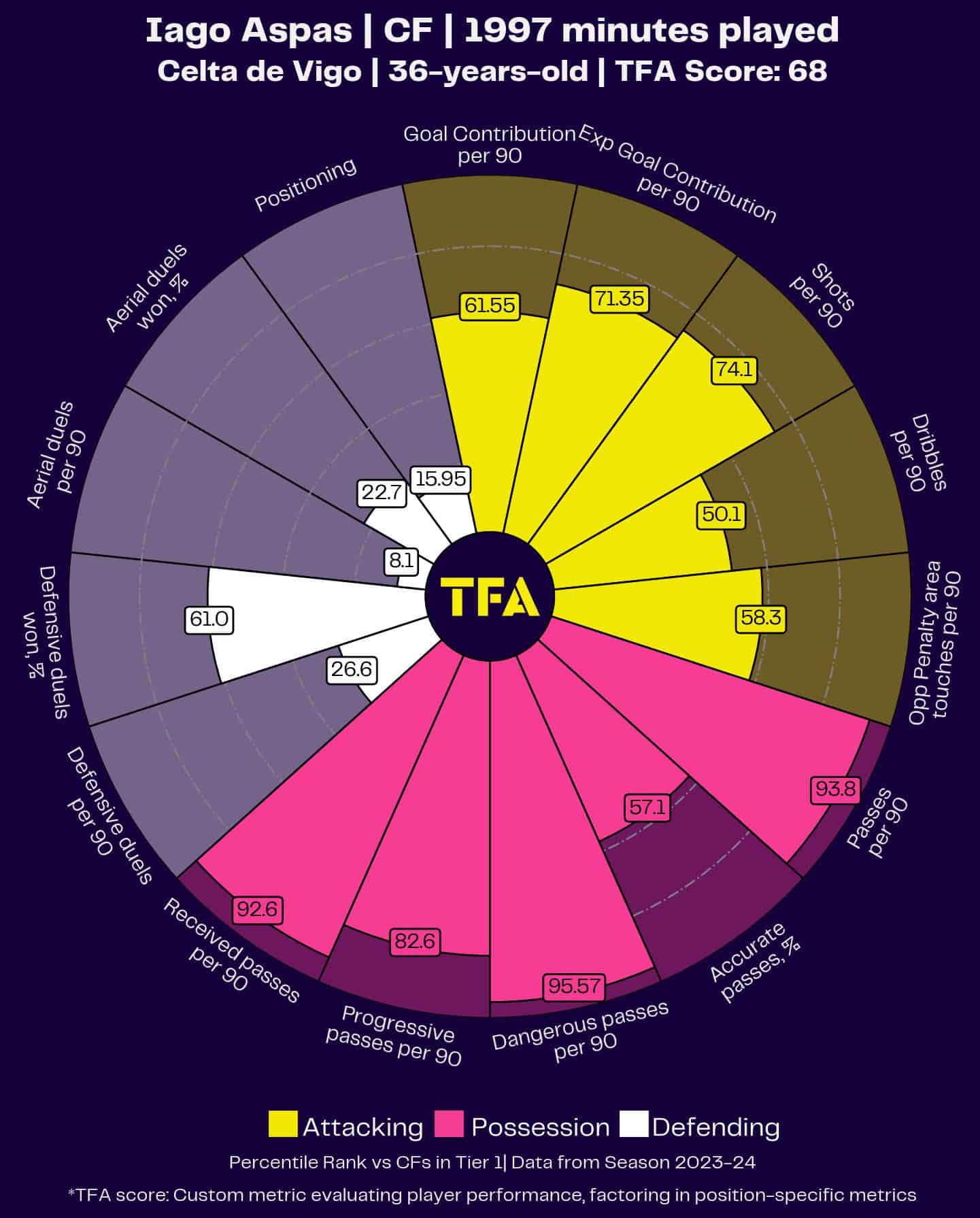
Aspas’ decline in form has left a noticeable void in Celta Vigo’s attacking output, as the team has heavily relied on his goal-scoring prowess in the past.
Without his usual contributions, the team has struggled to find the back of the net with the same frequency, highlighting the impact of his dip in form on Celta’s overall goal-scoring performance.
The new head coach will inherit a team facing several challenges that need to be addressed to steer Celta Vigo back on track.
Firstly, the team needs to improve its offensive efficiency, particularly in converting scoring opportunities into goals.
The departure of key attacking players and the dip in the form of star player Iago Aspas has left a void in Celta’s attacking prowess that the new coach must seek to address.
Conclusion
Rafa Benitez’s departure from Celta Vigo was necessary, considering the team’s underwhelming performances and precarious position in the league table.
Despite his extensive experience and tactical acumen, Benitez struggled to instill a cohesive playing style and achieve positive results with the squad at his disposal.
Furthermore, fostering a positive team culture and restoring confidence among the players will be paramount in revitalising Celta Vigo’s season.
Effective man-management and motivational techniques will be essential tools for the new coach to utilise in reinvigorating the team’s morale and performance on the pitch.
The new head coach at Celta Vigo will face the challenge of rebuilding a team in transition.
This will require a blend of tactical innovation, player development, and leadership qualities to propel the club towards a more promising future.
