
Fans of Dutch football will fondly remember the 2022/23 KNVB Cup when SV Spakenburg of the 3rd tier Tweede Divisie became the first amateur team to qualify for the semi-finals of the cup. Fast-forward to this campaign, which just passed, and Spakenburg continued to write headlines.
The club is managed by Chris de Graaf, who played for the club during his playing career, guiding Spakenburg to the Tweede Divisie title with their 82-point haul, a record for this level. This tactical analysis will provide an analysis of de Graaf’s tactics with the amateur side as they look ahead to competing in the Eerste Divisie next season.
Preferred formation & overview
When it comes to how Chris de Graaf looks to set Spakenburg up, the 36-year-old tends to favour a 4-3-3 formation, but this will tend to look different over the course of matches. At times, this shape will alter into a 4-2-3-1 or a 4-1-4-1, but the same basic principles that the Dutch coach has instilled stay relatively similar. When it comes to positional rotations, this is quite common for Spakenburg, with one of de Graaf’s main possession principles being quick and incisive combination play, usually resulting from movement in advanced areas that drags opponents out of position and opens up gaps to play through, but more on that in a little bit.
Spakenburg tend to prefer a possession-oriented style of play under de Graaf, but they are not afraid to go direct towards their target #9 if it is the more feasible option to progress play. It would be wrong to suggest that Spakenburg is patient in their build-up; however, de Graaf’s side is looking to quickly progress the ball into the advanced areas when in possession. The full-backs look to get forward in attack and tend to stay wide, with the wingers normally being the players who invert into more central attacking positions, but the roles of these two sets of players will sometimes be reversed. Statistically, Spakenburg were the best attacking and best defensive side in the Tweede Divisie in the 2023/24 season.
Use of quick ball movement to progress play into the final third
One of the main principles in Chris de Graaf’s style of play at Spakenburg is, without a doubt, the quick and intelligent ball progression when in possession, with the use of combination play and off-the-ball movements in advanced areas critical to this tactic.

The data viz graphic above shows the progressive passes of Spakenburg this season in all competitions, with the arrows highlighted in pink showing progressive passes that went into the penalty area, as we can see, while Spakenburg statistically have the 4th highest average ball possession in the Tweede Divisie (53.6%), a lot of the distribution from the goalkeeper has gone direct, focused on finding the centre-forward, with the Spakenburg midfielders collapsing in the midfield to concentrate on winning the second ball.
However, they will build with their centre-backs, though the ball progression is quick, with Spakenburg prioritising verticality over horizontal ball movement. As we can also gather from the graphic, the Dutch side tend to progress the ball into the penalty area from the wide areas of the half spaces, usually delivered into the box by either the wingers or advanced full-backs. Spakenburg averaged 15.16 crosses per 90 minutes this season in the Tweede Divisie, with their 36% accuracy on crosses the second highest in the Dutch third tier.
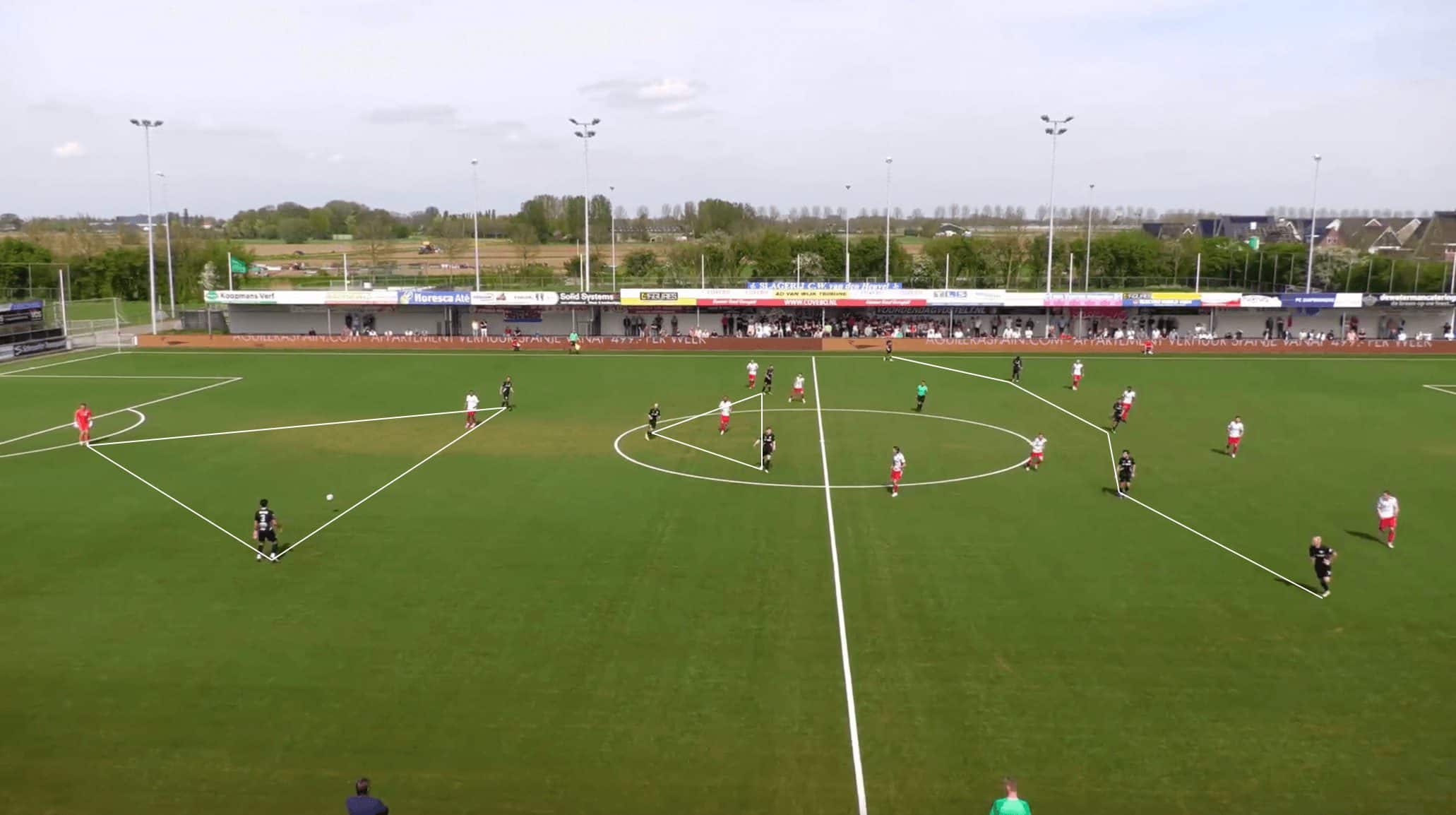
The image above shows an example of Spakenburg’s typical shape during phases of build-up play. The goalkeeper tends to play a large part in possession for de Graaf, with the goalkeeper and the two centre-backs forming a triangle between them, offering different passing options against either a one or two front opposition pressing shape. Further forward, the midfield three tend to stay tight and compact, with this narrow shape looking to drag the opposition centrally and crowd these areas of the pitch in the middle third.
On the forward line, it tends to look almost like a flat attacking five, with the full-backs pushing high and wide to hold the width. The two wingers are inverted and operating in the half-spaces. At the same time, the forward will either look to drop between the opposition midfield and defensive lines, almost in a free roaming role, or stay higher up, looking to pin the opposition defence back. As we can see, the space is in the wide areas, which is where Spakenburg tend to look to progress the ball into from the defensive third.

The image above shows an example of this combination play from Spakenburg and how this quick and incisive ball progression is able to catch opposition defences out. In this phase of play above against Kozakken Boys, the ball has just been played back to the right-sided centre-back, Masies Artien. The 30-year-old plays a first-time pass towards Wimilio Vink, with the #10 dropping into a pocket in the half-sphalf-spacen the opposition midfield and defensive lines.
All of the off-the-ball movement in the central area causes the opposition’s defensive shape to become more narrow, allowing the space out wide, with the right-sided full-back Hero van Lopik operating in the wide channel, with the winger Killian van Mil inverted into a more central position. As a result, Vink plays a first-time ball into the path of van Lopik, with the 22-year-old able to drive behind the opposition defence and send a cross with minimal pressure towards the edge of the penalty area.
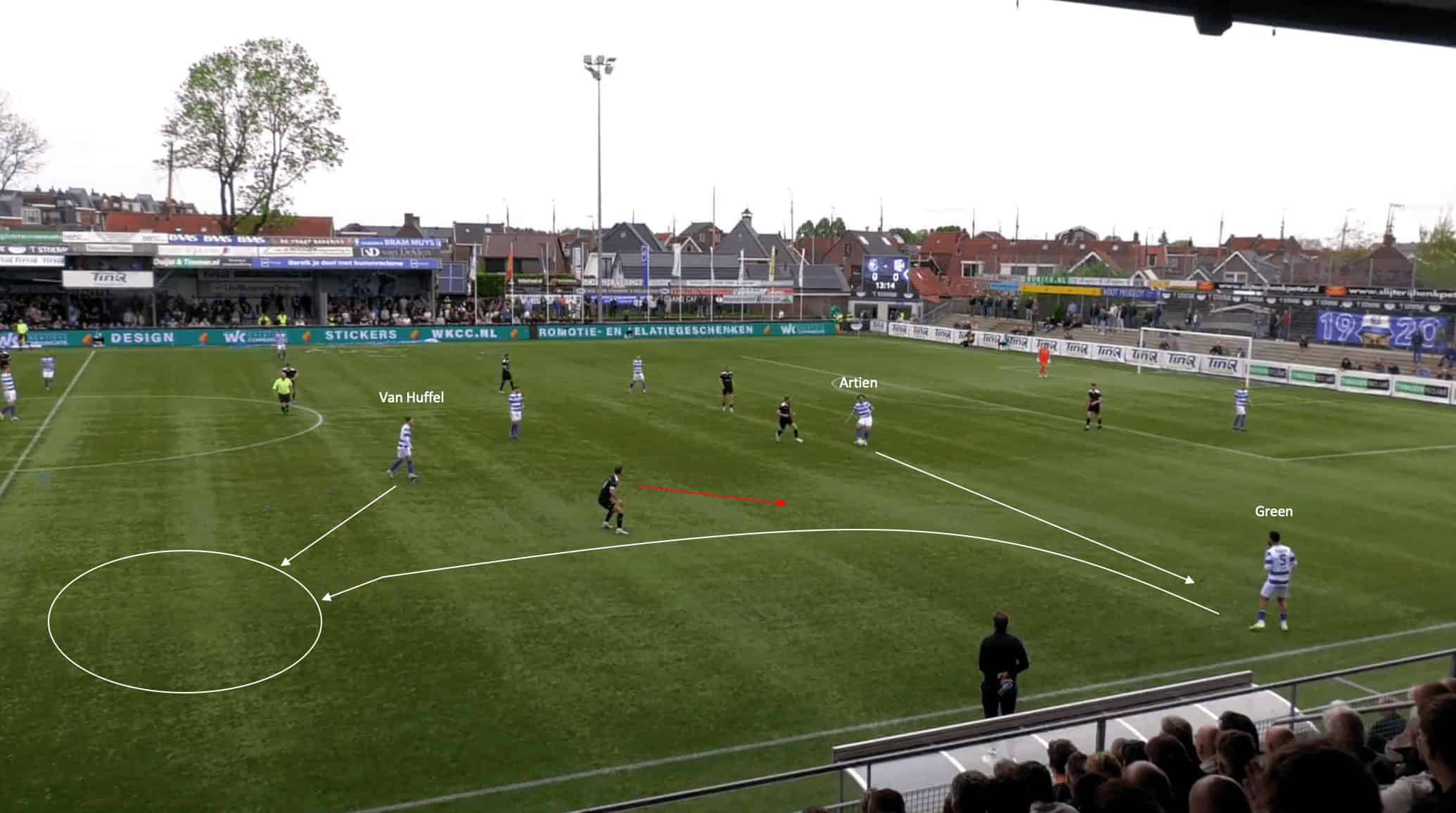
The image above shows another excellent example of this quick and incisive vertical style of build-up play from Chris de Graaf’s side. While in possession, Artien receives possession and drives into a more central area, luring the opposition’s defensive shape towards him and causing their forward line to become slightly detached from the rest of the defensive shape. The centre-back then plays a pass to the left-sided full-back, Dwayne Green, with this pass pulling the opposition midfielder towards the 27-year-old and out of position.
At the same time, midfielder Sam Van Huffel moves into the pocket of space vacated by the midfielder pressing, allowing Green to play a chipped pass into the pocket of space in the middle third. The 24-year-old Dutchman is able to gather possession, turn and drive into space under no pressure from the opposition, with the defensive shape looking to drop and prevent any more quick ball progression.
When it comes to possession principles from Chris de Graaf, the 36-year-old Dutch coach wants verticality and quick, incisive ball progression between the opposition’s defensive lines, with a heavy emphasis on combination play and operating in the wide channels and half-spaces to progress the ball into the final third.
A quick look at their clinical nature in front of goal & their danger in transitional moments
We just talked about how Spakenburg looks to progress the ball towards the final third of the pitch, but now let’s take a quick look at how they have been clinical in front of goal. This section will also examine their pressing ability and tendency to win the ball back in advanced areas of the pitch and how they are a major threat in transitional moments.
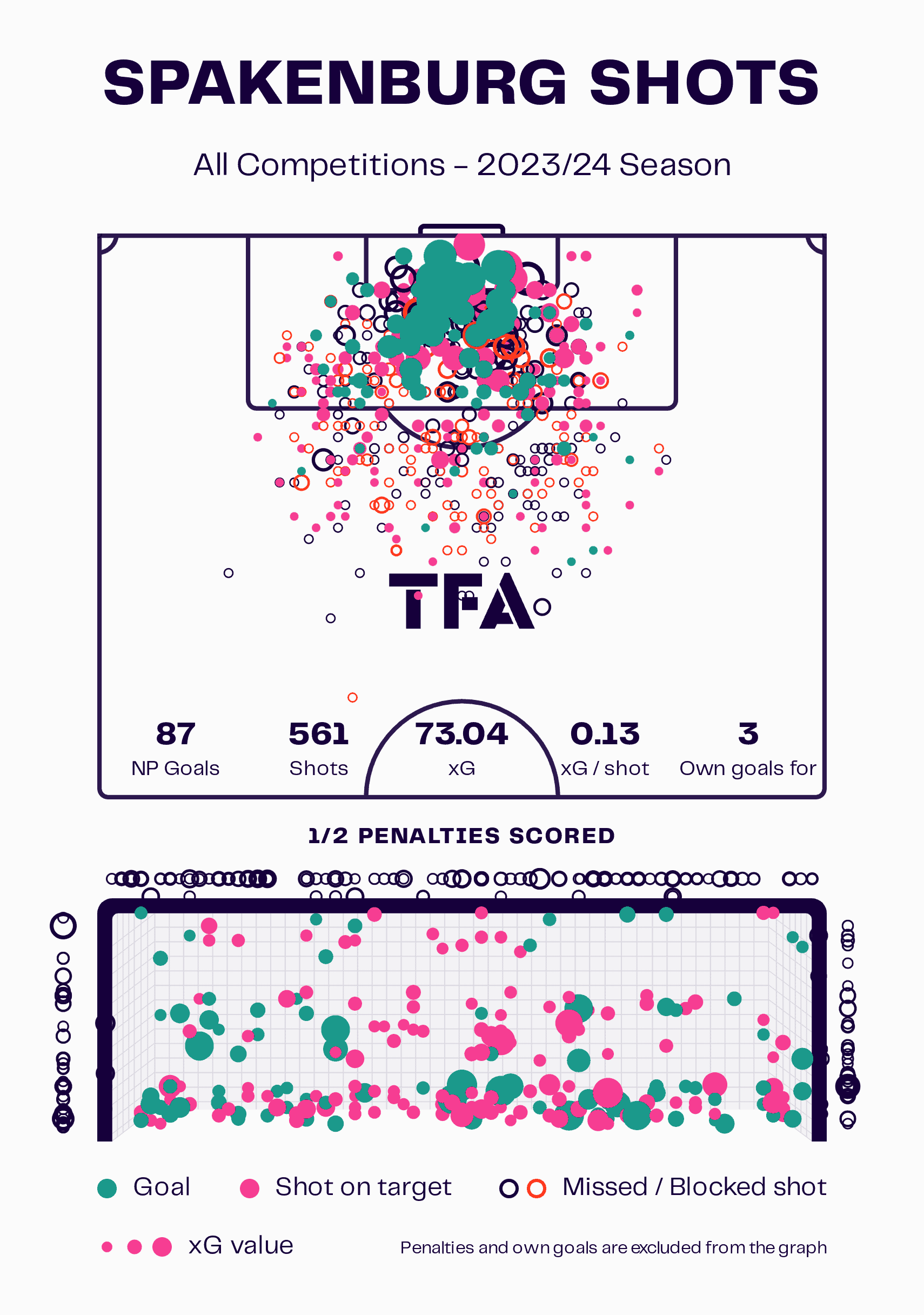
The shot map shown above gives us a bit of a better idea of just how clinical Spakenburg have been in front of goal in the Tweede Divisie this season. Their total shots is the highest number in the Dutch third tier, while they averaged over 15 shots per 90 minutes. Their 791 touches in the penalty area were also most in the Tweede Divisie, as were their 21.8 per 90 minute rate. Spakenburg’s xG of just over 73 was also the highest in the Tweede Divisie, highlighting the rate at which they created high-quality goalscoring chances.
Scoring goals was never a problem for de Graaf’s side this season. With a staggering 2.45 average goals scored per 90 minutes in the Tweede Divisie, they were an unstoppable force in front of goal this season. The Dutch side did outperform their xG by almost 10 goals, so it would be unsurprising if they revert back to the mean next season in the Eerste Divisie.
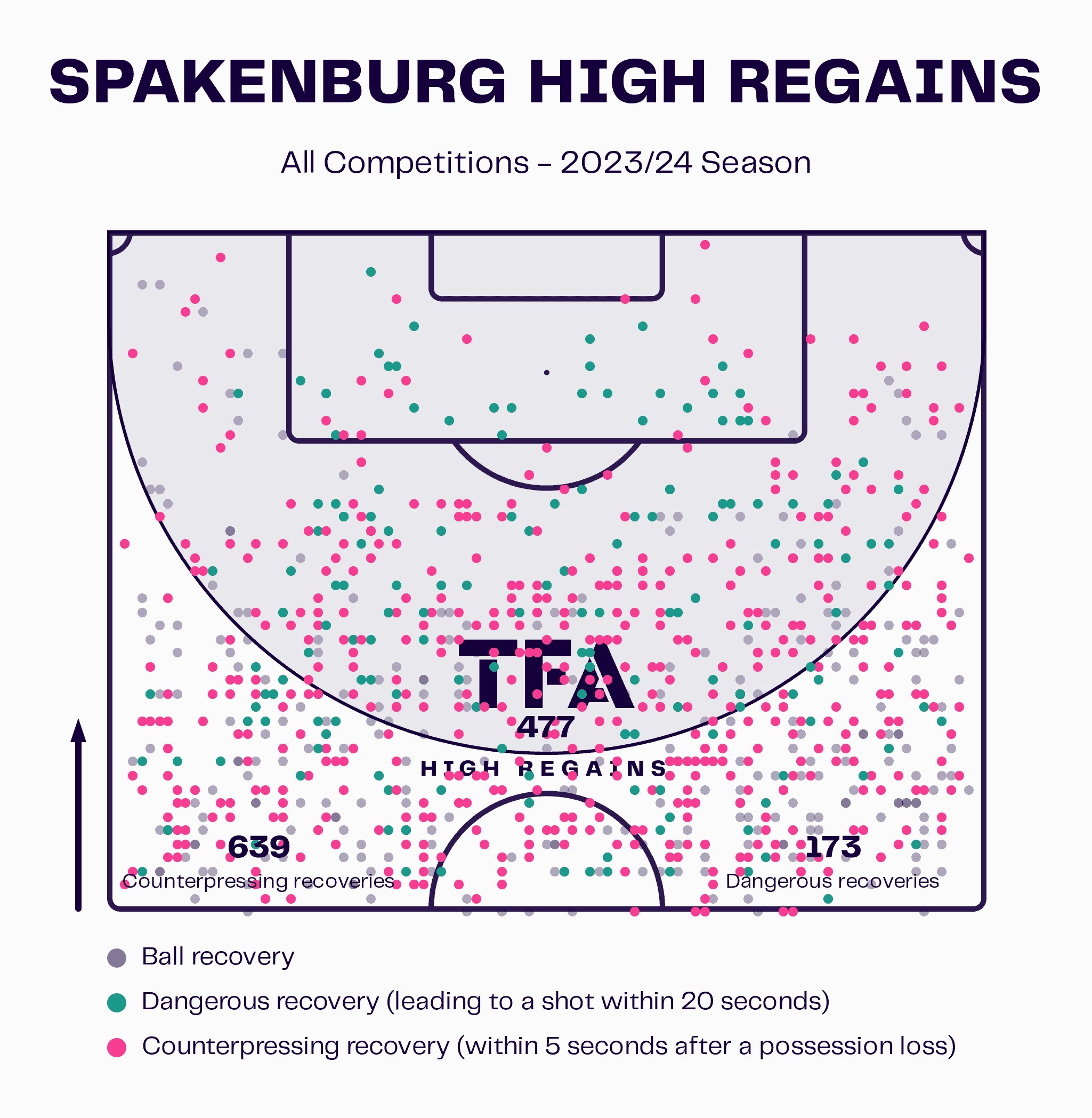
The graphic above shows the high regains of Spakenburg in all competitions this season, which helps to illustrate the danger they cause in transitional moments when they win possession high up the pitch. Spakenburg’s PPDA of 9.42 does not put them in the top five of clubs in the Tweede Divisie for pressing, but as we can see from the graphic, they are very active in trying to win the ball back in advanced areas, with de Graaf’s side having 173 dangerous recoveries in all competitions this season.
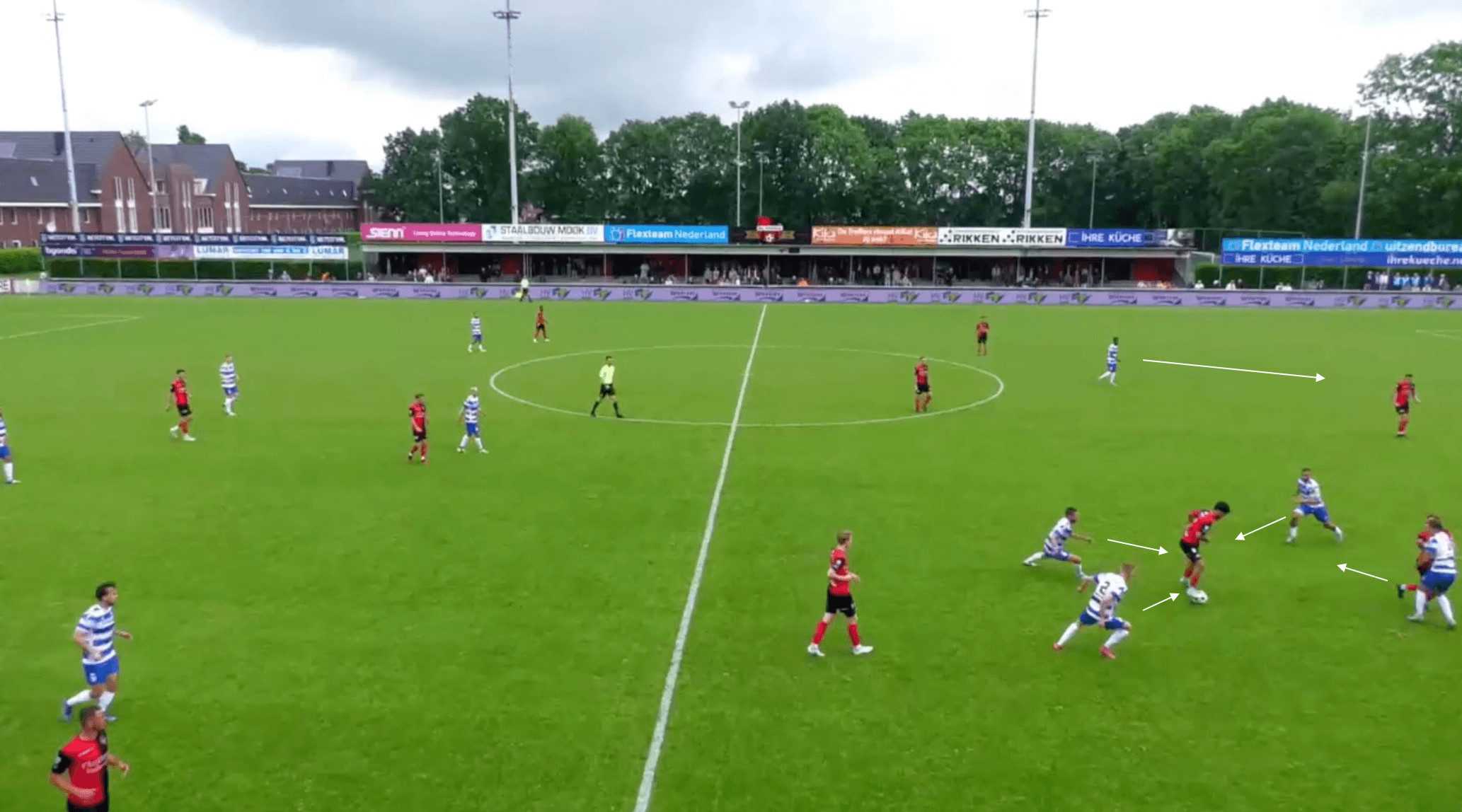
The image above shows a pressing moment from Spakenburg where their high regain results in a goal. The opposition are looking to build out from the back, with the ball currently in possession of the full-back. The defender receives possession and inverts, evading one Spakenburg player’s tackle. However, this attempted challenge forces the defender to face his own goal, which triggers the rest of the Spakenburg press.
This results in a 4v2 advantage in the halfspahalf-spaceakenburg, with the Tweede Divisie champions able to force a turnover in this advanced area. The left winger finds himself in an unmarked position in an advanced area on the far side, with the winger found on the edge of the penalty area with a quick vertical pass after possession is turned over. He is able to do the rest of the work, dribbling past the defenders and into the penalty area to slot the ball past the goalkeeper.
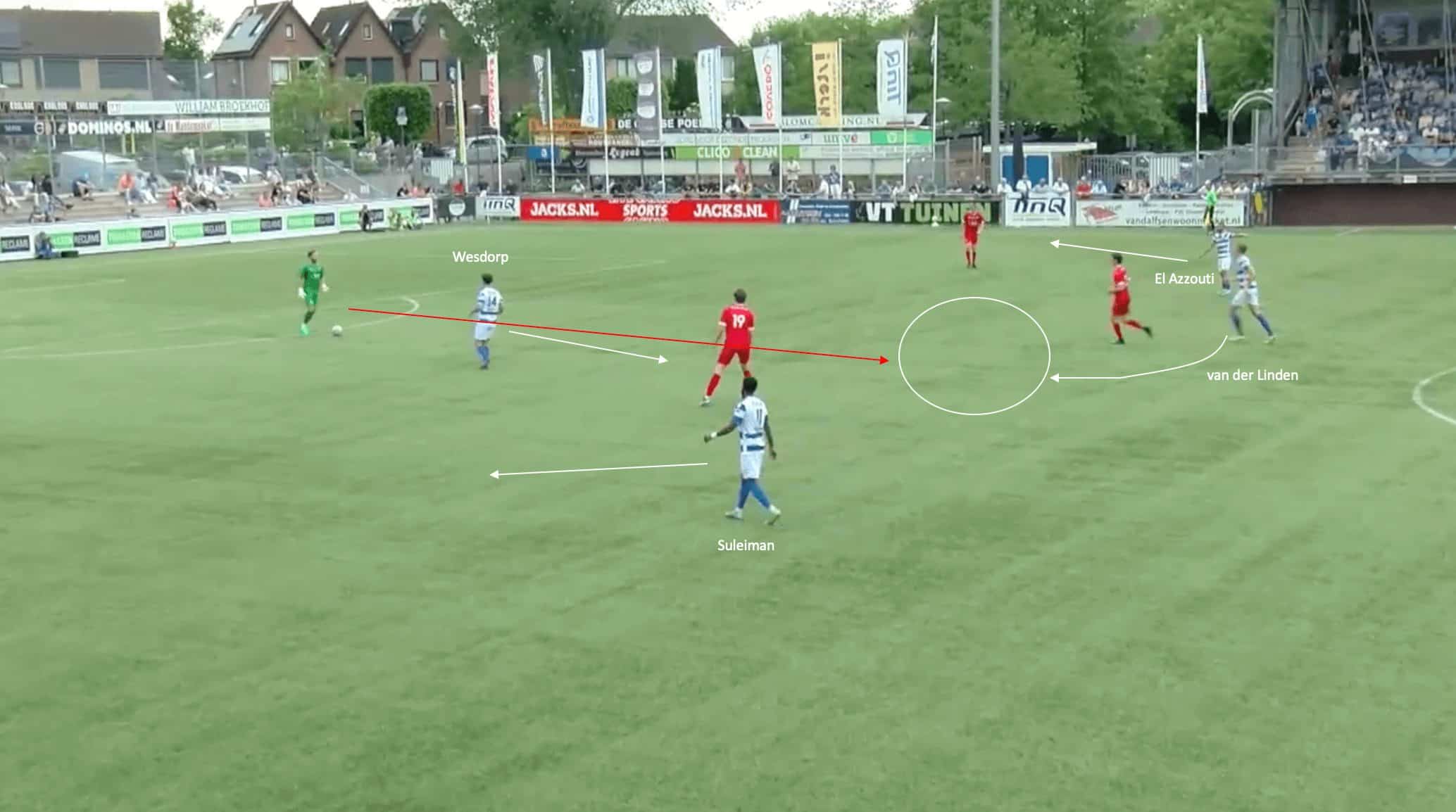
However, it is not always consistent pressing and swarming of opposition players that allow Spakenburg to win possession in advanced areas and have dangerous transitional moments. In some instances, like the example above, it is down to their positional awareness off the ball from their first line of pressure. In this phase of play, the opposition goalkeeper is in possession, with the first line of defence from Spakenburg not really looking to press high and put much pressure on the goalkeeper.
Instead, they look to sit off and see if they can lure the goalkeeper into making a mistake. Notice how the wide players, in this instance Mukhtar Suleiman and Ahmed El Azzouti, are looking to mark the space, with their positioning just close enough to allow them to jump a potential pass towards the full-backs in the wide channel. Midfielder Koen Wesdorp pushes high as a centre-forward, putting some pressure on the ‘keeper while also blocking the passing lane to the centre-back who has stepped into midfield. As a result, the goalkeeper chooses to play towards the defensive midfielder, with forward Floris van der Linden not in the best defensive position. However, the pass is mishit, with van der Linden able to intercept the pass and start a counter attack, with Spakenburg able to score due to their quick ball movement.
While they are not necessarily always looking to be an aggressive front-foot defending team under Chris de Graaf, Spakenburg will look to win the ball in advanced areas of the pitch. The side are dangerous when it comes to transitional moments once possession is turned over, with the Dutch side also at times opting for a more passive approach, looking for the opposition to make errors themselves.
Best defence in the Tweede Divisie
This was brought up earlier in this tactical analysis, but along with boasting the best attack in the Dutch third tier, Spakenburg also had the best defence, statistically, with only 38 goals conceded over the course of the season. This number slightly underperforms their xGA of 34.8, but with only 1.05 average goals conceded per match, it still is a slight gap to the second-best defensive side in the Tweede Divisie.
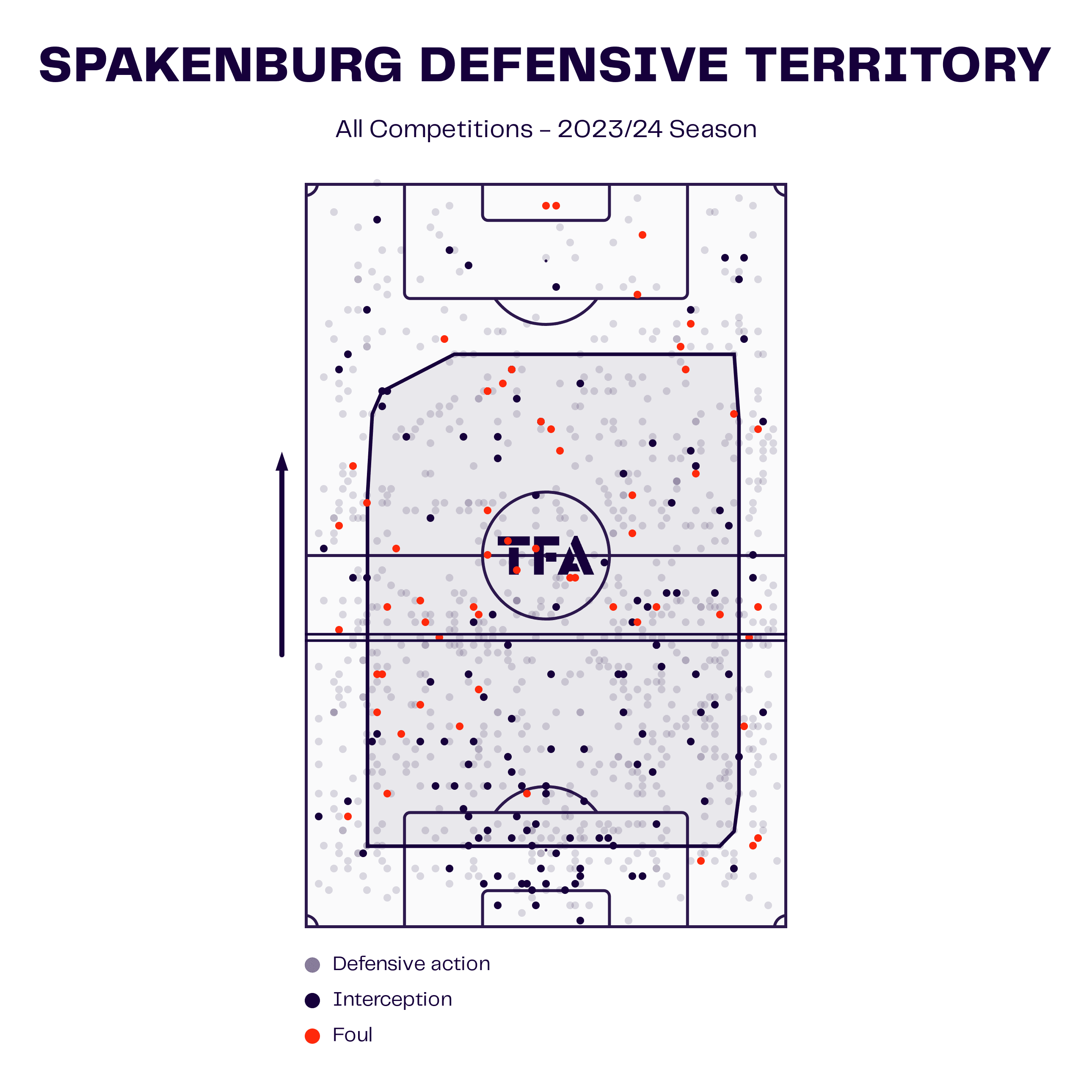
The data viz graphic shown above gives us an idea of the defensive territory of Spakenburg this season under Chris de Graaf. The Dutch tactician wants his side to hold a high line defensively, as is illustrated by the lines. Normally, when Spakenburg are in possession, their centre-backs will push high, almost to the halfway line, when the ball has progressed into the opponent’s final third.
When possession is turned over initially, or when the opposition are starting an attacking build from the goalkeeper, the defensive line will drop off slightly into their own half, but tend to stay high. While they have conceded the fewest goals in the Tweede Divisie, this has still caused them some issues, with the defence being caught too high and breached slightly easily, something that could be a cause for concern for de Graaf in the Eerste Divisie next season.
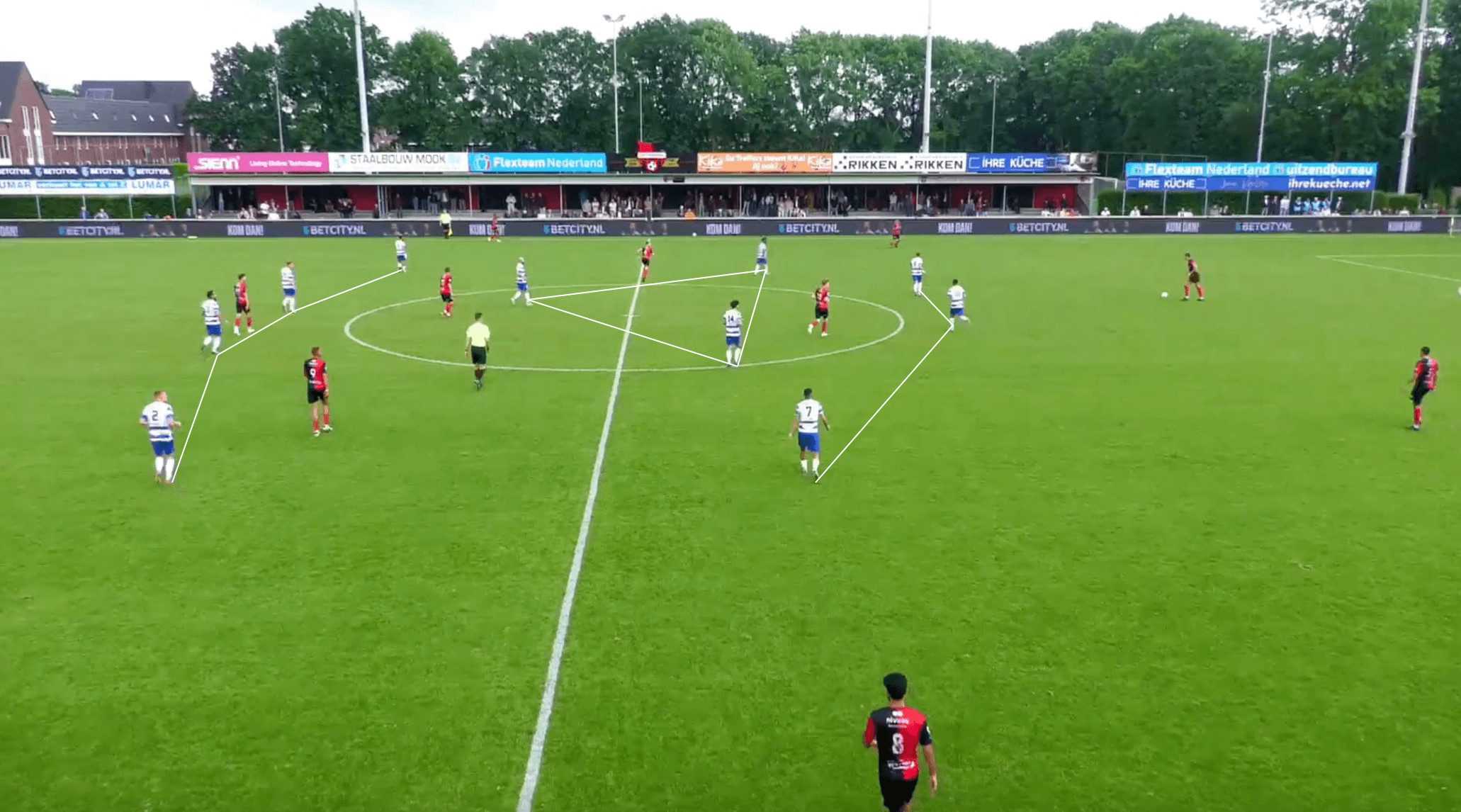
The image above shows the typical defensive shape for Spakenburg when the opposition is in possession with their backline. We can see how the shape looks very similar to a 4-3-3 out-of-possession, but this will alternate throughout various phases of the match. The defensive shape tends to be very narrow and compact, and we can see how they look to defend in a mid-block shape, with the defensive line positioned just a few yards outside the centre circle.
The goal from de Graaf’s side is to block the central channels and prevent central progression vertically, with this narrow shape allowing the opposition full-backs to get on the ball in wide areas but then slide quickly to prevent progressive passes down the line. So, as a result, this forces the opposition to either attempt to play over the top of the Spakenburg defence or horizontally and try to play around it by switching the point of attack. The ball is eventually recycled back to the opposition goalkeeper, with this being a cue for the Spakenburg defence to step up to the midfield line. The ensuing pressure from the Spakenburg defence forces the opposition to concede a throw-in deep in their half.
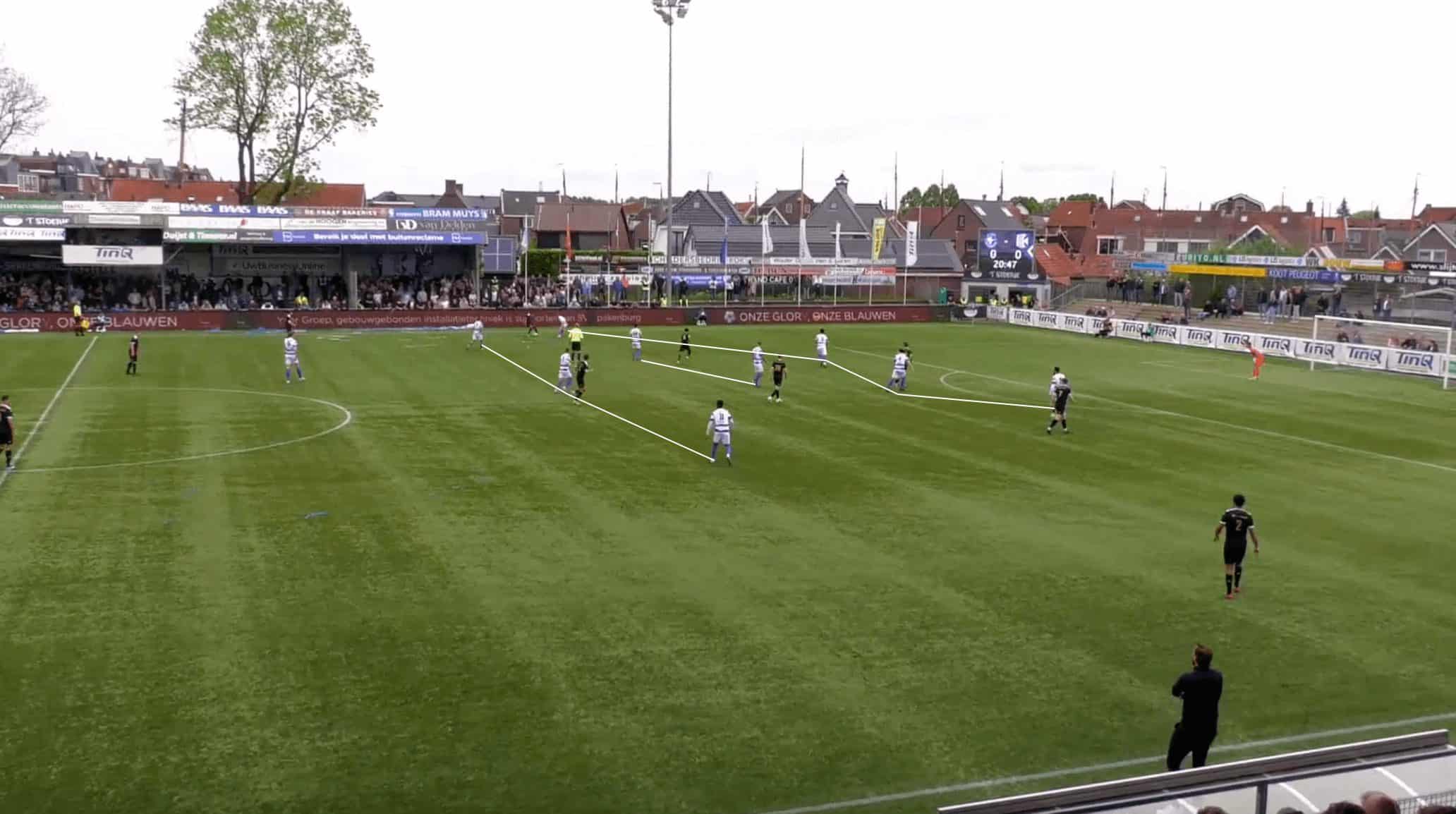
When Spakenburg are forced to defend a bit deeper, the shape slightly changes for de Graaf’s side. As we can see from this defensive phase of play above, the formation looks more like a 4-3-2-1, with the midfield five staying close to the back four. The basic principles are still the same, with de Graaf looking for his side to eliminate central progression and force the opposition into the wide areas, where they can then look to collapse on them and put pressure, looking to cause turnovers.
Talking about the Dutch side from a more encompassing defensive standpoint, Spakenburg had the best defence in the Tweede Divisie this season. Their philosophy is mainly based on winning possession in advanced areas of the pitch with a high defensive line. They also look to play in a more mid-block defensive shape, with their air-tight defence the best in the Dutch third tier.
Conclusion
As this tactical analysis has illustrated, Chris de Graaf has done a tremendous job at Spakenburg. First, it was the magical run to the KNVB Cup semi-finals last season, before now guiding the club to promotion to the Eerste Divisie with the highest point tally ever for the Dutch third tier. It will be interesting to see how the club fares in the second tier of Dutch football next season, with the dream of the Eredivisie in the future, and how de Graaf will be able to adjust his tactics to the step-up in quality.
