


Aston Villa entered the 2025/2026 campaign with a noticeably unstable rhythm, struggling to impose their identity during the opening weeks despite the continuity under Unai Emery.
As the season unfolded, the team experienced a clear tactical reawakening, evolving into one of the Premier League’s most balanced and tactically adaptable sides.
Their climb to third place, only three points behind Arsenal and a single point behind Manchester City, reflects more than improved results; it showcases a side that has rebuilt its structure and refined its mechanisms on and off the ball.
In this Aston Villa data analysis, we break down Aston Villa’s tactical solutions in detail, focusing on their evolving build-up patterns, long-range threat, and their broader capacity for in-game tactical adaptation.
We assess how these elements shaped their resurgence, supported by data, match sequences, and performance trends from the opening 15 fixtures of the 2025/2026 Premier League campaign.
Tactical Issues In Aston Villa’s Opening Weeks
At the outset of the 2025/2026 Premier League season, Aston Villa laboured to impose a coherent attacking identity, a stark contrast to their high-press, possession-driven structure under Unai Emery’s tactics in previous campaigns.
In the first four league games, the Villans failed to score at all, registering historically low shot quality and quantity, just 40 efforts and an expected goals (xG) tally of around 3.07 over that period, with average xG per shot among the lowest in the division.
This reflected deeper tactical problems; midfield positioning left the lone striker isolated, the No.10 played too deep, and Villa struggled to stretch opposition defences, resulting in minimal penetration and few clear shot opportunities.
Despite a high possession share and technical passing, they created too few high-value chances, leaving them rooted near the foot of the table early on and exposing a lack of adaptability in their build-up play.
Emery’s familiar 4-2-3-1 lacked its usual vertical intent, reducing Villa to speculative crosses and sideways passes rather than incisive progression.
Tactical Adaptation & Long-Range Threat
As the season developed, Villa demonstrated noticeable tactical adaptation and resilience.
Emery encouraged a more dynamic, less rigid approach, granting players greater freedom to exploit long-range shooting opportunities, a pragmatic solution against compact, low-block defences that routinely choked their traditional build-up routes.
By mid-season, Villa had scored more goals from outside the penalty area than any other Premier League side, with nine such strikes contributing disproportionately to their points tally despite an underlying xG that remained relatively low compared to the goals actually scored.
Premier League 2025/2026 Expected Goal Difference (xGD)
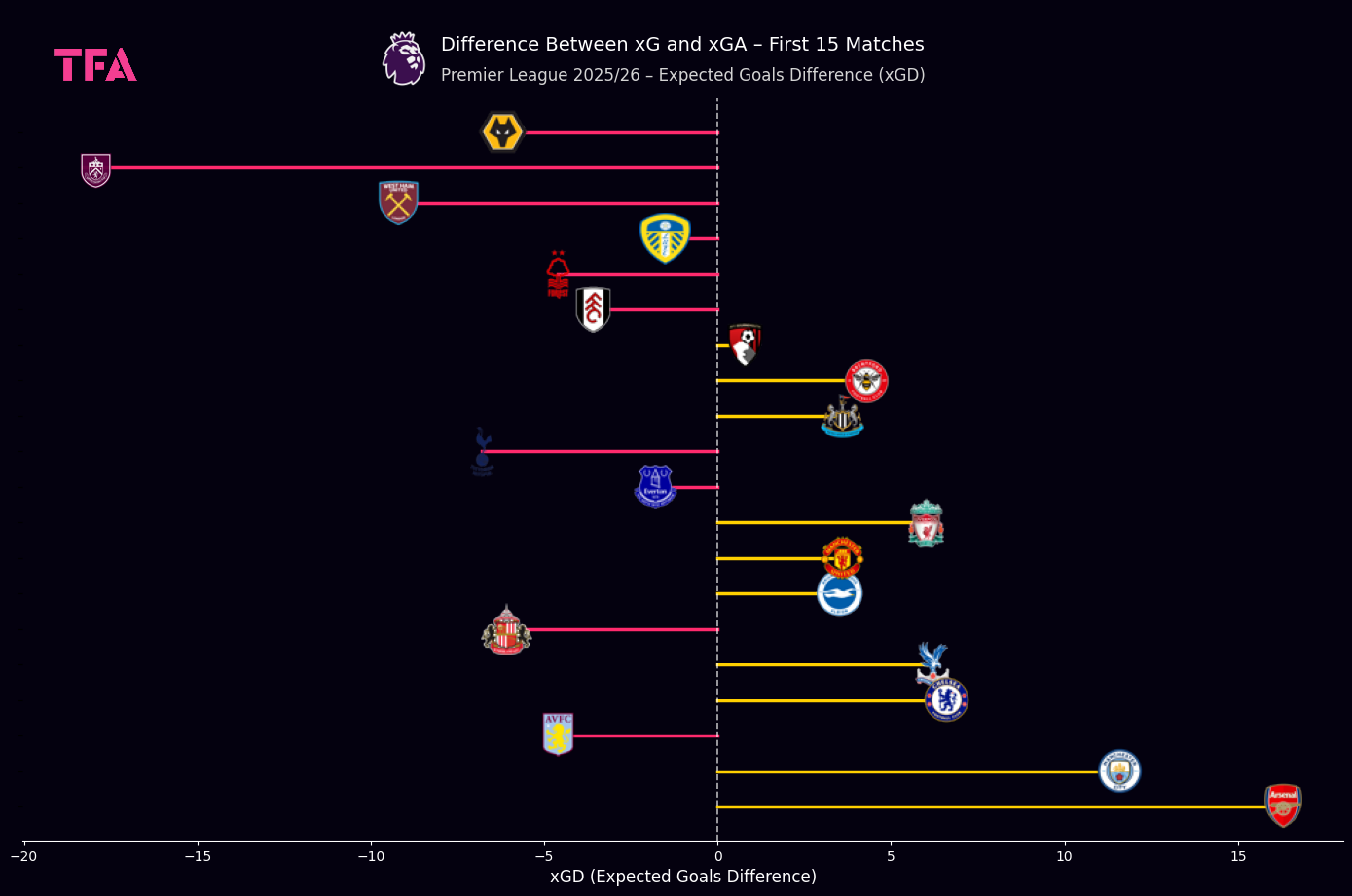
Their ability to convert efforts from distance routinely tipped tight, cagey fixtures in their favour, compensating for the lack of clear-cut chances inside the box.
Crucially, this long-range efficiency was no stroke of luck; it reflected Villa’s growing capacity to adjust their tactical emphasis within games, recognising that well-timed, rhythm-based strikes from distance could unpick even the most stubborn defensive blocks.
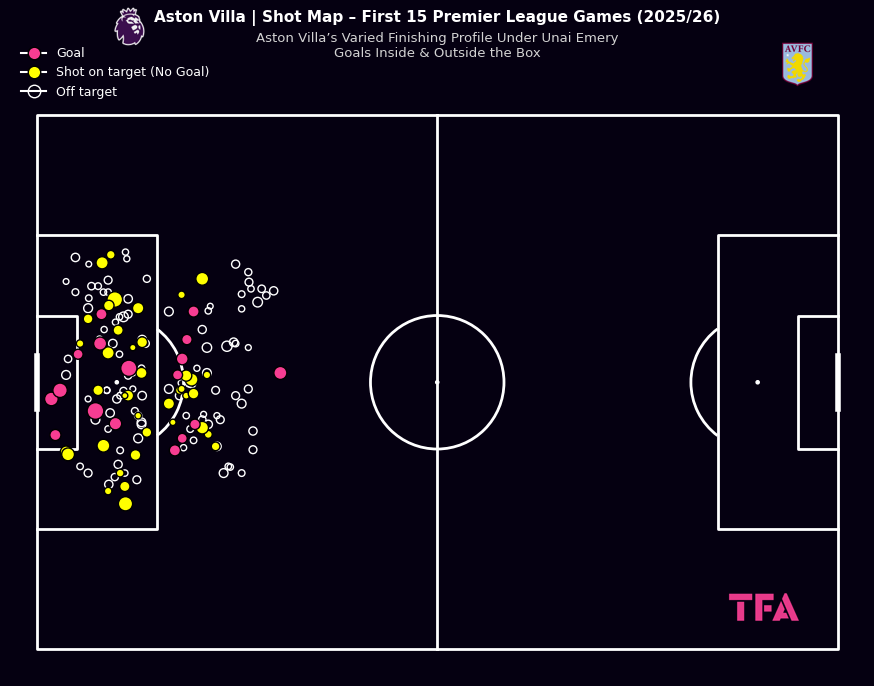
As shown by their shot map across the first 15 matches of the 2025/26 campaign, Villa attempted 174 shots in total, with an impressive 71 coming from outside the penalty area, nine of which resulted in goals.
Aston Villa Shot Map – First 15 Premier League Games 2025/2026
Crucially, Villa’s emphasis on long-range shooting did not emerge in isolation, but as a product of deliberate build-up patterns designed to break opposition lines.
The tactical evolution saw Villa utilise expansive horizontal phases coupled with quick interchanges across the width of the pitch to unsettle organised defences.
This wide-to-wide circulation created lateral displacements, stretching the defensive block and forging pockets of space at the edge of the area.
It wasn’t about random attempts from distance; rather, penetrating passing sequences would often precede these efforts, shifting the point of attack and breaking implicit defensive structures.
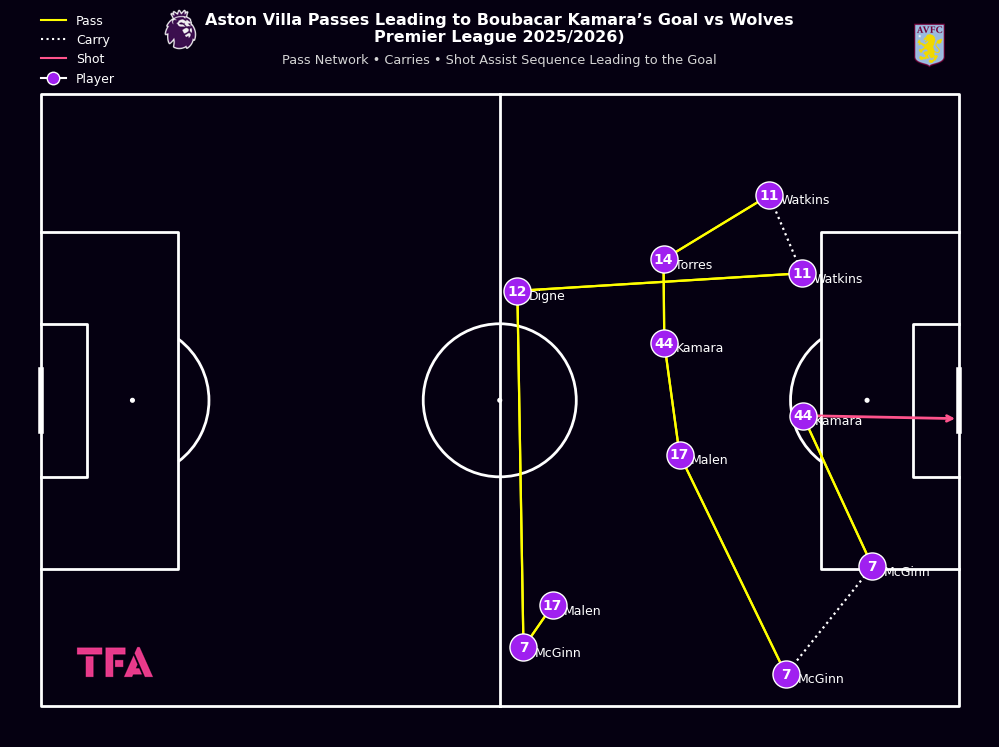
A clear example came against Wolverhampton Wanderers when an 11-pass build-up across the midfield and wide areas opened a seam on the edge of the box, allowing Boubacar Kamara to unleash a decisive long-range finish.
Aston Villa Passes Leading To Boubacar Kamara’s Goal Vs Wolves
In this sense, Villa’s success from distance was underpinned by strategic build-up work that created the conditions for productive shots, not by aimless shooting alone.
A further tactical solution emerged through Villa’s use of direct, vertical transitions, exploiting the sizable spaces left behind opposition defensive lines.
Instead of lengthy combinations, Emery encouraged immediate progression once possession was regained.
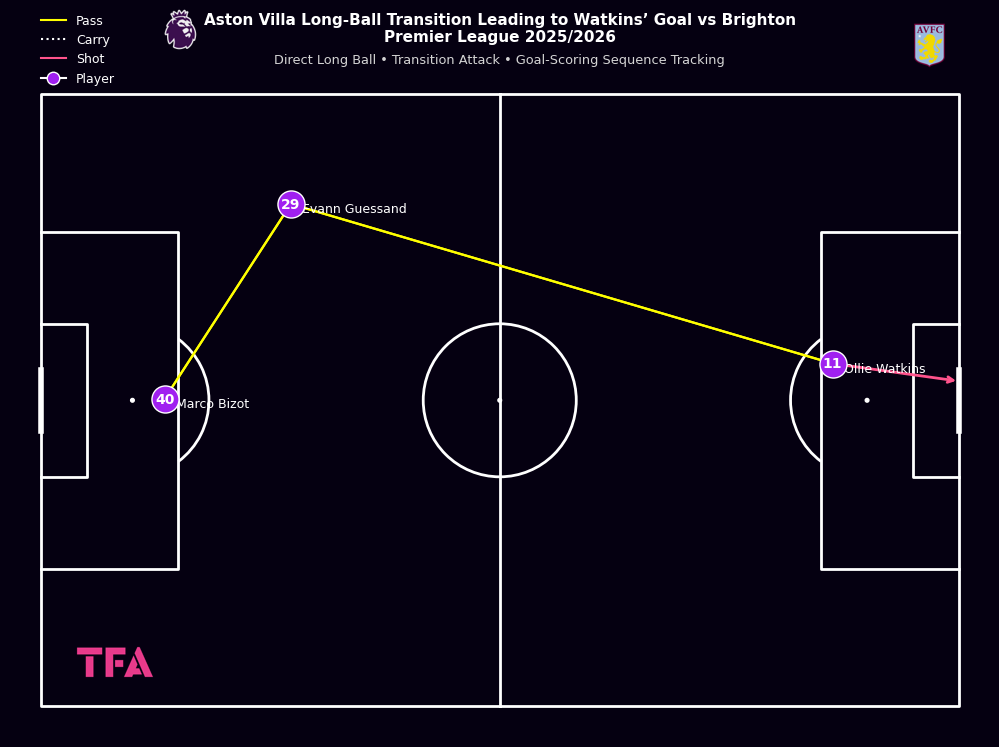
A clear illustration came in the goal scored by Ollie Watkins against Brighton, when Evann Guessand launched a precise long pass from the defensive third after receiving the ball directly from goalkeeper Marco Bizot, turning defence into a rapid scoring opportunity.
Aston Villa Long-Ball Transition Leading To Watkins’ Goal Vs Brighton
Tactical Divergences In Shot Quality & xG Output Between Aston Villa & Opponents
Aston Villa’s early-season resurgence was underpinned by a clear tactical divergence in shot quality and expected goals (xG) compared to their Premier League opponents, despite both sides recording near-identical shot volumes.
Across the opening 15 fixtures, Villa averaged 1.33 xG from 10.79 shots per match, marginally outperforming their opponents’ 1.19 xG from 10.57 attempts, a subtle, meaningful indication of superior chance construction.
Aston Villa xG vs Opponents – First 15 PL Games 2025/2026
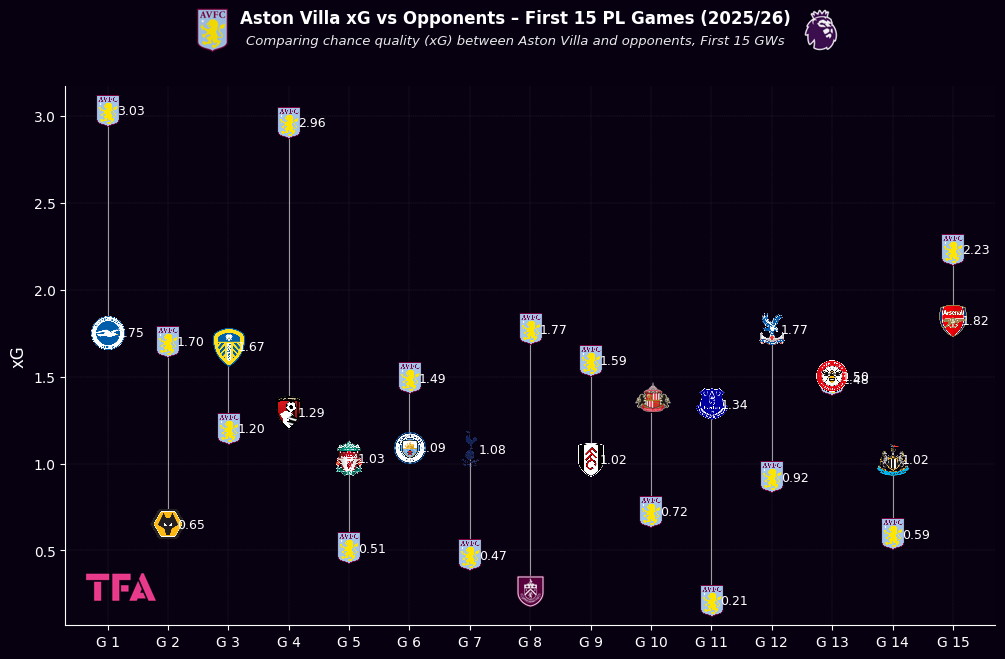
Several matches exemplified this trend: against Wolves, Villa generated 1.70 xG from 17 shots while restricting their opponents to just 0.65 xG from eight attempts; against Bournemouth, they produced 2.96 xG versus 1.29; and away at Brighton, Villa’s explosive 3.03 xG overshadowed Brighton’s 1.75 despite both sides taking 12 shots.
Even in tighter fixtures, such as Leeds (1.20 vs 1.67) and Manchester City (1.49 vs 1.09), Villa repeatedly crafted higher-value openings, reflecting Emery’s improved structural mechanisms and more deliberate final-third occupation.
How Villa Outperformed Arsenal In Shot Quality & xG To End The Gunners’ Unbeaten Run
Aston Villa’s 2–1 victory over Arsenal not only halted the league leaders’ impressive unbeaten run but also reinforced the tactical maturity that has defined their mid-season transformation.
Aston Villa Vs Arsenal Shot Map – Premier League 2025/2026
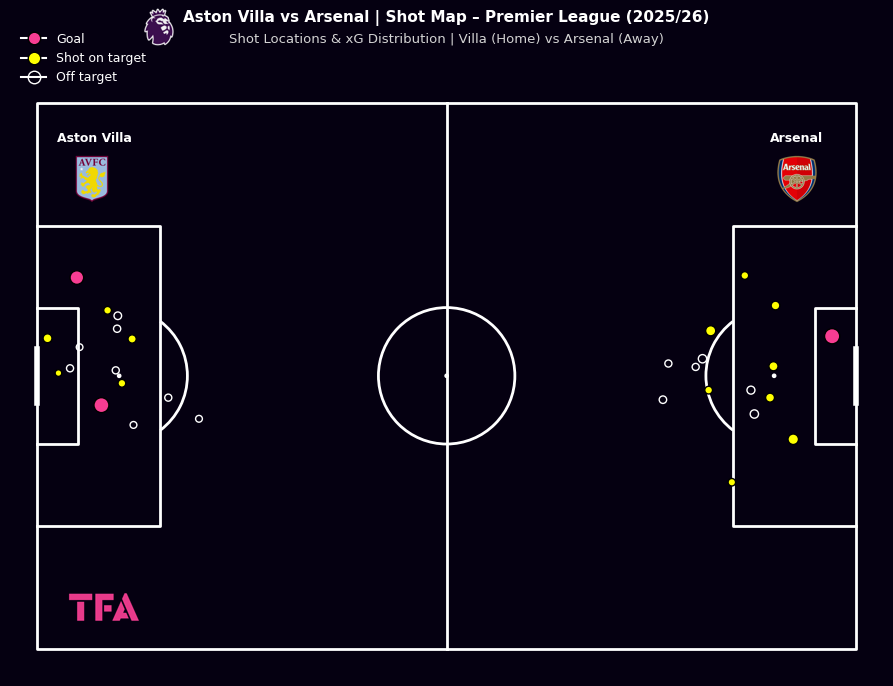
Despite Arsenal enjoying a slight possession advantage, Villa produced the superior attacking profile, registering 2.27 xG compared to Arsenal’s 1.82.
The shot map reflects a clearer pattern of chance quality: Villa generated 15 shots, six on target, including multiple high-value opportunities inside the box, while Arsenal’s 15 attempts yielded nine on target, but from generally poorer shooting positions.
Villa’s structural discipline allowed them to exploit transitional spaces, culminating in more dangerous central shots rather than speculative efforts.
The balance between controlled build-up and direct vertical breaks proved decisive, particularly in the sequences leading to both goals.
By outperforming Arsenal in xG and shot quality, Villa demonstrated a performance rooted not in fortune but in an increasingly refined, adaptable tactical model capable of dismantling elite defensive units.
Aston Villa’s Multi-Dimensional Passing Variability
Throughout the first 15 fixtures of the 2025/26 Premier League campaign, Aston Villa displayed a remarkable diversity in passing patterns, reflecting Unai Emery’s emphasis on structural flexibility and controlled ball progression.
Aston Villa Passing Profile – 2025/2026 Under Unai Emery
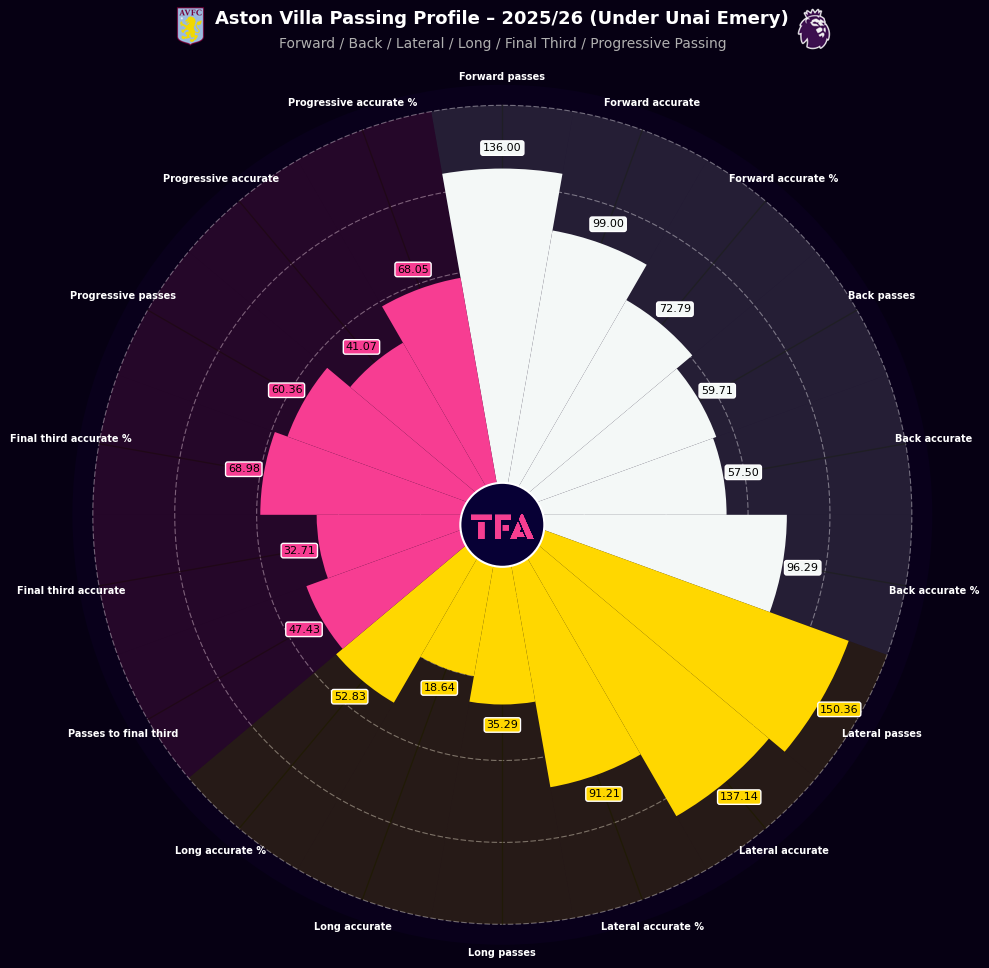
Across these matches, Villa averaged 415 passes per game with an accuracy of 84.42%, outperforming opponents’ 381.29 passes at 84.10% accuracy.
Notably, forward passes were executed with 72.79% accuracy, complemented by 59.71 accurate passes into the final third per match, illustrating Villa’s ability to penetrate opposition lines systematically.
Lateral circulation, averaging 136 passes per game, facilitated width exploitation, while 57.50 progressive passes per match drove vertical momentum, balancing horizontal and forward penetration.
Long passes also featured prominently, with 35.29 accurate attempts per match, underpinning rapid transitions and vertical exploitation, exemplified by Watkins’ and Kamara’s decisive goals.
This multi-layered passing strategy, blending controlled build-up, progressive passing, and long-ball directness, enabled Villa to generate high-quality chances consistently, contributing to their early-season resurgence and tactical maturity.
Aston Villa’s Situational Pressing Dynamics
Across the opening 15 games of the 2025/26 Premier League season, Aston Villa exhibited a variable, generally disciplined pressing intensity, as reflected by their Passes Per Defensive Action (PPDA) metrics.
Comparing Pressing Intensity (PPDA) Between Aston Villa & Opponents – First 15 GWs
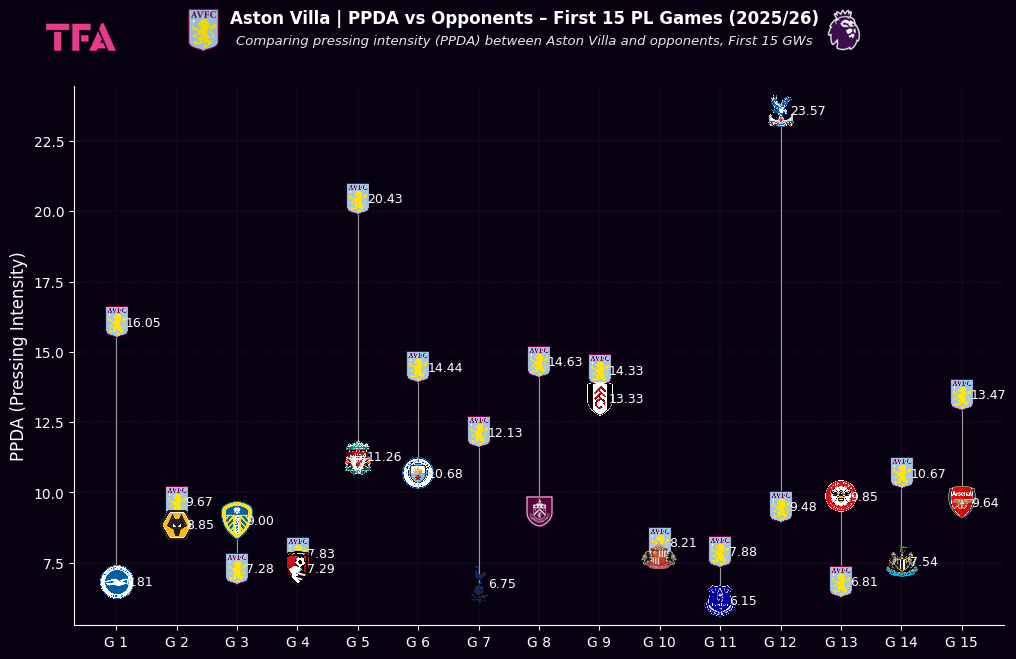
Villa averaged a PPDA of 9.88, slightly lower than opponents’ 10.68, indicating a moderately higher pressing intensity and a proactive approach to regaining possession.
Matches against high-possession teams such as Liverpool and Manchester City highlighted Villa’s tactical responsiveness, where PPDA rose to 20.43 and 14.44, respectively, reflecting a strategic retreat to absorb pressure.
Villa applied more aggressive pressing against mid- and lower-table sides, reducing PPDA to as low as 4.99 against Wolves and 5.78 against Sunderland, forcing turnovers in advanced positions.
These fluctuations were coupled with controlled match tempo and a balanced long-pass usage (averaging 8–12%), enabling Villa to transition rapidly upon regaining the ball.
This nuanced pressing model underscores Emery’s capacity to tailor defensive intensity situationally, combining structure with tactical flexibility to disrupt opponents’ rhythm while conserving energy for offensive transitions.
Conclusion
Aston Villa’s 2025/2026 campaign under Unai Emery demonstrates a remarkable tactical evolution, blending structural discipline with situational flexibility.
From early-season struggles marked by low shot quality and limited penetration, Villa transformed into a side capable of controlling possession, exploiting wide areas, and generating high-value chances through both progressive passing and long-range efforts.
The combination of multi-dimensional passing, targeted long balls, and adaptive pressing facilitated rapid transitions and effective exploitation of defensive spaces.
Villa’s resurgence was not a product of luck, but of meticulous tactical planning, in-game adaptability, and coherent structural development, enabling them to compete at the top of the Premier League and establish themselves as one of the division’s most tactically sophisticated sides.

