
Japan are Asia’s most successful team as far as the Women’s World Cup goes — they have qualified for every edition of the tournament since 1991. This year, they will look to better their previous effort of reaching the round of 16. They are in some fine form too, having qualified for the upcoming event as a result of them reaching the semi-finals of the 2022 AFC Women’s Asian Cup; they were knocked out in that round by the eventual winners: China. They face some top competition in this year’s competition, but Japan’s well-rounded & talented squad could be a difficult team to stop if they reach top gear.
This scout report will provide a tactical analysis of what to expect from Futoshi Ikeda’s side at the World Cup. We will analyse the tactics they’ve used on the road to the World Cup and also produce an analysis of the squad — who we should expect to make an impact, both individually and collectively.
Predicted starting XI

Over the course of recent friendlies and their appearances in the SheBelieves Cup, Japan have been pretty consistent in deploying a 5-4-1. While they have dabbled in other shapes, it is more likely that we see them deploy a 5-4-1 shape where the role of the wing-backs depends on the approach i.e. if they want to be more defensive, they’ll play more like traditional full-backs with less attacking responsibility. However, they have switched things up over the last year or so, testing out other formations such as 3-4-3, 3-4-2-1, and 4-3-3 amongst other shapes. In fact, the switch to 5-4-1 is a fairly recent one as they preferred four at the back systems at last year’s Asia Cup.
If they do opt for the 5-4-1, several players are practically nailed on to start (assuming they’re available). Goalkeeper Ayaka Yamashita looks to be a sure starter between the sticks, while Saki Kumagai has also been a regular pillar in the Japanese backline. They have some good depth when it comes to wide areas, which will be discussed in more depth later in this report, and the same can be said for the midfield unit too — but expect at least one of Fuka Nagano or WSL star Yui Hasegawa to start regularly, if not both of them. Again, they have options in attack but Riko Ueki seems to be the player Ikeda will opt for.

In terms of age and experience, Japan have a good balance — on paper, at least. The scale tips in the favour of youth, with just one player over the age of 30 at the time of writing (Saki Kumagai). But that isn’t to say that the squad lacks experienced players. Individuals like Mina Tanaka and Hikaru Naomoto, both aged 29, will bring good leadership qualities to the group.
There are also a cluster of players who are in their prime years as footballers: the likes of Hasegawa, Miyabi Moriya, and Risa Shimizu, for example, all bring good levels of experience while still having a youthful element to their style of play.
Interestingly, three players in the squad are 19 years old at the time of writing; these are Aoba Fujino, Rion Ishikawa, and Maika Hamano will all be hoping to use this competition as a platform to show the footballing world what the future of Japanese football could look like.
Attacking phase

In terms of match results, Japan have had a mixed experience, but certain aspects of their attacking data suggest they are capable of harming defences at the World Cup. They are efficient with their passing accuracy which aids their fluid build-up play. This has proven to be effective in terms of reaching the penalty area, as evidenced by their high percentile rank for touches in the box per match. We should expect to see a lot of activity from Japan in the final third, with plenty of efforts on goal.
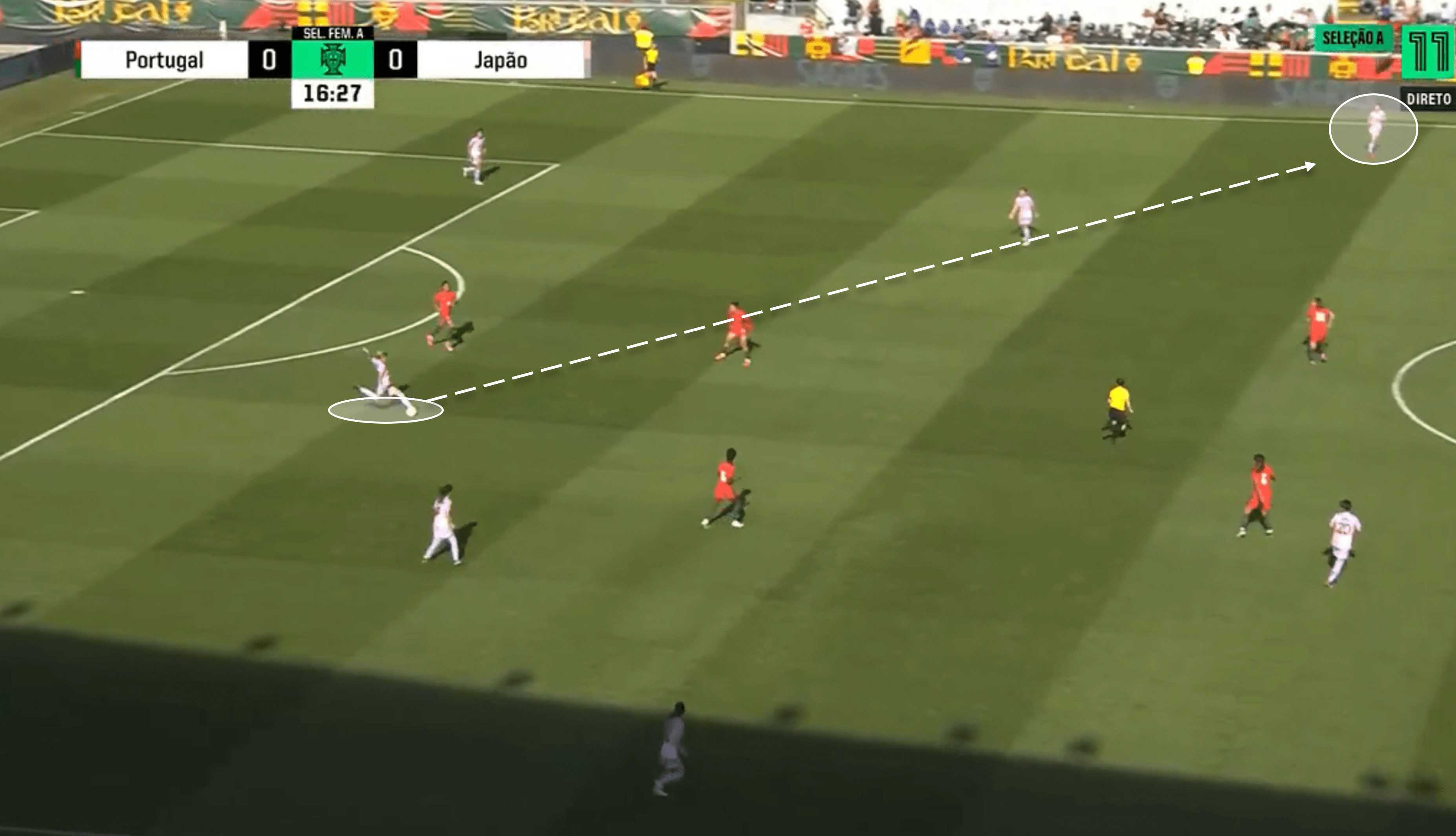
Japan look to play with a clear attacking intent that puts a focus on player movement within units and individual technique rather than focusing on physical player traits, such as the ones you may expect from a direct team. That isn’t to say they play with a tiki-taka style of play, as they are partial to a direct pass if it aids their build-up play. The example above shows us this, while also highlighting how they look to play into wide areas quickly when possible.
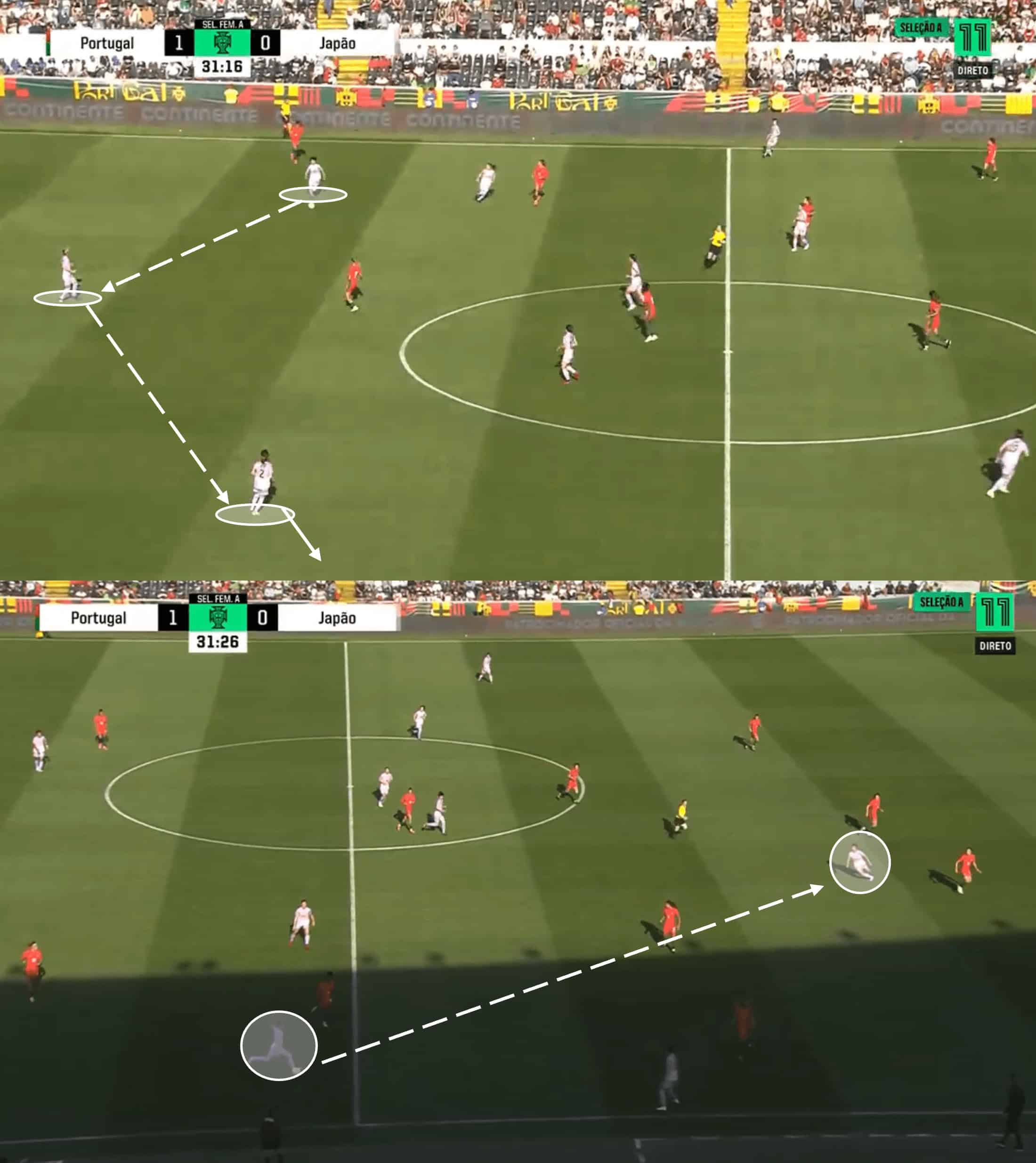
This next example above is a clearer display of how Japan like to break down the opposition. Fluidity in attack is important as we mentioned earlier, and for that to be possible, good team cohesion and off-the-ball movement need to be present. This also requires good technical ability with very little room for error as players are tasked with first touches, dribbling, and passing more often and in more areas.
The example above is a good demonstration of this: the move begins by using the free players at the back to work the ball into an area that gives them more chance of making good progress up the pitch. Japan’s attacking approach can sometimes be tricky to defend against and teams end up leaving space in dangerous areas, which Japan are good at exploiting. From there, we see how they use a variety of passes rather than being married to just short passes or just longer passes.
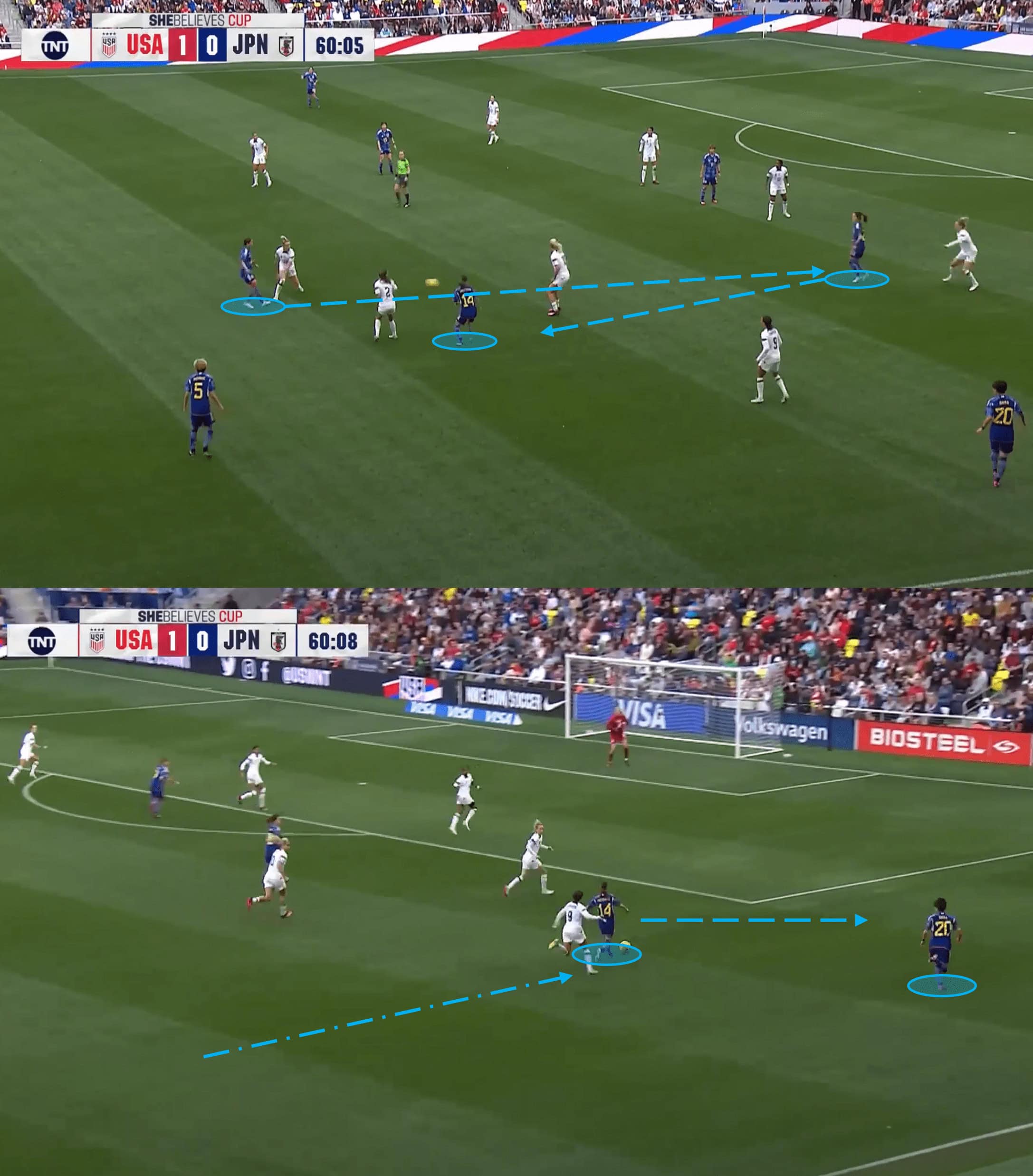
Defending against a team that works on strong attacking movement can be extremely difficult, and Japan’s varied attacks add to that difficulty. Their players are very talented when it comes to recognising opportunities for passing combinations or key passes; both of those were utilised in the move above.
Having multiple players committed to higher places to support an attack allows Japan to execute these passing combinations in dangerous areas. Of course, this can leave Japan vulnerable to being hit on the break, but their good defensive organisation helps them out, as we will cover later. In the example above, Japan get through that cluster of USA players in a central space with a passing combination before breaking into space on the right flank, where the player on the ball is met by good overlapping support.
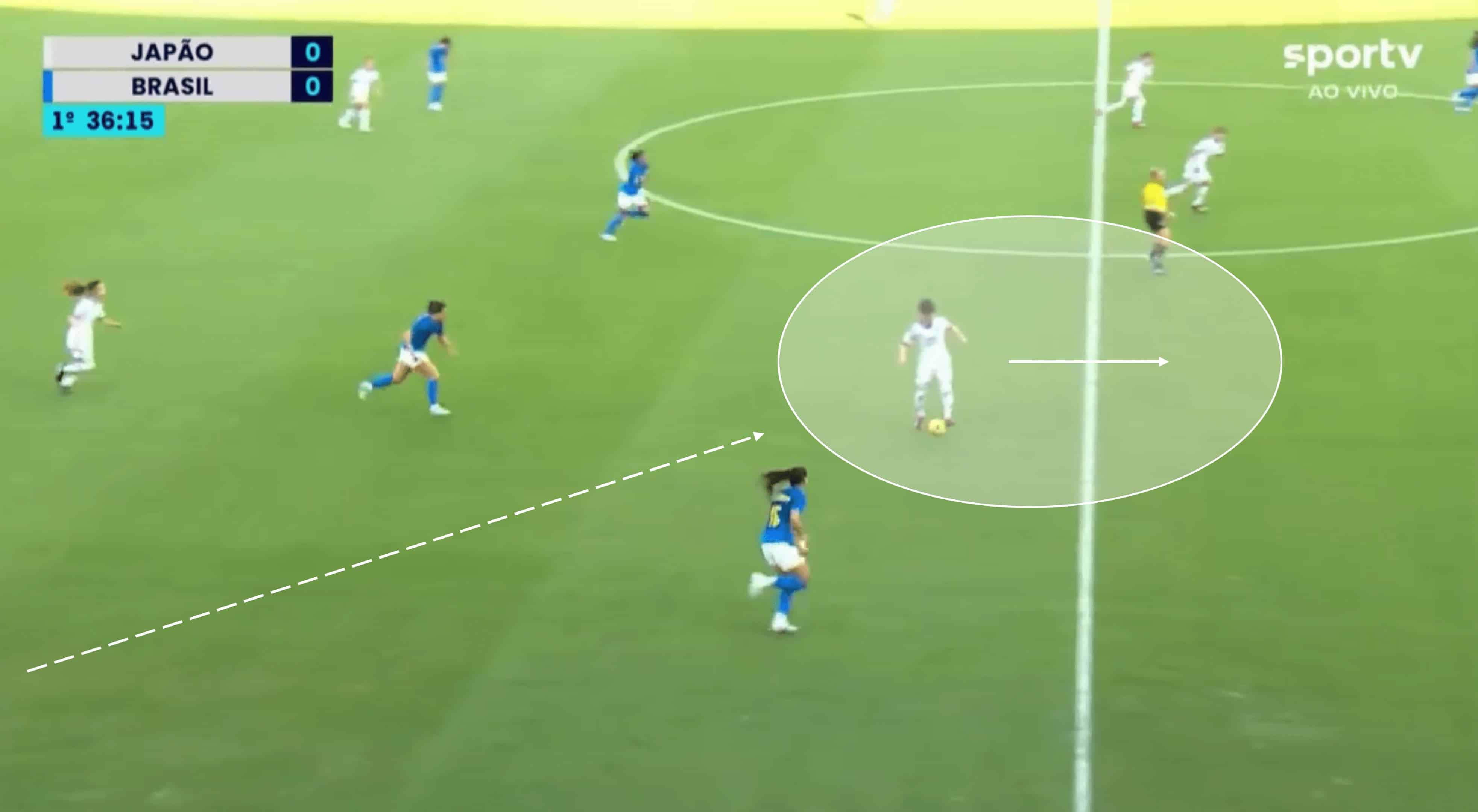
It is really important to emphasise just how important off-the-ball movement in midfield areas is to Japan’s build-up play. It allows them to build attacks quickly, with some regular passages of play sometimes looking like a counterattack! Finding and utilising these spaces in areas that would usually be heavily guarded can open up a range of attacking avenues, and in the image above, Japan wasted no time in taking advantage of the situation, with the player receiving the ball opting to drive forward into the opposition half before picking out a supporting teammate.
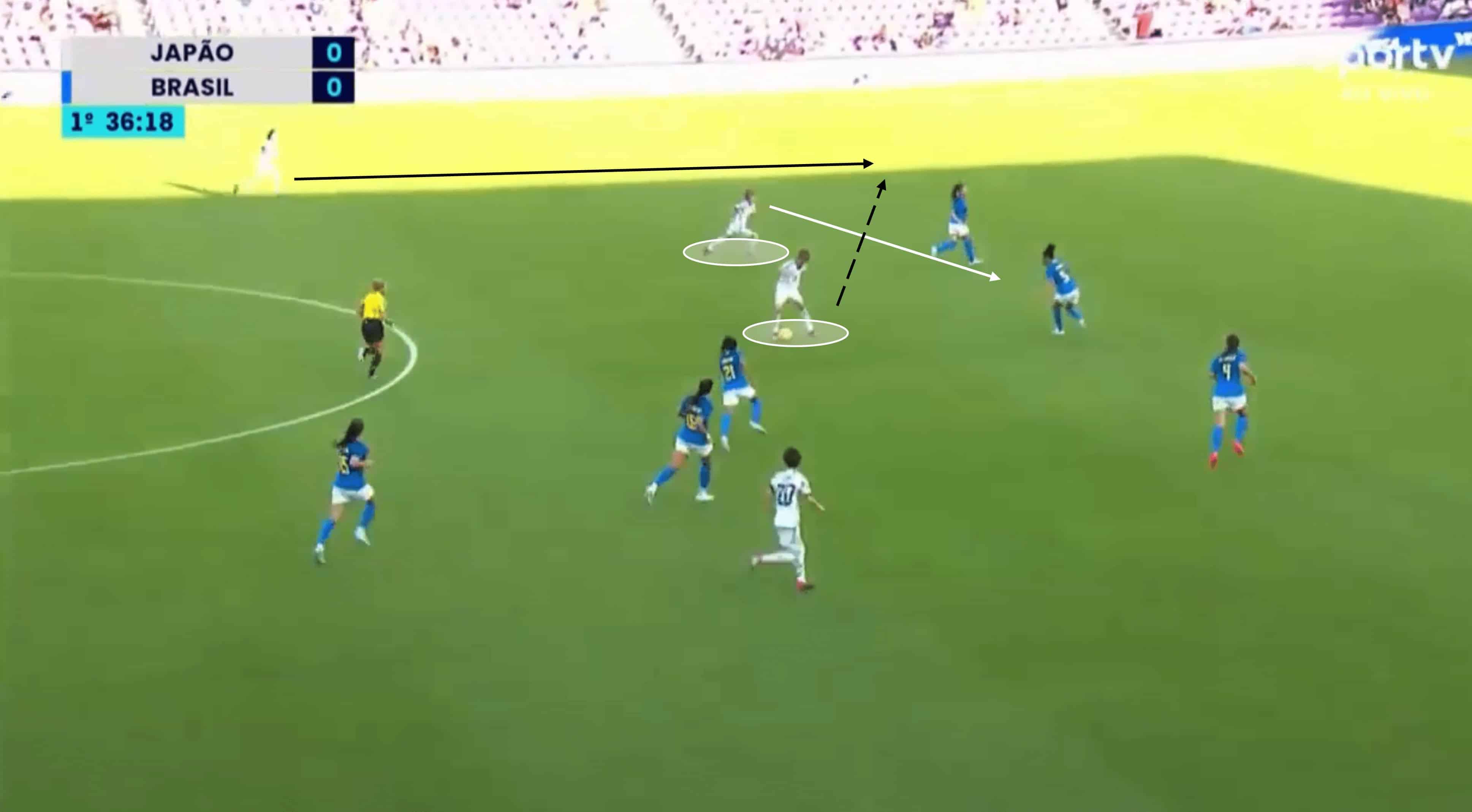
And if you needed more evidence of Japan’s talents in the area of off-the-ball movement, well look no further. The player on the ball has two passing options in her line of sight but recognises that the player initially in a deeper position can be more effective in the attack, using the run of the close supporting player as a decoy, taking the defender with her. This opens up yet more space for the arriving attacker, allowing her to create a dangerous chance on goal.
Defensive phase

As the data tells us, Japan are efficient when it comes to pressing, and as you’ll see later in the analysis, they have a knack for knowing when and where to execute a press to good effect. Their high percentile rank for final-third recoveries also shows that they are effective when they choose to press higher. However, it is also important to consider their high percentile rank for PPDA, which indicates that they aren’t a fully-fledged pressing team. Instead, they often like to allow the opposition possession initially, while using their unit shape & positioning to force the opponent into a particular area. When they feel the time is right, they will trigger the press and look to steal the ball back. So, in a nutshell, they post good numbers in various recovery metrics, as mentioned, which shows a strong consistency, while the PPDA percentile shows they don’t constantly press.
They will look to avoid physical battles, as evidenced by their low percentile ranking for defensive duels won %. Their defensive tactics rely more on the organisation and teamwork side of things rather than physicality.

We mentioned before that Japan are an efficient defensive team, utilising good organisation and positioning to limit the opposition’s passing options. The image above shows this, and it is also worth noting that they adjusted into a narrower shape in the initial phases of opposition possession. We will get to their pressing triggers shortly, but the timing and selection of the press from the midfield unit was present in the shot above.
The player that would be the RCM amongst the highlighted players could have been sucked into pressing the closeby USA player when she receives the pass, but that would’ve opened up space for the opponents to attack. To combat this, the deeper midfielder (LCM), rushes in to press the player instead. This gave Japan’s midfield unit the stability and defensive structure needed to not only slow down the USA but limit their options even moreso.
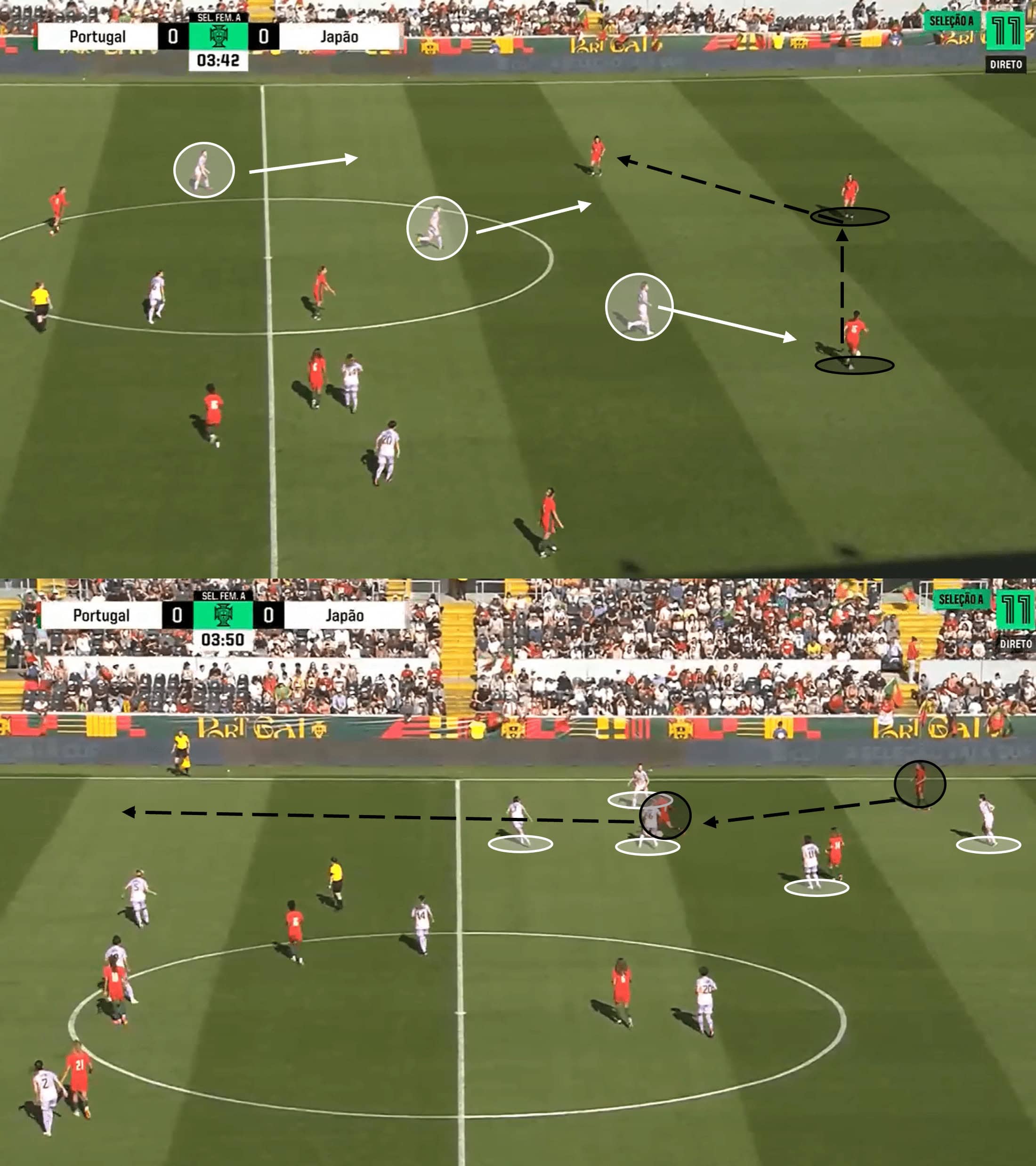
This example shows us a breakdown of how Japan use the aforementioned tactic of forcing the opposition possession in a direction to later execute the press. Notice the shape and positioning of the highlighted Japan players in the first of two images, the further away from the ball the player is, the deeper they are, thus encouraging the opponent to follow that direction at it appears to be safer.
But as we see, when the ball reaches that so-called safer area, Japan squeeze the space and flood the area to create a numerical advantage, with a selection of players applying pressure to the ball. This particular example resulted in the opponent realising the danger of the situation and cleared the ball deep into Japan territory, handing the Japanese possession.
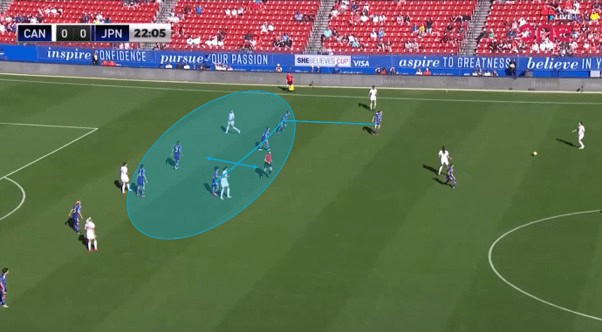
The element of defensive organisation is present again in the image above but in a different form. Since the USA have possession on the right side of the pitch and are looking to attack there, Japan flood the area to give themselves the numerical advantage, thus more chance of winning the ball back. But the players aren’t just scattered randomly. Take the midfield unit — they are tight; compact together with very little distance between them and the defensive unit, making them even more difficult to break down. You may not always see Japan sit deep like this, but the emphasis here, as with the previous example, goes on their ability to get set up with the sole intention of stopping the opposition attack.
Transition phases
When talking about defensive transitions, there isn’t really one set method for Japan. It seems to depend on factors such as the opponent and their actions in the transition. For example, if the opponent regains possession and looks to slow proceedings down rather than burst forward, Japan often seem happy to regroup and set up a solid defensive shape. Whereas they will combat a high-intensity counterattack with a counterpressing method, with a focus on 1v1 marking to stop/limit close passes, players will mark whoever is close to them with the aim of forcing the opponent into a long ball.
With Japan utilising high-intensity play in several areas of their game, it may not surprise you to learn that they act with similar gusto in attacking transitions. While there will be times when they judge it best to hold onto the ball and look to build some possession slowly, they show no fear or hesitation in counterattacking quickly, using their excellent off-the-ball movement and pass selection to get into the final third. This system, along with the intensity of their regular phase play, can be a physically demanding one, which is why Japan pick their moments to hit teams on the break.

We see that movement and urgency to progress in the example above. After a turnover in the Japanese half of the pitch, they break forward quickly via good individual ability. Despite the ball being on the right flank, the situation alerts Japan players even on the right flank to ready themselves to be involved in this quick attacking transition. They will use the opponent’s momentary disorganisation to exploit space and create numerical overloads where possible, with this particular example seeing Japan seamlessly shift possession from the right flank near the halfway line to the left flank near the penalty area.
Their formation plays quite nicely in some moments of attacking transition. Bear in mind that they would have defensively set up a few seconds prior — their positioning will be a lot more effective and beneficial than that of the opposition who are rushing to regroup. Thanks to this, along with Japan’s use of wing-backs, they have the element of added width, which they introduce with the long run from the LWB, as seen in the example above.
Defenders
Japan are fairly stacked in defensive options, taking nine players in total. Of course, some of those are wide players who have the ability to play as full/wing-backs or shift into a wide midfield position should Japan require — which could also come in handy if they opt for a change in formation. This goes both ways, as midfielder Hina Sugita has been known to slot in as a left wing-back for Japan on the odd occasion. Kiko Seike also provides wide support in defence having played in the right wing-back role for her national team in recent friendlies. Seike also has experience playing as a central defender for Japan in a back four.
While Moeka Minami, Saki Kumagai, and Shiori Miyake have been sighted as the likely starting trio in the heart of Japan’s defence, there is supporting depth from the likes of Hana Takahashi. Additional defensive support comes from Miyabi Moriya and Rion Ishikawa.
Midfielders
Japan’s official squad selection includes seven midfielders, including the four starting on the pitch, giving them three players waiting in the wings. As mentioned, Sugita can provide defensive cover in wide areas as well as operate in wide midfield roles, while Honoka Hayashi will want to push for a starting role, either in the middle of midfield or in wide areas.
There is good versatility in the squad, as touched upon with several players already. Likely starter Hinata Miyazawa is slated to play on the left flank in a midfield four, but she has been known to play in a more central role, particularly if Japan shift to a 5-3-2.
Attackers
Japan have selected four strikers in total, meaning they have three covering forwards. Could this suggest that they plan to keep opponents on their toes in terms of switching formations? Possibly. Mina Tanaka, Remina Chiba, and Maika Hamano are the three women in the attacking unit alongside likely starter Ueki. 19-year-old Hamano has made appearances from the bench recently and will look to make more of an impact when given the chance during the World Cup. Meanwhile, Tanaka has had some recent starts under her belt and scored in a recent friendly against Portugal.
Key player
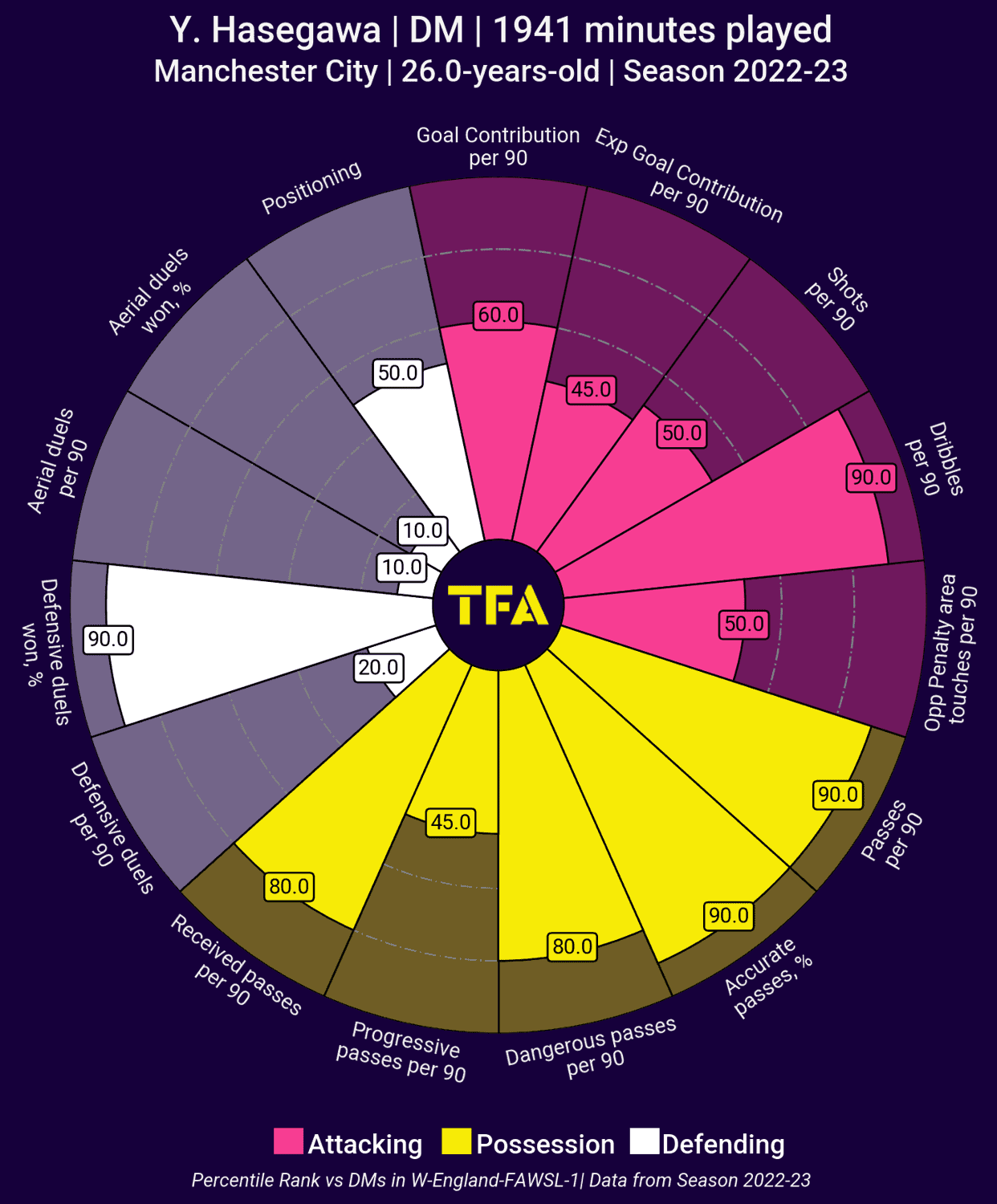
There are a few players in the Japan squad who have the potential to fire their team to glory and create problems for the opposition, but Manchester City midfielder Yui Hasegawa could be the real key to success. The data above is taken from her domestic football with City, where she has shown consistency and quality in several key areas.
While we highlighted a team weakness in defensive duels for Japan, individually speaking, Hasegawa has proven that she is more than capable of competing, as evidenced by her incredible percentile ranking in that area. Her biggest assets, though, lie in how she contributes to possession & attacks. High percentile ranks for dangerous passing & passing accuracy highlight consistency and reliability on the ball, while the data also suggests she contributes well with shots, dribbles, and overall goal contributions. Japan will certainly look for Hasegawa to bring her City form to the World Cup: she will be one of their most important players if they are to do well this year.
Tournament prediction
Japan are the only Asian team to ever win the World Cup in women’s football, lifting the trophy back in 2011; they also finished as runners-up in the 2015 competition. They will look to bring that sort of winning consistency to the table this time, as they look to better last time’s effort of reaching the round of 16. They will believe they are capable of at least reaching the final four this year, and they just might have the right ingredients to do so. Minimum objective? Anything less than qualifying for the quarter-finals will likely be deemed a huge failure for Japan.
