



With UEFA’s FIFA World Cup playoffs set to take place over the next week, Italy find themselves once again staring down the barrel of qualification uncertainty after a turbulent qualifying campaign that saw Gli Azzurri finish second in their group, three points behind Norway and relying on a difficult playoff route to keep their World Cup dreams alive.
Italy’s first hurdle is set to be Northern Ireland, with a potential tie against either Wales or Bosnia & Herzegovina awaiting the winners.
Under head coach Gennaro Gattuso, who took charge following the departure of Luciano Spalletti earlier in the campaign, the national side have emphasised attacking intent alongside rebuilding their tactical identity.
Italy’s attacking shapes, forward combinations and tactical approach up front have never been more crucial as they approach the playoffs.
In this Italy data analysis report, we’ll break down how Italy can unlock goals and secure progression, analysing frontline structure, player roles and tactical philosophies that could define their path back to the World Cup.
Gennaro Gattuso’s Tactical Framework & Italy’s Dual-Striker Focus
Since taking charge of the Italian national team, Gennaro Gattuso has experimented with several structural systems over the past year, and a clear tactical pattern has emerged.
Formation Usage By Italy Under Gattuso Over The Past Year
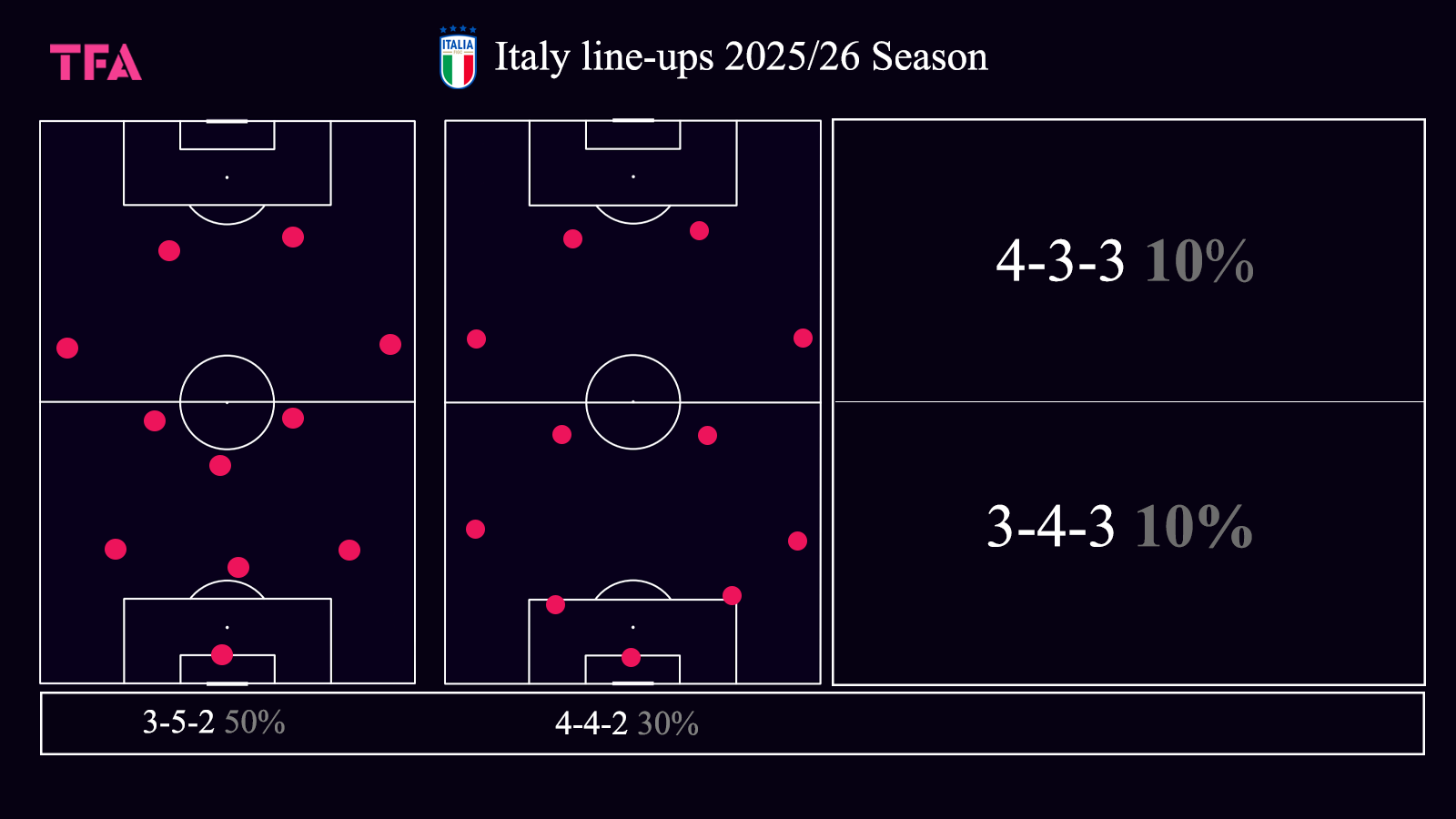
The 3-5-2 has been his most frequently used formation, accounting for roughly half of Italy’s matches, while a traditional 4-4-2 has served as the secondary structure in around 30% of games.
More occasional alternatives include the 4-3-3 and 3-4-3, each appearing sporadically as situational adjustments rather than long-term solutions.
Despite this variety, the defining element of Gattuso’s attacking blueprint has been the preference for a dual-striker partnership.
Italy have consistently relied on combinations involving Moise Kean and Francesco Pio Esposito as the primary pairing, with Mateo Retegui frequently rotating into the forward line depending on tactical context or availability.
This approach reflects Gattuso’s emphasis on verticality, physical presence, and penalty-box occupation rather than relying solely on wide attackers.
The double-striker system allows one forward to attack depth while the other operates as a reference point between centre-backs, creating central overloads and facilitating quick transitions.
For example, in Italy’s World Cup qualifier against Norway, a match that ultimately ended in a 4-1 defeat, Italy again deployed a two-man frontline, with Esposito partnering Retegui from the start.
Although the result exposed defensive fragilities, the attacking structure illustrated Gattuso’s tactical commitment to central striker partnerships as the foundation of Italy’s offensive design heading into the decisive March playoffs.
Mattia Zaccagni As Italy’s Left-Half-Space Attacker
Within Gennaro Gattuso’s dual-striker framework, Mattia Zaccagni offers a tactical profile that could naturally function as the third attacking piece around Italy’s central forwards.
Rather than operating as a traditional touchline winger, Zaccagni’s tendencies favour diagonal movements from the left flank into the inside channel, effectively attacking the left half-space and arriving in advanced central zones.
In a 3-5-2 or 4-4-2 structure, Gattuso could deploy him as a narrow left-sided attacking midfielder or roaming support player behind the strike partnership of Moise Kean, Francesco Pio Esposito, or Mateo Retegui.
This positioning would allow Italy to preserve their two-striker presence while still adding a dynamic runner capable of exploiting interior spaces.
Zaccagni’s off-ball timing is particularly valuable against compact defensive blocks such as those expected from Northern Ireland or Wales, where vertical entries into the half-space can destabilise the defensive line.
Equally important is his ability to progress play into dangerous zones.
Zaccagni averages 1.32 crosses per 90 and 1.08 shot assists per 90 and has produced 40 crosses with 19 accurate deliveries.
In addition, he contributes around 2.31 progressive runs per 90, illustrating his capacity to carry the ball into the final third.
Mattia Zaccagni Penalty Area Deliveries 2025/2026 Season
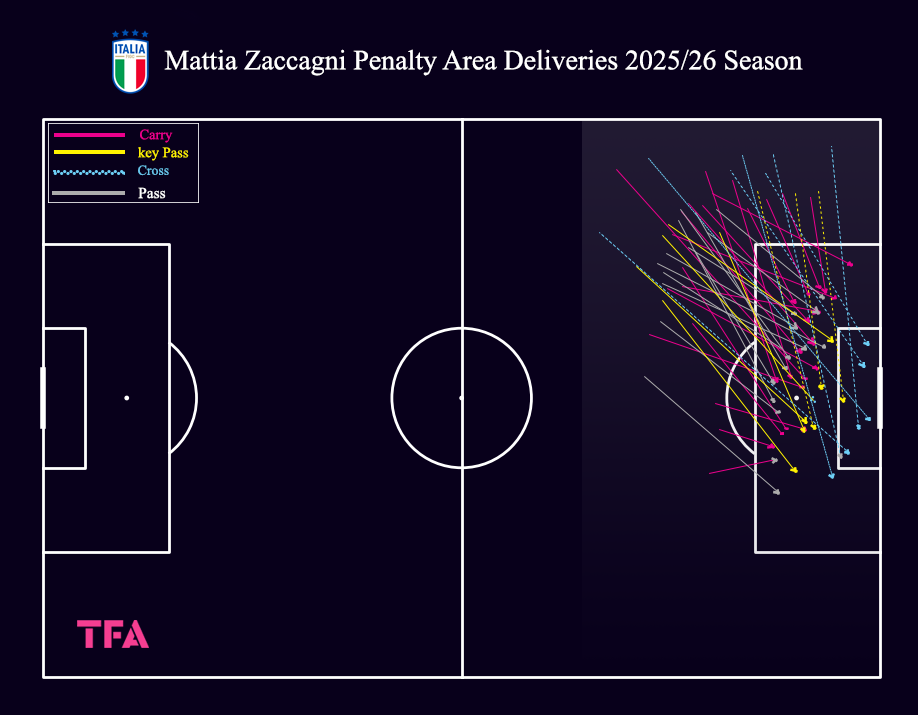
By drifting inside from the left, he can combine with the nearest striker while simultaneously drawing the opposition full-back inward, opening the corridor for overlapping wing-back runs.
His dribbling ability and progressive carries further support this role, enabling him to advance possession through the inside channel before linking play in the final third.
Zaccagni essentially functions as a hybrid between winger and secondary forward, allowing Italy to attack with a fluid front three despite formally maintaining a two-striker system.
Mattia Zaccagni xG & Shot Map 2025/2026
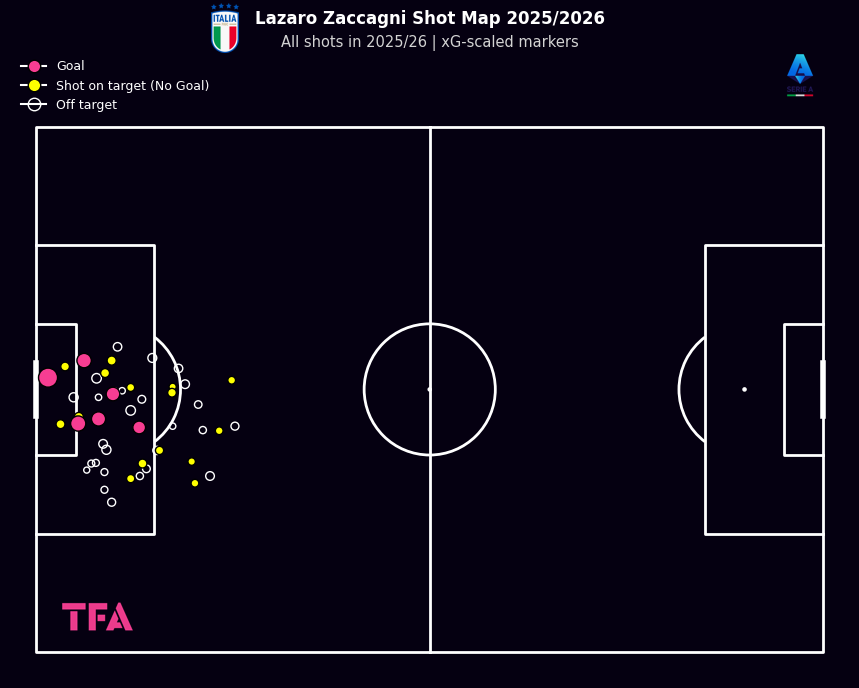
From a finishing perspective, Zaccagni’s scoring profile strongly supports this interior attacking role.
Over the last year, he recorded 54 shots with an xG of 8.93 and six goals, with 39 of those attempts coming from inside the penalty area and generating 7.74 xG.
Crucially, all six goals originated from inside the box, highlighting his tendency to arrive centrally as a penalty-area finisher rather than remaining wide.
Moise Kean As The Central Box Presence In Italy’s Frontline
The shot and heat map profile of Moise Kean illustrates a striker whose activity is heavily concentrated around the penalty area.
Rather than drifting consistently into wide zones, Kean’s movement pattern shows a clear preference for operating across the width of the box and the central channels just outside it.
His heat map typically highlights dense involvement between the penalty spot and the edge of the six-yard box, reflecting a classic penalty-area forward profile.
Moise Kean Heat Map 2025/2026 Season
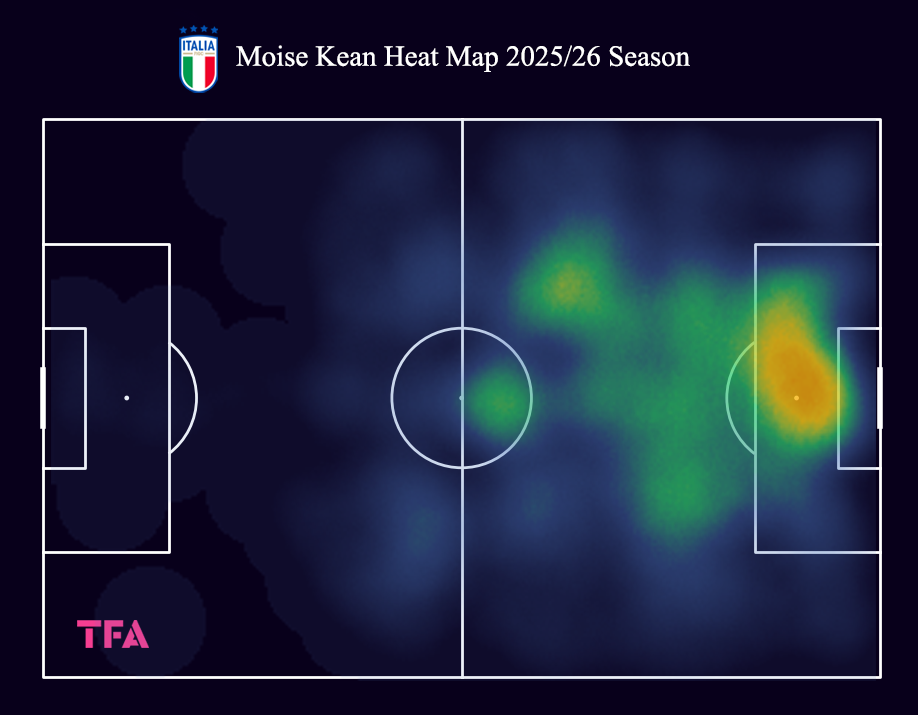
While he does occasionally drop slightly deeper to link play, his most influential actions occur when attacking deliveries from wide areas.
With runners from midfield and wide players supplying crosses and cutbacks, Kean’s positional discipline allows him to remain close to goal and attack high-value scoring zones.
This positioning aligns with that of a traditional box striker, whose influence increases significantly once play enters the penalty area.
From a tactical perspective within Gennaro Gattuso’s dual-striker framework, Kean’s role becomes particularly significant.
Operating alongside a partner such as Francesco Pio Esposito or Mateo Retegui, he often serves as the second striker, responsible for attacking depth and exploiting space between centre-backs.
In the 2025/2026 season so far, Kean has registered 93 shots and eight goals, with seven of those goals coming from inside the penalty area, underlining his identity as a close-range finisher.
His total expected goals figure of 14.26 xG further indicates a consistent presence in high-probability shooting zones.
Moise Kean Shot Map 2025/2026
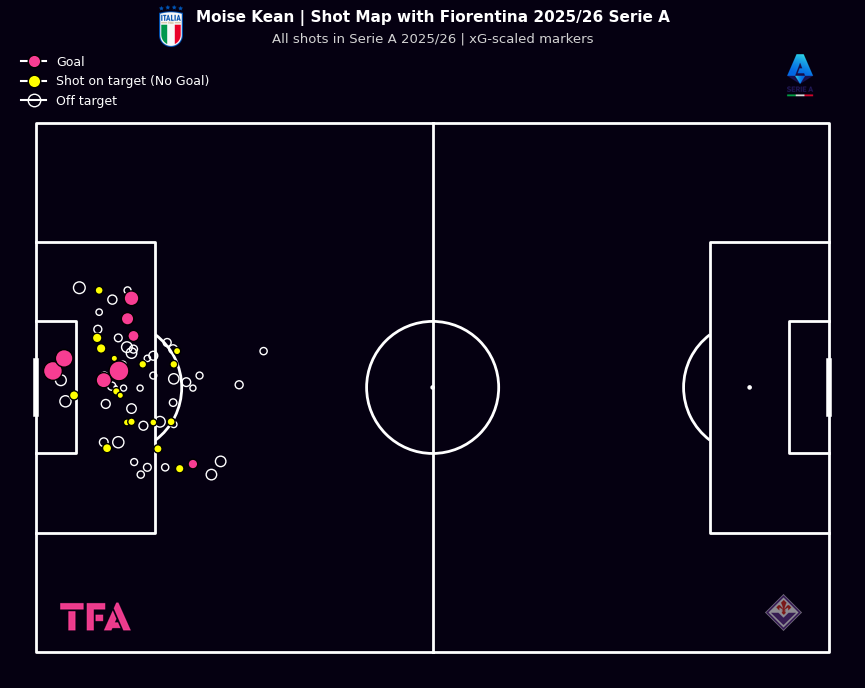
Within Gattuso’s tactical structures, particularly the 3-5-2 and 4-4-2, Kean’s vertical runs stretch the defensive line and create space for supporting runners arriving from midfield or the half-spaces.
This dynamic could prove crucial during Italy’s decisive play-off fixtures at the end of March, when compact defensive blocks from teams such as the Northern Ireland national football team or the Wales national football team may require quick central combinations and aggressive box occupation to unlock scoring opportunities.
Sebastiano Esposito As The Creative Connector In Italy’s Frontline
Within Gennaro Gattuso’s dual-striker framework, Sebastiano Esposito offers a slightly different attacking profile compared with partners such as Moise Kean or Mateo Retegui.
Rather than functioning purely as a penalty-box presence, Esposito combines finishing ability with creative involvement between the lines.
Across 2,091 minutes this season, he has recorded 11 goals and six assists, alongside 80 shots, 41.3% on target, and 14.3 xG, reflecting a forward who frequently reaches scoring zones while also contributing to chance creation.
Sebastiano Esposito Attacking Output 2025/2026 – Goals, Creativity, & Offensive Contributions
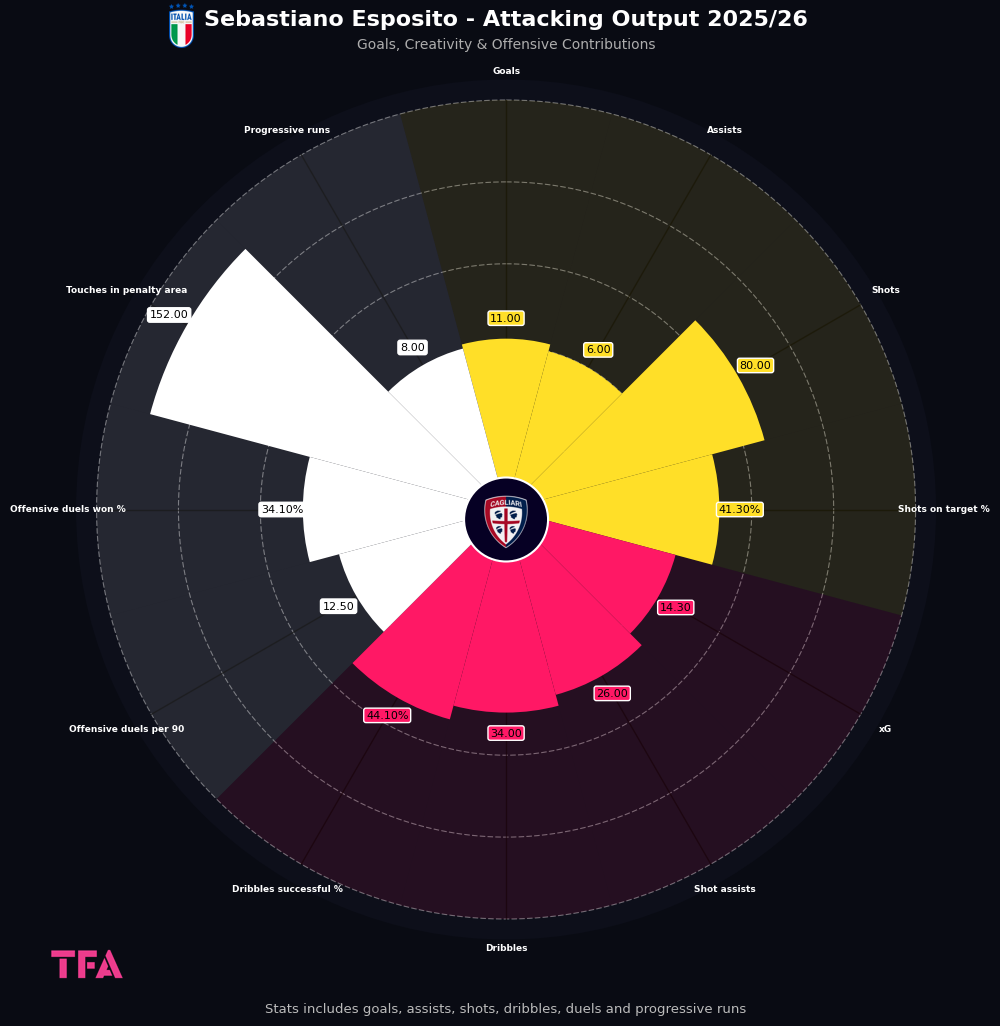
His 26 shot assists underline his ability to link attacks and supply teammates in the final third.
From a tactical standpoint, Esposito’s profile suits the role of a connecting striker within Italy’s two-forward system.
His 152 touches in the penalty area show consistent presence in advanced zones, his 34 dribbles (44.1% success) and eight progressive runs indicate a willingness to carry the ball and attack defenders directly.
Within a 3-5-2 or 4-4-2 structure, he could operate as the slightly deeper forward, dropping into the half-spaces to combine with midfield runners before releasing vertical passes or attacking the box himself.
In Italy’s upcoming play-off fixtures, this hybrid role could help link midfield circulation with the central striker, adding fluidity to the Azzurri’s attacking structure.
Conclusion
As Italy approach March’s World Cup playoffs, Gennaro Gattuso’s attacking blueprint will be pivotal in determining their qualification prospects.
The dual-striker system, anchored by Moise Kean’s central presence and complemented by Francesco Pio Esposito or Mateo Retegui, provides a clear focal point in the penalty area while facilitating quick vertical transitions.
Mattia Zaccagni’s intelligent diagonal movements from the left half-space offer an additional dimension, linking midfield runners with the strike partnership and exploiting compact defensive structures.
Sebastiano Esposito’s hybrid role as a creative connector ensures fluidity between lines and supports both chance creation and finishing.
This combination of positional discipline, interior attacking runs, and central overloads equips Italy with multiple avenues to unlock resilient defensive setups such as those expected from Northern Ireland or Wales.
In essence, Italy’s progression hinges not merely on individual talent but on the coherent execution of Gattuso’s tactical framework, blending physical presence, spatial awareness, and dynamic support play into a cohesive offensive strategy.

