


For Wolverhampton Wanderers fans, the 2024/25 Premier League season has been one of mixed emotions.
When Gary O’Neil was sacked back in mid-December, the club sat second-bottom of the Premier League standings and were four points from safety, having incurred 11 defeats from their opening 16 games.
It appeared at that stage as though they were doomed to the drop, but the appointment of Vítor Pereira as O’Neil’s replacement has certainly provided everyone at the club with fresh impetus and a newfound belief.
As a result, they have taken 17 points from the Portuguese’s 13 matches in charge and now have a nine-point buffer between themselves and 18th-placed Ipswich Town.
There have been many players who have contributed to that turnaround in fortunes, with Matheus Cunha the one who is constantly mentioned in dispatches.
However, one who rarely receives the credit his efforts have merited is Jean-Ricner Bellegarde, yet there is so much that Wolves would struggle to do without him on the field.
This tactical analysis will seek to correct that, with the scout report highlighting what he offers to Wolves’ tactics under Pereira and why he has become a player they simply can’t be without.
Jean-Ricner Bellegarde Patrolling The Midfield
Whilst Jean-Ricner Bellegarde has been utilised in every area of the field during his two seasons at Wolves, there is no denying that the former Strasbourg player is at his best when in the midfield.
This has been demonstrated on multiple occasions, with his presence in the central third key in Wolves’ ability to be both efficient when they have the ball and solid without it.

When it comes to the latter, what really aids him is his awareness of what is happening around him.
It is constantly apparent that he has an innate ability to identify where passes will go and to react early to regain possession for his side.
This is a prime example of that, with Liverpool’s Andy Robertson attempting to find Alexis Mac Allister but seeing his pass intercepted by Bellegarde, who had read the Scotland captain’s intentions and who had adjusted his body positioning accordingly.
However, whilst regaining the ball in this way is something that Bellegarde has done 49 times already this season (an average of 2.74 times per outing), where that awareness really shows is in what comes next.
Most players in this position would instantly turn and try to find a teammate higher up the field without assessing their surroundings.
They would be at risk of instantaneously giving the ball back to their opposition.
Bellegarde, though, plays with composure and control and so doesn’t often take unnecessary risks.
He generally opts for the pass that is best for the team at that moment in time.
In this case, that saw him send it backwards to Matt Doherty, enabling Wolves to build again from the back.
Therefore, when considering why he has been a key player for Wolves throughout the season, this ability to scan for potential danger has to be factored into the equation.
This is not to say that Bellegarde only comes into use whenever the Wolves are out of possession, though.
The analysis already mentions that he plays a key role in moving the ball around the field efficiently.
This comes through his ability to transform on the spot from a midfield disrupter to a deeper-lying playmaker.
He made a high number of interceptions but also possessed an 83.4% passing accuracy for this campaign alone.
What makes this possible is the way he controls the ball once it is sent in his direction.
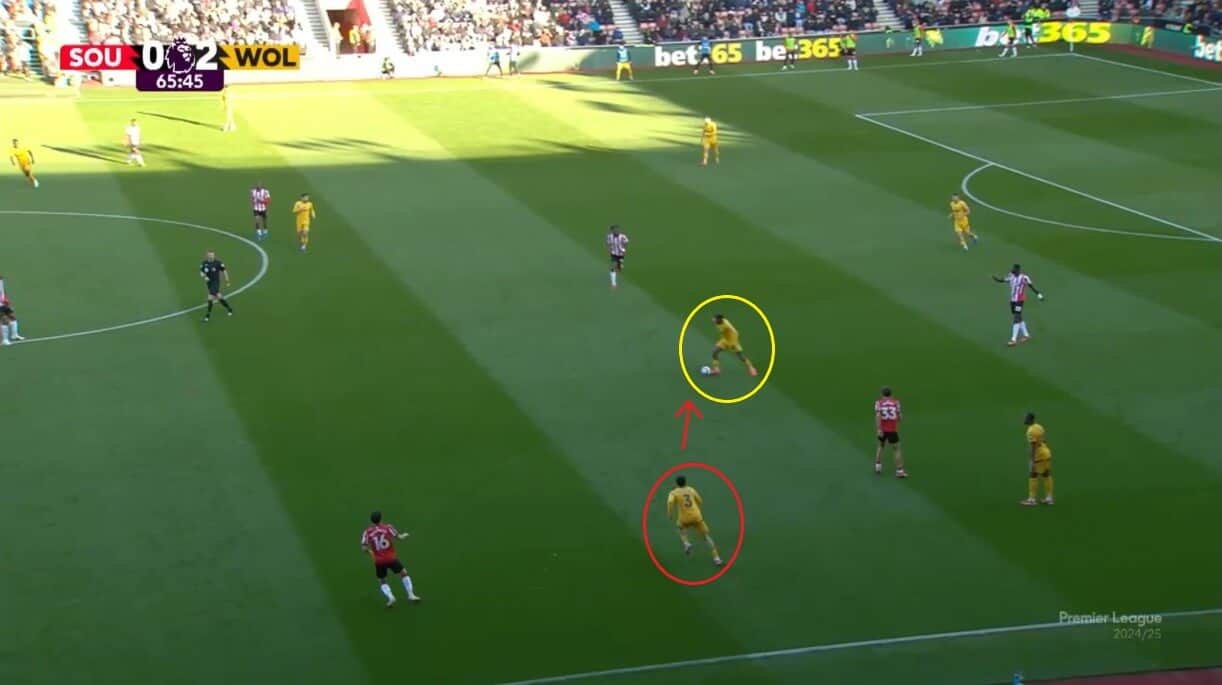
In this case, he has found space between the Southampton lines, and Rayan Aït-Nouri has passed the ball towards him.
As can be seen, Bellegarde allows it to travel across his body before stopping it with his right foot, which makes all the difference as it enables him to open his body up and create a wider range of angles through which he can transfer it up the field.
This is not to say that using his left foot here would be wrong, but doing so would certainly limit the options that he would then have available to him.
Therefore, when he has the time that Southampton afforded him here, it is common to see him looking up the field and playing intelligently, and it is another reason that Wolves have come to rely on him so much.
It is that ability to locate space and to be so composed when he has the ball that has made Bellegarde so effective in transitional phases.
There have been plenty of matches in which he has been seen drifting into space and connecting the dots for his team.
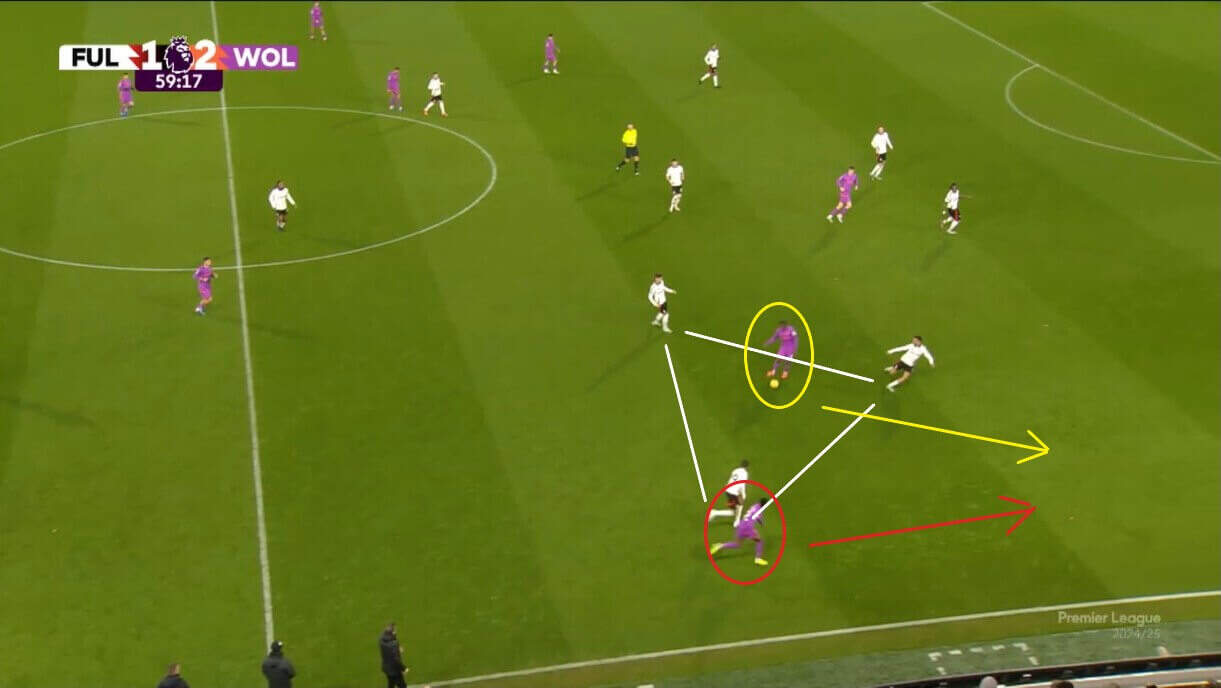
In this case, it is Fulham who have initially afforded him too much room to manoeuvre in, with Bellegarde now moving towards Pablo Sarabia in order to use that to Wolves’ advantage.
Whilst this does attract the attention of Tom Cairney, Reiss Nelson and Antonee Robinson, who form a triangle around him, Bellegarde doesn’t let that affect him.
Instead, he uses the attempted press against the trio, sending a return pass back out to Sarabia with his first touch and giving the former PSG winger a chance to exploit the space that Robinson had vacated.
It might not have led to anything on this occasion, with Robinson and Nelson recovering well to crowd Sarabia out, but Bellegarde’s 15 shot assists so far do reflect how important he has been in moving the ball into promising positions.
That is why he needs to be praised for his work in getting Wolves into a position from which they can now have genuine hope of securing another top-flight campaign.
Jean-Ricner Bellegarde Attacking Threat
Perhaps because of that creative threat, Pereira has predominantly deployed Jean-Ricner Bellegarde among the forward positions.
It is common to see him tucked behind the likes of Cunha or Jørgen Strand Larsen and alongside January addition Marshall Munetsi.
Whilst it might not be where most fans first envisioned him playing, it is a tactical change that has worked in his and the team’s favour.
It allows him to demonstrate more elements of his game and gives Wolves someone with energy and creativity around opposing defensive lines.
That energy and desire to never stop working has been shown in a number of ways, not least of which has been his explosive runs up the pitch.
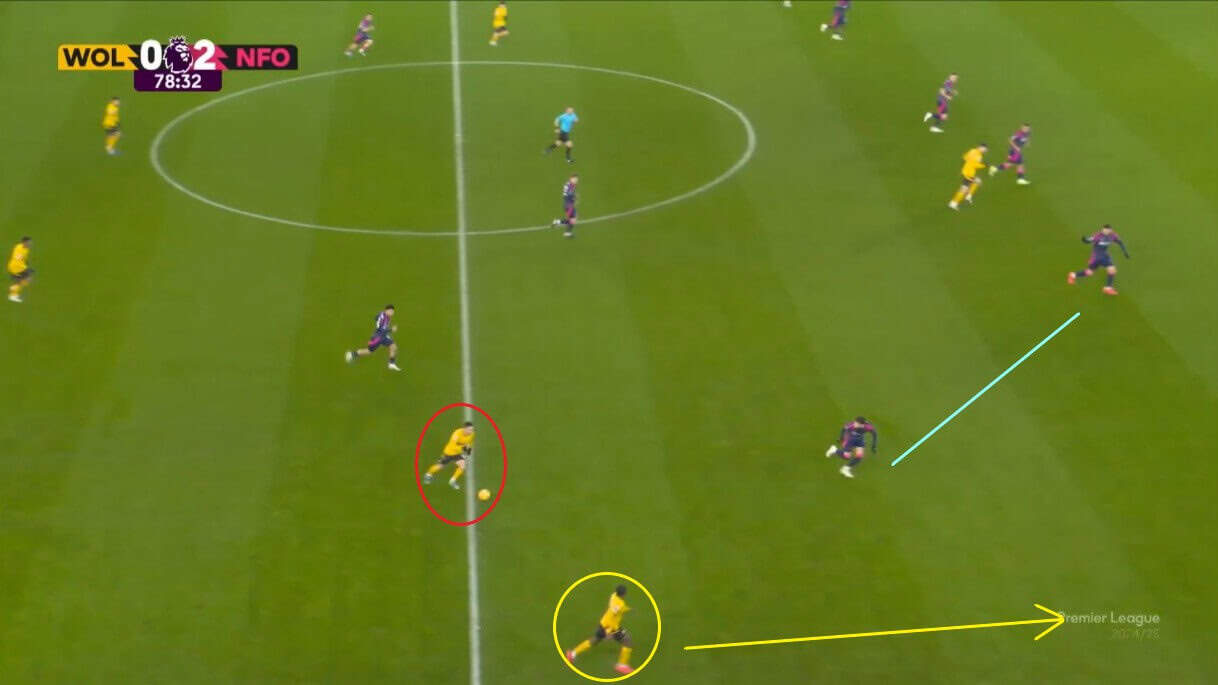
This tends to come whenever opponents leave gaps open or fail to track back in time, just as Nottingham Forest’s Neco Williams has done here.
In this case, Wolves are in the midst of another transitional sequence, with Sarabia, this time in a central position, and Bellegarde outside him.
With Williams staying ahead of the rest of the defensive line, the latter player has a perfect opportunity to get into the area behind him and fashion a goalscoring opportunity for a teammate.
It might not have led to anything this time around, but the fact that Bellegarde assisted the first goal against Southampton (one of four assists he has registered so far in the campaign) from a similar position shows the issues that can come from allowing him to make these runs.
Given the Portuguese influence at the club, it should perhaps come as little surprise that Wolves do want players who can progress up the wings in their team.
Traditional Portuguese tactics have long been based around a dependence on wide attackers to provide passing targets high up the field, and it is something that José Mourinho heavily advocated for during his early managerial career.
With Bellegarde showing that he can bring the same traits to Wolves’ play and can then find players when he does receive the ball (41.7% of his crosses so far this season have found their intended targets), it is yet another reason that he has become such an intrinsic player in Wolves’ turnaround in fortunes.
The other thing that Bellegarde has demonstrated adeptness at is managing the tempo of his side’s attacks.
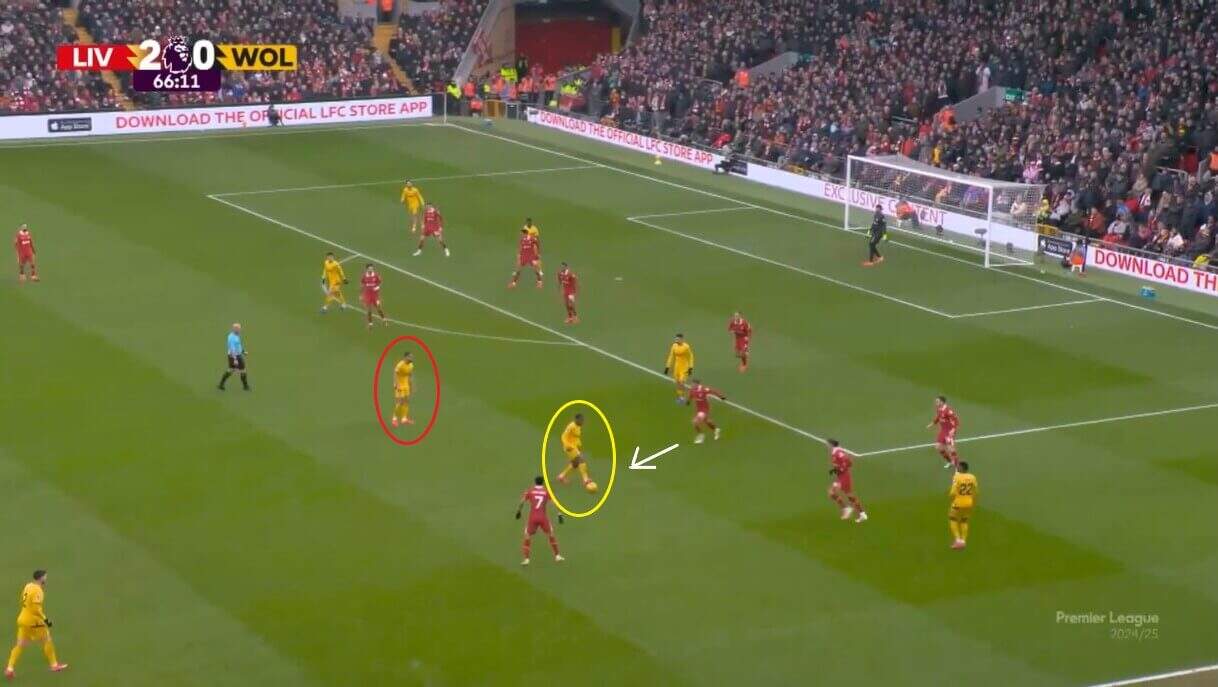
In this case, Nélson Semedo made a typical attacking run up the right wing, and Bellegarde was inside him, positioned between the Liverpool lines.
Arne Slot’s team has set up in a bid to limit the damage that Wolves can inflict on them here, but that doesn’t deter Bellegarde.
Instead, he once again shows control and intelligence to create space in this rearguard action.
This comes through Semedo sending the ball into his path and Bellegarde not instantly passing it onwards.
He instead holds onto it, tempting Mac Allister into moving out of line and closing him down.
Whilst the Argentina midfielder neither wins the ball nor leaves his teammates too exposed, his movement is enough to create a slight space that Wolves can now use to their advantage.
It is at this point that Bellegarde shifts the ball towards Cunha, who is on his left-hand side here, and gives the Brazil striker the opportunity to curl the ball beyond Alisson.
The dummy run made by João Gomes, which came once Cunha had controlled the ball, does need to be highlighted too as a reason for the goal coming about.
However, Bellegarde undoubtedly played an integral role in setting the chance up through his ability to manipulate the Liverpool players around him.
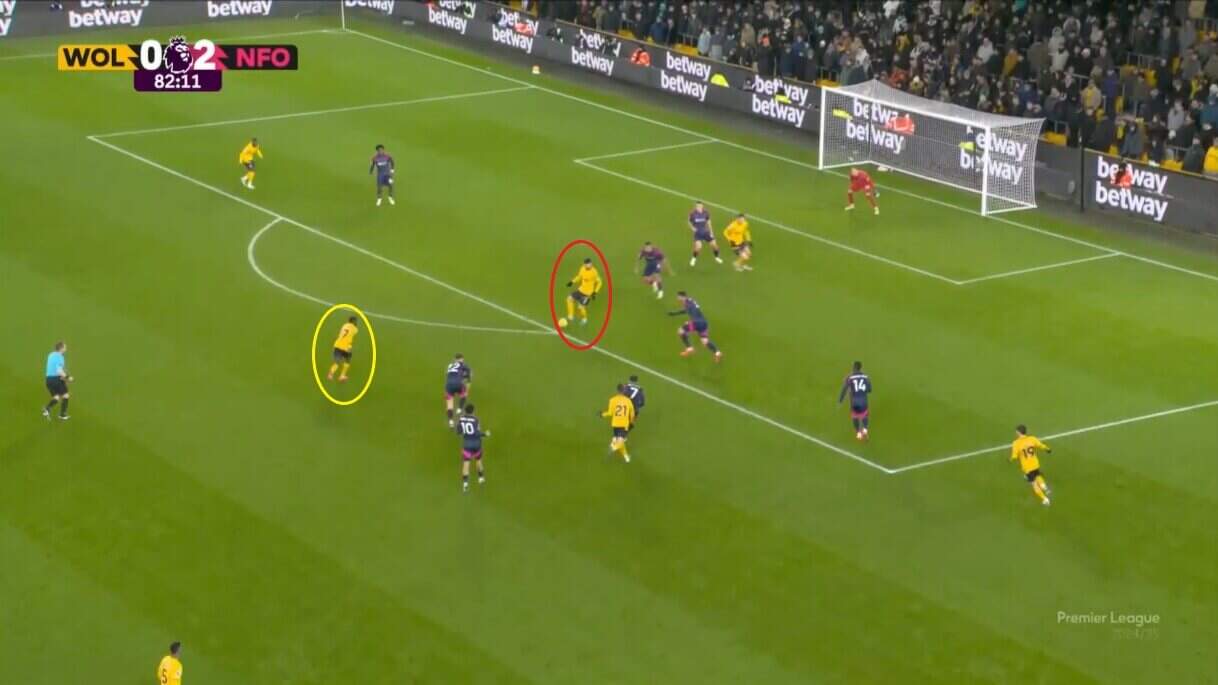
This is not to say, though, that Bellegarde is only capable of being a focal point in Wolves’ attacking play; he is just as comfortable in a secondary role.
That is demonstrated here, with Wolves in the process of breaking into the Nottingham Forest third and already having players there to create problems for their defensive line.
As a result, Bellegarde doesn’t have to think about running up the field and stays in the pocket on the edge of the goal area.
In doing so, he allows Wolves to use the space that Nottingham Forest has left open and enables Doherty to knock the ball backwards once Sarabia sends it towards him.
Once again, this eliminates the risk of the former Tottenham Hotspur right-back turning into the defenders ahead of him and risking losing possession.
It also hands Bellegarde a chance to test his own luck in front of goal.
Whilst it might not have resulted in anything this time around, Bellegarde’s effort being deflected out of play by Murillo for a corner shows how he is capable of shooting and creating for others, which is another reason for him becoming such a threat in the Wolves ranks.
Jean-Ricner Bellegarde Defensive Qualities
The scout report has placed great emphasis on Jean-Ricner Bellegarde’s contribution to Wolves’ play in attacking scenarios, and rightly so, given that that is where he is most commonly seen.
However, the analysis has also discussed his defensive contributions, which will now be expanded upon to show how vital they have been in Wolves’ fight to stay in the Premier League.
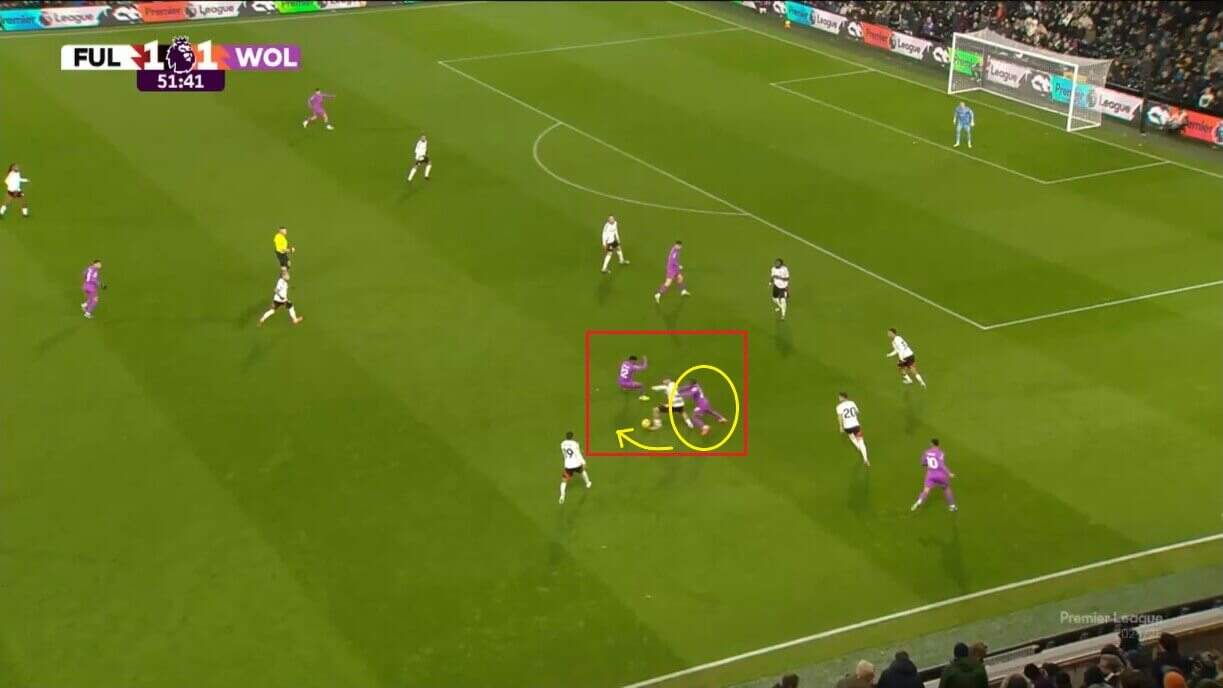
What stands out is the way he switches his mindset from attack to defence, rarely needing to spend too long doing so.
In this case, Cunha moved out towards the wing and tried to pull the ball back to Bellegarde in the middle, but the ball was not controlled cleanly, and Semedo was unable to assist because he was running too far ahead.
As a result, Fulham were able to regain the ball, and it appeared as though former Arsenal player Emile Smith Rowe had time and space to roam forward and turn a potentially perilous situation for his side into an advantageous one.
However, the speed at which Bellegarde reacted here ensured that that was prevented, and what really stands out is the way he moved to eradicate the danger.
As indicated, he didn’t simply attempt to tackle Smith Rowe from behind but instead made a curved run around him, ensuring that the space he had to run into was no longer available beforehand.
As a result, Smith Rowe was forced to dribble the ball horizontally before passing the ball backwards, with Fulham gaining the opportunity to build again but losing any momentum they had previously created.
The simple fact is that this would not have happened without Bellegarde reacting as rapidly and effectively as he did.
His success in 61.5% of his defensive duels this season is yet more evidence of how he has been essential to the Molineux machine in defence and attack.
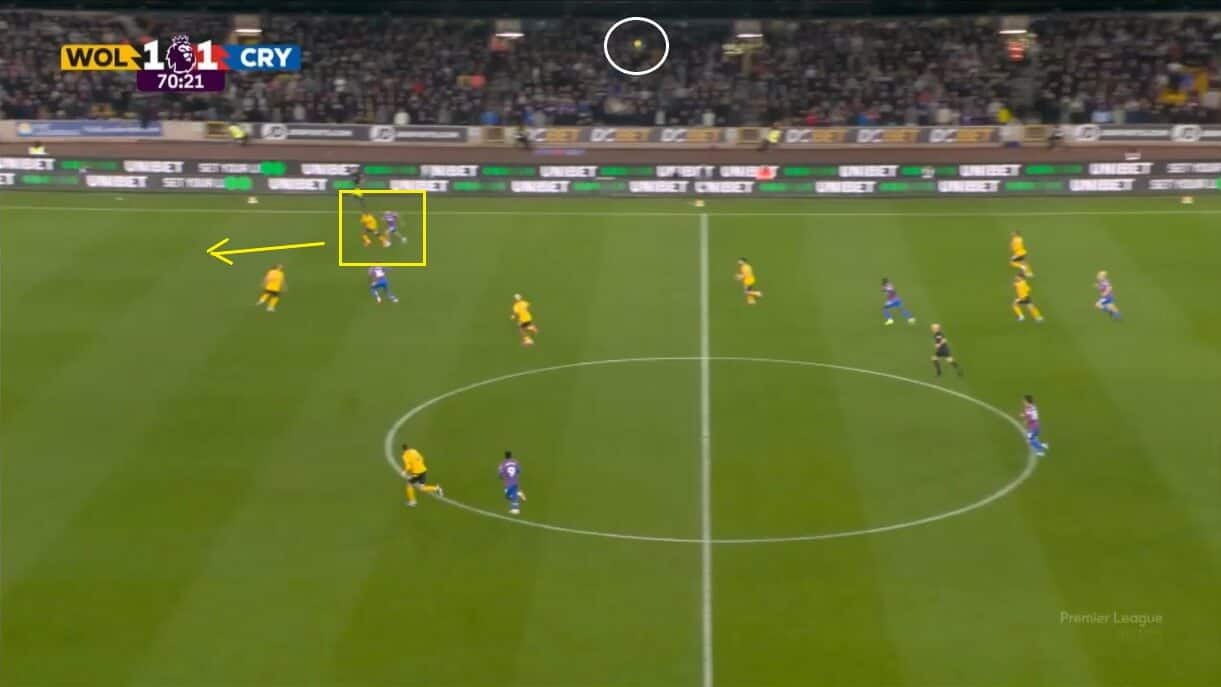
There is also an inherent team ethic instilled in Bellegarde, which also becomes apparent whenever Wolves are out of possession.
This is particularly clear to see in this situation, with Crystal Palace regaining the ball inside their own third and instantly passing it up the field aerially.
At this moment, Bellegarde is positioned on the far side of the field, and it would be easy for him to move into its landing zone and try to win it.
However, he knows that doing so would mean leaving Daniel Muñoz free to run behind him, which could then leave the Colombia right-back with space to break Wolves down in the same way as he has done to so many others this season.
As a result, and with the knowledge that he is not the best aerial combatant (having succeeded in just 26.75% of his duels in the air this season), he opts to hold his position and to ensure that Muñoz does not have an easy route through to goal.
As it turned out, this was the right decision, with Wolves failing to win the initial ball and Bellegarde successfully getting his body between it and Muñoz further back.
In the context of the match, which ended in a 2-2 draw, there is no doubting that this individual strength and teamwork was crucial in Wolves securing a point.
Jean-Ricner Bellegarde Statistics 2024/2025
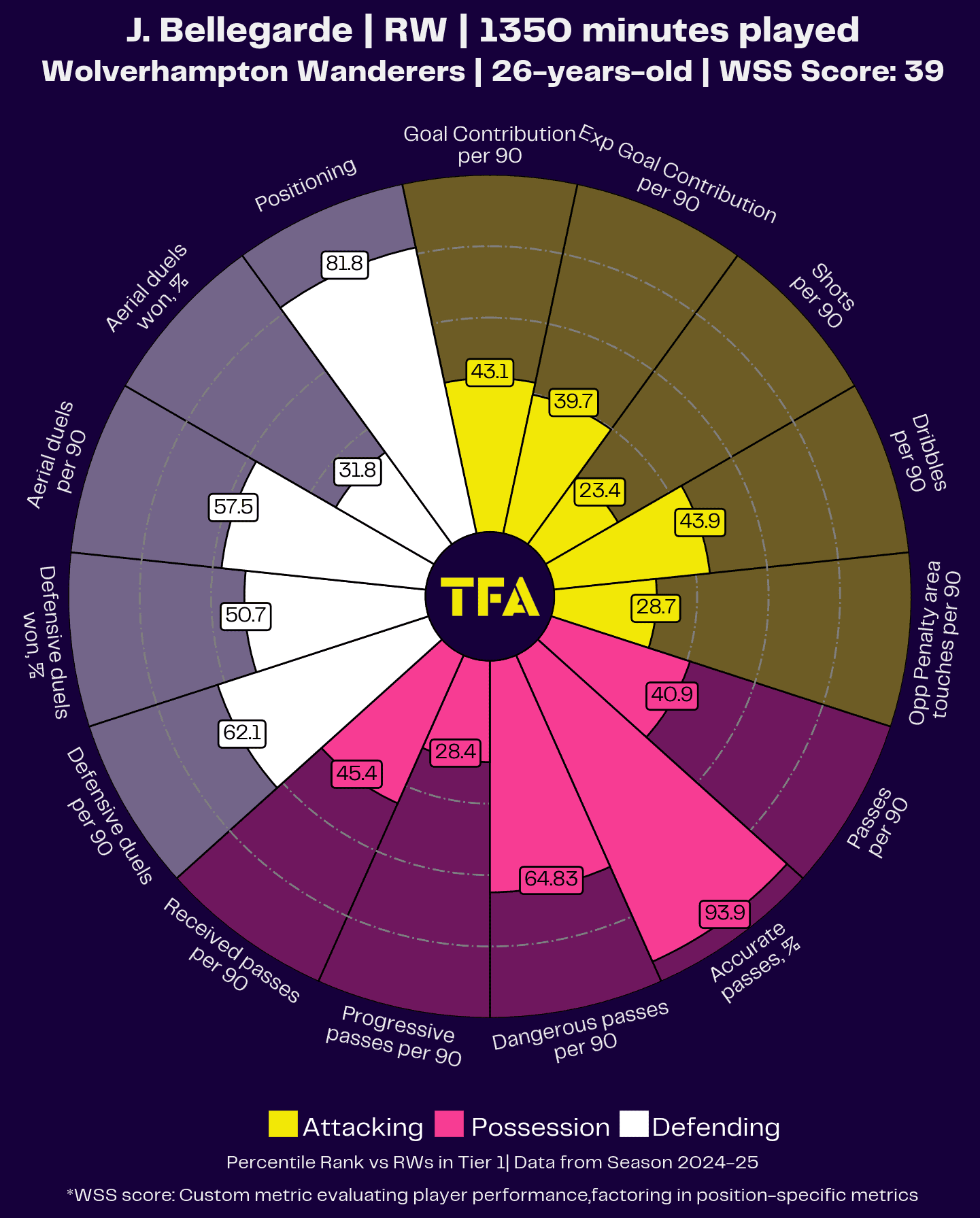
That balance that Bellegarde brings is highlighted clearly when looking at his data for the season so far, with his passing accuracy ranking highly in percentile terms when compared to all other Tier 1 players in his position.
At the same time, he also makes a high number of dangerous passes per game too, which further demonstrates that ability to make things happen whenever he has the ball at his feet.
However, the fact that his positioning is among the top two bands is what really needs to be pointed out here.
That demonstrates his ability to get into the right areas and assist his team whenever they are out of possession.
The fact that he has helped to thwart a number of opposing chances (like the one Muñoz could have had in the previous example) highlights how, even though he might not attract the headlines, he is a player that Wolves simply would not be in the position they are in at this moment in time without.
Conclusion
In conclusion, this tactical analysis has taken a closer look at Wolverhampton Wanderers’ Jean-Ricner Bellegarde, who has become something of a utility player during his time at Molineux and someone that Wolves would struggle without.
As has been mentioned, Bellegarde is not the type of player who tends to attract headlines, with others like Cunha and João Gomes tending to be the focus of post-match analysis.
Yet, without Bellegarde pulling the strings from the midfield and forward areas and lending a hand when Wolves come under pressure, so much of what has made them a difficult team to come up against since Pereira’s appointment simply wouldn’t happen.
There may well have been some wondering what Bellegarde would bring to their play when he first arrived.
Pereira himself has even admitted recently that he wasn’t sure where to fit Bellegarde into his system.
Those doubts will surely now have evaporated, and the fact that he has been nominated for March’s Premier League Player of the Month award (and won the club’s February Player of the Month award) is a just reward for an impressive season in which he has really established himself as a key player in the Wolves ranks.
If they do, as widely expected, retain their Premier League status, they will certainly have a great deal to thank him for.

