


SV Elversberg are enjoying what could be the biggest season in the club’s 118-year history.
They are currently in the top half of the 2. Bundesliga.
Given how close proceedings are at the moment, they could even be in the fight for promotion to the Bundesliga for next season.
This would be a historic first for this modest football club from the state of Saarland, as they are only four points off third place and a promotion play-off berth.
One player in particular who has stood out for them this campaign is their leading striker, Fisnik Asllani, who is on loan from TSG 1899 Hoffenheim.
Asllani has directly contributed to nearly half of Elversberg’s goals in the second tier so far this season, with 10 goals and five assists out of the club’s 33 strikes.
It’s been a breakout year for the forward, who seems to be finally finding his footing in senior football now that he is in his early 20s.
This term, his performances have caught the eye of several Bundesliga clubs keen to obtain his services.
This scout report and player analysis will examine Asllani’s performances this season, identifying some of the key factors behind his rise in the Zweite and areas where he may still need to improve to reach his full potential.
Who Is Fisnik Asllani?
Born in Berlin, Germany, Fisnik Asllani is a 22-year-old centre-forward who represents Kosovo internationally.
He has switched his allegiance to the country where his parents are from after representing Germany nine times at U18 and U20 levels.
He is 6’3″(191 cm) tall and weighs 178 lbs (81 kg).
He can lead the forward line as a number nine and play slightly more withdrawnly as a second striker or even off the left wing.
Now that we have some basic information about the striker, let’s examine his data profile for this season.
Fisnik Asllani Radar Map

Asllani’s radar map above highlights his percentile rank among other forwards in his division by different attacking, defending, and possession metrics.
Undoubtedly, and unsurprisingly, given his offensive production this season, his attacking metrics stand out the most at first glance.
They’re quite impressive, too, given that his goal contribution per 90 is in the top 15 percentile, even though his expected goal contribution only ranks in the 31st percentile.
He also ranks in the top 8 percentile for shot attempts per 90, yet his rank in penalty area touches in the opposition penalty area is quite low.
As the rest of his metrics aren’t noteworthy to further expand on, let’s dive more into his shot attempts and work in front of this campaign’s goal.
Fisnik Asllani Shots Map
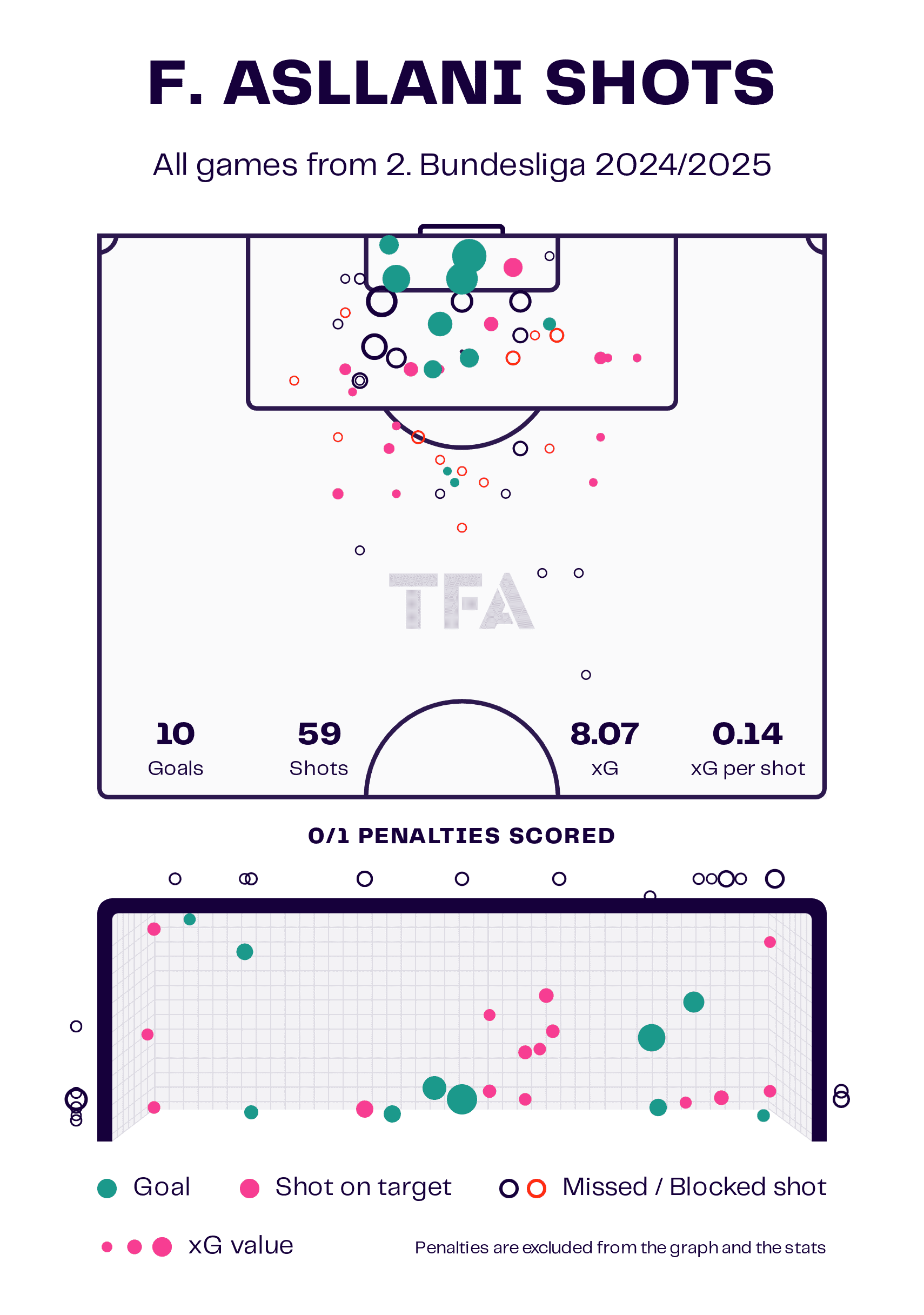
His shot map above encompasses all his attempts to score throughout the 19 rounds played in the 2. Bundesliga so far this season, as of this writing.
Statistically, a couple of things stand out here.
First, he is, in fact, overperforming on his expected goals (xG) of 8.07, with ten goals to his name to date.
Secondly, with those ten strikes coming from a total of fifty-nine attempts, he is averaging a goal every six shots he takes, which is impressive given that, as we saw earlier by his radar map, he doesn’t get that many touches in opposing penalty areas.
Looking further at the quality of his attempts, his highest xG value shots naturally come the closer he is to goal, mostly from the penalty spot up to the six-yard box.
Despite that, he is not frightened to shoot from distance, which he has evidently done a number of times this season, even scoring twice from outside the box.
Overall, judging by the data, Asllani comes off as a scientific forward who takes a calculated approach to play the role.
He values quality over quantity when it comes to chance generation and picking his moments to startle opposing defences.
In the following sections, we’ll examine some of his main strengths with Elversberg and some aspects of his game that he could still improve upon.
Fisnik Asllani Strengths
Throughout the season, Asllani has taken on the role of a deep-lying forward, dropping deeper in between the lines to offer himself as a passing option to his teammates and receive the ball with his back to goal.
These movements typically draw out opposing defenders, who step up to try to mark him and create spaces behind him for other Elversberg players to run into from deeper positions.
One example of that, among many, came in the recent away game at Köln.

Asllani drops into his own half to receive a pass.
A Köln defender follows him and tries to nick the ball ahead of him without fouling him or allowing him to control and turn.
At the same time, a gap appears in the centre of FC Köln‘s defence because of the defender’s choice to step out of position and gamble on himself winning the ball in this situation, where we can see an Elversberg player making the run into that space once he notices it.
Eventually, this led to a quick link-up play and an opportunity to run directly at Köln’s short-handed defence.
Although this didn’t result in a goal, it is a sample of what Asllani brings when the ball is further away from him and the opposing goal.

This is a similar example to the previous one above, albeit in a deeper area of the field with no obvious gaps that could lead to a scoring chance on the counter for Elversberg.
Here, Asllani drops very deep again to receive with his back to goal, as two Paderborn players come across to limit space for him to turn towards the attacking half.
Instead, Asllani played the ball backwards, allowing his team to maintain possession and eventually switch the point of attack to the opposite side as they progressed further forward.
This trait in his game will catch the eye of his suitors as it highlights his willingness to sacrifice and contribute to the team even when he’s not scoring at the other end, which is important to do so in the modern game, where forwards have to put a lot more work in off the ball to keep up with current demands.
Another impressive strength of his is his ability to invent scoring opportunities.
He finds ways to create chances for himself, sometimes out of very little.
Take, for instance, this goal against Hamburg.
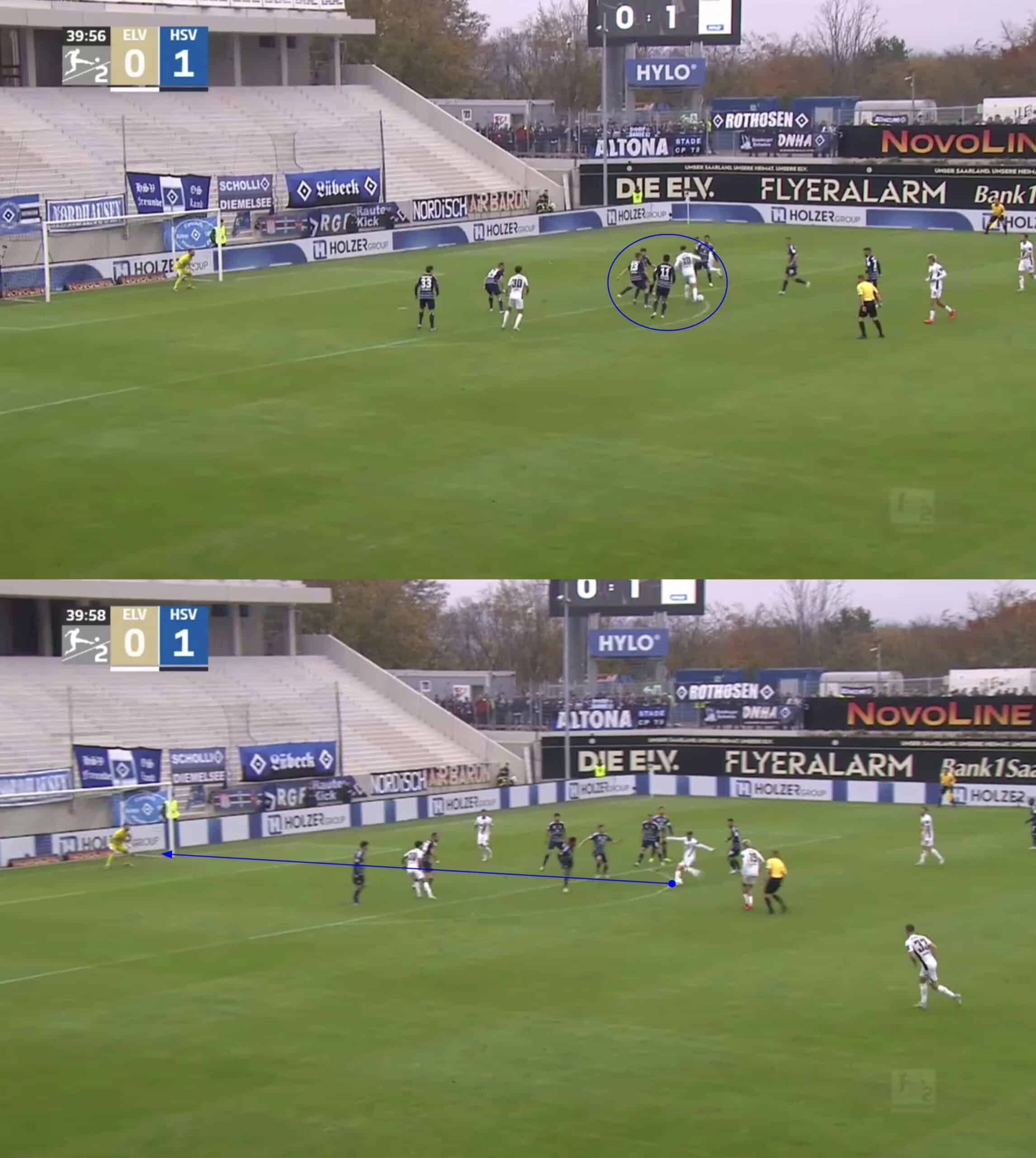
In the first image, Asllani receives the ball on the edge of the box and looks to move it onto his right foot.
However, he quickly realises he’s found himself in a cul-de-sac, with multiple Hamburg defenders blocking that side and no avenue to shoot.
Instead, Asllani works the ball back around onto his left side and unleashes a fierce low strike into the bottom corner in the second image to bring Elversberg on level terms.
It was a display of manoeuvring and rescuing a play and managing to get a shot away at goal despite the number of opposing bodies at the back, even if he had not scored, but it was all the more impressive given that he did.
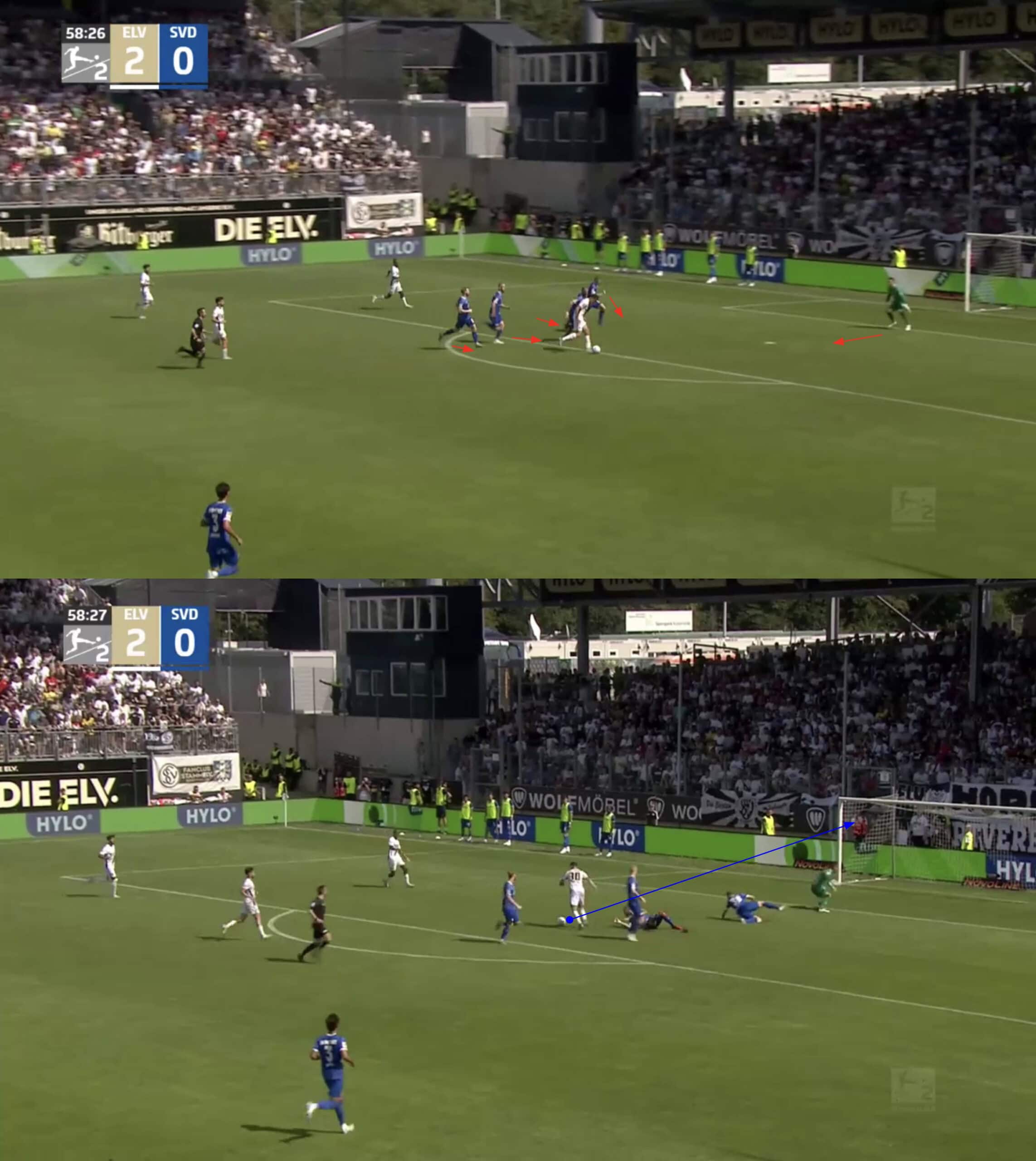
Here’s another one from the Darmstadt game.
In this one, he again assessed the situation well and decided to return the ball to his left side before scoring.
Although he may have been able to score in the first image, it wasn’t exactly a quality chance, given that there was a defender close by ready to shut him down with a last-ditch challenge.
Realising that was key before he decided to turn to his other side, which created an even better opportunity for him to score, given that he had removed all the defenders and the goalkeeper from the equation with one sharp turn.
Although, as mentioned earlier, Asllani may not receive a huge amount of the ball in the opposition’s box, he does make what he gets count.
With his intelligent play and smart, quick decision-making, he has the characteristics of a forward destined to play at the highest level.
Lastly, some areas of his game need improvement before he takes the next step.
Fisnik Asllani Areas Of Improvement
While Asllani’s playing style relies on his brain more than anything else, there are some elements that he could improve in.
The most particular one concerns the low number of duels he wins as someone of his size, at 6’3″.
He is both offensively and defensively successful in half or even less of different types of duels on the field.
Although he may be tall, he isn’t the bulkiest striker.
He struggles to impose his body when challenged by defenders and can be too easily thrown off balance or dispossessed.
However, when needed, this aggression and intensity in these situations could be the key to greater success in duels.
On the other hand, he isn’t the fastest forward or a flashy high-volume dribbler, which does limit his game.
Fisnik Asllani Ball Progression Map
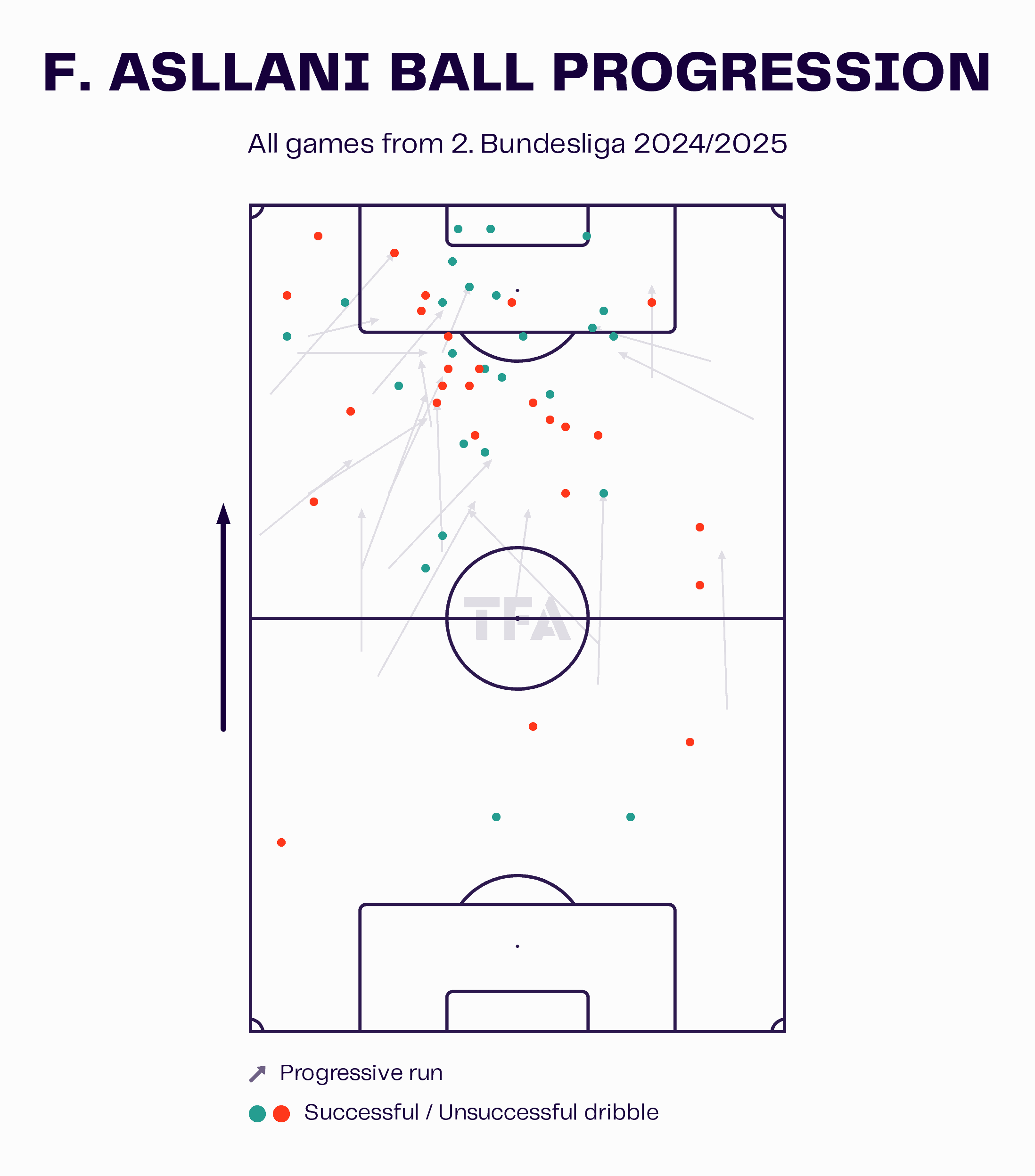
His ball progression map highlights his dribbles throughout the 2. Bundesliga season.
While he does find some success in the box, likely due to his invention, as mentioned earlier, he isn’t very effective on the dribble in other attacking areas in the final third, with more failures than successes there.
Overall, this issue is probably more minor because he’s able to bring the goods where they count the most, which is in the opposition’s penalty area.
After all, you have to work with what you’re given, and he certainly does well with what he has.
However, with his invention and intelligent playing style, ambidexterity, and raw physical attributes such as pace and improved dribbling abilities, we would be looking at a potential world-class player here.
Conclusion
After struggling to find game time at his parent club, Hoffenheim, and after an okay loan spell at FK Austria Wien, Asllani has finally found his footing in the senior game at Elversberg this year.
Given the season that he’s having, it’s unlikely he’ll stay in the 2. Bundesliga next season, even if Elversberg do or even if Hoffenheim go down a tier themselves.
He seems destined to be a Bundesliga player soon, given the recent interest in him following his impressive performances.
And who knows, maybe it could even take place before the January transfer window closes.
A few clubs in the league could use a striker with Asllani’s profile and current production.

