



The 2023 UEFA European U21 Championship is set to kick off on Wednesday, 21st June. This tournament will provide a platform for some of Europe’s brightest upcoming talents to showcase their talents and abilities on a prestigious stage, perhaps doing their reputation some good when their name is mentioned thereafter.
Germany are the defending champions coming into the 2023 edition of this competition, winning a 2021 U21 Championship that showcased defensive talents such as Germany’s Nico Schlotterbeck (who made a €20m move to Borussia Dortmund last summer), Croatia’s Joško Gvardiol (currently of RB Leipzig but linked with major transfers to several top clubs all around the continent at present), Spain’s Marc Cucurella (who made a blockbuster €63.5m move from Brighton and Hove Albion to Chelsea last summer) and the Netherlands’ Sven Botman (who would go on to join 2023/24 UEFA Champions League competitors Newcastle United from Lille last summer for €37m) — just to name a few.
This article and data analysis piece will present data and statistics, used along with our own video research and knowledge, to provide some analysis of five exciting defenders worth keeping a close eye on in this summer’s EURO U21 tournament.
Each of the five players we’ve selected hails from a different nation, though three come from the Belgian Pro League, one from LaLiga and one from Ligue 1. We’ve included one right-back, one left-back and three centre-backs in our analysis. Finally, we’ve selected players at differing stages in their careers, so as we’ll explain when discussing each individual, this isn’t necessarily a definitive list of the five best defenders in the tournament, but rather a list of five compelling contenders who are worth watching for different reasons.
All data and statistics used in our analysis were sourced via Wyscout. Without further adieu, let’s get into the analysis and check out our first defender!
Castello Lukeba, 20 years old, France U21 and Lyon

The first defender on our list is also probably the most ready for a major-money move and the most high-profile player from our selection. That would be France U21 and Lyon centre-back, Castello Lukeba (184cm/6’0”, 73kg/160lbs).
The 20-year-old broke into Lyon’s first team last season during a period in which the side was struggling defensively. Lukeba proved himself to be a perfect fit for what then-Lyon coach Peter Bosz required from his centre-backs and he’s remained a key part of Les Gones’ backline in 2022/23.
Lukeba brought a comfortability with defending proactively — engaging attackers in more advanced areas of the pitch — to the Lyon defence when he was promoted to the first team last season.
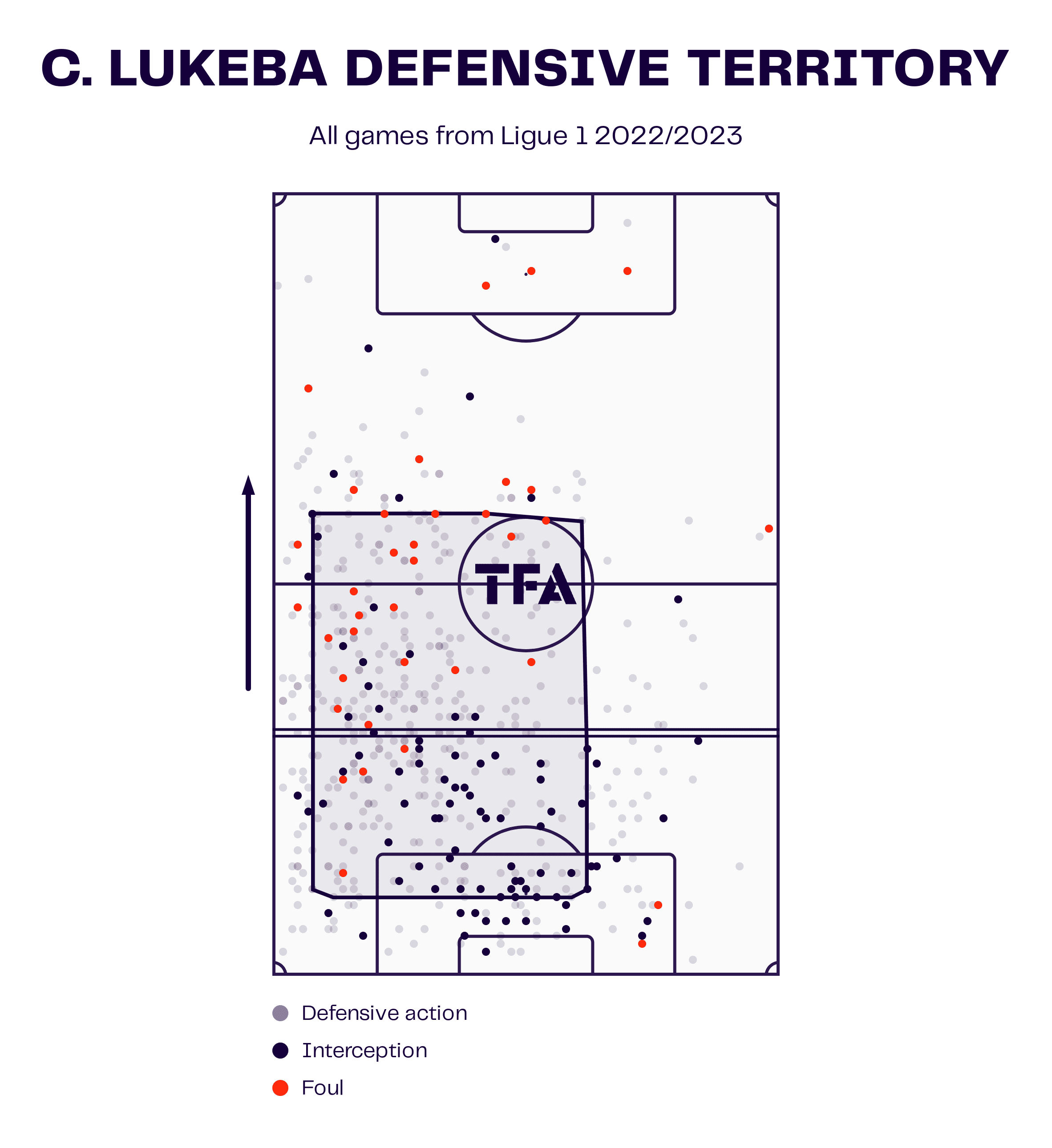
Figure 2 shows Lukeba’s average defensive territory and we can see how he clearly doesn’t shy away from approaching opposition attackers at around the halfway line, with plenty of his defensive actions coming in this area of the pitch.
Lukeba is a particularly useful asset for his side in this regard when shutting down the opposition’s counterattack thanks to his defensive technique, pace and anticipation — all of which are of high quality.
These strengths are reflected in the pizza chart from figure 1 which indicates that Lukeba has engaged in a relatively high number of defensive duels and won a high number of them when compared with other Ligue 1 centre-backs this season.
He’s not a perfect defender, of course. The 184cm centre-back struggles aerially and, at times, can be outmuscled — so these are areas his team must cover for him.
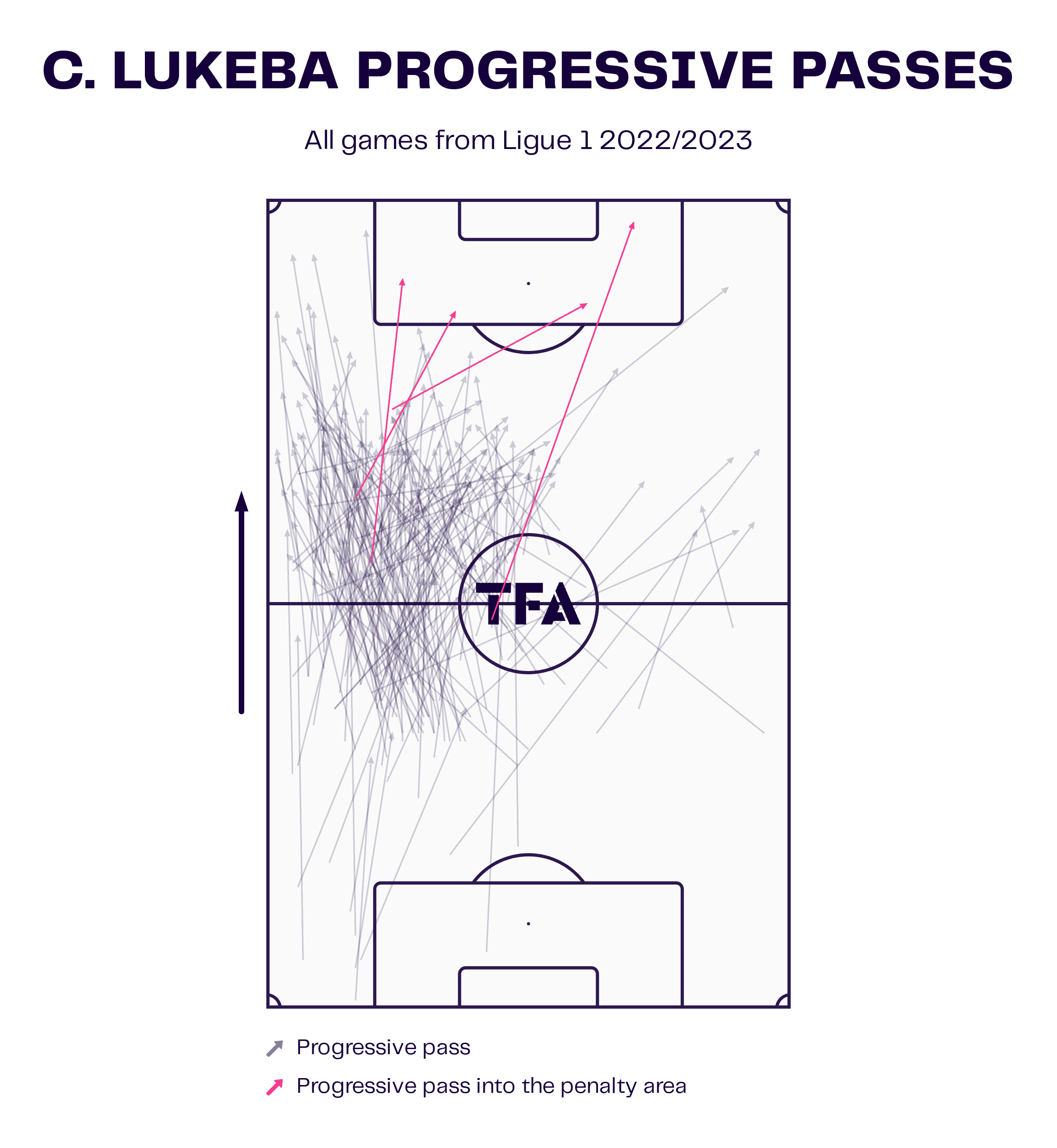
In possession, Lukeba is also an excellent asset for his side, particularly due to his composure on the ball. In and out of possession, the 20-year-old exudes calmness and confidence well beyond his years — and has done since being promoted to Les Gones’ first team.
Figure 3 displays the young Frenchman’s progressive pass map from 2022/23 and highlights the areas in which the left-footer typically passes from and to.
Lukeba is heavily involved in his team’s possession game, ranking in the 84th percentile for passes per 90, 87th percentile for received passes per 90 and 74th percentile for progressive passes per 90.
While he plays a lot of progressive passes and an above-average number of dangerous passes, as shown in figure 1, he retains a high pass success rate, indicating the quality and reliability — not just quantity — of his passing.
Technically, Lukeba generally demonstrates a good body shape when receiving the ball and is good at disguising his line-breaking progressive passes via his body shape as well, with the capability of manipulating the opposition’s defensive shape.
Lukeba will likely be the highest-quality centre-back on offer in this tournament for our money, so is certainly one to watch in the tournament.
Following high-profile moves out of Ligue 1 for the likes of Benoît Badiashile and Sven Botman within the last calendar year, Lukeba could be the next Ligue 1 centre-back in line for a transfer to a club of even higher stature than Lyon in the current footballing landscape should that be his ambition — and he may well be a good option for clubs at that level looking for a central defensive boost, depending on their specific requirements.
Arnau Martínez, 20 years old, Spain U21 and Girona

The second talent we’ll discuss in our analysis is Spain U21 and Girona right-back Arnau Martínez (182cm/6’0”, 74kg/163lbs). A versatile defender who can sufficiently assist his team at either right-back, right wing-back or right centre-back, Martínez has slowly built a rock-solid reputation in Spanish football over the past three seasons and is now a reliable first-team player for Blanquivermells.
Born in the small town of Premià de Dalt in 2003, Martínez was a member of Barcelona’s famed LaMasia academy until 2013 when he departed for the CE L’Hospitalet youth academy. He then moved across Catalonia to Girona in 2018, where he’s established himself as a major name for LaLiga’s currently eighth-placed club since.
This season, he’s made 30 league appearances for his club, accumulating 2696 minutes, scoring three goals and providing four assists.
For us, Martínez’s main strengths lie in his in-possession game. The right-back provides a consistent threat to the opposition’s penalty area and goal down the right wing, hence his 84.35 percentile rank in goal contributions per 90, 82.5 percentile rank in expected goal contributions per 90 and 72.5 percentile rank in opposition penalty area touches per 90.
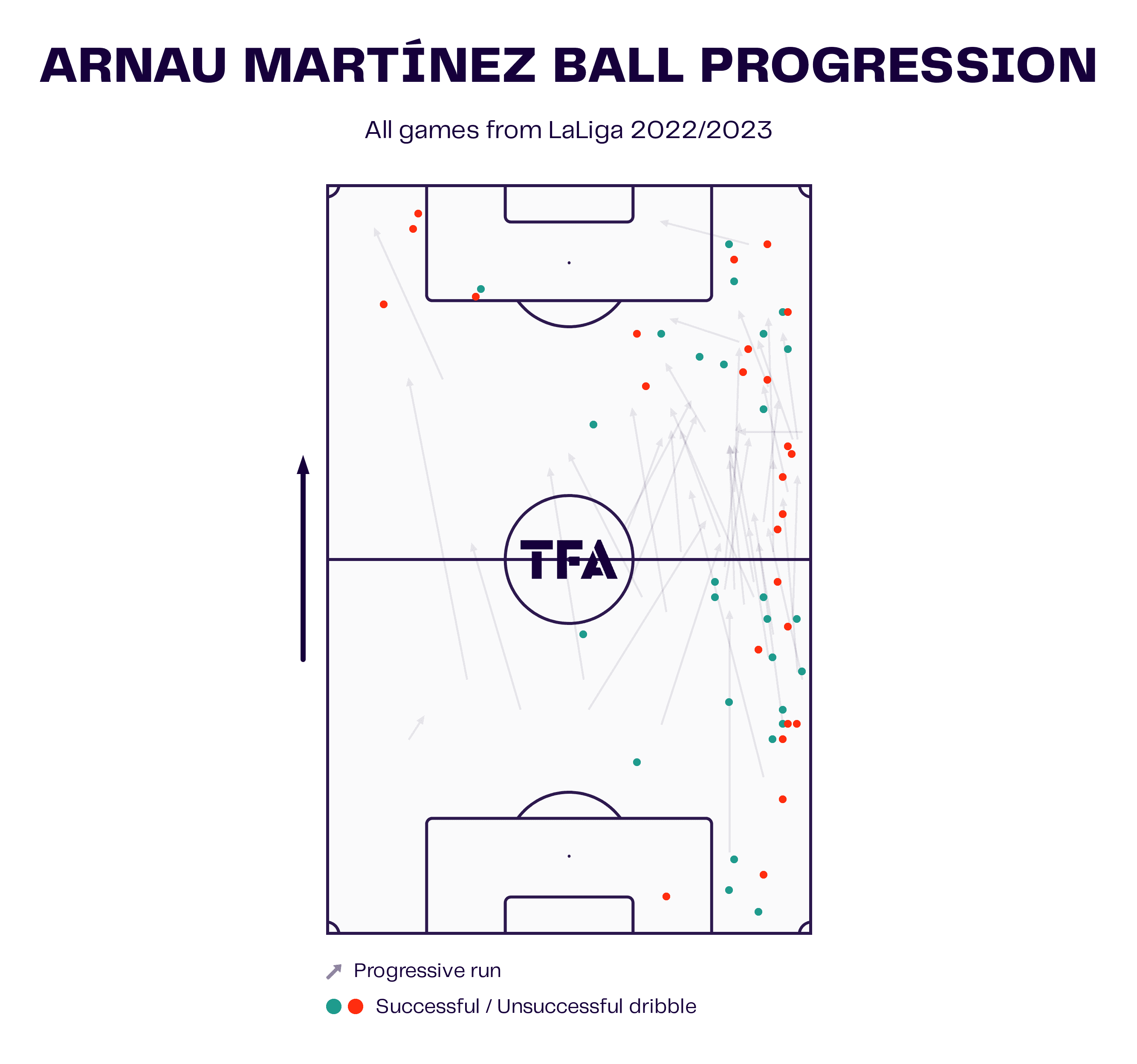
He often receives the ball fairly deep before progressing upfield with it. Figure 5 displays the right-back’s ball progression from this season and indicates the types of areas in which he typically has to take opponents on and try to dribble past. Martínez has made plenty of successful dribbles just inside the final third but also plenty just inside his own half.
The fact he’s had such a presence inside the final third despite often receiving deep is a testament to his dribbling quality. He’s got good close control and very solid ability to beat his man down the right wing.
Additionally, the former LaMasia man provides a threat down the wing in combination with his side’s winger via varied overlapping/underlapping runs on the outside. Thanks to these runs, Martínez can help his team overload the opposition’s left-back and either create space for his winger by attracting the opponent to him or exploit space himself before progressing into a good crossing position.

Figure 6 shows from where his crosses typically come. He switches things up quite a bit, rotating between crossing from more advanced positions near the byline and deeper positions towards the edge of the penalty area.
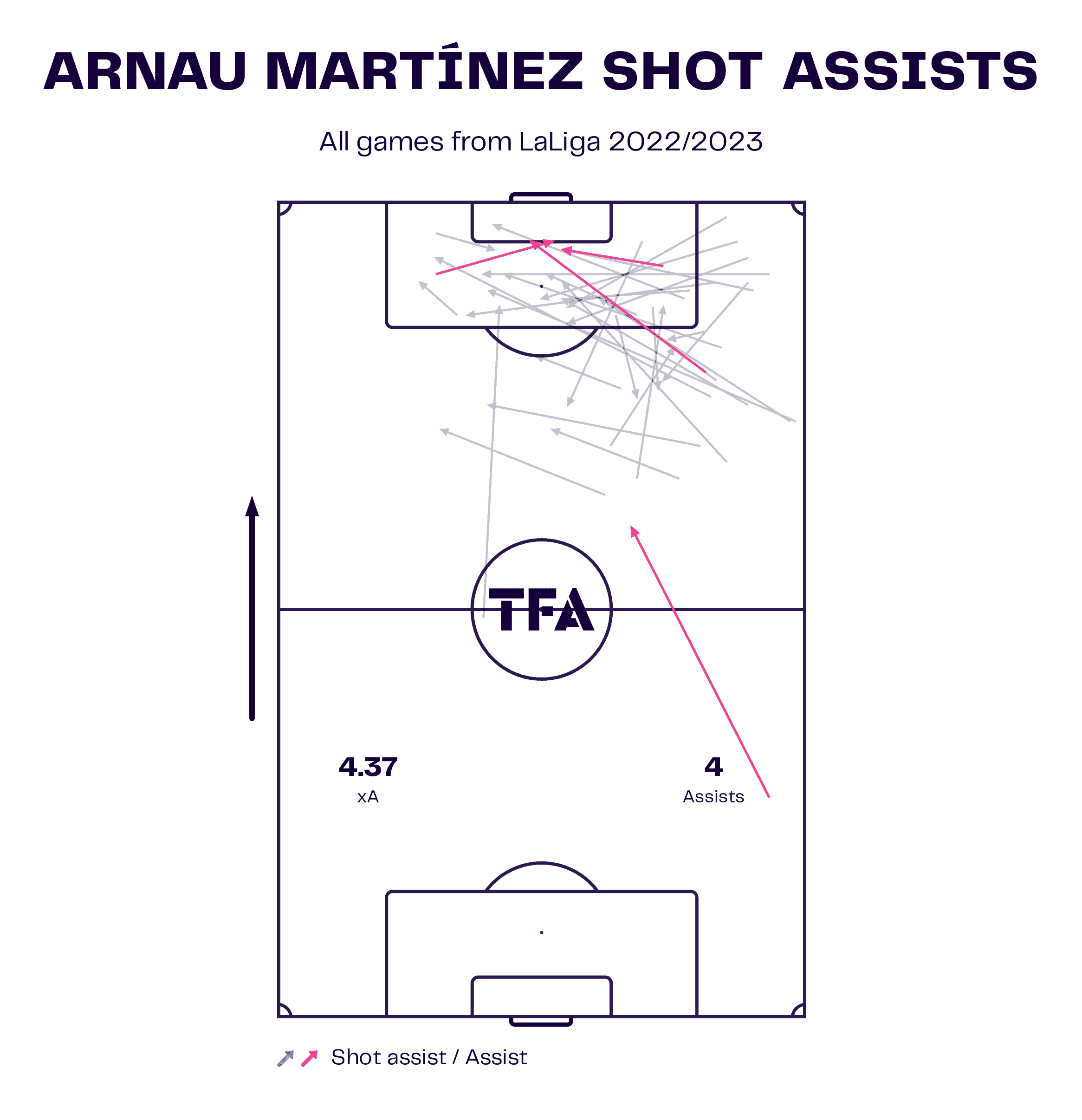
Plenty of these crosses result directly in shots, as figure 7 indicates. Again, this image provides a clear example of how the right-back varies his crossing a considerable amount. Furthermore, Martínez is quite two-footed which also adds to the unpredictability of his game.
The 20-year-old doesn’t just threaten via his crossing, however, he’s also able to create chances via his passing. Martínez possesses top vision and can create with through passes. He’s capable of making dangerous passes in tight areas, as well as over longer distances when required to play into more open space.
On the defensive side of things, firstly, Martínez is a solid option to have defending the back post aerially, as his jumping reach, in combination with his decent height for a full-back, helps him to win plenty of aerial duels, as his 82.5 percentile rank in aerial duels success rate indicates.
On the flip side, he can dive into challenges a little bit too early at times and also has a tendency to leave a trailing leg behind which opponents can exploit by either forcing a foul or jumping the trailing leg and just progressing beyond Martínez with their dribble.
Overall, Martínez is a very promising right-back, especially with regard to what he offers on the ball. He’ll be an excellent offensive asset for Spain in this competition and should provide some entertainment and threat in La Rojita’s games.
Zeno Debast, 19 years old, Belgium U21 and Anderlecht

Next up on our list is Belgium and Anderlecht’s young centre-back, Zeno Debast (191cm/6’3”, 76kg/167lbs). At just 19 years of age, Debast featured in Anderlecht’s starting XI for 100% of their league games this term, playing 96% of all possible minutes for Purple and White in the process.
At 191cm, Debast is physically gifted in terms of size but as was the case with Martínez above, the Belgian centre-back’s greatest strengths lie in what he offers his team on the ball.
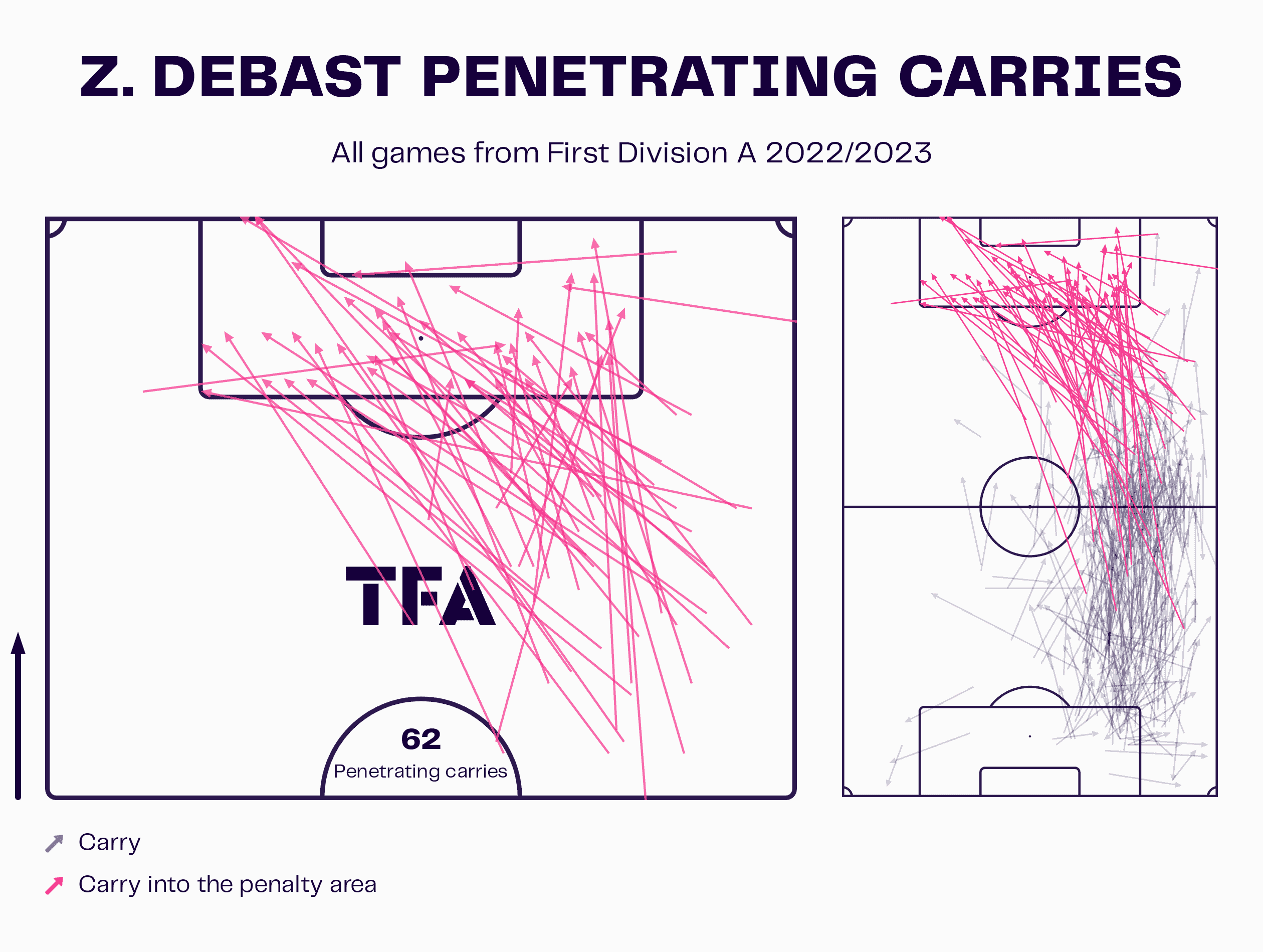
Despite his size, Debast is deceptively quick and agile in possession of the ball. If you took your eye off the game for a couple of seconds before looking back at the screen and missed Debast receiving the ball, you could easily be excused for mistaking the centre-back for a winger due to his ball-carrying quality; he’s very comfortable driving his team forward in possession.
Figure 9 highlights the Anderlecht man’s penetrating carries from the Belgian Pro League in 2022/23. The 19-year-old loves to get the ball at his feet and charge towards the opposition’s box, as the visual suggests.
With Anderlecht, Debast got experience playing as both a right centre-back in a three-centre-back shape and right centre-back in a two-centre-back shape this season, though Purple and White primarily lined up with two central defenders in a 4-3-3 this past term. Even so, it was common to see Debast throwing caution to the wind and darting forward from his centre-back position.
This happened frequently when he recovered the ball after stopping an opposition counterattack. The young Belgian has a good ability to read the game and quite impressive pace. As a result, he can be a major help in defensive transitions and quickly create a dangerous counterattack for his side after winning the ball.
Debast doesn’t like to tackle a lot — he prefers to be a bit standoffish at times, defending with his pace and positioning. Still, he can get caught out at times in terms of how he times his challenges, which can create problems for his side. In general, he likes to try and draw the attacker into a mistake before then pouncing at the first nice opportunity to win the ball rather than aggressively pursue the ball carrier.
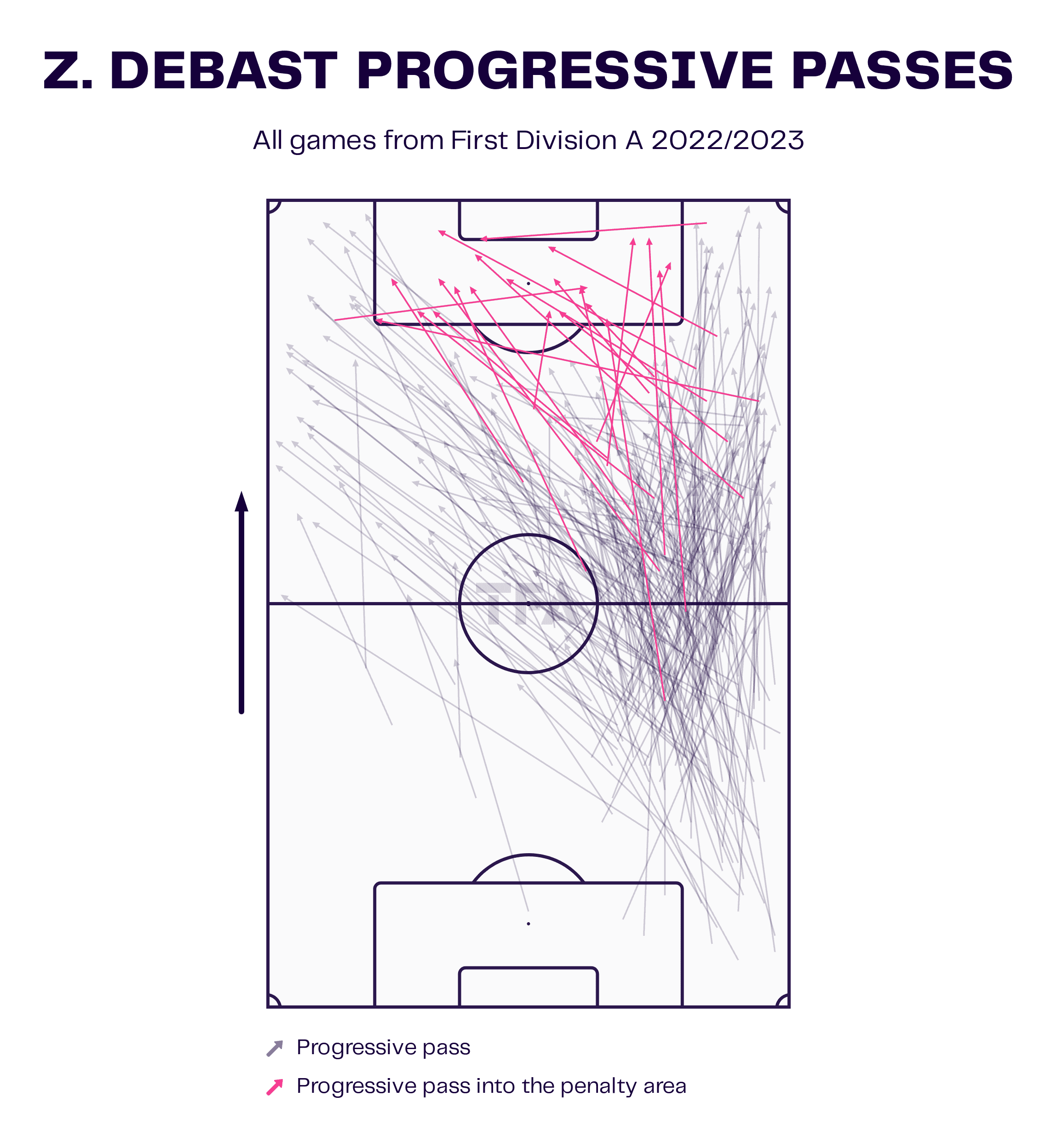
Debast has made the second-most progressive passes (10.88) of any U23 Belgian Pro League centre-back this season; this is also the sixth-most progressive passes of any Belgian Pro League centre-back including those aged over 23.
Figure 10 is Debast’s progressive pass map from 2022/23 which shows how varied his progressive passes are by type. He plays line-splitting balls down the right, into the centre and across the field while helping his team to break the opposition down and create chances.
In any event, the 19-year-old is good at shifting the ball, along with his body, back and forth to create the best possible passing angle.
Along with his technical execution and impressive vision, Debast is smart in how he manipulates the opposition’s press and defensive block with how he moves the ball. At times, he intelligently uses link-up play with nearby teammates to bait the opponent’s press and find a way beyond them — either going around or over the pressing player(s).
In conclusion, Debast is another player who has the potential to be a real treat in possession during the U21 Euros. He has some defensive weaknesses he can still improve on but his ability in transition to defence combines with his quality on the ball to make him a dangerous threat to the opponent at all times; this can make him a fun player to watch this summer.
Bjorn Meijer, 20 years old, the Netherlands U21 and Club Brugge

Taking the short journey from Brussels to Brugge, we find our fourth player to watch in the 2023 UEFA U21 European Championship: Club Brugge’s Dutch left-back, Bjorn Meijer (191cm/6’3”, 89kg/196lbs).
Meijer moved from Eredivisie side Groningen to Blauw-Zwart last summer for €6m. He established himself as the Belgian Pro League side’s starting left-back this past campaign, accumulating 2835 league minutes.
At 191cm and 89kg, Meijer is massive for a left-back. Despite this, his strengths do not lie in the aerial department. He engages in plenty of aerial duels but has just a 46.5 percentile rank for aerial duel success in 2022/23 — not dreadful but certainly not anything to write home about.
The 20-year-old Dutchman is physically gifted but doesn’t always enter aerial duels with a lot of conviction, allowing opposition attackers to get up over him and ultimately win the ball.
Meijer’s body positioning and footwork are sometimes lacking when entering into an aerial duel and he doesn’t possess a very impressive jump height; these are key areas to improve if he wants to make the most of his height at the back post as a full-back.
However, the Club Brugge man is very reliable when engaging in defensive duels, boasting a 93rd percentile rank for defensive duel success percentage. Meijer is good at getting his large frame between the dribbler and the ball, allowing himself to act as a barrier and regain possession for his side in sensitive positions. This makes his team’s left side of defence quite safe and secure.
Going forward, Meijer is a key creative threat for his team, with plenty of goal contributions, expected goal contributions and touches in the opposition’s penalty area to show for it, as the high percentile ranks in each of these areas displayed in figure 11 above indicate.
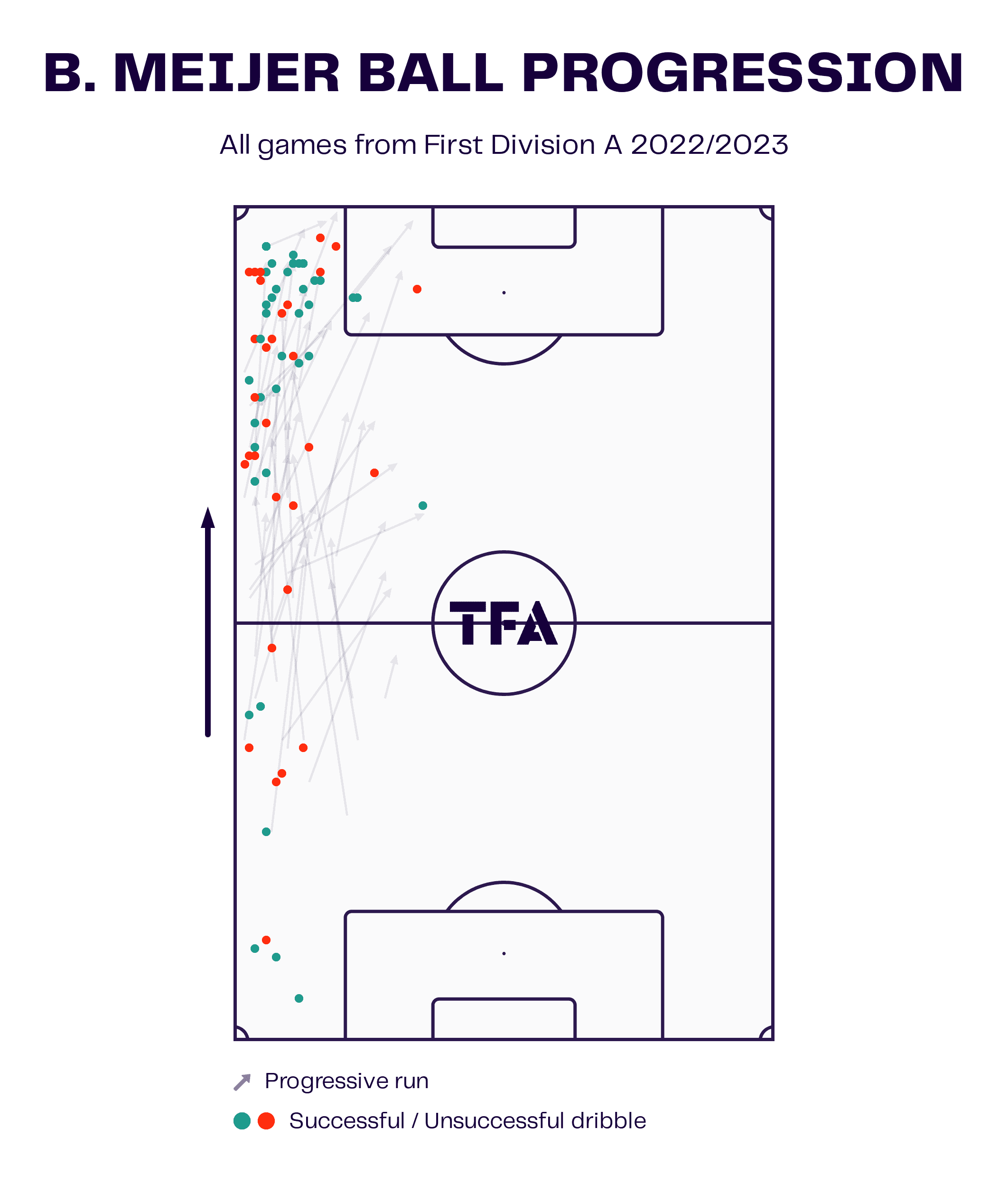
Unlike Girona’s Arnau Martínez earlier, Meijer isn’t required to collect the ball deep and beat men via his dribbling quality in deeper areas before progressing into more advanced positions. As figure 12 above exhibits, in fact, a far higher percentage of Meijer’s dribbles tend to occur in more advanced positions. This is in contrast to Martínez, who had a decent portion of his dribbles coming in deeper zones.

Again in contrast to Martínez from earlier, Meijer’s crosses are not so varied — there’s a lot more consistency in terms of what you can expect from the Dutchman in chance creation. He likes to play hard low driven crosses from advanced areas either just on the edge of the box or just inside the box.
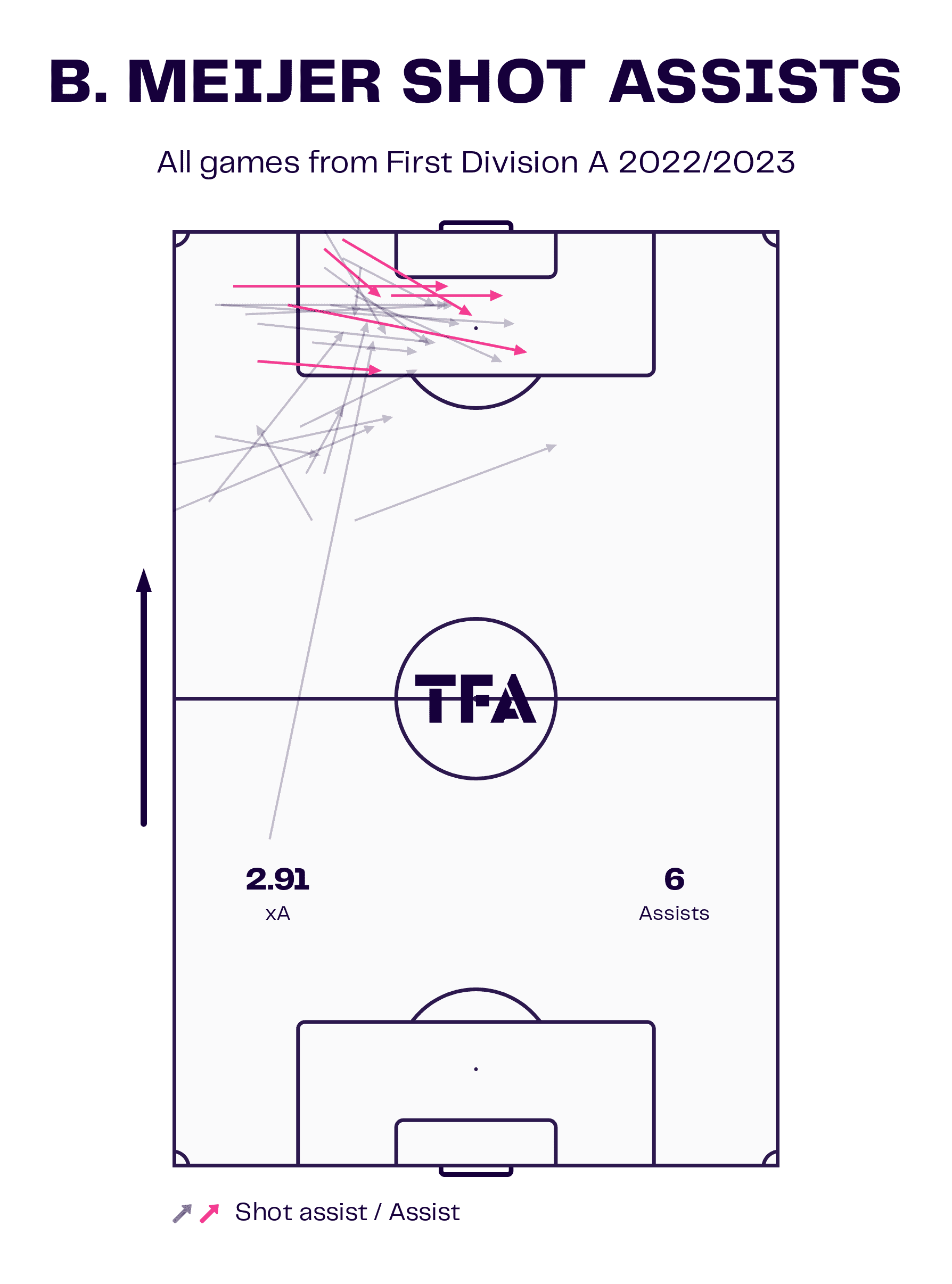
Figure 14 shows the 20-year-old left back’s shot assists from 2022/23 and this further highlights the areas from which Meijer tends to pop up as a creative threat — close to or just inside the box from where his low-driven crosses have a greater chance of causing chaos inside the box that his forwards can capitalise on.
It’s a common sight to see Meijer sprinting down the wing at pace, having just received a ball in behind the backline, aiming to beat his opponent on the outside and gain a few inches of space to drill the ball into the box. The Club Brugge man generally positions himself on the opposition’s last line, looking to receive the through ball and exploit the space in behind rather than dropping to receive to feet.
He has formed a devastating partnership with compatriot Noa Lang at Club Brugge that Belgian Pro League defences found difficult to handle at times this past season. As Lang would come inside, Meijer would overlap and if the winger could find Meijer with a through pass into space down the wing, this could lead to a dangerous goalscoring opportunity.
Lang’s technical quality and gravity (ability to draw opposition defenders to him) on the ball combines well with Meijer’s technical ability and blistering pace and power when running in behind to create a lethal left wing at Jan Breydel Stadium. If the Netherlands U21s can pair Meijer up with an equally devastating partner this summer, their left side could be an important weapon in their search for success.
Jesper Daland, 23 years old, Norway U21 and Cercle Brugge
We don’t have to leave Brugge or even the Jan Breydel Stadium for our fifth and final defender, but we do have to swap Club Brugge for Cercle Brugge as we finish our analysis by taking a look at Norwegian centre-back Jesper Daland (189cm/6’2”, 87kg/191lbs).
The fact he’s been linked with a move to Cercle Brugge satellite club Monaco of France’s Ligue 1 since December tells us a lot about how strong Daland’s performances have been for Cercle Brugge in 2022/23.
At 23 years old, Daland is the oldest player on our list and may also be the only one whose defensive abilities exceed his offensive abilities — perhaps indicating a bit of my own bias there!
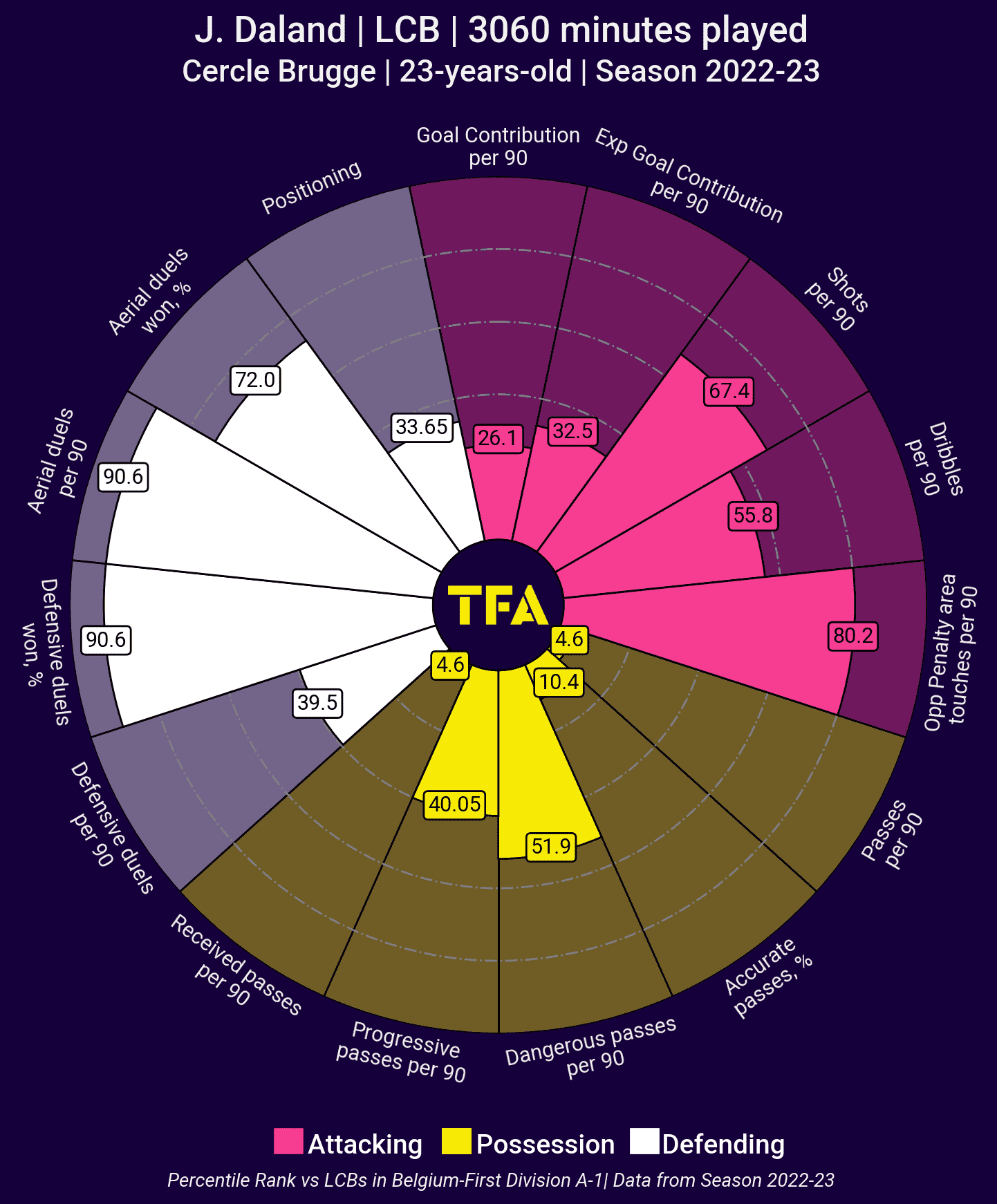
As the radar in figure 15 displays, Daland is excellent in the air relative to other Belgian Pro League centre-backs and is also very reliable in defensive duels, ranking in the 90th percentile for defensive duel success percentage.

Daland is good at winning the ball back high, as figure 16 displays; he’s comfortable stepping out of the backline early, standing attackers up and preventing them from turning or at the very least progressing beyond him thanks to his technical defensive quality and impressive physicality.
Even if he doesn’t win the ball when he steps out, his traits can be useful for stalling attacks and buying his midfielders/attackers time to get back into a more settled defensive shape.
With that said, however, this aggressiveness can backfire on occasion and the opposition can get in behind Daland to exploit the resulting gap in his team’s defence, especially if they remain calm and patient under pressure from him and find a way to play around the big Norwegian.
If they do get in behind, the 23-year-old lacks the recovery pace to always make up for it, so this can be a problem for his team that others need to try and help solve.
Still, going back to figures 15 and 16, we can see that Daland’s aggressiveness often pays off, hence why we still look at the 23-year-old as an overall defensive positive for his side even if he possesses some notable weaknesses for the opposition to potentially target.
On the ball, Daland doesn’t always present a figure of extreme calmness and composure under pressure and can take a second or two too much to get the ball out from under his feet every now and then, which, again, can be targeted perhaps by an opposition press, for instance.
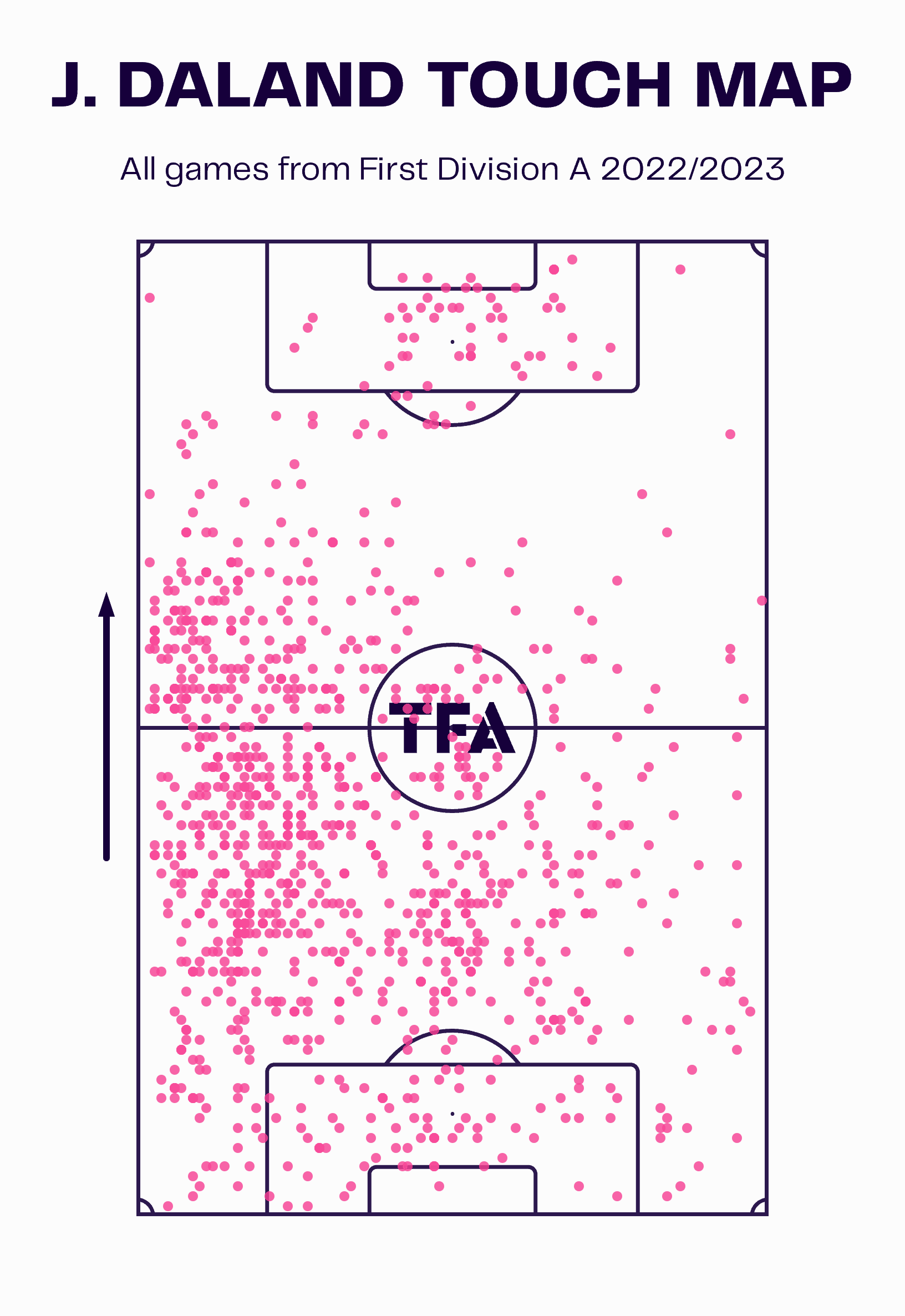
As the touch map in figure 17 shows, though, Daland gets involved quite high up the pitch. He is a centre-back who’s happy to provide options in advanced areas and support the attack.
Furthermore, with his 55.8 percentile rank in dribbles per 90, he’s comfortable bringing the ball out into midfield — and even beyond that — from left centre-back, driving into dangerous areas from where he can help his team break into the final third.
Daland possesses impressive speed and ball control when driving forward in possession. His carrying out from the back is definitely a tool that his team can and should make use of. Overall, if Norway are to achieve success in this tournament, they’ll need Daland on top of his game as the apparent Monaco target is one of their key players.
Conclusion
To conclude this analysis, we view France’s Castello Lukeba, Spain’s Arnau Martínez, Belgium’s Zeno Debast, the Netherlands’ Bjorn Meijer and Norway’s Jesper Daland as five exciting defenders to keep an eye on at this summer’s U21 Euros.
Feel free to join us in tracking these players throughout the tournament to see how they and their respective teams get on. Perhaps the competition will act as a reputation and hype launchpad for some, as international tournaments often do!

![PSG Vs Newcastle United [1–1] – Champions League 2025/2026: A Tactical Arm-Wrestle In Paris – Tactical Analysis](https://totalfootballanalysis.com/wp-content/uploads/2026/01/PSG-Vs-Newcastle-20252026-350x250.png "PSG Vs Newcastle United [1–1] – Champions League 2025/2026: A Tactical Arm-Wrestle In Paris – Tactical Analysis 22")

![Napoli Vs Chelsea [2–3] – Champions League 2025/2026: How Game Management Cost Antonio Conte – Tactical Analysis](https://totalfootballanalysis.com/wp-content/uploads/2026/01/Napoli-Vs-Chelsea-20252026-350x250.png "Napoli Vs Chelsea [2–3] – Champions League 2025/2026: How Game Management Cost Antonio Conte – Tactical Analysis 24")


