


On the last day of the summer market window, when everyone was expecting Barcelona to sign someone to replace Messi (or at least Atletico Madrid-bound Antoine Griezmann), the club announced the signing of a 19-year-old winger from Hércules, who had played just under 1,000 minutes in Segunda B: Abdessamad Ezzalzouli “Abde”.
Born in Morocco, Abde came through the academy at Hércules.
He made his debut for Hércules B aged 16 and that season they achieved promotion to Tercera, the Spanish fourth tier.
In total, he played 48 games for Hércules “B” over three seasons.
Last season, he was promoted to their first team, playing almost a thousand minutes across 17 games.
His performances at the end of the season were enough to catch the attention of Barça.
At the international level, Abde has represented Morocco U20 and U23 but is still to decide his senior national team as he can also represent Spain.
Morocco is likely to call him to the upcoming African Cup of Nations, so he’ll have to make a decision soon.
In this Abde Ezzalzouli Scout player analysis, we’ll examine how the 19-year-old Moroccan fits into Xavi’s tactics, as well as his strengths and weaknesses.
Abde Ezzalzouli Data Profile
Abde is just starting his career at Barcelona, and despite showing nice details, he’s still getting into the team and proving his worth.
In this section of the tactical analysis, we’ll have a look at his data last season with Hércules in Segunda B (third tier) to understand why Barcelona signed him and what he can potentially bring to the club.
 Looking at his data profile above, it’s clear that Ezzalzouli was an outstanding attacking player last season.
A relentless dribbler, he ranked in the top 3% among wingers in his league in attempted dribbles (10.74 per 90) and completed a high percentage of them (57.14%).
Skilled in tight spaces but also fast, he was in the top 2% for progressive runs with 5.59 per 90.
He started mostly on the left, looking to create from there.
His end product was also quite good, ranking in the top 25% for shot assists (1.21 per 90), key passes (0.66 per 90), expected assists (0.18 per 90) and assists (0.22 per 90).
In terms of scoring, he got into good positions (0.24 xG per 90, top 20%), but his finishing was below par, scoring just 0.19 goals per 90.
A direct winger oriented to dribbling, his passing numbers are not particularly impressive.
In defence, he worked very hard (9.54 defensive duels per 90) and possesses good physicality and intensity to recover the ball, winning 58.62% of his defensive duels; this is undoubtedly something Barcelona also valued when considering him.
All these statistics are from his 962 minutes at Hércules, so it’s still not a huge sample.
To add some context, he had just two goals and two assists, which look much better when expressed in per-90 figures.
According to our exclusive xGOLD tool, Abde’s most statistically similar player in the EPL is Bergwijn (83% similarity).
Abde Ezzalzouli Positioning
With Hércules, the Moroccan played on the left and had more freedom to come inside and receive the ball between the lines.
He was more dominant at that level so it’s normal that his team looked to find him as often as possible and in different situations.
In the map below, we see all the passes Abde received last season at Hércules in Segunda B.
We see he mainly played wide on the left but also had some presence in the left half-space, both in the middle and the final thirds.
Abde Ezzalzouli Ball Receptions Map At Hércules 2020/2021
 Since Ezzalzouli arrived in Barcelona, he has been used on both sides but always very wide and with less freedom to roam around the final third.
Very disciplined and patient, waiting wide until his team can generate a good 1v1 situation for him, the 19-year-old has understood very well what Barcelona and Xavi require from him.
Abde Ezzalzouli’s style of play remains essentially unchanged, regardless of which side he plays on.
The map with his ball receptions in La Liga shows this very well.
He gets the ball very wide and high up the pitch.
His involvement in central areas is almost non-existent, and so is his participation in the Barcelona build-up play.
Abde Ezzalzouli Ball Receptions Map At Barcelona 2021/2022

His role for Xavi is simple and clear.
He must provide width so that Barcelona can quickly move the ball to his side and allow him to engage in one-on-one duels.
In the next section of the scout report, we’ll have a look at Abde’s dribbling skills, which will help us understand why it’s crucial for Barcelona that he stays wide and gets the best possible chances to take on his marker.
Abde Ezzalzouli Dribbling Skills
When asked about Xavi’s instructions after the game against Betis, Abde replied, “Xavi tells me to dribble, so I dribble.” – And that defines his playing style.
Dribbling is always Abde’s first choice, and his intention is clear: get the ball into the box or shoot.
He’s skilled in manipulating the ball in tight spaces and has excellent acceleration and pace.
He’s also quite physical, resisting challenges, and at his age, he’s expected to continue building muscle.
Despite being right-footed, he isn’t predictable and can cut inside or dribble on the outside from either wing, as he’s not afraid to attempt shots and crosses with his left foot.
In the map below, we see all the dribbles Abde has attempted in his minutes at Barcelona’s first team.
We can see how he dribbles mostly in the final third, showing again that he’s patient enough to wait for the right chances to do so.
Additionally, he completes a significant number of his dribbles, especially considering how close to the box he dribbles.
He has also completed six dribbles in his half, most of which were used to initiate counterattacks.
Abde Ezzalzouli Dribbles Map

Let’s see some examples.
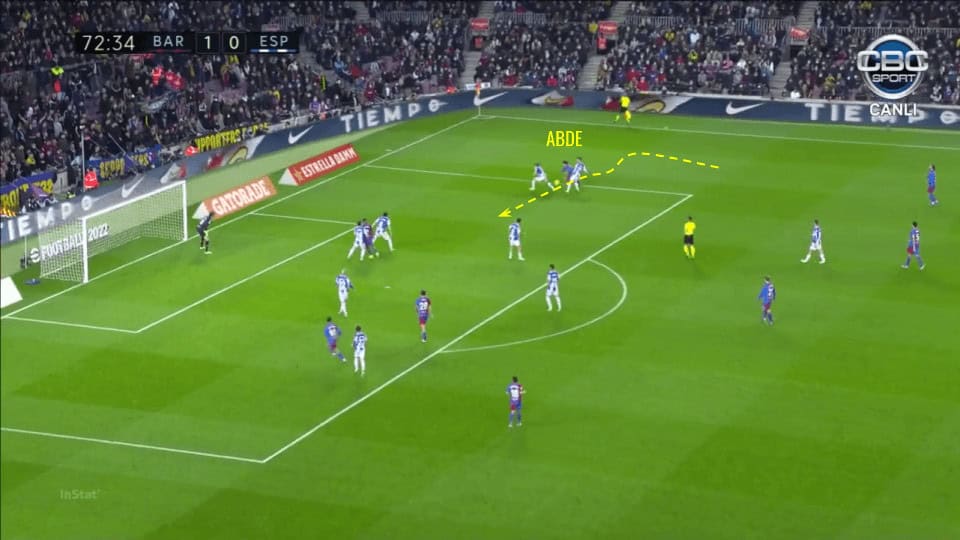
In the first example below, Ezzalzouli attempts to enter the box from the right side but is blocked by two Espanyol players.
With two quick touches – one to the outside and one lifting the ball between the two players – Abde gets into the box and a good shooting position.
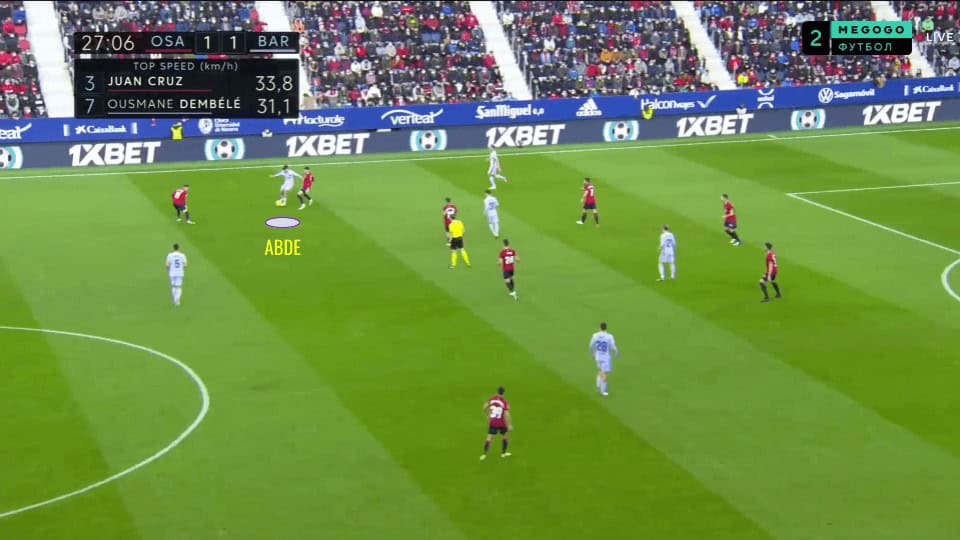
Standing at 1.77m and very mobile, Abde also has the ability to turn and leave rivals behind using his body.
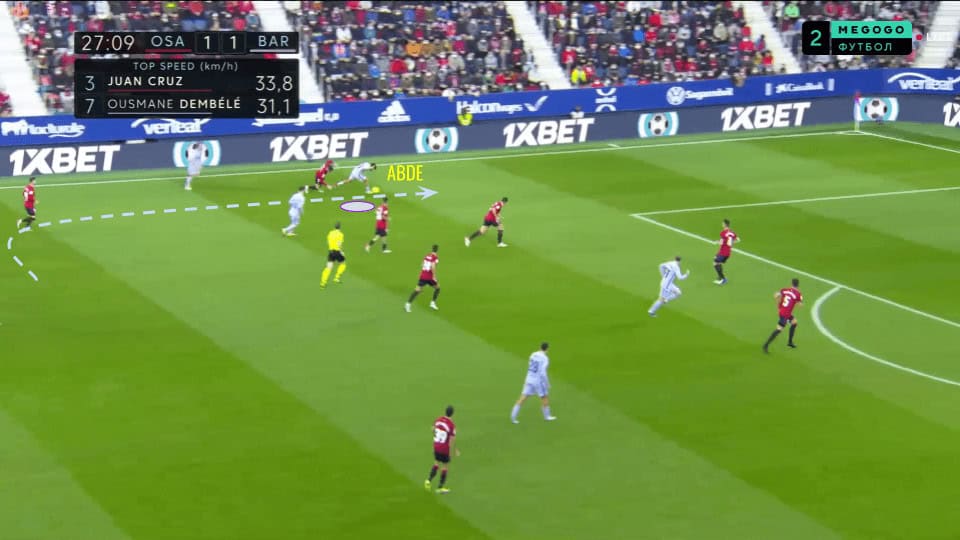
The next play is a good example.
Abde receives a long pass and controls it while using his arm to hold the rival.
With the sole of his foot, Ezzalzouli drags the ball and turns quickly to then accelerate and leave the rival behind.
He ends up provoking a foul.
Here, Abde demonstrates his strength and power in the first meters, complemented by his skill in manipulating the ball and his agility in turning and accelerating.
Another key aspect of Abde’s dribbling is his pace.
We’ve already seen his acceleration and agility, so in the following example, we’ll focus on his speed over long distances.
At Barcelona, Abde doesn’t usually have a lot of space to dribble as he should be waiting wide in the final third but he does enjoy some chances to show he’s rapid in counterattacks.
The sequence starts with Barcelona clearing the ball after a corner and Abde going for it. We see the Osasuna player has a slight advantage when they start running.
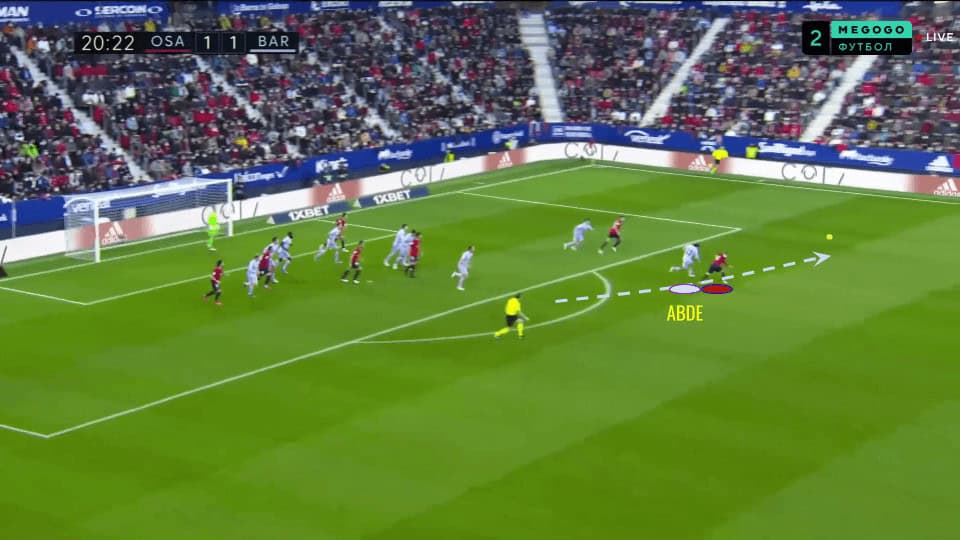
In the second picture, we see Abde’s first touch of the ball.
He’s already left behind the Osasuna player, even if he tried to pull his shirt and start running forward at full speed.
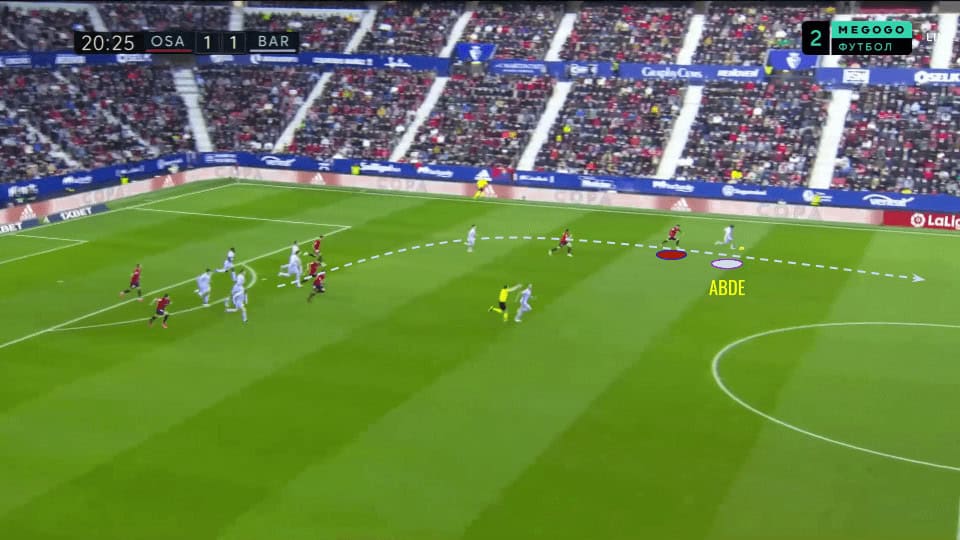
Lastly, we see him arrive at the edge of the rival box after running over 70 meters in around nine seconds.
We have marked the player who raced Abde at the beginning to give some context.
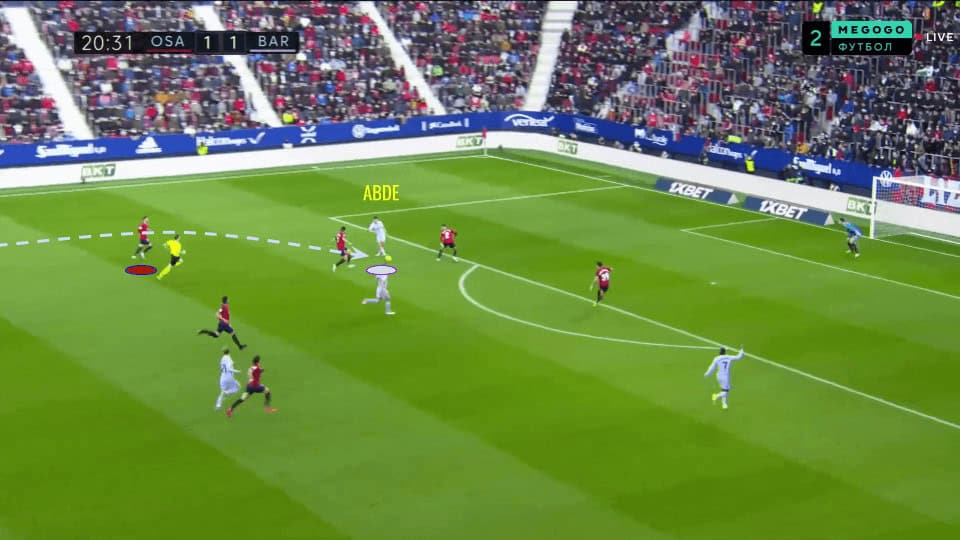
Even after a very long run with the ball at his feet at top speed, Abde raises his head and chooses a simple but good pass, but Luuk de Jong fails to continue the play.
We started this section of the analysis by stating that Abde looks to dribble almost in every play.
While he does well to stay wide and he’s usually in a good situation to dribble when he receives the ball, there are still some plays in which he should decide better, be more patient and pass the ball instead of running at his marker.
Ezzalzouli focuses too much on getting the ball into the box himself and can miss some good chances to combine with the overlapping full-back or get into the box with combinations and running in behind.
He needs to understand it’s not always possible to shoot or cross when he receives the ball.
Let’s see a couple of examples that illustrate this.
The first one is a sequence in which Abde starts wide on the left and has the ball at his feet for 15 seconds, dribbling, turning, and changing directions numerous times until he manages to get to the end line.

Ezzalzouli, indeed, ends up getting into a good position to cross.
However, during the play, he has several chances to pass the ball and accelerate the play.
With his skill and agility, he gets away from players (there are five dribbles in these 15 seconds) but makes it unnecessarily difficult when he could have gone for a 1-2 or even shot/cross after the first dribble.
The next one is similar.
Ezzalzouli starts wide on the right, with Sergiño Dest overlapping him and offering a clear passing option.
Instead of choosing that simple option, the Moroccan prefers to cut inside.
After the first dribble, he again has an easy passing option to combine with Gavi, but he tries to dribble again and ends up passing the ball to Gavi, but in a worse situation, so all the danger dissipates.

These two examples also provide some good context for Abde Ezzalzouli’s crazy dribbling stats.
He completes at least seven dribbles between both plays but they don’t add too much to Barcelona’s attack even if they look excellent on his statistical profile.
This is something we should keep an eye on for any dribbler we analyze.
While this issue in his decision-making isn’t the worst thing (it’s better to have too much confidence and willingness to dribble than not having enough), it should be something Xavi focuses on.
It will surely improve as he plays and trains, but it can’t be ignored.
In the next part of the tactical analysis, we’ll see what Abde creates after his dribbles.
Dribbling will still be an important part of it, as it’s Ezzalzouli’s trademark trait.
Abde Ezzalzouli End Product
Currently, Abde is creating more of a sensation of danger than actual opportunities.
His excellent dribbling skills and his determination to get past his man and shoot or get the ball into the box are enough to change games and make things happen.
However, he has only scored three goals and provided one assist in his senior career for Hércules, Barcelona B and Barcelona.
His two goals and two assists last season look just ok for a player in a lower league.
With Hércules B, playing in the fourth and fifth tiers of Spanish football, he scored 0.31 goals per 90, which is good for a winger but, again, not excellent considering he’s a Barcelona player in La Liga now.
Let’s see how Abde creates his chances.
Abde Ezzalzouli Key Passes & Crosses Maps
 Above, we have the maps of Abde Ezzalzouli’s key passes and crosses for Barcelona (left) and for Barcelona B and Hércules combined (right).
Both maps are quite similar.
First, we see Abde doesn’t create changes from central areas.
He doesn’t have the quality to play through passes and when he’s in those positions, he prefers to shoot.
So Abde’s primary source of assists will probably be crossing, both high and low.
With Barcelona, he crosses more from inside the box and reaches the byline more often, but for all his teams, the accuracy has been very poor.
The fact that only five of his crosses and key passes have been accurate in his career is quite worrying.
In terms of assisting, Abde seems to be a quantity-over-quality player.
He gets the ball into the box and crosses a lot and usually into decent positions but isn’t someone who will create with intricate passes and depends a lot on his teammates making the right movements in the box and understanding him.
Barcelona isn’t offering a lot of movement in the box at the moment, which is another reason why he struggles to get assists; however, he can still raise his head and coordinate with his teammates more effectively.
Moving into Abde Ezzalzouli’s scoring ability, he is still far from proving to be a decent goalscorer.
He creates lots of chances to shoot with his dribbles but it’s usually from difficult positions and his finishing is inconsistent or at least nothing special.
In the maps below of his shots for Hércules (top) and Barcelona (bottom), we see that he usually shoots from the left side and either from the edge of the box or from wide, which are the zones he can enter with his dribbles.
With Barcelona, even if the sample is still small, he has shown some ability to get into shooting positions at the far post when the attacks come from the opposite side, which is how he got the two shots circled and his only goal so far.
Abde Ezzalzouli Shots Maps

Looking at where Ezzalzouli’s shots end up, it isn’t easy to find patterns.
The 19-year-old winger often goes for power over accuracy, so lots of his shots are off-target or go too central.
Abde seems more accurate when he shoots to the left side of the goal or at least those shots go closer to the post.
Considering he shoots mostly from the left, that means he can catch the goalkeeper off-guard with shots to the near post.
What’s good about the Moroccan youngster, and immediately related to his dribbling ability, is his ability to get shots from either side.
Apart from not being afraid to shoot with his left or right foot, he’s swift and skilled at creating space for his shots, as we’ll see in the following examples.
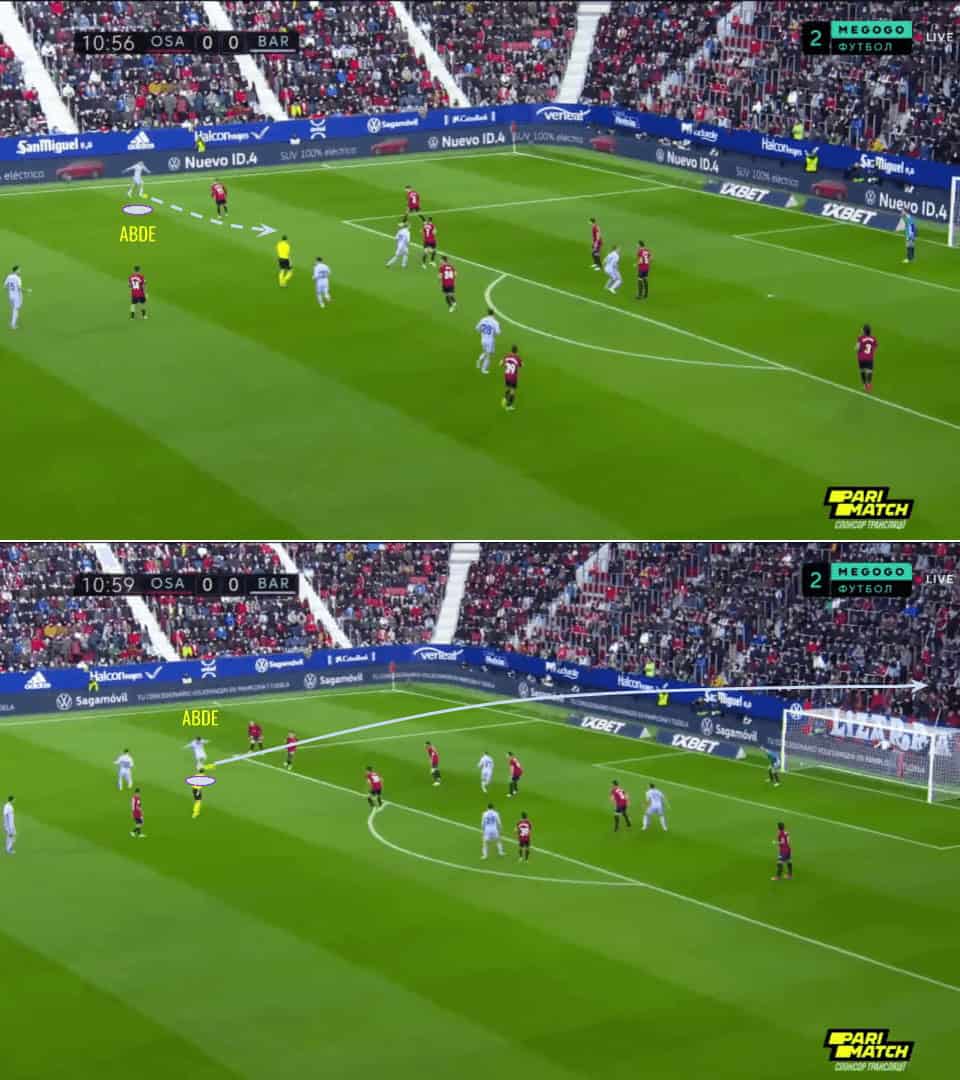
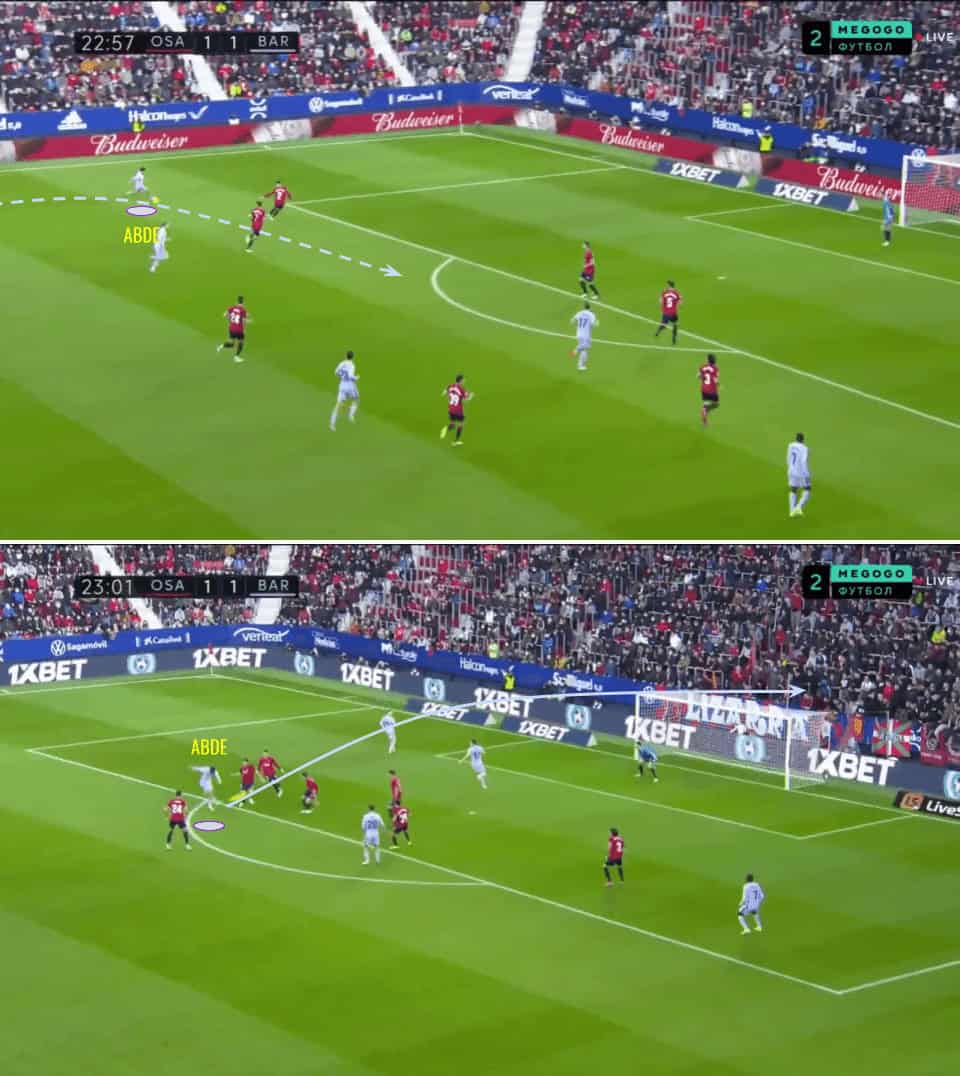
In the two examples above, Abde Ezzalzouli receives the ball on the left side and, with quick movements, creates space to shoot.
Both shots are indeed from difficult positions, but again, Abde creates more in quantity than in quality.
 He can also do that coming from the right and dribbling on the outside like in the example below.
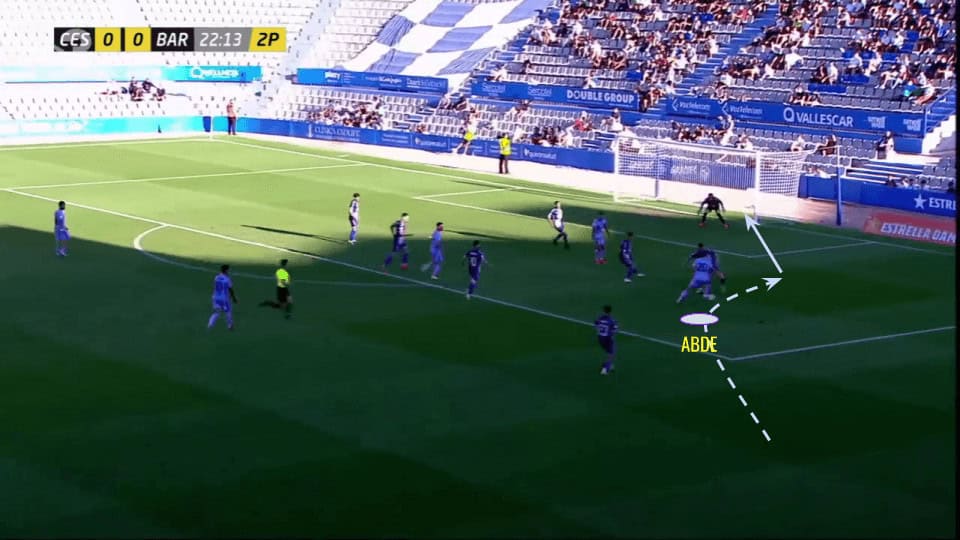
What he seems to be improving is his ability to get into scoring positions with off-the-ball movements.
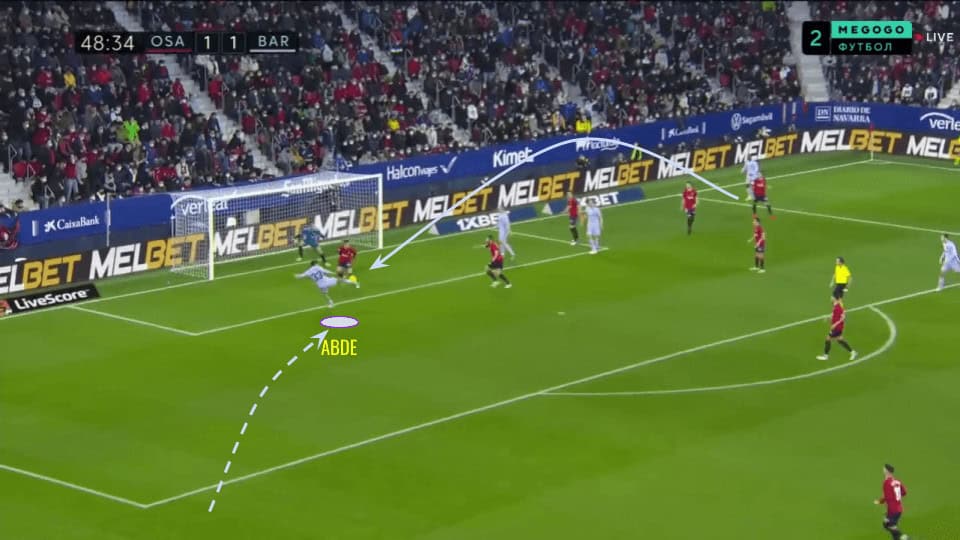
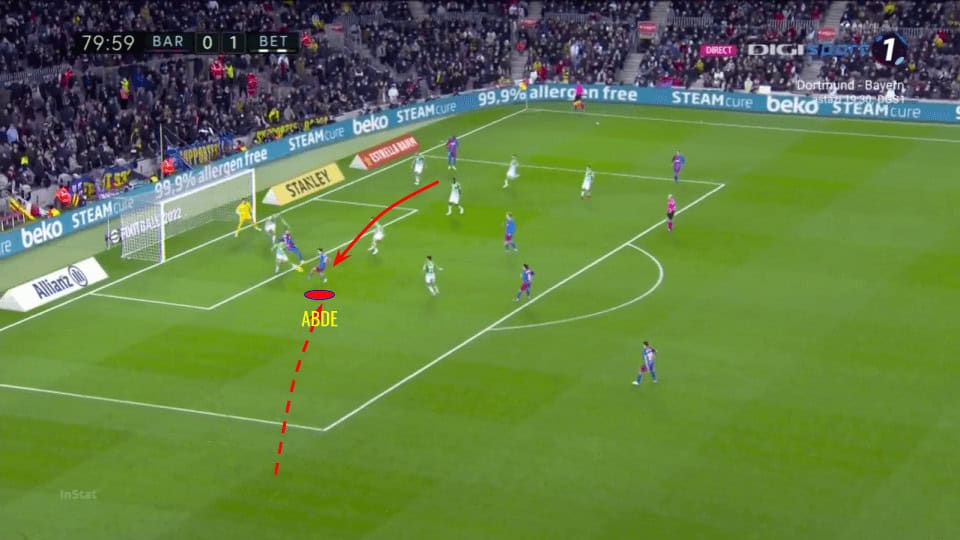
In his few games with Barcelona, we have seen him attack the far post when the attacks come from the opposite side, where he has created his best chances (and scored his only goal so far) this way.
Two examples of him getting into good positions are shown below.
For a player who, at the moment, seems to be struggling to finish, these movements add a lot as the chances of him scoring from these opportunities are much higher.
To summarize, we could say Abde’s end product still has a long way to go.
He hasn’t scored or assisted a lot either in Segunda B or La Liga yet, but at least he creates numerous opportunities to shoot or get the ball into the box.
With some improvement on his part and his teammates understanding him better, he should be able to add more goals and assists and finally translate all the danger he creates into the scoreline.
Abde Ezzalzouli Defensive Work Rate
The last part of Abde’s game we want to analyze is his work rate in defence.
Barcelona were looking for energetic players who could press and defend as intensely as before and even more so since Xavi arrived.
Ezzalzouli is precisely one of those players, especially since he didn’t come through a dominant academy.
Hence, he’s probably more used to defending than other top talents who could focus on attacking during their academy years.
Last season, the Moroccan already had a fantastic work rate, as we previously saw in the data analysis section.
However, after being selected for Barça’s first team, he has realised that he needs to give his all every time he’s on the pitch and not disappoint.
Abde Ezzalzouli Defensive Actions Map

If we examine Abde’s defensive actions (defensive duels and tackles: blue if successful and red if not; interceptions: yellow) for both Barcelona B and Barcelona this season, we see how much he helps his team off the ball.
He has a lot of interceptions in the opposition half, but what’s more impressive is his presence in his own half, supporting the full-back and recovering many balls.
His ambition and determination to help Barcelona and keep his place in the starting eleven are exactly what Barcelona needs. Let’s see a couple of examples.
The following sequence shows a defensive transition against Betis.
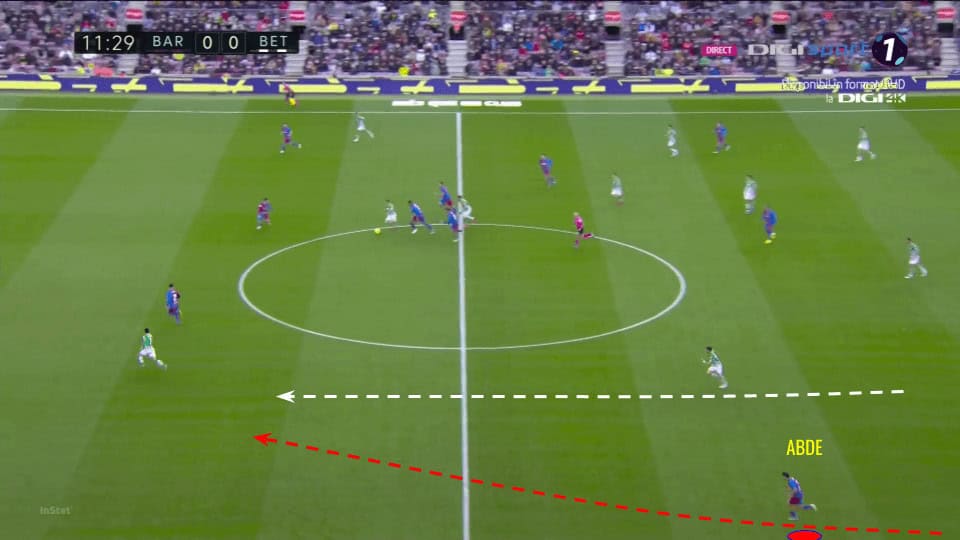 In the first picture above, Betis have just regained possession of the ball. We see how Abde sprints to track the rival who’s joining the attack.
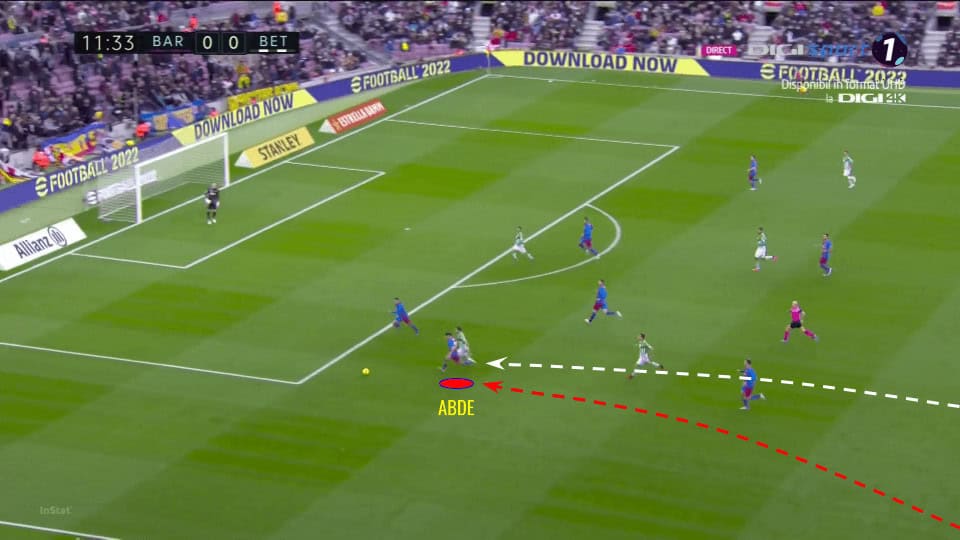
In the second instance, just four seconds later, Ezzalzouli overtook his rival and ensured Barcelona could recover the ball.
These transitions at full speed are normal in Abde, and they help a lot, as not every Barcelona player has the energy and fitness to run like that anymore.
The next play also shows his non-stop running and defensive commitment.
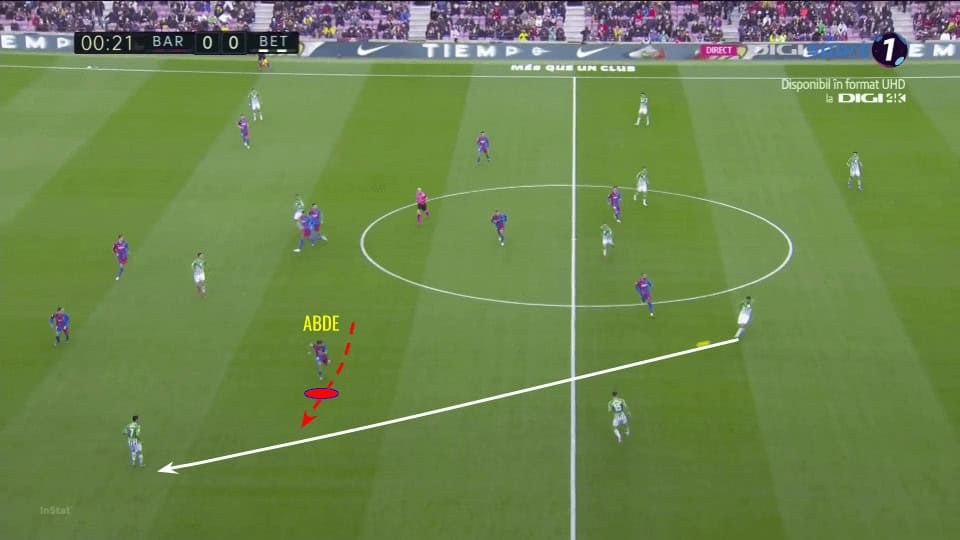
The play starts with Barcelona in a middle block and Betis playing wide.
Abde sprints to intercept the ball but doesn’t succeed.
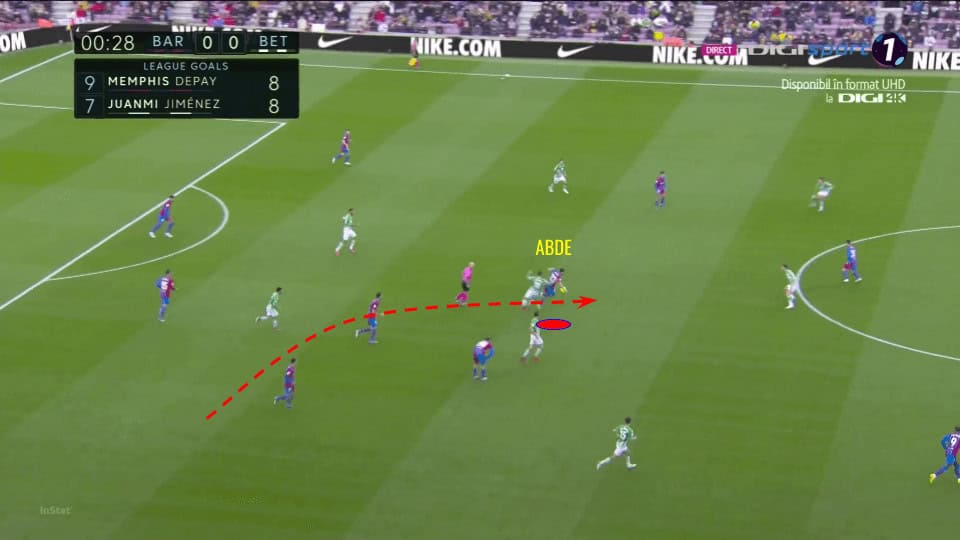
Instead of stopping, he continues his run and catches his rival by surprise to win the defensive duel.
But it doesn’t stop there, and Abde immediately transitions into the attack by getting past two players at full speed.
The play ends with Abde being fouled.
As it’s normal, he still needs to grasp some concepts about how Barcelona want to press under Xavi’s tactics, and he has some disadvantages there compared to La Masía players, but he makes up for it with his work rate and willingness to learn.
Conclusion
Abde has several rare traits that make him a perfect winger for Barcelona’s tactics and playing style.
He’s great in 1v1, fast, works extremely hard and is patient with his positioning.
His end product is still very inconsistent but so is Ousmane Dembélé’s, the player he’s expected to replace in the short term.
Both Dembélé and Abde Ezzalzouli share a lot in common and are playing at a similar level.
However, with Abde costing just two million euros (one-seventh of the price Borussia Dortmund got for Dembélé) and being four years younger, the 19-year-old Moroccan seems to be the natural replacement for the French winger, whose contract expires in the summer.

