
Shamrock Rovers Women has long been a name synonymous with women’s football in the Republic of Ireland (RoI), with the team being top-flight regulars for many years and securing plenty of silverware back in the 1990s and early 2000s. However, despite those successes, the team was disbanded in 2014, with the club announcing that they would be focusing their efforts on developing the men’s team from that point as they tried to grow the Rovers brand around Tallaght (the town in South Dublin where they are based) and make it stand for something in the local community.
Fast forward nine years though and the women’s team has finally made its long-awaited return, with them successfully reclaiming a place in the top flight (known as of 2023 as the Women’s Premier Division) from this season and looking to get back to where they were before. The early signs in that regard are good, with six wins and three draws and an unbeaten record (the only side in the division still to have one) indicating that the hard work that has gone on off the field to build the squad and implement the game plan has not gone to waste.
What has particularly caught the eye about their displays so far is the simplicity with which they have performed, with head coach Collie O’Neill demanding that his players don’t overcomplicate matters and instead focus on doing the basic things well, and this tactical analysis will expand on how that has benefitted them with and without the ball and allowed them to start their second life in such promising form.
Central overloads
When looking at an overview of O’Neill’s tactics, it is clear to see that he prefers possession-based football and wants his Shamrock Rovers Women team to control the flow of their games, ensuring that they don’t rely on their opponents to do them favours and instead keep their fate in their own hands.

With that in mind, he likes his side to numerically overload the central channel to ensure that, when the ball enters the final third, they have as strong a chance of scoring as it is possible to have. However, with his side lining up mainly in a 4-2-3-1 formation (something they have done in 44% of their matches so far), players have needed to show versatility when they don’t have the ball in order to adjust their positions and not remain in the same areas of the field for the entire 90 minutes.
This has played directly into the hands of Áine O’Gorman, who has demonstrated throughout her career that she can play on either wing, as a striker, in an attacking midfield role and at full-back, and she has been able to combine all of those skills into one package this season which has really benefitted Rovers.
With her able to move into all three channels and drop deep as well as push up the field, her vision and wide range of passing have become key aspects of Rovers’ play, and, as a result, the rest of the team have looked to use her as a pivot and to build around her. In this case, left-back Lia O’Leary has identified a gap on the near side of the field and has made a run into it, providing O’Gorman with the opportunity to switch the focus of play across the pitch and to exploit the space that Athlone Town Ladies have left open.
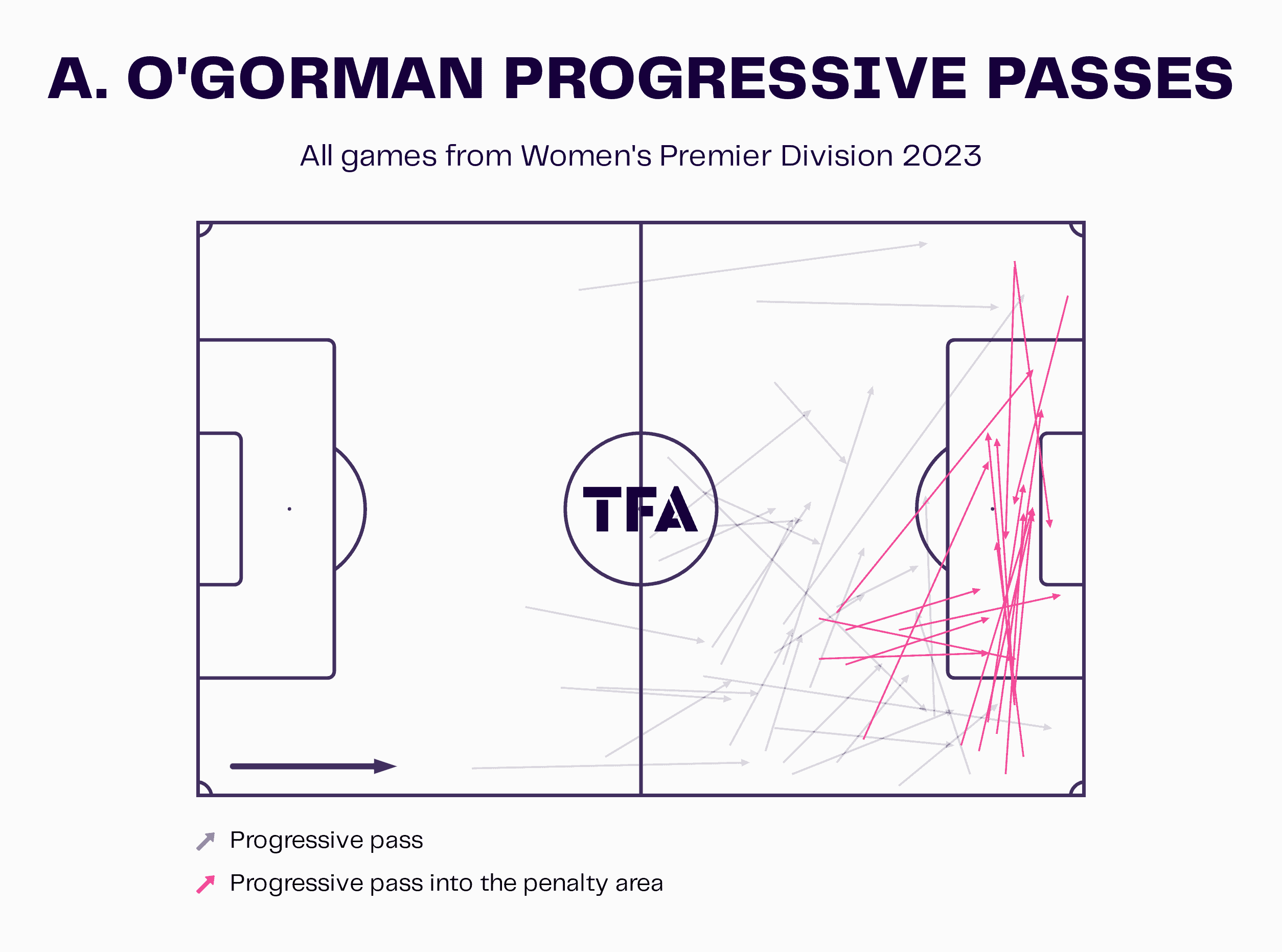
That pass led to a goal for O’Leary, and it was not the first time that O’Gorman has been responsible for starting attacks and creating goalscoring opportunities for her teammates, with this graphic indicating the number of progressive passes that she has made during the season so far.
It is evident from this just how much of an influence she has on her side’s attacking play, with her capable of starting attacks from almost any position on the field, and RoI head coach Vera Pauw will no doubt be relying on her to do the same things when the World Cup gets underway later this year.
O’Gorman is not a player who tends to attract the on-pitch headlines, with Arsenal Women’s Katie McCabe, Denise O’Sullivan, who features for NWSL side North Carolina Courage, and Birmingham City Women’s Louise Quinn (who has also played for Arsenal and Serie A Femminile side Fiorentina Femminile) the star names in the squad, but the Rovers player will be one to watch when the tournament does begin.
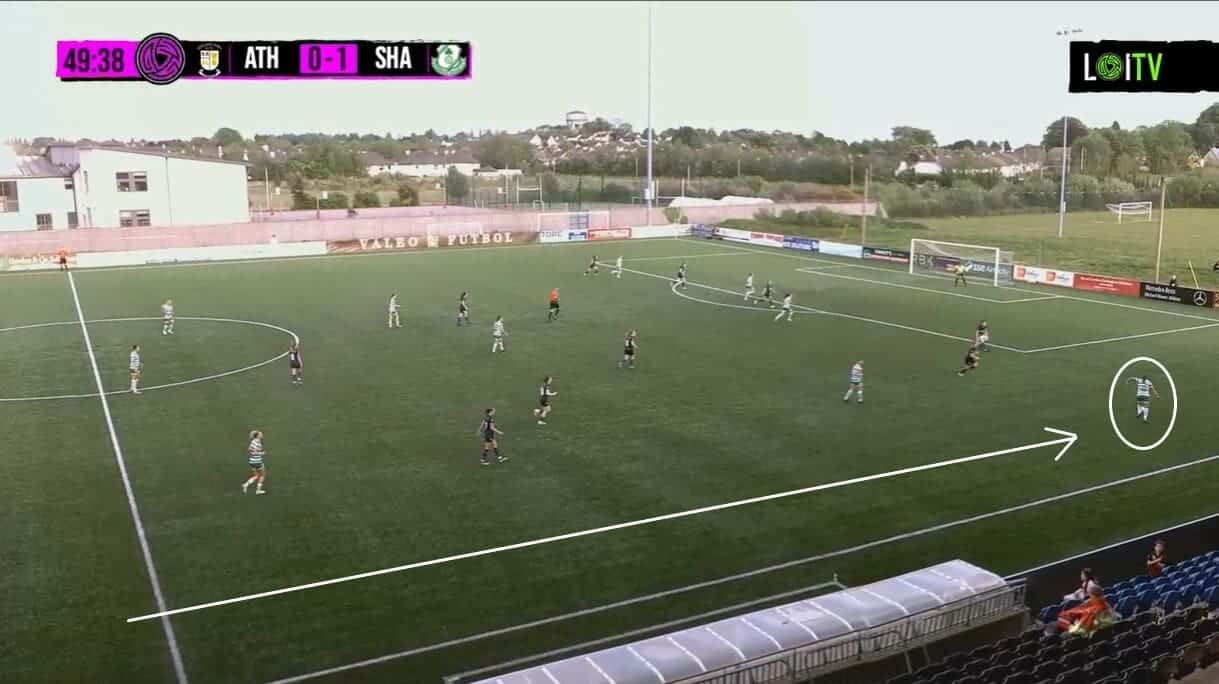
The reason that she and others are able to cut inside and play so centrally is that Rovers have full-backs who are happy to move up the pitch and offer support from the wings. On the left, O’Leary’s attacking threat has already been made clear, but right-back Jessica Gargan is just as dangerous, with her in line with the forwards here at the moment that she receives a long pass from her defensive teammates.
The key point to note here is the distance that the ball travels because it means that Rovers’ opponents, in this case Athlone, don’t have the same amount of time to set up their defensive line as they would if the ball was travelling towards them through the thirds, as the second eventuality would give them warning of what was coming. This long pass has instead caught them off guard, and so they are unable to drop back in time and prevent Gargan from transferring the ball into their goal area with the next pass.
On this occasion, nothing comes of the opportunity, but there have been plenty of examples of Shamrock Rovers playing these longer passes and using their full-backs to test the opposing defensive line whilst also maintaining the width in possession, and it is another important aspect of their tactics that O’Neill has clearly worked on as he has tried to give his team the best possible opportunity of winning matches.
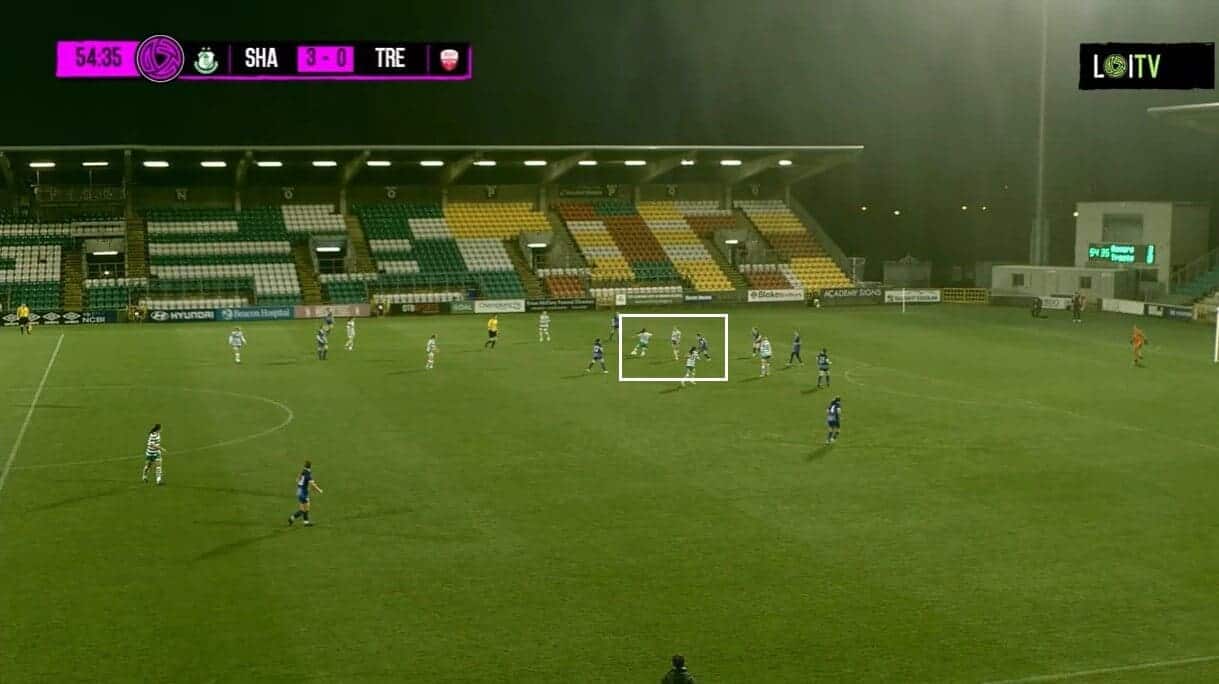
Not having to worry about the wide channels means that those in the middle have only needed to focus on what is happening in their immediate vicinity, both in terms of opponents’ whereabouts but also where their teammates are and how they can work together to create spaces.
Here, Alannah McEvoy and Jaime Thompson are looking to manipulate the Treaty United Women players into moving out of position, and the way they do this is very clever, with McEvoy passing towards Thompson and then following the ball and planting the idea into the Treaty United Women defenders’ minds that she is looking to receive the ball back. In fact, this is a trick, and one that Treaty fall for, with the defender nearest the ball edging out of position as she tries to close McEvoy down, which allows Thompson to shoot at goal and score her second of three in this game.
It would be easy to execute these situations poorly and to either lack communication or to not get the timing of the movements right, but the fact that Rovers made it work and then claimed their reward shows just how hard O’Neill works on this during training and how the players are buying into his ideas as he tries to lead them to success, and it is no surprise that they are the league’s top scorers, with 22 to their name, when looking at moments like this.
Build-up play
However, being a strong attacking side does not only mean getting the final pass or shot right, and instead relies on the rest of the team building play well in order to create the opportunities. It has already been highlighted that O’Gorman is someone that Shamrock Rovers Women look to when they are trying to play through their opponents, but there are others in the team who contribute just as much.
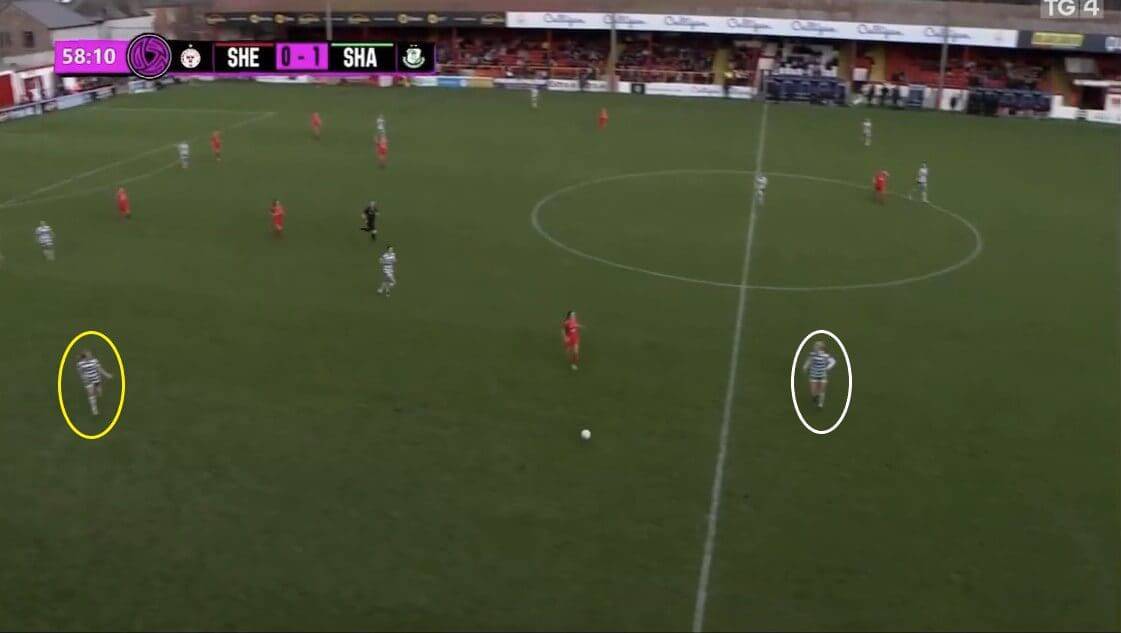
The defence is one part of the team that sometimes gets overlooked, and yet they have a very important role in that they pick up loose balls and keep Rovers on the front foot. This is evident here, with O’Leary pushing forward and testing the resilience of Shelbourne Women’s defensive line, but seeing her attempt to break through them rebutted by captain Pearl Slattery, who clears the ball and ends the attack.
However, this is where Rovers ensure that they don’t need to worry about getting back to prevent a counterattack because their defenders are already in position and are watching what is happening ahead of them in case they need to act. In this case, once Slattery clears the ball, Shauna Fox moves forward to secure possession and to play the ball back towards O’Leary, allowing the left-back to instantly turn and move forwards again without having conceded much territory.
She also now has options, with her knowing what is ahead of her in the form of Slattery and so recognising that she can either try again or dribble the ball infield on her own, and that goes back to the previous section of the scout report, in that it highlights the versatility that is required from each player in the team, as they look to find spaces and recognise when they need to switch between the channels in order to create goalscoring opportunities.
In this case, O’Leary’s second attempt to start an attack leads to a sequence of passes which ends with Abbie Larkin shooting at goal, but this would not have been possible without the contribution that Fox made to keeping the chance going once Rovers had lost the ball.
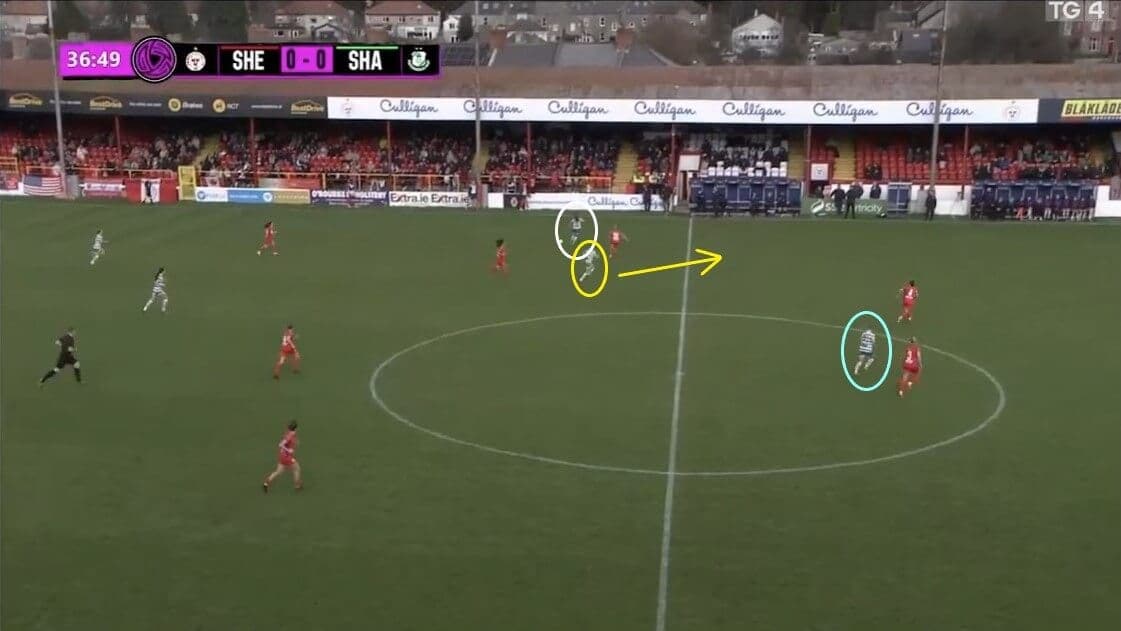
Counterattacks are another aspect of Rovers’ play when the wider team effort is clear to see, with them once again showing patience and building play rather than taking chances and risking the ball being lost. Here, Shelbourne are in retreat and the Hoops are trying to move the ball into their city rivals’ half, and yet they are not playing long passes and are instead relying on the spatial awareness of those involved as they try to keep the ball moving forwards before Shelbourne can cut it off.
This is never something that they need to be concerned about, with players moving into position early and setting up a clear line of progression for the ball to travel along, and that indicates how each member of the team knows what the others are looking to do and recognises what part they need to play in keeping the counterattack going.
On this occasion, Shamrock Rovers didn’t manage to convert the opportunity, but the intent was there and the mantra of doing the simple things well that has been evident throughout the analysis was once again at the heart of the attack, and, with that in mind, it is of no surprise that 56% of their counterattacks have ended in a shot on the opposing goal.

That ability to work as a team in order to maintain possession is clear when they get into the final third too, because there have been occasions when they have caught their teammates out through the speed of their attacks as well as their opponents. In this case, the ball is inside Shelbourne’s third but there is no central target to find, and so the Hoops have to find a way to keep the ball until someone can get into the middle to receive the cross.
As a result, it is common to see combinations between two or three players on the wings form as they move the ball between them and try to not allow their opponents to regain possession, and here it is simply a way of using up time whilst Aoife Kelly makes her way into the box. It might not be the most obvious example of teams building play, but it has been a key part of Rovers’ ability to construct attacking chances under O’Neill, and so has to be taken into account when looking at how their potent attack is down to the wider team effort.
Defensive tactics
Keeping things simple and not rushing things has been a key theme throughout this analysis, and it is just as prominent when looking at Shamrock Rovers Women’s defensive play too, with O’Neill again aiming to not overcomplicate matters and to instead ensure that his players are clear on what they need to do at each stage of the match.
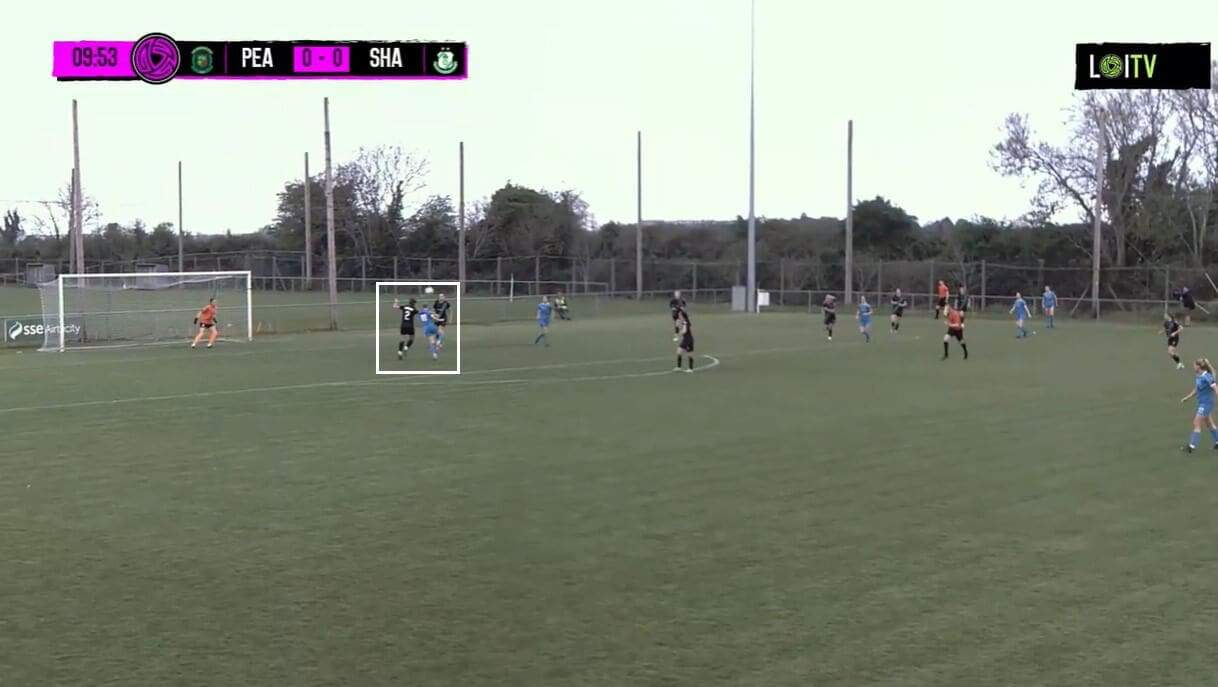
One key principle of his defensive tactics is to win first balls, and it is paramount that Rovers’ defensive line are strong in the air in order to end opposing attacks early and not allow the ball to drop to their feet, where there is a higher possibility that it will be taken away.
However, whilst some coaches might only look at their centre-backs to dominate these aerial battles, O’Neill wants his full-backs to also get involved in these situations. The reason for that is that he favours a player-to-player system when his team are inside their own third, and so the full-backs have to help out and each mark a player, meaning that they too have to be good at winning the ball and ending attacks.
Fortunately for O’Neill, he does have full-backs who are strong in the air and who are happy to play their part, with Gargan demonstrating her aerial prowess here in order to stop the cross from Peamount United’s Becky Watkins reaching Erin McLaughlin.
Rovers have won 44.6% of their aerial duels so far, so this is not a one-off, and it shows once again how so much of what they do is based on executing the simple things well.

That player-to-player system is also prominent when the ball is on the ground, as is shown here when Peamount have once again found their way into Rovers’ third. This time, Lauryn O’Callaghan has possession and is trying to find an angle through which she can deliver the ball into the middle, and, when she can’t find one, she tries to play a short pass into Watkins.
However, the Hoops have once again gone player-to-player and are working hard to prevent either of them from having the necessary time on the ball to pick out a teammate in the middle, with Larkin marking O’Callaghan and O’Leary monitoring the movement of Watkins. As a result, Rovers can once again react depending on where the ball goes, and that includes rotating with each other in order to stay with their individual opponents, as happens here.
That demonstrates the commitment that has been so evident in their defensive display and the fact that concentration levels are so high in these situations, and it is paying off, with Rovers only conceding four goals in their nine games, which is the lowest in the league this season.
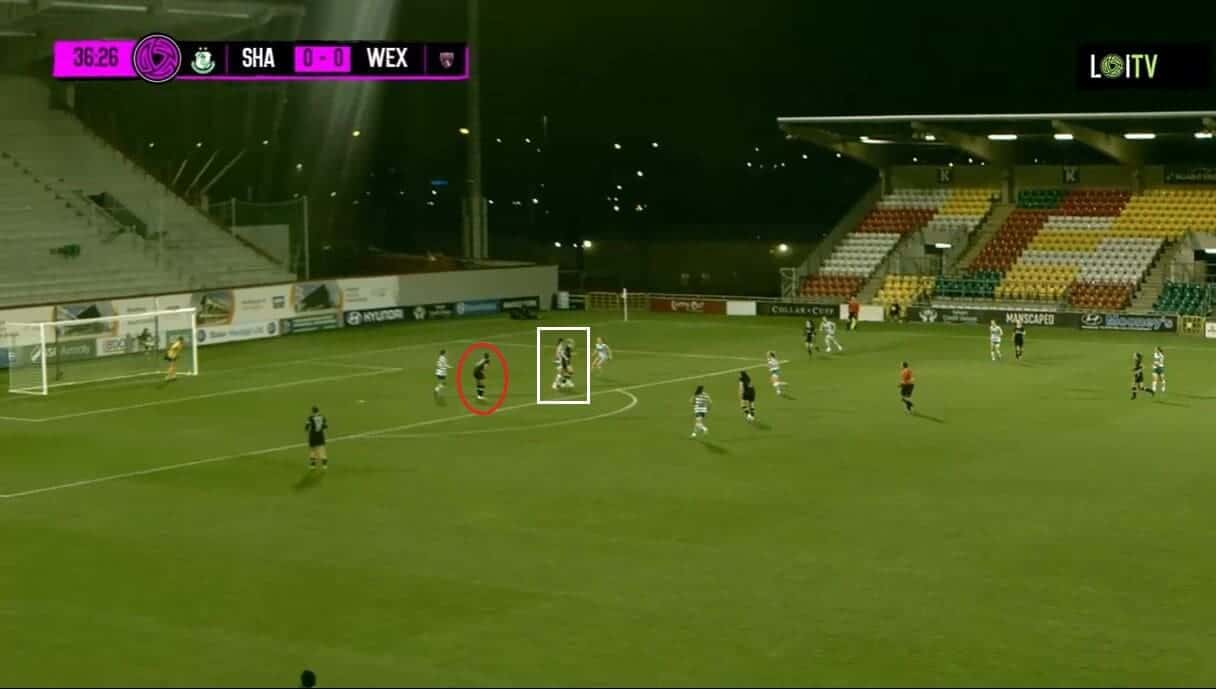
However, what they need to be careful of is becoming too predictable, because there have been occasions when their opponents have used this style of defending against them as they try to create gaps through which they can play the ball. This game was one of them, with Wexford Youths Women a team that can’t be allowed space to operate in and who can catch opponents out, and this situation showed how they had done their homework on how to break Rovers down.
To explain, the ball was sent towards Emily Corbet here and Shamrock Rovers instantly went to work, with one defender picking her up whilst the others stayed where they were, but that was what Wexford wanted to happen. Now, with there being a gap in the defensive line, Corbet can simply play the ball behind her and present former Brighton and Hove Albion Women and London City Lionesses striker Rianna Jarrett with a chance to score, and only a strong save from goalkeeper Amanda Budden denied her here.
Therefore, whilst Rovers do have an effective way of defending, some teams are learning how to counter it, and that is something that they should bear in mind as the campaign goes on.
Conclusion
In conclusion, this tactical analysis has looked in detail at Shamrock Rovers Women, who have started the new Women’s Premier Division campaign in fine form and who have demonstrated on their return to top-flight women’s football that they belong at the top table.
The general consensus on their return has been positive, with many managers and players alluding to their name alone as a reason to bring them back into existence. It has also been noted that their “Lazarus-act” could help to increase the fan interest in the women’s game in the RoI, especially at a time when it is entering an era of professionalism and clubs will be looking to make the most of those new fans who are watching the league each week.
On the field, Rovers have got a lot right so far, with their tactics being simple and easy to execute and their recruitment ahead of their return to action seeing them find the right blend between youthful promise and experienced talent. It is a case of taking small steps at a time, but it already looks very positive for them, and fans will hope that they will soon be lifting silverware and perhaps returning to the Champions League, and doing so really would cap off what has so far been “a fairytale return”.
