
After a rather rocky start as the interim head coach of New York City FC, Nick Cushing seems to have finally gotten things under control. Despite maintaining former head coach Ronny Deila’s methodology, the 37-year-old struggled to find organisation and stability. Similar to Man City, NYCFC’s identity consists of dominant possession-based tactics under an organised positional play structure. After Ronny Deila’s departure, the organisation and stability that is so important for this system to function had disappeared. Slowly, however, the former Man City Women’s manager has been able to improve the overall performance and most importantly, the results.
To further understand this process, it is important to remember a concept mentioned by Pep Guardiola. Attack and defence are inseparable. In other words, it is impossible to understand one without considering the other. Through this perspective, we are able to understand NYCFC’s recent results. While their attacking nature was relatively preserved, the organisation required, on both a structural and behavioural level, was not maintained. As a consequence, results like their 4-4 draw with Cincinnati or their 3-0 loss over New York Red Bulls happened. However, as seen in their last three wins, if time is given to Cushing, he might be able to restore their identity and consequent success.
In this tactical analysis, which will be completed in the form of a team scout report we will examine New York City FC’s tactics in recent matches in order to understand the playing model Nick Cushing is trying to implement. Furthermore in this analysis, we will identify the organisational shortcomings that have hindered their recent success.
Overview
Since the tactics used by Deila are essentially very similar to the ones Cushing is trying to implement, a statistical overview of this season allows for a better understanding of this tactical identity. As far as formations are concerned, Cushing has continued using the 4-2-3-1 deployed by Deila. This 4-2-3-1 is rather asymmetrical as a result of varying individual roles, but we will look at this more in-depth later.
City’s average possession of 58.2% is the second-highest in the league, and it highlights the basic idea that guides this side: domination. Dominating both the space, through their positional play, and the ball, through their behaviour with and without it, is the standard for every match. While City average 469.62 passes per 90, the highest in the league, their 85.7% completion rate highlights a certain level of control over their possession. Additionally, their league-high 15.1 passes per minute of possession demonstrate the high tempo through which they retain possession.
Their effectiveness in possession can be measured through a few metrics. Most significantly, they have the highest xG per shot in the league at 0.152. In addition, their 43.27 xG is by far the highest in the MLS. With 13.76 shots per 90 and 23.49 touches in the penalty area per 90 (both highest in the league), the volume through which they create is incredibly high. Finally, while they rank third in crosses, they have the highest amount of crosses to the six-yard box. This highlights their approach through the wings as we will look at later.
Without the ball, they are just as effective. An incredibly intensive approach is taken with the aim of recovering the ball as soon as possible, ensuring their desired dominance. While their PPDA of 8.05 is impressive, they also have the highest challenge intensity in the league at 7.1 per minute of opponent possession. With the third lowest xGA at 22.05, they have certainly been effective.
Now that we understand how the team wants to perform statistically, we can examine their tactics on the pitch. First, we will examine the structure through which they play, considering both the players’ positioning and the rules that guide it. Afterwards, their behaviour and strategy with the ball are considered. Upon understanding their tactics in possession, we will look at the organisational shortcomings that have left them vulnerable in recent matches. Finally, this analysis looks at their high-pressing system and why it has not fully worked under Cushing.
Structure
City’s 4-2-3-1 structure is guided by the concept of positional play while considering individual characteristics. In positional play, through horizontal and vertical lines, the pitch is split into zones with each player assigned to a certain zone. Considering a set of rules, players are constantly rotating in and out of these zones with the aim of disrupting the opposition. In an oversimplified way, this complex concept dictates the distribution of players on the pitch. Consequently, teams can have an asymmetric structure with varying roles, as long as the organisational rules are met. Considering this, NYCFC’s average positions can be illustrated below.

New York’s initial structure on the pitch can be identified below, considering each player’s role. The use of a double pivot almost always signifies a build-up through the sides, as they can easily shift wide to create passing triangles or diamonds. The inward movement from the wingers creates space for the fullback and diagonal passing lanes.

Their asymmetric tendency can be identified below, and it can be attributed to individual characteristics. On the right wing, both Gabriel Pereira and Santiago Rodríguez tend to drift inside and participate in the midfield. On the left, Talles Magno likes to occupy the wide channel before cutting inside further up the pitch. The fullbacks behave accordingly.
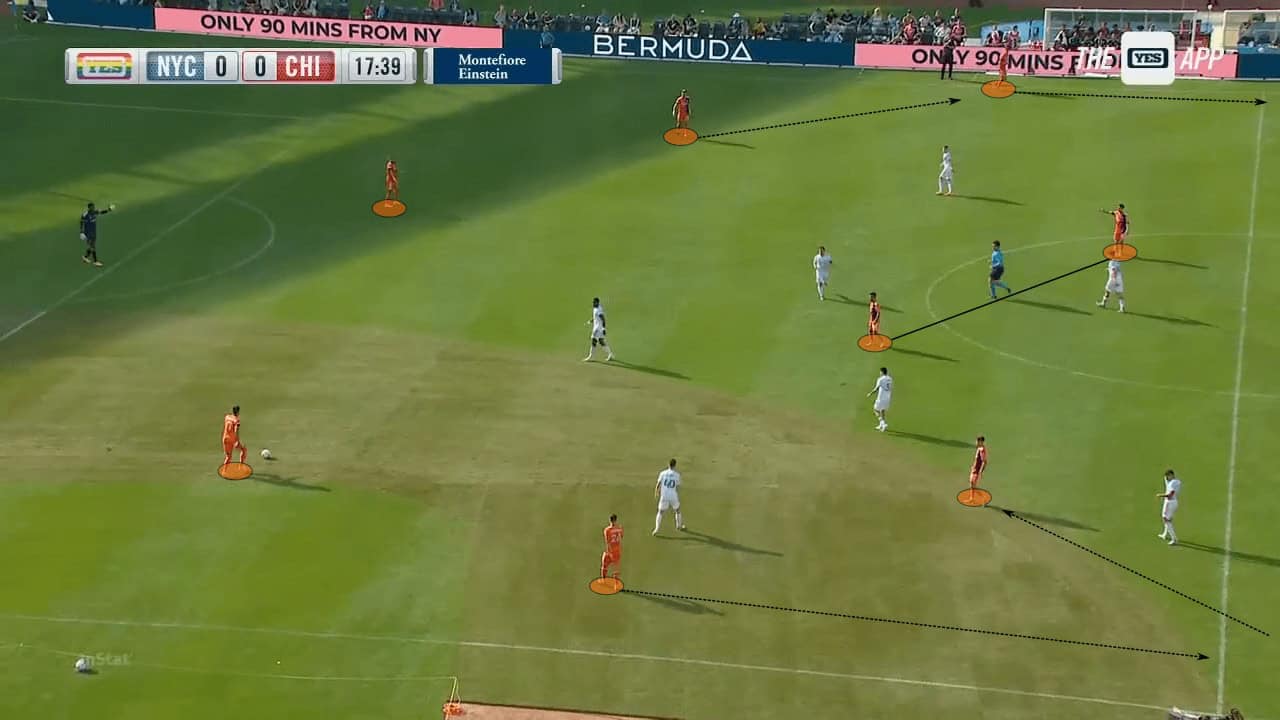
A further example of this concept can be seen below. As the opposition’s left-back will rarely follow them inside, GP and Rodríguez can quite often receive the ball in between defensive lines by drifting in.
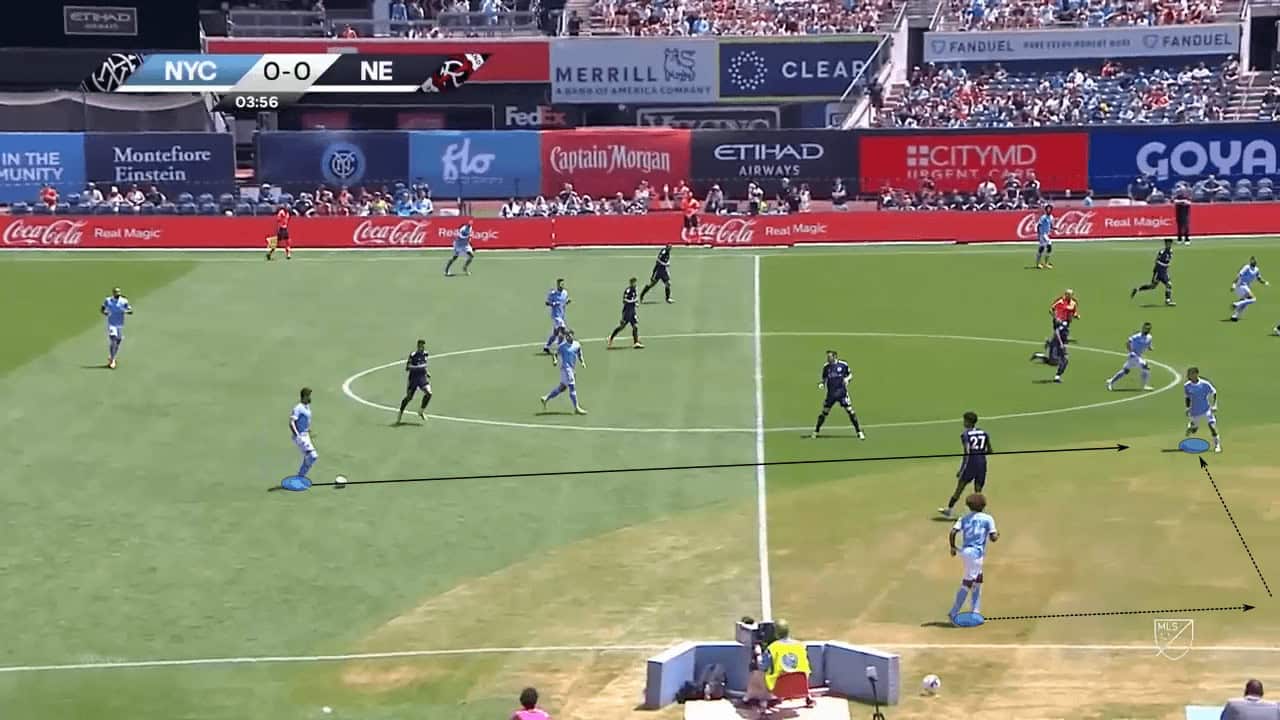
In possession
Upon identifying their structure, we can look at their behaviour in possession. It is important to understand the structure first because it is the biggest factor behind their strategy with the ball. With the use of a double pivot in a positional play organisation, City are almost exclusively constructing through the wide areas. This is not necessarily done by solely occupying the wing, but rather by its use in relation to the half-space. While the wide player(s) will maintain the width, players from the inside will rotate in and out of the half-space to create passing options and diagonal passing lanes. In the example below, in addition to the player maintaining width, three players come from inside to offer a passing option to the ball carrier on the wing.
In another example, the ball carrier is in the half-space and finds his teammate further up the pitch on the wing channel. This dynamic between the wing and the half-space creates the diagonal passing lane exploited by the centre-back. After receiving the pass, the wide player plays it back into the half-space where the attacking midfielder offers support.

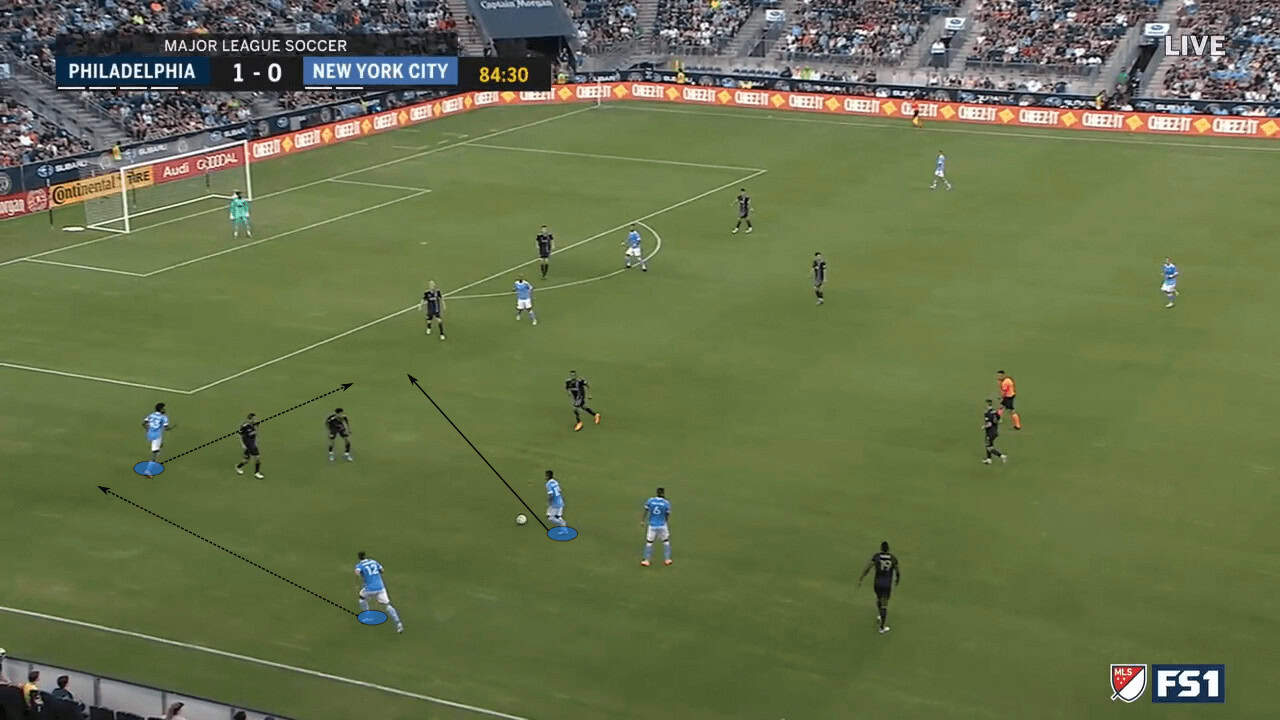
In the final third, the same approach is explored. While considering the structural principles of positional play, players are constantly rotating in and out of zones. This constant rotation is optimal in disrupting the defensive organisation and creating space. Furthermore, the dynamic between the wide channel and the half-space is also explored. In the example below, Talles drifts inside while Amundsen pushes up. Moralez is able to find Talles open in the half-space.
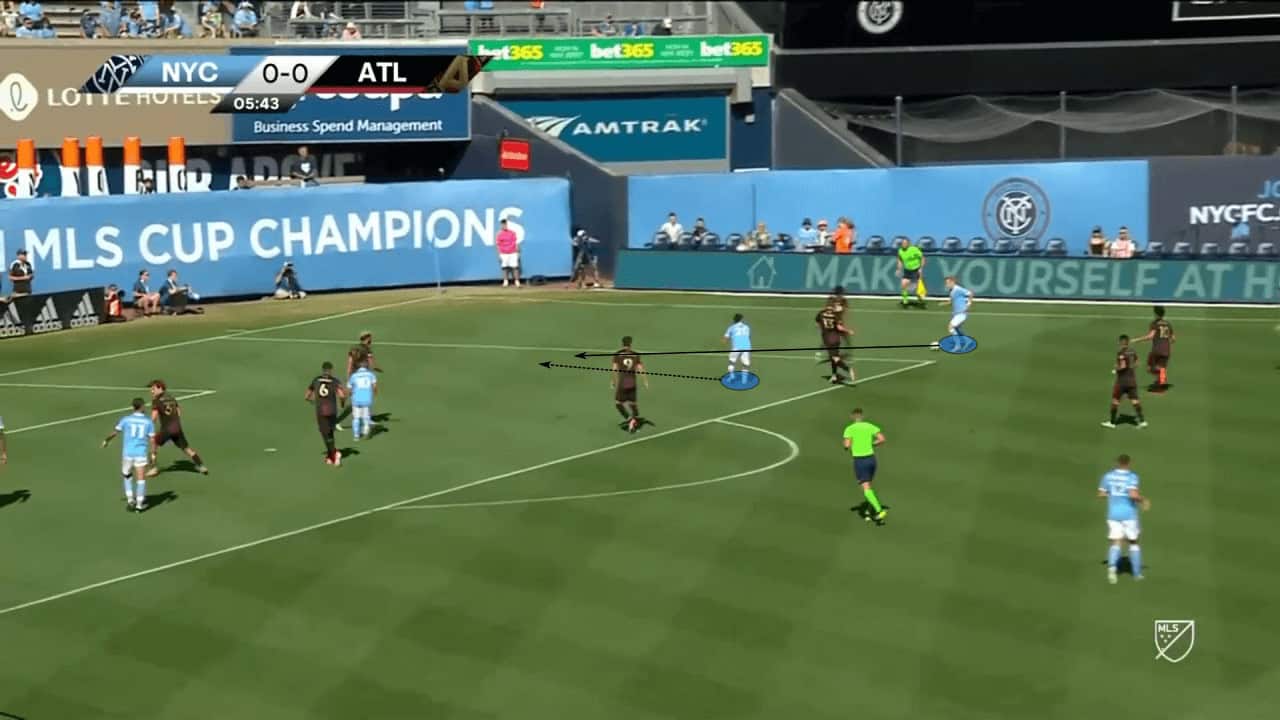
Similar to Man City, NYCFC are constantly trying to reach the assist zone (the two lateral channels of the box). Statistically, crosses from the wide channel are incredibly ineffective. On the other hand, reaching the assist zone for low crosses and cutbacks is perhaps the most dangerous strategy in the final third. Again, the dynamic between the wing and the half-space is used in the form of underlaps. In the example below, by staying in the wide channel, Tinnerholm stretches the defensive organisation. By doing so, he creates a little channel through which Rodríguez makes a run from inside into the assist zone.
Recent troubles
The transition from Deila to Cushing was not smooth, with a lot of key organisational principles being lost in the process. As a result, City’s attacking nature left them incredibly vulnerable. In Cushing’s first six matches, NYCFC conceded 14 goals. While they still dominated the ball, as seen in their possession metrics, they did not dominate the space. The defensive security they enjoyed with the ball was no longer there. Fortunately, Nick has been able to slowly recover this stability game by game. However, it is important to understand what some of these shortcomings are.
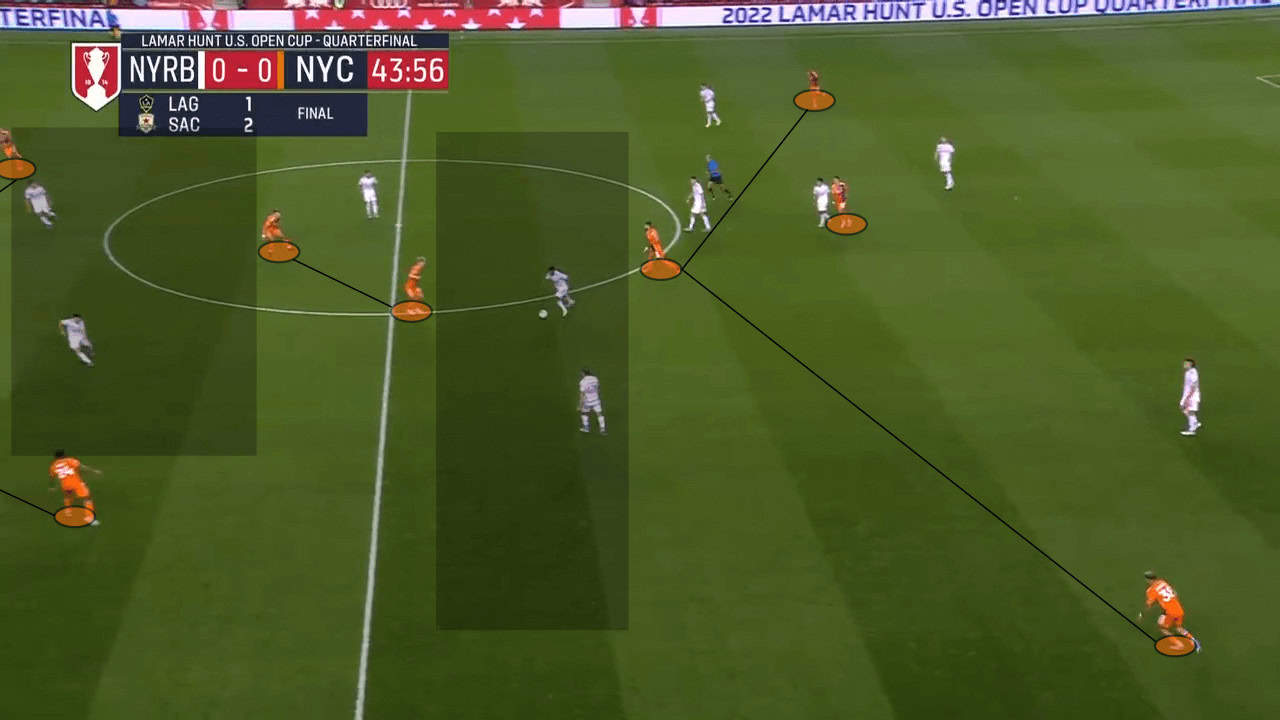
The overarching problem in this period has been the lack of compactness with the ball. Once the ball is lost, the lines are too distant from one another, leaving far too much space for the opposition to exploit. Not only does it leave space to be exploited, but it also makes counter-pressing virtually impossible.
This organisational problem stems from one struggle. In this system, the objective is to maximise the playing area in order to stretch the defensive organisation as much as possible. This is seen through the width constantly emphasised and maintained with the ball. The width, however, is not the problem, but rather the depth. The lines are not compact enough. Finding a balance between increasing the pitch while still being compact enough to prevent counter-attacks is essential. In the image below, we are able to see the space between the lines once the ball is lost.
In another example, once Moralez loses the ball, City are far too exposed. After playing it further up the pitch, the centre-backs do not push up fast enough. Between other positional mistakes, they leave tremendous space for Cincinnati to exploit.

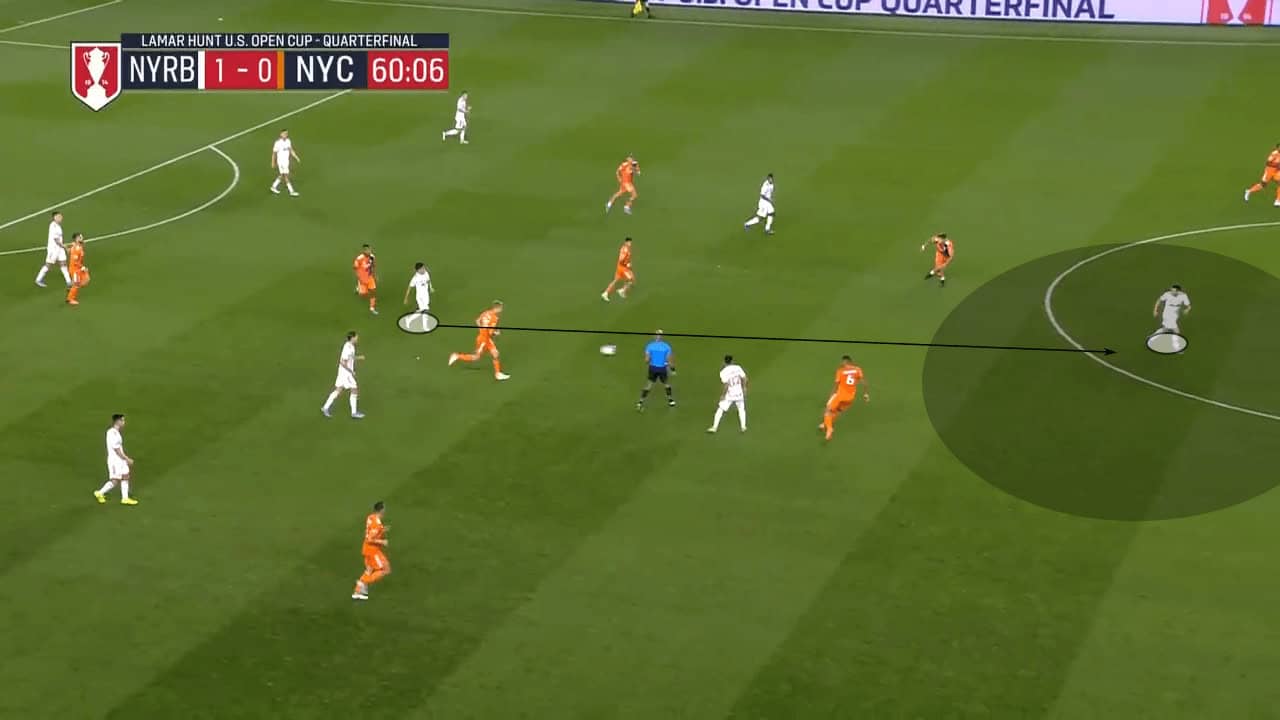
Now transitioning defensively, a similar mistake is committed. Once Red Bulls begin the counter-attack, the centre-backs begin dropping back too early. As a result, the forward is able to receive the ball with time and space ahead of the backline. On the contrary, the centre-backs should step up to press and essentially suffocate the opposition in their half. By counter-pressing and eliminating passing options, they are able to transition defensively in a manner that ensures their desired dominance.
High press
Without the ball, the Cityzens have a rather aggressive approach to recover it as soon as possible. This is most commonly done through their high press, where they aim to pressure the opponent’s build-up. The map below highlights this, illustrating how often and where they recover the ball in the final third.

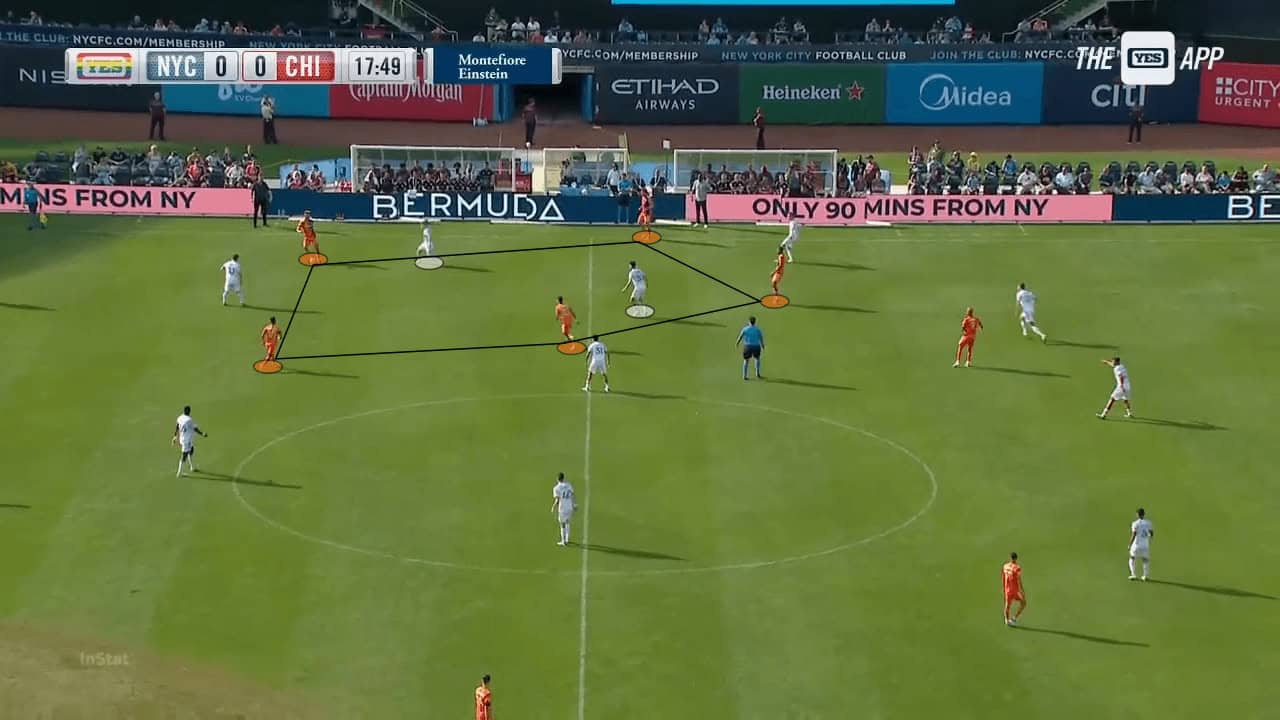
City’s high press is conducted through a zonal system, where they move as a unit to congest and minimise the opposition’s playing area. After boxing the opposition to one side, their 3-1 shape up top is maintained, with each player pressuring the closest opposition player.
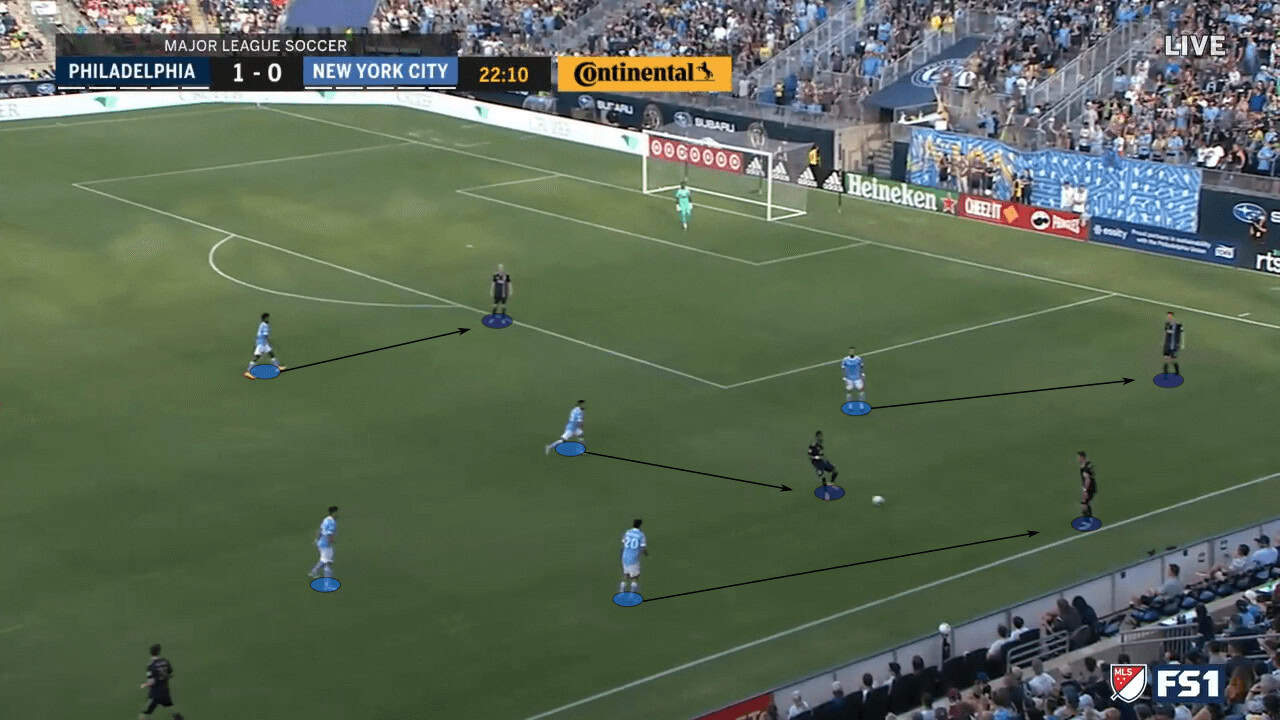
In another example, the players have rotated positions but maintained the same shape. With the two defensive midfielders and the closest fullback behind them to cover, they aim to overwhelm the opposition and force them long.
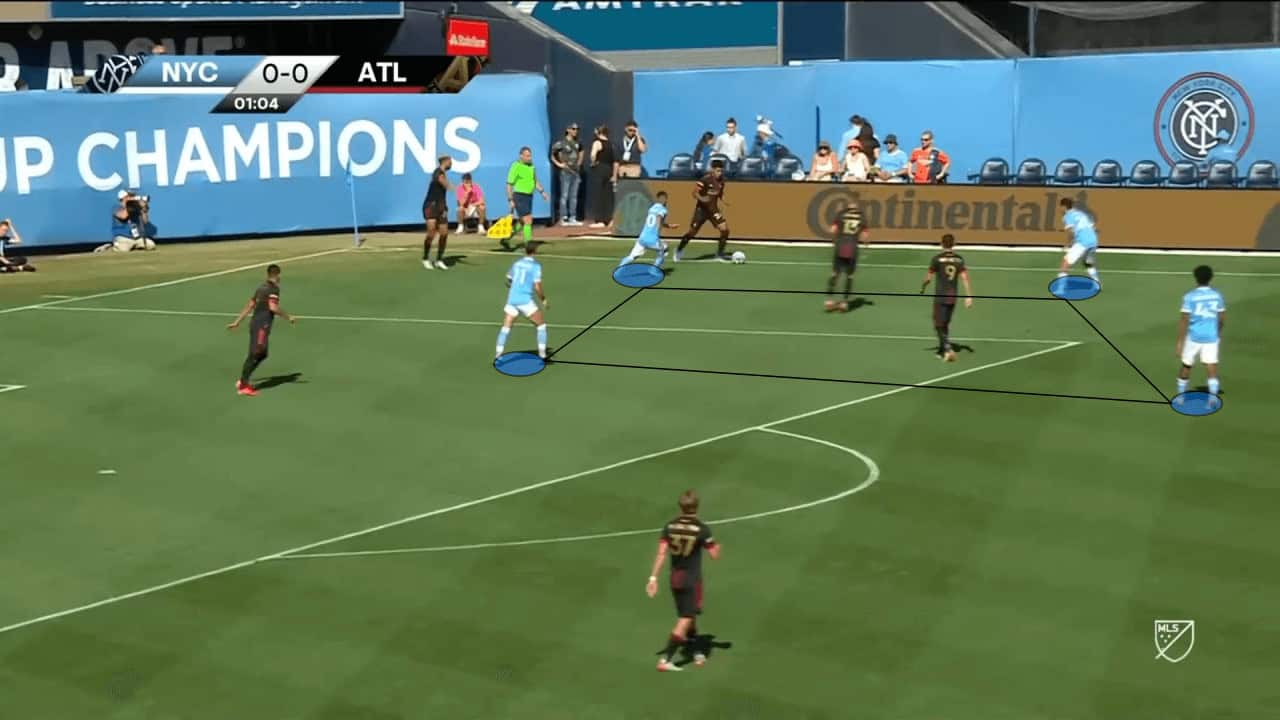
This system is obviously very aggressive, and if not conducted correctly, it can leave them incredibly vulnerable. There are many factors that make a high press successful, but compactness is perhaps the most important. The backline must maintain a high line in order to minimise the space between lines and compress the opposition. This has been another key organisation principle lost in the recent head coach transition.
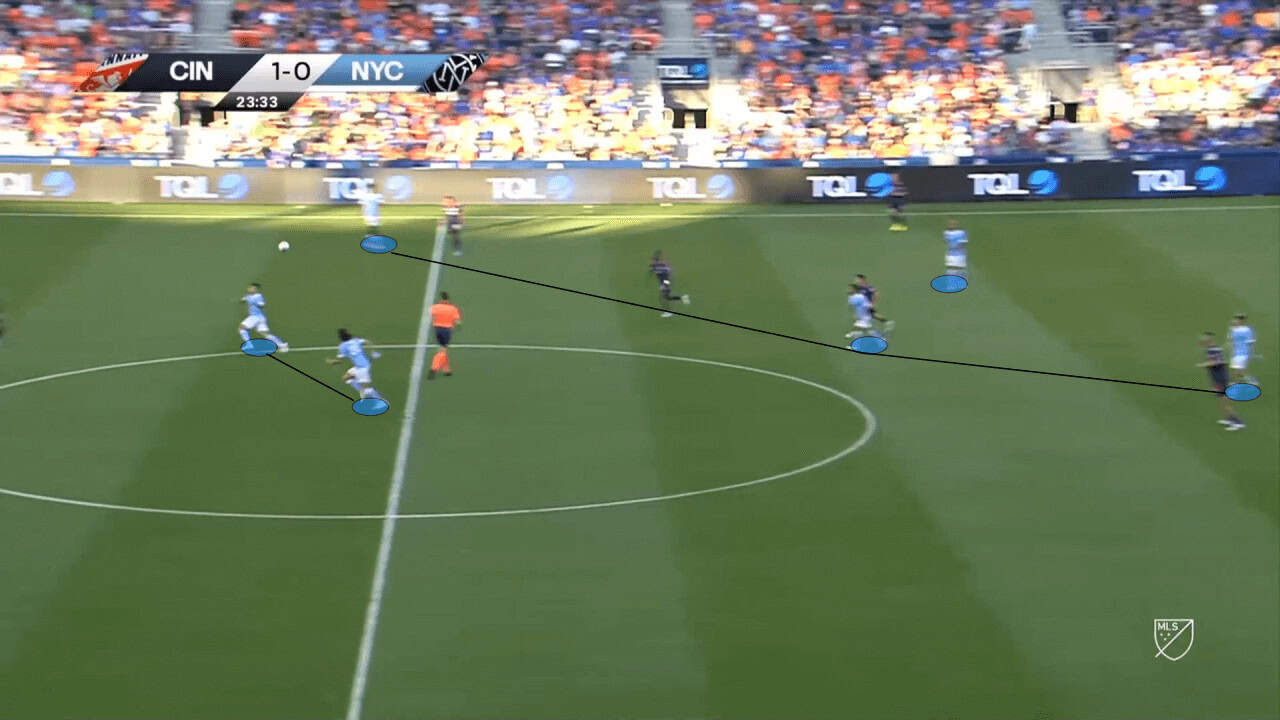
On a few occasions, the backline has failed to maintain a high line and consequently left too much space. In the example below, they drop back far too early allowing for the long ball to be played. Due to the defensive lines being too far apart, the forward has two options to lay the ball off.
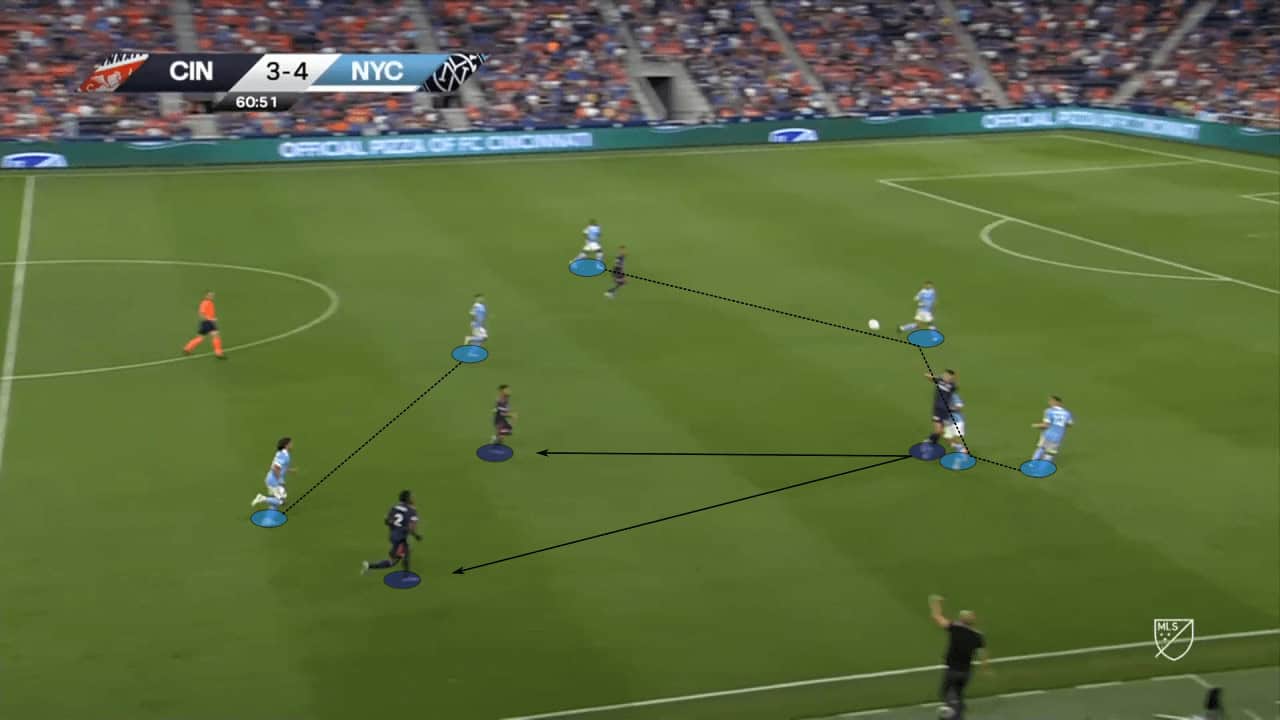
Earlier in the same match, we are also able to see how uncoordinated their press can be. While GP has pushed up to press, Talles has stayed behind. The midfield did not push up fast enough either and are in no man’s land. Finally, the backline is once again too far back. Pressing is a collective effort, and when not done correctly, it can be perilous.
Conclusion
The transition from Ronny Deila to Nick Cushing has not been easy, but with time, Cushing is slowly guiding them back to success. While their tactical identity is clear and effective, multiple organisational principles must be fixed. These details are essential to maintaining stability as, with such an attacking system, they can become very vulnerable.
While it is unclear whether Nick will be officially promoted to the head coach job, he has a golden opportunity in his hands. The 37-year-old has been with City Group for over a decade and knows their identity better than most. If successful, City should certainly look to give him an opportunity.
