
These days, the most popular in-possession structure used in football is the box midfield as elite coaches tend to rely on it, looking for numerical, qualitative, and positional superiority (positional play) on the pitch.
The box midfield shape, which can be done statically and rigidly, for example through 3-4-2-1 or 4-2-2-2, has become popular in a more dynamic manner to have a central superiority.
This season witnessed the revival of Manchester City as Pep Guardiola relied on the 3-2-2-3.
Before him, Roberto De Zerbi introduced a unique variation of the box midfield that made Brighton a significant challenge.
Jürgen Klopp made a tactical tweak by inserting Trent Alexander-Arnold more centrally during deep phases of play.
Additionally, Unai Emery was trying something new after his oversight of Aston Villa which has made them one of the best teams since he took charge.
Amidst the diverse approaches employed by these managers, a common objective unites them: how they structure the box midfield with different dynamic movements.
So, this tactical analysis aims to delve into the box midfield mechanisms, examining tactics via various examples from Aston Villa and Liverpool.
The box advantages
Before driving deeper into the tactical theory’s examples, it can be said that the formation in football no longer exists, but rather the system, which is not built on a static state, but rather a dynamic, changing form, that allows dynamic positions’ changing from one point to another which creates space and provokes or confuses the opponents.
Indeed, the advantages of the box midfield are not limited to that it gives many a numerical superiority (4 vs 2 or 3 opposition’s midfielders) and a positional advantage, which helps in midfield dominance and possession, but it also gives two players in the most dangerous and least crowded areas on the field (Half-Spaces), which naturally provokes the opponent’s players to move diagonally to confront them.
This takes place not only higher behind the opposition’s midfield but at the beginning of the box, where the first line forces the opponent to choose between defending the depth, which opens the wide lanes, or leaving the depth exposed (the dynamic movements from the initial set-up increase this confusion).
For the dynamics aspect, the initial positioning of the players, who can move horizontally, vertically, or diagonally to create spaces, diagonals, and diamonds requires the opponents or the whole defensive structure to adapt in different ways.

Furthermore, the benefits extend not only to the central areas but also to the flanks.
By effectively filling the box with players, teams have the potential to overload the flanks, which allows the wide triangles on the side and opens room for fluid positional interchanges and dynamic movements.
This multi-dimensional approach keeps opponents guessing and adds complexity to their defensive tasks.
It also can’t be omitted that the box midfield enhances defensive stability by effectively filling the five vertical lanes (3-2-5), as the box midfield can provide a compact structure (rest defence) in defensive transitions which pushes any defensive transition out wide.
Aston Villa
After a period of inconsistent performances, Aston Villa were close to the relegation zone.
At this time, they made the decision to dismiss Steven Gerrard and hire Unai Emery.
Emery brought about a swift transformation in the team’s playing style of chaos to control, emphasising possession-based football and encouraging more dynamics, and eventually managed to achieve seventh place and reach the UEFA Europa Conference League.
The Spanish coach predominantly utilised a 4-4-2 as the initial setup.
However, he displayed tactical flexibility during possession, altering the shape over time and generating various shapes derived from the foundation of the 4-4-2 formation.
In contrast to many managers who prioritise utilising wide wingers for maximum width, Emery adopted a different approach by employing his wingers in inside roles.
Firstly, he decided to use his wide midfielders/wingers as advanced playmakers, moving diagonally and horizontally from the flanks to the higher areas of both half-spaces which creates the box-midfield with the two straight defensive midfielders and also gained the positional advantage behind the opposition’s midfield.
This dynamic movement would frequently draw the opposing fullbacks inward, while Villa’s fullbacks, normally Matty Cash and Lucas Digne, would quickly overlap into the generated space, as the below graphic shows.
This mechanism creates 2-2-6.
The figure also shows the numerical superiority that it causes in all lines.

After that, the Spaniard decided to provide an additional passing lane deeper in the first line.
To achieve this, he employed asymmetric full-backs, as the right-back (often Ashley Young) inverts, while the left-back pushes higher up in the side.
This was reflected in the wingers’ dynamics, as he relied on an asymmetric shape as well, so the right-winger stretched the pitch, while the left entered the left half-space higher while a striker/attacking midfielder moved to the right one.
This move creates a 3-2-5 in-possession structure, as we can see from the below graphic.

The team’s tactical variations are dependent on the principles and decisions of the opponents.
The dynamic movements from point to point executed by the players aim to engage the opposition in multiple challenges and increase the likelihood of costly mistakes.
In scenario 1, depicted in the below graphic, Aston Villa frequently play the ball directly toward the space behind the opponent’s left fullback.
In this case, Villa’s right-back shifts to form the back-three, which forces the opponent’s left winger to move higher up the field.
This, in turn, leaves the right wide midfielder (RM) relatively isolated.
Meanwhile, the dropping striker (Emi Buendía) positions himself higher in the right half-space to create the box which had provoked the opponent’s left-back to push higher up to face him.
Capitalising on this movement, RM (John McGinn) and the dynamic striker (Ollie Watkins) exploit the space left behind by making vertical and diagonal runs.
In a variation of the same scenario, if Buendía receives with the wrong orientation, he always seeks to turn in one fluid movement and release Watkins and McGinn, who run behind the defenders quickly.

In the second scenario, creating a trio in the first line (3 vs 2) gives the wide centre-back more time, vision, space, and better passing angles.
The left midfielder (Jacob Ramsey) begins to run inside to create the box, so he often takes the attention of the opponent’s winger away from Villa’s left-back and provokes the opposition’s fullback to move higher to defend against him and leave the space there.
Once he receives the vertical laser pass from the centre-back, the LM plays to the overlapping left-back (Álex Moreno).
A third-man combination ensues.
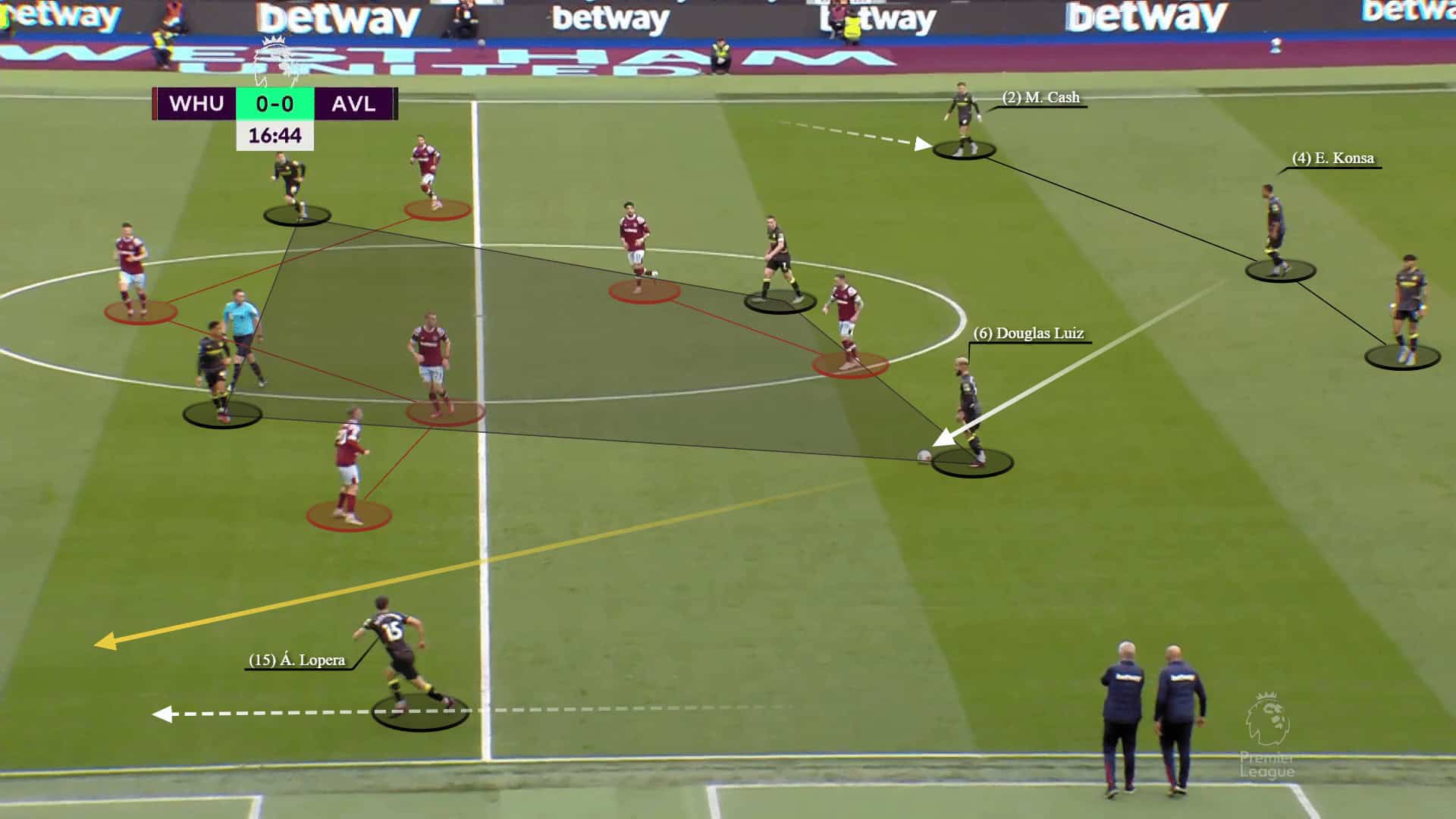
Furthermore, as a variation on this previous scenario, in their first goal against West Ham, as shown in the image below, the right-back Matty Cash inverted to create the trio in the first line, while Douglas Luiz, McGinn, Leander Dendoncker, and Ramsey made up the box midfield.
Luiz received the ball from Konsa, Meanwhile, Ramsey’s positioning caused Bowen and Tomáš Souček to close the distance to him.
This opened the passing lane towards the overlapping left-back Álex Moreno who received in space and a 5 v 4 situation made West Ham’s defence exposed.
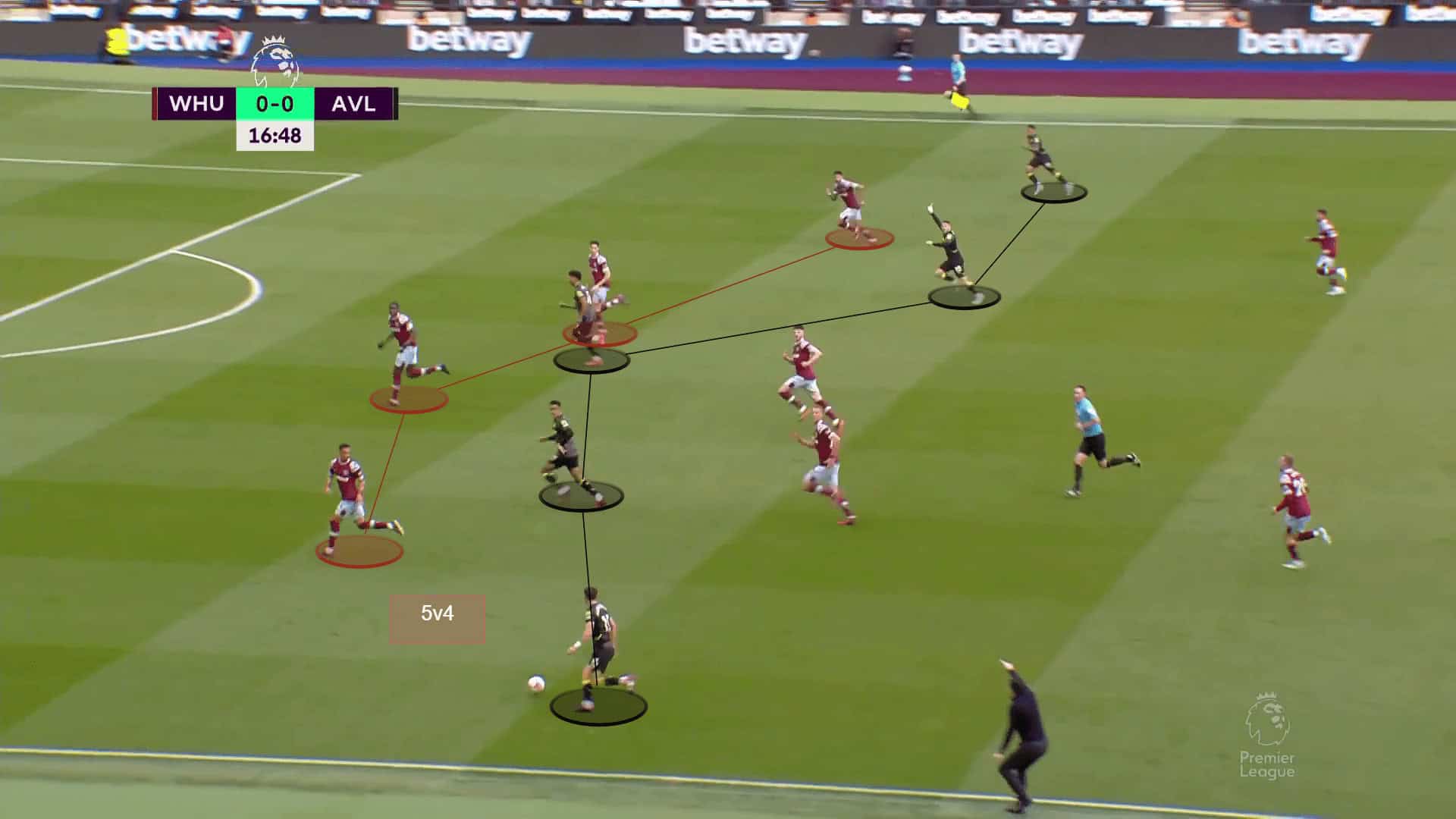
The attack ended with a goal after a cross from Moreno and a header from Watkins.
In scenario 3, Aston Villa employs a strategy to penetrate through the opposition’s defensive block from the depth.
Both number ’10s’ position dynamically higher into the half-spaces, moving to avoid the cover shadow of the opposition’s midfield.
The defensive midfielders (Boubacar Kamara and Douglas Luiz) possess the capability to receive and play vertical passes between the lines, effectively breaking the opposition’s defensive structure.
At the same time, the striker and the right midfielder make movements toward the gaps in the defensive line, pinning and preventing them from actively participating in the play.
This mechanism creates a potential 5v4 against the opposition’s backline, with the left-back overlapping.
In scenario 4, Aston Villa implements a tactical adjustment where the player occupying the right half-space moves horizontally inside to receive.
Simultaneously, the defensive midfielder advances dynamically higher up the field which changes the box-midfield configuration to a 1-3.
Meanwhile, the striker and the wide midfielders play a crucial role in pinning the opposition’s backline.
In their impressive victory over Newcastle (3-0), Aston Villa successfully applied a similar approach in their first goal.
Tyrone Mings in the below graphic finds Luiz behind the first line of Newcastle.
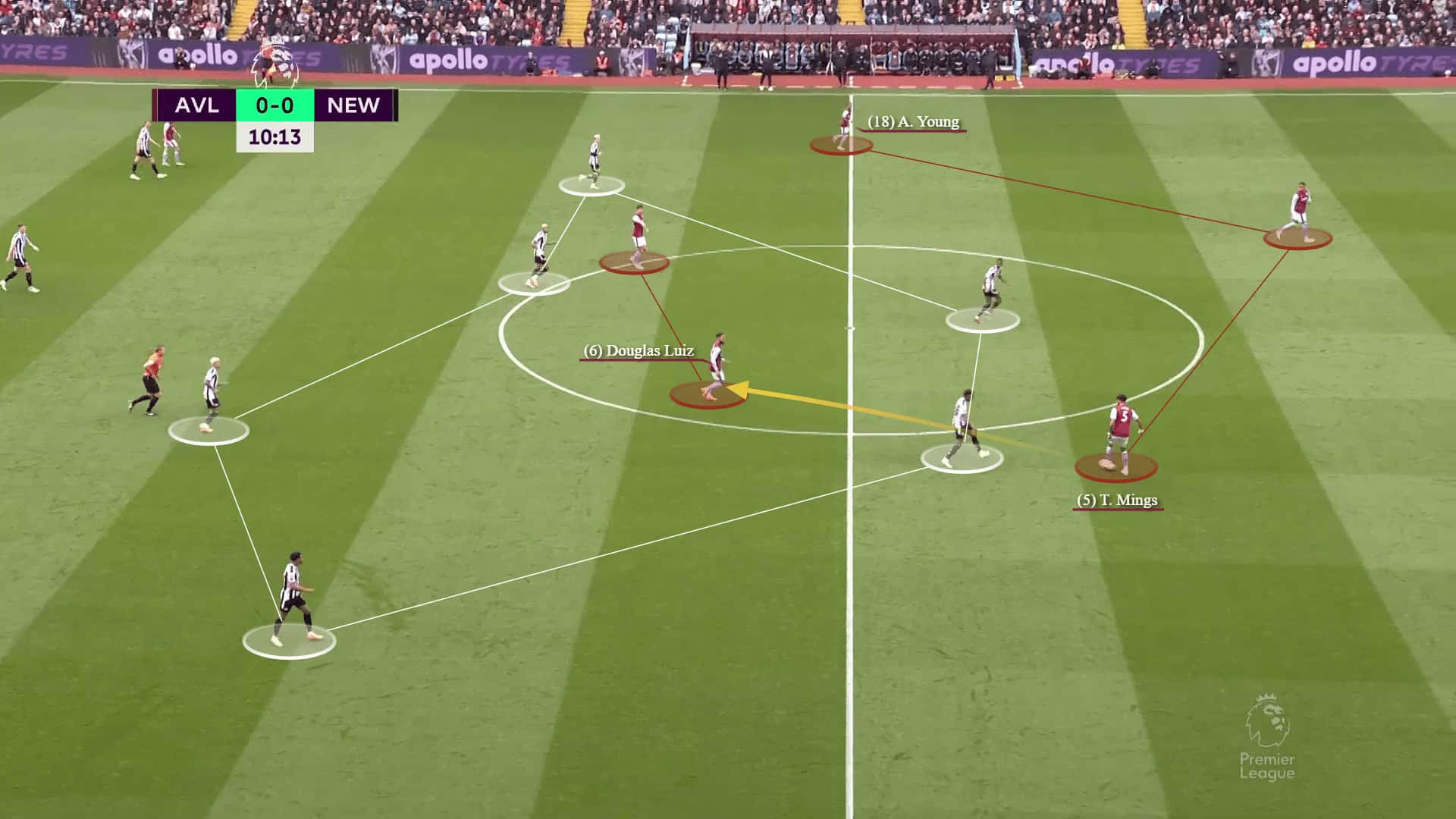
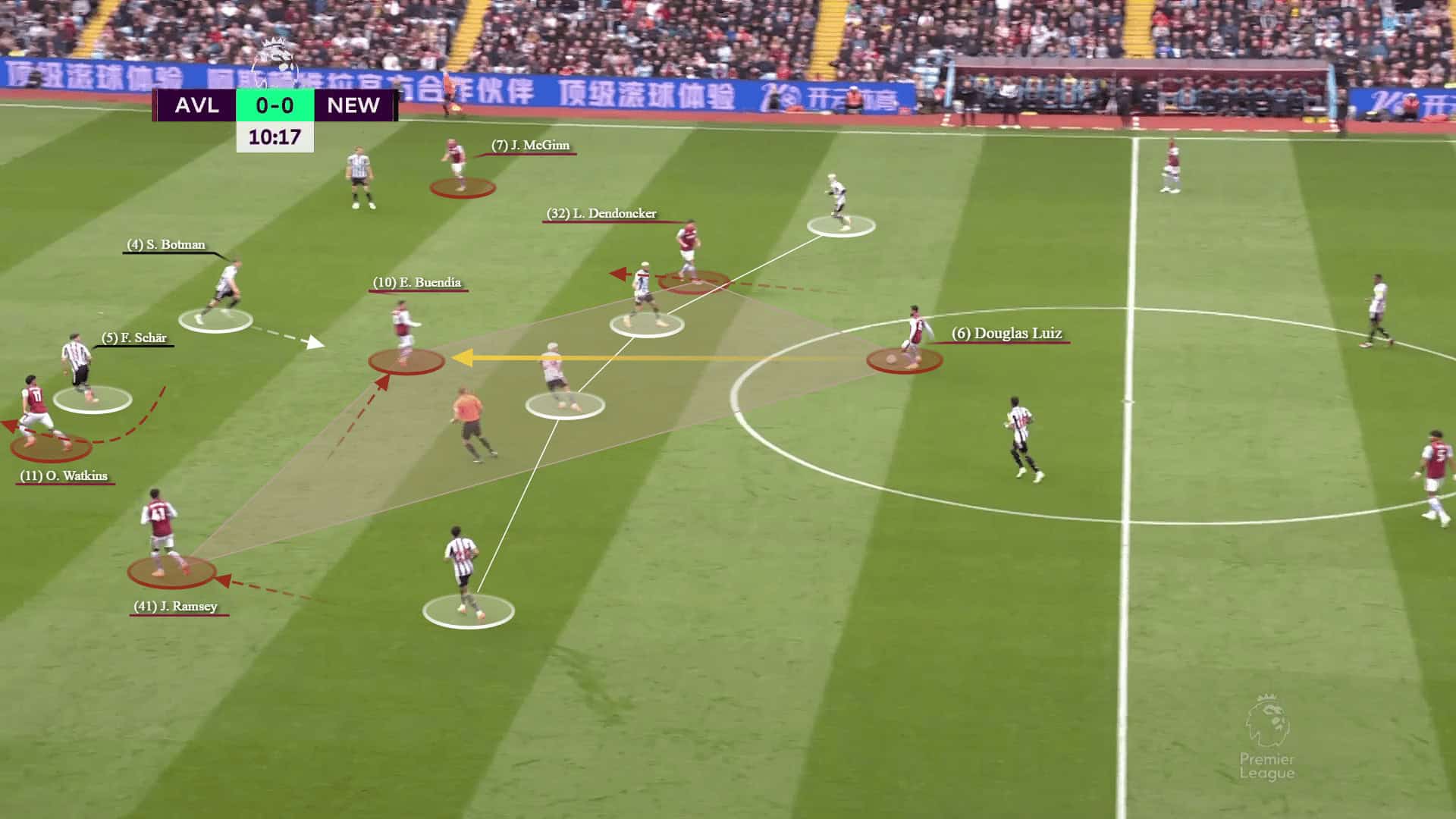
Luiz received the ball with freedom and then played a line-breaking pass towards Buendia behind the midfield which provoked Botman to set up to face him.
At the same time, Watkins made a deceptive move, drawing the attention of Schar.
Additionally, Dendoncker moved higher up to occupy the right-half space (1-3 shape).
Liverpool
Over the period of Klopp’s tenure at Liverpool, the team underwent significant development, resulting in a transformation of their style of play.
Initially, they heavily relied on high-intensity pressing and Phillipe Coutinho’s creativity.
However, following Coutinho’s departure, they evolved into an immensely formidable team in terms of pressure, adopting a more direct approach that emphasised winning second balls.
This season, however, various factors have led to a decrease in the team’s high-pressure and counter-pressing, consequently affecting their tempo.
Klopp’s need to adapt his tactics was largely influenced by Trent Alexander-Arnold, who played a pivotal role in the team’s tactical adjustments.
Towards the end of this season, rather than hugging the touchline and overlapping, the English fullback started drifting toward the right half-space during the progression and final third phases, allowing for better integration in the central playmaking.
However, the current dynamics have shifted, granting Alexander-Arnold newfound freedom on the pitch from the build-up phase.


In the following tactical board graphic, there is a distinct inversion of roles between the right-back (Trent) and the left-back (Robertson) during the build-up phase in different ways.
Trent starts his roaming in the second line, while Robertson joins the first line, which produces spaces on both sides that are reoccupied dynamically by the dropping-off wingers or the drifting number ‘8s’, according to the situation, after luring the opposition’s wingers inside.
Indeed, the decision to invert Trent into this deeper area was primarily aimed to enhance the team’s playmaking and maximise their distribution toward the players in between the lines, which also entails pushing both number ‘6s’ higher up in the half-spaces, having the positional advantage and exploiting vulnerable areas to receive these penetrating passes.

Despite this central overloading, the team still possesses fluidity and frequent positional rotations on both sides, as depicted in the provided graphic.
Trent Alexander-Arnold continues to roam deep as a deep-lying playmaker, while the right number ‘8’ interchanges positions with the right winger.
In contrast, on the left side, the left-winger adopts an inward movement that corresponds with a deep run from the left-back.
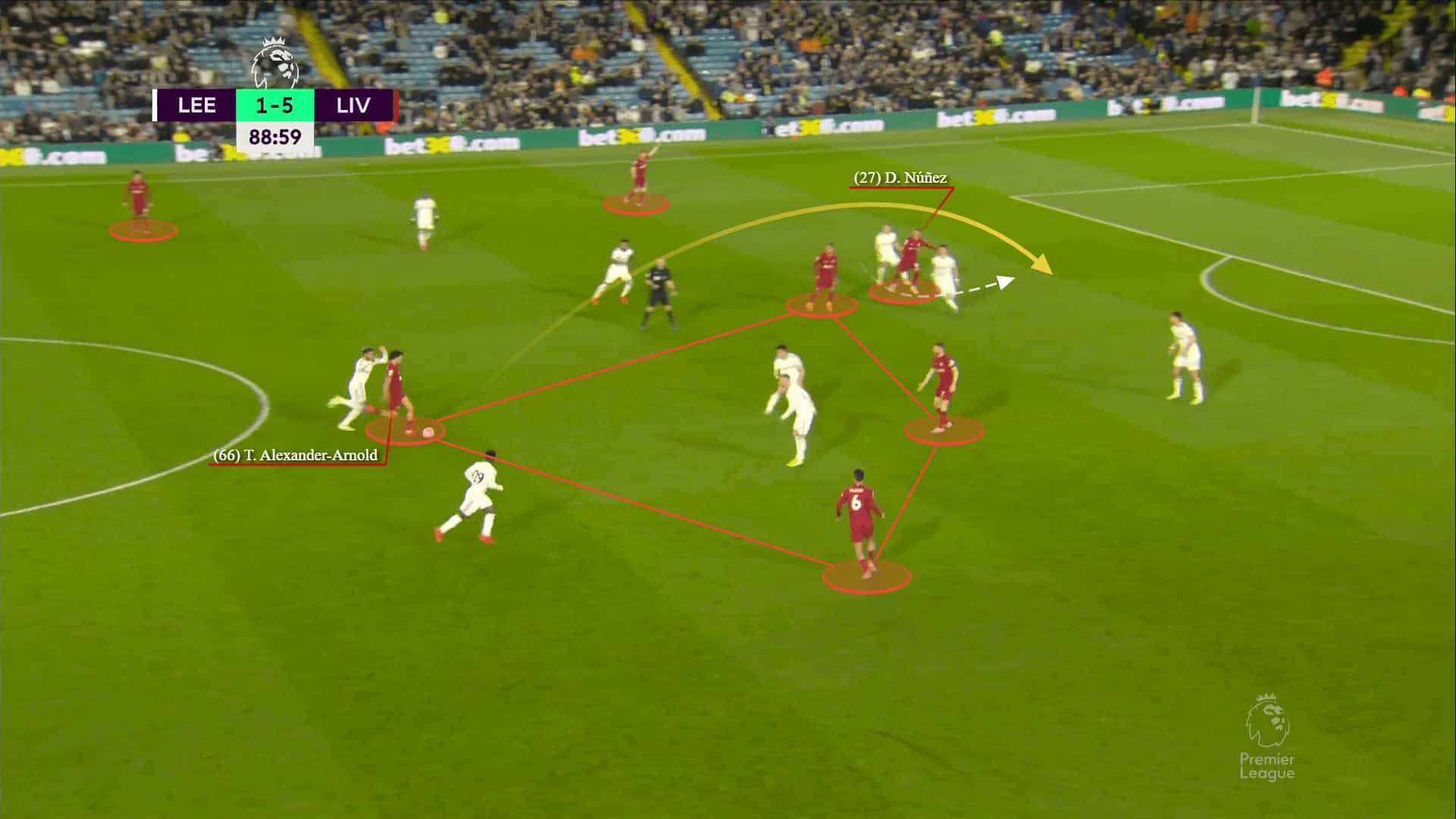
These positional rotations on the flanks serve to confuse and stretch the opposition’s defensive line and create gaps with also the frequent dropping off to link from the dynamic striker.
Rather than frequently participating in the right-side positional rotations, Trent assumes different functions that limit his involvement there.
However, on occasion, he integrates late support in the right half-space as a relay player to switch the play or provide accurate crosses into the box.
Due to his new role, these instances of Trent’s integration are less frequent and unexpected with his movement from the depth, not the side, which makes the box-midfield more fluid.
Conclusion
In conclusion of this tactical theory piece, the box midfield has become a popular and successful tactical approach in modern football, employed by top coaches to gain an edge on the pitch.
Its advantages include numerical superiority in midfield, players positioned in dangerous areas, and the ability to provoke opponents into making mistakes.
In this analysis, we examined the implementation of the box midfield by Aston Villa and Liverpool and how it impacted the two teams’ playing styles and the roles of specific players within the system.
