
The availability of space is often a scarce commodity that isn’t easily accessible. We’d see high-scoring games each week across each league and fixture if it were.
Dominant teams often find their opponents sitting deeper, with less space behind them available to penetrate. At the same time, submissive sides usually see less of the ball and have fewer opportunities to attempt to exploit the space that is usually available behind the defensive line.
Free kicks, often ones 20-40 yards away from the goal, provide your team with the golden opportunity to attack the space behind a defensive unit from a good position, with the free kick taker being given the chance to put a delivery into space with no pressure from the opposition. This combines the best of both worlds – the chance to deliver from a high position (like the dominant sides) and the opportunity to exploit the space behind the last line of defence (like the submissive sides).
There are numerous ways to take advantage of this space and opportunity, but one particularly effective method is the use of runs from deep. Through a longer run-up prior to the delivery being taken, attackers can generate enough speed to arrive in the space before their defensive counterparts. This, of course, is only possible against the sides who aim to defend further away from the goal.
In this tactical analysis, we will look into the tactics behind using deep runs during free kicks, with an in-depth analysis of the different ways it is possible to exploit the space behind a defensive line. This set-piece analysis will explain why deep runs are so hard to stop and so effective when properly timed. Deep runs give the free-kick taker more responsibility, and the ability to time the kick to the runs is easier to achieve.
The Effectiveness of Runs from Deep
In both open play and during set-pieces, when facing a high line, deep runs are one of the most effective tools for accessing the space behind the defensive unit. When the front attacking line is level with the defensive line, it is extremely difficult to enter the space unmarked. Both the attackers and defenders are in the same starting positions and have an equal race to the space behind once the ball is played.
Through well-oriented body positioning, defenders can see their opponents and, when the ball is about to be played, dart back toward their own goal to recover the space. The off-ball movement is made in time with the pass on many occasions, both in open play and during set-pieces, which can lead to timing issues, with it not being accessible for attackers to fully sprint towards the goal and see the free-kick taker simultaneously, meaning attackers often gamble at whether they will be onside or not, not knowing the exact moment the pass will be played.
Like in the example below, it is possible to see the ball and attack the box, but the lack of intensity in the run due to the body orientation means that the attacker cannot gain much separation from his marker.

As shown in the images above and below, when an attacker makes the first darting movement from beside their marker, they are only ever able to create one or two steps of separation, meaning that the cross would have to come in at an unrealistic pace and trajectory to arrive at the attacker’s head before the defender recovers the lost ground.

Furthermore, teams can be vulnerable to an offside trap if the attackers and defenders start on top of each other. Both teams roughly know the ball will be delivered shortly after the taker makes the first step, which makes it easier for the defensive side to plan to step up as a unit and make each attacker in the front line offside. However, the recent trend of dummy runs from takers helps to prevent defensive lines from taking this approach.
Flip the dynamic around, and the situation becomes much easier. Instead, the pass should be made in time with the off-ball movement. When the responsibility lies with the player on the ball, they can see both the potential recipients of the ball and the position of the defensive unit simultaneously, which means that the player can judge each run being made and decide on the perfect moment to execute the pass before a player moves into an offside position. For this dynamic to occur and the pass to be made based on the runs being made, the run should be made from a deeper position to give the player on the ball adequate time to execute the pass.
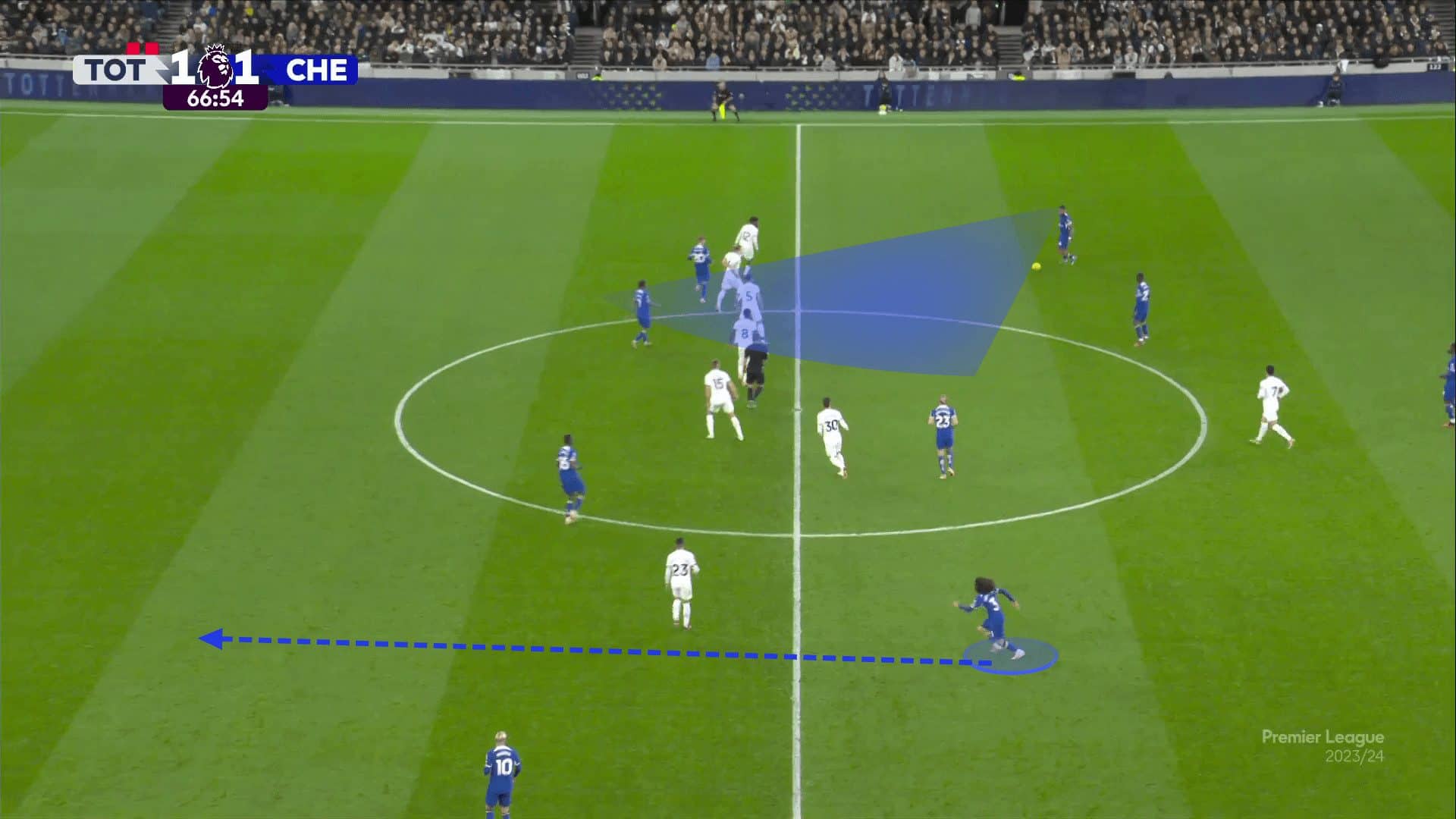
The below is an example from open play, and in extreme circumstances with Tottenham down to nine men, but it is used to show the extreme potential benefits that stem from the use of deep runs. In the image, Cucurella can be seen making a sprint into the space behind a defensive block, from his deep starting left-back position. Chelsea’s Reece James has plenty of time on the ball, as much as you would do during a free-kick, and he uses the time to wait until the last moment when Cucurella is about to break past the defensive line to give the defenders as little time as possible to get up to speed to Cucurella, as they hold their positions until the pass is played.
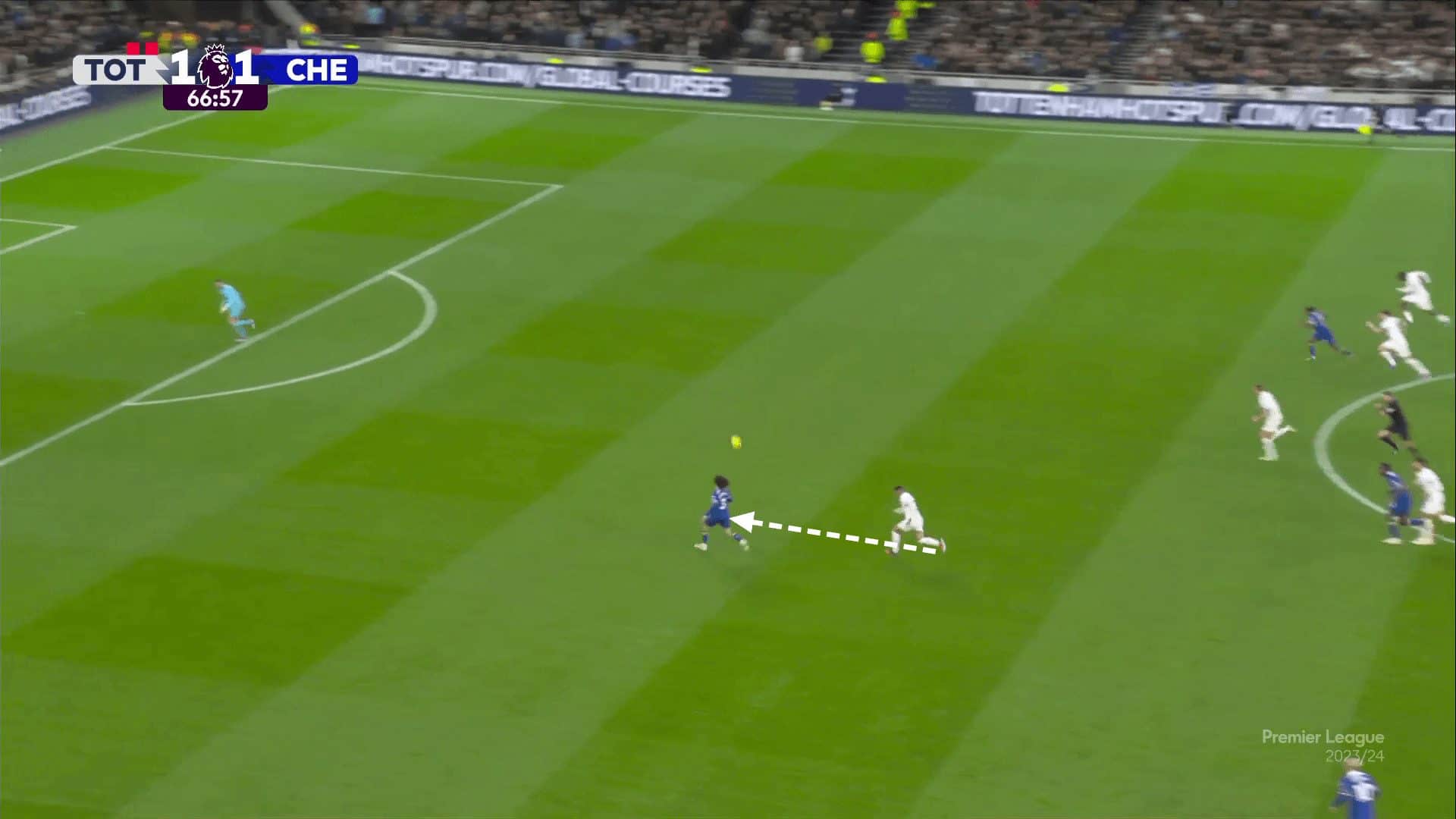
We can see that when the run from deep is made, by the time Cucurella arrives at the ball, he has a good six-yard advantage in the race to goal. Pedro Porro is aware of the run, but because of the restraint put on him to hold his position, Cucurella is able to use the extra space to build up speed, meaning at the point of the pass being made by Reece James, Cucurella is able to continue sprinting to the ball, as he has been for the previous 10-15 yards, whilst Porro has to initially accelerate from a standing start, preventing him from reaching a top speed until Cucurellas has already flown past him. This shows the instant advantages that stem from a run from deep.
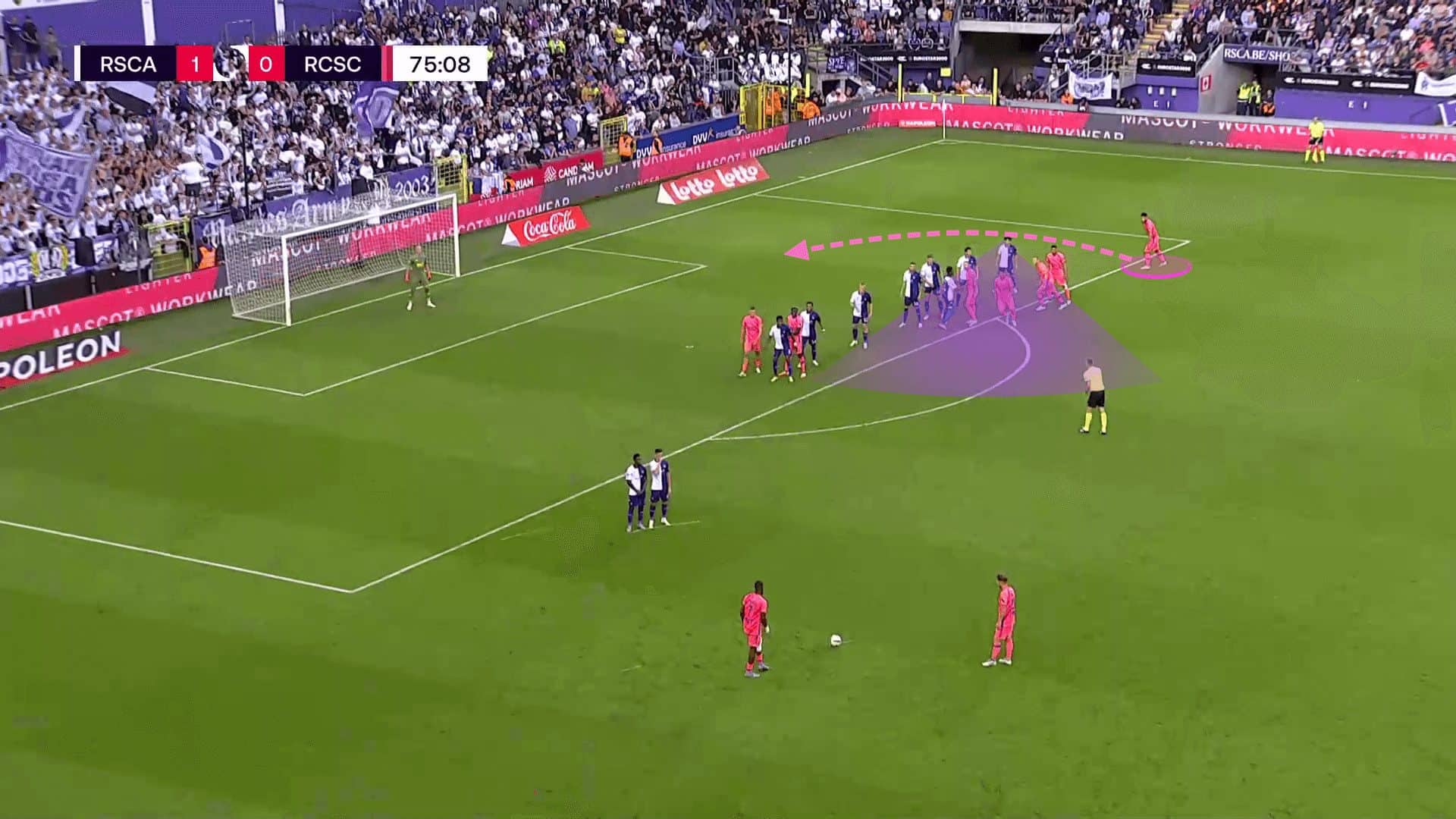
We can see that even Anderlecht’s sturdy set-piece defence can be torn apart by this simple concept by translating this theory into set-pieces. As the free-kick is about to be taken, the furthest player at the far side gives himself a couple of yards distance from the defensive line. This distance is what will help him accelerate to a speed that his markers won’t be able to reach in time. It’s also equally important that the attacker puts himself out of the defender’s view.
If a defender can see the ball and his marker, he may be able to try and move into the path of the attacker, whilst still retreating towards goal. Any sort of obstruction to the attacker’s path, and he could be forced to slow down and lose all the momentum generated from starting deeper. As a result, if the attacker can remain out of his marker’s eyesight, he can attack the space on the far side of the block, where he has an open area he can sprint through without having to worry about any obstacles in his path. He can the focus only on the ball.
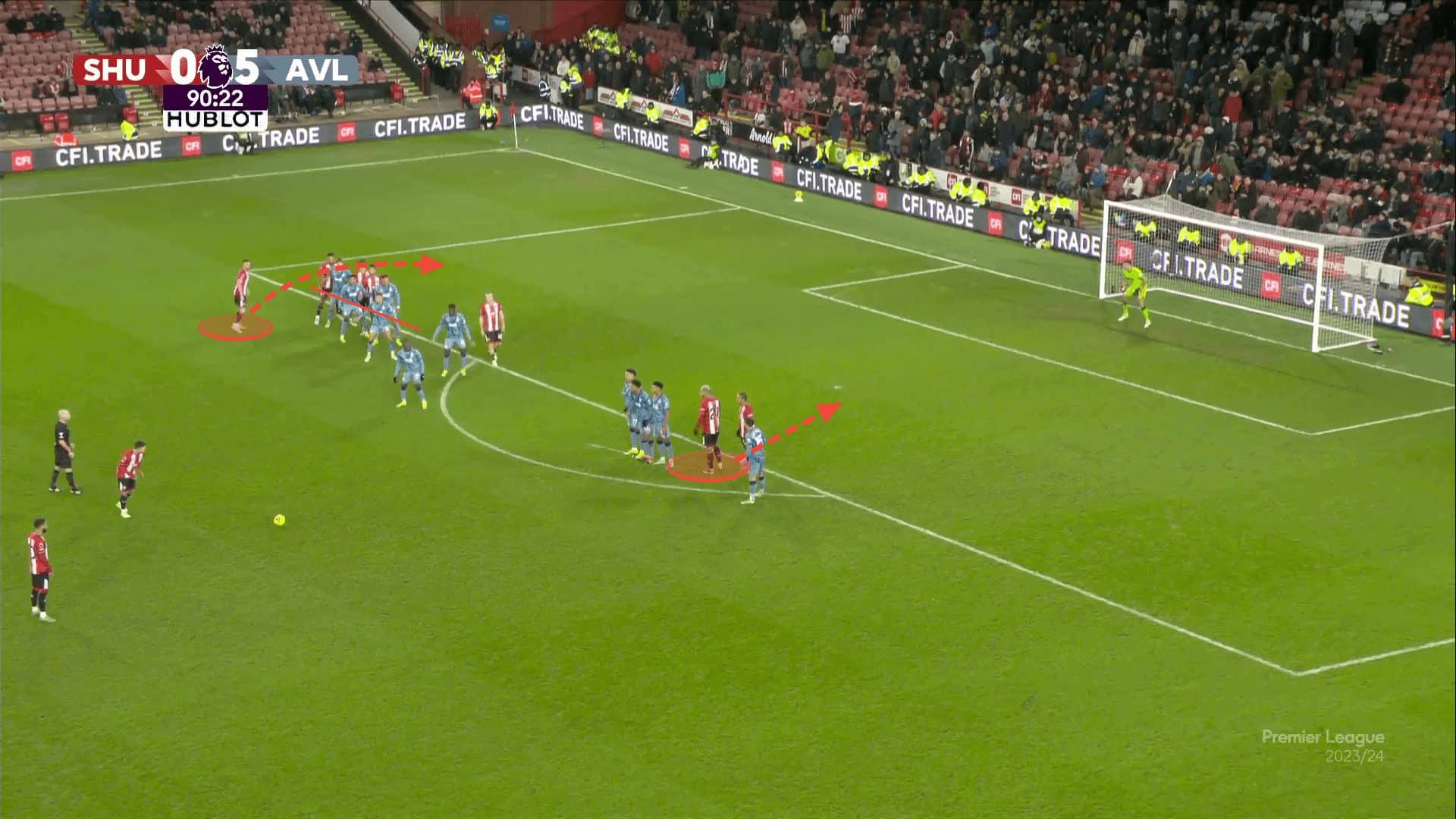
When the path to the open space is potentially obstructed by the defenders, numerous methods can be used to ensure that the runner from deep is still able to attack the penalty area without interruption. One of these methods is to use screens on the last member of the defensive line, on the far side, which can ensure that the attacker has a safe passage into the space inside the penalty area by moving around the outside.
When the last defender is prevented from covering the space behind his back, it ensures that the runner from deep has an easy and pre-determined route to the destination of the ball. This routine was used recently in Sheffield United’s loss to Aston Villa, where a spare attacker next to the wall was able to arrive on the end of a cross made by the run from deep, who was able to access the space inside the penalty area fairly easily. However, it ended up being minimally offside.
Previously, we mentioned how teams can ensure that runs from deep are made around the outside of defensive units. However, it is also possible to allow a runner from deep to enter the penalty area when trying to move through a defensive unit. With most set-pieces, a defender will be given the responsibility of dealing with either a specific player or any players who pass through their zone.
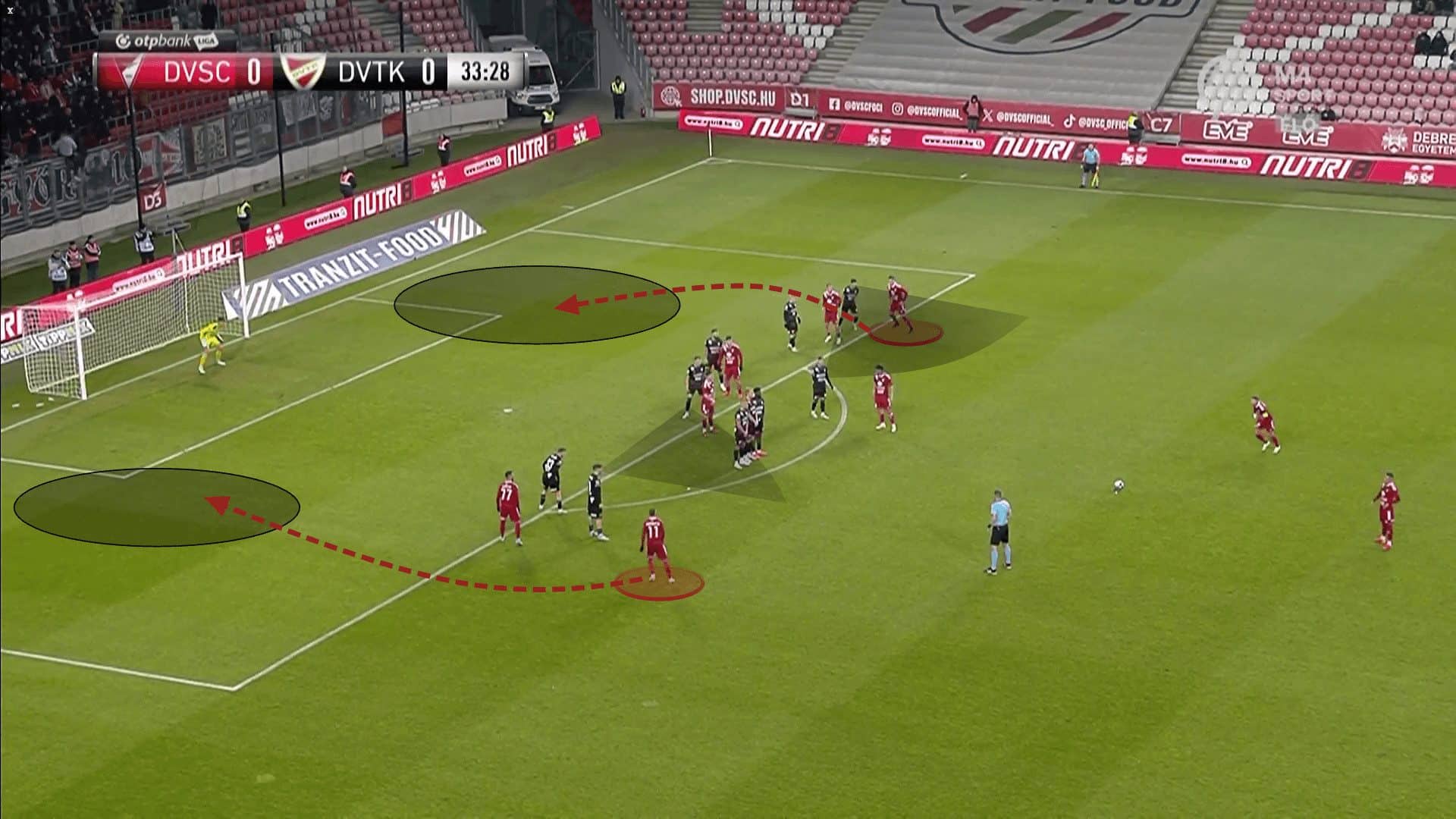
For teams to be able to attack with runs from deep through the centre of defensive units, a solution is to attack the paths where teammates are ready to double up.
For example, the image below highlights two runs which are made by players from deep. The attackers have purposely positioned themselves in line with their teammates, as they know that when they run past the defenders, the defender’s paths will be blocked by the teammate who is setting a screen. It resembles a projectile heading for a wall, but in the last moments, a window is temporarily created and opened in the wall.

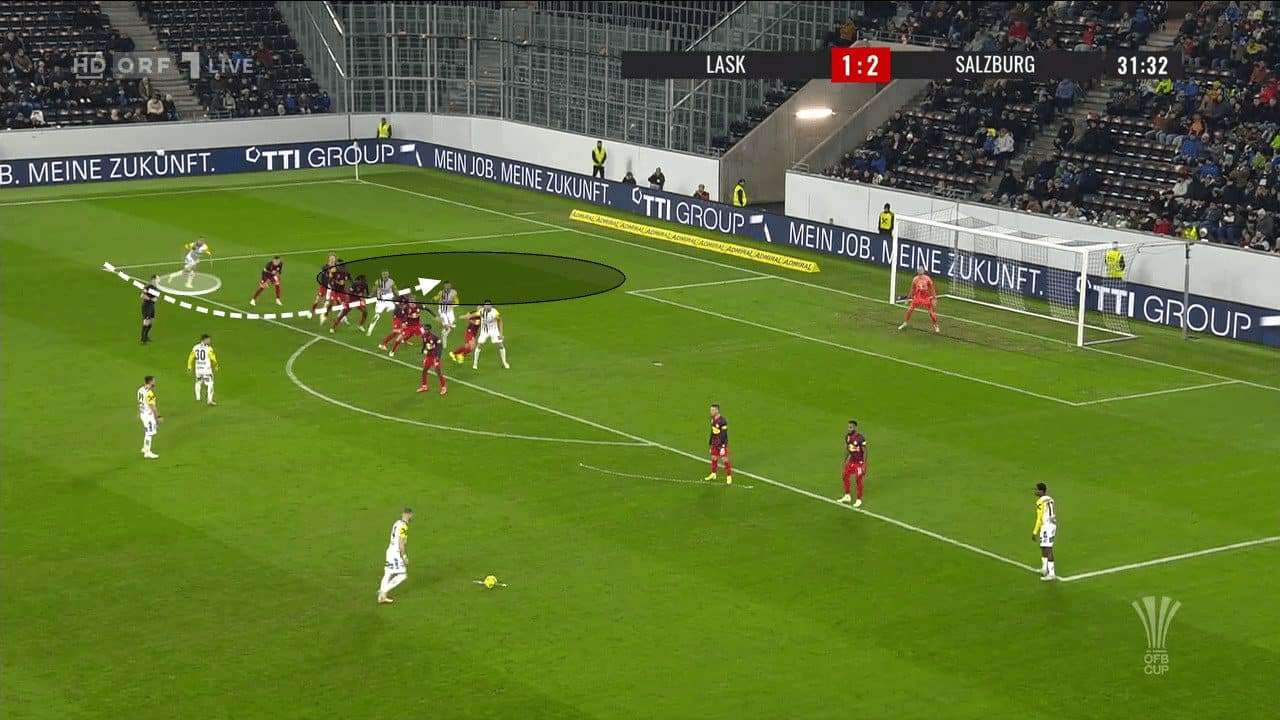
Curved runs from a position parallel to the defensive line are also a slight possible variation. Running alongside the defensive line before picking a moment to turn and burst through the defensive block is an alternative method to a run from deep. The attacker is still able to generate enough momentum to reach a target area first; however, it is harder for teammates to prevent this run from being uninterrupted as defenders could hypothetically start alongside the attacker and remain tight for the duration of the move, as they would always be able to stay goalside and with the ball in their sight.
It is also possible to attempt this from more central areas. As we can see below, the attacking side has the ball in the centre of the pitch, allowing them to use runs from deep in both the left and right-hand sides of the penalty area. The double penetration of the penalty area means that whichever side will receive the ball will have a free option to play the ball to the other side, who will be waiting at the back post for a tap-in to an empty goal. In this example, it is also possible to gain access into the penalty area by remaining out of their marker’s view.
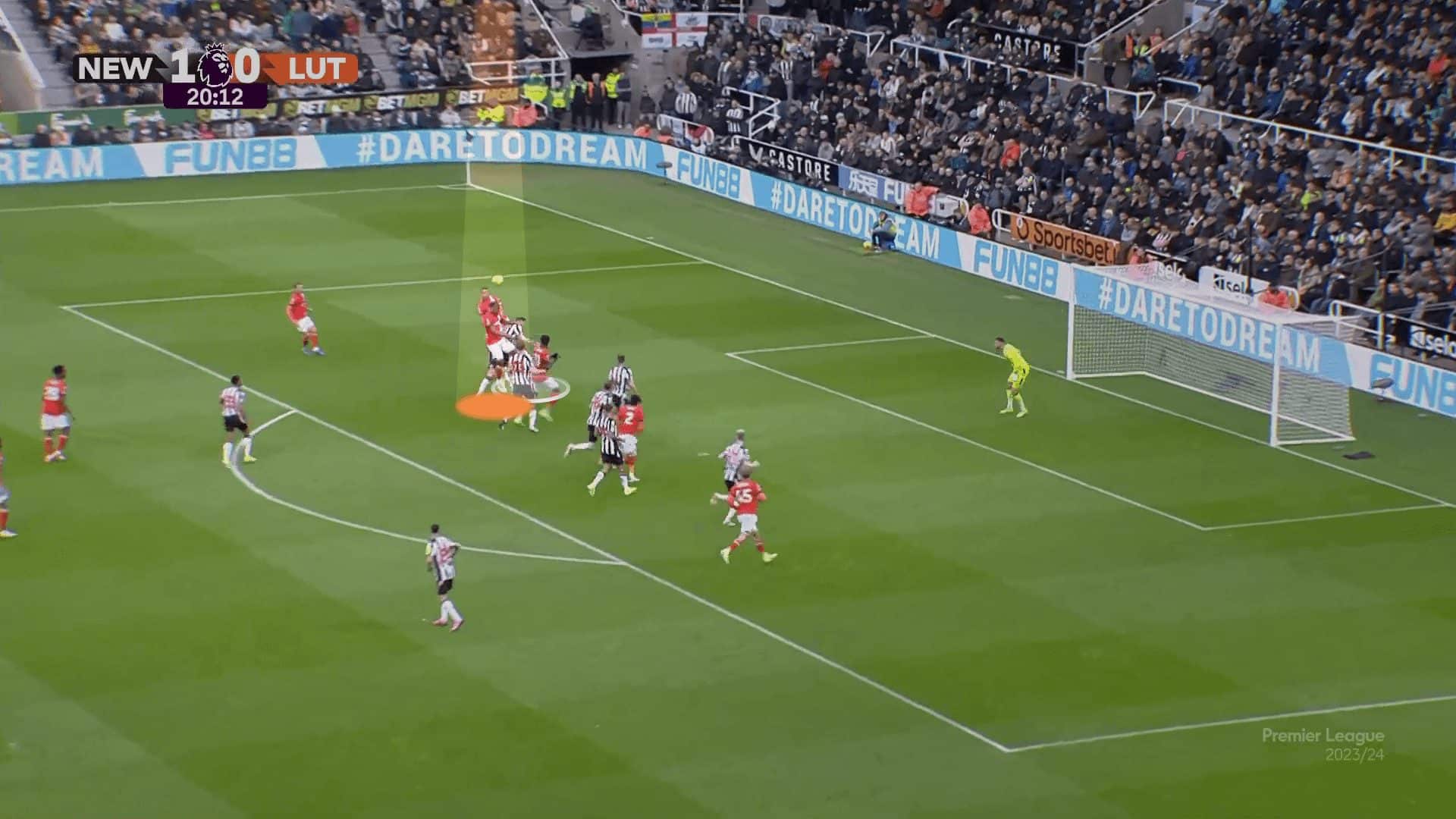
One last advantage of using runs from deep is that even if a defensive unit retreats and moves back before the free-kick is taken, the attacking side will have the advantage. Even though the attacking team doesn’t have the space to penetrate anymore, they have the advantage in the aerial duel as the runner from deep will have plenty of momentum to generate an aerial leap in comparison to the defenders who are backtracking and unable to reach the same heights due to being unbalanced and still having less momentum than the attacking side because of the deeper start.
Summary
This tactical analysis has showcased the different ways in which teams can use runs from deep to create great goalscoring chances from free-kicks. Runs from deep give attackers the potential to reach higher speeds and attack spaces behind defensive lines even quicker from the moment a free-kick is taken. Using deep runs is possible through the centre of defensive units or around the outside while also providing the free-kick takers with the opportunity to pick when to deliver the ball, with appropriate timing slightly easier to accomplish.
