
Independiente del Valle has become one of the biggest teams in South America because of its incredible youth academy, which is based on education, psychological balance, and the technical-tactical qualities of players who join it.
Academy graduates at Independiente, such as Brighton standout Moisés Caicedo, Belgian Pro League recent signings Angelo Preciado, Anthony Valencia, and William Pacho, and others like Alan Franco, Patrickson Delgado, Jackson Porozo, Gonzalo Plata, José Hurtado, or Bundesliga star Piero Hincapié, are some examples of what Independiente is doing year by year.
Players can be sure that they are in the right place, which will give them the perfect tools to make their dreams come true.
Exactly 26 days ago, Independiente del Valle lifted once again the CONMEBOL Sudamericana Cup, just like they did in 2019, with the likes of Alan Franco inside the starting eleven being one of the key players at only 21 years of age.
They won 3-1 against Argentinian Colón at that time. This season, they won against Rogério Ceni’s Sao Paulo, with young players like 20-year-old Marco Angulo, 24-year-old Lautaro Díaz or Luis Segovia, and the main man of this piece: 20-year-old Jhoanner Chávez.
This is just the tip of the iceberg. Independiente came from a 2016 CONMEBOL Libertadores Cup, where they were runners-up, won the u-20 Libertadores Cup in 2020, and were runners-up in 2018 and 2022.
They won their first league title in 2021 and have acquired European managers like Renato Paiva or Miguel Ángel Ramírez, who brought beautiful playing methods and philosophies not only to Independiente, but to Ecuador as a country that has become a league where teams often try to be in possession of the ball, directly affecting the National Team too, where lots of players are academy graduates from Independiente and can play brilliantly in possession-based ideas.
Jhoanner Chávez has not made his first appearance for his native Ecuador, but not just yet. He’s probably the most interesting and promising player at the left-back spot and surely one of the most intelligent players on the pitch.
Being one of the biggest young talents in his country, we have decided to scout him and analyse why he’s one to watch for the future.
This Jhoanner Chávez tactical analysis piece will be a scout report of Chávez.
It will analyze the left-back’s strengths and weaknesses and examine where he fits into Independiente’s tactics thus far.
Jhoanner Chávez Positioning
Independiente del Valle often play with a back three where Jhoanner Chávez likes to sit wide in the first stage of the build-up.
He has plenty of freedom on the pitch, and license to go very forward and join the attack.
However, his head coach, Argentinian Martín Anselmi, has given him a fantastic role to play inverted in the build-up. He leaves his zone and frees space there for a teammate who could receive, and then he passes it to Chávez, who has big off-the-ball movements.
His heatmap from the present season shows his amazing attacking display and use of many channels in every build-up, and also the way he plays inverted in the build-up.
Jhoanner Chávez Heat Map

At his age, he is very able to understand when he has to exchange channels between the wide and half spaces.
He also has great chemistry with his midfielders or centre-forwards when he’s high on the pitch to set the movements.
Against Macará in the Ecuadorian Serie A, his pass map is a good example of what he can offer when playing between the lines in the middle. He also stayed wide, delivering two cut-back crosses inside the penalty box.
This tactical ability to move across different areas is not often seen in young talents across the world.
Jhoanner Chávez Pass Map
 Jhoanner Chávez likes to place inverted to drag and confuse defenders to decide whether to jump or not off their line.
This can generate spaces at the opposition’s back, where he can start to show his powerful stride and sprint that normally makes Independiente del Valle progress and create a threat over the left wing.
On this occasion against Macará, Chávez came to the middle as a passing option and freed the wing for a teammate.
However, in this sequence, his positioning will cause him to drag a marker, leaving a dangerous space between the centre-backs for attack if the ball is played nicely.
This movement allows his team to play the ball wide, but at the exact moment this happens, Jhoanner makes the run forward and leaves space for his teammate in midfield.
That is going to be an option there, and after he receives, he delivers a long ball within his first touch to Chávez, who is making the run.

Nevertheless, Chávez can also play as a natural left-back that usually hugs the line.
In this position, the 20-year-old has excellent distribution capacities, especially playing short and direct almost every time with his first touch of the ball, as Independiente likes to build from the back and beat the press in four or five passes.
It’s almost obvious that his associative skills are very good because normally, the full-back who goes inverted has the skills to play with his back to goal and give few touches to the ball.
Two situations are normally seen when Chávez plays wide, one in his own third and the final third.
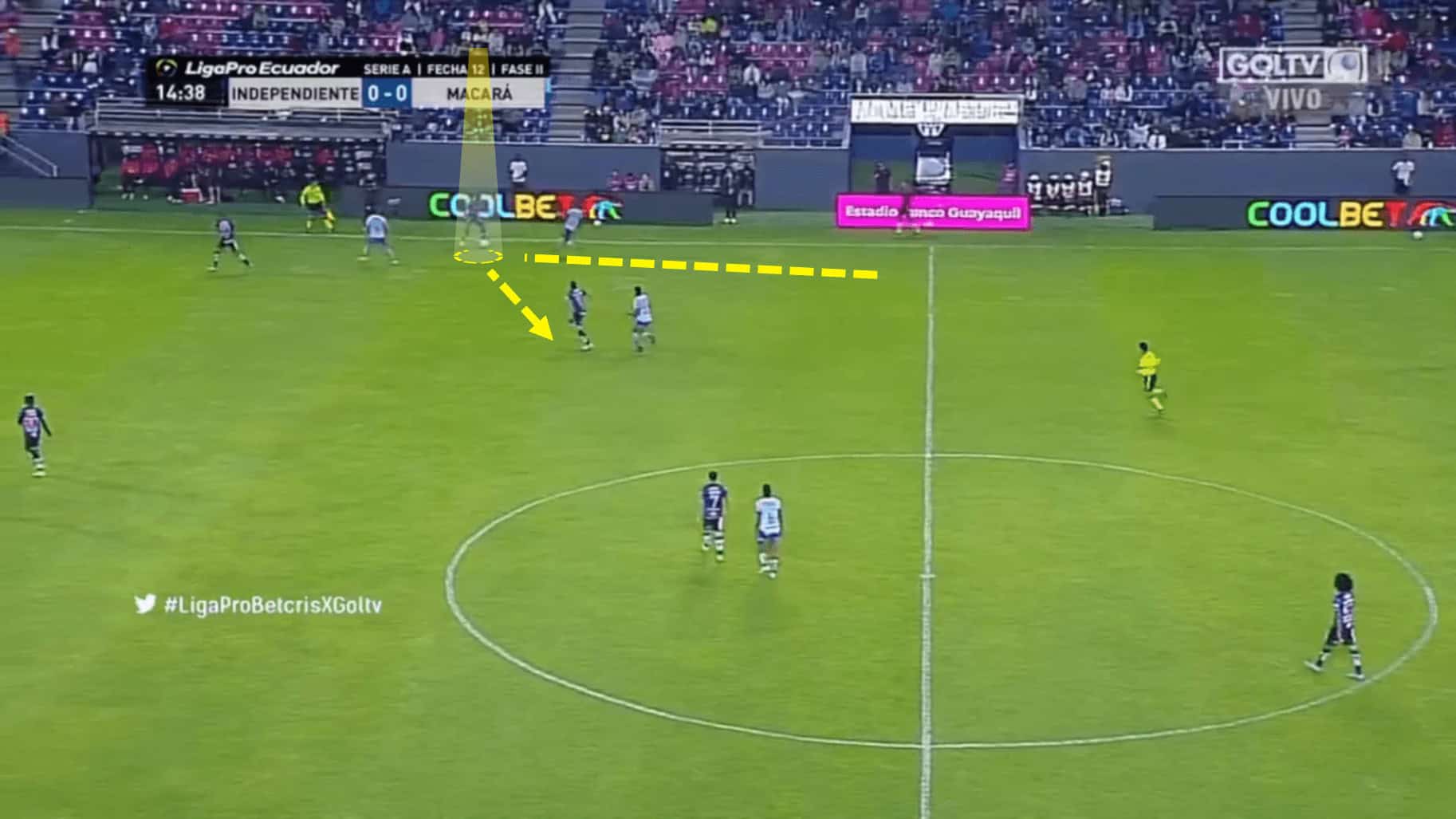
In the first steps of Independiente’s possessions, we can see a simple but effective automatism that moves the strong-side midfielder closer to the wing-back, who’s receiving wide, in this case, our main man Chávez.
He plays it immediately after receiving from his midfielder and makes the supporting run to create a new, higher-passing option.
These situations can be progressive in two ways: the midfielder has the quality to make a through-pass on the half-turn or create a third-man stage where the midfielder passes it back to the centre-back who then plays a long ball.
In the picture below, it was a third-man movement.
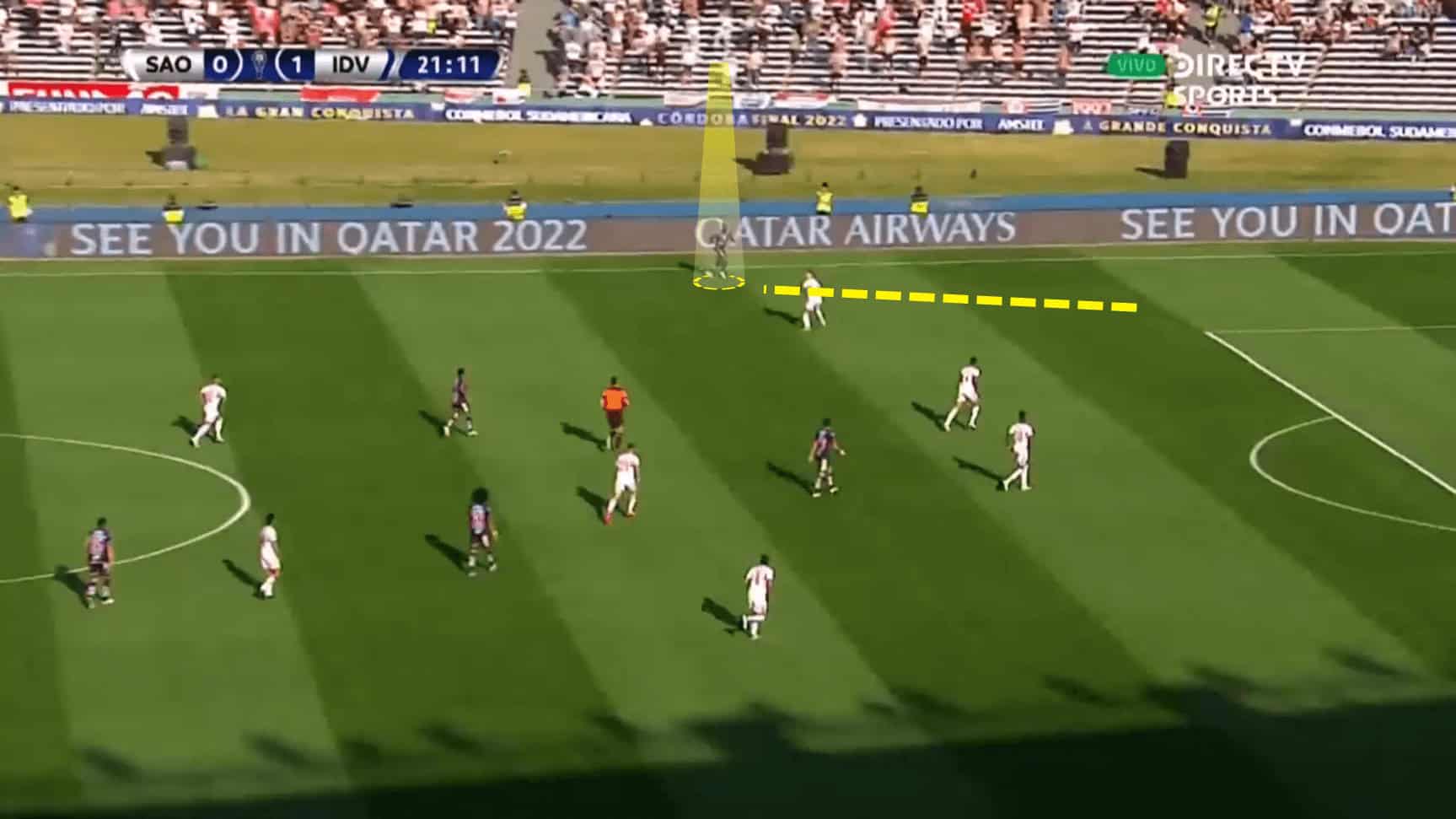
Martín Anselmi likes his team to mute from an ecstatic back-three in possession to a “back-four” where Chávez pins like a left-winger.
Normally, this is done as Independiente overloads many players in the central areas to then release a long pass to the outside player.
This can be seen many times in the Ecuadorian system, as the 20-year-old left-back has a strong build to hold the ball in physical 1v1 duels and the dribbling ability to elude rivals and get into the box.
 Jhoanner Chávez Attacking Output
Jhoanner Chávez’s biggest contribution to his team is in the attacking phase.
He has a wide variety of tools to escape from small spaces, as well as a great crossing ability and the right aggressivity to penetrate the box and score goals. He prefers powerful shots and is also a threat from outside the box when he stays behind in a more inverted role.
His off-the-ball movements are one of the greatest features of his games.
As mentioned before, he possesses tactical intelligence to step into different zones of the pitch in the first passes of the build-up.
Also, in the middle and final third of the pitch, Jhoanner shows great movements to be active from the outside to the inside and vice versa.
These exchanges are normally made in the middle third to final third and benefit having a free man in creative positions, as he confuses rivals when deciding which player they will mark, thanks to the rotations.
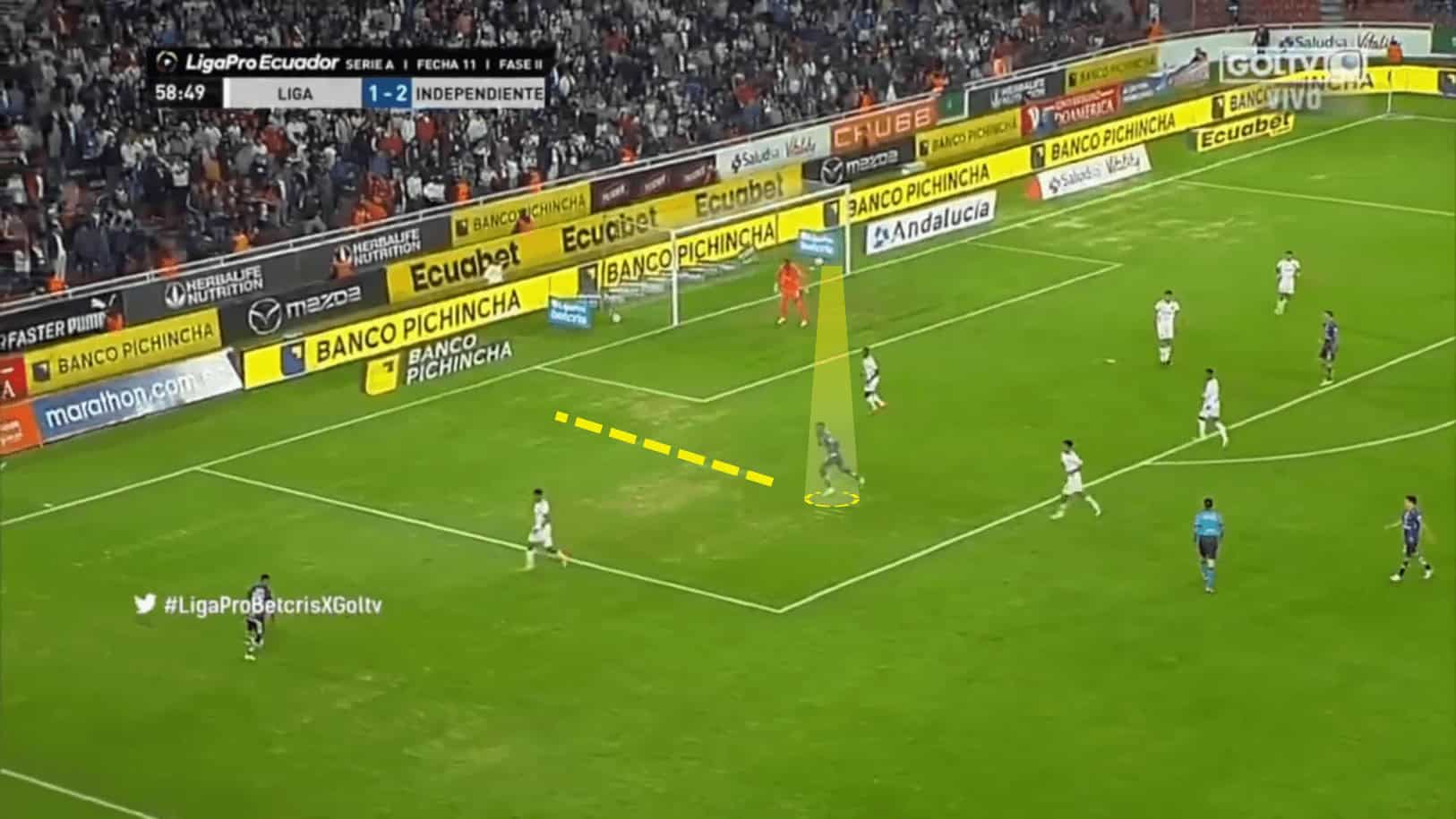
In the figure below, Independiente are attacking from the left-hand side of the pitch, a regular sight in their game thanks to the strong threat that comes from there.
Marked in yellow, Chávez has changed from the wide channel to the half-space, making a run inside the box behind the full-back and then executing a cut-back cross to the penalty spot.
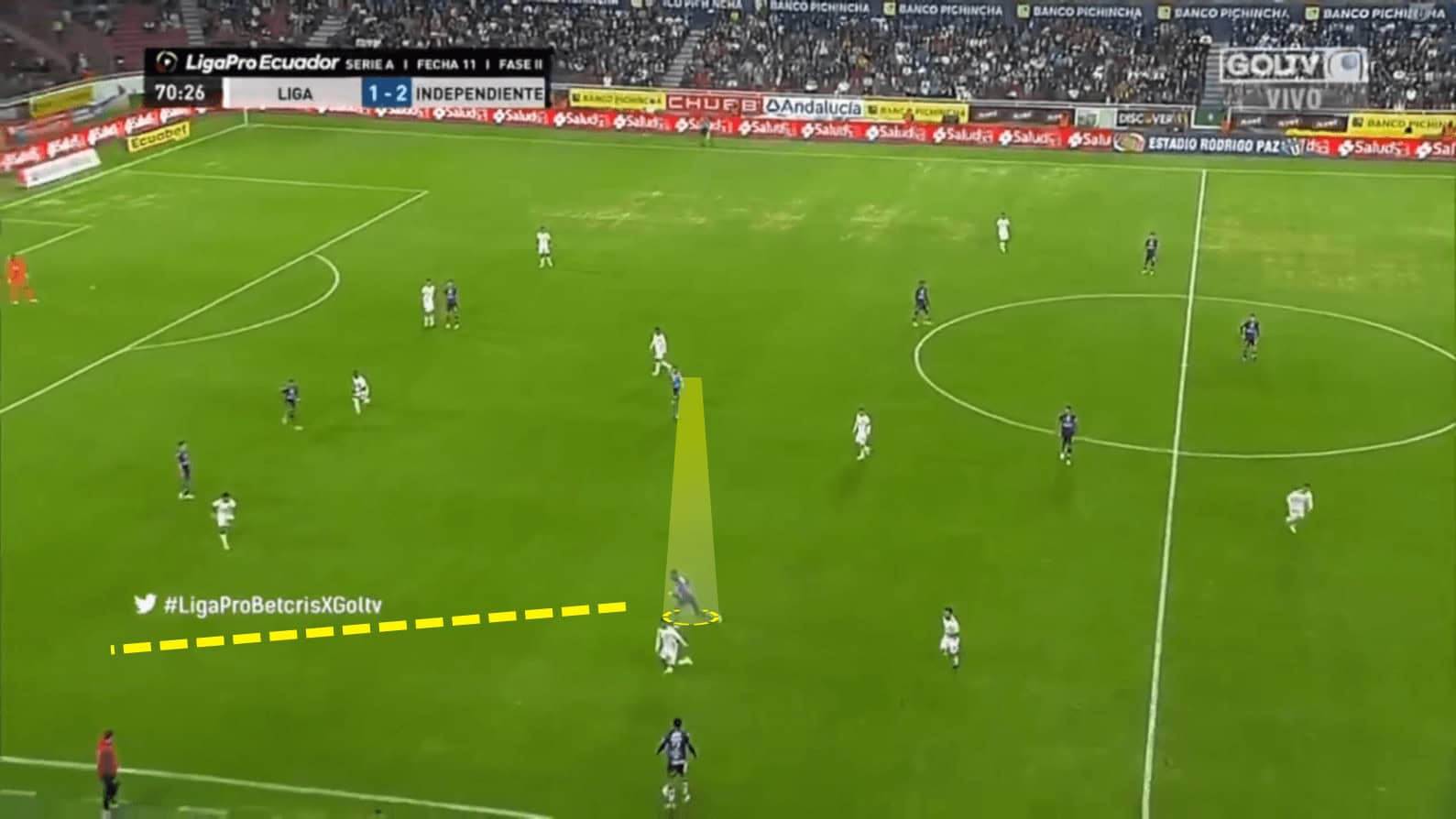
 We can also see these types of runs in the middle third, where he’s often leaving his zone to elaborate combinations and one-two situations through the middle to be activated like the picture below can show.
A teammate receives the ball very wide, while Jhoanner Chávez is already making a rapid movement to the outside.
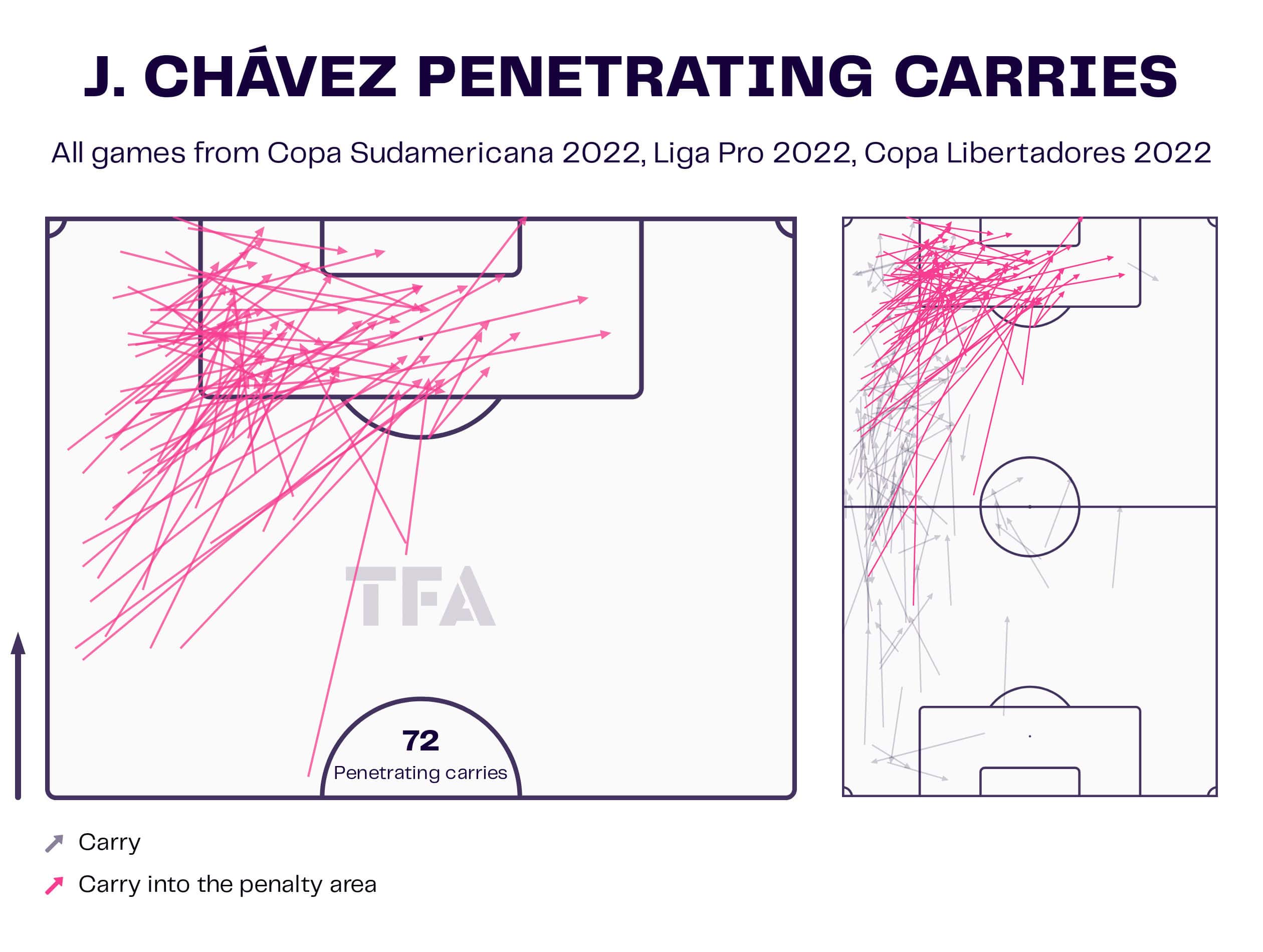
There, he’ll grab the ball and carry it aggressively, as this is one of his trademarks in his game.
 These carries are very important to point out in this piece as they’re probably the most common and successful ability Chávez shows on the field.
His overwhelming athletic build allows him to beat players thanks to his pace and strong lower body.
He combines great physical attributes with technical qualities that can leave opponents behind.
He likes to do it in every third of the pitch, and he’s not afraid to lose the ball in one of these progressive runs with the ball, as he’s very confident and mentally sharp.
When he sees the opportunity to receive the ball, take on a player and run at top speed, he’s going to do it.
He has a very nice end-product and technical deliveries when running.
The data viz below can explain what we are talking about: He massively relies on his ball-carrying ability, and he does it from everywhere: in the final third, to shoot closer to goal or generate shot assists; in the middle third to elevate his team higher; and in his own third to beat the press in an individual decision that helps his team collectively when they run out of ideas.
Jhoanner Chávez Penetrating Carries Map
 Jhoanner is also an incredible resource in the attacking phase, as he has proven himself an excellent goalscorer.
Normally, his goals are scored in a similar way: He makes the run behind the full-back, grabs a through-pass from a player at the edge of the box, and takes a very powerful shot that often changes the placement inside the net, but the bottom and upper corners are sought.
His xG map shows incredible stats for a young full-back who is actually playing in the top tier of his country and in top competitions such as the Libertadores and Sudamericana Cup.
The graphic samples a high percentage of shots taken on the left side of the box, as he frequently places himself here.
However, shots from outside are also tried.
Jhoanner Chávez xG Map

Another big asset in Chávez’s game is his cut-back crosses and deliveries from outside, which are very dangerous for any defender in the box.
He likes to go very deep to take these passes, which are mostly found by Lautaro Díaz who has been excellent as a centre-forward for Independiente del Valle.
He knows that goals can be very simple in this way, so he uses his incredible skills to get past players and then passes the ball back to one of the team’s centre-forwards or a surprising midfielder who arrives from behind.
Jhoanner Chávez has a very big output in the attacking phase.
Thanks to the threat he produces from the left side of the pitch, he is basically one of the key players in Anselmi’s system.
In attacking transitions, he’s a smart player who makes runs with changes of rhythm and direction that confuse defenders, and he could be free to finish the transition.
Jhoanner Chávez Defensive phase
One of the aspects Chávez has to improve on is defence.
As he’s an attacking-minded player, he forgets to get back and support his team to create a compact shape.
He can also be distracted to cover runs behind his back, so rivals tend to attack his zone with 2v1 situations.
Independiente is a high-pressing team that likes to defend in a high block, and Chávez is an important element in this defensive style. He goes very high to mark tight rival full-backs and delete passing options at the wings.
One of the positives of playing with a back-three is that wing-backs can have the security to go forward as a player is constantly looking to protect them behind.
However, this is not going to happen always, as football is just not like that.
Mistakes are made, and players have to solve situations.
In the following viz we can see the high-regains of Chávez, in which we see a tendency to defend very up and normally wide, marking rival full-backs.
Jhoanner Chávez High Regains Map

Jhoanner is not the best defender in terms of timing his tackles and measuring the power of his body slams to lay down players on the ball.
However, his intensity and proactivity allow him to intercept passes or block them as he tries to be everywhere with his mobility and speed.
This can sometimes be negative for his game, as he could be dragged off or go too high to defend a player, leaving space at his back.
His defensive territory shows many fouls, which describe his impetuous style of defending, which sometimes adds more power than needed.
Jhoanner Chávez Defensive Territory Map
 When the ball is being played at the other side of the pitch, he joins the box as another centre-back, and his 182cm are a helping hand as he also jumps high.
He’s attentive to defending low crosses that try to find a player at the far post. He’s constantly scanning who’s at his back and normally gives a good body shape to clear the ball out in dangerous moments that could end in an own goal.
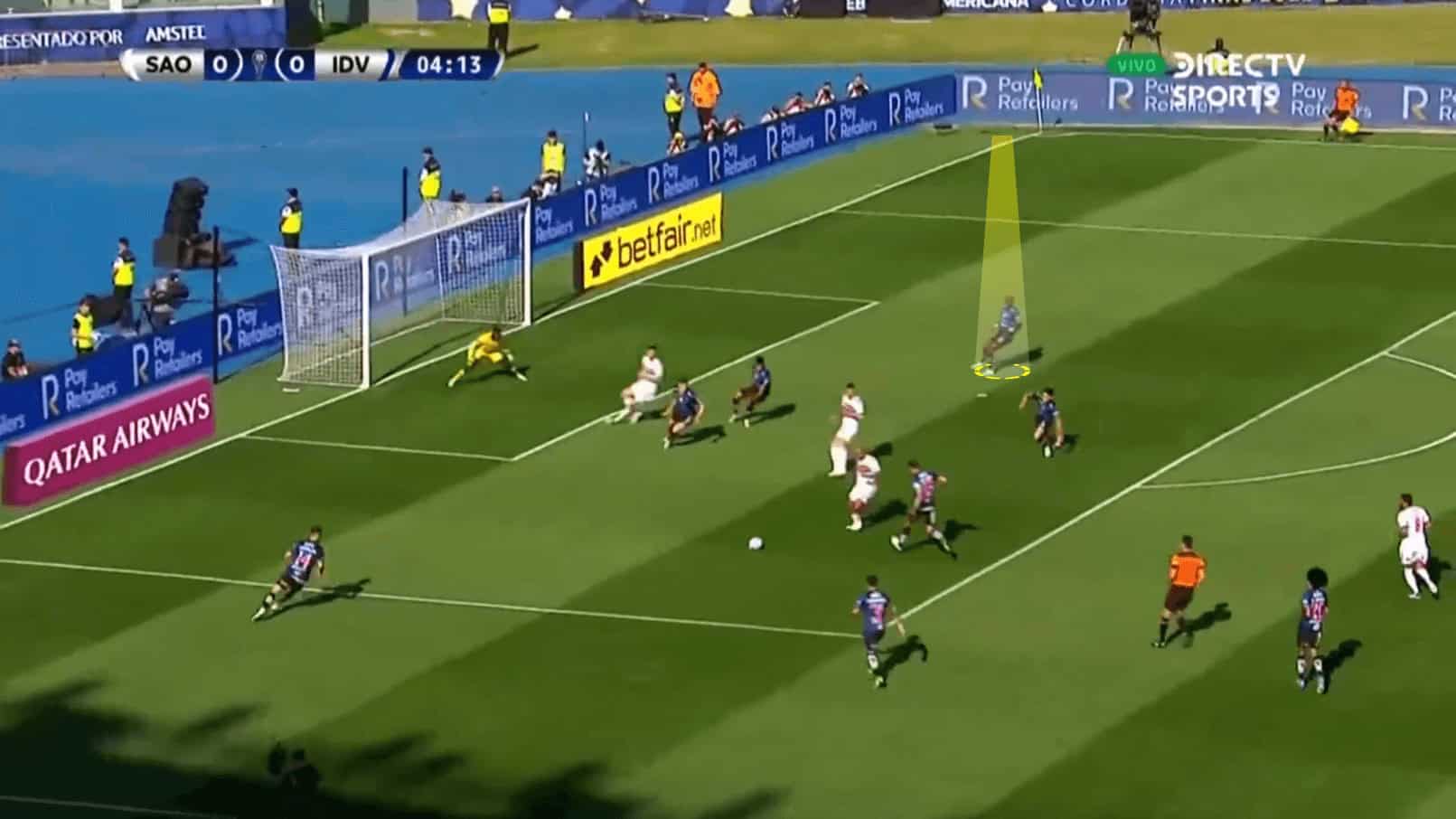
Against Sao Paulo, he showed an excellent defensive display inside the box, blocking options behind him and joining his own penalty area to support his team, adding more elements and making it even more difficult for the Brazilian side to do something inside.
 Conclusion
Jhoanner Chávez shows great talent, an intelligent tactical understanding of how to play in different zones, and technical qualities that lots of young players don’t have at his age.
Being developed as an attacking wing-back, he regularly issues with covering his backs or making impulsive decisions to go off his line and make a foul.
The 20-year-old is a fantastic project of a player at the left-back spot that surely is going to attract European football teams, looking to sign him on a long contract to keep growing his interesting playing style.
