Total Football Analysis
Once.Sport
  • Football Analysis
    • Data Analysis
    • Formations
      • 2-2-4 Formation
      • 2-3-5 Formation
      • 3-1-4-2 Formation
      • 3-2-2-3 Formation
      • 3-2-4-1 Formation
      • 3-1-6 Formation
      • 3-3-4 Formation
      • 3-4-1-2 Formation
      • 3-4-2-1 Formation
      • 3-4-3 Formation
      • 3-5-1-1 Formation
      • 3-5-2 Formation
      • 4-1-4-1 Formation
      • 4-2-2-2 Formation
      • 4-2-3-1 Formation
      • 4-2-4 Formation
      • 4-3-1-2 Formation
      • 4-3-3 Formation
      • 4-4-2 Formation
      • 4-5-1 Formation
      • 5-3-2 Formation
      • 5-4-1 Formation
      • 6-3-1 Formation
    • Head Coach Analysis
    • Match Analysis
    • Player Analysis
    • Recruitment Analysis
    • Set Piece Analysis
    • Tactical Theory
    • Tactical Preview
    • Team Analysis
    • Training Analysis
    • Tactical Analysis
    • Scouting Report
  • Competition
    • ALL Competitions
    • English Premier League
    • Champions League
    • La Liga
    • Bundesliga
    • Serie A
    • Ligue 1
    • Eredivisie
    • EFL Championship
    • FIFA World Cup 2022
    • WEURO 2022
    • Women’s Super League
    • NWSL
    • Belgian First Division A
    • A-League
    • Liga Profesional de Argentina
    • Austrian Bundesliga
    • Campeonato Brasileiro Série A
    • DFB Pokal
    • 1. HNL
    • Danish Superliga
    • EFL League One
    • EFL League Two
    • FA Cup
    • EFL Cup
    • Indian Super League
    • K-League
    • J1 League
    • Liga MX
    • Copa América 2021
    • Copa del Rey
    • MLS
    • Eliteserien
    • Euro 2020
    • Primeira Liga
    • Scottish Premiership
    • Allsvenskan
    • Europa League
    • UEFA Nations League
    • Liga AUF Uruguaya
  • Coaches
    • All Coaches
    • Alfred Schreuder
    • Ange Postecoglou
    • Antonio Conte
    • Arne Slot
    • Bo Svensson
    • Brendan Rodgers
    • Bruno Lage
    • Carlo Ancelotti
    • Christophe Galtier
    • Claude Puel
    • Claudio Ranieri
    • David Moyes
    • Dean Smith
    • Diego Simeone
    • Domenico Tedesco
    • Frank Lampard
    • Eddie Howe
    • Edin Terzić
    • Emma Hayes
    • Erik ten Hag
    • Ernesto Valverde
    • Gennaro Gattuso
    • Gerardo Seoane
    • Gian Piero Gasperini
    • Giovanni van Bronckhorst
    • Graham Potter
    • Igor Tudor
    • Imanol Alguacil
    • Jesse Marsch
    • Jonas Eidevall
    • Jorge Sampaoli
    • José Bordalás
    • José Mourinho
    • Julen Lopetegui
    • Julian Nagelsmann
    • Julien Stéphan
    • Jürgen Klopp
    • Luciano Spalletti
    • Lucien Favre
    • Manuel Pellegrini
    • Marcelo Bielsa
    • Marco Rose
    • Marco Silva
    • Massimiliano Allegri
    • Mauricio Pochettino
    • Maurizio Sarri
    • Mikel Arteta
    • Niko Kovač
    • Nuno Espírito Santo
    • Oliver Glasner
    • Patrick Vieira
    • Paulo Fonseca
    • Pep Guardiola
    • Peter Bosz
    • Rafa Benítez
    • Ralf Rangnick
    • Ralph Hasenhüttl
    • Roger Schmidt
    • Roy Hodgson
    • Sean Dyche
    • Sérgio Conceição
    • Simone Inzaghi
    • Sonia Bompastor
    • Stefano Pioli
    • Steffen Baumgart
    • Steven Gerrard
    • Thiago Motta
    • Thomas Frank
    • Thomas Tuchel
    • Unai Emery
    • Vincenzo Italiano
    • Xavi
  • Teams
    • ALL Teams
    • AC Milan
    • Ajax Amsterdam
    • Arsenal
    • AS Monaco FC
    • Atalanta
    • Atlético Madrid
    • FC Barcelona
    • FC Bayern Munich
    • Borussia Dortmund
    • Celtic FC
    • Chelsea FC
    • Everton F.C.
    • Inter Milan
    • Juventus F.C.
    • Leeds United F.C.
    • Liverpool FC
    • Manchester City
    • Manchester United FC
    • Paris Saint-Germain
    • Rangers FC
    • RB Leipzig
    • Real Madrid CF
    • Tottenham Hotspur
    • West Ham United
  • Players
    • ALL Players
    • Alisson Becker
    • Bukayo Saka
    • Erling Haaland
    • Harry Kane
    • Jack Grealish
    • John Stones
    • Julián Alvarez
    • Kalvin Phillips
    • Kevin De Bruyne
    • Kyle Walker
    • Kylian Mbappé
    • Lamine Yamal
    • Lionel Messi
    • Luis Díaz
    • Mohamed Salah
    • Phil Foden
    • Virgil Van Dijk
  • Contact
  • Write For TFA
No Result
View All Result
No Result
View All Result
Total Football Analysis
No Result
View All Result
Home Analysis

UEFA Champions League 2020/21: Chelsea vs Sevilla – tactical analysis

Young Wang by Young Wang
October 22, 2020
in Analysis, Champions League, Chelsea FC, Julen Lopetegui, Match Analysis, Sevilla FC
0
UEFA Champions League 2020/21: Chelsea vs Sevilla - tactical analysis tactics

This UEFA Champions League match ended with a 0-0 draw. Both sides created some chances but weren’t of high quality in the open play. Sevilla’s set-pieces created great threat but they didn’t take their chance.

In this tactical analysis, we shall examine the tactics of both sides, with the emphasis on Chelsea’s. In this analysis, we shall detail Sevilla’s attack and Chelsea’s attack in this match.

Lineups

UEFA Champions League 2020/21: Chelsea vs Sevilla - tactical analysis tactics

Chelsea: Edouard Mendy, Reece James, Thiago Silva, Kurt Zouma, Ben Chilwell, Jorginho, N’Golo Kanté, Christian Pulišić, Kai Havertz, Mason Mount, Timo Werner

Sevilla: Bono, Jesús Navas, Sergi Gómez, Diego Carlos, Marcos Acuña, Nemanja Gudelj, Suso, Fernando, Ivan Rakitić, Lucas Ocampos, Luuk de Jong

Sevilla’s attack controlled by Chelsea’s defensive principle

Sevilla in this match was the team that enjoyed more possession, however, their positional attack was not very effective. Their ball circulation was almost all around the block but wasn’t penetrating the block. This was because of the defensive work of Chelsea.

As Chelsea’s centre-back-duo would suffer from the exposure in the centre, due to their reckless decision making or mistakes (especially Zouma), it was crucial to “hide” the centre-back behind the midfield line. In this way the centre-backs would not have to step out to engage the on-ball opponent and it would be a more solid defensive line. Thus, Chelsea’s front and midfield players would cluster in the centre, preventing the Sevilla to break the lines in the centre.

As a result, Chelsea would force Sevilla to the outside in their high/mid-block defending, protecting the inside of the pitch. As Sevilla adopted a 4-2 playing out shape in the back, their pivots in the centre would be eliminated by the marking of Chelsea’s front players. Chelsea utilised a 4-2-3-1 shape in high-block. The weak side winger and the attacking midfielder would mark two pivots of Sevilla. Also, two pivots of Chelsea, serving as the balancing players, occupied central passing channels and prevented the opponent from passing forwards in the centre. In this way, they could prevent the centre being played through and hid the centre-backs.

UEFA Champions League 2020/21: Chelsea vs Sevilla - tactical analysis tactics

In the above image, we could see the positioning of the high-block of Chelsea. In the centre, Havertz and the winger Pulisic were marking two pivots of Sevilla. Pulisic on this occasion didn’t take a balanced position where he could shadow Sevilla’s left-back and pivot at the same time. Instead, he came close to the centre to secure the central spaces. In the second midfield layer, Kanté and Jorginho eliminated any possible forward passing options in the centre. The lone striker Werner ran in curve to force the ball outside, and the ball was forced to the right-back.

Thus, the aim of this was to prevent Sevilla’s use of centre in the early stage. As the ball travelled to the flank area, for Chelsea’s side the optimal outcome was to force mistakes and recover high up the pitch, though it didn’t occur many times in this match. That was due to the pressure-resistant ability of two side-backs of Sevilla, but their options were usually the vertical winger on the flank. If Sevilla’s side-backs succeeded in picking wingers, progressing the ball to final third, Chelsea would still close the centre. And they would want the ball to be played on the flank, while they would seize the timing in recovering possession utilising doubling-up or the strong tackles of James/Chilwell. Ideally, this would launch the counter on the flank and we will discuss this in the next section.
UEFA Champions League 2020/21: Chelsea vs Sevilla - tactical analysis tactics

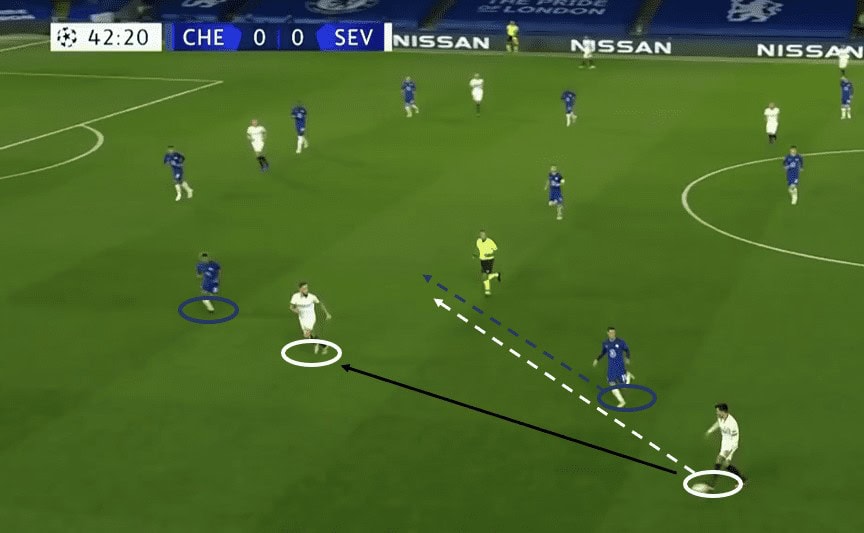
From the above image, Sevilla’s left-back was trying to pass and then underlap to attack the centre. In this scenario, Pulisic kept tracking him and closed the passing channel for the underlapping left-back. Also, James in this scenario prevented his matchup from turning, and he seized the timing to poked the ball from behind. This dispossession launched the counter from the flank and Pulisic’s later dribble created a foul.

However, if the possession couldn’t be recovered, Chelsea was not afraid of defending against crosses. With good physical centre-backs Silva and Zouma, their positioning and aerial ability enabled them to deal with the cross effective. Ideally, this would launch the counter in the centre, utilising passes of deep-lying playmaker Jorginho.
Hence, the principle of defending the centre, forcing to the outside had neutralised the attacking threat of Sevilla, as they were for most of the time, playing outside the block.

Chelsea’s counter benefiting from their defensive principle

As we mentioned in the previous section, Chelsea was closing the centre and forcing Sevilla to the side. Ideally, the way of recovering for Chelsea would be: 1. recovering directly on the flank (doubling-up; good tackles etc.) or 2. intercepting/ clearing/ heading in the centre from the attempts to put the ball in the centre with crosses. Thus, this might lead to the two major methods in the counter: dribbling through the flank to progress, or use deep-lying playmaker/ number ten to start the attack.

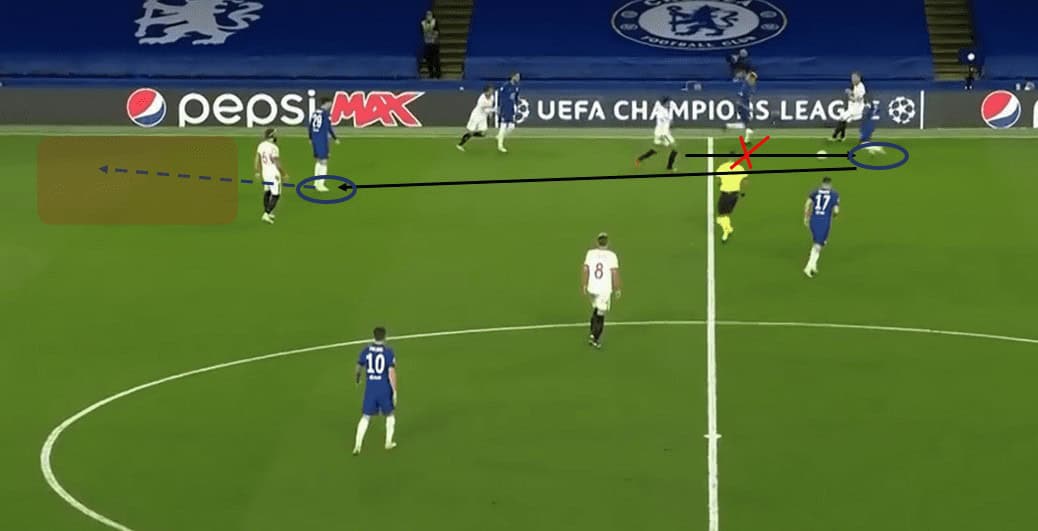
For the first counter method, the logic behind it was the deployment of good on-the-ball progressor and make use of the space left by Sevilla’s full-backs in the attack. In particular, on the right flank Sevilla’s left-back Acuña attacked high and Chelsea’s left-winger Pulišić was incredible on the ball. In this way, Chelsea could effectively progress the ball to the final third.
UEFA Champions League 2020/21: Chelsea vs Sevilla - tactical analysis tactics

From the above image, Sevilla developed their attack on Chelsea’s right flank, whereas Kanté joined the defensive unit and dispossessed the opponent in this tight area. The ball was poked to the space left by Sevilla’s left-back Acuña, and in this case, Chelsea’s attacking midfielder Havertz who was also a good dribbler got the ball. Havertz utilised the space and brought the ball into an advanced area, bringing the play to the next phase.

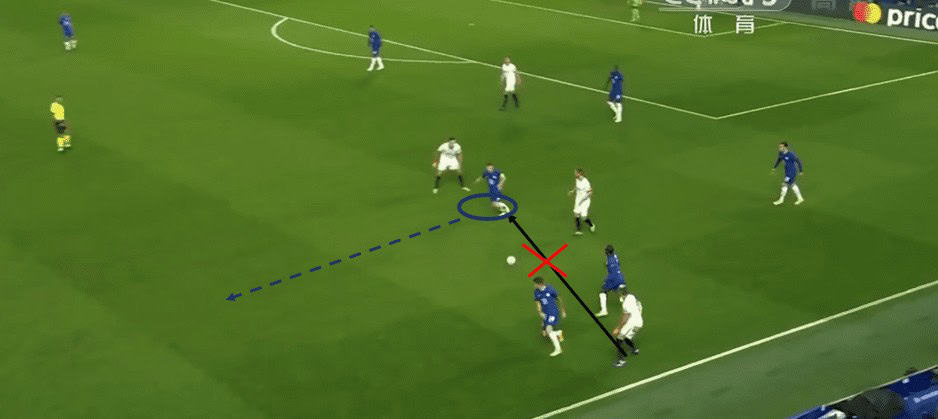
For the second method, with a deep-lying playmaker like Jorginho, who could pass to create threat so long as he is facing forwards, and Werner who can run in behind to stretch the play/ provide as a final pass option, the play could be directed into the final phase and chances would be created.
UEFA Champions League 2020/21: Chelsea vs Sevilla - tactical analysis tactics

From the above image, we could see that Sevilla tried to put the ball into the centre. That was when Jorginho seized the timing to surprise the opponent from behind and intercepted the ball. Then he could launch the counter in the centre.
UEFA Champions League 2020/21: Chelsea vs Sevilla - tactical analysis tactics

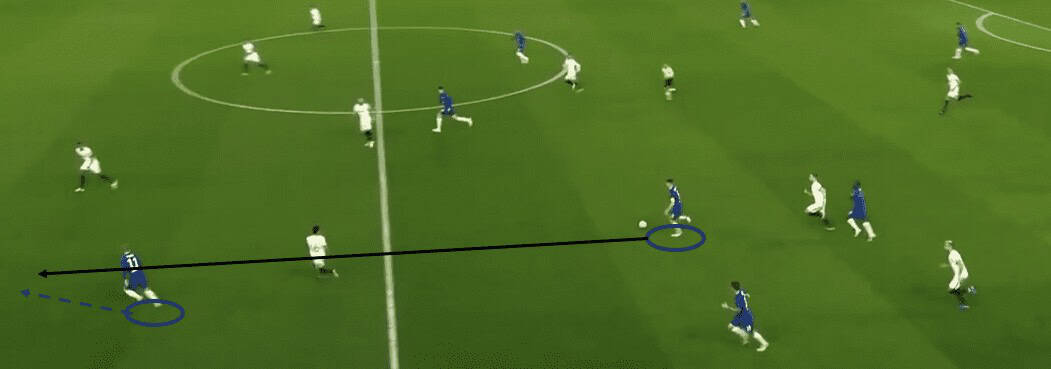
He dribbled a few steps forwards, encountering no pressure from the opposition. On this occasion, Werner was also running at the shoulder of the defensive line. As Jorginho had an eye contact with Werner, Werner started to accelerate and received on behind the line. He therefore had a chance to score, but his form was not fit in this match. He wasted the chance.

Chelsea’s positional play utilising their attacking midfielder

Apart from their effective counterattack, Chelsea also had control over their positional play. Their attack was more effective as suggested by the xG (0.66-0.48). They could successfully play out from the back, breaking through the pressure from Sevilla’s 4-2 pressing shape.

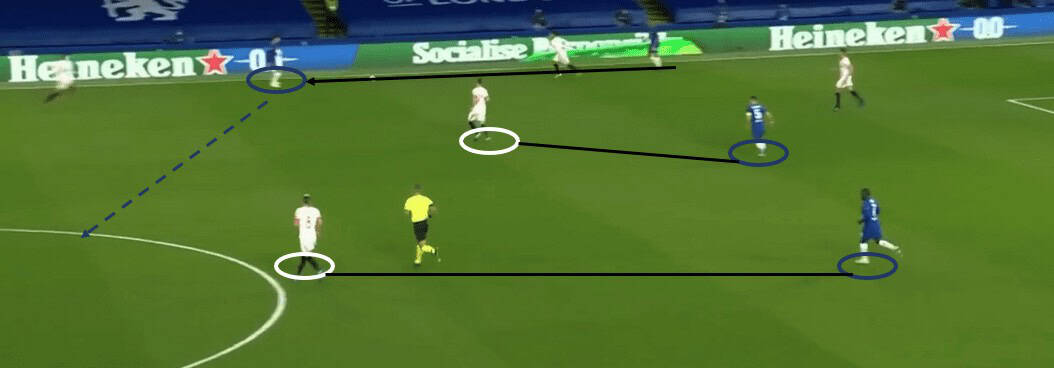
They succeeded in doing so by dropping the attacking midfielder in front of the midfield line, as two pivots in the 4-2-3-1 system were occupied by the opposition central midfielders. Then the free man was created. Also, as the winger pinned the opponent’s full-back, the attacking midfielder could drop to the flank and receive there. He would have space and time to turn due to the pinning of the winger.
UEFA Champions League 2020/21: Chelsea vs Sevilla - tactical analysis tactics

From the above image, we could see that Havertz dropped to the right flank to receive from the right-back. We can see that two pivots of Chelsea pinned the opposition central midfielders. The pinning of the right-winger Mount had created enough space and time for Havertz to half-turn. Then Havertz utilised his dribbling skill to bring the ball into an advanced area and into the final phases as he broke the lines.
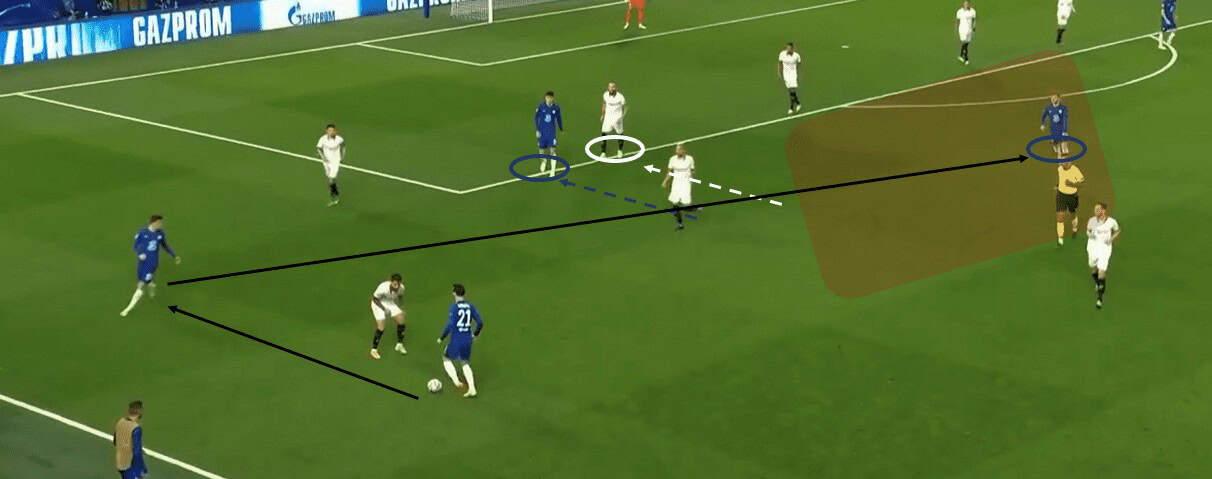
Chelsea utilised the attacking midfielder’s movement as a solution in the first phase. In the final phases, attacking midfielder Havertz’s off-the-ball movement was also important to create an opening for other teammates to create a threat.
UEFA Champions League 2020/21: Chelsea vs Sevilla - tactical analysis tactics

From the above image, we could see that Havertz went towards a high position at the shoulder of the opponent’s defensive line. As Sevilla’s pivot Gudelj tracked him, zone 14 was vacated. Then Werner dropped to the zone 14, later receiving from the flank. He was therefore having time and space to shoot from outside the box, hitting the target.

Sevilla’s possible solution for the next matchup

Sevilla has tall and physique player de Jong, who is good at playing as the target man. However, in this match, Sevilla mostly played short and abandoned the direct play to him. It is suggested that de Jong is deployed as the target man, with Munir along with his side to receive from the lay-off or flick-on. This is a good way to escape the lines and direct hit the centre.
What’s more, if Silva is deployed in the next match, some run-in-behind when Chelsea defends in the high block on his side is suggested. He’s not a pacey defender as he is now 36 years old, and it’s worth trying hitting the space behind him.

Conclusion

Both teams don’t have very good results at the beginning of their respective leagues (La Liga and English Premier League). As their form gradually become better, we shall expect more intriguing tactics and performance from both teams in their next matchup.

Previous Post

2015 predictions made by Lionel Messi make for grim reading

Next Post

UEFA Champions League 2020/2021: Paris Saint-Germain vs Manchester United – tactical analysis

Next Post
UEFA Champions League 2020/2021: Paris Saint-Germain vs Manchester United - tactical analysis tactics

UEFA Champions League 2020/2021: Paris Saint-Germain vs Manchester United - tactical analysis

  • About Total Football Analysis
  • Contact Total Football Analysis
  • Write For Total Football Analysis
  • Advertise
  • Privacy Policy
  • Cancellation / Refund Policy
  • Resources
  • Terms Of Service

© 2026 Total Football Analysis

No Result
View All Result
  • Football Analysis
    • Data Analysis
    • Formations
      • 2-2-4 Formation
      • 2-3-5 Formation
      • 3-1-4-2 Formation
      • 3-2-2-3 Formation
      • 3-2-4-1 Formation
      • 3-1-6 Formation
      • 3-3-4 Formation
      • 3-4-1-2 Formation
      • 3-4-2-1 Formation
      • 3-4-3 Formation
      • 3-5-1-1 Formation
      • 3-5-2 Formation
      • 4-1-4-1 Formation
      • 4-2-2-2 Formation
      • 4-2-3-1 Formation
      • 4-2-4 Formation
      • 4-3-1-2 Formation
      • 4-3-3 Formation
      • 4-4-2 Formation
      • 4-5-1 Formation
      • 5-3-2 Formation
      • 5-4-1 Formation
      • 6-3-1 Formation
    • Head Coach Analysis
    • Match Analysis
    • Player Analysis
    • Recruitment Analysis
    • Set Piece Analysis
    • Tactical Theory
    • Tactical Preview
    • Team Analysis
    • Training Analysis
    • Tactical Analysis
    • Scouting Report
  • Competition
    • ALL Competitions
    • English Premier League
    • Champions League
    • La Liga
    • Bundesliga
    • Serie A
    • Ligue 1
    • Eredivisie
    • EFL Championship
    • FIFA World Cup 2022
    • WEURO 2022
    • Women’s Super League
    • NWSL
    • Belgian First Division A
    • A-League
    • Liga Profesional de Argentina
    • Austrian Bundesliga
    • Campeonato Brasileiro Série A
    • DFB Pokal
    • 1. HNL
    • Danish Superliga
    • EFL League One
    • EFL League Two
    • FA Cup
    • EFL Cup
    • Indian Super League
    • K-League
    • J1 League
    • Liga MX
    • Copa América 2021
    • Copa del Rey
    • MLS
    • Eliteserien
    • Euro 2020
    • Primeira Liga
    • Scottish Premiership
    • Allsvenskan
    • Europa League
    • UEFA Nations League
    • Liga AUF Uruguaya
  • Coaches
    • All Coaches
    • Alfred Schreuder
    • Ange Postecoglou
    • Antonio Conte
    • Arne Slot
    • Bo Svensson
    • Brendan Rodgers
    • Bruno Lage
    • Carlo Ancelotti
    • Christophe Galtier
    • Claude Puel
    • Claudio Ranieri
    • David Moyes
    • Dean Smith
    • Diego Simeone
    • Domenico Tedesco
    • Frank Lampard
    • Eddie Howe
    • Edin Terzić
    • Emma Hayes
    • Erik ten Hag
    • Ernesto Valverde
    • Gennaro Gattuso
    • Gerardo Seoane
    • Gian Piero Gasperini
    • Giovanni van Bronckhorst
    • Graham Potter
    • Igor Tudor
    • Imanol Alguacil
    • Jesse Marsch
    • Jonas Eidevall
    • Jorge Sampaoli
    • José Bordalás
    • José Mourinho
    • Julen Lopetegui
    • Julian Nagelsmann
    • Julien Stéphan
    • Jürgen Klopp
    • Luciano Spalletti
    • Lucien Favre
    • Manuel Pellegrini
    • Marcelo Bielsa
    • Marco Rose
    • Marco Silva
    • Massimiliano Allegri
    • Mauricio Pochettino
    • Maurizio Sarri
    • Mikel Arteta
    • Niko Kovač
    • Nuno Espírito Santo
    • Oliver Glasner
    • Patrick Vieira
    • Paulo Fonseca
    • Pep Guardiola
    • Peter Bosz
    • Rafa Benítez
    • Ralf Rangnick
    • Ralph Hasenhüttl
    • Roger Schmidt
    • Roy Hodgson
    • Sean Dyche
    • Sérgio Conceição
    • Simone Inzaghi
    • Sonia Bompastor
    • Stefano Pioli
    • Steffen Baumgart
    • Steven Gerrard
    • Thiago Motta
    • Thomas Frank
    • Thomas Tuchel
    • Unai Emery
    • Vincenzo Italiano
    • Xavi
  • Teams
    • ALL Teams
    • AC Milan
    • Ajax Amsterdam
    • Arsenal
    • AS Monaco FC
    • Atalanta
    • Atlético Madrid
    • FC Barcelona
    • FC Bayern Munich
    • Borussia Dortmund
    • Celtic FC
    • Chelsea FC
    • Everton F.C.
    • Inter Milan
    • Juventus F.C.
    • Leeds United F.C.
    • Liverpool FC
    • Manchester City
    • Manchester United FC
    • Paris Saint-Germain
    • Rangers FC
    • RB Leipzig
    • Real Madrid CF
    • Tottenham Hotspur
    • West Ham United
  • Players
    • ALL Players
    • Alisson Becker
    • Bukayo Saka
    • Erling Haaland
    • Harry Kane
    • Jack Grealish
    • John Stones
    • Julián Alvarez
    • Kalvin Phillips
    • Kevin De Bruyne
    • Kyle Walker
    • Kylian Mbappé
    • Lamine Yamal
    • Lionel Messi
    • Luis Díaz
    • Mohamed Salah
    • Phil Foden
    • Virgil Van Dijk
  • Contact
  • Write For TFA
  • Login

© 2026 Total Football Analysis