
The final match of the second game week of the new Premier League campaign saw Wolverhampton Wanderers taking on Manchester City at the Molineux stadium. The hosts were up and running for the season after an important league win over Sheffield United last week and an EFL cup defeat during the midweek. On the other hand, the visitors were playing their first match of the league due to their stretched 2019/20 season.
Over the past two seasons, Wolves have become a very tricky side for the top teams, especially for Manchester City as Nuno Espírito Santo’s side had scored two goals in the final 10 minutes in each of those games to become the only team, besides Manchester United, to do a league double over the Citizens during the last season.
After a strong first half that saw the visitors take a comfortable 2-0 lead, Wolves’ goal in the second half made things interesting as the fans waited for a déjà vu moment. However, a stoppage-time finisher ensured a comfortable 3-1 win for the visitors.
In this tactical analysis, we will analyze Pep’s positional play tactics that lead to domination in the first half. We will also do an analysis of how Wolves managed to get back in the second half.
Lineups

Nuno made one change from Wolves’ previous league win over Sheffield United. Rúben Neves’ match fit status meant that he replaced Leander Dendoncker in the midfield and resumed his pairing alongside João Moutinho. It indicated a shift in the formation from their last game’s 3-5-2 to a 3-4-3. The back-six behind and the front-three ahead of the two Portuguese midfielders retained their places in the side.
As for City, it was not a surprise to see Ederson starting between the sticks. Nathan Aké’s arrival from Bournemouth during the summer allowed Pep Guardiola to form a left-foot and right-foot center-back pairing of Aké and John Stones. Consequently, Fernandinho was relieved from the center-back duty as he was reinstated to his favored defensive-midfield position alongside Rodrigo to form the double pivot. Kyle Walker and Benjamin Mendy were selected as the full-backs. Kevin De Bruyne was deployed as the number 10 in the three-man attacking midfield alongside Raheem Sterling on the left and Phil Foden on the right. Finally, Sergio Aguero’s injury meant Gabriel Jesus was an automatic selection as the lone striker in what looked to be a 4-2-3-1 setup from the Spanish manager.
City’s effective positional play and high pressing rattled Wolves in the first half
Manchester City was on the front foot right from the start as the previous season’s runners-up began the game with high intensity and tempo thereby putting any fitness related qualms to bed. It is a well-known fact that Manchester City, like all the previous teams of Pep, likes to play the positional style of football.
One of the major principles of the positional play is to expose all the vertical channels during the attack by stretching the team horizontally to provide the width and vertically to provide depth in turn generating optimal coverage of the pitch. The following position map of City is a perfect representation to start our analysis.

As you can see, there is enough width and depth occupied by the Manchester City players to cover all the possible vertical channels. The two full-backs provide the width to occupy the wide channels by constantly pushing high during an attack and deep during the defense. The center-backs are positioned in the defensive half-spaces (inside-channel) while the pivots are positioned in the central space (channel) to cover the defensive third. Number ‘7’ is positioned in the left inside channel but made runs in the 18-yard box along with the number ‘9’ who is positioned in the central channel. Number ‘47’ is in the right inside channel while the number ‘17’ had a free role to occupy the free spaces required to maintain the positional structure. As you can see, with this kind of positioning, it is easy to create tringles all over the field.
The following sequence of figures shows the in-game implementation of Manchester City’s positional play, which also led to the first goal for the visitors.

The initial setup is similar to the positional map shown previously. Foden provided width this time by occupying the wide channel on the right. Hence, De Bruyne was seen to make a movement in the inside channel (half-space) while Walker drifted inside to keep the structure intact. Observe that Wolves’ compact 5-3-2 defensive shape prevented any central space from the away side.

In the next moment, Walker provided a pass to Foden (not shown in the figure). Observe that Foden followed the first-touch with a left-footed inside movement. This movement was done in order to trigger an inside movement of the Wolves’ players consequently compressing the shape of the Wolves’ midfield. This was an important movement as we shall see its importance later. Moments later, the 20-year old laid the possession to Stones and retreated to his wide position.

As you can see in the figure, the previous actions had compressed the Wolves’ shape in the center as they left more space in the outer channel. Hence, Pedro Neto, who was providing a cover-shadow to Foden in the first image, had now cleared the passing lane towards the 20-year old. Hence, as soon as Stones received the ball, he quickly provided it back to Foden on the right flank.

As Foden received the ball, Ruben Vinagre had no choice but to press Foden as Neto was left too far away from Foden as a result of the previous actions. De Bruyne anticipated this and hence, made a movement in the space that will be vacated beyond the Wolves’ backline once after Vinagre’s movement. Eventually, Romain Saïss made a pointless sliding tackle on the Belgian inside the box to concede a penalty.
The initial horizontal width that stretched the Wolves’ defense combined with quick passing movements along with high tempo in the midfield opened up spaces for City in the attacking third as Wolves’ midfield was unable to cope with City’s intensity.
While Manchester City were relentless on the ball with their positional attacking play, their high pressing structure off the ball strangled Wolves at the back. Pep’s side implemented a man-to-man pressing scheme in the Wolves’ half which prevented the home side to swiftly build their attacks from the back. Considering that City were playing their first game without any pre-season, it was only natural that their pressing intensity (PPDA), which was 13.2, was not at their usual best. Having said that, it was effective to deny easy attacking passage to the home side.
The following figure shows City’s pressing structure.

As shown in the figure, City’s (white boxes) front-four pressed the three center-backs and a defensive-midfielder of Wolves (yellow boxes) in a diamond structure to cut any possible exchanges amongst them. Furthermore, the full-backs pushed high to pin the Wolves’ wing-backs in their own half. The only option Wolves had was to go long centrally. However, with Raúl Jiménez being the only physical attacking player on the field, Nuno’s side hardly ventured into this idea.
Hence, Rui Patrício often looked for Adama Traoré on the right, with the hope that the Spaniard can use his strength to hold off Mendy and create attacks, as shown in the goalkeeper’s long-passing map below.

However, Mendy’s strength on the flank and Rodrigo’s wide movement to double up on the Wolves attacker nullified Traoré’s threat. As shown in the following figure, with no Wolves attacker dropping deep, Traoré has no passing option as Rodrigo closes in. Furthermore, the Spaniard cannot make a turn as Mendy is too close.

As a result, Manchester City were able to win possession in the Wolves half more often than not as the statistic shows that Wolves’ 16 out of 25 losses were in the own half. Nuno finally made a tactical tweak just after half an hour when he instructed one of his attackers to drop deep to support Traoré in the buildup and create an overload on the flank that could allow swift passage of passing play in the middle third. The change, however, came too late as the home side was already trailing 2-0 by then. The following sequence of figures showcases tactical change.


Manchester City’s pivots unleashed Kevin De Bruyne
While Nuno reverted to a two-man central midfield pairing for this game, Pep’s choice of two pivots was interesting as the Spaniard has generally preferred a 4-3-3 system. Having said that, the two pivot-system provided stability in the middle of the park and built a foundation to play positional football, as we shall see in this section.
With the 4-2-3-1, City’s plan was to ‘gain numerical superiority behind each line of pressure to create a free man’, which is one of the essential components of positional play. In the following figure, we can see that in spite of Wolves committing four men in City’s third, Fernandinho and Rodrigo helped the visitors to maintain a numerical advantage by creating a four versus five in the buildup.

In his favored 4-3-3 system, Pep liked one of his players to join Rodrigo in the center during the last season. This player can be a left-back or an attacking midfielder. Since Fernandinho was primarily used as a center-back and Mendy is not adept for this role, it was either Oleksandr Zinchenko or De Bruyne who dropped deep. This shift compromised the latter’s creative abilities in the opposition half.
Fernandinho’s switch to the defensive-midfield position provided the freedom to De Bruyne and allowed the Belgian to do what he does the best, which is to create goal-scoring opportunities for his team.
The PFA Player’s Player of the Year ran havoc in the attacking third as he had the greatest number of shots (nine), the most chances created (six), the highest number of attacking third passes (37, with over 70% accuracy), a goal and an assist.
The 29-year old made movements across the field to occupy the spaces created by Wolves in consequence of City’s positional play. De Bruyne was seen to occupy both the inside spaces, both the wide spaces, and the central space throughout the game. In fact, he was also seen to take the left-back position at one moment, which epitomizes the freedom that the midfielder got due to the two-pivots behind him.
The visitors transmitted the numerical advantage gained during the build-up phase, as established earlier, into the opposition half. In most cases, De Bruyne found himself to be the “free man” in the left half-space to trigger a penetrating ball inside the penalty box for Sterling and Jesus, who made timely runs beyond the Wolves’ backline. Pep’s plan was to ensure that their most creative player got enough time and space in the attacking third to provide goal scoring opportunities. The following heatmap of De Bruyne asserts his influence in the left half-space.
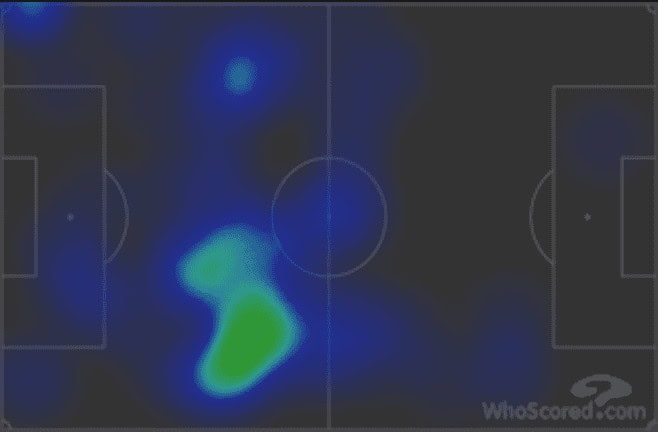
The in-game examples of City’s plan to unleash De Bruyne in the final third can be showcased from the following figures.

Foden tucked inside near De Bruyne. As the youngster received the ball, Neves started to press while cover-shadowing De Bruyne. However, Foden passed to Jesus, who in turn provided a lay over to the Belgian in the half-space and made a run inside the box. De Bruyne got enough time and space to provide a penetrating pass inside the penalty box.

Once again, a triangle was formed in the middle to isolate the two pivots of Wolves. This time, it was Fernandinho who looked for Foden, who once again positioned himself centrally. Although Moutinho had provided cover-shadow for the Belgian in the first part, he drifted away to press the man in possession in turn losing his marker. Foden performed a one-touch layover to De Bruyne, who now had time and space for a penetrating pass.
In both the scenarios, the Wolves’ midfielders were defensively poor. In the first image, Neto failed to quickly close down Foden which forced Neves to leave De Bruyne in space. In the second case, it was Neves who was watching the ball rather than following his marker (Foden) and closing him down. Lapse of concentration and reading of the game, along with City’s tactics created the second goal for the visitors.
Kevin De Bruyne’s performance was not limited to attacking. He showcased an excellent defensive display of his game by attempting seven (five successful) tackles, which was the highest in the game. Moreover, he made nine recoveries, only behind Neves’ 10. The Belgian’s work rate was an example for young players as he was strong in every challenge all over the field.
Wolves’ response in the second half
The Wolves are known to be the second-half masters as 37 out of 51 goals in the previous season came during the latter half of the game. After being completely dominated in the first half, Nuno’s men were expected to come stronger into the second half.
City, on the other hand, looked fatigued in the second half, naturally so due to the lack of pre-season fitness. The intensity of the press reduced so was the quick tempo of attacking play which was on display in the first half. For Pep’s team, the second half was all about solidity at the back and avoiding the circumstances of last season’s games.
It did not take long for the home side to finally find the grip on the game as they started to evade the high press of the visitors and began to enjoy possession. While they had just over 37% possession in the first half, the initial 10-15 minutes in the second half saw Wolves enjoying 60% of possession.
When this Wolves team has the momentum, it is generally very good in creating dangerous goal-scoring chances due to the quality and technicality of their players. The movements started to get better as the home side began to find spaces between the lines as well as beyond the high defensive line of Manchester City. Eight of their 10 shots (total) came in the second half. However, the home side’s poor execution in the final third gave them no more than one goal.
The following figure shows an instance where Jiménez dropped deep to draw Aké out of his position to isolate Stones one versus one against Podence with ample space beyond the high defensive line of the visitors. Moutinho executed a perfect pass beyond Stones but Podence missed an easy one versus one chance against Ederson.

The following figure shows an instance of Wolves finding spaces in the opposition half. Notice the space in the pocket that Neto has found himself in the middle third. Also, observe that the City attackers are happy to let Willy Boly enjoy the possession without much pressure. Both aspects were unseen in the first half.

Manchester City started to concede more possession as the game progressed. Hence, they began to organize themselves in a mid-block structure of 4-4-2 or 4-5-1.
Although Wolves scored just under the 80-minute mark, City ensured security at the back as the away side started to lose momentum most that and the visitors were able to strike a stoppage-time finisher.
Conclusion
It was a game of two halves as both the teams got either of the halves to dominate and influence the result. However, it was the away side that took out most from their chances in the first half on the back of an unstoppable Kevin De Bruyne’s performance. Even though the hosts posed a significant threat in the second half and one can argue that they deserved something out of this game, their poor final third execution meant they could not repeat their last season’s feat of scoring late goals to hurt Pep’s team.
Manchester City commenced their mission to recapture the title from Liverpool on an impressive note as they overcame one of the trickiest fixtures in the Premier League. It is too soon to predict but Pep’s side looks more solid than last season. As for Wolves, Nuno will have to inspire his team for their next weekend’s trip to the London Stadium against West Ham United after their second successive defeat in a week.
