
In what seems like a now daily occurence, the Premier League offered up another mouth-watering clash between two top sides managed by two of the best coaches in world football. The matchup was not an unfamiliar one, with Thomas Tuchel getting another opportunity to face off against his fellow countryman Jürgen Klopp, with Tuchel hoping to pick up his first away win against Klopp in his career. The systems and philosophies of both teams were fairly predictable before the game, however it was Tuchel’s adjustments and concepts in the build-up that saw his side gain a deserved three points. Liverpool were uncharacteristically poor out of possession and struggled to manage Chelsea’s build-up effectively, and not for the first time this season, it would be fair to say Liverpool lost the game having been largely outplayed.
This tactical analysis will focus on that dynamic of Chelsea’s build-up against Liverpool’s pressing, with this facet of the game being one of the major contributors towards Chelsea’s three points. I’ll review the build-up tactics used by Chelsea in the game, as well as highlighting the subtle problems which caused Liverpool problems in their own pressing.
Lineups
As mentioned there were no real shocks in terms of systems from either side, with Liverpool using their 4-3-3 while Chelsea used their 3-4-3. Liverpool welcomed back Fabinho into central defence alongside Ozan Kabak, while they went with a midfield three of Curtis Jones, Gini Wijnaldum and Thiago. The biggest talking point for Chelsea was probably their front three, with Hakim Ziyech and Mason Mount on either side accompanying Timo Werner in the centre.

General structure
The general structures of both sides in the game is illustrated below with Chelsea looking to build through Liverpool’s press and then over when possible. Liverpool’s press followed the usual ideas, with inside forwards pressing from outside to in and cutting off the lanes to wing-backs using their cover shadow, while Roberto Firmino looked to press a centre back while cutting access to a Chelsea pivot. Due to Chelsea’s use of the back three, Firmino had to focus more often on pressing the middle centre back in order to maintain pressure on the ball, while the natural width across the back line provided by the back three posed some challenges to Liverpool’s diagonal pressing, as I’ll discuss in detail later.

On paper Liverpool matched up 3v2 in midfield, however the dropping movements of Chelsea’s inside forwards (mainly Mason Mount) meant that this became a 3v3 overall in the midfield. The Liverpool full-backs would push on to press the Chelsea wing-back if they could be accessed, however this was made more difficult by the presence of Timo Werner on the back line, as this could help to pin the full-back from pressing higher. If Chelsea could overcome the initial press then and reduce pressure on the ball, they had opportunities to catch Liverpool in a 2v2 or 3v2 at the back, with players like Mount also able to push on to support.
Mount, pinning actions and the use of depth and distances
After the match, Thomas Tuchel praised his side’s brave build-up play and their excellent use of distances while building up. This idea of distances as well as the concept of depth within midfield build-up was key to Chelsea’s ability to break Liverpool’s press. This concept of depth is a very simple one, in that it involves a midfielder dropping more towards their own goal in order to receive the ball. The deeper a midfielder drops, to maintain pressure on this player a presser has to obviously move further up the pitch away from their own goal, and so risks leaving space in behind. Jorginho especially was able to escape the pressure of a Liverpool player simply by dropping deeper.
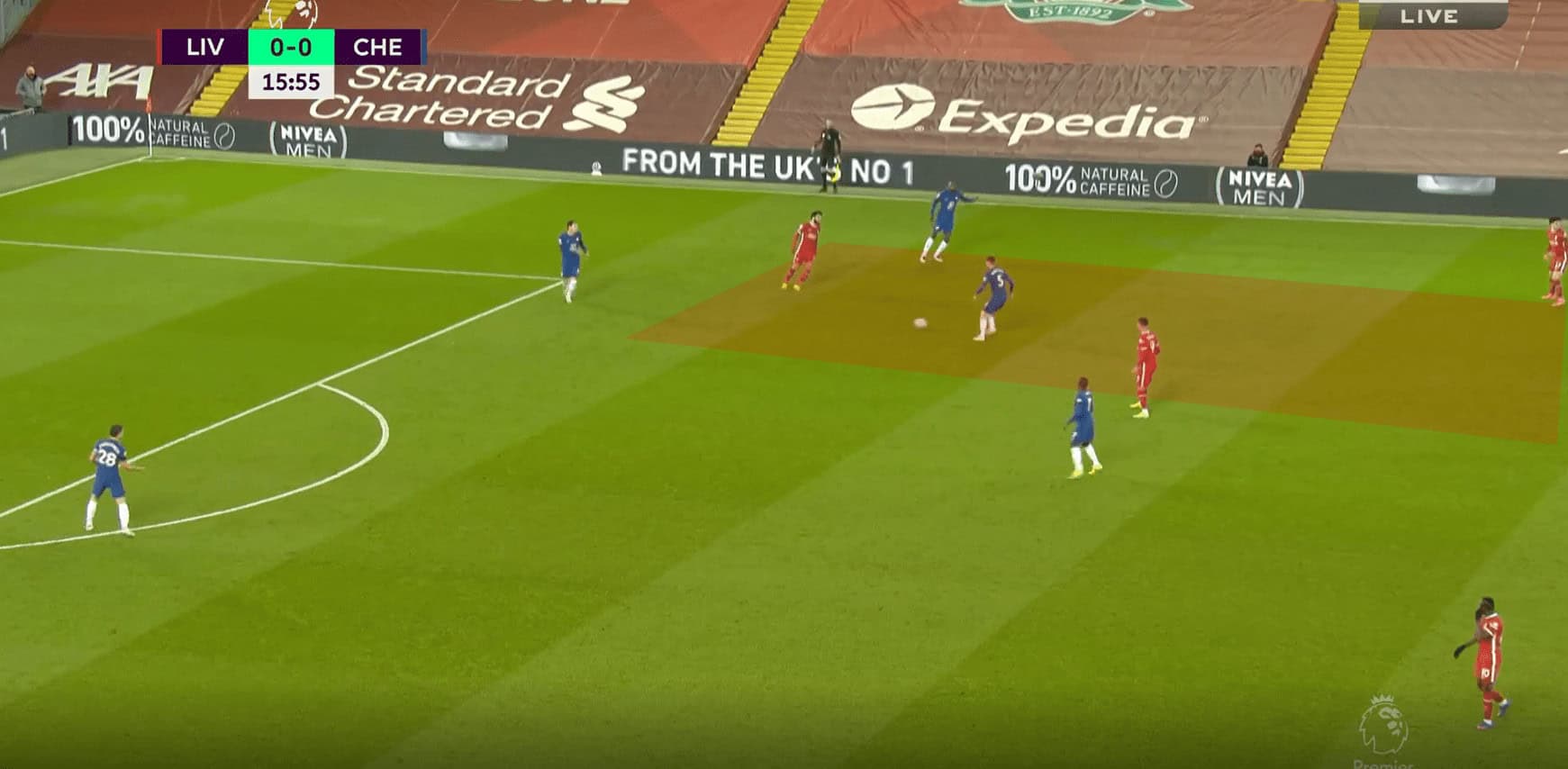
The main reason such a movement was able to work so effectively is because there was a threat in behind the wider central midfielders, and so they did not want to press too high otherwise they would risk leaving a player higher up the pitch unmarked/uncovered.
The key player in Chelsea’s build-up in this regard was Mason Mount, as he occupied the role of overloading the wider midfielder and was often the player who received that pass that relieved the initial pressure from Liverpool and allowed Chelsea to start running at the defence. We can see an example of this below with Jorginho now able to turn having received the ball in depth. Thiago is overloaded with a player in front and behind, and he gets caught in no man’s land not committing in either direction, and so Jorginho is able to find Mount.
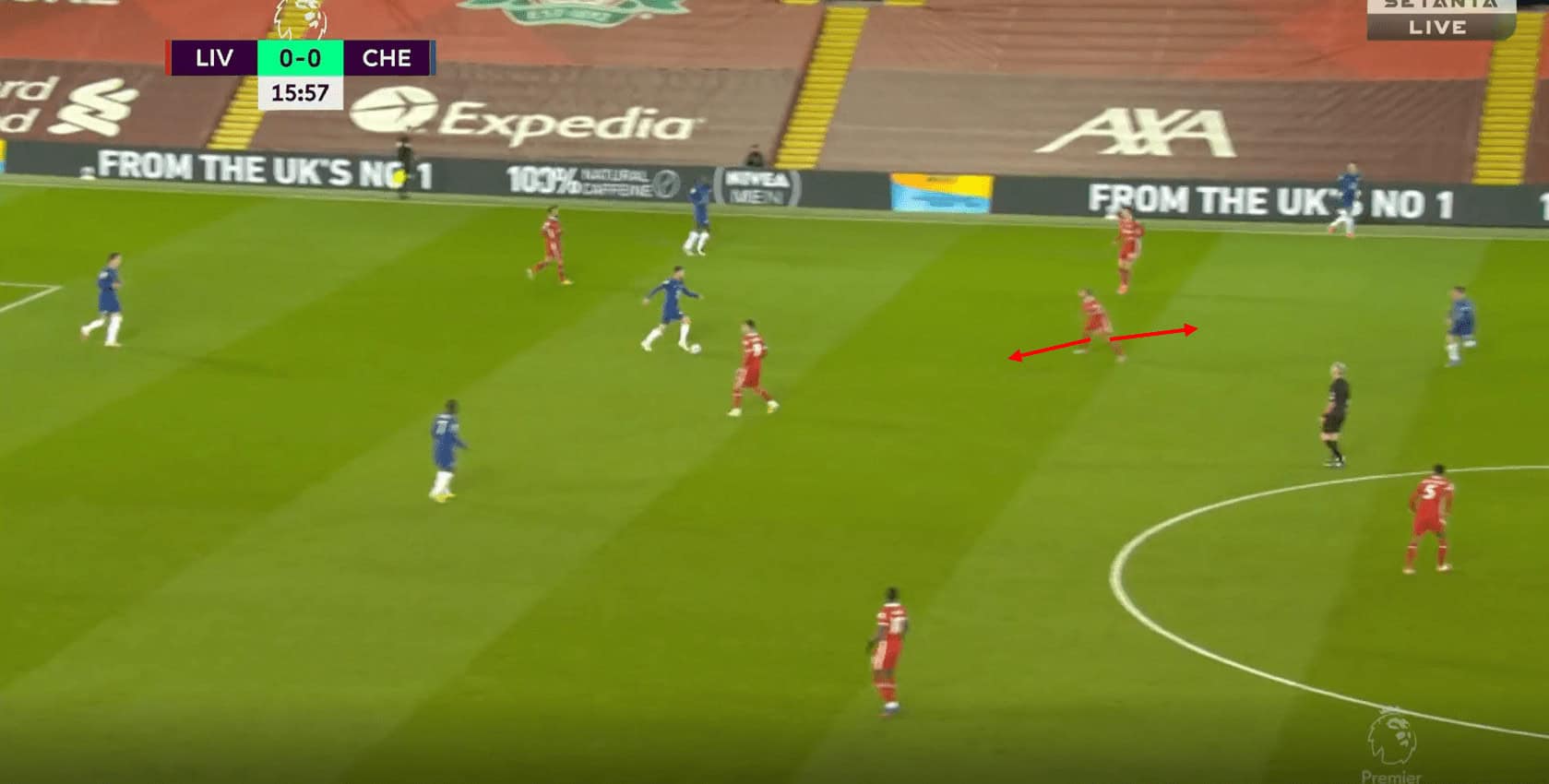
Mount is not pressured from behind by Liverpool here due to the wing-backs high positioning helping to pin the full-back wide, as well as Werner and Ziyech’s pinning of the centre backs.
We can see another example of this concept of depth working well to overload Thiago here. The Spaniard drops off in order to cover the passing lane into Mount, but while doing so is conceding the space for Jorginho to play with. As a result, Jorginho is able to receive the ball, and plays the ball in behind for a goal which was marginally ruled out for offside.
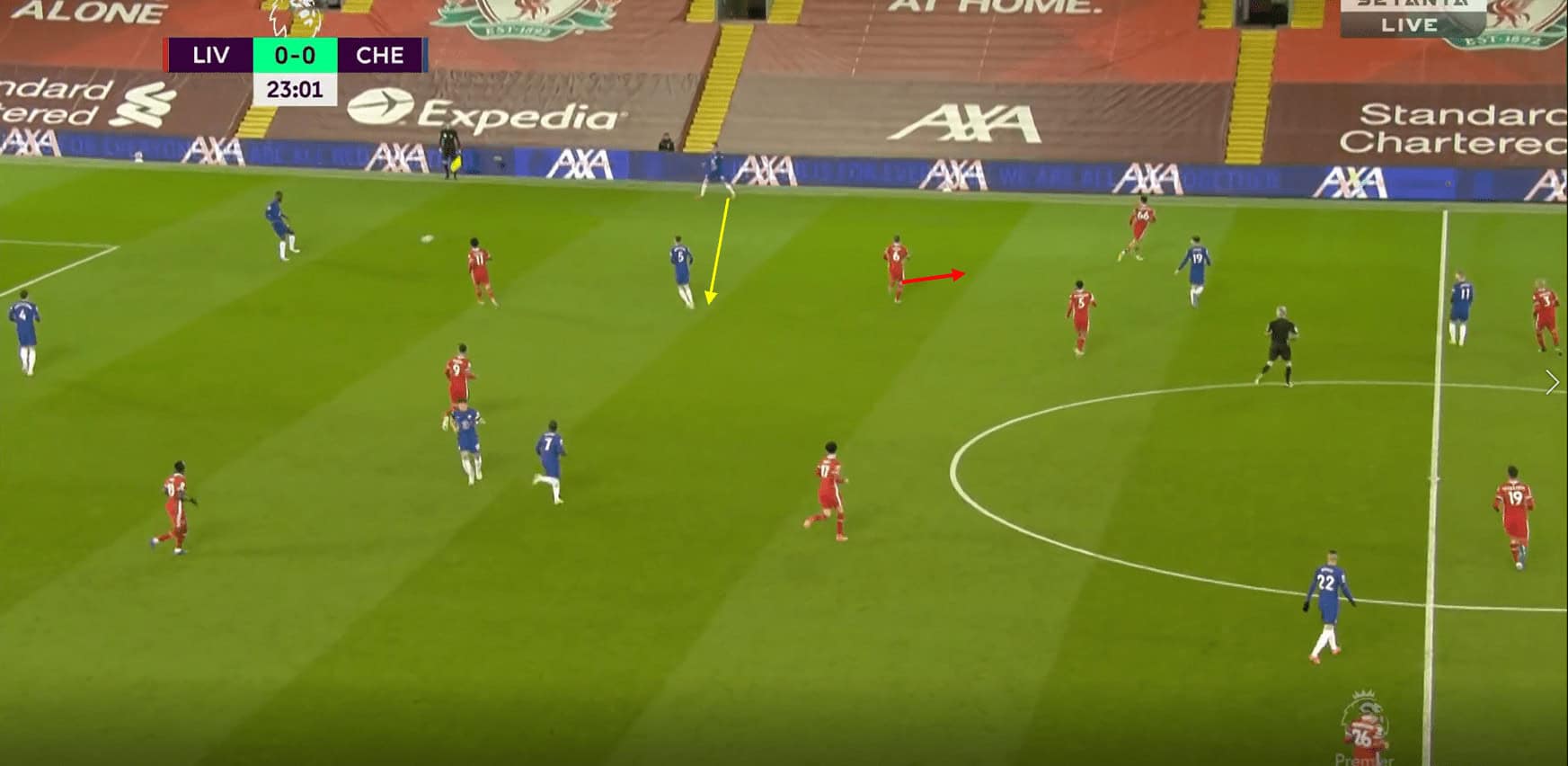
Chelsea’s spacing and the positioning of Jorginho here plays a big part in opening the space for Mount again here. We see Jorginho positions himself slightly wider, while Kanté and Ziyech maintain more central positions in front and behind Wijnaldum. Jorginho’s positioning drags Thiago wider, and Wijanldum stays deeper to protect the central lane, and so again we see Mount is able to potentially drop into the half-space and receive the ball. This is one example of Liverpool’s very poor shifting in the game, as if we examine Thiago’s positioning more close we see that Jorginho is actually covered by Firmino’s cover shadow, and so he has no reason to push so wide to prepare to press the Italian. This is something I will discuss in more detail later.
We can see another example here where Thiago and Jones are attracted to press ins slightly wider positions towards the two Chelsea pivots. Ziyech and Mount then drop either side of Wijnaldum to overload, and Christensen is able to be very calm on the ball and excellently pick out a pass to Mount. One of the added bonuses to such positional play was that if players in midfield could be accessed without pressure on the ball, they could find the wide open wing-backs with simple passes, which ultimately harmed Liverpool’s pressing structure further,
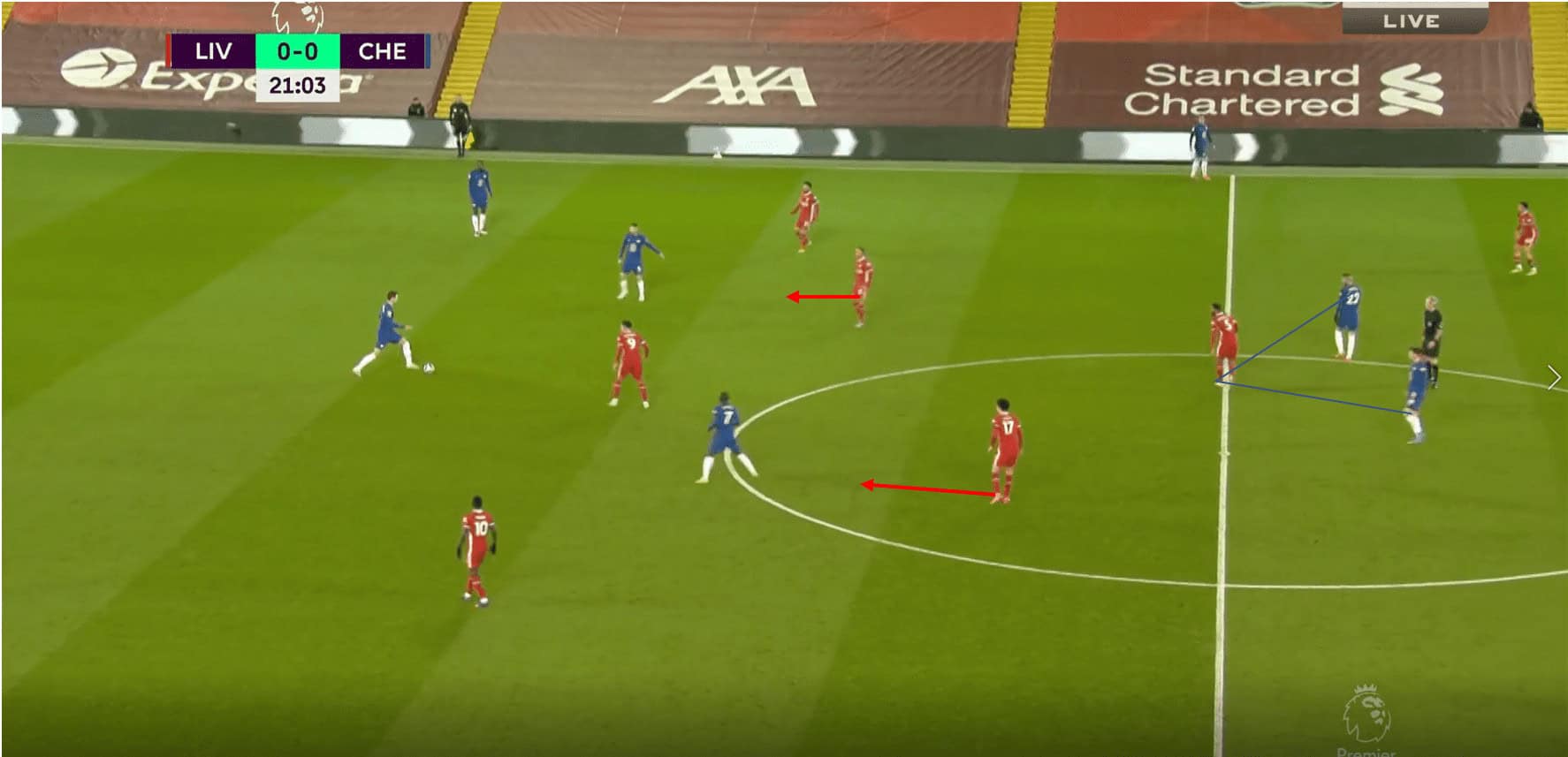
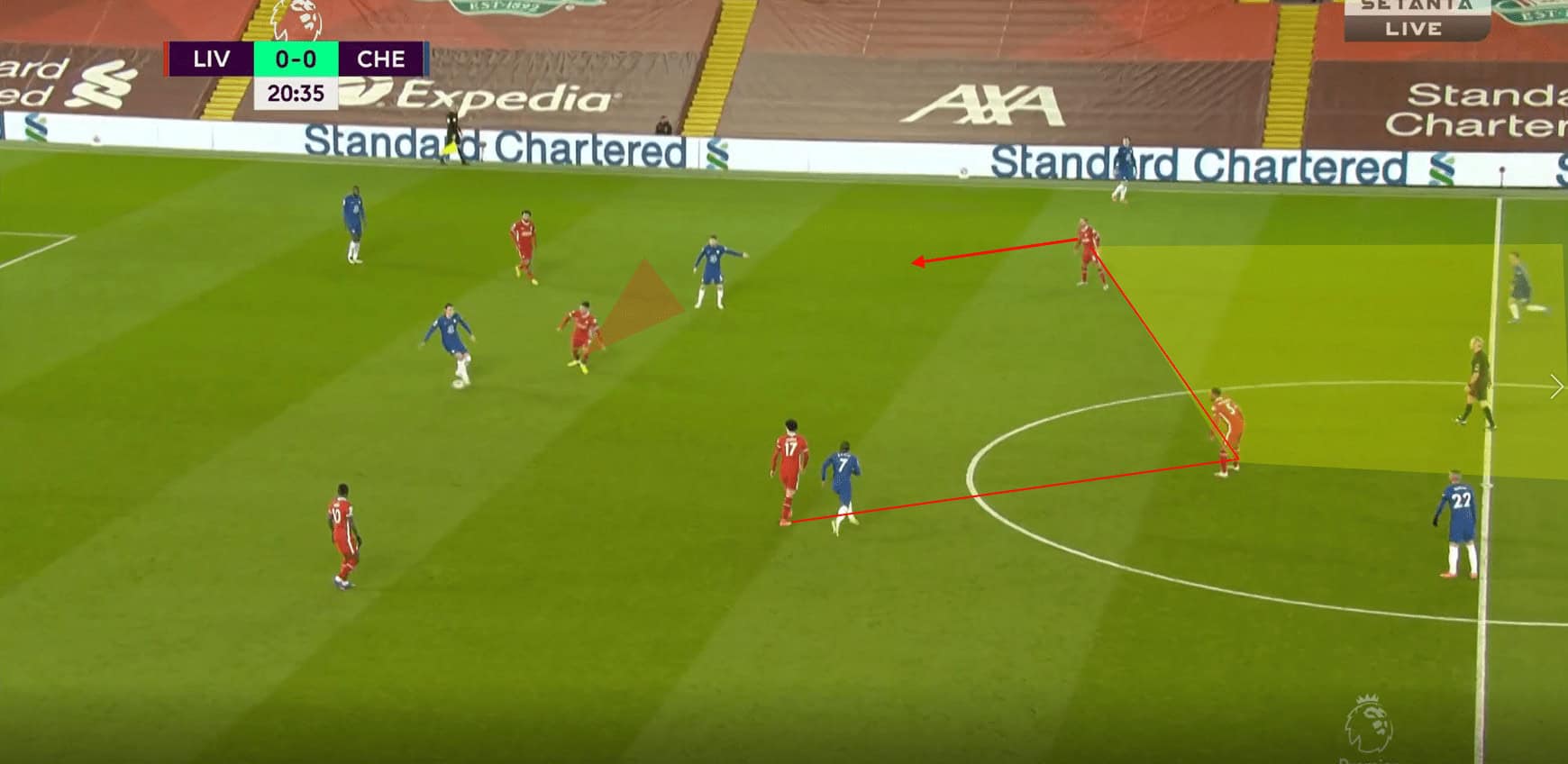
As mentioned earlier, Chelsea’s spacing in midfield and their use of a back three allowed more access to the wing-backs at times, and we can see a good example of this below and the effect it had on Liverpool’s pressing structure. The ball is switched from right to left in this example, and we can see the Chelsea double pivot had naturally shifted across initially. Jorginho though maintains a more central position throughout the attack, and so with Wijanldum sat deeper, Mo Salah tucks in more to protect the lane into him while the ball comes across. As a result, by the time we come to the scene shown below, Salah is in no position to cut the wide passing lane.
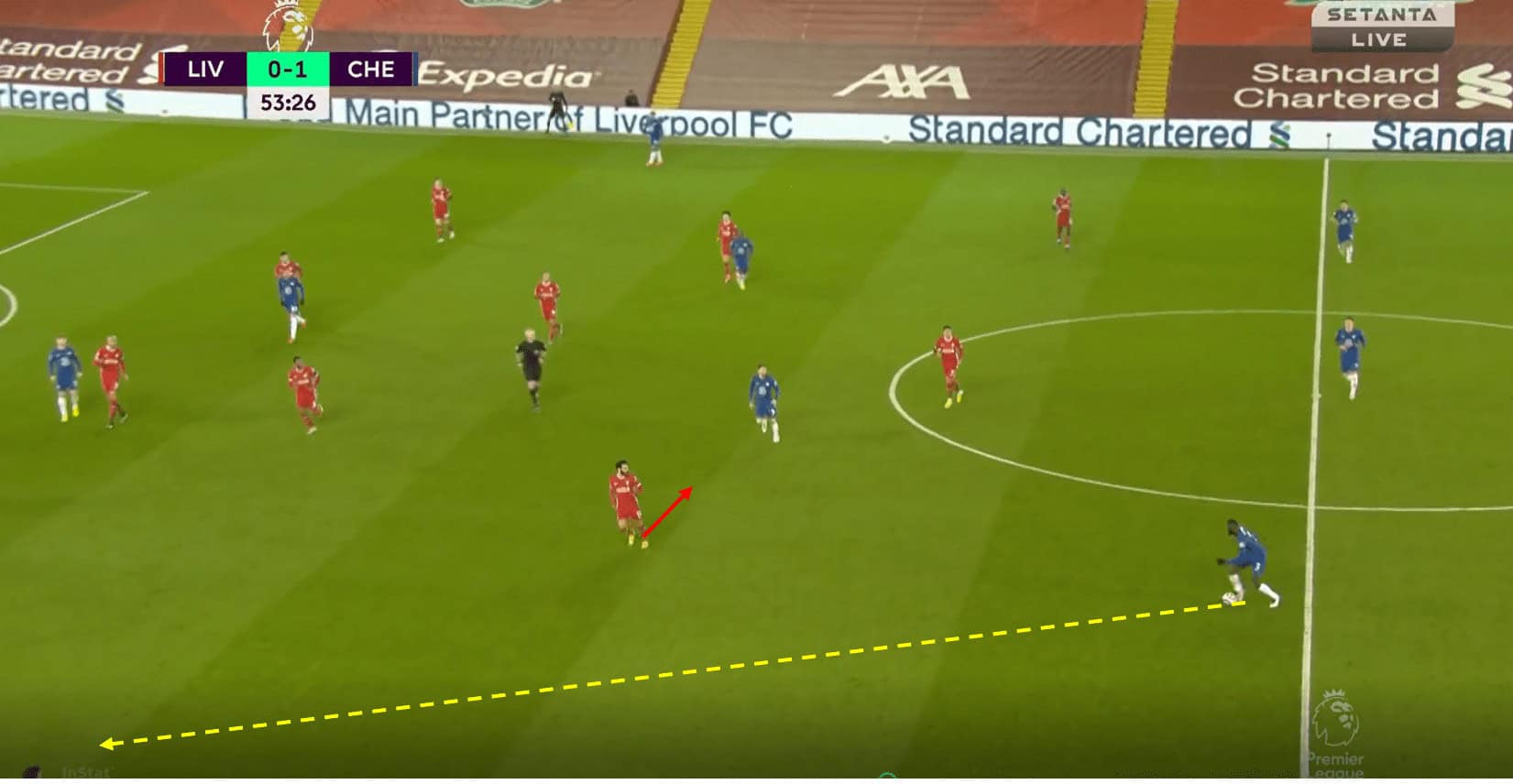
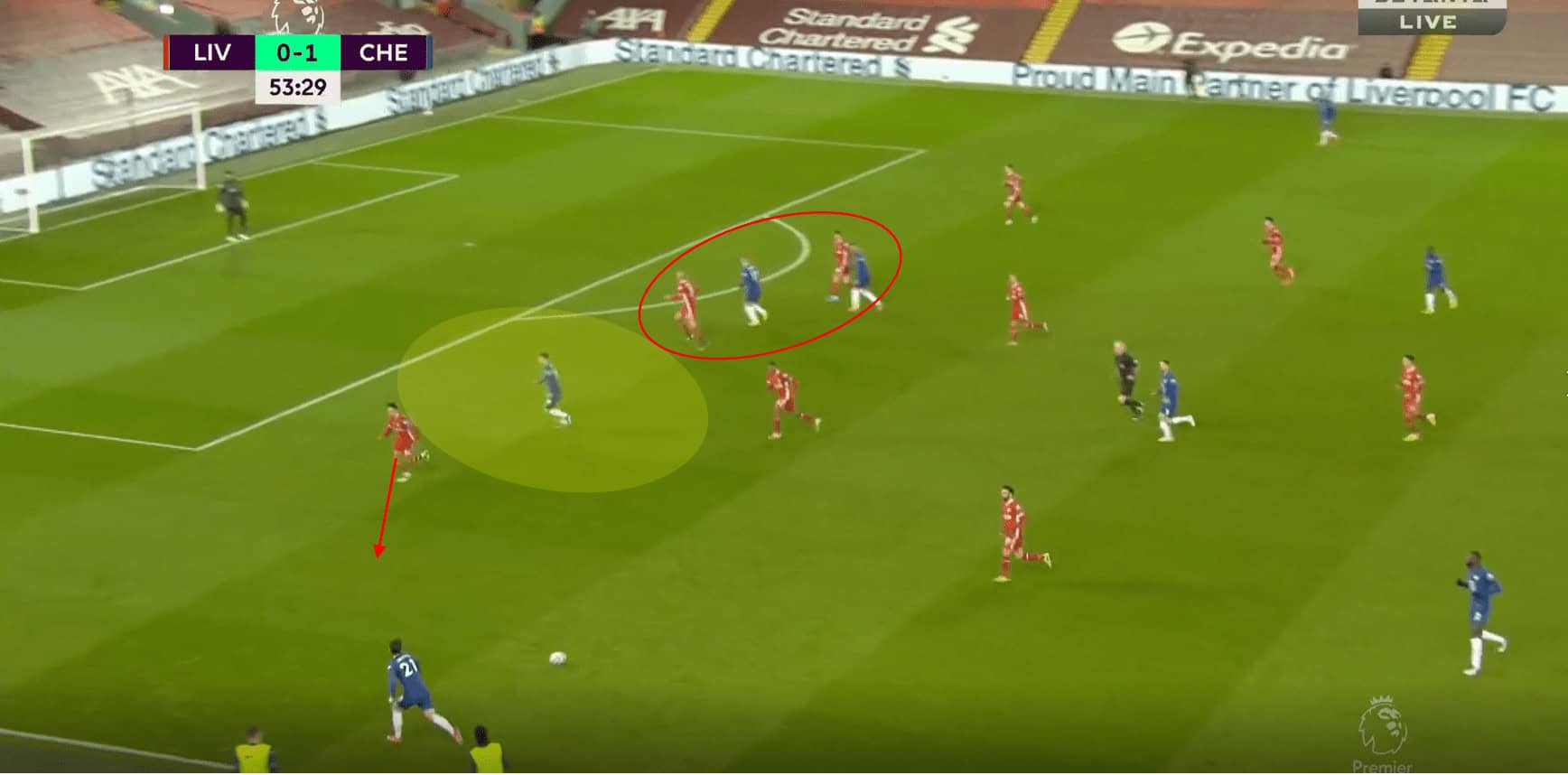
The cutting of this wide passing lane is the very foundation on which Liverpool’s press is built, so any pass of this nature is generally a failure on Liverpool’s part. With no other wide player available to press, the full-back is forced to press, and as stated in some recent work I did on defending the half-space, pressing full-back to full-back without any cover is a very poor press. We see Chelsea do an excellent job of creating a 2v2 in the centre and occupying both centre backs, and so Liverpool rely on a midfielder tracking back to cover Mount, which Chelsea overcome by moving the ball quickly. Chilwell plays the ball into Mount and follows his pass, resulting in a shot and then a rebound which is cleared off the line by Liverpool.
Liverpool’s shifting problem and generally poor pressing
I have mentioned Liverpool’s shifting several times so far, but actually given any detail on what that means yet and how this also contributed to Chelsea’s success in building.
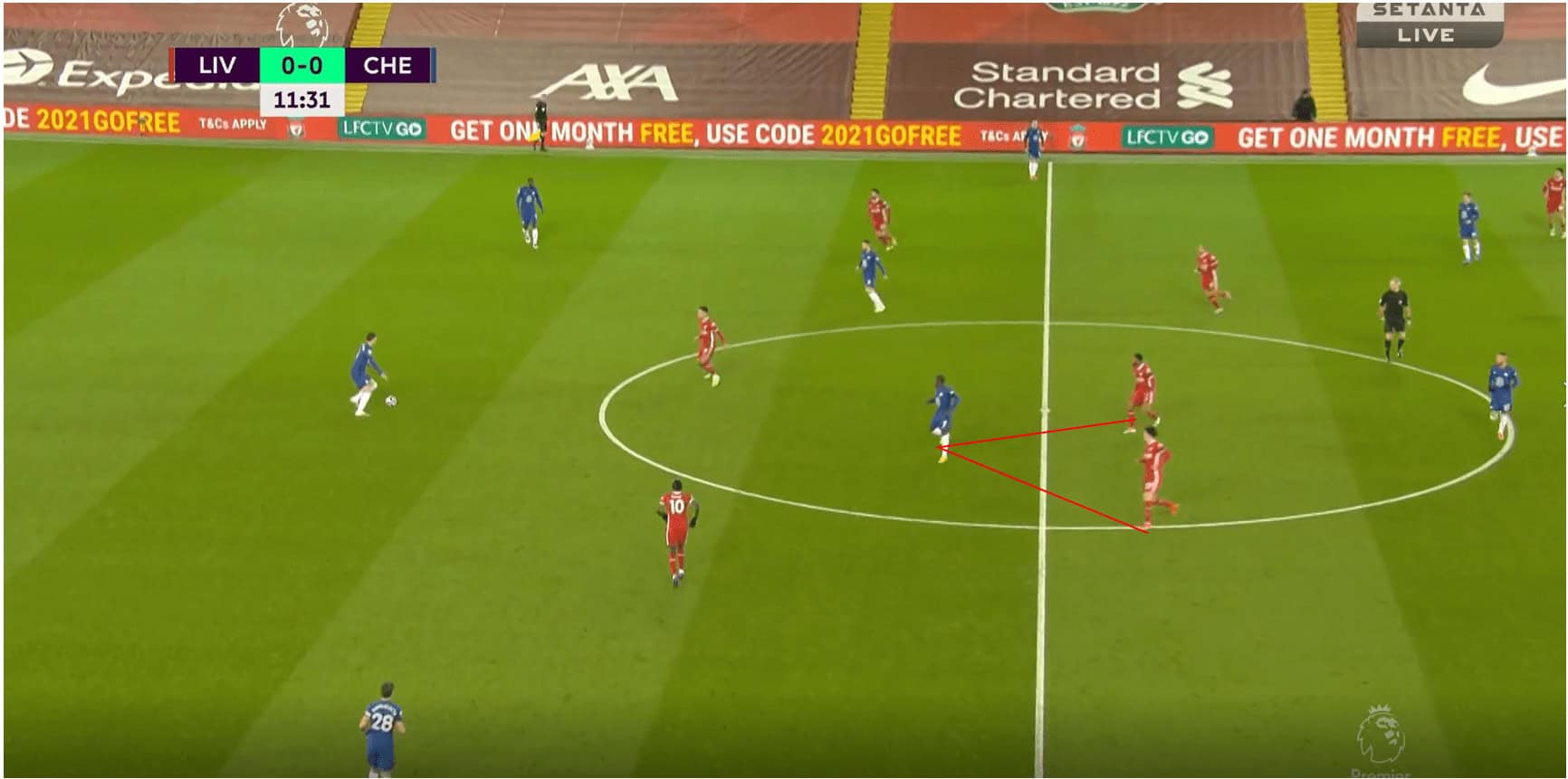
Liverpool’s central midfield is not protected by wingers like in most traditional systems, and so the three central midfielders have to shift and space across the centre of the pitch effectively in order to cover the whole area. As also seen above, they have to be in a position to press or mark an opposition midfielder, and so even without an overload, teams can exploit and play through the midfield as previously seen. The example below shows Kanté spaced equidistant between the central midfielder and left-sided central midfielder (Wijnaldum and Jones), and so Liverpool have to shift according to who is going to deal with this player. We see Wijanldum takes a few steps forward as does Jones, and with Thiago pinned wider by Jorginho, a space opens up. Firmino’s pressure on the ball and cover shadow cover this space, but this example shows the kind of margins involved when pressing in this way.
We can see an excellent example here, with the Chelsea double pivot forming a more asymmetrical shape, with both players more on Christensen’s right side. We see Liverpool’s midfield spacing is very poor, and Gini Wijnaldum in particular as the middle of the midfield almost becomes useless in such a situation, and Liverpool looked at times like they suffered from having too many midfielders in this area. Two Chelsea players are able to manipulate three Liverpool players, as we see Thiago reacts to Jorginho’s positioning, and Mount drops in to receive the ball freely. In an ideal scenario, Wijnaldum should push higher to press Jorginho in the centre, and Thiago should be free to cover a wide lane. Instead, what we saw on many occasions was Wijanldum stood with no role in the press.
Trent Alexander Arnold is pinned in place by the very high and wide wing-back, while Fabinho is pinned back by Timo Werner, and so Mount can turn and play forward. Firmino also doesn’t do enough as he focuses more on covering the far Chelsea pivot, and so as a result reduces the pressure on the ball.
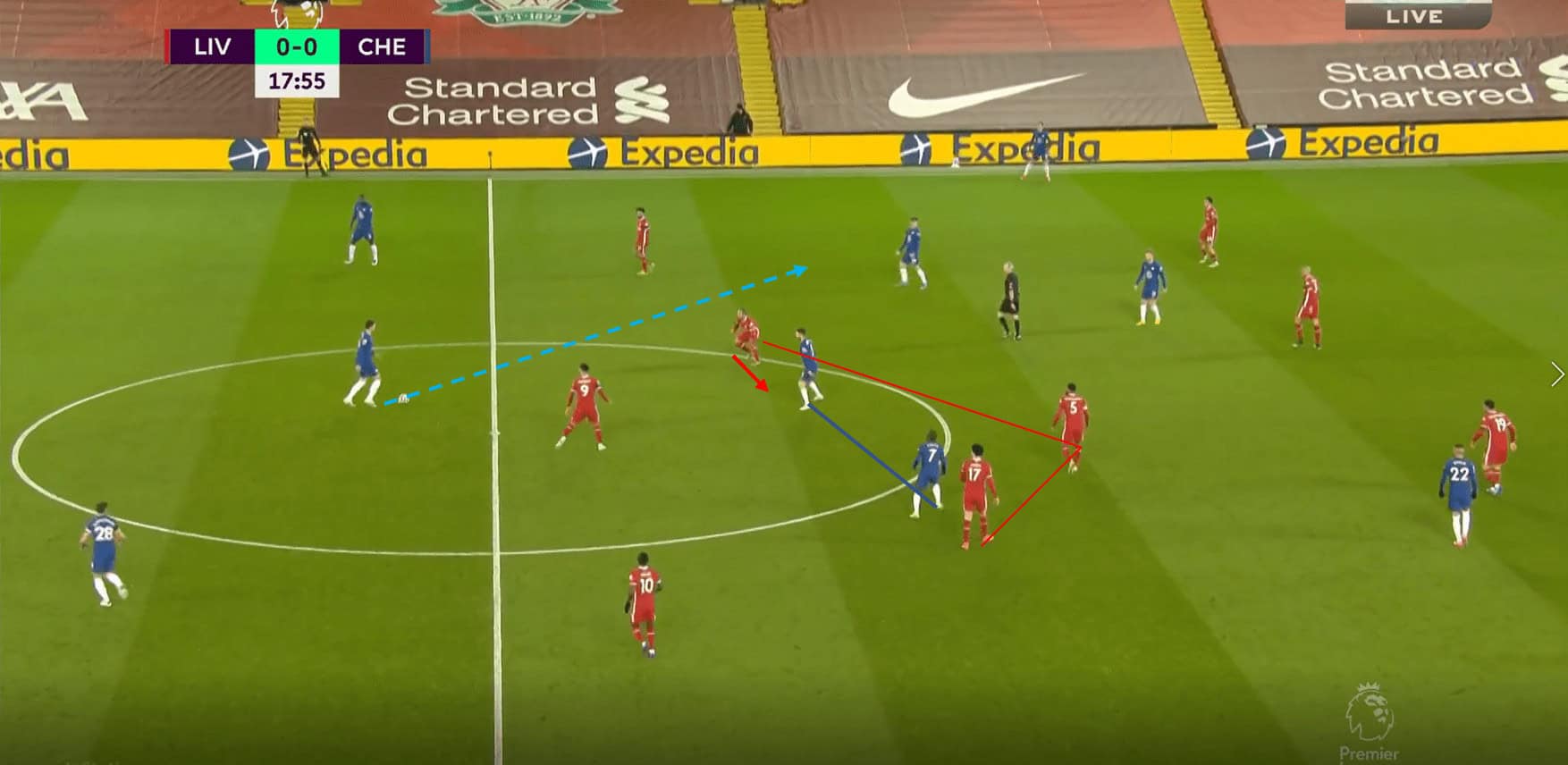
We can see another example here, where Kanté is able to receive the ball and turn somehow due to relaxed pressure from Jones. Thiago shifts to press Jorginho, but recognises he is overloaded by Mount so retreats back quickly. Wijnaldum’s role in the press is again voided then, as he isn’t anywhere near close enough to being able to press Jorginho, and he isn’t really cutting the real dangerous lane, as Jorginho can still turn and access Mount. Again then, Wijnaldum has to either start higher and closer to Jorginho, or has to sit and take care of Mount. Mount’s positioning in a wide area though means even if Liverpool sat with a traditional six, Mount could still evade them at times. Man marking Mount was another option, however this would just probably allow Ziyech to cause havoc on the other side.
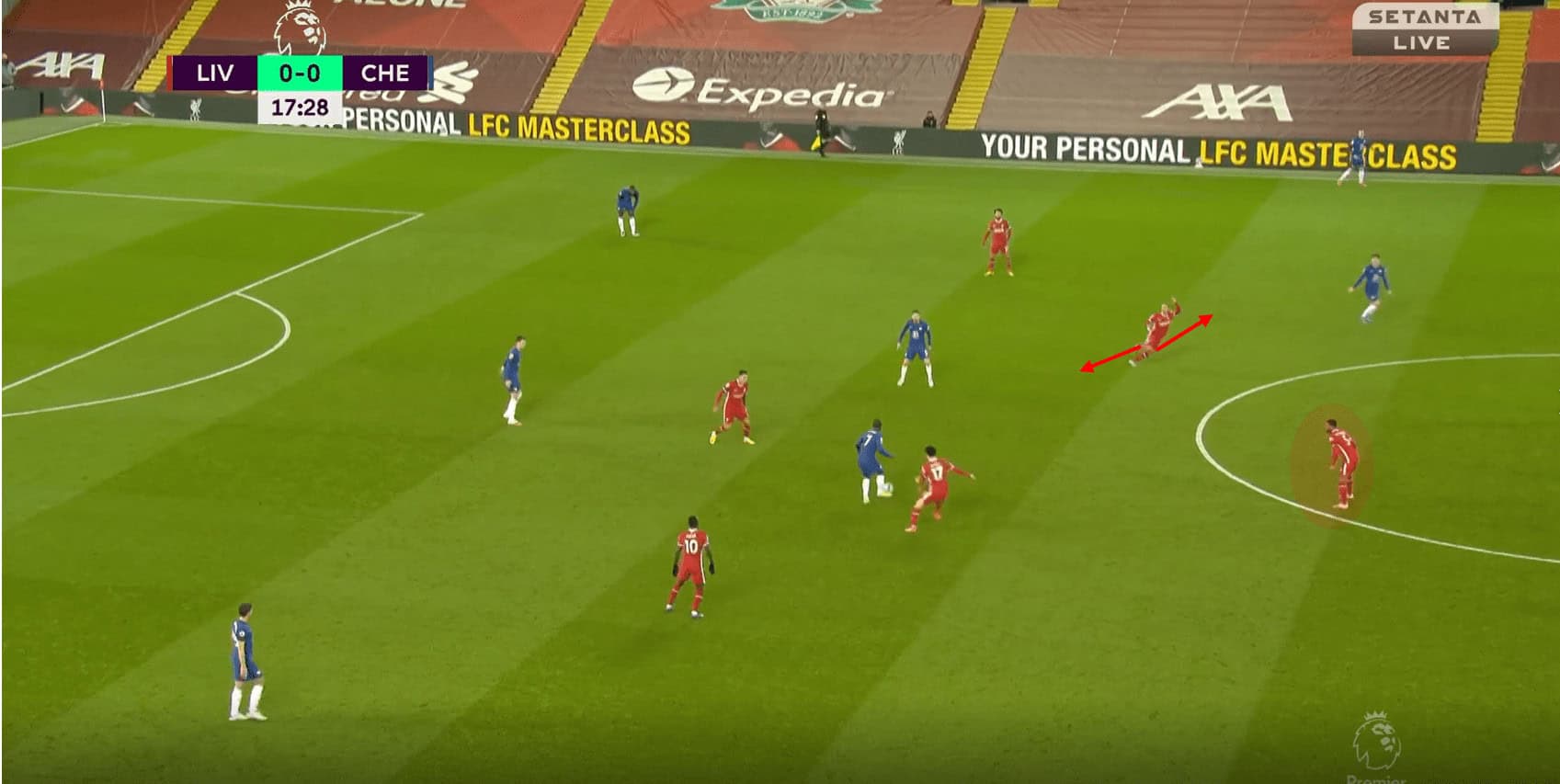
We can see an almost identical scenario in which Liverpool’s shifting is much better, with Wijnaldum now covering Jorginho and allowing Thiago to cover Mount, creating a 3v3 in midfield. Wijnaldum can move wider thanks to Firmino’s cover shadow and his pressure on the ball, and so Liverpool are theoretically in a very good place here if everyone does their job.
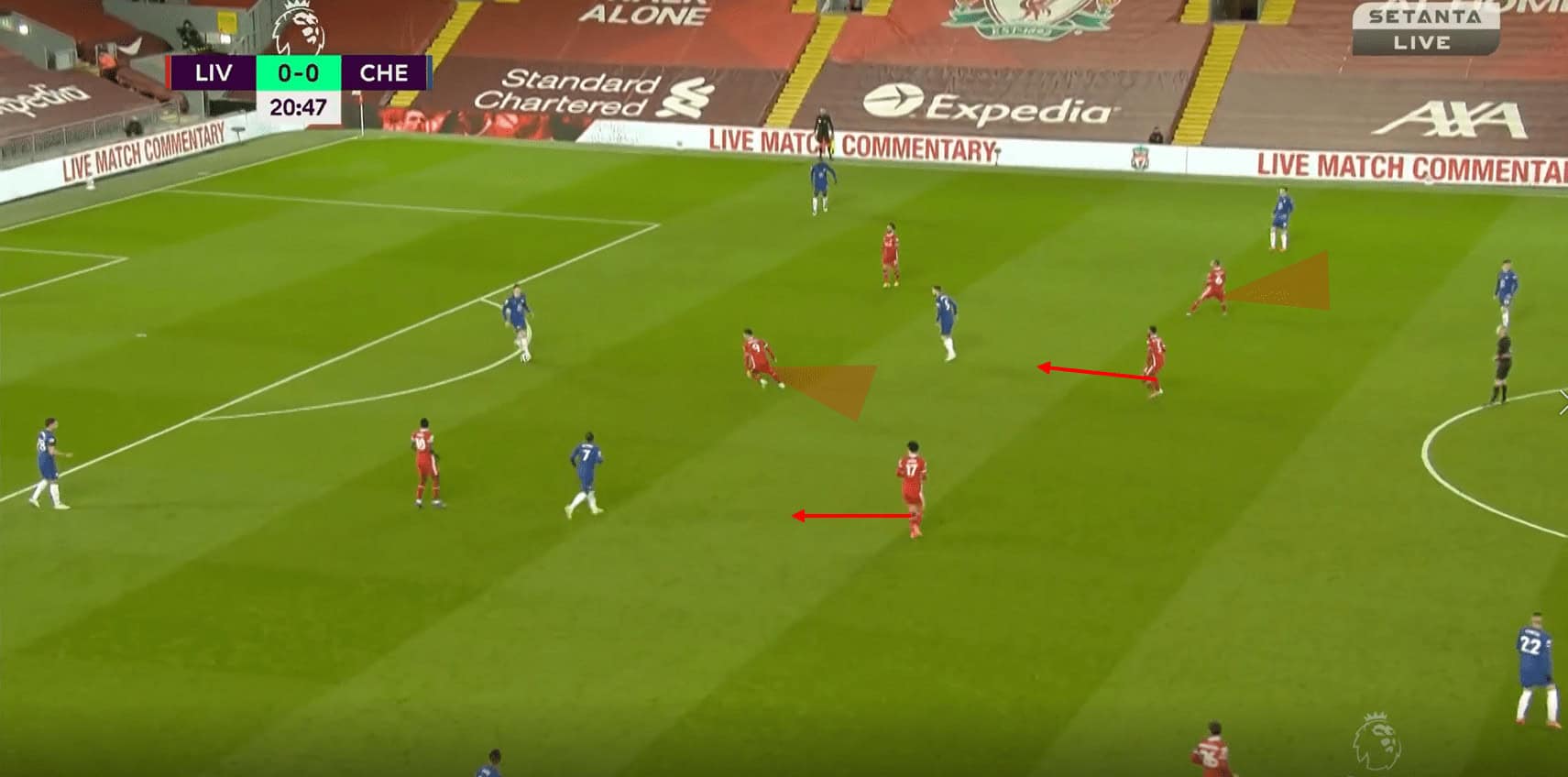
Two seconds later though, the nice structure is ruined by Jones not actually then going to press, with him instead letting Kanté receive the ball, turn, and access the central lane between him and Wijnaldum. Liverpool’s press aims to force these passes and then collapse on them with pressure by the nearest midfielder, but Jones movement is just odd as he doesn’t react once the pass is played and instead backs off. On a few occasions Chelsea were allowed through just by Liverpool poorly allowing people to turn out, which just summed up their performance in this regard.
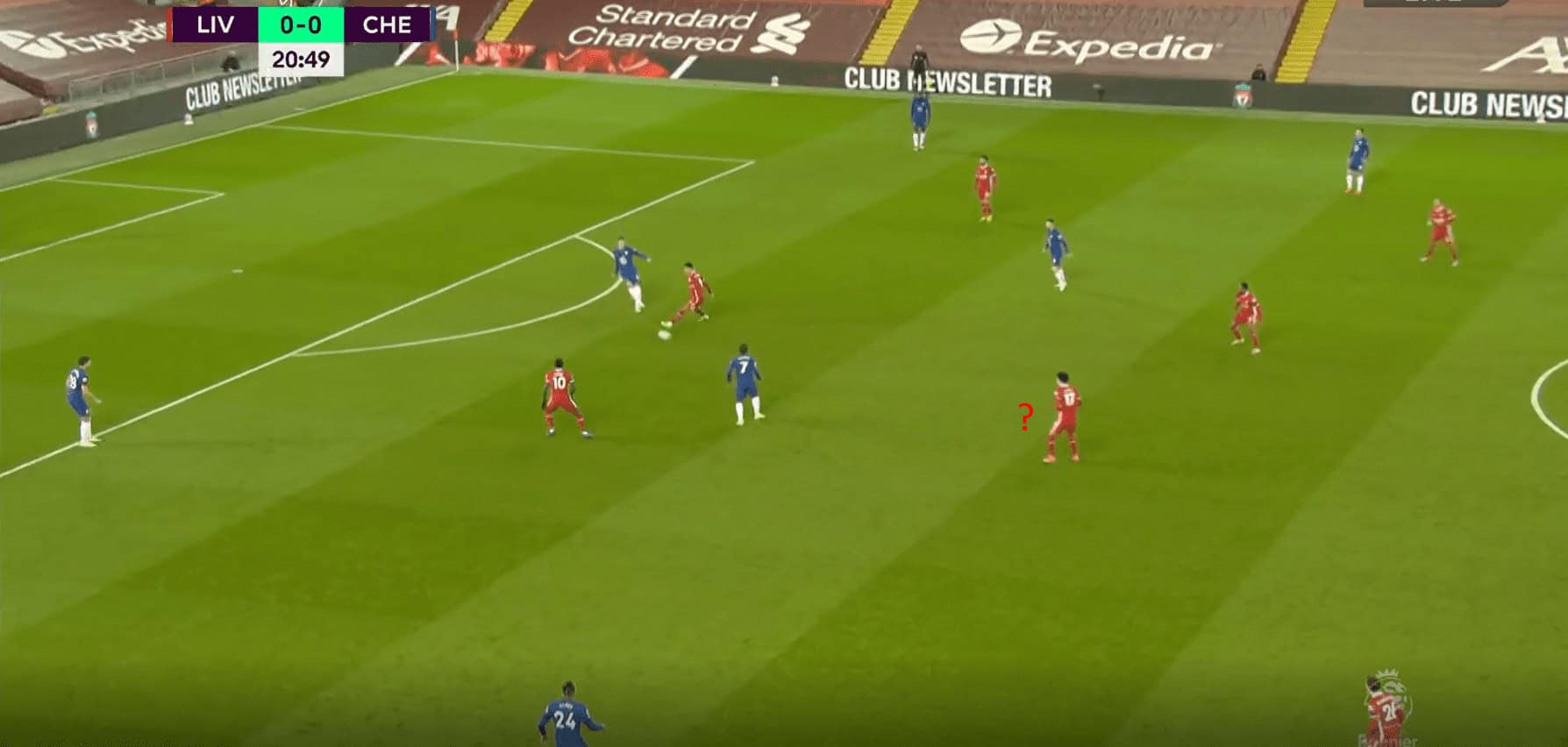
A similar thing happened a few times where the pressure was either not present or just wasn’t enough to put the central midfielder off and disrupt their passing, and so Chelsea could access the wide lanes which Liverpool look to restrict. Often this forced the nearby central midfielder to jump to press wider, which then reduced Liverpool’s numbers in midfield and made it easier for Chelsea to create that overload I’ve spoken about. If the full-back could press higher without being pinned, it could lead to a 3v3 in the back line which Chelsea could take advantage of with longer passes. RB Leipzig had some success playing in a similar fashion against Liverpool a few weeks ago, but Liverpool’s midfield shifting was much better, as I covered in this analysis of the game
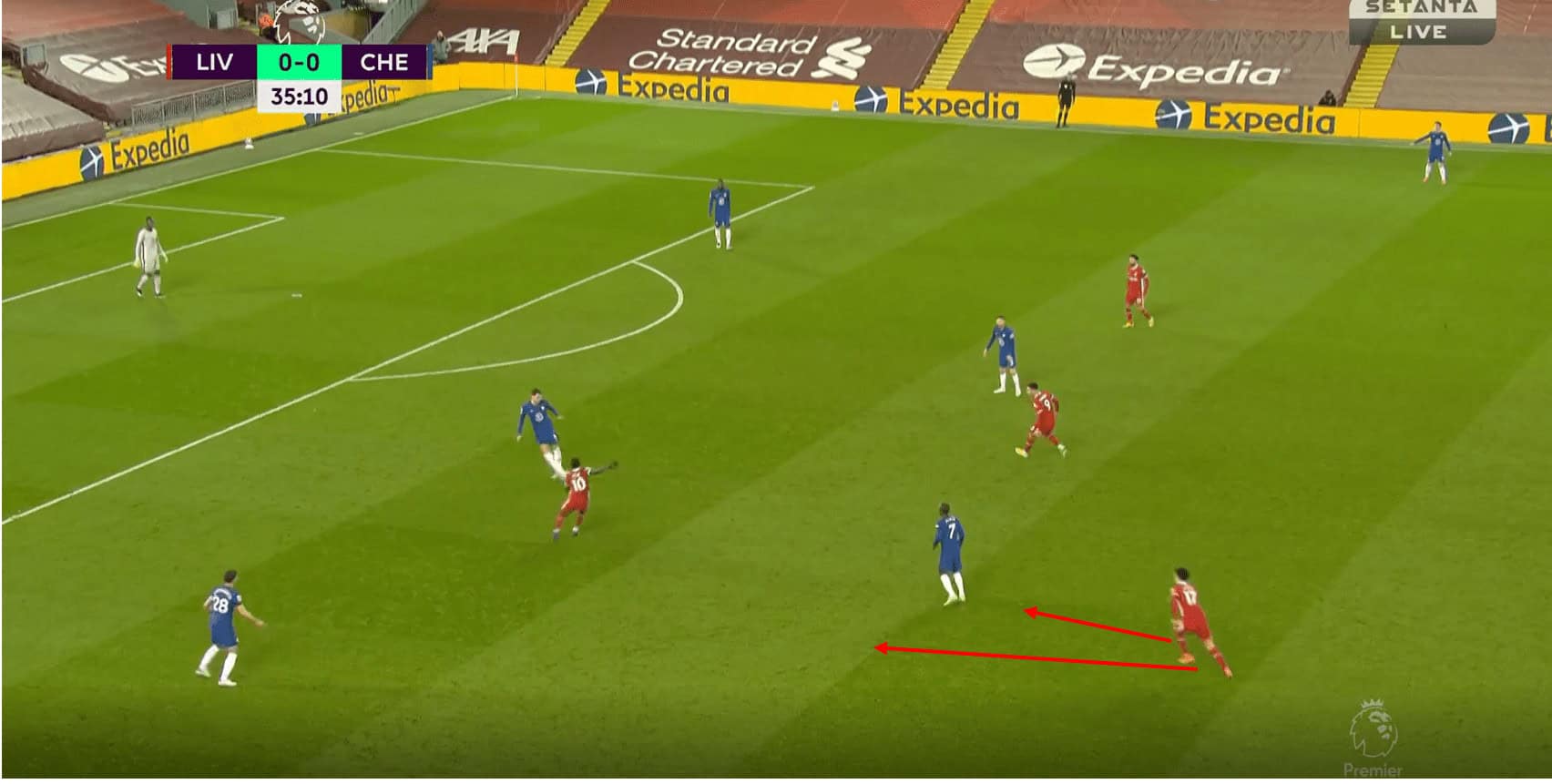
To solve this shifting issue Liverpool’s wingers would sometimes move narrower and protect the lanes into the centre, which naturally meant that their starting positions were more central, which limited their ability to then cut lanes into the wide areas, meaning full-backs got dragged up and caused the problems I’ve already discussed. Here Thiago should push higher on Jorginho, and Salah wider to get in a position to cut the wide lane that Rüdiger goes and accesses.
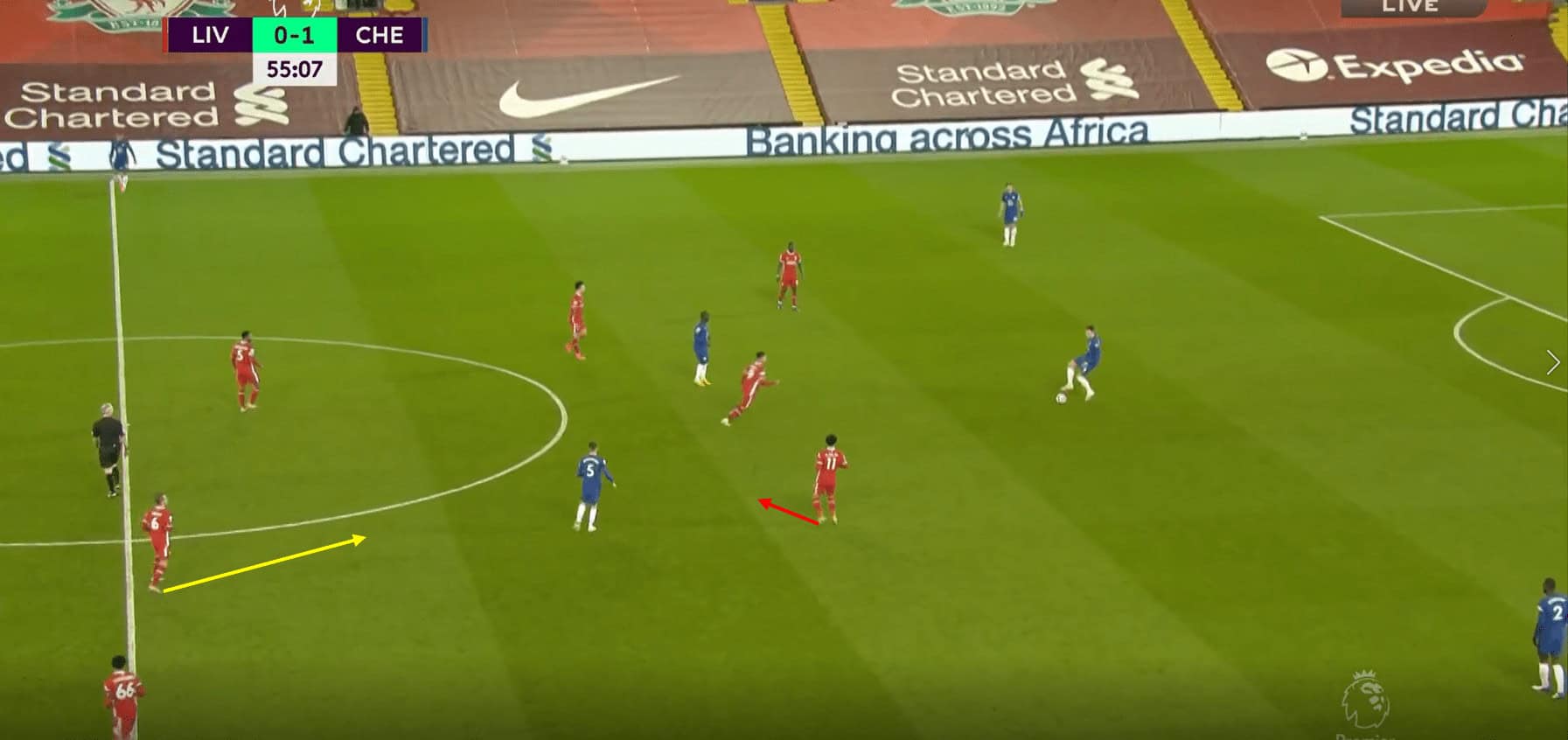
As another solution, Firmino would at times look to cover a pivot from deeper which allowed a more diamond-like structure, however Liverpool then struggled to maintain pressure on the ball, and meant that when Chelsea’s press resistant midfielders received, they could access the wide areas again and the wide centre backs had more time on the ball.
Conclusion
Chelsea executed their game plan well and picked up a deserved victory, with their build-up structure allowing them to break the Liverpool press several times. They controlled transitions with a good rest defence with the two central midfielders and back three, and when they needed to sit deeper and defend their 532/523 shape limited Liverpool to only one shot on target. Having said this, the game came down to one moment of individual quality from Mason Mount, and had Liverpool had that in situations like Mané’s chance in the first half, it could have been a different game. In the end though, Liverpool’s shifting and general pressing was not good enough to deserve anything from the game, and they lacked a real offensive plan it seemed other than hitting the ball long over Chelsea, which often wasn’t accessible. To summarise then, Tuchel’s Chelsea continued to impress and made a firm statement to the top four, while Liverpool gave more clear evidence that they just have to keep trying to improve.
