
For most of the match, Uruguay dominated possession of the ball, generating 10 shots, of which only one went on target.
However, having possession does not mean playing better, and a lot has been shown in this World Cup, in which many teams have proposed exquisite work off the ball that has given them results.
Their possession of the ball was very harmless, thanks to the defensive work that South Korea did in large part.
Diego Alonso’s team was not particularly special when it came to generating chances.
Uruguay reached the World Cup after the change of one of their greatest legends in its history, with the departure of Óscar Tabárez, the manager who led them to the glory of the Copa América and reached the semifinal of the 2010 World Cup.
His time came to an end after a cycle of an abysmal run of matches in terms of play and idea.
Diego Alonso took Tabárez’s legendary place and overcame what was expected to be an elimination in the South American qualifiers.
Paulo Bento’s team, for their part, following an excellent performance in the 2018 World Cup in Russia, where they were very close to qualifying for the next round, including victories against Germany, went on to win the East Asian Championship in 2019 and qualify for the present tournament.
With established players like Tottenham Hotspur’s Heung-Min Son or Napoli‘s Kim Min-Jae, as well as a starting eleven full of players who have recently played in Europe, Bento sought to be as aggressive as Uruguay, with a very decent defensive plan.
In this tactical analysis, we examine the tactics and analysis of both teams and see how Uruguay and South Korea offered a really passive and tactically organised game plan.
Lineups
Diego Alonso came out onto the pitch with a 4-3-3 that changed to 4-4-2 in different phases and areas of the game.
Sergio Rochet was chosen in goal, with a back-four made up of Mathías Olivera as left-back, Jose María Giménez and Diego Godín as central defenders and Martín Cáceres as the right-back.
Rodrigo Bentancur was the #6, with Federico Valverde closer to him and a functional Matías Vecino, accompanied by Darwin Núñez and Facundo Pellistri on the wings and Luis Suárez as the centre-forward.

South Korea and Paulo Bento chose Seung Gyu Kim in goal, a back four also with Kim Moon-Hwoan at right back, Kim Min-Jae and Young Gwon-Kim in the middle of defence, and Kim Jin-Su on the left side as the full-back.
In-Beom Hwang, Jung Woo-Young, and Jae-Sung Lee formed a midfield three.
Heung-Min Son and his threatening football up front completed the starting lineup with Ui-Jo Hwang and Na Sang-Ho.
Uruguay’s defensive approach inside a 4-4-2
The match began with a premise that evolved over the course of the match.
South Korea sought to start with high ball possession, attracting deep players like Kim Min-Jae in the first passing line, who have a good technique to release passes between the lines.
Many balls were also executed from above in order to appear behind the Uruguayan pressure line.
Diego Alonso employed a solid and rigid 4-4-2 formation, featuring movements from Matías Vecino, who created a double line of forwards, with Luis Suárez covering the passing line between centre-backs and the #6.
The midfielder aimed to be more aggressive in his approach to pressing higher ball-holders.
This forced South Korea to rush at certain times when they owned the ball by not finding spaces between the lines or at the outside because Darwin Nuñez and Facundo Pellistri’s route to avoid 2v1 situations protecting their full-backs every time that they had to fall back to join the block was really good and coordinated.
This was to prohibit South Korea from applying their high speed and pace over the flanks.
The block exchanges were constant in their intentions since at times they pressed quite high with the same 4-4-2 but a few more steps forward on the pitch, looking to win the ball back.
At other times, they were much more passive in trying to steal the ball from their central defenders and sought to be more aggressive on the outside or in the middle.
Beyond the advancement of lines, it was not really effective pressure.
The players were at very long distances and did not perform the high-pressure work correctly.
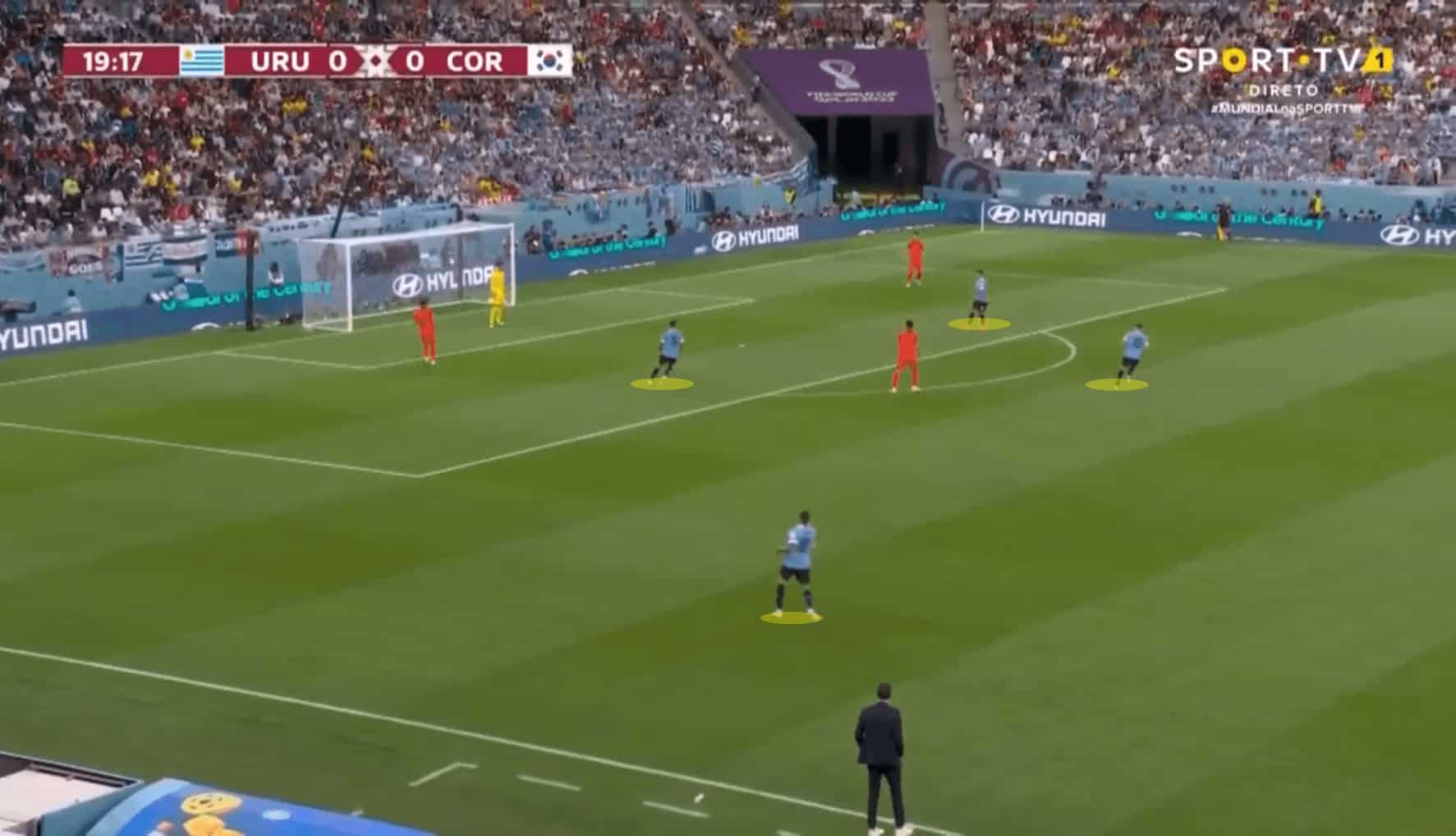
In this example, we can see how high Matìas Vecino and Fede Valverde were going in these exchanges of zones.
On the outside, Darwin and Pellistri struggled to find their place and appeared a bit lost, allowing South Korea to evade this type of defensive positioning very easily. They played from a central defender to the full-back and then executed an inside pass in just a few touches.
That is why Uruguay felt more comfortable letting Bento’s men position themselves higher and not being attracted so low into their third.
This allowed Uruguay to close the middle third, where South Korea could not build quality link-up plays to break down the block of Alonso’s team.
In this intention, the first movement was played through Valverde or Vecino, who exchanged heights as double-forwards with Suárez.
When they went back, they generated a 4-5-1 that was even more difficult to pass.
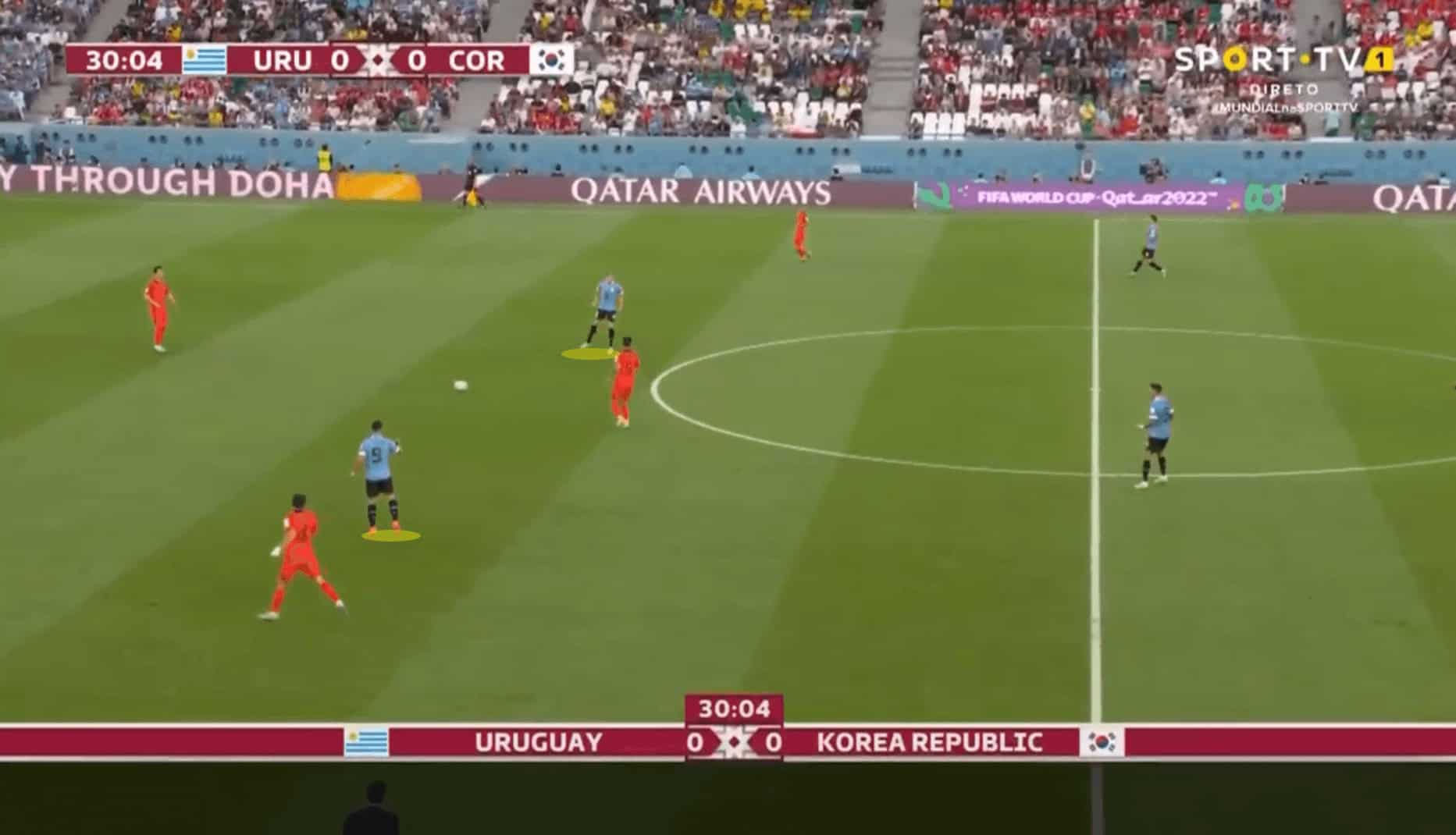
The most dangerous attempt was from South Korea, with some excellent dragging movements and one-touch passes that messed up Uruguay in a matter of seconds.
Unfortunately for the Asians, this could only be done once or twice.
Actually, the defensive result in both teams was quite solid because they were very even in terms of creating chances, with 10 shots to 7 and only one on target by Uruguayans.
The South Americans generated 0.59 xG, and Paulo Bento’s team had a small difference of 0.64 xG. However, the Asians had much more danger and a high possibility of scoring in a nice move that Ui-jo Hwang could not finish.
Nonetheless, the game’s low xG and creation were due to the solid defensive work of both and the little they could do to turn it into a more offensive game.
South Korea’s block and why Uruguay’s tactical tweaks in possession were poor
South Korea sought to “equalise the aggressiveness of the opponent,” as Paulo Bento mentioned after the game at the press conference.
With a similar defensive style and idea, the South Koreans sought to lock Uruguay into a zonal 4-4-2, with aggressive and proactive jumps off their lines from the midfielders when the ball was played through the central channels of the pitch, as well as a tremendous commitment from wingers to close spaces in the wide areas.
Normally, Uruguay wanted to create with a back-three, in a high block, which South Korea allowed after feeling more comfortable defending a few meters from their goal.
Their lines were very close together, so the players did not have to travel long distances in search of a poorly executed ball or a dynamic movement of one of the Uruguayan players.
It was tight and uncomfortable for Uruguay, but it was done with a high level of concentration that prevented their rivals from progressing.
The back three in question: Bentancur, in this case, joins the line, Cáceres and Olivera free themselves high in the wide areas, and the midfield is extremely empty, with Vecino and Valverde far from the distribution of the game.
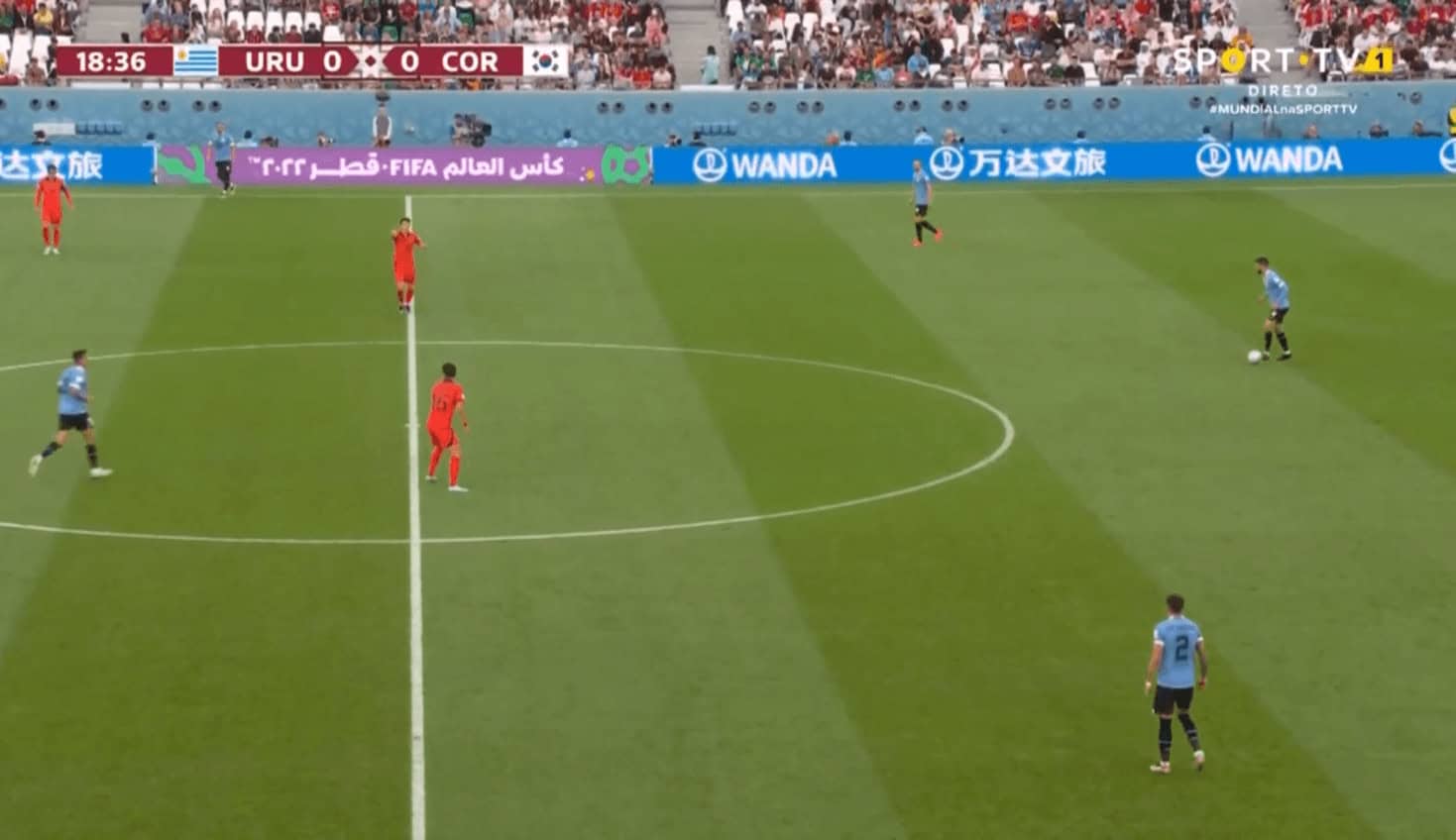
Diego Alonso used a back three that was joined by Martín Cáceres, his right-back, who is originally a centre-back. Rodrigo Bentancur also did it.
When the first made this movement, Bentancur tried to find himself in the middle, between the two defenders of the forward line in the 4-4-2, but he was very blocked and it was impossible to find him.
Higher, it was Matías Vecino and even more like a #10 was Federico Valverde.
This positioning stretched Uruguay a lot. Uruguay could not find a passing lane and was extremely static in its match proposal.
When Rodrigo Bentancur entered the centre-backs’ line, then the midfield was even clearer and farther away for those first stages of the build-up, which Uruguay did not find naturally, so they had to look for the long ball to one of their forwards, Darwin Nuñez or Luis Suárez, who were the opposite in terms of explosiveness and creation of chaos because the latter was not in the fascinating rhythm and physique of a few years ago.
These long balls did not pose any problems for South Korea due to the solidity and strength provided by Kim Min-Jae in each of these duels, who did not tire of clearing these balls and keeping his defence calm.
Occasionally, it may be perceived as threatened by some movements from Darwin or Valverde, primarily along the lines.
The intention was that with Olivera’s high position down the left wing, Cáceres attracting deeper, and Pellistri taking advantage of this, the long balls would create a lot of damage to South Korea, which was extremely solid in how it defended these executions with solid and hard full-backs, which they were staying low in a more defensive role to stop this.
Even they weren’t attracted at all by players like Càceres, as they were very rigid with zonal marking and intelligent jumps.
Federico Valverde was sometimes chosen for this type of pass, which proved useless to Uruguay.
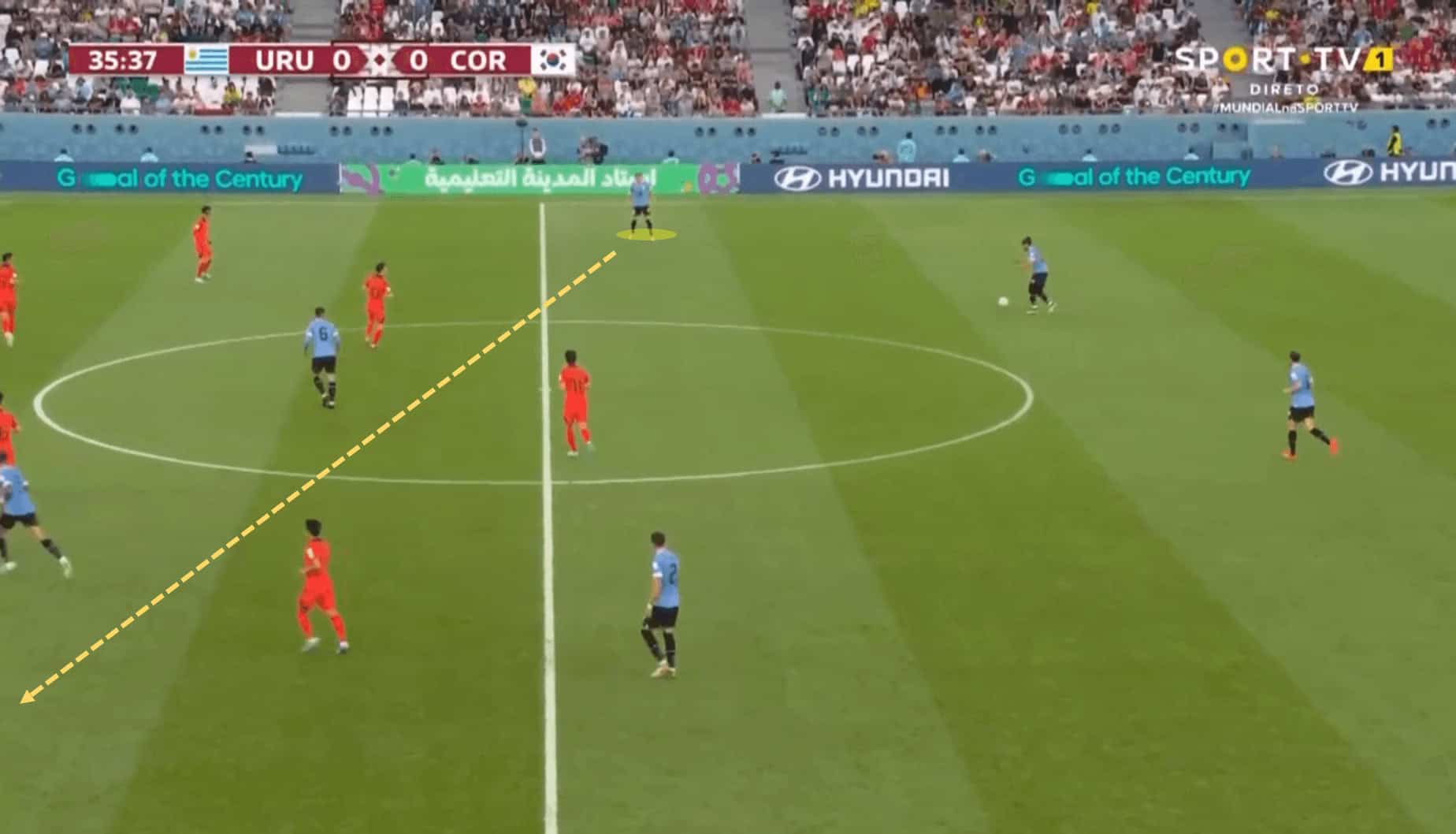
Another of the problems of Diego Alonso’s team was the distance with which Facundo Pellistri played from what was offered on the pitch.
Beyond using possession on the other side of the field, when the game passed by his flank, few footballers approached him, offering runs or receptions so that he could continue and generate 1v1 opportunities, which is his best facet.
Cáceres was not good at all in his task of dragging enemies for Facundo and creating 2v1 situations, which he did not have spaces to generate.
The image shows a sequence where the Manchester United player receives in his most common position, very wide on the right wing.
However, after receiving the ball, he raises his head to see his options and finds no one close to him.
There was little to offer between the lines.
Valverde was too far away, and a South Korean block that turned from side to side placed up to two or three players in front of these wider players.
This resulted in a backpass and restart of the build-ups between the defenders, a usual sight in the match.
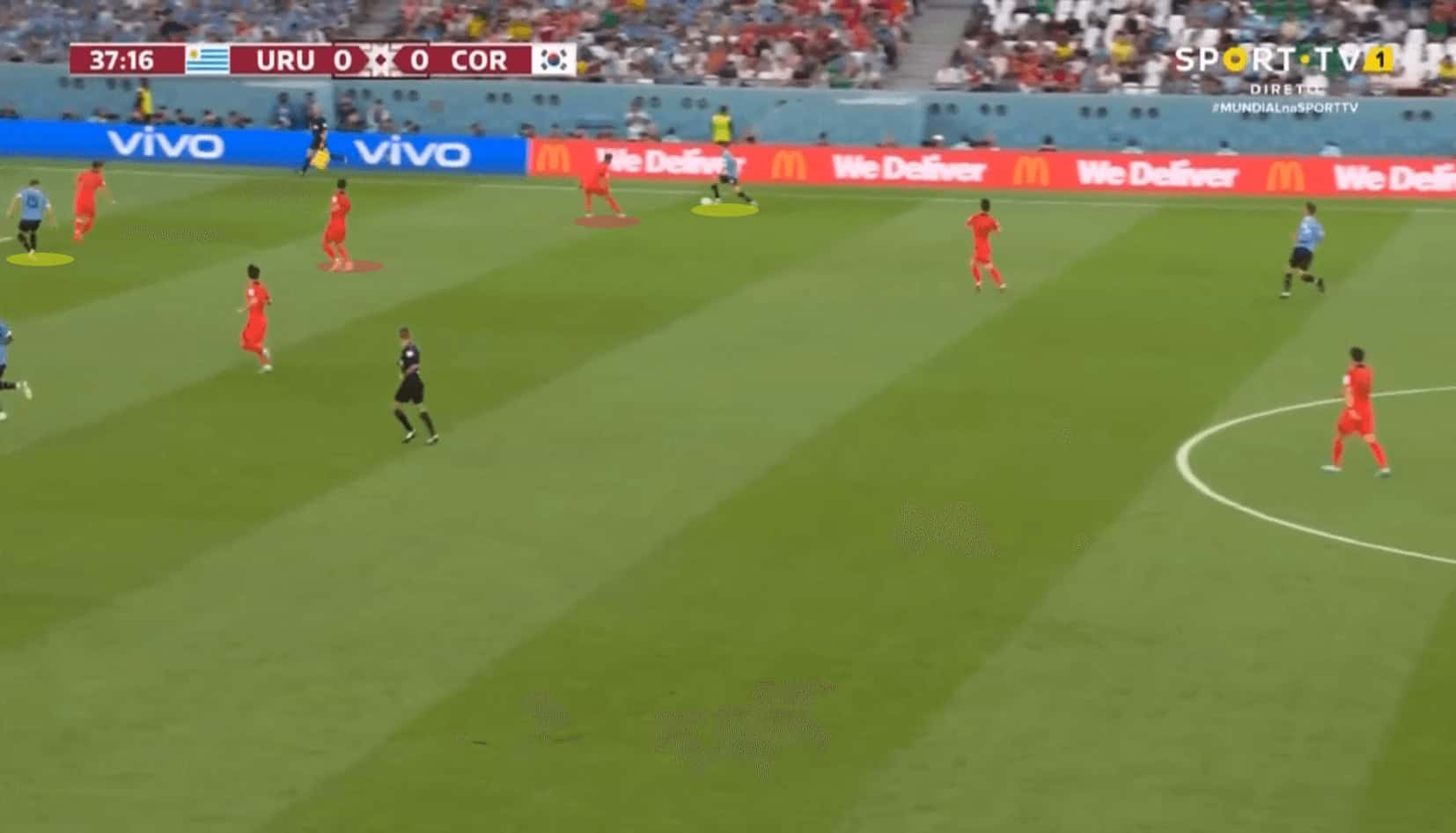
Alonso’s team was really harmless with the weapons they had and used in the match, and with which they wanted to find their first three World Cup points.
Much has been criticised within his style of play, particularly these few combinations between players and shapes in each phase of the pitch, which became very static and poor in their idea, typically against teams that counterattack them with very compact zonal blocks, something that he had faced little in South America, with such coordination as that of Bento’s team.
Even the chances that were closest to being a goal were long shots, one of which was executed by Valverde, who has been recording a fabulous season in terms of shots and long-distance goals.
Luck was not on the side of the Uruguayan side that will have to correct itself, and it was a lot against teams like Ghana and Portugal that, among many details, demonstrated ideas that could harm Alonso’s men.
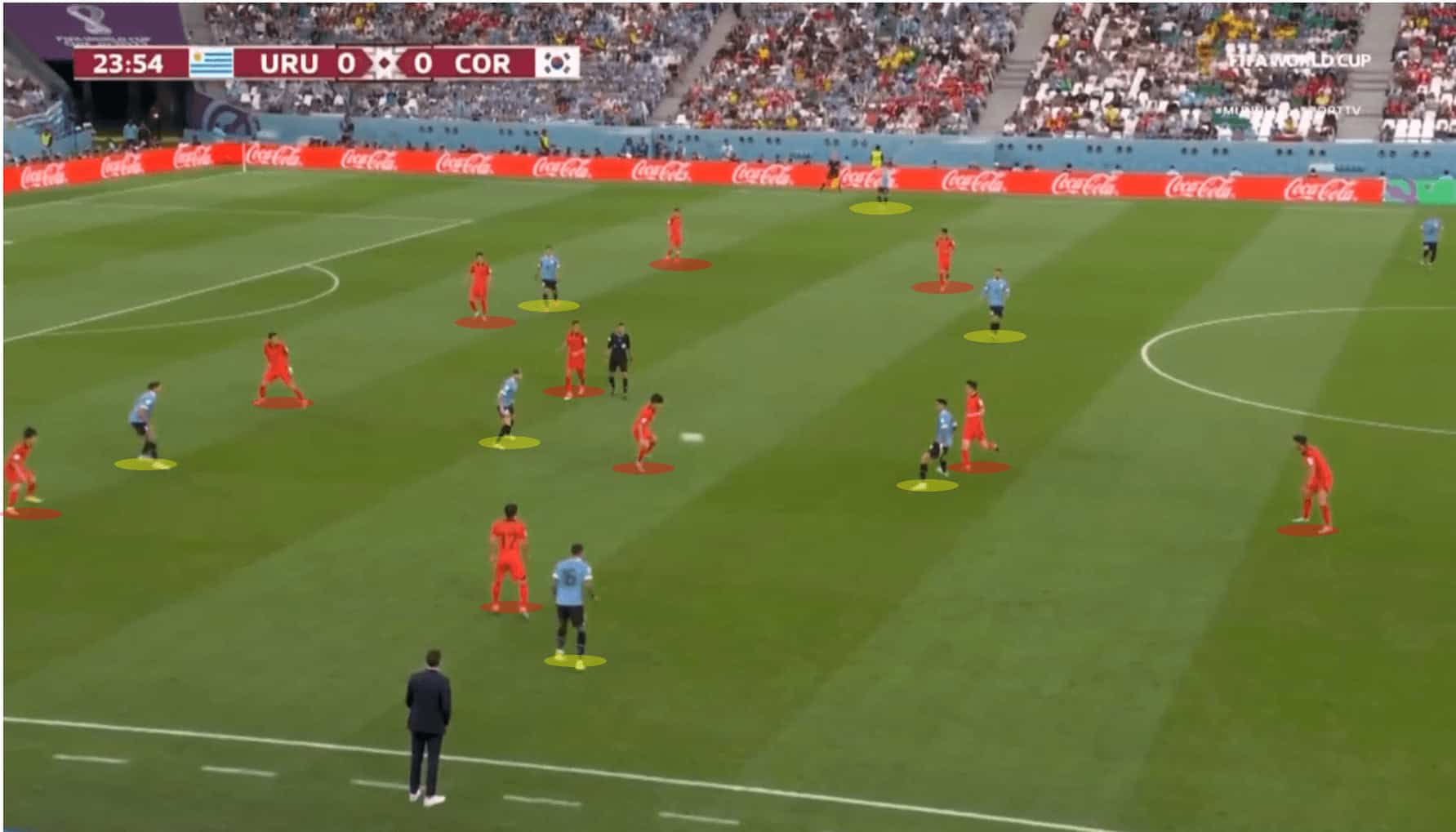
This was the staging of South Korea when Uruguay progressed and sat higher.
A 4-4-2 with aggressive jumps from one of the midfielders, who was sure of the coverage of his partner in the middle.
A defensive line very close to the midfield one, offering zero receptions between these two, thus making Uruguay very flat, who suffered from certain suffocating pressures but also when they raised their heads and had only players in red shirts in front of them, stressing the players very much, dropping their concentration levels.
Conclusion
South Korea and Uruguay did little damage to each other in an extremely passive and tactical game that prioritised rigidity and order above all else, rather than mobility, dynamism, and chance creation.
Both Paulo Bento and Diego Alonso have a lot of work to do, the first on finishing and breaking lines, while the other on putting together a more comfortable structure so that his players can develop link-up plays with a sense, rather than a very stretched and far team that didn’t look comfortable on the pitch, not only because of what South Korea did, but they seem like they didn’t know each other and the chemistry was nonexistent.
