
Total Football Analysis
Once.Sport
  • Football Analysis
    • Data Analysis
    • Formations
      • 2-2-4 Formation
      • 2-3-5 Formation
      • 3-1-4-2 Formation
      • 3-2-2-3 Formation
      • 3-2-4-1 Formation
      • 3-1-6 Formation
      • 3-3-4 Formation
      • 3-4-1-2 Formation
      • 3-4-2-1 Formation
      • 3-4-3 Formation
      • 3-5-1-1 Formation
      • 3-5-2 Formation
      • 4-1-4-1 Formation
      • 4-2-2-2 Formation
      • 4-2-3-1 Formation
      • 4-2-4 Formation
      • 4-3-1-2 Formation
      • 4-3-3 Formation
      • 4-4-2 Formation
      • 4-5-1 Formation
      • 5-3-2 Formation
      • 5-4-1 Formation
      • 6-3-1 Formation
    • Head Coach Analysis
    • Match Analysis
    • Player Analysis
    • Recruitment Analysis
    • Set Piece Analysis
    • Tactical Theory
    • Tactical Preview
    • Team Analysis
    • Training Analysis
    • Tactical Analysis
    • Scouting Report
  • Competition
    • ALL Competitions
    • English Premier League
    • Champions League
    • La Liga
    • Bundesliga
    • Serie A
    • Ligue 1
    • Eredivisie
    • EFL Championship
    • FIFA World Cup 2022
    • WEURO 2022
    • Women’s Super League
    • NWSL
    • Belgian First Division A
    • A-League
    • Liga Profesional de Argentina
    • Austrian Bundesliga
    • Campeonato Brasileiro Série A
    • DFB Pokal
    • 1. HNL
    • Danish Superliga
    • EFL League One
    • EFL League Two
    • FA Cup
    • EFL Cup
    • Indian Super League
    • K-League
    • J1 League
    • Liga MX
    • Copa América 2021
    • Copa del Rey
    • MLS
    • Eliteserien
    • Euro 2020
    • Primeira Liga
    • Scottish Premiership
    • Allsvenskan
    • Europa League
    • UEFA Nations League
    • Liga AUF Uruguaya
  • Coaches
    • All Coaches
    • Alfred Schreuder
    • Ange Postecoglou
    • Antonio Conte
    • Arne Slot
    • Bo Svensson
    • Brendan Rodgers
    • Bruno Lage
    • Carlo Ancelotti
    • Christophe Galtier
    • Claude Puel
    • Claudio Ranieri
    • David Moyes
    • Dean Smith
    • Diego Simeone
    • Domenico Tedesco
    • Frank Lampard
    • Eddie Howe
    • Edin Terzić
    • Emma Hayes
    • Erik ten Hag
    • Ernesto Valverde
    • Gennaro Gattuso
    • Gerardo Seoane
    • Gian Piero Gasperini
    • Giovanni van Bronckhorst
    • Graham Potter
    • Igor Tudor
    • Imanol Alguacil
    • Jesse Marsch
    • Jonas Eidevall
    • Jorge Sampaoli
    • José Bordalás
    • José Mourinho
    • Julen Lopetegui
    • Julian Nagelsmann
    • Julien Stéphan
    • Jürgen Klopp
    • Luciano Spalletti
    • Lucien Favre
    • Manuel Pellegrini
    • Marcelo Bielsa
    • Marco Rose
    • Marco Silva
    • Massimiliano Allegri
    • Mauricio Pochettino
    • Maurizio Sarri
    • Mikel Arteta
    • Niko Kovač
    • Nuno Espírito Santo
    • Oliver Glasner
    • Patrick Vieira
    • Paulo Fonseca
    • Pep Guardiola
    • Peter Bosz
    • Rafa Benítez
    • Ralf Rangnick
    • Ralph Hasenhüttl
    • Roger Schmidt
    • Roy Hodgson
    • Sean Dyche
    • Sérgio Conceição
    • Simone Inzaghi
    • Sonia Bompastor
    • Stefano Pioli
    • Steffen Baumgart
    • Steven Gerrard
    • Thiago Motta
    • Thomas Frank
    • Thomas Tuchel
    • Unai Emery
    • Vincenzo Italiano
    • Xavi
  • Teams
    • ALL Teams
    • AC Milan
    • Ajax Amsterdam
    • Arsenal
    • AS Monaco FC
    • Atalanta
    • Atlético Madrid
    • FC Barcelona
    • FC Bayern Munich
    • Borussia Dortmund
    • Celtic FC
    • Chelsea FC
    • Everton F.C.
    • Inter Milan
    • Juventus F.C.
    • Leeds United F.C.
    • Liverpool FC
    • Manchester City
    • Manchester United FC
    • Paris Saint-Germain
    • Rangers FC
    • RB Leipzig
    • Real Madrid CF
    • Tottenham Hotspur
    • West Ham United
  • Players
    • ALL Players
    • Alisson Becker
    • Bukayo Saka
    • Erling Haaland
    • Harry Kane
    • Jack Grealish
    • John Stones
    • Julián Alvarez
    • Kalvin Phillips
    • Kevin De Bruyne
    • Kyle Walker
    • Kylian Mbappé
    • Lamine Yamal
    • Lionel Messi
    • Luis Díaz
    • Mohamed Salah
    • Phil Foden
    • Virgil Van Dijk
  • Contact
  • Write For TFA
No Result
View All Result
No Result
View All Result
Total Football Analysis
No Result
View All Result
Home Competitions FIFA World Cup 2018

FIFA World Cup 2018: Uruguay Vs Saudi Arabia

Farkhunda Jabeen by Farkhunda Jabeen
June 22, 2018
in FIFA World Cup 2018, Match Analysis
0
Juventus Napoli Serie A Tactical Analysis

Earning six straight points without conceding any goal yet, Uruguay along with the host Russia became the first to qualify for the next round of FIFA World Cup 2018. Saudi Arabia, on the other hand, had to pay the cost of their lack of quality strikers as they are yet to score since their opening kickoff in Russia 2018.

Formation

Uruguay played with their usual 4-4-2 set up with Suarez and Cavani at the front end. The fullbacks Varela and Cáceres were meant to stop the advancing opponent fullbacks at the respective flanks while going up the front in the offensive phases to join their advanced teammates.

uru 442
Uruguay’s 4-4-2 formation

Saudi Arabia played with 4-1-4-1 with Al-Owais as the goalkeeper now as opposed to Al Mayouf who conceded 5 goals against Russia last week. The fixture also replaced the winger Al-Shehri with Sultan Babhir as the former showed weak ball handling against Russia last week. Besides, Fahad Al-Muwallad was deployed at the front end with Babhir from the left wing also cutting deep to join the more advanced region as the former would often have to drop back to join the play or collect the ball.

Saudi Arabia's 4-1-4-1 formation with Babhir more advanced and deeper than the either winger.
Saudi Arabia’s 4-1-4-1 formation with Babhir more advanced and deeper than either winger.

Saudi Arabia’s mid defence line in the first period

Saudi Arabia started with mid to high press by the start of the match. They put a heavy check on Uruguay players. Their press and defensive coverage up till the half line caused Uruguay to lose possession whenever the latter tried penetrating through the deeper zones.

Saudi Arabia's mid defence line and aggressive checking.
Saudi Arabia’s mid defence line and aggressive checking.
Rodriguez's pass to Varela through half space intercepted by Saudi Arabia.
Rodriguez’s pass to Varela through half space intercepted by Saudi Arabia.

Unlike their game against Russia, Saudi Arabia was able to hold their play in Uruguay’s half. They also demonstrated a compact passing structure to retain the possession unlike producing loose touches in their opening fixture. Otayf served his role as buffer well and facilitated distribution of the ball across the planes. In fact, Saudi Arabia’s consistent hold in the opponent half and the ability to recover forced Uruguay to sit back in their own half for the first quarter of the game.

Not only this, Uruguay had to use the flanks to make their way up the pitch via wide plays. The wingers and fullbacks remained at the width while the centre mids remained deep. Though still, with Suarez multi-pressed and the centrally compressed defence they were less likely to cut into the opponent box in the first quarter.

Uruguay fullback and winger going up from the width due to Saudi Arabia's deep press.
Uruguay’s fullback and winger going up using the touchline width due to Saudi Arabia’s deep press.

Even when Cavani dropped into the passing lanes to allow his team to penetrate, Saudi Arabia’s defence pushed back and reduced the gap between the lines causing Uruguay to lose possession eventually.

Cavani dropping in between the lines but Saudi Arabia defence lines closing together causing the side to win back possession.

Uruguay took opportunities of quick penetration

As Saudi Arabia was dominating in Uruguay’s half in the first quarter this made the latter intensify their press deep in their defensive block. However, with most of the play now in Uruguay’s half, there were definitely dangers of quick penetration in the opponent half by Tabarez’s men during the transitions. And that’s what happened. Their quick, frequent penetrations put pressure on the opponents to worry about their defence now.

Among one of these instances, Cavani dropped in the passing lane as he had been doing. This was a good, timely move followed by a dangerous cross by Rodriguez which won Uruguay the goal-leading corner. As Uruguay possesses a pool of good finishers, it was very likely that their frequent penetration in the opponent half would put pressure on the latter causing Uruguay to win set pieces.

As Cavani dropped into the passing lane, the defence lines again closed him down but this time leaving the space at the back for Rodriguez to run up.

Saudi Arabia weak at the finishing end

Despite having a prolonged retention in the opponent half, Saudi Arabia couldn’t convert any of their attempts. As they forced Uruguay to compress their defence in the first quarter, their wide players got open. Saudi Arabia’s attacking combination involved wingers to cut inside while fullbacks remaining wide. This allowed them in the first half to cut into Uruguay defence in multiple instances from their right flank.

The passing map, provided by @11tegen11 using Opta data, also shows that Saudi Arabia’s play is mostly shifted to the right. The fullbacks Al Shahrani and Al Burayk remained wide while the wingers dropped into their respective half spaces.
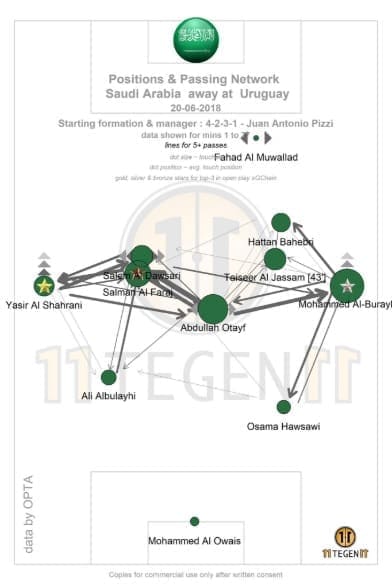
SA map

Yet, the losing team lacked the attacking partnership as well as the kind of finishers and dead ball specialist needed to hit the back of the net yet in Russia 2018 just once, even after Fahad replaced by Al Sahlawi in the final quarter.

Uruguay’s deep passing in the second period

As there was always a pressure to concede an equaliser with the whole second period of the game remaining, Uruguay couldn’t just sit back defending in their own half as they had opted to do in the first period. In the second period, Uruguay switched from defending deep within their half to attacking from the deeper zones into the opponent half.

With Laxalt subbed in for Rodriguez, Uruguay executed their passing plays in deeper zones. Laxalt cut into half-spaces to have Cáceres went up the width while connecting to the deeper teammates including the forwards – Suarez and Cavani. These movements to sustain in the deeper offensive zones enabled Uruguay to have more bodies in that region and keep up their threatening forward play.

The passing map by @11tegen11 also highlights Uruguay’s passing plays shifting towards deeper zones and half spaces with Cavani also dropping deep. The play was often shifted to the left half-space where Cáceres and Rodriguez contributed to most of the side’s offensive moves.
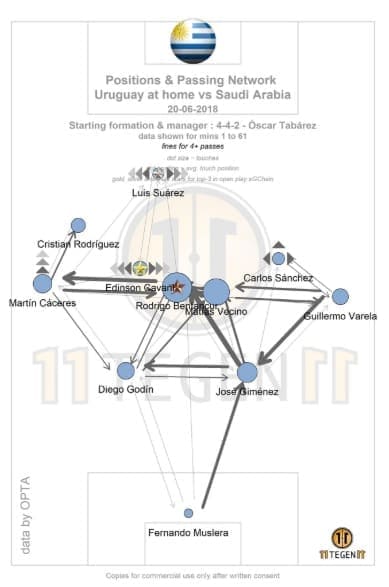
URU map

Uruguay’s deep attacking in their final third forced Saudi Arabia to sit back in their low block defence. Here again, the centrally compressed play – now in Saudi Arabia’s half – kept their wingers free at the width as in the first period of the game, but, the losing team still couldn’t execute any effective attacking moves from there.

Deep passing play by Cavani, Laxalt and Suarez.
Laxalt passed to Cáceres who would remain at the width while the former would cut deeper into the box with the other two forwards. Another glimpse of Uruguay's deep attacking play.
Laxalt passed to Cáceres who would remain at the width while the former would cut deeper into the box with the other two forwards. Another glimpse of Uruguay’s deep attacking play.

Conclusion

In simpler words, Uruguay attacked deeply to defend their lead. Though they couldn’t double their lead, the strategy to deliver the attack in the deeper planes worked well to make Saudi Arabia worry about their defence at the back – and thus to sustain Uruguay’s lead.

Previous Post

FIFA World Cup 2018: Russia vs Egypt

Next Post

FIFA World Cup 2018: Portugal Vs Morocco

Next Post
Juventus Napoli Serie A Tactical Analysis

FIFA World Cup 2018: Portugal Vs Morocco

  • About Total Football Analysis
  • Contact Total Football Analysis
  • Write For Total Football Analysis
  • Advertise
  • Privacy Policy
  • Cancellation / Refund Policy
  • Resources
  • Terms Of Service

© 2026 Total Football Analysis

No Result
View All Result
  • Football Analysis
    • Data Analysis
    • Formations
      • 2-2-4 Formation
      • 2-3-5 Formation
      • 3-1-4-2 Formation
      • 3-2-2-3 Formation
      • 3-2-4-1 Formation
      • 3-1-6 Formation
      • 3-3-4 Formation
      • 3-4-1-2 Formation
      • 3-4-2-1 Formation
      • 3-4-3 Formation
      • 3-5-1-1 Formation
      • 3-5-2 Formation
      • 4-1-4-1 Formation
      • 4-2-2-2 Formation
      • 4-2-3-1 Formation
      • 4-2-4 Formation
      • 4-3-1-2 Formation
      • 4-3-3 Formation
      • 4-4-2 Formation
      • 4-5-1 Formation
      • 5-3-2 Formation
      • 5-4-1 Formation
      • 6-3-1 Formation
    • Head Coach Analysis
    • Match Analysis
    • Player Analysis
    • Recruitment Analysis
    • Set Piece Analysis
    • Tactical Theory
    • Tactical Preview
    • Team Analysis
    • Training Analysis
    • Tactical Analysis
    • Scouting Report
  • Competition
    • ALL Competitions
    • English Premier League
    • Champions League
    • La Liga
    • Bundesliga
    • Serie A
    • Ligue 1
    • Eredivisie
    • EFL Championship
    • FIFA World Cup 2022
    • WEURO 2022
    • Women’s Super League
    • NWSL
    • Belgian First Division A
    • A-League
    • Liga Profesional de Argentina
    • Austrian Bundesliga
    • Campeonato Brasileiro Série A
    • DFB Pokal
    • 1. HNL
    • Danish Superliga
    • EFL League One
    • EFL League Two
    • FA Cup
    • EFL Cup
    • Indian Super League
    • K-League
    • J1 League
    • Liga MX
    • Copa América 2021
    • Copa del Rey
    • MLS
    • Eliteserien
    • Euro 2020
    • Primeira Liga
    • Scottish Premiership
    • Allsvenskan
    • Europa League
    • UEFA Nations League
    • Liga AUF Uruguaya
  • Coaches
    • All Coaches
    • Alfred Schreuder
    • Ange Postecoglou
    • Antonio Conte
    • Arne Slot
    • Bo Svensson
    • Brendan Rodgers
    • Bruno Lage
    • Carlo Ancelotti
    • Christophe Galtier
    • Claude Puel
    • Claudio Ranieri
    • David Moyes
    • Dean Smith
    • Diego Simeone
    • Domenico Tedesco
    • Frank Lampard
    • Eddie Howe
    • Edin Terzić
    • Emma Hayes
    • Erik ten Hag
    • Ernesto Valverde
    • Gennaro Gattuso
    • Gerardo Seoane
    • Gian Piero Gasperini
    • Giovanni van Bronckhorst
    • Graham Potter
    • Igor Tudor
    • Imanol Alguacil
    • Jesse Marsch
    • Jonas Eidevall
    • Jorge Sampaoli
    • José Bordalás
    • José Mourinho
    • Julen Lopetegui
    • Julian Nagelsmann
    • Julien Stéphan
    • Jürgen Klopp
    • Luciano Spalletti
    • Lucien Favre
    • Manuel Pellegrini
    • Marcelo Bielsa
    • Marco Rose
    • Marco Silva
    • Massimiliano Allegri
    • Mauricio Pochettino
    • Maurizio Sarri
    • Mikel Arteta
    • Niko Kovač
    • Nuno Espírito Santo
    • Oliver Glasner
    • Patrick Vieira
    • Paulo Fonseca
    • Pep Guardiola
    • Peter Bosz
    • Rafa Benítez
    • Ralf Rangnick
    • Ralph Hasenhüttl
    • Roger Schmidt
    • Roy Hodgson
    • Sean Dyche
    • Sérgio Conceição
    • Simone Inzaghi
    • Sonia Bompastor
    • Stefano Pioli
    • Steffen Baumgart
    • Steven Gerrard
    • Thiago Motta
    • Thomas Frank
    • Thomas Tuchel
    • Unai Emery
    • Vincenzo Italiano
    • Xavi
  • Teams
    • ALL Teams
    • AC Milan
    • Ajax Amsterdam
    • Arsenal
    • AS Monaco FC
    • Atalanta
    • Atlético Madrid
    • FC Barcelona
    • FC Bayern Munich
    • Borussia Dortmund
    • Celtic FC
    • Chelsea FC
    • Everton F.C.
    • Inter Milan
    • Juventus F.C.
    • Leeds United F.C.
    • Liverpool FC
    • Manchester City
    • Manchester United FC
    • Paris Saint-Germain
    • Rangers FC
    • RB Leipzig
    • Real Madrid CF
    • Tottenham Hotspur
    • West Ham United
  • Players
    • ALL Players
    • Alisson Becker
    • Bukayo Saka
    • Erling Haaland
    • Harry Kane
    • Jack Grealish
    • John Stones
    • Julián Alvarez
    • Kalvin Phillips
    • Kevin De Bruyne
    • Kyle Walker
    • Kylian Mbappé
    • Lamine Yamal
    • Lionel Messi
    • Luis Díaz
    • Mohamed Salah
    • Phil Foden
    • Virgil Van Dijk
  • Contact
  • Write For TFA
  • Login

© 2026 Total Football Analysis