
Total Football Analysis
Once.Sport
  • Football Analysis
    • Data Analysis
    • Formations
      • 2-2-4 Formation
      • 2-3-5 Formation
      • 3-1-4-2 Formation
      • 3-2-2-3 Formation
      • 3-2-4-1 Formation
      • 3-1-6 Formation
      • 3-3-4 Formation
      • 3-4-1-2 Formation
      • 3-4-2-1 Formation
      • 3-4-3 Formation
      • 3-5-1-1 Formation
      • 3-5-2 Formation
      • 4-1-4-1 Formation
      • 4-2-2-2 Formation
      • 4-2-3-1 Formation
      • 4-2-4 Formation
      • 4-3-1-2 Formation
      • 4-3-3 Formation
      • 4-4-2 Formation
      • 4-5-1 Formation
      • 5-3-2 Formation
      • 5-4-1 Formation
      • 6-3-1 Formation
    • Head Coach Analysis
    • Match Analysis
    • Player Analysis
    • Recruitment Analysis
    • Set Piece Analysis
    • Tactical Theory
    • Tactical Preview
    • Team Analysis
    • Training Analysis
    • Tactical Analysis
    • Scouting Report
  • Competition
    • ALL Competitions
    • English Premier League
    • Champions League
    • La Liga
    • Bundesliga
    • Serie A
    • Ligue 1
    • Eredivisie
    • EFL Championship
    • FIFA World Cup 2022
    • WEURO 2022
    • Women’s Super League
    • NWSL
    • Belgian First Division A
    • A-League
    • Liga Profesional de Argentina
    • Austrian Bundesliga
    • Campeonato Brasileiro Série A
    • DFB Pokal
    • 1. HNL
    • Danish Superliga
    • EFL League One
    • EFL League Two
    • FA Cup
    • EFL Cup
    • Indian Super League
    • K-League
    • J1 League
    • Liga MX
    • Copa América 2021
    • Copa del Rey
    • MLS
    • Eliteserien
    • Euro 2020
    • Primeira Liga
    • Scottish Premiership
    • Allsvenskan
    • Europa League
    • UEFA Nations League
    • Liga AUF Uruguaya
  • Coaches
    • All Coaches
    • Alfred Schreuder
    • Ange Postecoglou
    • Antonio Conte
    • Arne Slot
    • Bo Svensson
    • Brendan Rodgers
    • Bruno Lage
    • Carlo Ancelotti
    • Christophe Galtier
    • Claude Puel
    • Claudio Ranieri
    • David Moyes
    • Dean Smith
    • Diego Simeone
    • Domenico Tedesco
    • Frank Lampard
    • Eddie Howe
    • Edin Terzić
    • Emma Hayes
    • Erik ten Hag
    • Ernesto Valverde
    • Gennaro Gattuso
    • Gerardo Seoane
    • Gian Piero Gasperini
    • Giovanni van Bronckhorst
    • Graham Potter
    • Igor Tudor
    • Imanol Alguacil
    • Jesse Marsch
    • Jonas Eidevall
    • Jorge Sampaoli
    • José Bordalás
    • José Mourinho
    • Julen Lopetegui
    • Julian Nagelsmann
    • Julien Stéphan
    • Jürgen Klopp
    • Luciano Spalletti
    • Lucien Favre
    • Manuel Pellegrini
    • Marcelo Bielsa
    • Marco Rose
    • Marco Silva
    • Massimiliano Allegri
    • Mauricio Pochettino
    • Maurizio Sarri
    • Mikel Arteta
    • Niko Kovač
    • Nuno Espírito Santo
    • Oliver Glasner
    • Patrick Vieira
    • Paulo Fonseca
    • Pep Guardiola
    • Peter Bosz
    • Rafa Benítez
    • Ralf Rangnick
    • Ralph Hasenhüttl
    • Roger Schmidt
    • Roy Hodgson
    • Sean Dyche
    • Sérgio Conceição
    • Simone Inzaghi
    • Sonia Bompastor
    • Stefano Pioli
    • Steffen Baumgart
    • Steven Gerrard
    • Thiago Motta
    • Thomas Frank
    • Thomas Tuchel
    • Unai Emery
    • Vincenzo Italiano
    • Xavi
  • Teams
    • ALL Teams
    • AC Milan
    • Ajax Amsterdam
    • Arsenal
    • AS Monaco FC
    • Atalanta
    • Atlético Madrid
    • FC Barcelona
    • FC Bayern Munich
    • Borussia Dortmund
    • Celtic FC
    • Chelsea FC
    • Everton F.C.
    • Inter Milan
    • Juventus F.C.
    • Leeds United F.C.
    • Liverpool FC
    • Manchester City
    • Manchester United FC
    • Paris Saint-Germain
    • Rangers FC
    • RB Leipzig
    • Real Madrid CF
    • Tottenham Hotspur
    • West Ham United
  • Players
    • ALL Players
    • Alisson Becker
    • Bukayo Saka
    • Erling Haaland
    • Harry Kane
    • Jack Grealish
    • John Stones
    • Julián Alvarez
    • Kalvin Phillips
    • Kevin De Bruyne
    • Kyle Walker
    • Kylian Mbappé
    • Lamine Yamal
    • Lionel Messi
    • Luis Díaz
    • Mohamed Salah
    • Phil Foden
    • Virgil Van Dijk
  • Contact
  • Write For TFA
No Result
View All Result
No Result
View All Result
Total Football Analysis
No Result
View All Result
Home Analysis

EURO 2020: How Denmark’s change of formation helped them cruise past Wales into the quarter-finals – tactical analysis

Rishickesh Ramesh by Rishickesh Ramesh
June 28, 2021
in Analysis, Euro 2020, Match Analysis
0
Euro 2020: How Denmark's change of formation helped them cruise past Wales into the quarter-finals - tactical analysis tactics

The EURO 2020 knockouts are underway and we are here to discuss the tactical analysis of the first knockout clash of the tournament between Wales and Denmark. Both are dark horses of the tournament and faced tough challenges in the form of Italy and Belgium in the group stages respectively.

This tactical analysis will discuss the tactics deployed by both teams and will look into how Denmark outclassed Wales to book their berth in the quarter-finals. Let’s begin the analysis.

Lineups

Wales lined up in a 4-3-3 formation with a midfield trio of Joe Allen, Joe Morrell and Juventus‘ Aaron Ramsey. The forward line consisted of Manchester United’s Daniel James, Tottenham loanee Gareth Bale and Cardiff City striker Kieffer Moore.

Euro 2020: How Denmark's change of formation helped them cruise past Wales into the quarter-finals - tactical analysis tactics

Denmark, on the other hand, made two changes to their lineup that thrashed Russia last time out. Yussuf Poulsen and Daniel Wass were absent from the matchday squad, the former sustaining a minor injury and the latter picking up an illness. Former Ajax youngster Kasper Dolberg and wing-back Jens Stryger Larsen replaced the ailing duo respectively. 

Bale provides Wales with a decent start

Wales started off the game well or at least in a much better fashion than they ended it. With Denmark playing a 3-4-3 system that fell back into a 5-4-1 when they shifted to a low block, Wales decided to use Gareth Bale as the key to get themselves into the final third. Already having a 3v2 disadvantage against Wales’ 4-3-3 system at the centre of the park, Denmark found it even more difficult when Bale kept dropping into the half-space and creating overloads or making himself free. Those half-spaces were very difficult for the two Denmark midfielders to cover on their own and hence when Bale dropped they couldn’t stop him from receiving the ball. We can see an example of that in the image below where Bale is free on the right half-space and the wing-back on that side being double-teamed due to the presence of the Wales full-back.

Euro 2020: How Denmark's change of formation helped them cruise past Wales into the quarter-finals - tactical analysis tactics

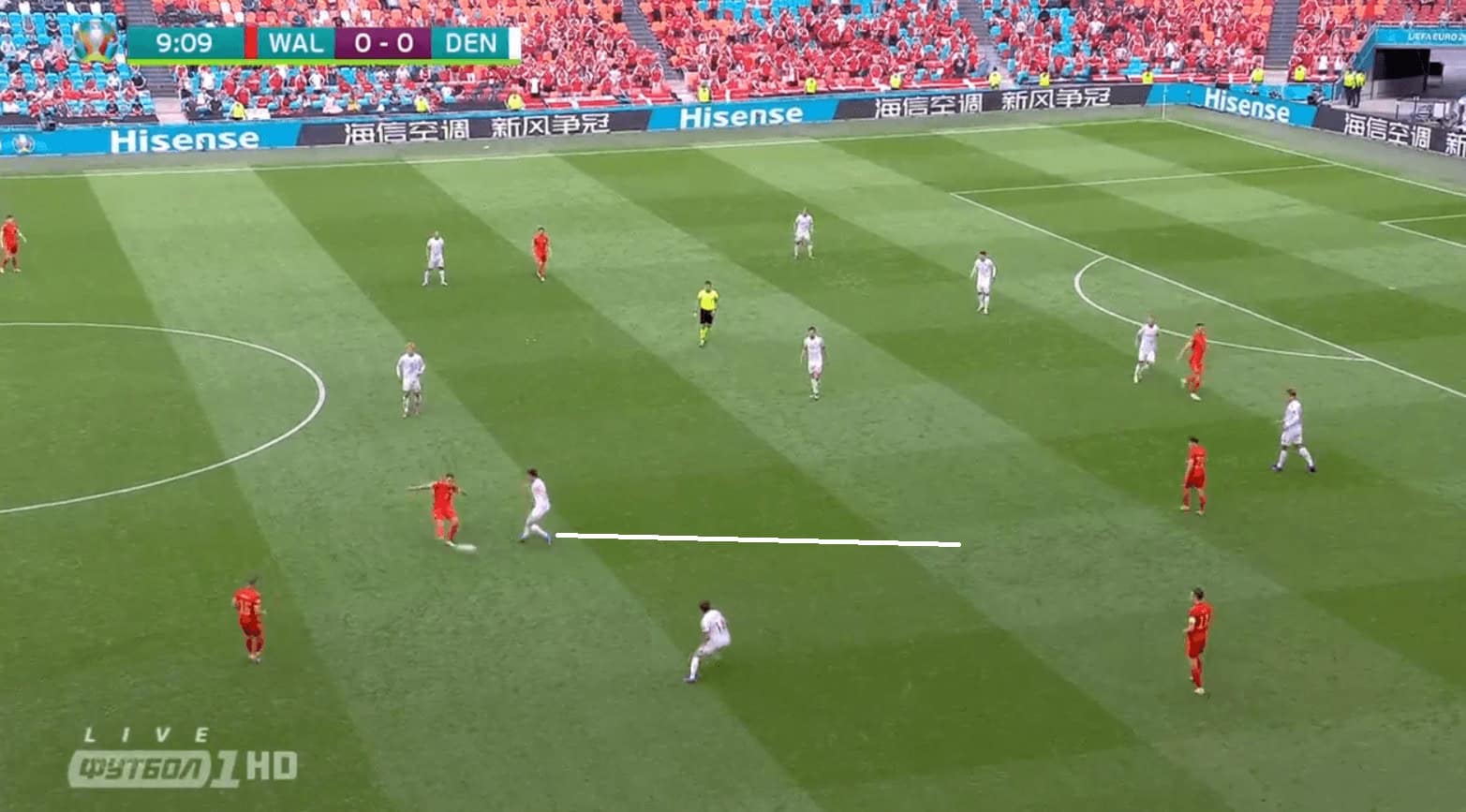
Bales kept dropping into these spaces and took it upon himself to immediately turn and drive at the defenders. He also had couples of powerful long shots that threatened the Denmark defence in the first fifteen minutes. The pressing from Denmark in that interval was also questionable as they took some bad decisions to press when they shouldn’t have. In one of the situations, the central midfielder who was playing as part of the two-men midfield stepped out unnecessarily without properly maintaining cover-shadow that resulted in Bale receiving the ball in space and again having a chance to drive.
Euro 2020: How Denmark's change of formation helped them cruise past Wales into the quarter-finals - tactical analysis tactics

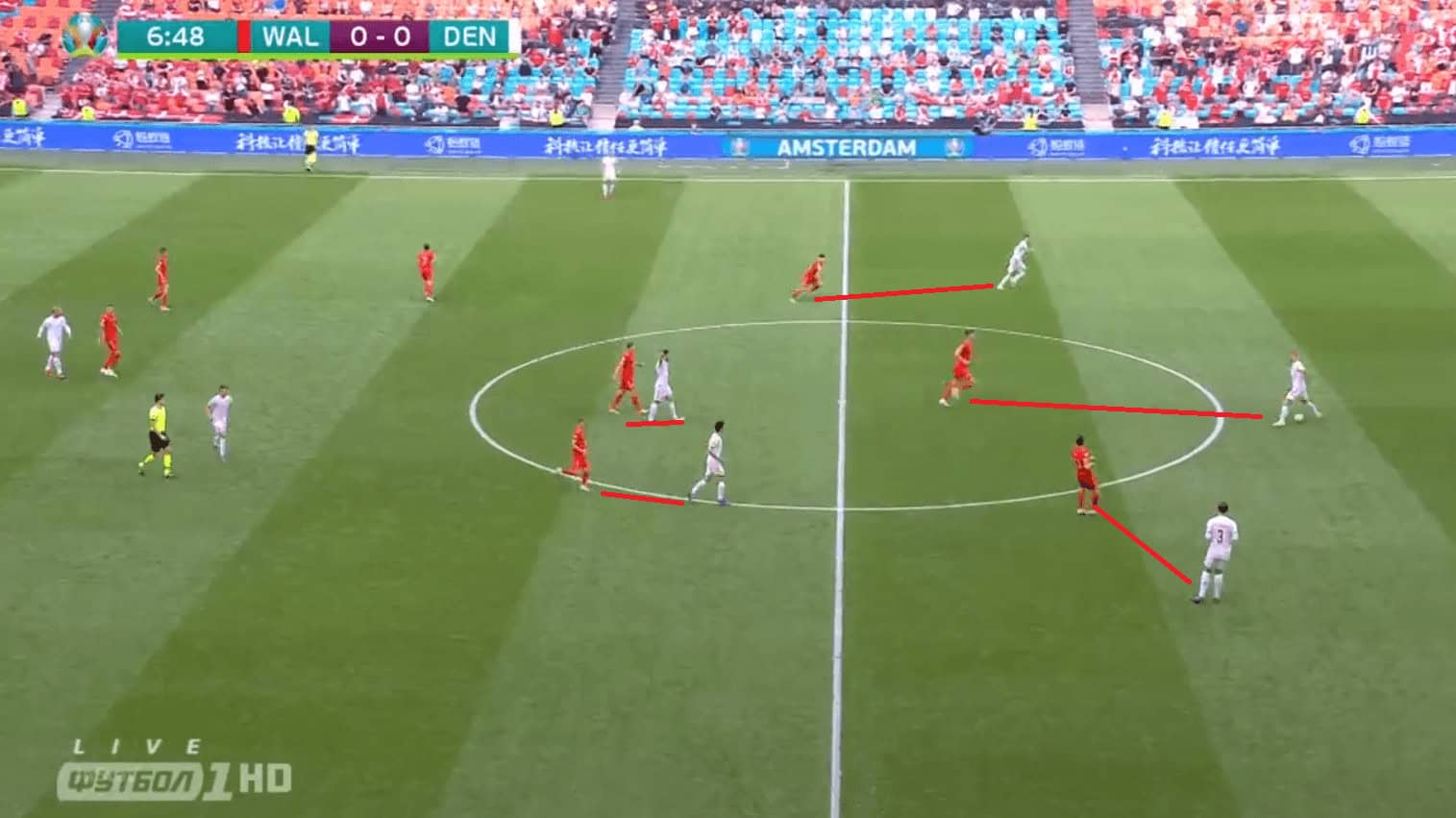
Apart from the Bale situation, another area where Wales found it easy was to press the Denmark backline as they were able to cover the three Denmark centre-backs with their forwards while the two central midfielders would press the two Denmark’s holding midfielders. We can see an example of that in the image below where they have covered the Denmark centre-backs. 
Euro 2020: How Denmark's change of formation helped them cruise past Wales into the quarter-finals - tactical analysis tactics

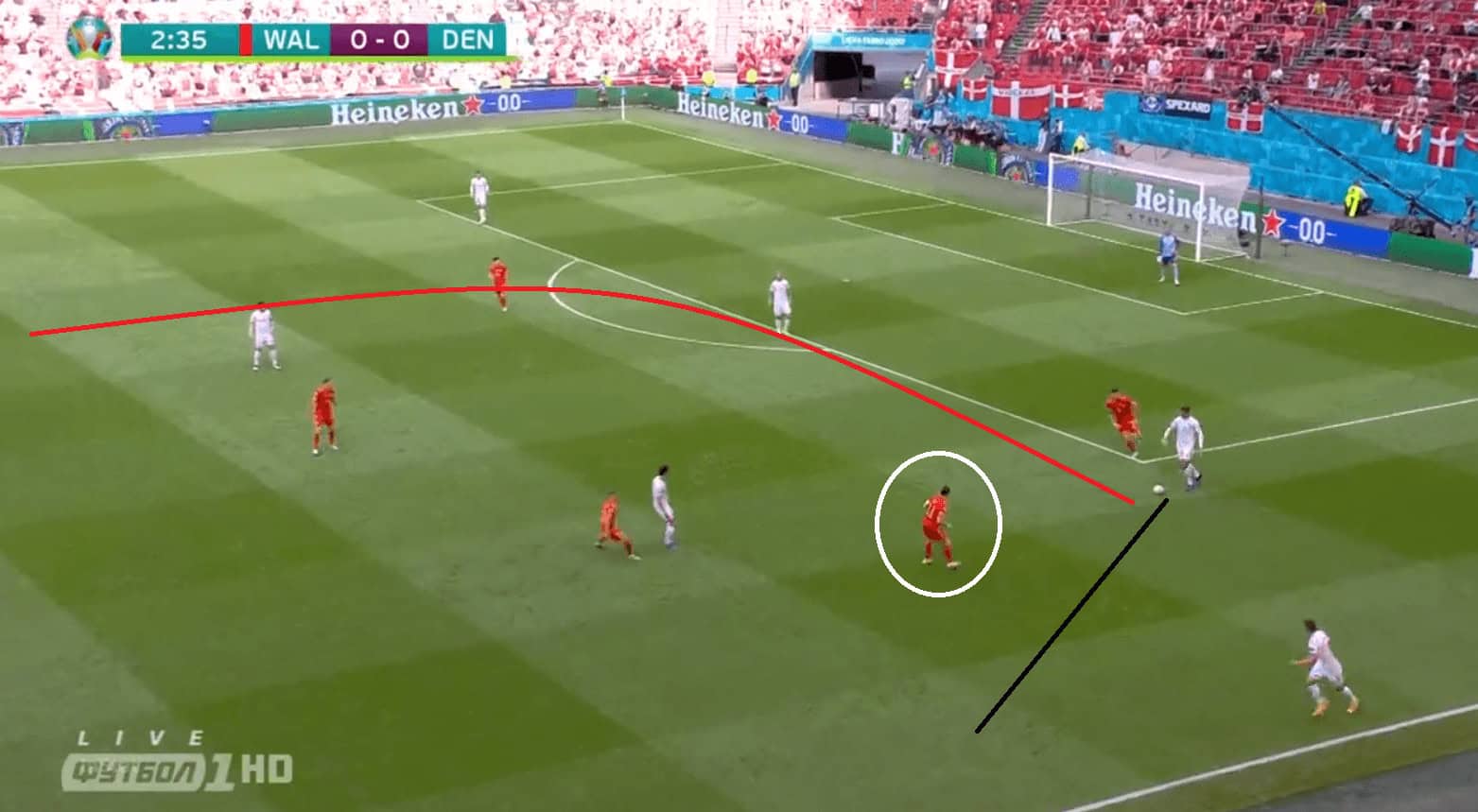
Though they could have used Wales pressing to their advantage, Denmark failed to capitalize on that and struggled to progress the ball forward. In the example below, we can see Wales forward pressing the Denmark centre-back by covering the pass into the interior regions, this means that the pass to the wing-back was left open. The Denmark centre-back in the image below instead of playing that pass decided to play it long and they lost possession.
Euro 2020: How Denmark's change of formation helped them cruise past Wales into the quarter-finals - tactical analysis tactics

Denmark change formation, change the game

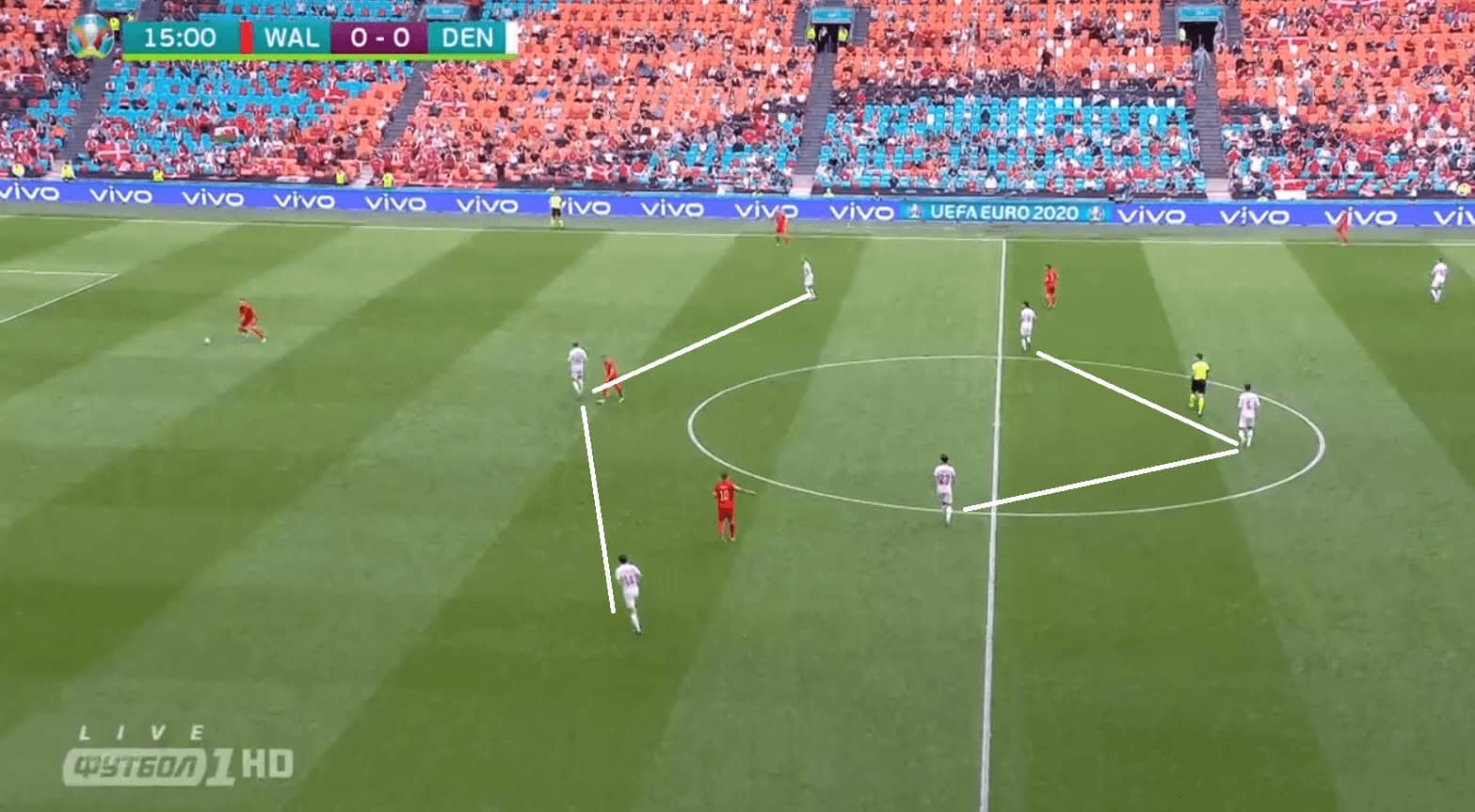
Denmark displayed a wonderful tactical display against Russia that booked their place in the Round of 16. The move to play Andreas Christensen as a number six and shift to a 4-3-3 proved to be a masterstroke. It was a surprise when Kasper Hjulmand decided to change his system and back to a 3-4-3 for this clash. We saw how it was initially left to be exposed as Wales found it easy to play against Denmark. Hjulmand decided to shift back to a 4-3-3 which turned to be a turning point in the game as it eventually alleviated both of Denmark’s issues. They now had a 3v3 matching in the middle of the park and also Bale now would not be free when he dropped into the half-space as the central midfielder near him had to access him immediately. 
Euro 2020: How Denmark's change of formation helped them cruise past Wales into the quarter-finals - tactical analysis tactics

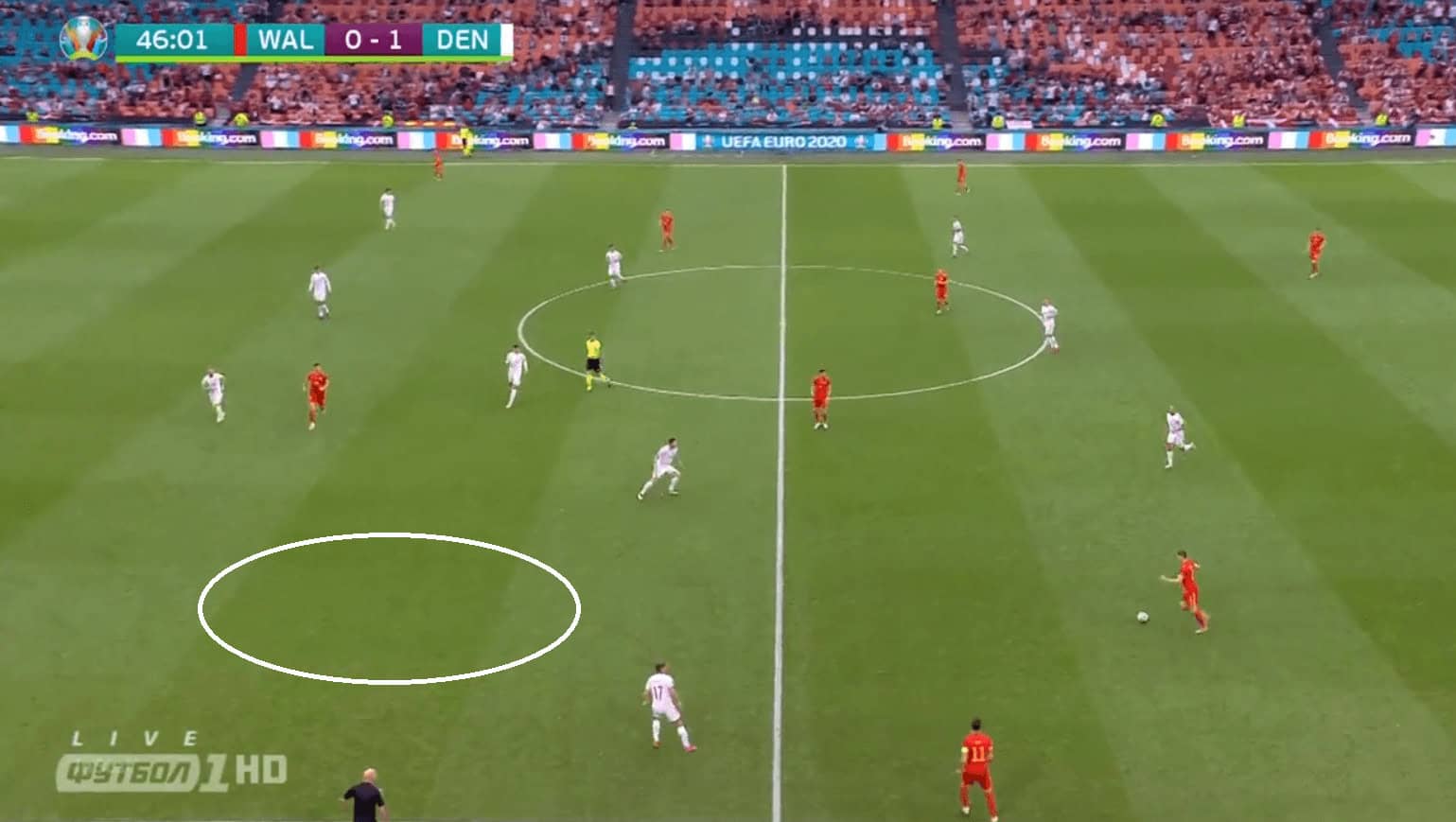
We can see an example of their 4-3-3 system from the above image as Christensen’s position had been shifted from the RCB to CDM. Their overall pressing also improved as a result of this as they were able to get better coverage to the Wales players while also covering the important passing lanes around. We can see that in the image below where Denmark are pressing high and in a man-man fashion. The ball is played to the full-back and even he is pressed intensely. None of the Wales players are then accessible for Ben Davies as no one drops into space (white oval). 
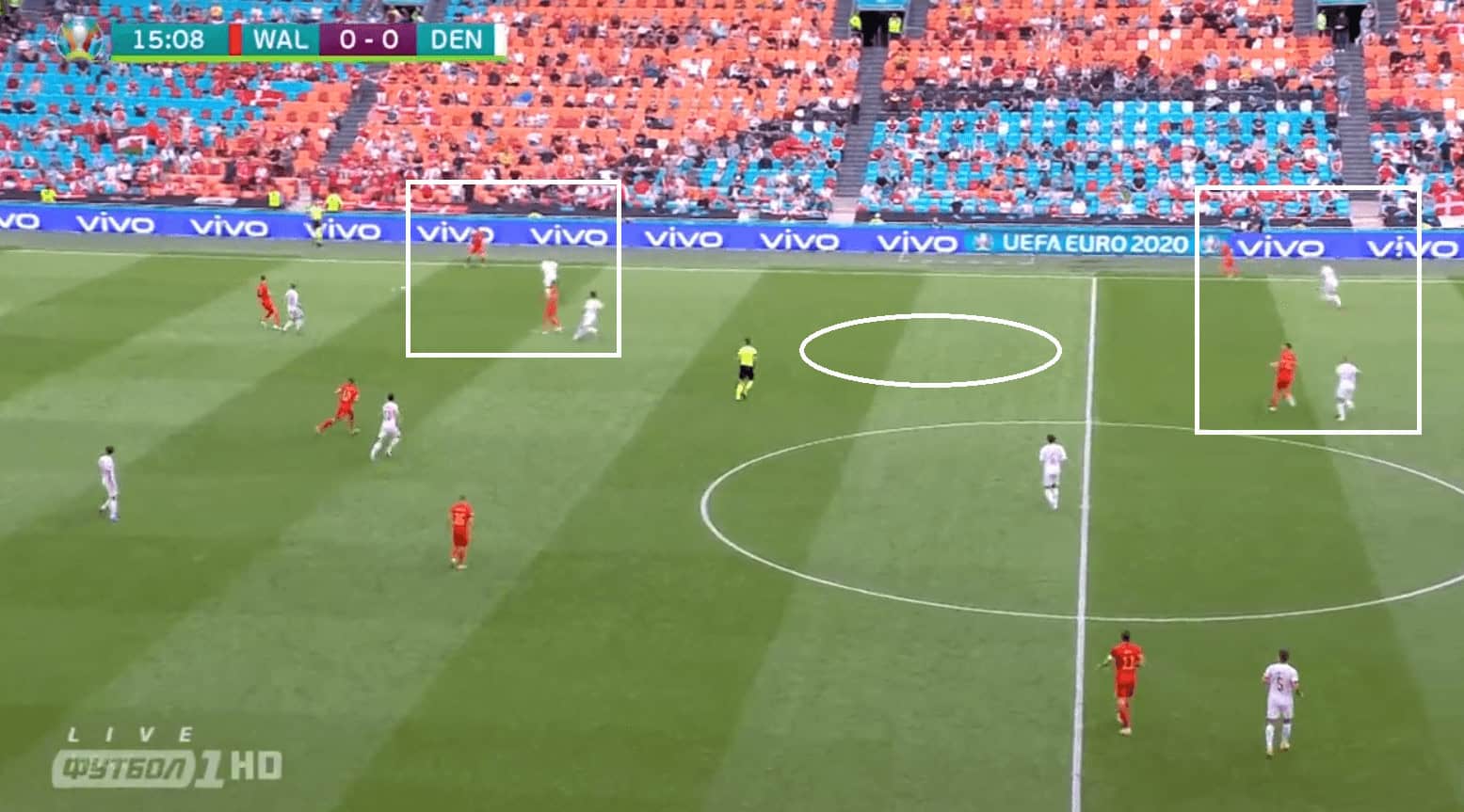
Euro 2020: How Denmark's change of formation helped them cruise past Wales into the quarter-finals - tactical analysis tactics

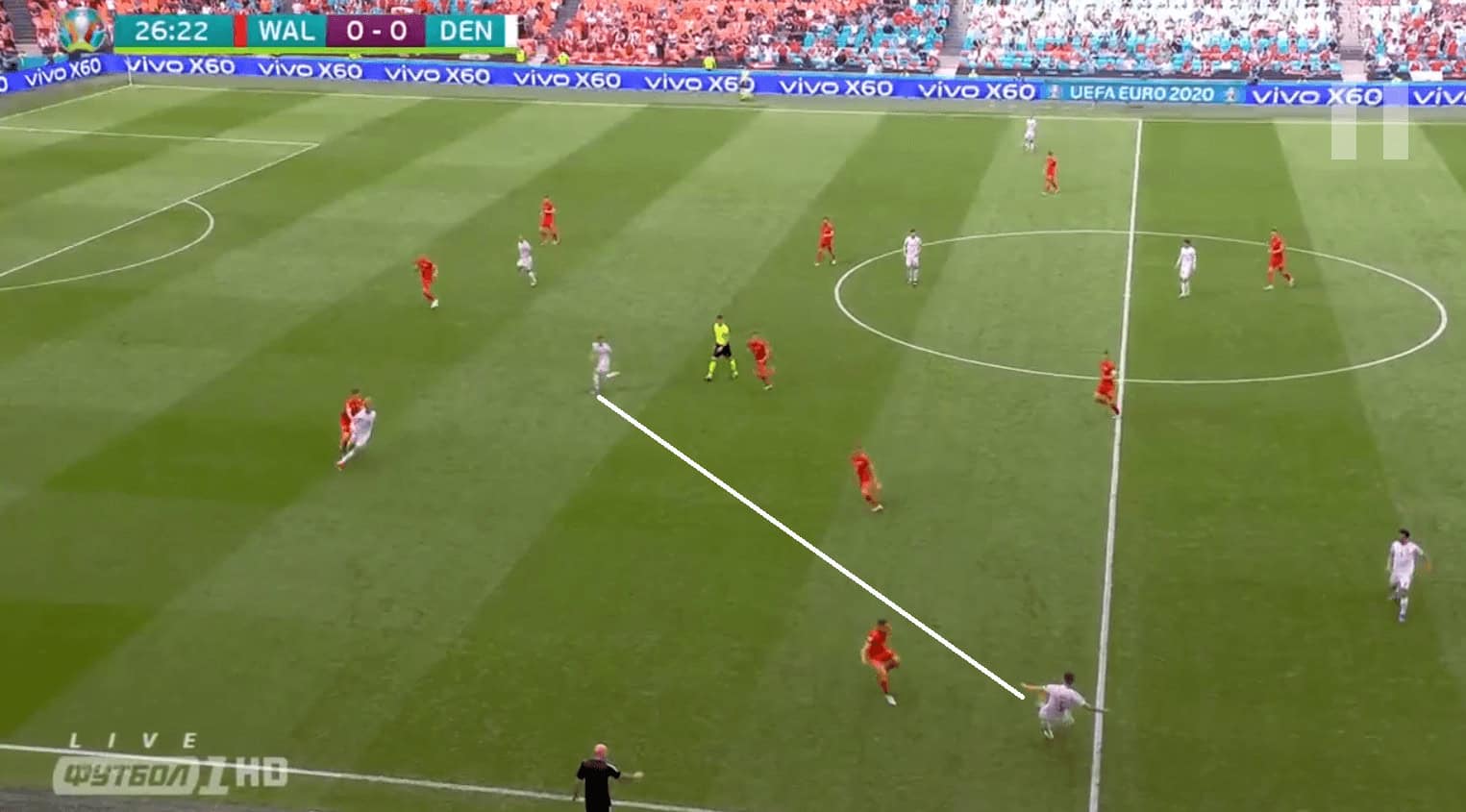
Denmark’s verticality also improved as they repeatedly looked to launch long balls without any hesitation. This was mainly due to the fact that Wales didn’t want to have their centre-backs press very high along, like in the image below, with their forwards and midfielders. So the second balls from the long-balls launched resulted in the space in between the lines and Denmark were more alert to win it. 
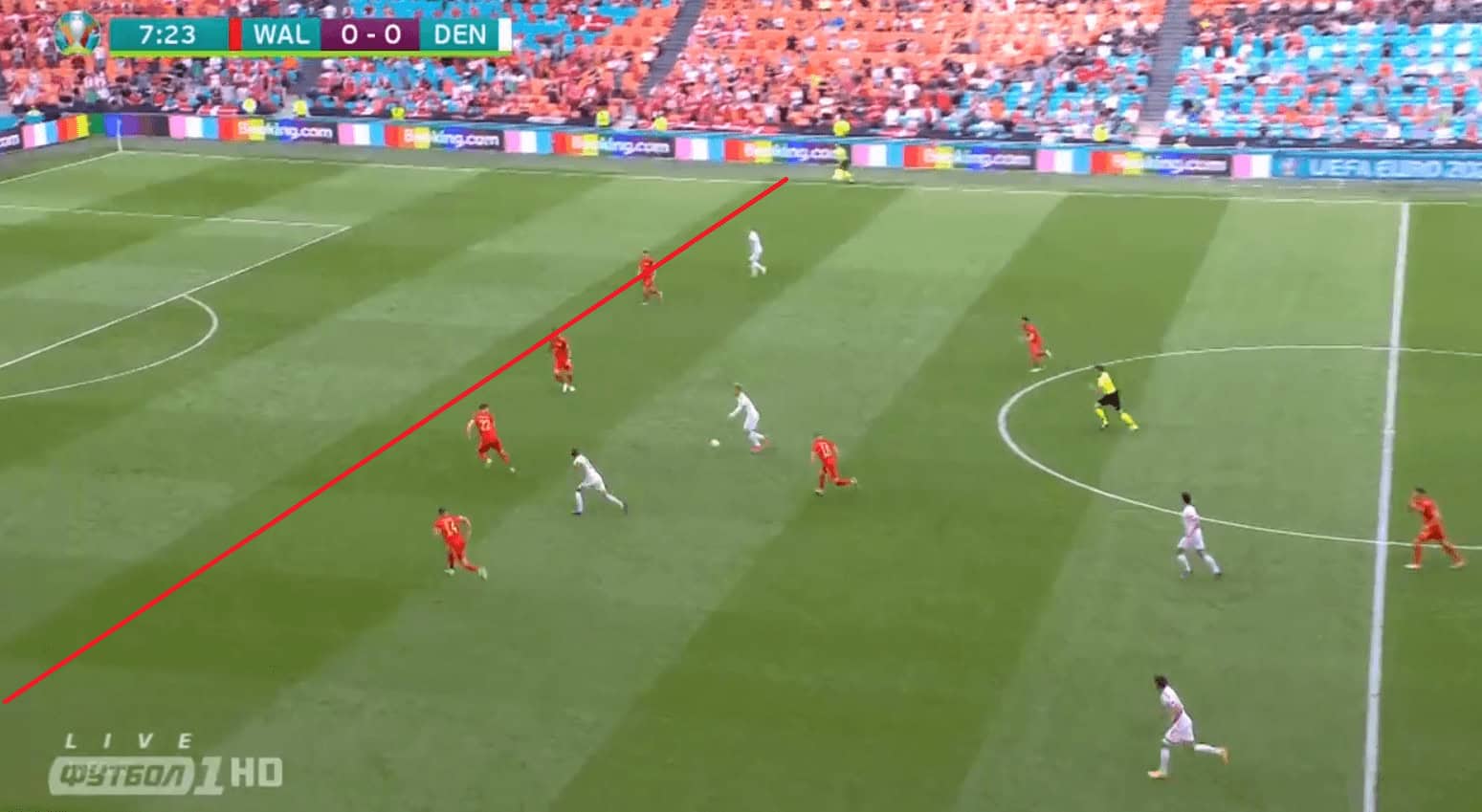
Euro 2020: How Denmark's change of formation helped them cruise past Wales into the quarter-finals - tactical analysis tactics

With the shift in the system, Denmark now had the opportunity to use rotations and triangles in wide areas. When Wales had their full-back step out to press the Denmark full-back, the likes of Damsgaard or Delaney attacked the space in behind the full-back. We can see an example of that in the image below where Damsgaard attacks the space behind Roberts when he stepped up to press Maehle, though the pass isn’t played to him on this occasion.
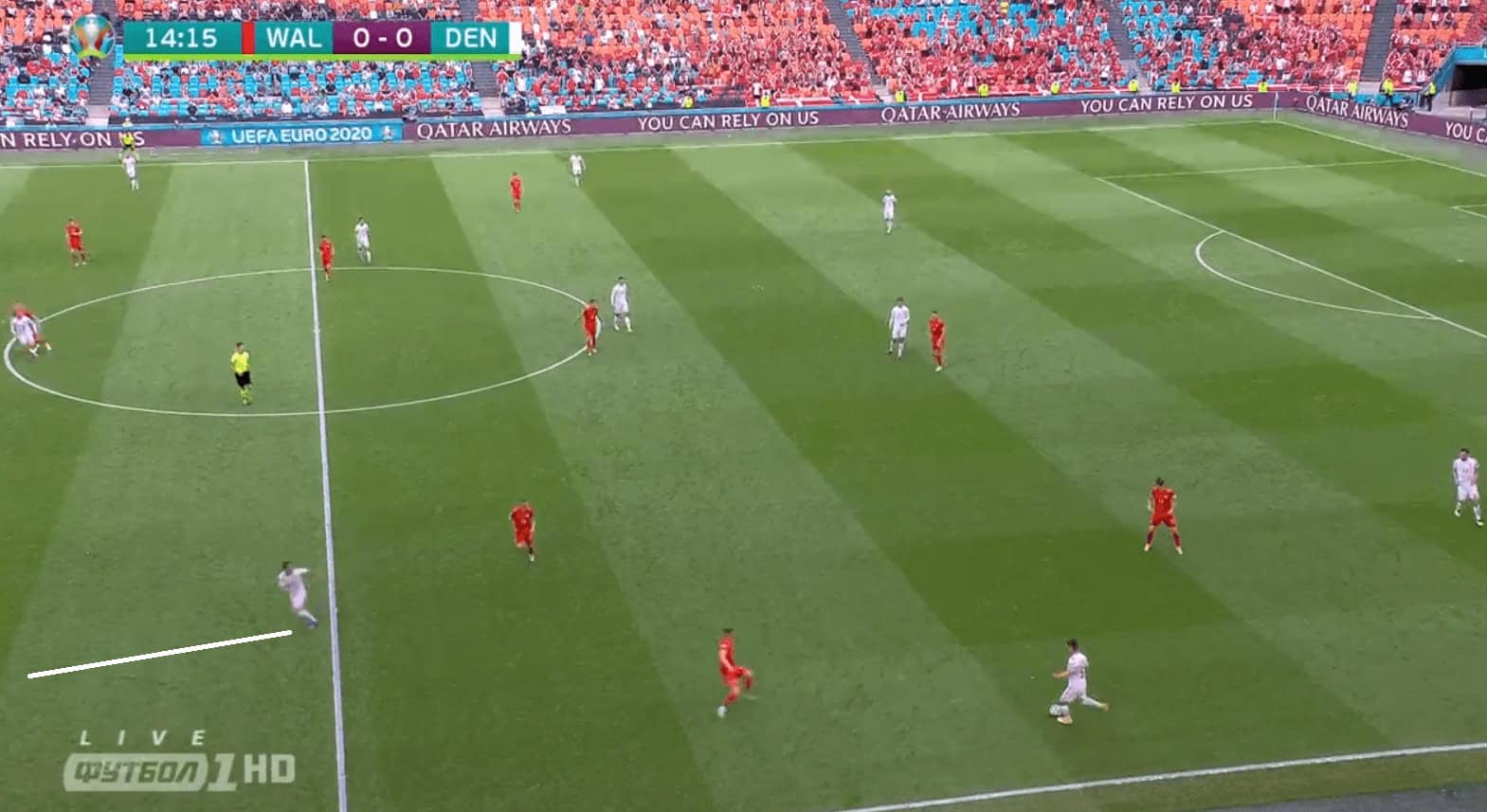
Euro 2020: How Denmark's change of formation helped them cruise past Wales into the quarter-finals - tactical analysis tactics

In another example, Damsgaard was pinning Ben Davies while Dolberg was occupying one of the centre-backs. When the ball goes to the Danish right-back, Ben Davies steps out to press him by transferring Damsgaard to Allen. Damsgaard made a dummy run into the space left by Davies while also dragging Allen away from his position. Dolberg then dropped into the space left by Allen and engaged a wall-pass back to Larsen. Delaney, meanwhile, made a run into the space vacated by the centre-back to receive a pass from Larsen. This can be seen in the example below and swiftness and automatism in the move meant Wales found it very hard to defend.
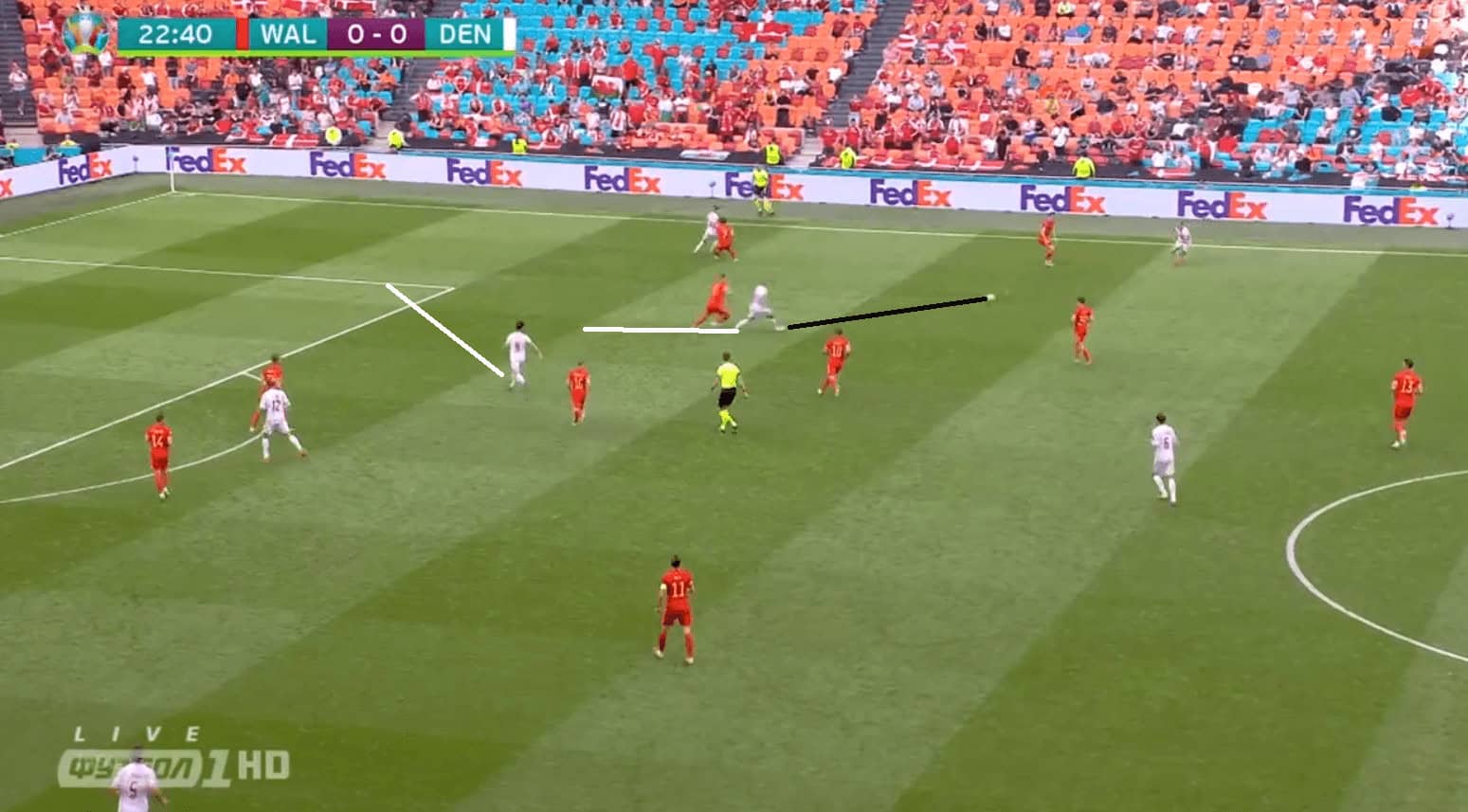
Euro 2020: How Denmark's change of formation helped them cruise past Wales into the quarter-finals - tactical analysis tactics

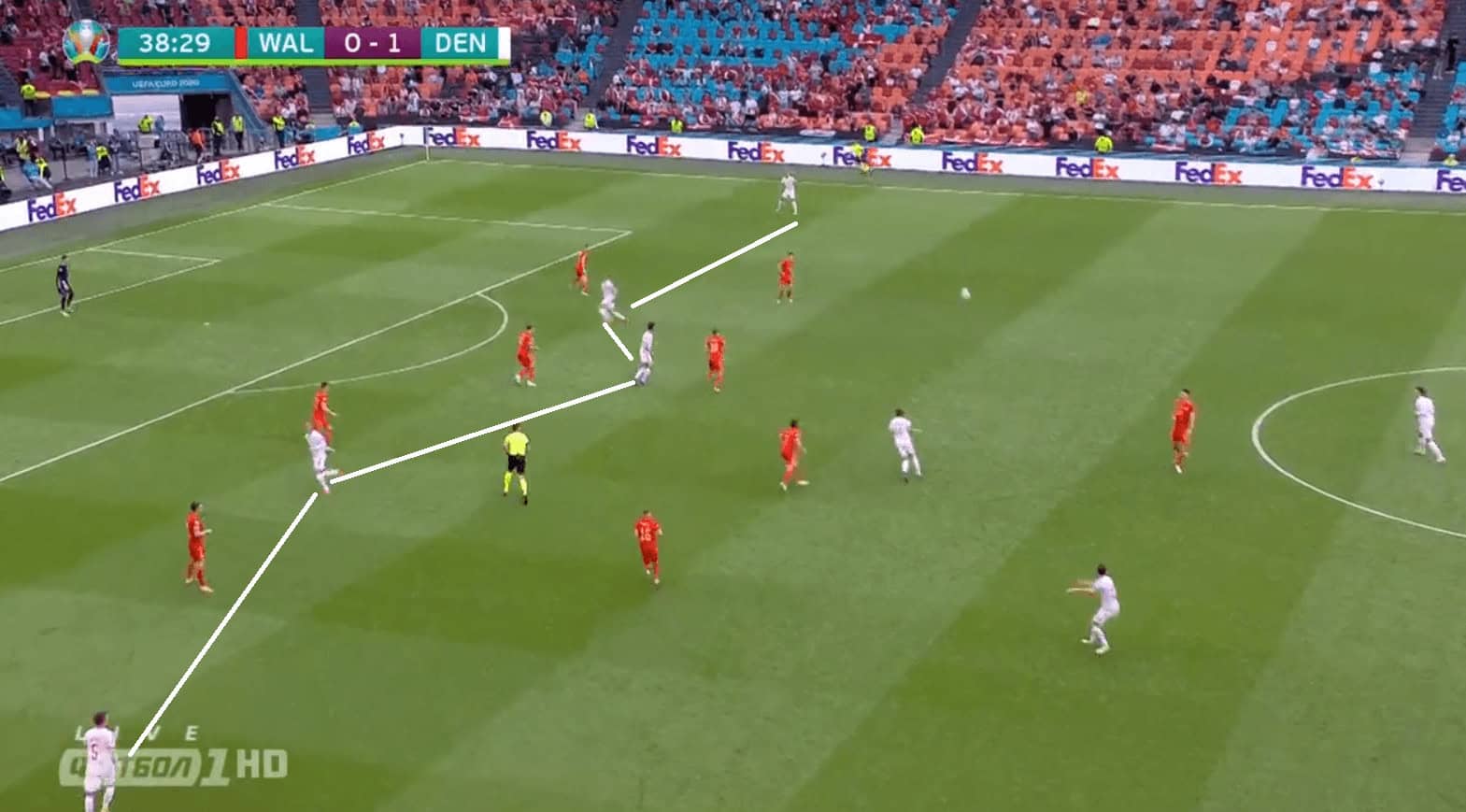
The signs were there and Wales eventually conceded from a similar pattern. This time it was from the left flank where Roberts stepped to press Maehle. Dolberg made a similar movement to drop and drag the Wales defender out of position. This opened a passing lane to Damsgaard and Maehle played a very good ball to him. Damsgaard then provided the final ball for Dolberg who scored the goal to put Denmark into a 1-0 lead.
Euro 2020: How Denmark's change of formation helped them cruise past Wales into the quarter-finals - tactical analysis tactics

Their system grew to be flexible as they also made good use of their full-backs / wing-backs attacking ability by playing them high and wide with a final line of 5 players. The positioning of Damsgaard and the central midfielders meant that Wales were hesitant to give a lot of space for them centrally and defended very narrow.
Euro 2020: How Denmark's change of formation helped them cruise past Wales into the quarter-finals - tactical analysis tactics

Wales’ fundamentals are the cause of their own downfall

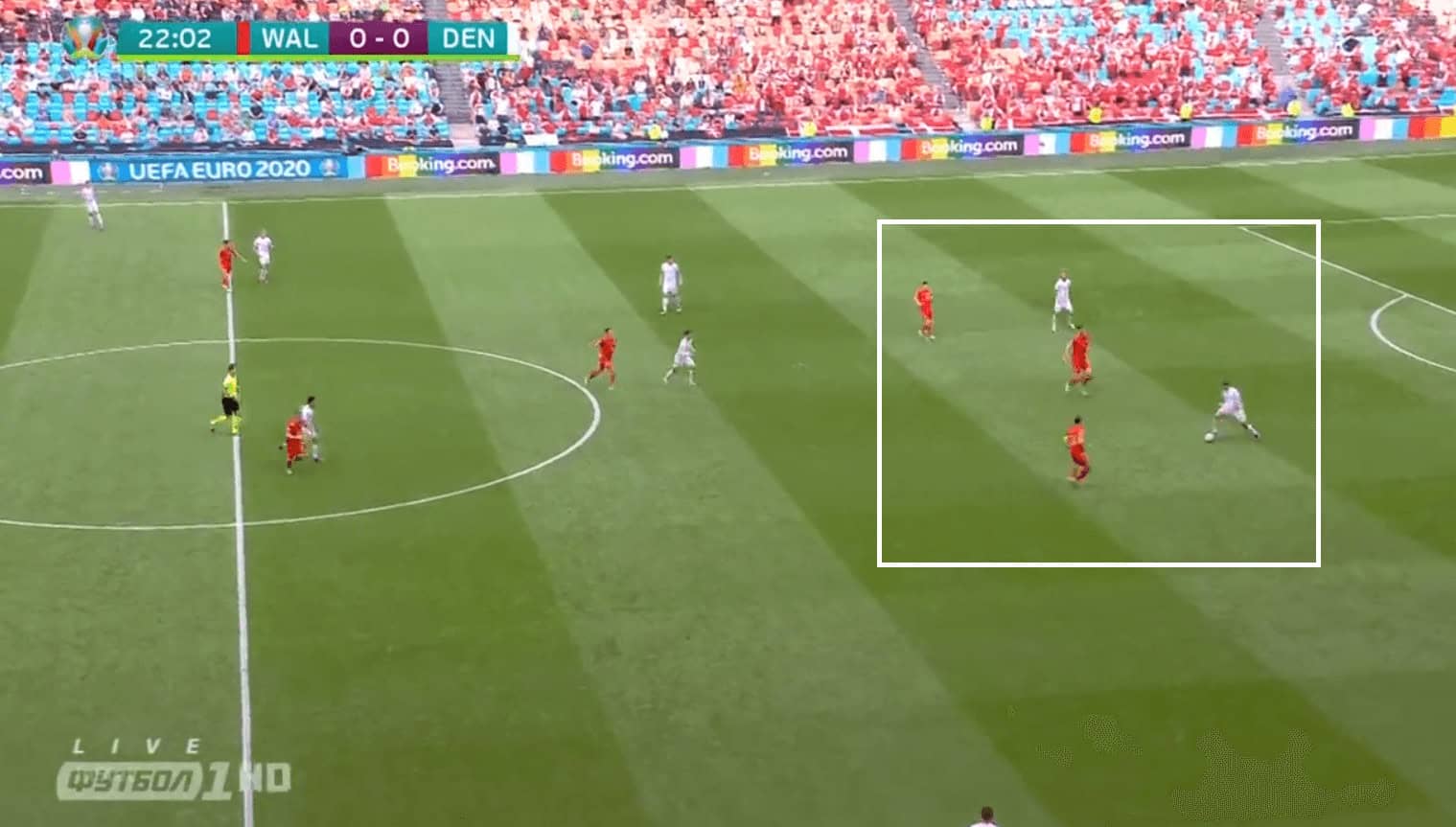
As good as Denmark were, Wales’ fundamentals and lack of quality meant they were to blame themselves for the loss. Though they started in a very good fashion, once Denmark shifted their formation, Wales were pretty much clueless in finding solutions to it. Despite Denmark shifting to a two-men CB setup, Wales were pressing in a 4-3-3 with CF pressing the CB and not covering the CDM. At one point three Wales players were pressing the two Denmark forwards like in the image below which was one of the fundamental issues and also due to poor coordination. Even if they had to press in such a way they could have at least closed the passing lanes in a much better way as the pass to the full-backs were open.
Euro 2020: How Denmark's change of formation helped them cruise past Wales into the quarter-finals - tactical analysis tactics

Like Denmark, even Wales had chances to attack the space behind the full-back when he had to step out to press. But Wales players were unaware of that and did not make such movements like in the image below. Even in situations where they did, the players having the ball did not find them with the balls due to their inferior quality when compared to their opposition.
Euro 2020: How Denmark's change of formation helped them cruise past Wales into the quarter-finals - tactical analysis tactics

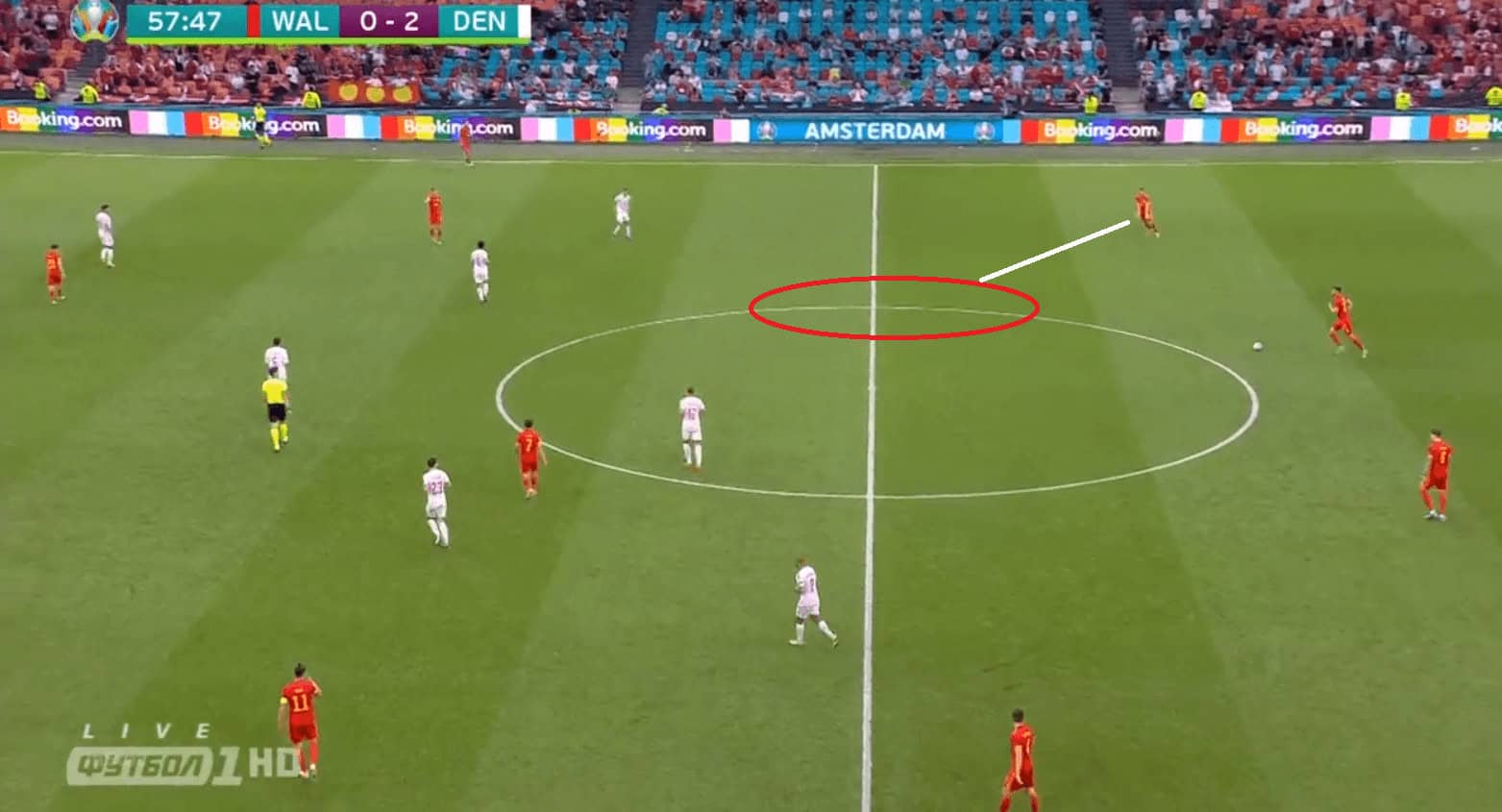
The below example will give a much better picture of why they were bound to have issues. When there is space available for the CM to receive the ball and also with the Danish forwards not pressing intensely, he did not have to drop into the region where he currently is and could have stayed higher. This means that another player had to drop to show himself for a pass and this domino effect means Wales’ threat higher up the pitch is suppressed.
Euro 2020: How Denmark's change of formation helped them cruise past Wales into the quarter-finals - tactical analysis tactics

Conclusion

Denmark deservingly won the game and they did in an emphatic fashion by putting 4 goals past the Wales defence. The win means Denmark were the first team to book a quarterfinals place followed by Italy and will be playing the winner of the Netherlands – Czech Republic clash. 

Previous Post

EURO 2020 analytics: Italy vs Austria – watch our video

Next Post

EURO 2020: Why win against plucky Austria showed that Italy are not title contenders yet – tactical analysis

Next Post
EURO 2020: Italy v Austria - tactical analysis tactics

EURO 2020: Why win against plucky Austria showed that Italy are not title contenders yet - tactical analysis

  • About Total Football Analysis
  • Contact Total Football Analysis
  • Write For Total Football Analysis
  • Advertise
  • Privacy Policy
  • Cancellation / Refund Policy
  • Resources
  • Terms Of Service

© 2026 Total Football Analysis

No Result
View All Result
  • Football Analysis
    • Data Analysis
    • Formations
      • 2-2-4 Formation
      • 2-3-5 Formation
      • 3-1-4-2 Formation
      • 3-2-2-3 Formation
      • 3-2-4-1 Formation
      • 3-1-6 Formation
      • 3-3-4 Formation
      • 3-4-1-2 Formation
      • 3-4-2-1 Formation
      • 3-4-3 Formation
      • 3-5-1-1 Formation
      • 3-5-2 Formation
      • 4-1-4-1 Formation
      • 4-2-2-2 Formation
      • 4-2-3-1 Formation
      • 4-2-4 Formation
      • 4-3-1-2 Formation
      • 4-3-3 Formation
      • 4-4-2 Formation
      • 4-5-1 Formation
      • 5-3-2 Formation
      • 5-4-1 Formation
      • 6-3-1 Formation
    • Head Coach Analysis
    • Match Analysis
    • Player Analysis
    • Recruitment Analysis
    • Set Piece Analysis
    • Tactical Theory
    • Tactical Preview
    • Team Analysis
    • Training Analysis
    • Tactical Analysis
    • Scouting Report
  • Competition
    • ALL Competitions
    • English Premier League
    • Champions League
    • La Liga
    • Bundesliga
    • Serie A
    • Ligue 1
    • Eredivisie
    • EFL Championship
    • FIFA World Cup 2022
    • WEURO 2022
    • Women’s Super League
    • NWSL
    • Belgian First Division A
    • A-League
    • Liga Profesional de Argentina
    • Austrian Bundesliga
    • Campeonato Brasileiro Série A
    • DFB Pokal
    • 1. HNL
    • Danish Superliga
    • EFL League One
    • EFL League Two
    • FA Cup
    • EFL Cup
    • Indian Super League
    • K-League
    • J1 League
    • Liga MX
    • Copa América 2021
    • Copa del Rey
    • MLS
    • Eliteserien
    • Euro 2020
    • Primeira Liga
    • Scottish Premiership
    • Allsvenskan
    • Europa League
    • UEFA Nations League
    • Liga AUF Uruguaya
  • Coaches
    • All Coaches
    • Alfred Schreuder
    • Ange Postecoglou
    • Antonio Conte
    • Arne Slot
    • Bo Svensson
    • Brendan Rodgers
    • Bruno Lage
    • Carlo Ancelotti
    • Christophe Galtier
    • Claude Puel
    • Claudio Ranieri
    • David Moyes
    • Dean Smith
    • Diego Simeone
    • Domenico Tedesco
    • Frank Lampard
    • Eddie Howe
    • Edin Terzić
    • Emma Hayes
    • Erik ten Hag
    • Ernesto Valverde
    • Gennaro Gattuso
    • Gerardo Seoane
    • Gian Piero Gasperini
    • Giovanni van Bronckhorst
    • Graham Potter
    • Igor Tudor
    • Imanol Alguacil
    • Jesse Marsch
    • Jonas Eidevall
    • Jorge Sampaoli
    • José Bordalás
    • José Mourinho
    • Julen Lopetegui
    • Julian Nagelsmann
    • Julien Stéphan
    • Jürgen Klopp
    • Luciano Spalletti
    • Lucien Favre
    • Manuel Pellegrini
    • Marcelo Bielsa
    • Marco Rose
    • Marco Silva
    • Massimiliano Allegri
    • Mauricio Pochettino
    • Maurizio Sarri
    • Mikel Arteta
    • Niko Kovač
    • Nuno Espírito Santo
    • Oliver Glasner
    • Patrick Vieira
    • Paulo Fonseca
    • Pep Guardiola
    • Peter Bosz
    • Rafa Benítez
    • Ralf Rangnick
    • Ralph Hasenhüttl
    • Roger Schmidt
    • Roy Hodgson
    • Sean Dyche
    • Sérgio Conceição
    • Simone Inzaghi
    • Sonia Bompastor
    • Stefano Pioli
    • Steffen Baumgart
    • Steven Gerrard
    • Thiago Motta
    • Thomas Frank
    • Thomas Tuchel
    • Unai Emery
    • Vincenzo Italiano
    • Xavi
  • Teams
    • ALL Teams
    • AC Milan
    • Ajax Amsterdam
    • Arsenal
    • AS Monaco FC
    • Atalanta
    • Atlético Madrid
    • FC Barcelona
    • FC Bayern Munich
    • Borussia Dortmund
    • Celtic FC
    • Chelsea FC
    • Everton F.C.
    • Inter Milan
    • Juventus F.C.
    • Leeds United F.C.
    • Liverpool FC
    • Manchester City
    • Manchester United FC
    • Paris Saint-Germain
    • Rangers FC
    • RB Leipzig
    • Real Madrid CF
    • Tottenham Hotspur
    • West Ham United
  • Players
    • ALL Players
    • Alisson Becker
    • Bukayo Saka
    • Erling Haaland
    • Harry Kane
    • Jack Grealish
    • John Stones
    • Julián Alvarez
    • Kalvin Phillips
    • Kevin De Bruyne
    • Kyle Walker
    • Kylian Mbappé
    • Lamine Yamal
    • Lionel Messi
    • Luis Díaz
    • Mohamed Salah
    • Phil Foden
    • Virgil Van Dijk
  • Contact
  • Write For TFA
  • Login

© 2026 Total Football Analysis