
In a matchup that few people were likely to follow closely during matchday five of the UEFA Champions League, Shakhtar Donetsk managed to overcome Antwerp 1-0 in Germany, keeping their knockout hopes alive.
At the same time, Antwerp were sent out of European competition altogether with this result.
As a result, Mark van Bommel has yet to win a single Champions League match as a manager in 15 attempts (4 draws, 11 defeats), with the Belgian club playing only for pride in their final group stage match against Spanish champions Barcelona.
This tactical analysis will examine two tactical trends, one from each side, that both managers sought to utilise to exploit the other.
Shakhtar Donetsk Vs Royal Antwerp Lineups
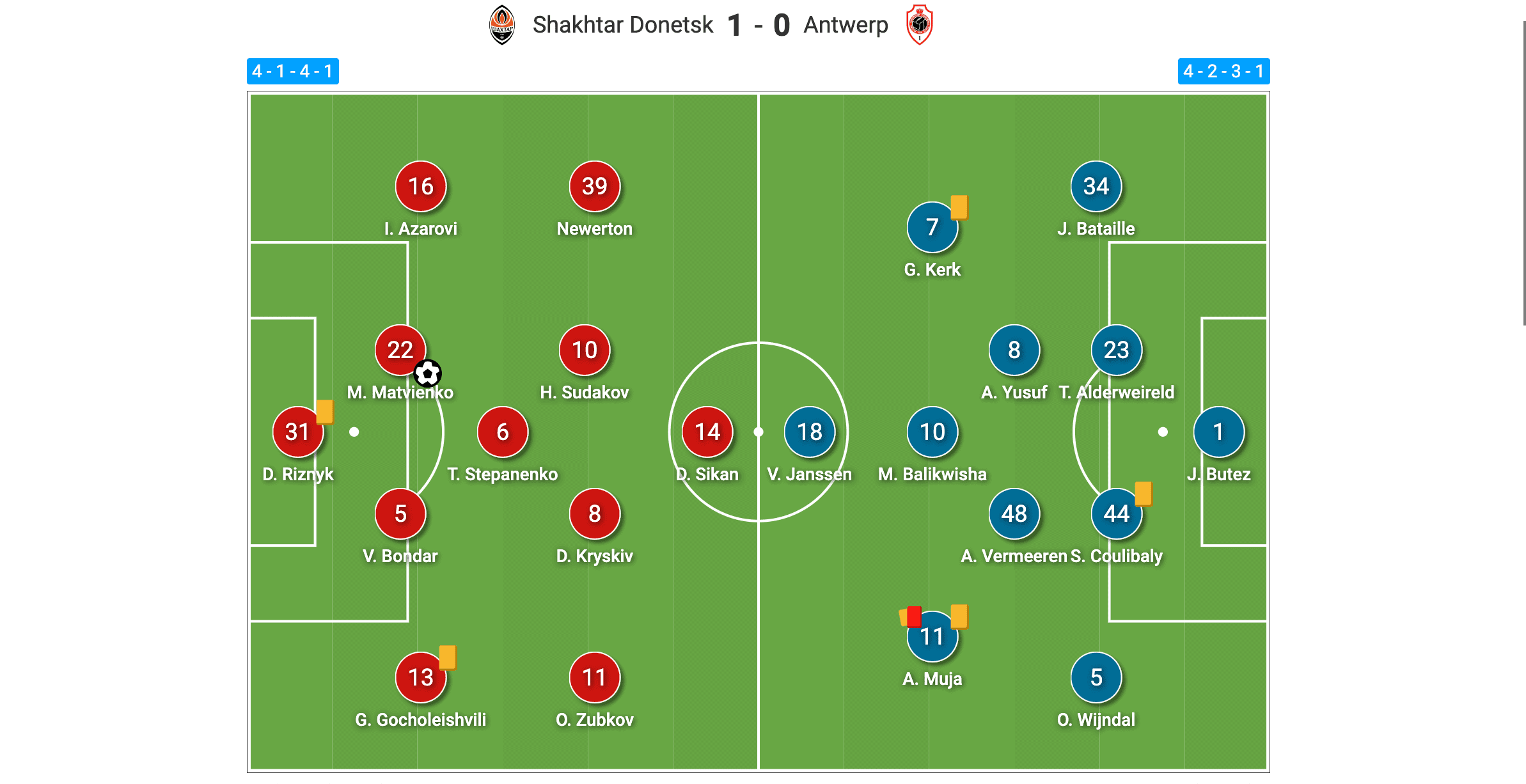
For Shakhtar, Marino Pušić set his side up in a 4-1-4-1 formation, with one change in defence coming from their previous Champions League match against Barcelona, where Yaroslav Rakitskiy dropped to the bench and Georgian defender Irakli Azarovi took his place.
The rest of the starting XI remained the same, with Dmytro Riznyk in goal behind a back four of the aforementioned Azarovi, goalscorer Mykola Matvienko, Valeriy Bondar, and Georgian Giorgi Gocholeishvili.
Club captain Taras Stepanenko played in a holding midfield role, with Heorhii Sudakov and Dmytro Kryskiv starting ahead of him centrally.
Newerton and Oleksandr Zubkov started out wide, with 22-year-old Danylo Sikan starting up top.
Mark van Bommel tactically opted for his traditional 4-2-3-1 formation, with the Dutchman making five changes from their previous UCL match, a 2-0 loss in Portugal to FC Porto.
Jean Butez started in goal, with the Frenchman playing behind a back four of Owen Wijndal, Soumaïla Coulibaly, club captain Toby Alderweireld and Jelle Bataille.
Arthur Vermeeren and Alhassan Yusuf played as the double pivot, with Arbnor Muja, Michel Balikwisha, and Gyrano Kerk starting to advance further in midfield.
Vincent Janssen regained his place in the starting XI up top.
Shakhtar confidence in possession to build through the Antwerp press
One thing that Shakhtar seemed to come into this match with a lot of was confidence, with Marino Pušić’s side not shying away from trying to play into and through the Antwerp midfield when they were looking to press and win back possession in the advanced areas of the pitch.

The data viz graphic above shows the pass map of Shakhtar from their match against Antwerp.
This helps to highlight the point that the Ukrainian side was not afraid to play into the central areas where Antwerp tended to have superior numbers, with the majority of their successful passes occurring in the middle defensive third of the pitch.
Pušić’s side employed numerous off-the-ball movements to facilitate ball progression in these areas of the pitch.
Still, much of their success came when they could quickly progress possession with one-touch passing to keep playing vertically or switch the point of attack and escape the Antwerp press.

The image above shows an example early in the match of Shakhtar looking to be brave and play through the Antwerp press instead of playing over the top.
In this phase of play above, the ball is in possession of Ukrainian centre-back Mykola Matvienko.
After receiving possession, he began to come under pressure from Antwerp’s striker, Vincent Janssen.
The defender has no outlets to play the ball vertically into the midfield, with the available options being marked by the Antwerp forward line, who looked to push up higher into the attack and force turnovers in these advanced midfield areas when Shakhtar looked to play through them.
To counter this, Pušić looked for his more advanced central midfielders to make late movements and drop into these areas to receive, allowing them to be options while also pulling Antwerp players out of possession in more advanced attacking areas.
Here, Sudakov drops deeper into the midfield, receiving possession from Matvienko while also pulling Vermeeren out of position.
Marino Pušić joined Shakhtar recently from current Eredivisie champions Feyenoord, where he worked under Arne Slot as his assistant manager.
The next part of the example illustrates a principle that the Croatian boss has successfully implemented with the Ukrainian side: the use of quick ball progression with one-touch and two-touch passing, a tactic employed by Slot at Feyenoord.
Due to Antwerp looking to force Shakhtar into these areas and regain possession, the pressing shape of the Belgian champions becomes very narrow, allowing space for the switch out wide.
Sudakov can do this with the Ukrainian able to take a touch before switching the play out wide to Gocholeishvili, who can drive forward into space vacated by Antwerp.

The above image shows another example of Shakhtar attempting to play through the Antwerp press, with the Ukrainian side remaining calm and composed for most of the night in these situations.
The ball is again in possession of Matvienko, with the Ukrainian side using some very neat triangle passing to keep playing around the Antwerp forward press. The seven players in the Shakhtar defensive half all look to converge around the ball to win possession back.
Shakhtar again had other ideas, with Pušić’s side looking calm and composed in this situation before the ball was played back to Heorhii Sudakov, who was able to find a slight pocket of space in the mass of Antwerp players.
He can quickly turn and play a first-time diagonal out wide to Newerton, allowing Shakhtar to escape the Antwerp pressure again.
This was a constant trend throughout the match for Shakhtar Donetsk, with van Bommel’s Antwerp side unable to find many answers to prevent these gaps from appearing within their pressing shape.
Although Shakhtar were unable to create many goal-scoring chances directly from these areas, they were still able to break Antwerp’s lines early and often, which provided a tactical advantage that Marino Pušić could rely on throughout the 90 minutes.
Antwerp’s ability to create chances from the wide areas
Though this match ended in the wrong fashion for Mark van Bommel and Royal Antwerp, the Belgian side did show their ability to create chances, with the Belgian champions able to utilise the wide areas during attacking spells to reach the penalty box often during the course of the 90 minutes, albeit with a lack of finishing touch at the end of these chances.
Statistically, Antwerp held possession for a greater portion of the match and took the same number of shots on target as Shakhtar.
However, the Ukrainians were able to find the back of the net.
This, however, does not take away from Antwerp’s ability to create chances.

The data viz graphic above shows the penetrating carries from Antwerp during the match, showing they were able to progress the ball into the penalty box via dribbling pretty often, with most of these chances coming from the wide players or the overlapping full-backs looking to dribble into the penalty box before sending a cross towards the attacking numbers located in better goalscoring areas.
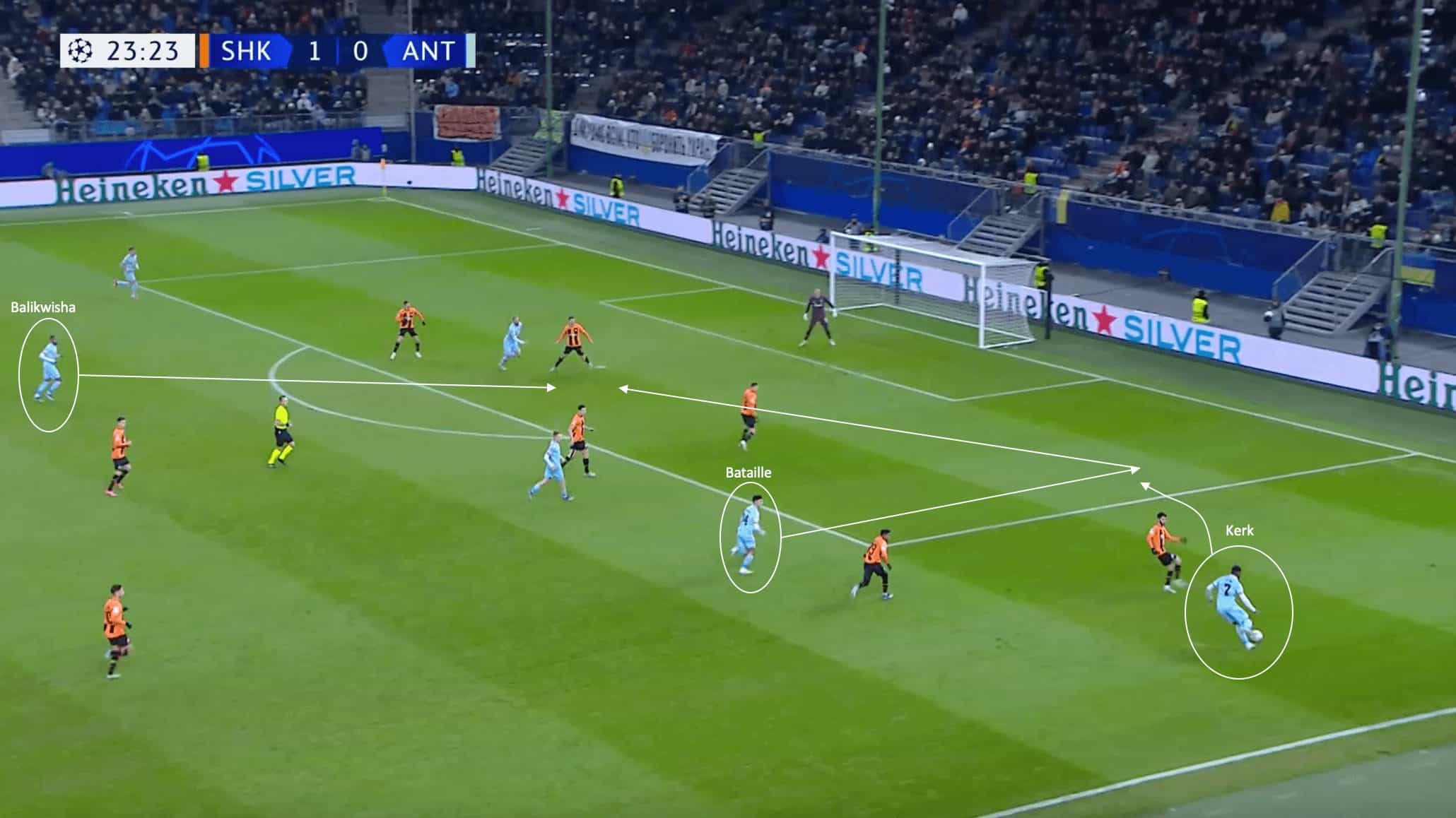
The image above shows an example of the chance creation from wide areas that Antwerp were able to display throughout the course of their match against Shakhtar, even though it did not lead to any goals.
In the attacking phase of play above, the ball is in possession of Dutch winger Gyrano Kerk, who is able to attract the attention of two Shakhtar players.
This allows full-back Jelle Bataille the ability to make an underlapping run into the penalty box, sneaking into the gap left by the full-back, who has become disconnected from the rest of the Shakhtar backline.
This run from Bataille allows Kerk to play a perfectly weighted ball into the path of the Belgian defenders, with the Shakhtar centre-back shifting over to try and engage the defender and stop a potential cross from reaching the penalty spot.
Noticing a gap emerging, Michel Balikwisha makes a late darting run into the 18-yard box towards the penalty area, with Bataille able to find the Belgian with a cutback cross.
Unfortunately, the attacker does not make clean contact on the first shot, allowing Riznyk in the Shakhtar goal to catch the ball.
Though the lack of clinical ability in front of goal was on show in this phase of play for Antwerp, it still is able to illustrate just how Mark van Bommel’s side was able to create chances, with Antwerp looking dangerous often when they were able to get numbers forward and allowed runners to get into the penalty box with the ball at their feet.

The image above shows another example of Antwerp’s ability during the match to create chances from the wide areas, albeit with a lack of end product.
In this phase of play, the ball is in possession of the full-back, Owen Wijndal, who gathers possession and drives all the way towards the end line before looking to deliver a cross towards the penalty spot.
The Antwerp forward, Vincent Janssen, makes a great run from deep towards the penalty spot, with Wijndal able to find him almost perfectly.
However, the Dutch striker’s shot is mishit first time, with the ball falling to the edge of the penalty box for Arthur Vermeeren to attempt a shot, which goes over the bar.
As this section has illustrated, Mark van Bommel’s side had a tough night when it came to being clinical in front of goal.
While the Belgian champions could generate plenty of chances, especially from the wide areas, they were unable to find the back of the net and crashed out of Europe altogether.
Conclusion
As this analysis has shown, Marino Pušić tactics implemented an excellent attacking game plan for Shakhtar Donetsk, which allowed them to win and earn an opportunity to reach the Champions League Round of 16.
At the same time, Mark van Bommel was left scratching his head after a result which ended his side’s chances of any European football after the holiday period.
